
HOW SINGAPORE EDUCATION WORKS · Kindergarten colour, careful comparison and purposeful play
Find your next learning step
Begin with two known colours, predict the result, combine measured amounts and compare the new colour with the starting samples. Change one proportion only when the first comparison is clear.
Full chapter index · Practice and checking · Sources and next reading · How Singapore Education Works
Colour mixing becomes useful learning when the child can connect a prediction, an action and a visible result. The point is not to memorise a chart. It is to notice that the materials, amounts and kind of colour—paint, light or screen—shape what appears.
This is a teaching suggestion, not a prescribed preschool lesson. Use school- or manufacturer-approved washable, non-toxic materials with adult supervision. Protect eyes, clothes and surfaces; do not taste mixtures; check allergies and clean-up instructions. A light-mixing display is not the same investigation as mixing paint or coloured water.
The choices at a glance
| What you notice | Likely issue | Useful next move |
|---|---|---|
| Every cup turns muddy brown | Droppers or brushes are carrying old colours into new mixtures | Use one clean tool per starting colour and a fresh cup for each comparison |
| The child says “blue and yellow always make exactly this green” | The pigment, concentration and proportion are being treated as fixed | Name the actual materials and compare a second ratio |
| Several colours and amounts change together | There is no readable cause-and-result comparison | Return to two starting colours and alter one proportion only |
Full chapter index
See the structure
Work and diagnose
Repair and practise
Recall, transfer and questions
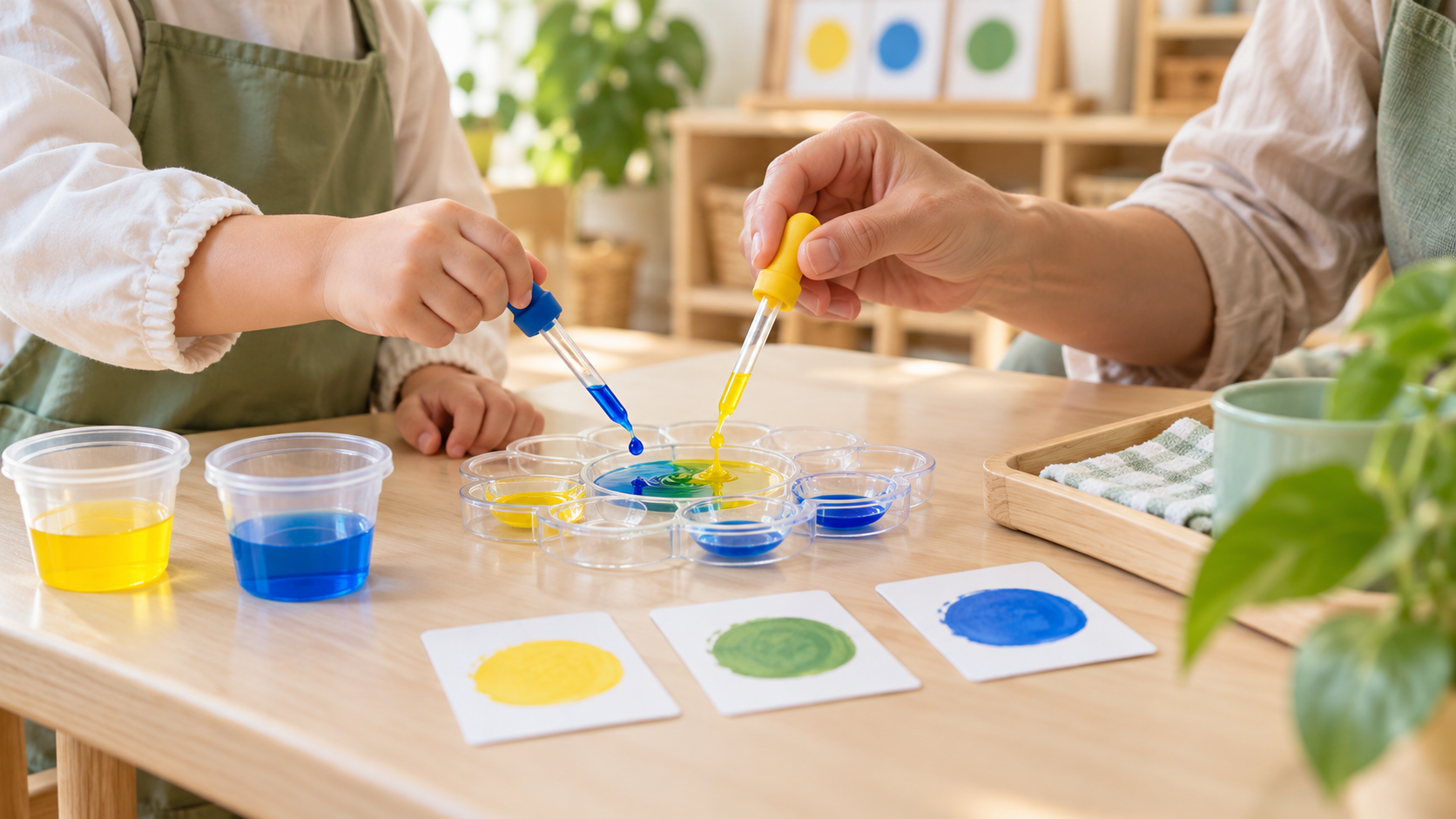
Place the two starting colours beside the empty mixing cup. The child first names or points to each colour, predicts what may appear and then watches the combination. Keeping the originals visible makes “before” and “after” concrete.
For paint and many coloured liquids, the result depends on which colourants are present and how much of each is used. A red labelled by one manufacturer may not behave exactly like another red. The careful statement is “these materials made this result under this mix”.
Singapore’s Nurturing Early Learners guidance for aesthetics and creative expression includes colour exploration and describes primary colours being combined in varying amounts. Use that idea as an invitation to explore, not a test of whether a young child can recite formal colour theory.
| Condition | Keep or change? | What to record |
|---|---|---|
| Starting colours | Keep the same for a ratio comparison | Names or swatches |
| Amount | Change one proportion | Drops, spoonfuls or equal brush loads |
| Tool | Keep clean and separate | One dropper or brush per starting colour |
| Container | Use a fresh clear cup or palette well | Mixture ID |
| Light and background | Keep similar | White card and same viewing place |
Small counting units are easier than vague instructions such as “add a bit more”. Drops need not be scientifically exact, but the same droppers and a simple count make the comparison visible.
Label mixtures before combining them. A card such as Y2+B2 prevents the child and adult from guessing later which cup held which amounts.
Assumptions: the adult provides washable yellow and blue liquid colour from the same classroom set, separate droppers, two clear palette wells and a white card. Mixture A receives two drops yellow and two drops blue. Mixture B receives three drops yellow and one drop blue.
The child predicts both will look green, then observes that A appears a balanced green while B appears more yellow-green under the same light. A has four drops total and a 2:2, or equal, relationship. B also has four drops total but a 3:1 relationship.
Checked answer under these assumptions: the total amount is held at four drops, while the proportion changes. The comparison supports saying that increasing yellow’s share shifted this particular mixture toward yellow. It does not prove that every yellow and blue product will produce the same shade.
Place the two labelled mixtures beside the untouched starting colours. The child can now point from ingredients to result and back again.
If later mixtures become dull, inspect the tools first. A blue dropper returned to the yellow bottle changes the starting material, so every later comparison becomes uncertain.
If two cups have different total amounts as well as different ratios, pour depth may make one appear darker. Use the same total count or spread equal samples thinly on white card.
If a screen produces a surprising result, pause. Screens combine coloured light; paint and pigments interact with light differently. Treat them as two related but separate investigations.
- Label a fresh cup with the two starting colours and amounts.
- Ask for a prediction without marking it right or wrong.
- Combine with clean, separate tools and count aloud.
- Place the result beside the starting colours and another labelled mixture.
- Explain one observation using “When we changed…, we noticed…”.
A useful sentence is “When we used three yellow drops and one blue drop, this mixture looked more yellow than the equal mixture.” It names the change, evidence and comparison.
Do not chase a “correct” shade by adding uncounted colour. If the result differs from the prediction, keep it as evidence and start a new labelled mixture.
Guided
The adult prepares two starting colours and models one clean equal-parts mixture while the child predicts and points to the before-and-after samples.
Shared
The child counts drops for a second mixture, helps label it and compares which result appears closer to yellow or blue.
Independent within boundaries
The child chooses one permitted 3:1 or 1:3 mix, keeps the total amount fixed and explains the comparison using the labels.
A day later, show the labels without the mixtures and ask the child to predict which would look more yellow. Then repeat one mix to check memory against observation.
National Gallery Singapore introduces children to colour through art, play and works from Singapore and Southeast Asia. Around the world, artists choose pigments, palettes and colour relationships for different materials and meanings. A recipe can travel, but local materials and cultural interpretations should not be assumed identical.
Changed-context transfer: use transparent coloured overlays or a digital light activity. Ask what stayed familiar and what changed, then avoid claiming that light and paint follow the same mixing rule.
Must children memorise primary and secondary colours?
No. Begin with prediction, comparison and language. Formal labels can support exploration when they remain meaningful.
Can we mix food colouring?
Only when the setting approves it and adults manage staining, allergies and no-tasting boundaries. Washable art materials may be more appropriate.
Why did our red and blue not make the purple shown in a book?
Different colourants and proportions produce different results. Record the actual products and treat the difference as evidence.
How many mixtures are enough?
Two clear comparisons can teach more than many unlabelled cups. Stop while the child can still explain what changed.
Sources and next reading
- MOE — Nurturing Early Learners Framework 2022
- NEL — Aesthetics and Creative Expression Educators’ Guide
- National Gallery Singapore — Clues in the Hues