
HOW SINGAPORE EDUCATION WORKS · Comparing collections in kindergarten
Find your next learning step
To compare two small collections, pair one object from the first collection with one from the second. If every object has a partner, the collections have the same number. If objects remain without partners, that collection has more. Start with movable objects before asking a child to trust a long row or a written numeral.
Full chapter index · Practice and checking · Sources and next reading · How Singapore Education Works
A child may count correctly and still say that a spread-out row has more than a tightly packed row. That is a useful clue: they are attending to space. A short pairing game gives them evidence they can move, check and explain. The activity below is a teaching suggestion for home or preschool, not an entrance test or a developmental diagnosis.
The choices at a glance
| What you notice | Possible issue | Useful next move |
|---|---|---|
| Chooses the longer row | Spacing is driving the comparison | Make one-to-one pairs |
| Pairs correctly but reverses more and fewer | Language may be the difficulty | Point to leftovers and model both sentences |
| Equality disappears after rearranging | Quantity and layout are being confused | Move objects without adding or removing any |
Full chapter index
Understand the comparison
Check quantity and language
Repair and practise
“Bigger” can describe an object's size, a group's footprint or its number of objects. Before correcting an answer, ask, “Do you mean bigger pieces, a longer line, or more pieces?” A child who points to the longest line may be answering a different question.
Place three large blocks beside four small blocks. Ask which collection has more blocks, not which collection is bigger. Keep the objects safe for the child's age and supervise the activity; large counters, blocks or toy plates work well. Counting small loose parts is unnecessary.
Singapore's MOE Nurturing Early Learners numeracy overview includes comparing two collections of up to ten objects and learning language for equal and unequal quantities. Our starting collections of three to six objects keep the comparison easy to inspect. They are a chosen teaching step, not a prescribed lesson sequence.
Make a pair by putting one red block next to one blue block. Each object must belong to only one pair. Continue until one collection runs out. Pairing prevents an object from being used twice and makes leftovers visible.
Suppose there are five red blocks and four blue blocks. Four pairs use four red and four blue blocks. One red block remains. The red collection has more; the blue collection has fewer. The unmatched block also shows that the difference is one.
Do not begin with “Which is more?” followed immediately by the adult's answer. Ask the child to build the pairs. Then ask, “Is anything left without a partner?” A child can demonstrate a valid comparison before confidently using every comparison word.
If pairing becomes confusing, use two parallel strips of paper with room for one pair at each position. Reduce the collections to two and three. Restore a clear action before increasing the quantity.
CHAPTER 3 OF 8 · Check quantity and language
3. Worked case: the shorter row has more
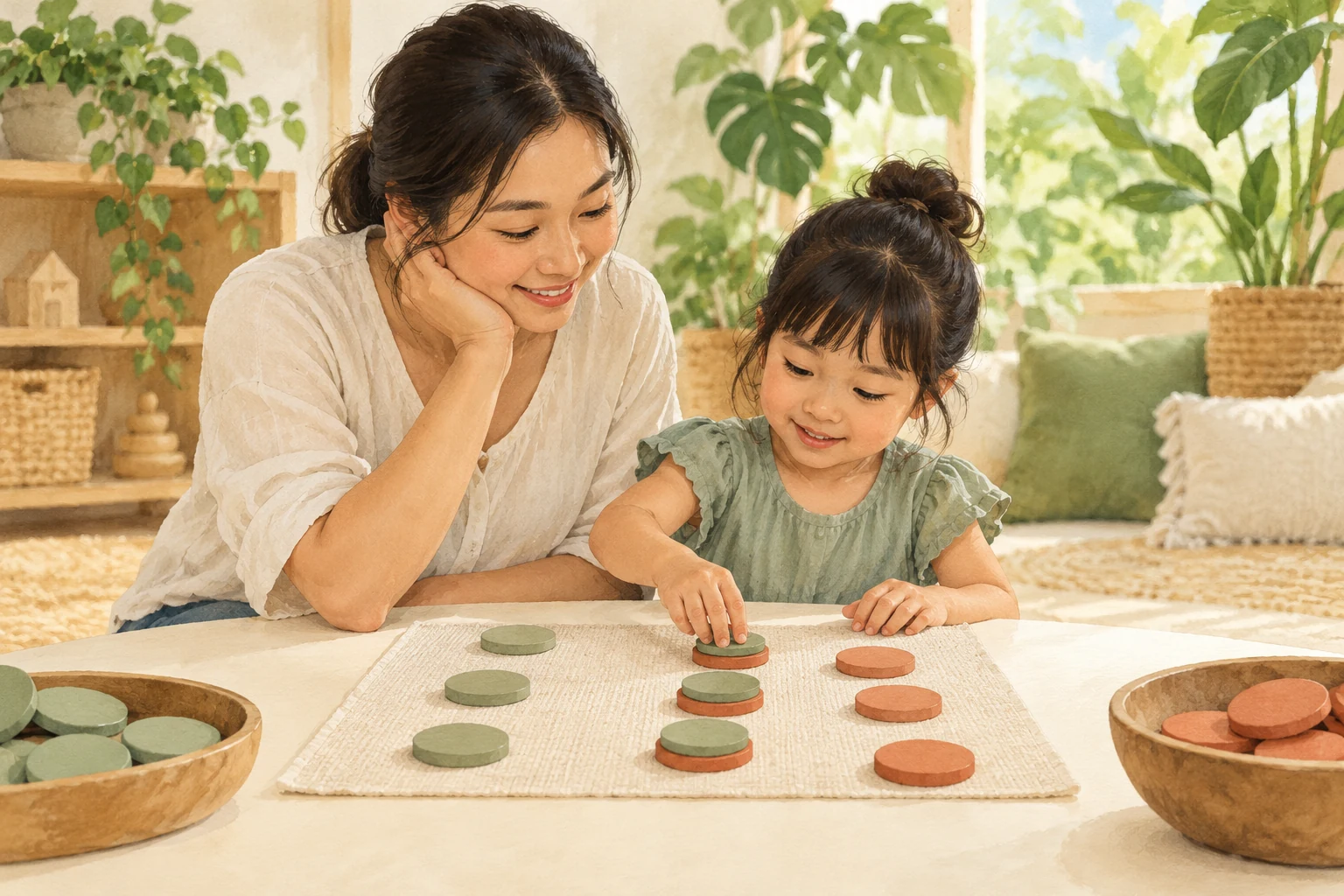
Here is a fictional table-top case. There are six identical green counters in a compact row and four identical orange counters in a widely spaced row. The orange row reaches farther across the table. No counters are added or removed during rearrangement.
An adult asks, “Which collection has more counters?” Mei chooses orange because its row is longer. Rather than saying “Count again,” the adult invites Mei to move one orange counter beside one green counter until all orange counters are paired.
| Check | What happens | What it tells us |
|---|---|---|
| Pair the first four green counters | Each has one orange partner | Four objects from each collection are matched |
| Inspect the remaining green counters | Two have no partners | Green has two more counters |
| Count each collection as a second check | Green is six; orange is four | The counts agree with the pairing |
| Spread the orange row out again | Still four orange counters | Longer spacing has not created objects |
Checking answer: green has more counters, orange has fewer, and the difference is two. Six minus four equals two. Row length was misleading because the gaps were different.
Now let Mei rearrange the green counters herself. Ask what changed and what stayed the same. “The spaces changed; no counters came or went” explains the result more clearly than simply repeating “Six is more than four.”
After establishing “Green has more than orange,” ask for the reverse statement: “Orange has fewer than green.” The comparison concerns the same two collections. Turning the sentence around changes the word, not the objects.
Then make four green–orange pairs with nothing left. Say, “They have the same number of counters.” The counters need not be the same colour, size or arrangement for the quantities to be equal.
Some children learn “more” quickly and use it for every unequal comparison. Ask them to choose the collection with fewer objects, then justify the choice by pointing to the unmatched objects in the other collection. Do not rely on a fast verbal answer alone.
For ordinary countable objects, “fewer blocks” is a helpful language model. Accept a child's explanation of the quantity while gently supplying the phrase. The mathematics should not disappear into a vocabulary correction.
If the child gives every block a partner but pairs one block with two others, return to the pairing rule. Say, “One partner each,” and model a single pair. This is different from a counting error.
If the pairs are correct but the child chooses the smaller collection as “more,” ask them to point to the leftovers. They may understand the arrangement but be reversing the words. Offer a sentence stem: “These have more because these two have no partners.”
If they compare successfully only with identical objects, change colour first while keeping size constant. Later compare large and small objects. Change one feature at a time so you can see what affected the answer.
If the child is tired, stop. A brief successful comparison is enough for today. Repeated difficulty across ordinary activities is something to discuss with the preschool educator using specific observations, rather than diagnosing from one game.
For guided practice, put out three toy plates and five large pretend buns. Ask the child to place one bun on each plate. Ask whether there are enough buns for every plate and what remains. Keep the goal “one bun per plate” explicit.
Checking answer: three buns are paired with three plates and two buns remain. There are more buns than plates. If the task is to have exactly one bun for every plate with none spare, remove two buns or add two plates. These are different repairs with the same equal-quantity result.
For independent practice, offer two trays: one with five blocks and one with four. Arrange the four blocks in a longer row. Ask, “Which tray has fewer blocks? Show me a way to check.” Wait before offering the pairing strategy.
Checking answer: the tray with four has fewer. Four pairs leave one block from the five-block tray unmatched. A count of four and five is another valid check if the child can explain which total belongs to which collection.
Finish by asking the child to create two equal collections. This checks whether they can produce the relationship, not only recognise an adult's example.
On another day, compare four toy passengers and three toy seats, with one passenger allowed per seat. Ask whether everyone can sit. This changes the context from counters to a practical question while retaining one-to-one matching.
Checking answer: three passengers can be paired with seats and one has no seat. One additional seat would be enough under the stated rule. A larger seat does not solve the problem unless the seating rule also changes.
Ask the child to explain without immediately moving objects, then let them check. If yesterday's language has gone, rebuild the pairs without treating the lapse as failure.
There is a meaningful global connection here. The University of Cambridge's NRICH discussion of early-years problem solving encourages rich play contexts, thoughtful resources and questions. Its setting is different from Singapore's NEL framework, but both offer a reason to let children investigate rather than rush to a worksheet answer.
Must children count before they compare?
They can compare by pairing without first naming both totals. Counting adds another way to check and eventually lets them state how many more. Keep the distinction between demonstrating a relationship and naming its quantities.
Should we introduce greater-than signs now?
They are unnecessary for this activity. Let the child compare, explain and reverse the relationship in words first. Follow the preschool's teaching approach when symbols are introduced.
What if sorting gets in the way?
Decide what counts as one object before comparing. If the child is still deciding which objects belong in each group, our guide to sorting by two attributes addresses that separate task.
What counts as useful progress?
Look for a child who checks partners, notices leftovers and keeps the comparison when spacing changes. One confident explanation with a small collection tells you more than a rushed page of guesses.
Sources and next reading
Reviewed 23 October 2026. The examples and practice cases are original teaching suggestions.
MOE Nurturing Early Learners: Numeracy overview provides the Singapore learning context. NRICH: Mathematical Problem Solving in the Early Years supplies a complementary perspective on exploratory mathematics.
Continue through the How Singapore Education Works hub for other learning stages.
Learning at other stages
Continue with a different learning task in this series. Each guide has its own worked cases, practice and limits.
Reading a play script at school