
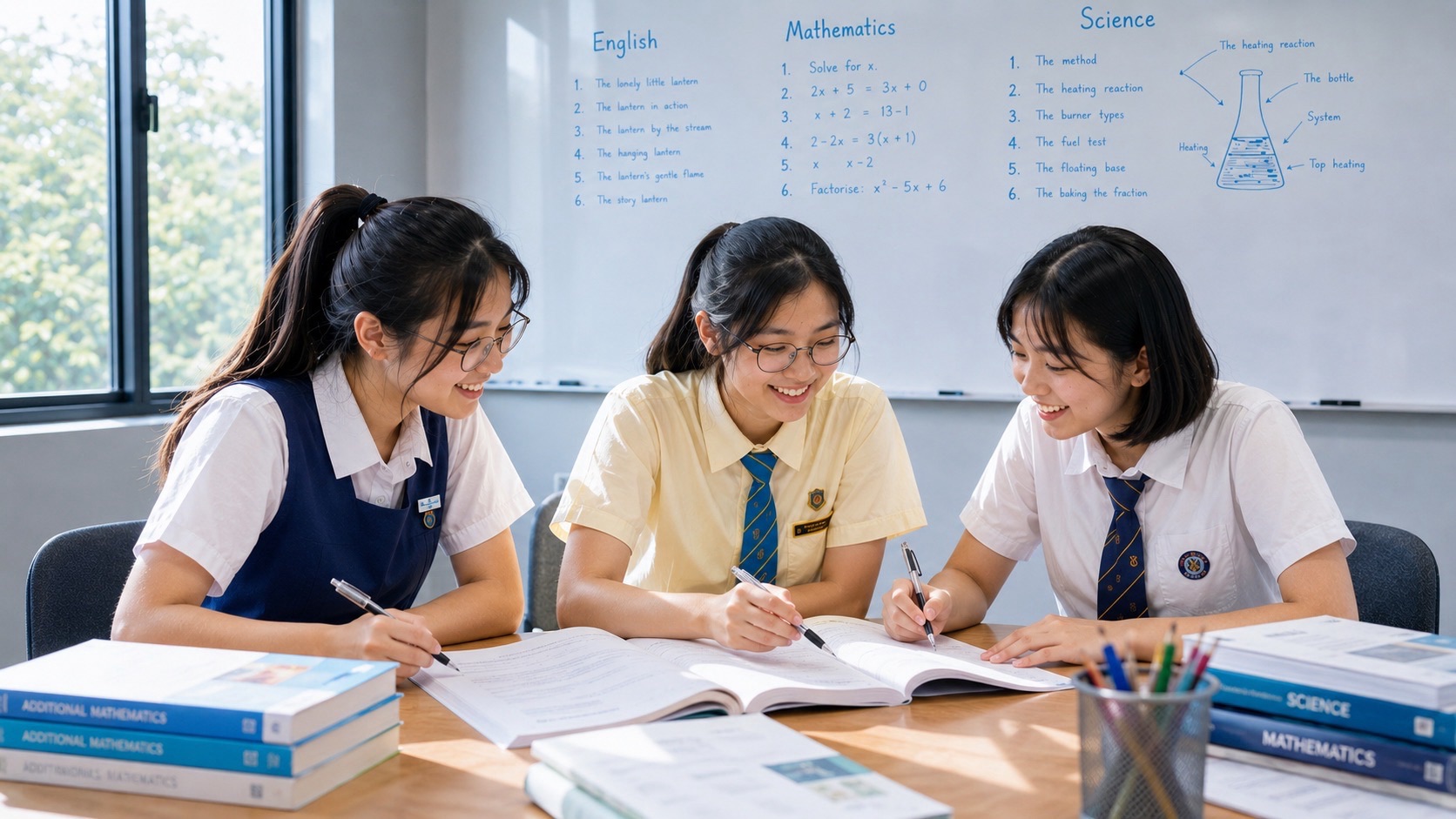
How to be good at science experiments? Start by changing the picture in your head.
A science experiment is not simply a colourful activity in a laboratory.
It is a controlled way of asking a question about the world, changing or comparing something deliberately, measuring what happens and deciding what the evidence supports.
The gold standard is therefore not an experiment that looks impressive. It is a test whose variables, measurements, controls, procedure and conclusions are clear enough that somebody else can understand what was actually learned.
That makes experimental skill a combination of curiosity, design, measurement, safety, data analysis and critical thinking.
Did You Know? A Good Experiment Begins With a Good Question
“What happens if I mix these?” is curiosity.
A scientific question is more controlled.
For example:
“How does water temperature affect the time needed for a fixed mass of sugar to dissolve under the same stirring conditions?”
Now the variables begin to appear.
A good experiment turns curiosity into something testable.
The Gold-Standard Experimental Loop
- Question — define what you want to know.
- Hypothesis — state a testable expectation where appropriate.
- Variables — identify what changes, what is measured and what is controlled.
- Design — choose a fair procedure.
- Measure — collect data consistently.
- Repeat — reduce the influence of random variation.
- Analyse — look for patterns.
- Conclude — answer the question from evidence.
- Evaluate — identify limitations and improvements.
Step 1: Write a Testable Question
A strong experimental question names a relationship.
Useful forms include:
- How does X affect Y?
- What is the relationship between X and Y?
- Does changing X alter Y under controlled conditions?
Avoid questions that cannot be measured or compared.
Step 2: Identify Variables
Independent Variable
The factor deliberately changed.
Dependent Variable
The outcome measured.
Controlled Variables
Other factors kept as consistent as reasonably possible.
Variable control is what helps the experiment isolate a relationship.
Step 3: Define How Variables Will Be Measured
Words such as “growth”, “speed” or “strength” are not enough.
Define the measurement.
For example:
- plant growth = change in height in centimetres;
- reaction rate = volume of gas produced per minute;
- temperature = reading from a thermometer in degrees Celsius.
Operational definitions make experiments reproducible.
Step 4: Build a Fair Comparison
If two groups differ in five important ways, the result becomes hard to interpret.
Ask:
- What should stay the same?
- Which factor must change?
- Is there a suitable control group or baseline?
- Could another factor explain the result?
Fairness is about interpretability.
Step 5: Choose the Right Apparatus
Equipment should match the precision required.
Consider:
- measurement range;
- scale divisions;
- sensitivity;
- repeatability;
- safety.
Using a measuring cylinder for a tiny volume may produce more uncertainty than a more suitable instrument.
Step 6: Write a Procedure Someone Else Could Follow
A strong method includes:
- quantities;
- timings;
- equipment;
- order of steps;
- how measurements are taken;
- what is repeated.
Avoid vague instructions such as “add some water”.
Scientific procedures need operational clarity.
Step 7: Think About Safety Before Starting
Safety is part of experimental design.
Identify:
- heat;
- glassware;
- chemicals;
- electricity;
- sharp objects;
- biological materials.
Use school or laboratory safety procedures and teacher supervision where required.
A good experiment is not only informative.
It is responsibly conducted.
Step 8: Record Data Immediately
Do not rely on memory.
Use a table.
Include:
- clear headings;
- units;
- consistent decimal places where appropriate;
- all measurements, including unexpected ones.
Do not quietly remove results because they look inconvenient.
Step 9: Repeat Measurements
Repeated measurements help reveal random variation.
If three readings differ, that tells you something about measurement consistency.
Repeated trials can support a more reliable average and expose anomalies.
Step 10: Use Appropriate Graphs
Graphs make patterns visible.
Choose the graph type based on the data.
For continuous variables, a line graph or scatter plot may be appropriate.
For categories, a bar chart may be more suitable.
Always label axes and units.
Step 11: Distinguish Accuracy, Precision and Reliability
These words are related but not identical.
- Accuracy — closeness to the true or accepted value.
- Precision — fineness or consistency of measurement.
- Reliability — consistency of results when the procedure is repeated.
Using the words precisely improves evaluation.
Step 12: Treat Anomalies Carefully
An anomalous result is a result that does not fit the general pattern.
Do not automatically delete it.
Ask:
- Was there a recording error?
- Was the apparatus disturbed?
- Could the variation be real?
- Should the measurement be repeated?
Science should investigate surprises, not erase them.
Step 13: Analyse Before Concluding
A conclusion should follow from the data.
Describe:
- the overall pattern;
- important values;
- whether the data supports the hypothesis;
- how strong the relationship appears.
Avoid claiming more than the experiment actually tested.
Step 14: Separate Correlation From Causation
If two variables move together, that does not automatically prove one caused the other.
Controlled experiments can support causal claims when the design successfully isolates the relevant variable.
Observational data often requires greater caution.
Step 15: Evaluate the Method
Good evaluation is specific.
Instead of saying “human error”, identify the mechanism.
For example:
- reaction time when starting the stopwatch;
- heat loss to the environment;
- parallax when reading the scale;
- unequal sample sizes.
Then propose an improvement that addresses the mechanism.
Step 16: Understand Measurement Uncertainty
Every measurement has limits.
The instrument resolution, technique and experimental conditions all matter.
Students should learn that data is not infinitely exact just because it appears as a number.
Science Experiments for Primary Students
Primary Science experiments should help students learn to:
- observe carefully;
- compare fairly;
- record evidence;
- identify simple variables;
- explain from results.
The goal is not merely completing the activity.
The goal is learning how evidence answers questions.
Science Experiments for Secondary Students
Secondary students should increasingly control:
- variable design;
- measurement quality;
- graphs;
- repeat trials;
- method evaluation;
- data interpretation.
They should also become more precise with scientific language.
Biology Experiments
Biology adds challenges such as natural variation between organisms.
Good design may require:
- larger sample sizes;
- careful controls;
- standardised conditions;
- ethical treatment.
Chemistry Experiments
Chemistry often requires careful control of:
- concentration;
- volume;
- temperature;
- mass;
- time;
- reaction conditions.
Small procedural differences can change results significantly.
Physics Experiments
Physics experiments often depend heavily on measurement and graphical analysis.
Students should pay attention to:
- instrument zero errors;
- repeated readings;
- units;
- gradients;
- uncertainty.
Experiments and Research
Experimental skill is one branch of research skill.
Research asks a broader question: what evidence is needed to answer this claim?
Some questions need experiments.
Others need observation, documents, surveys or existing datasets.
See How to be Good at Research.
Science Experiments With AI
AI can help brainstorm variables, explain methods and generate practice questions.
But never use AI as a substitute for laboratory safety instructions or teacher supervision.
Verify procedures against approved school or laboratory guidance.
Common Experimental Traps
Changing Too Many Variables
The result becomes hard to interpret.
No Repeat Trials
One unusual measurement controls the conclusion.
Vague Procedures
The experiment cannot be reproduced.
Deleting Bad Results
Unexpected evidence is hidden instead of investigated.
Conclusion Beyond Data
The claim becomes broader than the experiment.
Generic “Human Error”
The limitation is named without mechanism or improvement.
A 30-Day Experimental-Skills Scaffold
Week 1: Questions and Variables
- Turn five curiosities into testable questions.
- Identify independent, dependent and controlled variables.
- Define measurements.
Week 2: Methods
- Write clear procedures.
- Choose appropriate apparatus.
- Identify safety considerations.
Week 3: Data
- Design tables.
- Practise graph choice.
- Analyse repeated measurements.
Week 4: Evaluation
- Identify limitations.
- Propose specific improvements.
- Write evidence-based conclusions.
How to Measure Improvement
- Can you identify variables quickly?
- Can another person follow your method?
- Are measurements recorded consistently?
- Can you explain anomalies?
- Do conclusions match the data?
- Can you propose specific methodological improvements?
How This Connects to Singapore Science
Singapore Science education emphasises scientific inquiry, evidence, conceptual understanding and application.
Experimentation is therefore not a side activity.
It is one of the clearest ways students learn how scientific knowledge is produced and tested.
Explore How to be Good at Science, How to be Good at Biology, How to be Good at Chemistry and How to be Good at Physics.
Frequently Asked Questions
What makes an experiment fair?
The relevant comparison should differ mainly in the independent variable while important confounding factors are controlled.
Why repeat an experiment?
Repeated trials reveal variation and improve confidence in the pattern.
What is a control variable?
A factor kept consistent so that it does not provide an alternative explanation for the result.
Should anomalous results be removed?
Not automatically. Investigate the cause and repeat measurements where appropriate.
What makes a good conclusion?
It directly answers the research question using the observed evidence without claiming more than the data supports.
Can AI design experiments?
It can suggest ideas, but laboratory procedures and safety must be checked against authoritative guidance and supervision.
Helpful Reading Inside eduKate
- How to be Good at Science
- How to be Good at Research
- How to be Good at Critical Thinking
- How Science Works
How to Be Good at Science Experiments
Good experiments turn curiosity into evidence.
Question. Control. Measure. Repeat. Analyse. Conclude. Evaluate.
The gold standard is not a dramatic laboratory result.
It is a method clear enough that the evidence can genuinely teach you something.
Continue with How to be Good at Mental Math, How to be Good at Algebra and How to be Good at Research Writing.
Properly taught kids shine a bright light into the future.