
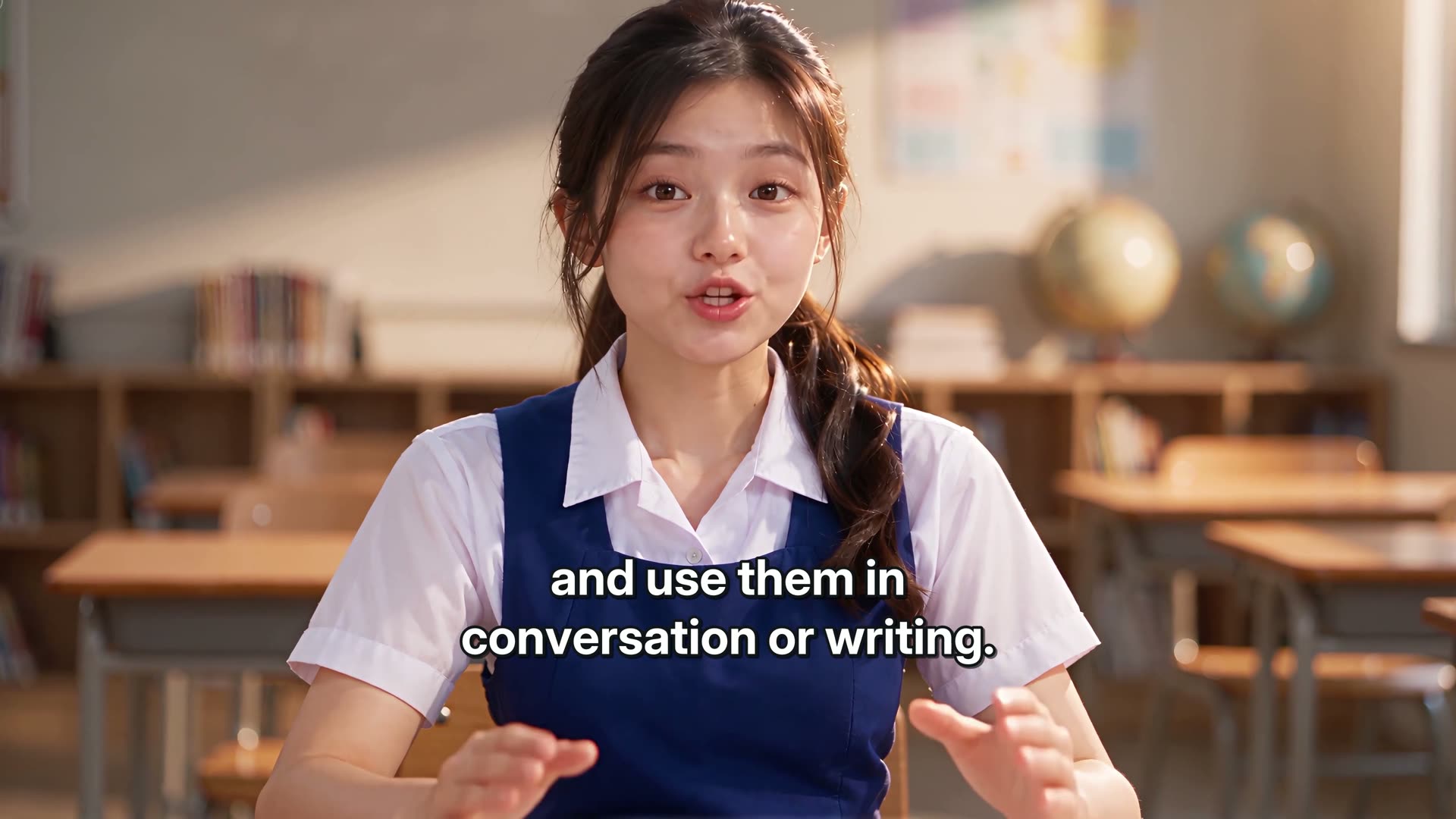
Learning English vocabulary from movies and TV shows works best when you watch a short, understandable scene for meaning, choose a few useful expressions, check the subtitles, then practise saying them without the screen. A film can show you who is speaking, how they feel, why a phrase is used and what happens next. Those clues make words memorable—but watching for hours without active recall does not automatically make you a fluent speaker.
This guide answers questions such as how to learn English through movies, best way to watch English TV with subtitles, learn vocabulary from films, English expressions in TV dialogue, and how to improve English listening while watching shows. It includes a 20-minute scene routine, original mini-scripts, 48 practical expressions grouped by familiar screen situations, advice about accents and informal speech, a seven-day plan and self-tests.
Quick answer: Watch once for the story, watch again for two to five useful phrases, check their meanings and pronunciation, close the subtitles, and say or write your own version in a different situation. Return later with another scene or conversation. Recognition on screen is not the same as independent use.
A 20-minute method for learning English from a single scene
- Minutes 1–4 — Watch for meaning: choose a short scene and identify who wants what, the problem and the outcome. Keep it enjoyable.
- Minutes 5–7 — Note useful expressions: select three to five relevant words, phrases or collocations. Ignore obscure expressions you will not need.
- Minutes 8–10 — Check subtitles and context: look up ambiguous words, sentence structure and any cultural reference that matters. Use reliable captions when possible.
- Minutes 11–13 — Listen without reading: replay the selected lines and try to recognise them by sound.
- Minutes 14–16 — Say your own version: imitate short segments for pronunciation, then change the person, object, time or situation.
- Minutes 17–19 — Explain the scene: give a three-sentence summary without the subtitles and use two of the target expressions naturally.
- Minute 20 — Review plan: write a brief situation cue for later recall. Test tomorrow or after another gap, not only immediately.
The British Council’s guide to learning through film recommends pausing, predicting, repeating short dialogue and discussing what happened. Those activities turn the film from passive exposure into language practice.
Should you watch with English subtitles or no subtitles?
Use subtitles for a particular purpose. If you cannot follow the story at all, accurate captions may help you connect sound to text. If you understand the scene with subtitles but miss the same words when the text disappears, your next task is audio-only recognition. If the film is already easy, watch naturally and select only occasional expressions to review.
One workable sequence is watch for meaning → check the English captions → watch again with captions hidden. For a very challenging scene, you might use native-language subtitles once to understand the story, then return to English. The best choice depends on your current listening level; captions are a tool, not a moral test.
Automatic captions can be wrong, particularly with names, accents, sound effects and overlapping voices. If an expression matters, verify it with an accurate transcript or a dictionary. Do not treat a machine-generated subtitle as unquestionable evidence of what was said.
Which films or TV programmes are best for vocabulary?
Choose a format whose language you can broadly understand and whose situations are relevant to your life. A slice-of-life show may offer greetings, plans and disagreements. A workplace series may offer deadlines and meetings. A documentary may offer explanations, cause-and-effect language and evidence terms.
Some genres are less suitable as your main source of everyday vocabulary. Fantasy may contain invented terms. A historical drama may deliberately use dated expressions. A crime series may include specialist or emotionally intense language. These can still be enjoyable reading and listening experiences, but a learner should not automatically copy them into everyday speech.
Interest matters. A short scene you want to discuss is often more valuable than a long programme you are using only because someone calls it educational. Choose comprehensible and relevant, not a supposed universal “best TV show”.
Forty-eight useful English expressions from common screen situations
The following examples are original teaching sentences, not quotations from films or television. This is a practical selection, not a verified frequency ranking. The meaning of an expression can vary with tone and context.
1. Everyday home scenes
- 1. make yourself at home — feel comfortable in someone’s house. Come in and make yourself at home.
- 2. help yourself to — take an offered item. Please help yourself to some tea.
- 3. running late — not arriving on time. I’m running late because the bus broke down.
- 4. tidy up — put things in order. Let’s tidy up before our guests arrive.
- 5. sort something out — resolve or organise a problem. We need to sort out the booking.
- 6. give me a hand — help me. Could you give me a hand with these bags?
When you watch family and home scenes, notice how small verbs such as put, get, make, help and sort combine with other words. Help yourself to some tea is an invitation, while help me with the bags is a request. The verb is familiar, but the conversational purpose differs.
2. Friends and relationships
- 7. catch up — exchange news after a gap. We should catch up over coffee.
- 8. get along — have a friendly relationship. They get along well.
- 9. fall out — have an argument or damaged relationship. The friends fell out over a misunderstanding.
- 10. make up — become friendly again. They made up the next morning.
- 11. keep in touch — maintain contact. Let’s keep in touch after the trip.
- 12. hear someone out — listen to their complete explanation. Please hear me out before deciding.
Friendship scenes teach vocabulary about relationships and emotion, but register matters. Fall out and make up can describe social conflict; catch up can describe exchanging news. For formal reporting, use a clearer statement when the exact event matters.
3. Choices and disagreements
- 13. I see your point — acknowledge another view. I see your point, but I’m still concerned about the cost.
- 14. I’m not convinced — express continuing doubt. I’m not convinced that the plan will work.
- 15. that’s a fair question — recognise a reasonable question. That’s a fair question; let’s check the figures.
- 16. what’s the alternative? — ask for another option. The train is cancelled. What’s the alternative?
- 17. let’s think it through — reason carefully before acting. Let’s think it through before signing.
- 18. we have a deal — express agreement on terms. We have a deal if delivery is confirmed.
Disagreement scenes can teach useful turn-taking and tact. “I see your point” recognises a position but does not necessarily mean agreement. “I’m not convinced” communicates uncertainty. Practise the response and the reason rather than parroting a dramatic character’s tone.
4. Mysteries and investigations
- 19. a clue — information pointing towards an explanation. The broken seal was an important clue.
- 20. a witness — someone who saw or knows relevant events. A witness described the vehicle.
- 21. verify — confirm by checking evidence. We need to verify the time.
- 22. rule out — exclude a possibility after consideration. The team ruled out a software fault.
- 23. piece together — combine details to form a fuller picture. She pieced together the timeline.
- 24. a lead — information that may guide further investigation. The investigator followed a new lead.
Mysteries contain words about evidence and inference. A clue is not proof. A lead is something worth examining; it is not a solved case. If you see an investigation in fiction, remember that the procedural details may be invented or exaggerated; use the vocabulary without assuming the plot teaches real investigative procedure.
5. Workplace drama
- 25. a deadline — time by which work is due. The deadline is Friday.
- 26. on track — progressing according to plan. We’re on track for the review.
- 27. a setback — a problem that slows progress. The missing file was a setback.
- 28. run the numbers — calculate or examine financial figures. Let’s run the numbers before committing.
- 29. take responsibility — accept an obligation. I’ll take responsibility for the correction.
- 30. follow up — take another action or contact someone later. I’ll follow up after the meeting.
Workplace scenes often sound convincing while displaying unrealistic deadlines or authority. Learn expressions such as follow up and on track, but use them truthfully in your work. “We’re on track” is not appropriate when the project is already seriously delayed.
6. Comedy, surprise and reactions
- 31. you’ve got to be kidding — express surprise or disbelief. You’ve got to be kidding—that’s the third delay.
- 32. what a relief — express a feeling that worry has eased. What a relief! The bag was found.
- 33. that was awkward — describe an uncomfortable interaction. That was awkward, but we handled it politely.
- 34. I didn’t see that coming — express surprise about an outcome. I didn’t see that coming; the plan changed suddenly.
- 35. no wonder — express that a reason makes something understandable. No wonder the room is cold; the window is open.
- 36. give it a try — attempt something. The exercise looks challenging, but give it a try.
Comedy relies on tone. “You’ve got to be kidding” can be humorous with a friend but confrontational in a service encounter. “No wonder” helps connect a reason and an observation; “That was awkward” identifies discomfort. Learn the social effect, not merely the dictionary meaning.
7. Documentaries and explainers
- 37. according to — attribute a statement to a source. According to the report, the figures changed.
- 38. the evidence suggests — state a tentative interpretation. The evidence suggests a possible link.
- 39. a contributing factor — one cause among potentially several. Heavy traffic was a contributing factor.
- 40. in contrast — mark a difference. In contrast, the second region had lower rainfall.
- 41. over time — across an extended period. The coastline changed over time.
- 42. to date — up to the present reporting point. To date, the study has collected three rounds of data.
Documentary vocabulary can describe evidence, but it is important to preserve uncertainty. “The evidence suggests” is not the same as “The evidence proves”. The film may present a position without providing all its sources; fact-check consequential claims independently.
8. Travel and adventure scenes
- 43. take a shortcut — use a shorter route. We could take a shortcut through the park.
- 44. get separated — become apart from a group. The visitors got separated at the station.
- 45. find your way — navigate to a destination. Can you find your way back to the hotel?
- 46. run out of — use up all of a supply. We’ve run out of water.
- 47. head back — begin returning. Let’s head back before dark.
- 48. check in — register on arrival at a hotel or for a flight. We need to check in before the desk closes.
Adventure scenes teach navigation and emergencies. If an action affects your real safety, rely on actual local instructions and verified services, not movie dialogue. The useful vocabulary skill is to ask for directions, report being separated from a group and request clarification.
Original scene 1: a missed meeting
Context: Two colleagues meet after a planning call.
A: “I’m sorry I’m running late. The train stopped unexpectedly.”
B: “No problem. We need to sort out the meeting time.”
A: “I didn’t see that coming. Can we move it to three?”
B: “I see your point, but let’s check whether everyone is free.”
Comprehension check: What caused the delay? What decision remains open? What does “I see your point” mean here? It acknowledges a concern without automatically agreeing to the proposed new time.
Transfer exercise: Replace the train delay with a missing document. Then ask for a later deadline. Cover the script and say the exchange in your own words.
Original scene 2: a friend returns after a long trip
Context: Two friends talk at a café.
Maya: “It’s been ages. We should catch up properly.”
Theo: “Absolutely. I almost ran out of time before the trip.”
Maya: “How was it?”
Theo: “Great, although we got separated at the station once.”
Maya: “What a relief that everyone found their way back.”
Comprehension check: Is ran out of used literally as running out of a place? No; the expression here refers to almost having no time left. Did got separated describe a deliberate argument? No; it describes becoming physically apart.
Transfer exercise: Retell the story in the past tense and change station to museum. The purpose is to apply vocabulary across settings rather than memorise this fictional conversation.
Original scene 3: documentary narration
Context: An imaginary programme compares two travel routes.
Narrator: “The two routes changed over time. The northern route became shorter after the new bridge opened. In contrast, the southern route remained longer but served more villages. According to the planning report, the original proposal had cost limitations.”
Comprehension check: Does the narrator claim one route is universally better? No. The phrases show a comparison, but the right option depends on criteria such as travel time, access and cost.
Transfer exercise: Summarise the comparison without using the words northern or southern. Then explain a real route you know, if you have verified information.
Four activities that go beyond copying subtitles
Activity 1: predict the next line
Pause before a character replies. Say what a reasonable person might ask or explain. Then watch and compare your prediction with the scene. Your answer does not need to match exactly: the exercise trains language for the communicative purpose.
Example: A character sees a cancelled booking. You might predict “Could you check whether another time is available?” The actual programme may use a very different phrase. Learn the one that works for your own life.
Activity 2: translate the idea into plain English
If a character says “We’re in the same boat”, paraphrase as “We’re dealing with a similar problem”. If they say “Let’s get the ball rolling”, paraphrase as “Let’s begin”. This helps you understand the figurative sense without assuming that idioms are always the best way to speak.
Use the Common English Idioms and Phrases guide for fuller context and register examples.
Activity 3: imitate, then vary
Listen to a short everyday sentence with a natural rhythm. Repeat it once or twice, then change something: “I’m running late” becomes “The delivery is running late” or “We’re running late because of traffic”.
Imitation can support pronunciation and awareness of connected speech. The next step—changing the phrase—tests that you understand its structure and can use it independently.
Activity 4: describe the visual action
Watch a brief section with the sound muted. Explain what is visibly happening: “A person enters the shop, looks at the menu, and asks the cashier a question.” Then watch with audio and compare which words the speakers actually use.
Visual action can help you infer enter, reach, notice, offer, hesitate and respond, but facial expressions alone do not prove what a character is thinking. Distinguish what you observed from what you inferred.
How to learn informal speech without copying mistakes
Television characters may swear, use highly regional slang, speak aggressively or intentionally break grammatical rules. Those choices can be realistic in the story but unsuitable in your own email, workplace conversation or public request.
Create two notes: what the character said and how I would say the same thing politely. For instance, a rude demand can be paraphrased as “Could you explain what happened?” You can learn the meaning of an expression without adopting its tone.
Also notice that spoken English often uses contractions such as I’m, we’ve, can’t and I’d. These are normal in many contexts. A casual line may omit words that formal written English would include; check whether the construction is a deliberate conversational fragment or a widely accepted pattern.
Why a familiar word can sound different in a film
Connected speech links sounds across word boundaries, and unstressed words may be reduced. A learner can read Did you get it? perfectly and still fail to recognise it in a quick exchange.
Replay one short section, identify where the words begin and end, then say the phrase. Avoid trying to reconstruct the entire phonetic system from an approximate written spelling such as “didja”. The spelling may help awareness, but the sound and grammatical structure matter more.
Accents also differ. An actor’s pronunciation represents a character, region or performance style; it is not the only correct form of English. Listen to different clear speakers and focus on understanding the message.
The subtitle trap: why you may understand more than you can hear
When you read while watching, you benefit from printed words and visual clues. Those supports are valuable, but you may still be unable to understand the same expression in audio alone.
To diagnose the problem, replay an unfamiliar scene in three ways: audio only, with accurate English subtitles, then audio only again. If recognition improves only when the text appears, concentrate on pronunciation and phrase boundaries. If the words are recognised but the concept remains unclear, study the meaning. If the phrase is understood but cannot be spoken, practise retrieval and production.
Do not turn the exercise into a harsh test of every sentence. The main story still matters, and enjoyment helps sustain the habit.
A seven-day learning plan using movies and TV
Day 1 — Choose suitable content. Find a programme with understandable dialogue and a topic you like. Watch one short scene and summarise the main event in three sentences.
Day 2 — Everyday phrases. Select five useful expressions from a home, café or social scene. Check their meaning and create new examples.
Day 3 — Listening without text. Replay yesterday’s expressions with subtitles hidden. Identify which words you recognise and which sound unfamiliar.
Day 4 — Social tone. Choose a disagreement or friendly exchange. Rewrite one informal or rude sentence as polite English without changing the intended message.
Day 5 — Action vocabulary. Watch a short sequence and describe what people actually do. Distinguish observations from guesses about motives.
Day 6 — Phrase transfer. Use five collected expressions in an original fictional conversation. Change the people and setting, then explain why the expressions fit.
Day 7 — New-scene test. Watch a different scene at a similar level with captions hidden, summarise its purpose and retrieve old phrases in new sentences. Mark weak items for later review.
The programme length and review intervals are adjustable. It is not necessary to watch an entire film each day. A small section studied deliberately can be enough for a meaningful practice session.
Twenty quick practice questions
Choose the meaning or use that fits the situation.
1. “I’m running late.” Is the speaker likely early or delayed? 2. “Let’s catch up.” Do the speakers want to exchange news or race? 3. “Please hear me out.” What does the speaker request? 4. “I see your point.” Must the speaker completely agree? 5. “What’s the alternative?” What is being requested? 6. “We have a deal.” What has been reached? 7. “The investigator found a clue.” Is that automatically proof? 8. “Let’s rule out the first explanation.” What should happen to it? 9. “We need to verify the number.” What should someone do? 10. “We’re on track.” Is progress generally proceeding as planned? 11. “That was a setback.” Did it help or hinder progress? 12. “I’ll follow up tomorrow.” What does the speaker promise? 13. “What a relief!” Which emotional change is expressed? 14. “I didn’t see that coming.” Was the outcome expected? 15. “No wonder the room is cold.” Is a reason being connected to the observation? 16. “According to the report …” What does the phrase identify? 17. “The evidence suggests …” Does that necessarily mean proof? 18. “In contrast …” What relationship follows? 19. “We’ve run out of water.” Is some supply still available according to the sentence? 20. “Let’s head back.” In which direction is the group moving?
Answers: 1 delayed; 2 exchange news; 3 listen to the entire explanation; 4 no; 5 another option; 6 agreement; 7 no; 8 exclude it from current consideration if justified; 9 check it; 10 generally yes; 11 hindered; 12 further contact or action; 13 worry or tension has eased; 14 no; 15 yes; 16 the source; 17 no; 18 difference; 19 no; 20 returning towards the earlier place.
To make the quiz harder, write a new scene description for five phrases without using the printed definitions.
Common mistakes in learning English from movies
- Watching without an active purpose: choose a short section and a few useful phrases to study.
- Using only subtitles: occasionally test audio-only comprehension.
- Selecting the most dramatic line: choose expressions you can use in real life.
- Copying an actor’s rude or sarcastic tone: check social appropriateness.
- Treating fictional details as facts: verify real procedures outside the story.
- Writing down too many words: choose what you will realistically review.
- Studying every slang term equally: prioritise frequent, relevant usage.
- Ignoring grammar: collect the whole phrase, not just the verb.
- Mistaking recognition for speaking skill: produce sentences without the script.
- Sharing or republishing copyrighted dialogue: use your own summaries and original examples for notes you distribute.
Frequently asked questions
Can I improve English vocabulary by watching movies?
Yes. Films provide context, pronunciation and meaningful examples. Active selection, checking, retrieval and varied use help turn exposure into durable vocabulary knowledge.
Is it better to watch with English subtitles?
It depends on your level. English subtitles can support comprehension and word recognition; audio-only replay helps test listening independently.
How many words should I learn from one episode?
Choose a manageable number relevant to your goals. A few well-understood phrases that you can use may be better than a long list you cannot revisit.
Which genre is best for learning English?
Everyday dialogue and relatable subjects often offer transferable language. Documentaries and specialised genres also help if their vocabulary suits your interests and level.
Can I learn English from cartoons?
Yes, but speech, humour and invented words vary across programmes. Choose suitable material and check whether the expressions are natural in adult everyday English.
Should I imitate actors’ accents?
It can help you notice pronunciation and rhythm, but you do not need to copy a single accent. Prioritise intelligibility and understanding different speakers.
Do TV subtitles always match the audio?
No. Subtitles may paraphrase, omit dialogue or contain automatic-caption errors. Confirm important expressions with reliable sources.
Can I improve my speaking just by watching?
Watching can build comprehension and phrase awareness. For independent speaking, add dialogue practice, recall and feedback.
Is watching an entire movie necessary?
No. A brief section with a clear learning goal can be useful. Longer viewing may provide enjoyment and exposure, but it is not automatically more effective practice.
What should I learn next?
Use collected expressions in real conversations, read short passages containing similar vocabulary and review the words you forget. The next useful step depends on whether your weakness is sound recognition, meaning or production.
Sources and further learning
The British Council’s English-through-film guide recommends activities such as stopping to predict, shadowing short dialogue and discussing scenes. Its Starting Out video series offers levelled everyday listening material with exercises.
For sound recognition, visit English Vocabulary Through Listening. For speaking practice, use Daily English Conversation Practice, and for retaining phrases see How to Remember English Words. You can also explore the eduKateSG Vocabulary Learning Hub.
Start today: pick one short scene you enjoy. Understand it, learn three expressions, check them and say them again without the subtitles. Tomorrow, use the same ideas to describe something entirely different.