
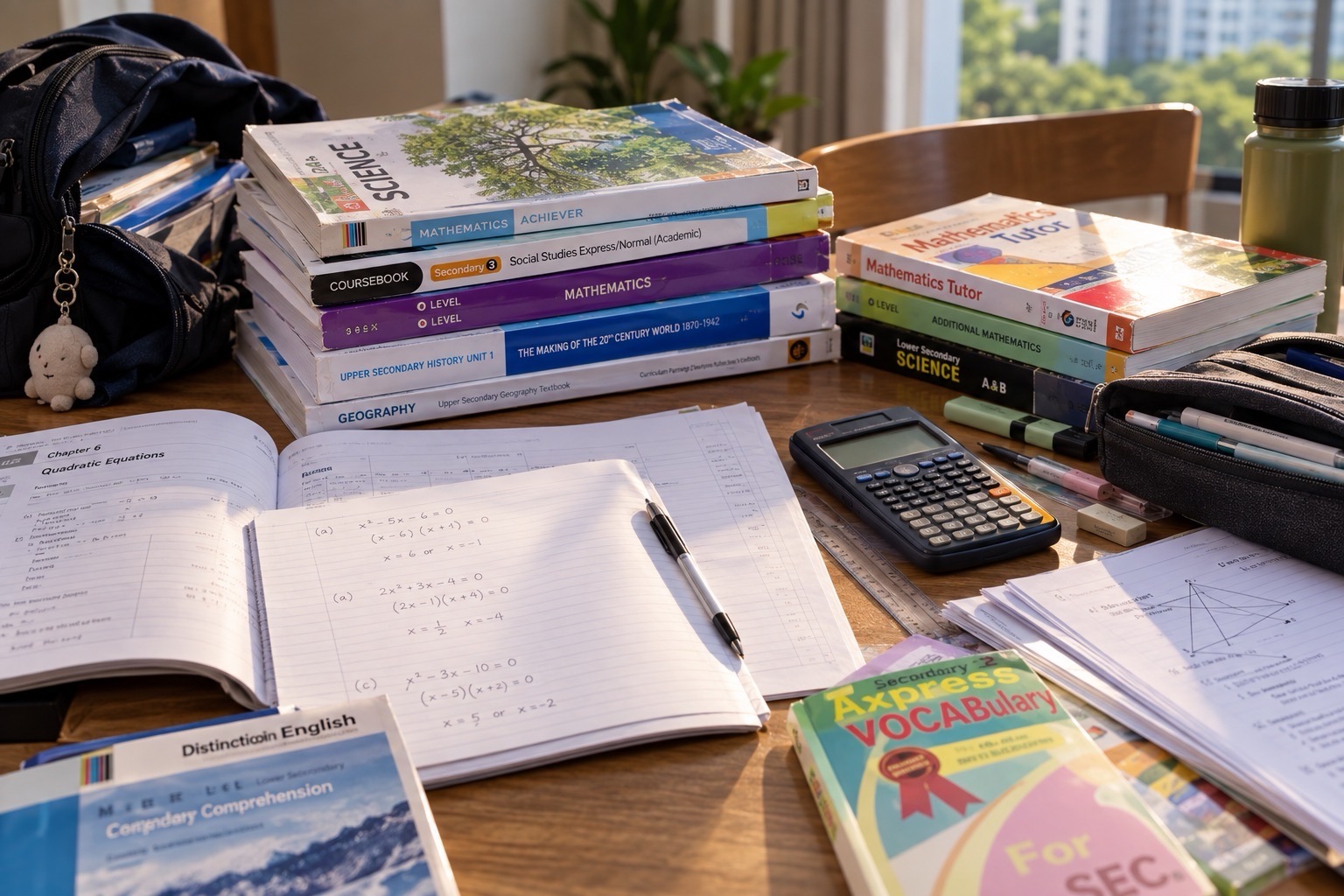
To survive G3 Physics, stop asking whether you remember enough formulas and start asking whether you can describe the physical situation before you calculate. If a graph is showing velocity, an arrow represents acceleration, or a circuit has two branches, the diagram must make sense first. A student who keeps substituting numbers into the wrong relationship needs a model-and-meaning repair, not another hundred calculations. Begin with one marked question, identify the first mistaken physical assumption, and explain the correction in ordinary language before attempting a changed example.
For the 2027 Singapore–Cambridge Secondary Education Certificate (SEC), the G3 Physics syllabus is K323, corresponding to the earlier O-Level Physics code 6091. Candidates take three papers: multiple choice, structured and free response, and practical. The full G3 Physics subject is different from the Physics component of the two-science G3 combined Science K326 or K327. Download materials for the correct syllabus. There is useful overlap, but its depth and assessment scheme cannot be assumed identical.
The optimistic part is that Physics rewards a set of habits which can genuinely be taught: draw the relevant forces, define what changes, select a relationship, keep units consistent, and check whether the result makes physical sense. These same habits are useful in engineering, architecture, transport, electronics, environmental technology, medical equipment, data modelling and even ordinary home energy decisions. The subject can keep technically demanding pathways open, but it does not guarantee admission to any particular junior college, polytechnic, ITE programme or career. Check each institution’s current requirements.
The next practical action is simple. Find three mistakes from the last assessment. Label each as misunderstood concept, wrong diagram, incorrect equation, mathematical manipulation, experimental interpretation or timing. Then repair the most repeated category first. This guide provides the official paper structure, original solved examples, an achievable four-week plan, safety-conscious practical preparation and helpful advice for families planning beyond the SEC.
Your first 20-minute diagnosis
- Check that your 2027 syllabus entry is K323 rather than a combined-Science component.
- Choose three recent mistakes; label each as concept, diagram, formula, algebra, measurement or interpretation.
- Redo one incorrect step and explain why the revised method fits the physical situation.
- Try a different question using the same idea without copying the model answer.
- Keep one short practical-data task in your weekly routine as well as theory.
How the 2027 K323 papers are assessed
SEAB specifies Paper 1 as a one-hour multiple-choice examination with 40 questions and 40 marks, contributing 30% of the final result. Paper 2 is 1 hour 45 minutes, 80 marks and 50%. Paper 3 is a 1 hour 50 minute practical worth 40 marks and 20%. This balance matters: a strong calculator performance cannot replace practical skills, and a good practical test cannot compensate for every theory misunderstanding. Make weekly space for all three formats instead of spending nearly every evening on calculations.
In Paper 2, Section A has 70 marks of compulsory structured questions. Its final two questions together carry 20 marks, including a data-based question worth 8–12 marks. Section B has 10 marks; candidates answer one of two questions. That choice is limited to Section B. Practise reading the instructions before solving. A student who completes both options in Section B at the expense of compulsory questions has spent time without a likely return.
Physics practical Paper 3 is organised into two 55-minute sections. Section A contains one or two compulsory practical experiment questions totalling 20 marks. Section B has one compulsory 55-minute practical experiment question worth 20 marks. Some questions include planning and some data analysis may be done without apparatus. Students must comply with assigned apparatus access periods; effective preparation therefore includes handling equipment and organising observations within real time constraints.
The assessment objectives make the philosophy clear: theory is not only recall. Knowledge with understanding represents about 45% of the theory marks, while handling information and solving problems represents about 55%. The practical paper checks planning, measurement, observation, recording, analysis and evaluation. Learn a concept, use it on unfamiliar data, and then explain why your conclusion follows. That is what an exam-focused and life-useful Physics education can look like.
The first mistake to fix: name quantities before choosing formulas
When students feel overwhelmed, they often scan the question for numbers and search their memory for a formula containing the same letters. That may work on an easy drill but fails when there are two stages of motion, when directions matter, or when a question requires explanation rather than calculation. A better opening is to write three labels: GIVEN, REQUIRED and MODEL. Given describes the observations or conditions; required states the requested quantity; model identifies the relationships that apply under those conditions.
Consider a trolley that changes velocity from 3 m/s east to 15 m/s east over 6 seconds at a steady rate. The target is acceleration, not distance. The relevant change in velocity is 12 m/s east, and acceleration is 12 divided by 6, or 2 m/s² east. If a student uses 15 divided by 6, they have treated final velocity as change in velocity. That is a misunderstanding of a quantity, not a small arithmetic error.
Practise translating unfamiliar wording into symbols: mass m, velocity v, acceleration a, force F and time t, each with SI units. Then do a dimension check. If the question asks for acceleration, the unit should be m/s²; an answer in metres alone cannot be acceleration. Not every physical check is decisive, but units are a powerful first filter. They also prevent casual mixing of centimetres with metres or grams with kilograms.
Parents can help without studying the entire formula sheet. Ask, ‘What exactly is changing?’ and ‘What would the correct unit be?’ Those questions prompt the learner to create meaning before calculation. An explanation the student can defend matters more than a number they happened to recognise from a worked example.
Measurement: use precision honestly rather than inventing it
The 2027 syllabus begins with physical quantities, units and measurement. This is foundational because a scientific statement must include a defined quantity and a suitable unit. A measurement of ‘five’ is incomplete if the reader does not know whether it refers to seconds, metres or kilograms. The choice of measuring instrument should reflect the size and precision of the quantity rather than whichever tool is closest to hand.
Suppose a rectangular object is approximately 0.08 m long. Writing 8 cm may be convenient, but multiplying that value with a breadth expressed in metres without converting units leads to an area error. Put all measurements in compatible units before calculating. A correct physics equation is still wrong if the numbers inserted are expressed on incompatible scales. Practice should include millimetres to metres, grams to kilograms and kilo- or milli-prefixes.
Distinguish accuracy from precision. A series of tightly grouped readings can be consistently wrong if the instrument has a calibration problem. A single result near the accepted value can be lucky rather than reliable. In school practicals, discuss specific causes such as zero error, parallax and resolution instead of writing ‘human error’ as a universal explanation. The improvement should target the named limitation.
A weekly measurement exercise is to inspect a printed diagram of a ruler, scale or instrument and write the reading with unit, possible uncertainty, and reason for choosing that instrument. It is often enough to restore confidence in questions that previously felt difficult because the student could not tell what to do with the apparatus information.
Scalars and vectors: direction changes the answer
Physics distinguishes quantities that have magnitude only from quantities that have magnitude and direction. Speed is scalar, velocity is vector. Distance is scalar, displacement is vector. These distinctions become decisive when objects reverse direction. A student who memorises the same numerical formulas for all four quantities can produce answers that sound plausible but describe the wrong movement.
Original exercise: a person walks 40 m east, then 10 m west. Total distance travelled is 50 m, while displacement is 30 m east. If the journey takes 10 seconds, average speed is 5 m/s and average velocity is 3 m/s east. The difference is not caused by a trick in the algebra; it comes from what each measured quantity actually represents.
Draw a one-dimensional arrow diagram before finding displacement. If vectors lie in different directions in two dimensions, follow the graphical methods within the syllabus, rather than adding magnitudes as though arrows had no directions. Ask whether the resultant should become bigger, smaller or even zero when the arrows oppose one another. A sketch can expose impossible answers faster than a calculator.
Use short transfer tasks: walking around a rectangle, a lift moving up and then down, or an object thrown vertically upward. In every task, label the reference direction and explain whether a negative sign means reverse direction rather than a ‘negative amount of movement’. This repairs the interpretation beneath several mechanics chapters at once.
Motion graphs: read axes before reading shapes
Distance-time and displacement-time graphs are not identical, and velocity-time graphs have a different interpretation again. On a displacement-time graph, the gradient describes velocity. On a velocity-time graph, gradient describes acceleration while signed area gives displacement for the suitable motion represented. If a graph only provides speed, its area gives distance. Students lose easy marks when they recognise a triangle yet forget what that triangle means.
Imagine a velocity-time graph showing a vehicle increasing uniformly from 4 m/s to 12 m/s east in 4 seconds. Acceleration is (12−4)/4, or 2 m/s² east. The displacement in that period is average velocity times time, giving (4+12)/2 × 4 = 32 m east. One graph answers two questions through two distinct operations: gradient and area. Writing both units is a useful check.
If the velocity graph dips below the time axis, some displacement is in the chosen negative direction. The net displacement is a signed sum, while total distance accumulates travel in both directions. Students who blindly add all geometric areas to report net displacement may get the wrong sign. Draw a reference arrow and explain what the negative section physically represents.
Try the graph-language drill: for each figure, name both axes, the unit of any gradient, the meaning of any area, and whether a flat section means rest or constant motion. The answer differs by graph type. Once this distinction becomes automatic, kinematics questions become less dependent on spotting a familiar diagram.
Newton’s laws: draw the forces acting on one object
A free-body diagram is a disciplined choice about which body you are analysing. Draw that one body and only forces acting on it. For a book at rest on a level table, gravity pulls it downward and the table pushes upward. The two forces balance in the vertical direction if no additional vertical force acts. It would be wrong to call those two forces a Newton’s third-law pair because they act on the same body.
Third-law pairs act on different bodies. When the book pushes the table downward, the table pushes the book upward with equal magnitude and opposite direction. That pair is different from the book’s weight, which is the force of Earth on the book. If a student treats all equal-looking arrows as reaction pairs, ask them to name the two bodies involved in each interaction. This one correction can transform diagrams and written explanations.
For a 2 kg trolley accelerating at 3 m/s² horizontally, resultant force is 6 N in the direction of acceleration. That does not imply any single applied force must equal 6 N when resistive forces are present; 6 N is the net effect of all horizontal forces. Draw and combine forces before substituting into F=ma. Distinguish mass measured in kilograms from weight measured in newtons.
Students who say an object needs a forward resultant force to maintain constant velocity are mixing up motion and change of motion. Newtonian reasoning says zero resultant force corresponds to zero acceleration, which is consistent with rest or constant velocity. Practise explaining both cases with diagrams and real everyday examples, then use a changed question to test whether understanding transfers.
Moments and equilibrium: measure perpendicular distance
A moment describes the turning effect of a force about a pivot. The distance in moment = force × perpendicular distance must be measured perpendicular to the line of action of the force. Students often use the longest drawn line in the diagram, which may not be the correct lever arm. Mark the pivot first, extend the force’s line of action if necessary, and draw the shortest perpendicular segment to it.
Original example: a horizontal lever has a 12 N downward force acting 0.50 m to the left of the pivot. Its moment is 6 N m anticlockwise. To balance with a downward force acting 0.30 m to the right, the required force is 20 N because 20 × 0.30 = 6. An answer of 7.2 N resulting from multiplying the two distances would have no valid balancing logic.
Static equilibrium may require zero resultant force as well as zero resultant moment. Do not equate ‘balanced moments’ with every possible condition of equilibrium unless the full setup supports it. For stability, learn how the centre of gravity and support base influence tipping. These ideas connect diagrams, force reasoning and everyday objects without requiring elaborate mathematics.
At home, use safe paper diagrams and familiar examples such as door handles or seesaws rather than attempting risky balancing experiments with heavy objects. Ask which choice increases the turning effect: larger force, larger perpendicular distance or different force direction. A student who can answer conceptually has an anchor for exam calculations.
Pressure and fluids: check area, depth and density
Pressure is force per unit area. If the same normal force acts over a smaller contact area, pressure increases. This explains why a sharp edge can create greater pressure than a blunt one under similar forces. The units matter: pascals represent newtons per square metre. When an area is provided in cm², convert it appropriately before substituting.
For a force of 60 N distributed uniformly over 0.020 m², pressure is 3000 Pa. If the area is halved while force stays constant, pressure doubles to 6000 Pa. The pressure change follows from division, not from an informal claim that the object has become ‘heavier’. Ask the student to predict the direction of change before calculating.
In a uniform liquid at rest, pressure difference due to a liquid column depends on density, gravitational field strength and vertical depth. Under a suitable model, p=hρg. A point twice as deep below the free surface has twice the pressure contribution from the liquid column if density and g remain constant; overall absolute pressure additionally includes surface pressure. The distinction is worth making when interpreting context.
Hydraulic systems transmit pressure through confined fluids under appropriate assumptions. Students should not assume forces are identical on pistons of different areas; it is pressure that is transmitted, with force depending on piston area. Draw and label the pistons, then test whether the inferred force relationship makes physical sense.
Energy, work and power: follow where energy goes
Energy is conserved overall, but it can be transferred between stores and surroundings in ways not all useful for the task. Students should avoid saying energy simply disappears in a motor or lamp. Instead, state the input, useful output and other transfers. The chosen useful output depends on the purpose: thermal transfer is desirable for a heater but may be unwanted for an electrical motor.
Suppose a device receives 800 J electrically and transfers 600 J into its intended useful output. Efficiency is 600/800 × 100% = 75%. The remaining 200 J is transferred in other ways; it is not annihilated. A different task may specify power rather than energy, in which case use useful output power divided by input power, with matching units.
Work done by a constant force is force multiplied by distance travelled in the force’s direction. If a student pushes a box with 20 N through 3 m in that direction, work done by that force is 60 J. If the object does not move in the direction of the force, the relevant mechanical work can be zero. This prevents a simple but persistent mistake: equating every applied force with positive work done.
Power describes the rate of energy transfer or work done. If 600 J is transferred in 5 s, average power is 120 W. These distinctions are useful for understanding machinery, appliances, electric vehicles and energy efficiency. In revision, create a diagram showing quantities and units before calculating. It is the relationship between them, not the number of formulas memorised, that unlocks the question.
Thermal physics: temperature is not simply energy
Temperature helps describe the thermal state of matter but is not identical to the total internal energy of an object. A large quantity of warm water can contain more internal energy than a tiny quantity of hotter water. Heating, cooling, melting and boiling require students to distinguish how energy is transferred from how temperature changes. Start with particle behaviour, then return to observable quantities.
During melting of a pure substance at its melting point under constant pressure, added energy may go into the change of state rather than raising temperature until melting finishes. That is why a simple heating curve can contain a flat region. Students who assume a constant temperature means that no energy is entering the material need to reconnect the graph with the particle model.
Conduction, convection and radiation transfer energy in different ways. Convection involves bulk movement of fluid, while electromagnetic thermal radiation does not require a material medium. When a metal spoon becomes warm in hot soup, conduction matters; the circulation of heated water can involve convection. Describe the process in the specific situation rather than listing all three as a ritual.
Practise sketching particle diagrams for solids, liquids and gases and describing arrangement, motion and the relative effects of heating. Label where a model is simplified. A useful learning check is asking what the model explains and what it does not show. Scientific models become powerful when they are understood, not treated as photographs of invisible particles.
Waves: separate transfer of energy from travel of matter
The syllabus highlights a general wave principle: waves transfer energy without transporting matter over the full wave journey in the same way. Learn amplitude, wavelength, frequency and speed as defined quantities. On a transverse wave sketch, wavelength is measured between corresponding points on successive cycles; amplitude is the maximum displacement from equilibrium, not the total crest-to-trough height.
Original example: a wave has frequency 5 Hz and wavelength 0.40 m. Its speed is v=fλ=5×0.40=2 m/s. If frequency doubles in the same medium while wave speed remains constant, wavelength halves. This relationship should be explained using the variables, not a rote slogan that frequency always makes every wave move faster.
Students sometimes think a louder sound is necessarily higher pitched. Loudness is associated with amplitude and perception under specific conditions, while pitch is connected to frequency. Learn to interpret a trace showing a larger amplitude but the same time period, or a shorter period but the same amplitude. The visual difference can be tested without complex arithmetic.
When dealing with reflection or refraction, mark the wave boundary and the normal clearly. Explain which properties change at a medium boundary under the given conditions. Do not claim that frequency always changes when a light wave enters a new medium; frequency is set by the source and remains unchanged across a stationary boundary under ordinary conditions.
Light and the electromagnetic spectrum: use context
Reflection and refraction are not interchangeable terms. In reflection, a wave changes direction at a boundary while remaining in its original medium. In refraction, its direction may change as it crosses between media because its speed changes. The normal is the line perpendicular to the surface, and angles are measured from it. A badly positioned normal is enough to corrupt an otherwise correct ray diagram.
Draw a ray entering a denser optical medium from air at an oblique angle under ordinary transparent conditions. It bends towards the normal when its speed decreases. When it exits towards air, it bends away from the normal under suitable conditions. Avoid calling this simply ‘light likes to bend towards glass’; state the physical cause and the reference direction.
The electromagnetic spectrum includes different frequencies and wavelengths, yet all electromagnetic waves travel at the same speed in vacuum. Students should recognise the broad order from radio waves through microwaves, infrared, visible light, ultraviolet, X-rays and gamma rays, and connect applications to properties and risk. A claim about safety must consider intensity, exposure and context, not just a dramatic label.
An effective retrieval exercise asks students to draw a blank spectrum line, label relative wavelength and frequency directions, and place examples of everyday uses. Later ask them to explain why a particular region suits a communication, imaging or heating task. This is a route from memorised order to application.
Direct current circuits: one circuit, several quantities
Electrical calculations are most reliable after a proper circuit sketch. In a series circuit, the current in the single path is the same through all components; potential differences across components add to the supply voltage in a simple ideal model. In parallel branches, potential difference across each branch is the same, while currents split and later recombine under appropriate conditions. These are relationships of a connected circuit, not rules about which component is ‘first’.
Consider a 12 V source with 4 Ω and 8 Ω resistors in series, ignoring source internal resistance. Total resistance is 12 Ω and current is 1 A. Potential differences across the two resistors are 4 V and 8 V, which add to the 12 V source. If a student claims the current after the first resistor is lower because electricity was consumed, ask them to check conservation of charge in steady state.
An ammeter measures current and is connected in series with the relevant branch according to the practical arrangement. A voltmeter measures potential difference across a component and is connected in parallel with that component. Wrong connections can produce bad readings or unsafe conditions. Students should practise these with school-approved low-voltage equipment under supervision, or with a trusted virtual circuit tool; do not improvise mains wiring.
Electrical power is related to current and voltage. Under suitable conditions P=VI. If a 9 V component draws 0.20 A, its electrical power is 1.8 W. But first ensure that the 9 V is actually the potential difference across that component, not just a supply value that includes other circuit elements. This is how a correct formula can still lead to an incorrect answer when the circuit has been misread.
Magnetism and induction: predict the direction from change
Magnetic field diagrams should show direction and relevant spatial relationships. The key mental move is to connect a changing situation with its physical effect. A steady current can produce a magnetic field, while a changing magnetic environment through a conducting circuit can induce an electromotive force under appropriate conditions. Students must separate the phenomenon from whatever measuring instrument is shown.
Imagine moving a magnet towards a coil connected to a sensitive galvanometer. The motion changes the magnetic flux linkage, so an induced effect may be observed. If the magnet is held still relative to the coil under otherwise constant conditions, the changing-flux cause disappears. A common wrong explanation is that a magnet ‘has electricity in it’ that flows into the circuit. It does not describe electromagnetic induction accurately.
Learn to compare two situations: faster movement versus slower movement, more turns versus fewer turns, and reversal of relative motion. For direction questions, apply the appropriate right-hand rules and Lenz’s law reasoning in the scope required by the syllabus. Describe what changes and why, rather than memorising a single arrow from one picture.
These concepts connect to generators, transformers, electric motors and the grid. Students need not know every industrial detail to see why induction matters. A short annotated diagram plus a two-sentence causal explanation often demonstrates more understanding than a paragraph full of equipment names.
Radioactivity: distinguish activity from the hazard model
Radioactivity is a scheduled part of the K323 content. Students should identify alpha, beta and gamma radiation in the relevant syllabus treatment, nuclear changes, half-life and basic uses or risks, while respecting the difference between radioactive decay and an ordinary chemical reaction. Radioactive decay is a nuclear process; heating a substance does not simply accelerate the decay by making its particles move faster in the way it can speed chemical collisions.
A half-life is the time taken for the number of undecayed nuclei, or the activity of a sample under appropriate assumptions, to fall to half its value. If a sample’s activity begins at 800 counts per minute after suitable background correction and its half-life is 3 hours, the expected activity is 400 after 3 hours and 200 after 6 hours. The progression is multiplicative, not a subtraction of 400 every three hours.
A useful check is to distinguish irradiation from contamination. Exposure to a radiation source does not in every scenario mean radioactive material is deposited on the object. Risks and precautions depend on what type of radiation, duration, distance, shielding, contamination route and other conditions are relevant. Students should use school-approved sources and safety guidance, never handle unknown radioactive material.
Practice with graphs of activity against time, extracting successive half-lives and explaining the shape rather than computing only one point. Link physical meaning to responsible use in industry and medicine. The goal is informed reasoning about benefits and risks, not exaggerated fear.
Paper 1 multiple choice: identify the misconception in each distractor
Multiple-choice practice is most valuable after marking, not just during the timed hour. A wrong option often corresponds to a recognisable idea: adding distances instead of displacements, using final speed instead of change in speed, confusing resistance with current, or measuring moment distance at the wrong angle. The student should write why the chosen option was attractive and why the correct answer follows from the physical model.
Before looking at options, try to estimate direction, order of magnitude and unit. If a question asks for a current around 0.2 A, a choice of 200 A should trigger scrutiny of kilo-, milli- or decimal conversions. If all options are numbers with the same unit, explain how one can still distinguish between formulas that share dimensions. A unit check is helpful but does not replace conceptual analysis.
Under timed conditions, leave a particularly confusing item temporarily rather than abandoning later questions. Mark it clearly in your practice booklet, return where time permits and compare the two routes of reasoning afterwards. Every marked paper should produce a short list of actual error families, not just a single percentage.
Work in sets of ten questions containing different chapters. Correct them fully before attempting a second mixed set two days later. A perfect score achieved by remembering the option layout is much less evidence of progress than a new question correctly answered from first principles.
Paper 2 structured answers: evidence, law, working, interpretation
Structured and free-response questions reward readable thinking. For a calculation, begin by naming the quantity, select the applicable relationship, substitute compatible values, and finish with a unit and any requested direction. For an explanation, state the relevant observation or change, apply the correct principle, then connect the principle explicitly to the outcome. These are habits, not rigid paragraphs to memorise.
A common free-response error is answering with a correct general fact that does not explain the particular case. If asked why a trolley slows on a rough surface, writing ‘friction exists’ is incomplete. You may need to explain that an opposing resistive force contributes to a resultant force opposite its velocity, producing an acceleration opposite to its direction of motion. The exact explanation must match the conditions given.
Data-based questions can introduce unfamiliar apparatus or a new setting. Do not panic because the story is new. Identify the same quantities you already understand, read tables and graph axes, and state what the data support. If several readings are present, look for the requested comparison rather than listing every number. A novel context does not automatically require a new physical law.
Answer presentation also matters. A line of algebra without labels may be harder to interpret and check. Show major substitutions, specify units and conclude in words when the question requests a decision. The examiner needs to see that the calculation belongs to the scenario. A coherent short answer can be more convincing than long, disconnected remarks.
Paper 3 practical: measurement is a skill, not a formula
Practical Physics cannot be fully learnt through reading. The 2027 K323 practical paper checks manipulations, measurements, observations, presentation, analysis, evaluation and planning. Use supervised laboratory sessions to practise setting apparatus correctly, observing what really occurs and recording data promptly. Use paper diagrams or simulations at home to reason about methods, but do not treat them as a substitute for legitimate supervised handling experience.
Before starting an experiment, read the whole instruction sequence and identify the independent variable, dependent variable, controlled conditions, required apparatus and time allowance. Students sometimes begin recording large data tables before learning that the task requires a specific range of readings. A small amount of planning can save significant time and reduce avoidable mistakes.
In Paper 3, do not invent a neat result because you expect a straight line. An anomalous measurement is information. Check the instrument, reread the procedure and repeat a reading when the instruction and timing permit. Report what you observed honestly. Science values integrity in data, and accurate reporting is part of assessment readiness.
A sound lab routine finishes with the question, ‘What is the observation, and what does it show?’ If an experiment asks for the relationship between quantities, it may be necessary to derive a gradient with units, use a best-fit line, or justify whether results support a proposed model. Good practical preparation includes explanation as well as apparatus familiarity.
Graphs and experimental evaluation: name the actual limitation
A graph should carry the correct variables and units on each axis. Choose a scale that uses the page well; plot measured points accurately and draw an appropriate line or curve where the task requires one. When reading a gradient, use points on the best-fit line where appropriate rather than automatically selecting the first and last raw measurements. The gradient’s unit comes from vertical-axis units divided by horizontal-axis units.
Suppose an experiment plots extension of a spring in metres vertically against load in newtons horizontally over a suitable approximately linear range. A positive gradient in m/N indicates extension per unit applied force. If the axes are swapped, the gradient’s meaning and units change. The paper may ask for a physical constant derived from the slope rather than the slope alone, so read the definition carefully.
Evaluation requires an identified source of uncertainty linked to a credible improvement. For stopwatch reaction-time variation, repeating and averaging suitable timings can reduce random variation. For parallax on a ruler, reading at eye level and using a pointer can help. Simply writing ‘take more accurate readings’ is not a specific plan because it does not name how accuracy changes.
Students should also distinguish random scatter from systematic offset and understand that a plausible straight line does not establish every claimed causal relationship. The experiment’s controls matter. Use your teacher’s feedback to form an observation–reason–improvement table after each lab session. The technique transfers to higher scientific study.
A four-week rescue plan that does not exhaust the learner
Week one is diagnostic. Attempt a short mixed set of mechanics, thermal, waves and electricity questions and a paper-based practical data task. Label each error as concept, picture, equation, algebra, units or evidence. Choose the two most frequent categories. Keep the written list small enough that you can remember it without re-reading twenty pages.
Week two is repair. If the difficulty is vectors and graphs, draw and explain before calculating. If it is circuits, sketch current paths and voltage relationships before using Ohm’s law. If it is energy or heat, draw an energy-flow or particle model. Complete five to eight short targeted questions in each troublesome skill area, and check the method with fresh numbers rather than copying the corrected answer.
Week three is transfer. Mix topics so the title of a worksheet no longer reveals which equation is needed. Add one data-based question and one supervised practical task if your school programme allows. Revisit the earlier failure category and see whether the student now independently selects a valid relationship. If not, reduce the complexity and explain the first undecided step again.
Week four is timed rehearsal with recovery. Attempt short sections from Papers 1 and 2 and one practical-data evaluation task. Record the point where time was lost: interpreting the diagram, selecting an equation, performing algebra or checking. Develop a short final-check routine for units, signs, scale, significant figures and physical plausibility. Sleep and normal schoolwork are part of sustainable preparation; an exhausted learner cannot reason well.
What parents should expect from targeted support
A student’s weak Physics result can come from a missing mathematical prerequisite, an incorrect mental picture, poor familiarity with apparatus or a genuine conceptual gap. These are different problems. A useful teacher or tutor listens to the student’s attempted explanation, identifies the first incorrect decision, and then asks the learner to make the corrected decision on a changed example. More hours spent copying solutions are not automatically more learning.
If the student struggles with unit conversions, help them organise a short table of prefixes and repeat small calculations. If they know equations but choose the wrong one, ask them to translate the question into given, target and model. If they forget practical steps, coordinate with supervised school lessons rather than proposing hazardous home experiments. The support should fit the cause, not the parental fear.
A small tutorial can give the learner space to speak through misconceptions, but it should include individual diagnosis, feedback and independent reattempts. Ask prospective tutors what evidence they use to show that a student can now perform a task without cues. Guaranteed-grade claims are not a substitute for a teaching method.
When reviewing a disappointing mark, focus on one corrected explanation rather than turning the mark into an identity. A student who learns to distinguish velocity from acceleration, to read the diagram and to repair a wrong choice has made a real step. That competence is what later exam performance can be built upon.
Future study and careers: Physics creates useful options, not a single route
Physics can connect with mechanical, electrical, civil and aerospace engineering, technical computing, architecture, transport systems, renewable energy, environmental measurement, medical technology and many forms of applied research. Different professions require very different training routes. Some value strong Mathematics alongside Physics, others combine technical learning with design, management or communication skills. Studying G3 Physics does not force a teenager to commit to any one of these paths.
For the first SEC cohort in 2027, MOE has announced changes to post-secondary admissions beginning in 2028. Students should examine the actual routes to junior college, Millennia Institute, polytechnics and ITE using official contemporary information. Subject combinations, course-specific prerequisites, grades and applications all matter. A good grade is useful, but no single G3 subject guarantees entry.
A practical career conversation starts with problems the student enjoys: designing safer transport, understanding electrical systems, modelling environmental changes or building devices that support healthcare. Then examine what subject skills are required for the next study stage. Keep realistic alternatives in view so one exam result does not appear to decide a lifetime.
The next small action remains educational rather than speculative: take a problem you could not solve, identify the hidden physical decision and repair it. Physics improves when mathematical symbols reconnect with how objects, energy and evidence behave. That habit can remain valuable even if the student eventually pursues a profession outside science.
Twenty original short Physics practice missions
Use these as short diagnostics, not as a second entire examination. Pick two or three missions related to the student’s current error pattern, explain each decision and check it later in a changed context. Real laboratory work remains a supervised school activity.
The diagram-first decision
For three unseen questions, write only the chosen object, direction of motion or field, and relevant forces or quantities before performing any calculation. Explain whether the diagram describes the situation as the question states.
Velocity versus displacement
Walk 40 m east then 10 m west in a fictional 10-second problem. Identify distance 50 m, displacement 30 m east, average speed 5 m/s and average velocity 3 m/s east.
Acceleration from change
A trolley changes velocity from 3 m/s to 15 m/s east in six seconds. Find acceleration 2 m/s² east; explain why 15/6 is not the required calculation.
Read a graph twice
For a velocity-time graph, calculate one gradient with m/s² and one signed area with metres. Write what each operation describes before you put numbers into a calculator.
Third-law body labels
For a book on a table, draw all forces on the book. Then name the two bodies involved in the normal-force action-reaction pair. Check that your selected pair acts on different objects.
Moment from the true arm
A 12 N downward force acts at a perpendicular distance 0.50 m from a pivot. Find its moment 6 N m. Describe what changes if only the perpendicular distance becomes 0.25 m.
Hydraulic pressure check
Apply 60 N to 0.020 m². Find 3000 Pa. Halve the contact area and predict the new pressure before calculating it. State what is assumed constant.
Energy pathway
A device receives 800 J and sends 600 J to useful output. Compute 75% efficiency and describe where other energy transfers may occur, instead of saying energy vanished.
Work and power split
A force of 20 N acts through 3 m along its direction, doing 60 J. If it happens in two seconds, average power for that work is 30 W. Confirm the distinct units J and W.
Heating curve explanation
Sketch a generic pure substance melting under constant pressure. Label the approximately constant-temperature interval and explain that energy can support a state change despite no temperature rise.
Wave-property reset
For 5 Hz frequency and 0.40 m wavelength, find 2 m/s speed. Then predict wavelength change when frequency doubles but speed is held constant.
Refraction drawing
Draw a normal on a transparent interface and mark incident and refracted rays. Explain what a change in speed has to do with direction. Measure angles from the normal, not from the surface.
Circuit series verification
Solve a 12 V ideal series circuit with 4 Ω and 8 Ω. Compute 1 A current and voltage drops 4 V and 8 V, then show their total agrees with the supply.
Electrical power reading
For 9 V across a device drawing 0.20 A, obtain 1.8 W. State that the measured voltage must be across that specific device, not an unrelated supply label.
Induction change test
Explain why a moving magnet relative to a coil may induce a response whereas the same motionless arrangement may not. State the varying physical quantity and describe reversal.
Half-life repetition
From 800 counts per minute with a three-hour half-life, find 400 after three hours and 200 after six. Contrast repeated halving with repeated subtracting.
Paper 2 question selection
Look at a mock Paper 2 and find compulsory Section A and choice Section B. State the number of Section B questions you should answer and why attempting both may waste time.
Practical graph units
If extension (m) is plotted against force (N), determine the slope unit m/N. Reverse axes in thought and explain why the slope would no longer mean extension per unit force.
Specific uncertainty
Replace ‘human error’ with a named timing, scale-reading or alignment limitation and one feasible corrective change. Explain how the change targets the limitation.
Fresh-context transfer
After correcting a familiar question, change the object, direction or given quantities. Solve the new version from the model rather than from memory of a worked solution.
Frequently asked questions about surviving G3 Physics
Is G3 Physics the same as combined Science Physics?
No. K323 is the full G3 Physics syllabus, while combined Science has different codes, paired disciplines and its own papers. Check the official PDF matching your subject entry.
What is the 2027 SEC G3 Physics code?
K323. The SEAB table gives the earlier O-Level reference code as 6091.
How much is the practical paper worth?
Paper 3 counts for 20%, with a 1 hour 50 minute assessment worth 40 marks. Schools prepare students for supervised practical work.
Which paper contains the data-based question?
Paper 2 Section A includes a data-based question worth 8–12 marks within its final two questions. The complete Paper 2 is worth 50% of the final grade.
Can I pass Physics by memorising a formula list?
Recall matters, but the theory objectives emphasise applying knowledge and handling unfamiliar information. Practise modelling, diagrams, graphs, units and justification alongside formulas.
Why do my answers look right but lose marks?
Check whether the answer uses the requested quantity, shows required reasoning, includes correct units and interprets the result in the physical situation. Compare with teacher feedback rather than making assumptions.
How should I practise practical Physics at home?
Use school notes, apparatus diagrams, safe simulations and supplied data sets. Equipment experiments should be carried out in approved supervised conditions.
Should I study the hardest chapter first?
Begin with the recurring prerequisite error most responsible for lost marks. It may be unit conversion or force diagrams rather than the chapter with the most complicated title.
Does G3 Physics guarantee a technical career?
No single subject determines a job or course. It builds useful concepts and reasoning; actual pathways depend on other subjects, interests and current institutional admission rules.
How much revision should I do daily?
Short, repeated sessions with feedback often work better than unstructured marathons. Set a manageable schedule around schoolwork, rest and the specific skills needing repair.
Official references and neighbouring learning guides
The 2027 SEAB K323 syllabus is the authoritative reference for assessment details and content. Older worked examples can still teach the relevant principle, but their administrative details and topic coverage should be checked against the correct SEC year.
- Official SEAB 2027 G3 syllabus list
- Official 2027 K323 G3 Physics syllabus
- SEAB SEC qualification and examination guidance
- MOE official 2026 announcements on post-secondary changes
- eduKate G3 combined Science survival and practical decisions
- eduKate G3 Mathematics paper and problem solving
- eduKate G3 Additional Mathematics and calculus
- eduKate SEC Science practical papers comparison
- eduKate small-group mathematics transition support
Tomorrow’s most useful first move
Take one recent question you could almost solve. Draw the physical situation, mark what is given, identify what is required, and explain why the chosen relationship is valid. Then retry with changed data. Surviving G3 Physics is not a matter of pretending the examination is simple; it is a matter of making each difficult question a sequence of understandable decisions. That is a skill worth developing for examinations and for work beyond them.