
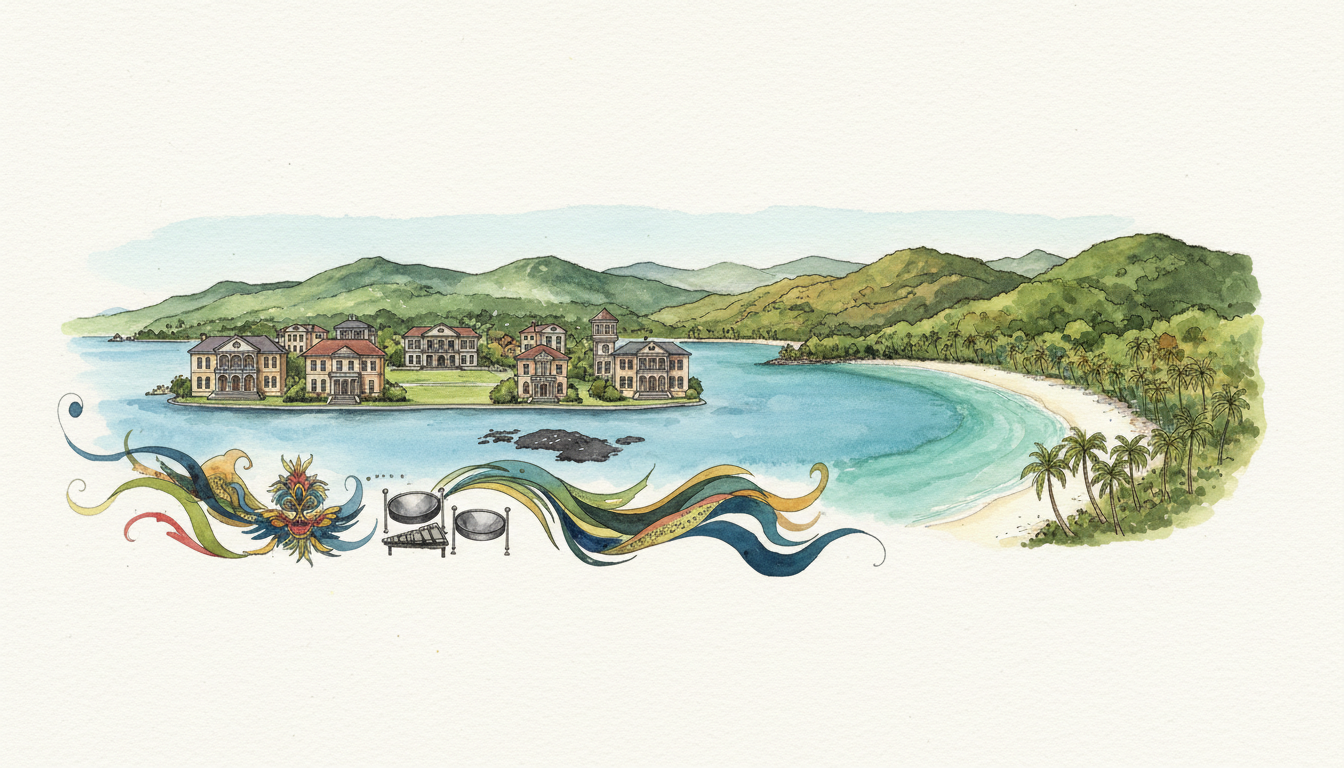
How does Trinidad and Tobago work? This two-island republic connects national parliamentary government, Tobago’s distinct local administration, natural gas and petrochemical exports, ferries, schools and everyday services. Follow an energy shipment or a grocery delivery to understand how decisions reach households.
The guide joins the 195-country A–Z directory. It explains the whole country without pretending that Trinidad’s industrial centres and Tobago’s communities work identically.
Trinidad and Tobago at a glance
Official name: Republic of Trinidad and Tobago. Capital: Port of Spain, on Trinidad. Government: parliamentary republic, with an elected House of Representatives, appointed Senate, president as head of state and prime minister leading the government. Currency: Trinidad and Tobago dollar (TTD). Main islands: Trinidad and Tobago, with smaller islands. Economy: natural gas, petrochemicals, other manufacturing, services, trade and tourism.
The islands belong to one country, yet they do not have identical economic roles or local responsibilities. Trinidad hosts much of the energy and industrial activity, while Tobago has an important tourism and community-service economy. Sea and air links tie their households and businesses together.
How does Trinidad and Tobago work in one minute?
National institutions make laws, collect revenue, allocate public budgets and provide services. Private firms and state-linked operations produce and transport energy and other goods. Local authorities and the Tobago House of Assembly manage particular needs, while families, workers and communities sustain social and cultural life.
Imagine a hotel in Tobago buying flour, electricity and maintenance services. The flour might travel through Trinidad or be imported, the electricity needs a local network, and staff need schools, healthcare and affordable transport. A good economy must make those simple links dependable.
Who governs Trinidad and Tobago?
Trinidad and Tobago is a parliamentary republic under a written constitution. The president is head of state, while the prime minister heads the government and Cabinet. Parliament has a House of Representatives and a Senate. Courts have responsibilities under the law.
Unlike a presidential executive system, the head of state’s ceremonial and constitutional powers should not be confused with the prime minister’s daily leadership of government. For a new public programme, check which ministry is responsible, which law authorises it and how funding will be audited.
How are members of Parliament chosen?
The House of Representatives is elected from constituencies in national elections. Senators are appointed under constitutional arrangements, including government, opposition and independent representation. The precise membership and office-holders should be checked against Parliament’s current list.
Parliament debates laws and public finances and asks questions of the government. Whether a policy genuinely reaches residents requires another level of evidence: effective spending, skilled staff, procurement and functioning services.
What makes Tobago’s local government different?
Tobago has a distinctive devolved institution, the Tobago House of Assembly (THA). It manages functions assigned under law and coordinates services on the island. Its executive and legislature have their own roles within Trinidad and Tobago’s national constitutional framework.
Devolution does not make Tobago an independent country. National and island responsibilities overlap in some policy areas, so a resident needs to identify the right authority for a road, tourism facility, health issue or development application. The presence of a local budget is only part of the delivery chain.
Why does the country have two different island economies?
Trinidad has major energy, processing, manufacturing and business activities, along with large communities and commercial transport. Tobago has a smaller economy with a strong tourism role, local services, fisheries, agriculture and cultural life. Both depend on national finance and connections to external markets.
A single national GDP growth number may hide different local experiences. When gas prices rise, public revenue may increase without every guesthouse on Tobago receiving more bookings. When a storm closes an inter-island route, the consequences differ for factories, shopkeepers and patients.
Why are natural gas and LNG so important?
Natural gas has long played a major role in exports, government income, power production and industrial development. Liquefied natural gas (LNG) is gas cooled for overseas shipment. The country also uses gas as a feedstock for downstream manufacturing.
Natural gas reserves and plant capacity do not guarantee full output every year. Production depends on available fields, investment, maintenance, prices and contracts. Headline announcements about new gas supplies should be checked for their projected start dates and whether volumes have actually reached customers.
What are petrochemicals, ammonia and methanol?
Petrochemicals are industrial products manufactured using hydrocarbons as inputs. Trinidad and Tobago produces commodities such as methanol and ammonia used in global supply chains. Their manufacture connects gas supply, chemical engineering, port operations, equipment maintenance and international customers.
An export dollar is not all profit for the public. Plants incur wages, feedstock costs, capital expenditure, logistics and environmental obligations. To understand national benefit, compare export value with public revenue, employment, local purchasing and long-term sustainability.
Can the economy succeed when oil or gas production falls?
Energy market cycles expose the country to volatility, so stronger opportunities outside the sector matter. Tourism, financial and professional services, agriculture, digital enterprises, creative industries and other manufacturing can help diversify jobs.
Diversification is not a magic switch. Small firms need finance, electricity, land, training, safety, reliable shipping and export-market access. Moving public announcements into operating companies is a multi-year process, and results should be measured in productivity and household income.
How do ports, ferries and flights connect the islands?
Ports on Trinidad handle trade, and ferry services and domestic flights help move people and goods between Trinidad and Tobago. Timetables, safety checks, vessel capacity, weather and maintenance influence reliability. Smaller businesses feel disruption when they cannot restock or receive customers.
For an urgent hospital appointment, a transport connection is not just a tourism convenience. It is part of the healthcare system. An honest national transport report should include journey reliability, accessibility, booking systems and what happens when a service is cancelled.
Why does road transport affect household budgets?
Commuting costs, traffic, road conditions and drainage affect the price of delivering goods and the time people have with their families. Urban congestion can make short distances slow. Flooding can interrupt school journeys, industrial deliveries or access to clinics.
Transport investment should be judged by safer, more reliable journeys, not simply kilometres of new asphalt. Maintenance, useful bus routes, walking access and transparent roadworks scheduling often determine whether communities actually benefit.
How do electricity and energy prices reach homes?
Energy resources may be produced domestically, but households still need safe generation, transmission, distribution and billing. A power interruption can stop refrigerators, water pumps, point-of-sale machines and school computers. Electricity reliability is an everyday measure of development.
Affordable energy can support industry and households, but financial sustainability matters too. Systems need money for repairs, efficient usage and equipment replacement; subsidies or pricing policies have distributional effects that should be examined openly.
Where does drinking water come from?
Water services rely on natural resources, treatment plants, storage, pipelines and maintenance. Supply reliability can differ by community, and drought or bursts can affect households. Public-health risks also depend on safe sanitation, drainage and wastewater arrangements.
Finding water at a national level is not enough. A resident needs adequate pressure, water quality, information on outages and an accessible way to report repairs. Water infrastructure is successful when service is stable after the construction team leaves.
How do schools connect to employment?
Students study through primary and secondary education and may continue to universities, colleges, vocational programmes or apprenticeships. Learning English, mathematics, science, technical subjects and creative skills can open different pathways. Qualifications help only when employers understand and can use the capabilities.
An energy economy needs engineers and technicians, but tourism also needs cooks, digital marketers, mechanics and entrepreneurs. Education planning should include foundational learning, practical skills and the ability to retrain when industry demands change.
How are healthcare and public services delivered?
Healthcare involves community clinics, hospitals, staff, medicine supply and referrals. National policy and funding matter, but actual quality depends on where someone lives, the service they need and whether it is available when required.
An island-based patient needing specialist treatment may also depend on transport and coordinated records. A hospital cannot be evaluated solely by beds built; reliable treatment, infection control, waiting times and continuity of medicine are essential.
Why are carnival, steelpan and music economically important?
Trinidad and Tobago has a rich cultural life including Carnival traditions, steelpan and music. Cultural events are not just entertainment: designers, performers, fabricators, caterers, transport workers and hotels can all participate in the surrounding economy.
These traditions have social meaning beyond cash receipts. Good reporting avoids reducing residents to tourism attractions. The relevant business questions include contracts, licensing, working conditions, fair payment and whether local creators retain long-term value.
How do climate and coastal risks affect island life?
Heavy rainfall, flooding, coastal erosion, heat and marine conditions can affect homes, businesses, roads and agricultural land. Different regions have different exposures. Adaptation may involve drainage, building standards, environmental management and credible public warnings.
A hotel owner planning improvements should examine local hazard maps and real maintenance needs. A national resilience strategy works only when agencies, utilities and households know their respective roles.
Worked example: gas becomes a product sold overseas
Imagine gas produced offshore and delivered to a processing facility on Trinidad. Skilled workers operate equipment, utilities support production, a chemical plant or LNG facility processes the feedstock, and a ship carries the result to an overseas buyer. Inspections, environmental rules, finance and port operations are necessary at every stage.
This is an illustrative supply chain, not a description of one specific commercial contract. It makes clear that production announcements, actual output, export revenue and public benefit are four different measures.
Worked example: a Tobago guesthouse needs supplies
Imagine a guesthouse booking visitors for a weekend. It needs clean water, electricity, functioning internet, trained staff, road access and deliveries of food and linens. A delayed ferry can affect the business even if overseas demand is strong.
The practical teaching question is what each organisation controls: a carrier schedules shipments, a utility maintains power, a public agency manages standards, and the owner plans stock and safety. Better coordination reduces cost and uncertainty.
Frequently asked questions about Trinidad and Tobago
Are Trinidad and Tobago separate countries? No. Together they form one sovereign republic.
What is the capital? Port of Spain, on Trinidad.
Does Tobago have its own assembly? Yes. The Tobago House of Assembly has devolved responsibilities under law.
Who heads the government? The prime minister; the president serves as head of state.
What currency is used? The Trinidad and Tobago dollar (TTD).
Is natural gas important? Yes. It supports LNG, petrochemical activity and public revenues.
What are the main inter-island connections? Air and ferry services, with schedules and availability dependent on the operators and conditions.
Is Trinidad and Tobago only an energy economy? No. Services, tourism, creative industries, manufacturing and agriculture also matter.
Sources and further reading
Official institutions: Parliament of Trinidad and Tobago — current members, Tobago House of Assembly Legislature, and Ministry of Finance — national accounts by industry. Figures are subject to revision and should retain their dates.
Continue through How Countries Work — A–Z hub and the published country series.