
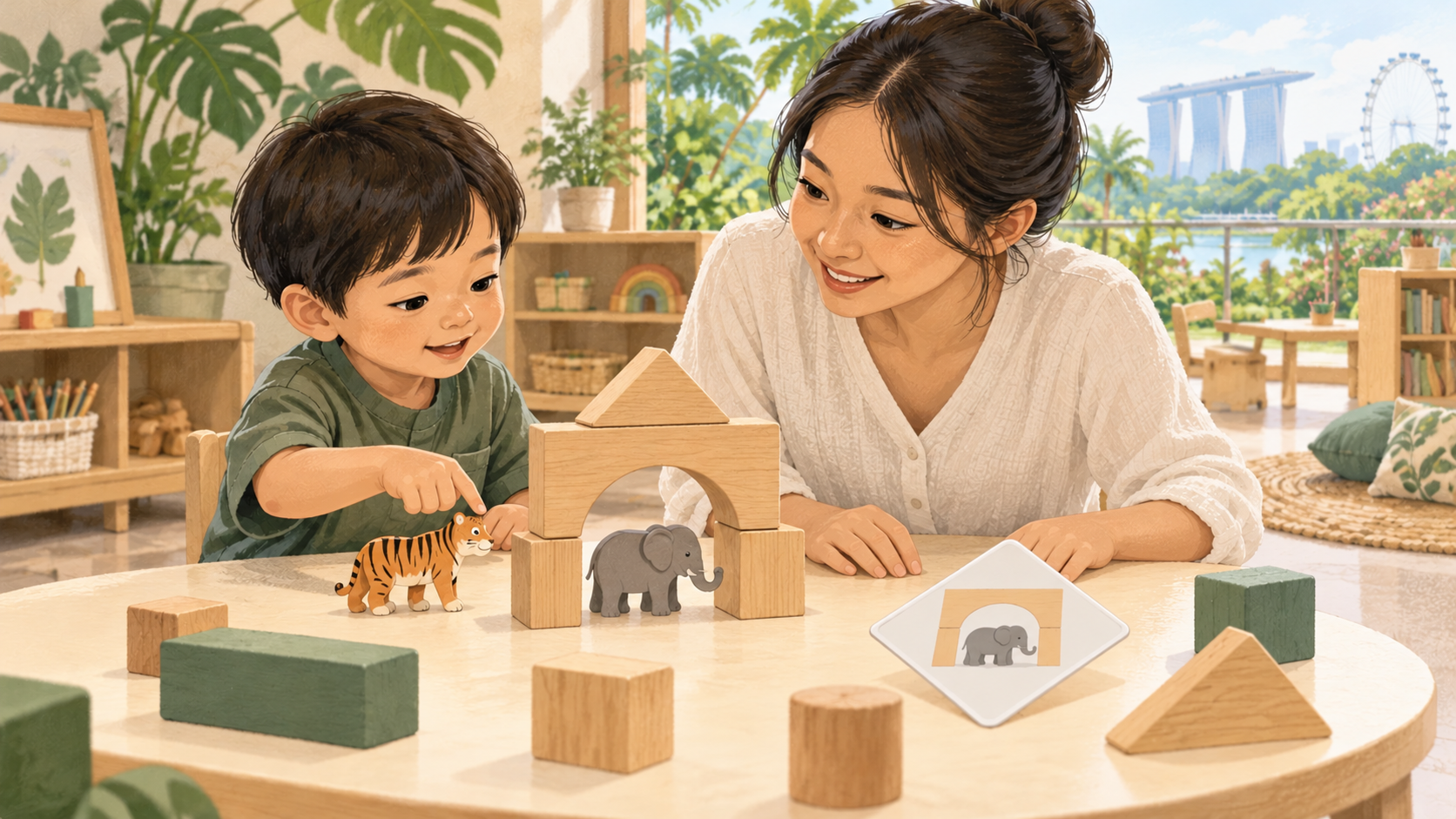
Improving children’s vocabulary through pretend play is about giving a child words they need for an imaginary purpose. At a make-believe café, they can recommend a meal, describe an ingredient, take an order or explain why something is unavailable. In a cardboard-spacecraft adventure, they might navigate, inspect, repair or investigate. The words are easier to discuss because the scene gives each one a job.
Families searching for pretend play ideas for kids, role-play activities for preschoolers or how to improve vocabulary through play can start with everyday objects already at home. This guide provides twenty distinct role-play ideas, sample parent language and a way to tell when play is actually building word knowledge. Nothing here requires a purchased playset or a formal lesson.
The point is not to make every game a grammar test. Follow the child’s imaginative direction, offer a precise word when it helps, and let the child use it naturally. Pretend play can be valuable for social interaction and storytelling in its own right; extra vocabulary is one possible benefit, not a guaranteed score.
Quick answer: how to build vocabulary with pretend play
- Ask what the child wants to pretend and what problem the characters need to solve.
- Select two useful words that fit the scenario: appointment and schedule for a pretend clinic, for example.
- Model the words inside a believable line: “Our next appointment is at three.”
- Let the child take a turn and make a decision that requires the words.
- When play finishes, invite a short retelling; try one word in another context on a different day.
Two-minute start: Put three books on a table and call it a pretend library. Say, “I want to borrow a book. Could you recommend one about animals?” Explain borrow as taking something with permission and returning it, and recommend as suggesting something for a reason. Then follow the child’s answer.
Why role-play gives words a useful purpose
Pretend play differs from a word list because the child has an imagined role, another person to communicate with and a task to complete. To be a shopkeeper, the child needs language for products, quantities, choices and payment. To be an explorer, the child needs words for directions, observation, uncertainty and safety. These relationships make it natural to ask what a word means and whether it fits.
The National Association for the Education of Young Children (NAEYC) explains that meaningful dramatic play includes choosing roles, planning a scenario and practising the speech associated with those roles. Its guidance on dramatic play and literacy also describes vocabulary and storytelling opportunities. Families can borrow the principle without copying a classroom structure.
Avoid assuming that dressing up automatically teaches a word. A child may pretend to repair a vehicle without ever hearing inspect, fault or replace. A brief, understandable adult contribution can introduce the missing language. The child then needs a chance to use the meaning rather than just mimic the adult’s sound.
Twenty pretend-play ideas with vocabulary and real scripts
Role-play 1–5: places people visit
1. A neighbourhood café. Target words: menu, ingredient, recommend, order. Adult: “I’d like to order something with fruit. What do you recommend?” Child: “I recommend banana toast.” Ask what made the choice suitable. Keep food imaginary or use safe toy items.
2. A small library. Words: borrow, return, catalogue, section. Set out a few books. Ask for a recommendation; then “return” the borrowed book. Discuss why borrowing is different from buying or keeping.
3. A grocery shop. Words: compare, quantity, receipt, substitute. Ask whether the pretend customer wants one item or several. If bananas are sold out, suggest a substitute and explain how an alternative differs from the original choice.
4. A community help desk. Words: enquire, explain, direction, available. One person asks how to reach the “museum”; the other gives directions using beside, opposite and between. Do not teach children to give real personal information to strangers.
5. A museum ticket counter. Words: exhibit, visitor, admission, guide. Make a picture exhibit with household drawings. The “guide” describes why an object is on display. A ticket is optional; the real language goal is explaining an exhibit.
Role-play 6–10: people solve problems
6. A toy repair workshop. Words: inspect, damage, repair, replace. Pretend a toy has a loose wheel. Ask, “Should we inspect it before deciding to repair or replace the part?” Avoid actual electrical tools or unsafe repairs.
7. A veterinary waiting room. Words: appointment, symptom, care, reassure. Use a stuffed animal and imaginary issues. Make clear that real illness needs appropriate adult decisions and professional help, not pretend diagnoses.
8. A building site. Words: blueprint, structure, support, sturdy. Build a safe block tower. Ask whether a wider base provides better support and what the child could adjust. Do not use construction machinery.
9. A weather station. Words: forecast, observe, estimate, warning. Make a pretend weather report. Ask what is observed today and what is a prediction for tomorrow; a forecast is not a fact about the future.
10. A rescue-plan discussion. Words: route, safe, signal, assist. Use a fictional board or toy village, not hazardous real-world tasks. The child plans how a character could get help. Explain that real emergencies require real safety procedures and trusted adults.
Role-play 11–15: stories, journeys and exploration
11. A spaceship expedition. Words: mission, navigate, destination, discover. A cardboard box becomes a spacecraft. The child explains where the crew is going and what clues might support a discovery.
12. A train station. Words: departure, arrival, platform, transfer. Arrange seats as carriages. Ask what changes when a passenger transfers. Avoid implying that all transport systems use identical terms.
13. A forest research camp. Words: habitat, track, observe, preserve. Imaginary researchers examine a picture of an animal. They can say what is visible and what remains a guess.
14. A detective office. Words: clue, suspect, evidence, conclude. Hide a harmless household object in a toy story. Ask which clue supports a conclusion. Explain that suspicion is not the same as proof.
15. A theatre rehearsal. Words: rehearse, perform, audience, improvise. Let the child change the ending of a story. Talk about how rehearsing differs from performing in front of an audience.
Role-play 16–20: families, communities and decisions
16. A birthday organiser. Words: invitation, schedule, prepare, celebrate. Pretend to organise a small party. Ask how the schedule changes if guests arrive earlier than expected.
17. A pet-care organiser. Words: routine, responsibility, gentle, provide. Use a toy animal. The child decides what the imaginary pet needs and describes a suitable routine.
18. A postal counter. Words: parcel, address, deliver, destination. Use imaginary names and addresses. Explain the difference between sending and receiving. Never share a child’s real home address in a public game or recording.
19. A family planning meeting. Words: priority, alternative, compromise, decision. Two characters want different outings. Ask how they can agree on a fair plan and which items matter most.
20. A news studio. Words: report, interview, claim, verify. The child makes a fictional report about a missing toy or a pretend festival. Clearly label imagination as pretend and distinguish it from factual reporting.
How to choose the right words inside the game
A useful word helps the characters do their task. In the café game, recommend is useful because one person needs a suggestion. In the detective game, evidence is useful because characters need to explain why they believe something. Long, rare words are not automatically better than familiar, precise ones.
Ask three questions: Does the child understand the idea? Does the word fit this scenario? Can they use the word in a different sentence? A child who hears investigate and later says “I investigated why my plant leaves were turning yellow” is beginning to transfer the idea, even if the investigation is incomplete.
Do not replace every ordinary word. A child can say “help” when that is the most natural expression. Offer assist or support when a meaningful distinction matters. For deeper comparisons, see the eduKateSG synonyms and antonyms guide.
The three-turn adult script
Turn 1: follow. Child: “This is my café. What do you want?” Adult: “I’d like a drink. What’s available?” The adult has introduced available naturally, not by demanding a definition.
Turn 2: expand. Child: “We have juice.” Adult: “Could you recommend a drink that is not too sweet? To recommend means to suggest something you think will suit someone.” The child can name a pretend drink and explain why it fits.
Turn 3: return. Later: “You recommended an orange drink. Can you recommend a book for our story time?” This changes the context and checks whether recommend has become a usable word rather than a café-only phrase.
Adjust the activity by age and readiness
Toddlers and young preschoolers: Use short make-believe routines with familiar objects and actions. A toy is sleepy, a cup is empty, a doll needs a blanket. Adults can model the words and accept gestures or single words. No formal role script is required.
Older preschoolers: Introduce two roles and a simple problem: the toy library has no animal books, so the “librarian” must suggest an alternative. Children can practise requests, explanations and short sequences with adult support.
Early primary: Add more precise role language, short written signs, prices, schedules and longer explanations. Children can negotiate and revisit a change of plan. Keep the vocabulary meaningful rather than testing fifteen new terms.
Older children: Use ethical dilemmas, evidence-based investigations and imagined organisations. A pretend journalist might need to distinguish a claim from evidence; a designer might compare two proposals. Avoid complex vocabulary that the child cannot yet define or use.
Common problems and corrections
The child only wants to repeat the same scene. Repetition is not automatically a problem. Introduce one small change—a different customer, a missing ingredient, a new destination—and offer one useful word related to the change.
The child does not want an adult to direct the game. Give back control. Join as a customer or helper rather than a lecturer. Model language in character, and stop teaching if it prevents the play from being enjoyable.
Every answer is one word. Show a natural longer response without requiring it immediately: “Juice” can become “Orange juice is available.” Later invite a choice or explanation.
Children disagree about roles. Treat the moment as a chance to practise words such as turn, agree, compromise and alternative, while keeping boundaries fair and respectful.
The child understands the role but forgets the new word. Use a simple clue, repeat the model without scolding, and revisit in another situation. The goal is meaning over time, not immediate flawless performance.
A one-week pretend-play vocabulary plan
- Monday: let the child choose a scenario and a role; model one useful verb.
- Tuesday: repeat the scenario with a new character or small problem.
- Wednesday: use the same word in an ordinary family conversation.
- Thursday: let the child explain a choice or reason in character.
- Friday: change the scenario, such as turning a café into a shop, and test a word in a new setting.
- Saturday: make a simple picture or sign for the imaginary place.
- Sunday: retell one favourite event and invite one word to be used independently.
This plan is an optional set of opportunities, not a proven seven-day learning target. Children vary in age, interest, language background and communication style. Many will prefer shorter games or repeated familiar scenarios.
Frequently asked questions
Does pretend play improve children’s vocabulary?
Pretend play offers opportunities to hear and practise words associated with roles, objects, social purposes and imagined events. Research and early-childhood guidance support rich language during meaningful play. The value depends on interactions and word meaning; dressing up alone does not guarantee a measurable vocabulary gain.
Do we need special costumes or a play kitchen?
No. Cardboard boxes, toy animals, books, simple paper signs and a child’s imagination are enough. A real conversation with two roles can be an entire activity.
Which role-play vocabulary should I teach first?
Choose words needed by the current situation. Borrow and return suit a pretend library, while inspect and repair suit a toy workshop. Teach a few clearly, then revisit them.
What if my child prefers solitary pretend play?
Solo play can still involve rich language. Follow the child’s preference and occasionally join by invitation, offering a word through a short comment rather than imposing a conversation test.
Can pretend play work in a multilingual household?
Yes. A child can express ideas in the home language and practise useful English phrases where appropriate. Rich, comfortable family communication should not be replaced by forced translations.
Next useful eduKate guides
For a broader set of short activities use 20 Easy Word Games for Kids; for language outside pretend scenes visit 30 Everyday Conversation Questions. For feelings in stories see Emotion Words for Children, and for real household action words visit Cooking and Daily Routines. Explore the Vocabulary Learning Hub and Master Vocabulary hub for the wider series. This page specifically owns the pretend-play and role-language activity bank.
Evidence and editorial note
Reference material: NAEYC: The Power of Dramatization in Kindergarten (2024); NAEYC: Dramatic Play Areas That Support Literacy Development; and NAEYC: Talking With Parents About Play and Learning. All dialogues and scenarios here are original family teaching examples; they do not replace professional advice.