
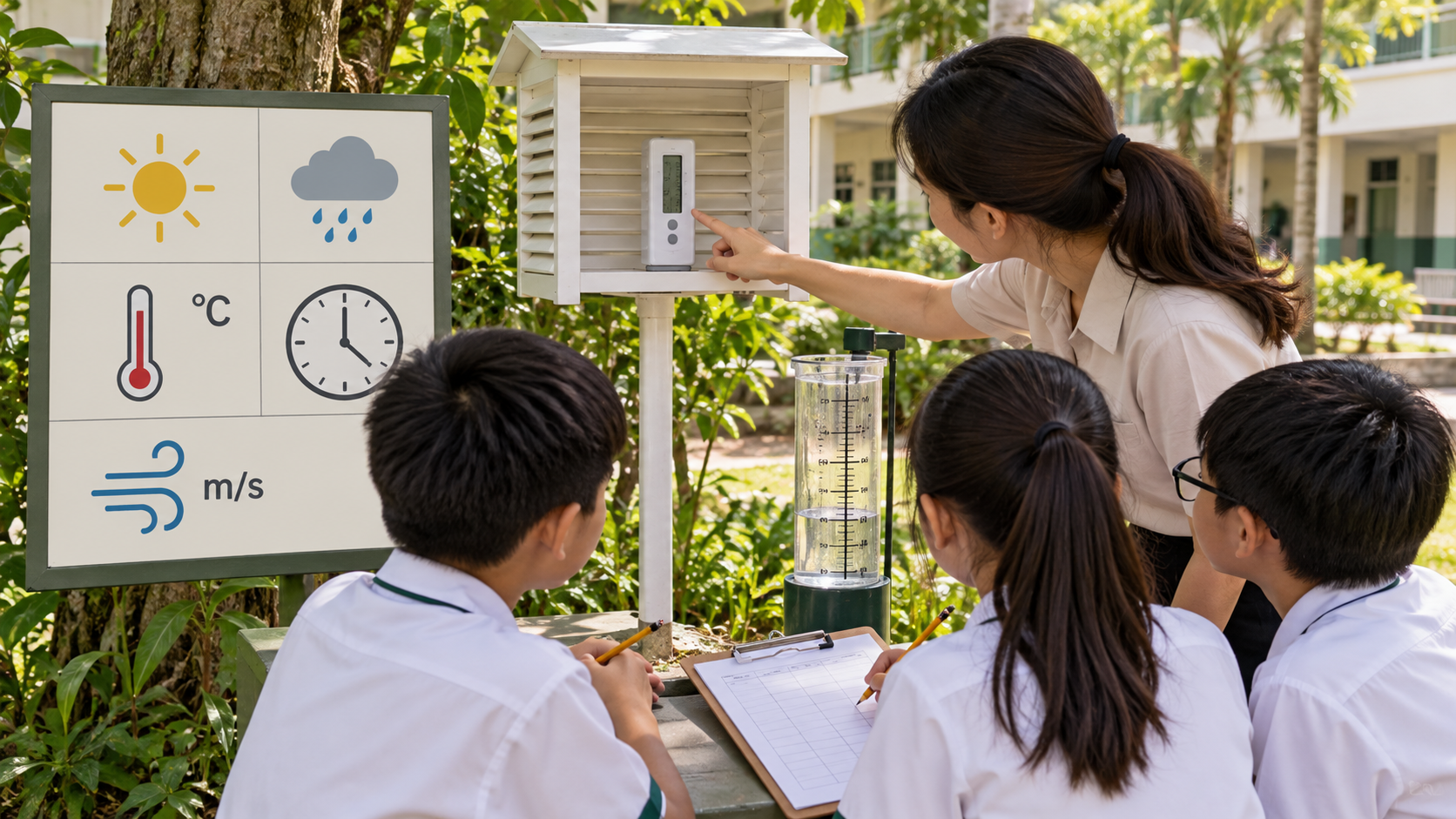
Improving children’s vocabulary with weather forecasts and climate words helps them distinguish what the sky looks like now, what a forecast predicts, and what scientists mean by long-term climate. A child who knows the word rain can learn that drizzle, showers, thunderstorm and precipitation describe different phenomena. They can also learn why a forecast is not a guarantee.
Parents searching for weather vocabulary for kids, forecast words for children, climate vs weather explained to kids or how to read weather reports can use the forty-word glossary, safe observation routines and example forecast interpretations below. The focus is clear language and evidence rather than predicting today’s weather or conducting outdoor experiments during storms.
The simplest distinction is that weather describes atmospheric conditions at a place and time, while climate describes typical patterns and their variability over much longer periods. A rainy afternoon does not, by itself, establish a climate trend. Use real current official forecasts for decisions, not an old example or a fictional weather table.
- Observe: Describe whether the sky looks cloudy, the ground is wet, or leaves are moving.
- Clarify the word: A shower is not the same weather description as steady rain in many forecasts.
- Read the forecast: Find its location, issue time, validity period and uncertainty.
- Compare: A prediction describes what may happen; an observation describes what has happened.
- Stay safe: Follow official warnings and seek safe shelter during lightning and severe weather.
- Reuse: Explain the same word in a different day, picture or nonfiction text.
Weather versus climate: the foundation
The World Meteorological Organization defines weather through short-term atmospheric elements including temperature, precipitation, pressure, wind and humidity. Climate concerns typical conditions over long periods, usually described through many years of data. Standard climatological normals are often based on thirty-year periods.
The US National Oceanic and Atmospheric Administration likewise explains that weather changes over minutes, hours and days, while climate represents long-term patterns. A child can understand this using a simple analogy: weather is one snapshot of the atmosphere; climate is the pattern seen when many snapshots are studied together.
Avoid saying climate means just the average temperature. Climate also includes variability, rainfall patterns, extremes and other conditions. A scientific claim about climate needs appropriate long-term evidence rather than a single sunny or rainy day.
Forty weather, forecast and climate words children can learn
Words 1–10: conditions we notice
| Word | Plain meaning | Example |
|---|---|---|
| weather | atmospheric conditions at a place and time | Today’s weather is cloudy and warm. |
| sunny | receiving much visible sunshine | The sky looks sunny. |
| cloudy | having a substantial amount of cloud cover | The sky became cloudy by afternoon. |
| overcast | mostly or completely covered by cloud | The sky was overcast before rain. |
| fair | generally pleasant or clear in a forecast context | The report described fair conditions. |
| drizzle | light rain consisting of small droplets | It was drizzling during the walk. |
| shower | a relatively brief episode of precipitation, often with a clear beginning and end | The forecast mentions afternoon showers. |
| thunderstorm | a storm associated with thunder and lightning | The family went indoors during the thunderstorm. |
| haze | reduced visibility due to suspended particles in air | Haze made distant buildings difficult to see. |
| visibility | how far objects can be seen under the conditions | Visibility was reduced by heavy rain. |
Terminology can depend on the issuing meteorological service. The Meteorological Service Singapore (MSS) forecast guide distinguishes rain, showers, thundery showers, fair conditions and haze. When reading local warnings, use that service’s definitions rather than assuming all countries categorise weather descriptions in exactly the same way.
Words 11–20: air and water in the atmosphere
| Word | Plain meaning | Example |
|---|---|---|
| temperature | a measure of how hot or cold something is | The air temperature is reported in degrees Celsius. |
| humidity | how much water vapour is in the air, described by a particular measure | Relative humidity can be high even when it is not raining. |
| water vapour | water in gaseous form | Air contains water vapour. |
| condensation | conversion of water vapour into liquid water | Water may condense on a cold surface. |
| evaporation | change from liquid to gas at a surface | A puddle can lose water through evaporation. |
| precipitation | water falling from the atmosphere in forms such as rain or snow | Rain is a type of precipitation. |
| wind | moving air | The wind shook the leaves. |
| breeze | a light wind | A gentle breeze moved the paper. |
| gust | a short, sudden increase in wind speed | A strong gust moved a branch. |
| atmospheric pressure | force per unit area exerted by the atmosphere | Weather instruments can measure air pressure. |
Children may say “the air is wet” when they mean humid. Explain that humidity refers to water vapour rather than necessarily showing liquid water droplets. Some technical concepts, including relative humidity and atmospheric pressure, can be introduced through trustworthy diagrams before formal calculations.
Words 21–30: forecasts, observations and uncertainty
| Word | Plain meaning | Example |
|---|---|---|
| forecast | a prediction of future weather based on available information | We checked the forecast for tomorrow. |
| prediction | a statement about what may happen | A prediction is not a guarantee. |
| observation | something measured or noticed | We observed rain at the window. |
| measurement | a measured quantity obtained with a method or instrument | The recorded temperature is a measurement. |
| probability | a way to describe how likely something is under stated conditions | A forecast may include a probability of precipitation. |
| confidence | the degree of trust in a particular prediction or estimate | Forecast confidence may vary by place or time. |
| update | a new version of information | The weather service issued an update. |
| advisory | guidance or information about a possible concern | Read the official weather advisory. |
| warning | a notice about a hazard requiring attention or action | A lightning warning may affect outdoor plans. |
| validity period | the interval of time covered by a forecast or warning | Check when the alert applies. |
A forecast percentage needs careful interpretation. It may refer to precipitation occurring under a particular official definition, place and period; it is not automatically the proportion of the day that rain will last. Read the issuing service’s explanation before claiming that “60%” means exactly what the child imagines.
Words 31–40: long-term patterns and climate
| Word | Plain meaning | Example |
|---|---|---|
| climate | typical weather conditions and variability over long periods | Singapore has a tropical climate. |
| season | a recurring part of a year with characteristic conditions or calendar meaning | Some places experience a dry season. |
| monsoon | a seasonal wind system linked to regional weather patterns | Monsoon patterns influence rainfall in parts of Asia. |
| average | a representative value calculated from a dataset by a stated method | An average helps summarise many readings. |
| normal | a standard reference for typical conditions in climatology | Climate normals are based on multi-year data. |
| trend | a general direction of change across data | A temperature trend requires many observations. |
| variability | how much conditions differ across observations or time | Rainfall varies between seasons and years. |
| extreme | an unusually large, intense or rare value or event relative to context | A very intense rainfall event may be extreme. |
| climate change | a persistent change in climate statistics over time | Climate change cannot be proved by one rainy day. |
| adaptation | changes made to prepare for or respond to conditions | Shade and drainage plans may be forms of adaptation. |
A climate trend and an ordinary sequence of weather events should not be confused. A period of cooler weather does not automatically disprove a long-term warming trend, just as one unusually hot day does not on its own prove a trend. This is a useful lesson in how evidence, time spans and descriptive words work together.
Worked example: reading a weather report
Suppose a fictional report says: “Cloudy in the morning, with thundery showers possible later in the day. Updated at 8:00 a.m.” Ask the child to find the issue time, the morning description, the later prediction and the uncertain word possible. Do not treat this fictional statement as a forecast for any actual location.
Now compare an observation. At 10:00 a.m. the child sees clouds but no rain from a safe indoor position. The observation is “It is cloudy where we are now.” The forecast is “Thundery showers may occur later.” Both can be consistent at that moment.
If the weather changes, consult the updated official forecast and warning information. Explain that forecasts are revised as more observations and models become available. A change in forecast does not automatically mean a forecaster acted irresponsibly; weather prediction involves uncertainty.
Worked example: rain, showers and thunderstorms
The child hears the words rain and showers. Explain that a forecast may use rain for persistent precipitation and showers for shorter, more localised episodes, as the MSS terminology guide describes. Thunder and lightning indicate a different safety context.
Ask whether an apparently blue patch of sky guarantees it is safe to be outdoors during thunderstorm conditions. It does not. Lightning can occur under hazardous conditions, and actual safety decisions should follow official advisories and common lightning-safety guidance.
Teach the term warning as different from a descriptive word. “Cloudy” describes conditions; a weather warning communicates a hazard and may require a change in plans. Adult decisions should prioritise safety over teaching.
Worked example: one hot day versus climate
A child says, “Today is hotter than yesterday, so the climate changed overnight.” Explain that the first clause compares two days’ weather. It does not establish a long-term climate change. Climate patterns are studied using many years of reliable observations, including temperature, rainfall and extremes.
Now show a simple fictional calendar with temperatures fluctuating across several days. Ask which values are daily weather observations. Explain that calculating a longer-term average requires more data than the short example supplies. This helps a child practise average, trend and uncertainty.
Avoid inventing actual climate statistics when no verified dataset is supplied. If the child wants to investigate a real city’s climate, use an authoritative meteorological or climate source and distinguish observed history from future projections.
Ten indoor weather vocabulary activities
- 1. Window observer: Describe safely visible cloud cover without standing outdoors in dangerous weather.
- 2. Forecast versus fact: Compare an invented forecast sentence with an imaginary observed result.
- 3. Word sort: Group drizzle, shower, gust and haze by precipitation, wind and visibility.
- 4. Weather diary: Record a few observed conditions using a simple time and place label.
- 5. Cloud caption: Describe an appropriate public weather photograph with precise words.
- 6. Time check: Look for a forecast’s validity period and update time.
- 7. Probabilities conversation: Explain that “possible” differs from “certain” without fabricating a percentage rule.
- 8. Climate versus weather: Sort example statements by single-day conditions or long-term patterns.
- 9. Advice role-play: Discuss how a family would check an official thunderstorm warning before an outing.
- 10. New-context word: Use estimate in transport or trend in a reading chart.
Questions parents can ask
- What conditions can we observe directly?
- What is the difference between an observation and a forecast?
- Which part of the report refers to the morning?
- What time was the information issued?
- Where does this forecast apply?
- Does “possible” mean guaranteed?
- Which word describes a brief increase in wind?
- What is the difference between drizzle and thundery showers?
- What does humidity measure?
- Why might a warning change our plan?
- Where can we check for an official update?
- How long does a forecast remain applicable?
- What does climate describe?
- Could a single rainy afternoon establish a climate trend?
- Why do scientists examine many years of data?
- How can we explain uncertainty honestly?
As with all vocabulary activities, a few carefully chosen questions are better than a long quiz. The child should have space to ask their own question and request clarification of unfamiliar terms.
Age and safety guidance
Preschoolers: Start with sunny, cloudy, rain, wind, hot, cool, wet and dry. Observe from a safe indoor place and use short picture comparisons.
Early primary: Add showers, drizzle, forecast, thunderstorm, temperature, humidity and warning. Distinguish present observation from a possible future event.
Older children: Introduce probability, confidence, validity period, climate, variability, monsoon and trend. Let them read simple official explanations with adult support.
Safety: Do not use thunderstorms, lightning, flash floods, unsafe heat, poor air quality or strong winds as hands-on learning opportunities. Seek suitable shelter, follow official instructions and use trustworthy current local information. A child’s vocabulary must never determine whether a hazard is safe.
A four-week weather-language progression
- Week 1 — Describe: Notice ordinary sunny, cloudy, wet, dry and breezy conditions using safe observation.
- Week 2 — Interpret: Read a simple forecast and find its location, time and uncertainty words.
- Week 3 — Explain: Compare an observation with a prediction; discuss rain, showers and warnings.
- Week 4 — Generalise: Discuss climate and long-term patterns separately from individual daily observations.
This is an optional family plan. Weather does not follow a teaching schedule, and no particular conditions should be expected or sought out to complete a lesson.
Common misunderstandings
- Calling a forecast a guarantee.
- Assuming every percentage on a weather app means the fraction of time it will rain.
- Confusing high humidity with rain already occurring.
- Treating drizzle and thunderstorm warnings as equivalent.
- Assuming one extreme weather day proves or disproves a climate trend.
- Ignoring the time or location covered by a forecast.
- Going outdoors during hazardous conditions to demonstrate a weather term.
Frequently asked questions
How is weather different from climate?
Weather describes atmospheric conditions at a particular place and time. Climate describes typical conditions and variability over much longer periods, often studied with multi-decade records.
What weather words should preschoolers learn first?
Begin with familiar observable words such as sun, rain, cloud, wind, warm, cool, wet and dry. Add drizzle and forecast when a real example makes them meaningful.
Does a forecast percentage mean it will rain for that part of the day?
Not automatically. Probability products have specific definitions that depend on the service. Check the forecast provider’s explanation of what the percentage represents.
Can children learn climate vocabulary from daily weather?
Yes, daily observations can provide a starting comparison, but climate claims require long-term information. Teach the difference rather than claiming a few days’ results represent decades.
What should a family do during a thunderstorm?
Follow local official weather-safety instructions and seek suitable shelter. Do not stand outdoors or conduct experiments for the sake of vocabulary learning.
Related eduKateSG vocabulary routes
This guide owns weather reports, forecast uncertainty and climate terminology. For nature descriptions visit 40 Outdoor Words; for reading scientific information see Nonfiction and Science Words; for interpreting everyday numerical descriptions use Measurement Vocabulary. The Weather Forecast Words companion gives a forecast-focused route, and How the Brain Builds Vocabulary explains the wider learning approach.
Sources and editorial note
Authoritative references: World Meteorological Organization: Weather; NOAA: Weather versus Climate; Meteorological Service Singapore: Weather Forecast Terminology. The glossary, example reports and family activities are original. This page is not a source of current forecasts or safety alerts.