
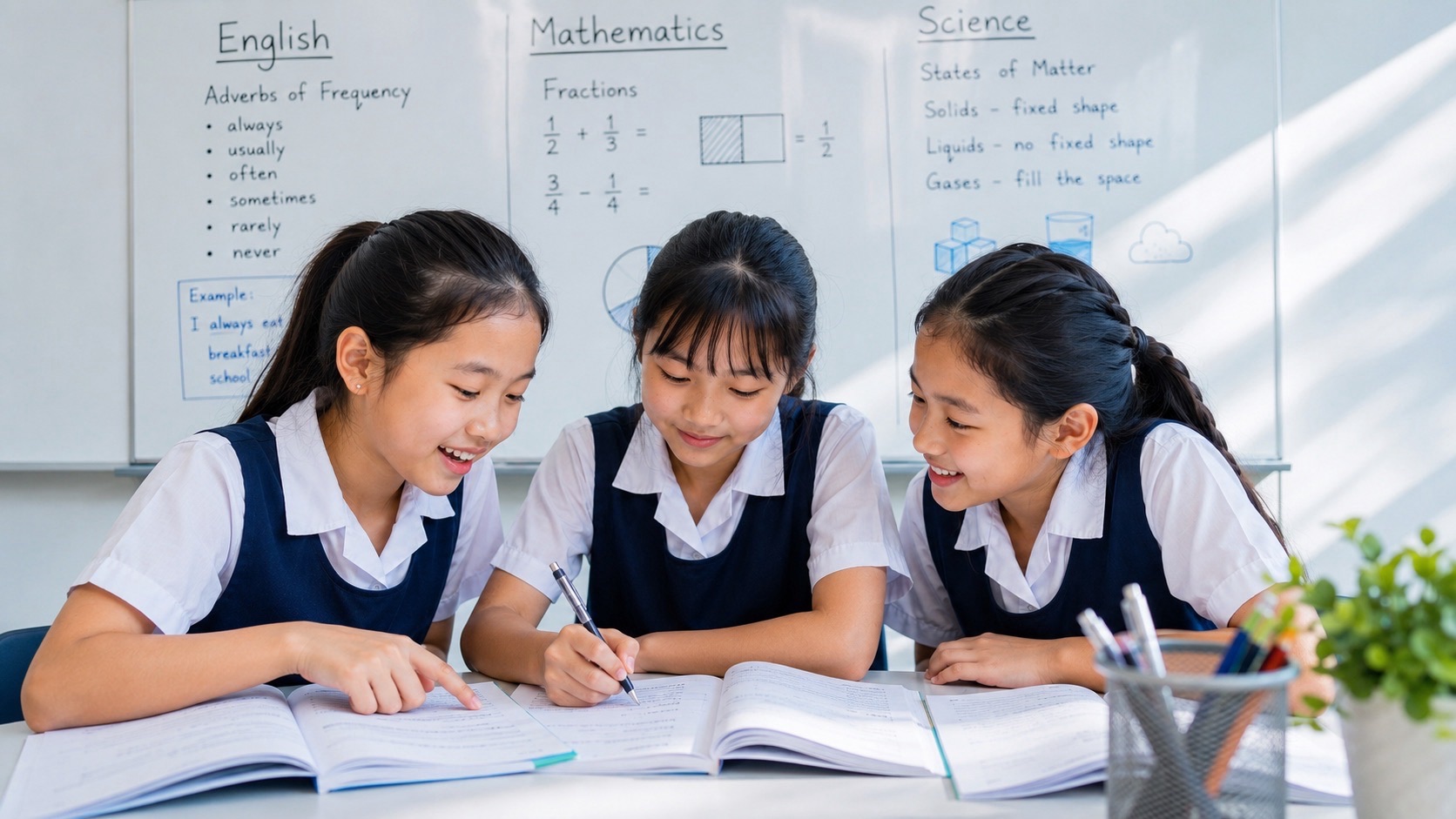
Is Canberra Primary School a good school? Yes — particularly interesting for a child who wants to explore coding and creative technology while discovering expression through musical theatre. At 21 Admiralty Drive in Sembawang, Canberra Primary’s Digital Making Applied Learning Programme has a foundation stage and a later orientation stage, guiding learners from using learning devices purposefully towards creating and communicating with digital tools. Its Musical Theatre Learning for Life Programme gives children opportunities to enjoy drama, music, dance and art. That combination can be a good fit for a curious learner with the right teaching support and family routine.
Parents searching for a Canberra Primary School review, Canberra Primary School Digital Making ALP, Canberra musical theatre LLP, Primary 1 registration Sembawang or Canberra Primary School coding and robotics can start with concrete facts. Its 14 September 2026 ALP page lists ScratchJr, drones, Micro:bit, robotics, Sphero and a recess Maker Mania activity under Tier 1, with further Scratch games, Swift app development and AI-related robotics in Tier 2. The arts LLP meanwhile provides a Graduation By Performance experience for Primary 2 and Primary 6 pupils. Distinguishing broad provision from selected extension is essential.
Did you know? Canberra’s arts programme explicitly has a three-part approach: Expose, Experience and Enrich. A pupil can first be an attentive audience member at a theatre performance, later take part in creating one and, if sufficiently interested, seek further arts enrichment. Its Canberra Young Artist’s Academy lists programmes such as Sing Canberra, Canberra’s Got Talent, The Little Composer and Visual Arts Ambassadors. These are wonderful possibilities — but the normal arts journey matters even if the child is never selected for a special showcase.
Canberra Primary School: two linked school-choice guides
Why go Canberra Primary School? — the wider school introduction. Is Canberra Primary School a good school? — specific ALP, LLP, admissions and child-fit evidence. Parents & Pathways Hub.
What parents need to know immediately
| Campus | 21 Admiralty Drive, Singapore 757714 |
|---|---|
| Applied Learning Programme | Digital Making, curiosity, computational thinking and responsible technology use |
| Foundation Stage | Start Young Start It Right — Curating My Learning |
| Orientation Stage | Orientation to My Future Learning — Ready for Tomorrow |
| Tier 1 digital activities | ScratchJr, drones, Micro:bit, robotics, Sphero and Maker Mania recess activities |
| Tier 2 digital extension | Scratch game development, Swift mobile apps and VinciBot/TEMI robotics and AI |
| Learning for Life Programme | Immersing in Canberra Experience through Musical Theatre Education |
| Arts sequence | Expose, Experience and Enrich |
| Broad arts milestone | Graduation By Performance for all P2 and P6 pupils in the school programme |
| Arts enrichment | Canberra Young Artist’s Academy, including Sing Canberra and The Little Composer |
| Official sources | Digital Making ALP · Musical Theatre LLP · School contact |
The school’s two directions might suit a child with several interests
A child may enjoy making a little character move on a screen while also loving music or pretending to be part of a story. Parents sometimes feel they must choose between a technically oriented school and an artistic one, but Canberra’s current public programmes show these interests can coexist.
The Digital Making ALP focuses on curiosity, invention, computational thinking and digital literacy. The LLP treats art, music, drama and dance as opportunities to understand emotions and diverse viewpoints. Neither programme asks an incoming Primary 1 pupil to arrive with specialist training.
The attractive possibility is a child who can experiment with tools and learn to communicate meaning. A good fit still requires clear classroom teaching and a sustainable timetable.
Did you know? The ALP has two separate developmental stages
The school names a Foundation Stage, Start Young Start It Right – Curating My Learning, and an Orientation Stage, Orientation to My Future Learning – Ready for Tomorrow. Its 2026 programme description explicitly says the first builds habits for using learning devices and coding, while the later stage uses digital production and communication as pupils prepare for future learning.
This is important because the goal for a beginner should differ from the goal for an older pupil. Early learning might involve understanding a simple sequence and how to use a device respectfully. Upper-primary work can demand a more involved digital artefact and a clearer explanation of its intended purpose.
Ask for the actual level-by-level plan and how the school recognises when a pupil is ready for more complexity. A stage name is useful only when it corresponds to teaching that builds securely from prior understanding.
ScratchJr: programming can begin with moving a character
The school lists ScratchJr under its Tier 1 activities. This visual approach to coding can let young children arrange instruction blocks and observe how a character responds.
The important learning is not the number of blocks placed on the screen. A child should be able to describe the intended result, explain the order of steps and recognise why something unexpected happened.
For families new to digital learning, this is a welcoming entry point. Ask how much guidance beginners receive and whether the lesson includes opportunities to talk, draw and reason away from the screen as well.
Micro:bit and robotics create visible cause and effect
The ALP names Micro:bit, robotics, Sphero and drones as elements of its Tier 1 programme list. They are engaging tools because instructions may lead to visible movement, lights or other responses that children can inspect.
A child who sees a robot travel in the wrong direction might discover that a command was entered out of order or a sensor was not interpreted properly. This is a chance to practise troubleshooting rather than treating the result as a mysterious machine failure.
However, the list does not establish that every P1 pupil operates each device or that all devices are available in every term. Ask about age and cohort access, safety, equipment provision and what thinking the teacher expects the student to demonstrate.
Maker Mania during recess offers another doorway
The ALP includes a Maker Mania recess activity. A short making experience can create an opportunity to test an idea without turning every part of the school day into a high-stakes assessment.
A pupil might become curious about how a structure or mechanism works, then talk to a classmate about an improvement. Good guidance can make the activity collaborative and safe.
Parents should confirm how the recess programme is supervised and whether pupils use it through rotation, sign-up or another arrangement. A public programme name does not promise unlimited access to a resource whenever a child wishes.
Tier 2 game development is a different question from basic digital literacy
The school names Scratch Game Development in its Tier 2 offerings. Making a game requires a learner to anticipate player decisions, sequence instructions, define winning or losing conditions and test whether the rules behave as expected.
That is a more complex task than trying a beginner’s ScratchJr example. It can be exciting for a child who enjoys building systems, but families should ask who qualifies and how much additional work is expected.
School admission does not guarantee selection for Tier 2. The broad Tier 1 should remain a worthwhile experience even if the child chooses to pursue music, sports or another activity instead.
Swift mobile app development: the value is in thinking about the user
Tier 2 also names mobile app development using Swift. An app only makes sense when it answers a real need. The pupil has to consider who will use it, what information should appear and how someone would know the next step.
That introduces communication, design and decision-making alongside programming syntax or tools. A technically correct app may still be confusing to another person.
Parents should ask whether students test their work with others and describe improvements, rather than counting the number of screens or functions created. As with all selected activities, actual access, timetable and tools require confirmation.
AI with VinciBot and TEMI: age-appropriate scepticism matters
Canberra’s September 2026 ALP page explicitly lists robotics and Artificial Intelligence with VinciBot and TEMI in Tier 2. It is a distinctive enrichment direction, but the name AI should not be taken as a promise that every primary pupil trains sophisticated models or uses unrestricted chatbots.
The useful educational question is whether a learner understands what the system does, what it cannot reliably infer and why an output must sometimes be checked by a person. Confidence with technology should include the capacity to recognise uncertainty.
Ask what the actual activities entail, how digital safety is addressed and which students can participate. Good education about modern tools makes them understandable, not magical.
Digital literacy should include responsibility and limits
The school says its ALP teaches habits and values around learning devices. Children need to know how to use a shared tool, handle information respectfully and seek assistance when they encounter inappropriate or confusing material.
A child can move around a screen with great confidence and still struggle to recognise whether an online explanation is correct. Responsible literacy includes checking sources and not spreading uncertain material as fact.
Ask how parents are informed about accounts, privacy, device expectations and safe practice at home. The strongest school-home approach is consistent, age-appropriate guidance rather than an unexamined increase in screen time.
The LLP makes theatre a learning experience, not a talent contest
Canberra’s musical theatre programme uses music, dance, drama and art to help pupils interpret emotions, explore different perspectives and develop self-expression. Its September 2026 page calls the approach Expose, Experience and Enrich.
Exposure may involve attending or watching a theatre performance; experience involves taking part in suitable artistic activity; enrichment gives interested learners opportunities to go further.
The school describes aspirations of creativity, empathy and collaboration. These are intended outcomes, not proof that every child will feel confident immediately. A parent should ask how beginners and shy pupils receive a manageable first role.
Why seeing a theatre production as an audience member matters
A child watching a theatrical work has opportunities to notice tone, gesture, character motivation and how music changes an audience’s understanding of a scene.
The artistic experience can also create questions about people whose lives or perspectives differ from the child’s own. The adult’s role is to help learners discuss their interpretation respectfully and support it with details from the production.
Ask how the school prepares pupils for theatre exposure and what reflection follows. Watching something entertaining becomes deeper education when the child understands the choices made by performers and creators.
The unusual fact: Graduation By Performance at P2 and P6
Canberra’s LLP page explicitly identifies Graduation By Performance for all Primary 2 and Primary 6 pupils, marking important learning transitions. It aims to strengthen class relationships and allow students to experience a collaborative production.
A Primary 2 class preparing a simple shared presentation faces a different challenge from a P6 cohort able to coordinate more complex roles and communicate deeper ideas. Each level can be meaningful in its own way.
Parents should ask what the current event requires, how the work is shared and how a child who feels anxious about performing is supported. A schoolwide milestone does not mean every child has to be a solo performer or be given the same stage role.
Young Artist’s Academy: the extra arts path is not universal
Canberra Young Artist’s Academy names Sing Canberra, Canberra’s Got Talent, The Little Composer and Visual Arts Ambassadors. These are opportunities for pupils with a developing interest or talent to explore a creative field more deeply.
They are different from the general arts programme and the broad P2/P6 graduation experiences. A family should not choose the school because it assumes a future Academy appointment or competition appearance.
Ask what is part of class education, what requires registration or selection, and what additional rehearsals might mean for home schedules. A child who never enters a talent pathway can still have a valuable arts education.
Technology and musical theatre can both improve communication
A digital application and a musical scene are very different products, but both have an audience. A pupil must decide what the audience needs to know and what sequence of actions or images communicates it.
There is also a shared habit of revision. A program may fail to perform as intended; a scene may fail to convey a character’s feeling. In each case, the learner can identify the cause and change the work.
This is an educational interpretation of Canberra’s two programmes, not a claim that every digital ALP class formally connects with the LLP. Ask staff for actual examples of collaboration between the strands when that matters to your child’s interests.
What if the child loves coding but needs reading support?
An enthusiastic young maker can still misunderstand the words in a task. Another pupil might be expressive on stage but struggle to recognise the quantities in a Mathematics problem. Children rarely develop every skill at precisely the same rate.
Parents can ask whether a particular learning difficulty comes from a missing concept, reading fluency, vocabulary, weak representation or difficulty following multiple instructions. Those require different responses.
Good learning continuity begins with understanding where the connection breaks. The teacher can then explain the missing part, give manageable practice and check whether the learner can transfer the understanding. Neither robotics nor theatre automatically substitutes for that foundational work.
The Admiralty Drive journey deserves a trial
The official current school address is 21 Admiralty Drive, Singapore 757714. Families should not confuse Canberra Primary School with Canberra Secondary School, or assume that a school carrying the Canberra name is located next to every nearby residential project.
Try the normal weekday route with the child’s walking pace, gates, weather and transport in mind. If a child later joins a technology or arts extension, ask whether its timing changes the pickup plan.
A well-designed routine protects time for food, sleep, friends and play. The most impressive programme will be less useful to a child who arrives exhausted each day.
Who should shortlist Canberra — and who should compare?
It belongs on the shortlist for a child who enjoys machines, coding, music, drama or a combination of these, and for families interested in a coherent progression from early digital habits towards more independent work.
Compare alternatives when individual academic or wellbeing support is uncertain, when the journey is impractical or when access to Tier 2 AI robotics or a selected arts academy is the entire reason for choosing the school.
A good-fitting school allows a child to participate in the ordinary programme, make mistakes, receive useful instruction and grow into greater confidence at their own pace.
Five useful questions for Canberra Primary
- What does the Foundation Stage mean for an ordinary P1 student, and which digital devices does that year group actually use?
- Which Tier 1 coding and Maker Mania opportunities reach every pupil, and how are Tier 2 places allocated?
- How does the school teach children to question the reliability and safety of digital or AI-assisted outputs?
- How does Graduation By Performance work for P2 and P6, including a child who needs a smaller stage role?
- How do teachers respond when a curious digital maker has a specific English or Mathematics learning gap?
P1 admission remains separate from programme enthusiasm
Check the child’s registration year, citizenship, eligible phase and recognised home address through MOE’s P1 registration phases and dates. Historical balloting records show demand in a particular exercise, not teaching quality or a guaranteed future place.
For entry in 2028, MOE has announced changes applying to the 2027 registration exercise. Use the current official framework and check whether any designated-school arrangements apply. The presence of an interesting programme does not change eligibility.
The Canberra Primary School verdict
Yes — Canberra Primary can be a very good fit for a child who is ready to explore creative technology and musical theatre. Its published two-stage ALP, clear Tier 1/Tier 2 distinction and P2/P6 performance milestones provide concrete reasons to investigate.
The right choice is the one where the learner’s interests, the school’s patient teaching and the family’s everyday arrangements reinforce one another. A good school is a good-fitting school.
Quick parent answers
Where is Canberra Primary School? 21 Admiralty Drive, Singapore 757714.
Does every child receive every robotics or AI programme? No. The school publishes separate Tier 1 digital experiences and Tier 2 extension.
What is the arts LLP? Musical Theatre Education, with Expose, Experience and Enrich, including Graduation By Performance for P2 and P6.
Sources and editorial evidence boundaries
Reviewed 10 October 2026 against school ALP, LLP and contact pages updated in September 2026. Specific digital devices and selected enrichment places may vary by cohort. General arts participation is distinct from Academy selection. Independent eduKate parent guidance, not an official school ranking, endorsement or admission guarantee.