
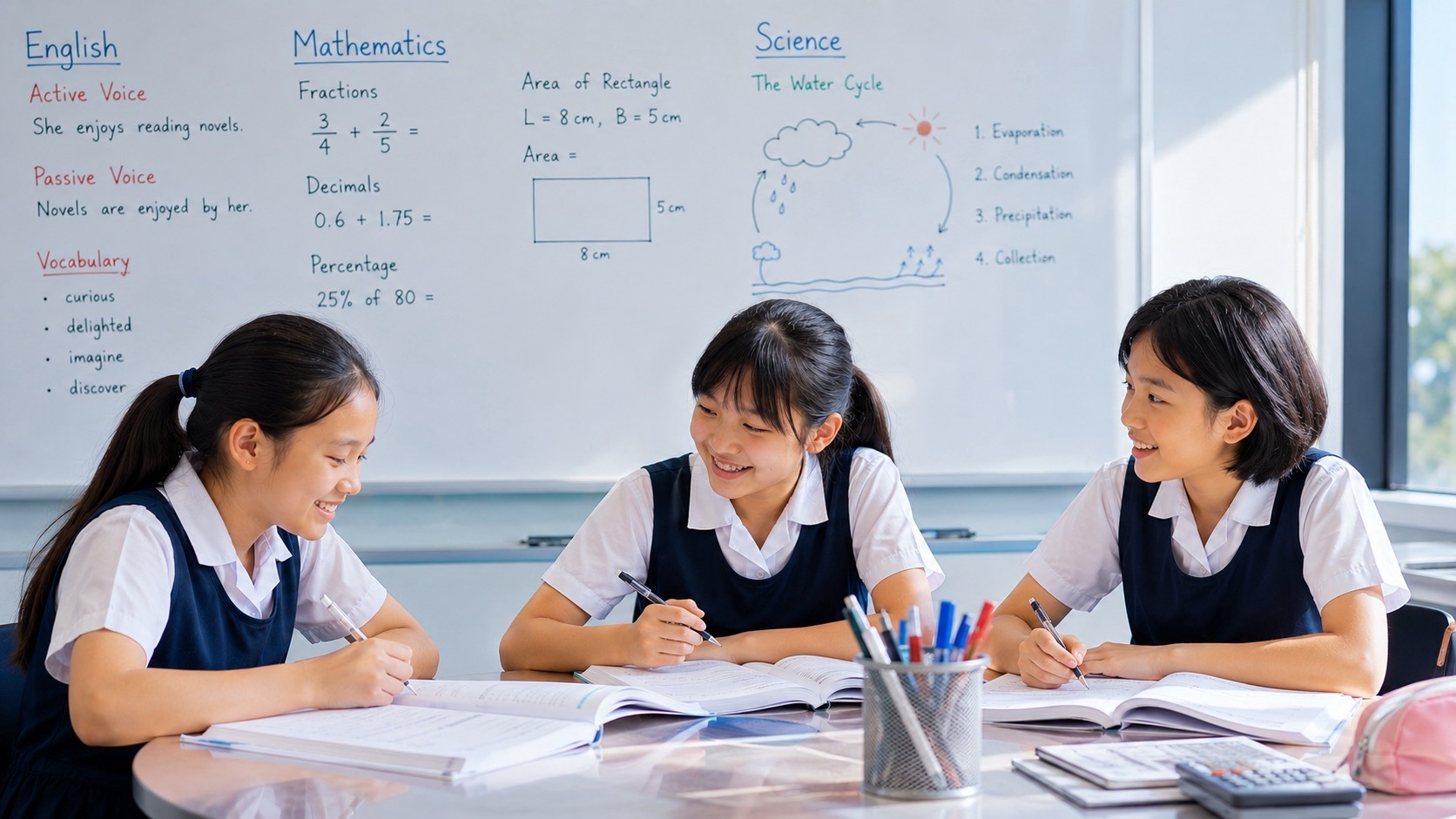
Is Zhenghua Primary School a good school? Yes — it is a particularly interesting choice for a child who loves nature, drawing, music or making ideas understandable to other people. At 9 Fajar Road in Bukit Panjang, Zhenghua Primary School combines an Applied Learning Programme for Advocates and Innovators for Sustainable Living with Creative Arts@Zhenghua, a Learning for Life Programme bringing music, visual art, dance and drama into a six-year journey. Its schoolwide sustainability experiences and progressive arts curriculum give families two concrete reasons to investigate the fit.
Parents researching a Zhenghua Primary School review, Zhenghua Primary School ALP, Creative Arts@Zhenghua LLP, Primary 1 registration Bukit Panjang or primary school near Fajar LRT should begin with facts. The school’s July 2026 ALP moves from Clean SG in lower primary to Green SG in middle primary and Future Dream SG in upper primary. Its LLP has a detailed progression, from P1 percussion to P3 keyboard, P4 recorder, P5 ukulele and P6 ensemble music. That sequence is much more informative than a vague label of “well-rounded education.”
Did you know? Zhenghua’s Primary 4 arts curriculum includes Interdisciplinary Museum-Based Learning with National Gallery Singapore, connecting art with English, Social Studies, Character and Citizenship Education and Malay Language. Its sustainability ALP asks pupils to express ideas through creative arts and technology. The interesting possibility is a child who can observe an environmental issue, think about who is affected and then explain a solution through a drawing, model, performance or clear argument.
Zhenghua Primary School: two companion guides to fit
Why go Zhenghua Primary School? — discover its fuller school journey. Is Zhenghua Primary School a good school? — current programme evidence and a child-first decision guide. Parents & Pathways Hub.
At a glance: Zhenghua’s distinctive reasons to shortlist
| Campus | 9 Fajar Road, Singapore 679002 |
|---|---|
| Applied Learning Programme | Advocates and Innovators for Sustainable Living |
| Schoolwide ALP progression | Lower primary: Clean SG; middle primary: Green SG; upper primary: Future Dream SG |
| Design process | Observe with empathy, define a need, generate possibilities, prototype and test an improvement |
| Making resource | T(h)inker Space for selected ALP activities; access and scheduling vary |
| ALP Tier 2 | Greenovation Club — selected/interested pupils seeking additional sustainability making and advocacy |
| Learning for Life Programme | Creative Arts@Zhenghua: music, visual art, dance, drama and cultural appreciation |
| Music sequence | P1 unpitched percussion; P2 resonator bars; P3 keyboard; P4 recorder; P5 ukulele; P6 carousel/ensemble |
| Art examples | P3 batik; P4 National Gallery museum-based learning; P5 ceramics; P6 digital art on social issues |
| Arts Tier 2 | P2 Music, Art & Dance enrichment; subsequent art and performing arts CCAs |
| School-linked preschool | MOE Kindergarten @ Zhenghua, with separate admissions |
| Official references | ALP · Creative Arts LLP · Contact |
The reason to consider Zhenghua is a conversation, not a ranking
Imagine a child who becomes concerned after seeing rubbish in a park. One school could ask for a colourful poster. Another might guide pupils to investigate where the rubbish comes from, consider different people’s habits and develop a practical response they can explain.
Zhenghua’s Applied Learning Programme explicitly aims for the second kind of thinking. It uses interdisciplinary inquiry and a design process around sustainable living in home, school and community contexts. The programme is not described as an isolated coding class; its purpose is to make the learner an informed, responsible advocate or innovator.
The Creative Arts LLP then supplies several forms of expression. A child who prefers drawing to formal speech may have meaningful ways to participate. The fit question is whether teachers help the learner connect real understanding with the medium they choose.
Did you know? Its sustainability themes grow with the child’s age
The school’s 24 July 2026 ALP sets out a schoolwide progression: Clean SG for lower primary, Green SG for middle primary and Future Dream SG for upper primary. This gives families a clear way to discuss the learning trajectory across six years.
For a young child, keeping an environment clean is familiar enough to notice and talk about. By middle primary, environmental relationships may invite more detailed observations and questions. Upper-primary work can move towards imagining and evaluating future solutions.
These themes are programme directions rather than guaranteed identical activities for every coming year. Ask for the actual current cohort’s tasks and how teachers connect the stages. A good progression should preserve what children have learned while making new challenges possible.
Empathy is supposed to come before the invention
Zhenghua’s ALP uses a Design Thinking sequence of empathising, defining, ideating, prototyping and testing. Its official description says children begin by observing how other people interact with their surroundings.
This is a significant detail. A pupil should not simply invent an object because it looks exciting. They first need to know whose problem it addresses, what the person actually needs and how the first idea might fail.
Parents can ask for a case where a pupil altered a proposal after learning something about its intended user. That ability to revise a belief is a more useful marker of intellectual growth than one perfect final display.
The T(h)inker Space is an opportunity, not the entire school
The ALP describes a T(h)inker Space equipped with tools and materials for selected learning activities. It is intended as a place where children first think collaboratively and then tinker with their ideas through practical experimentation.
A pupil may imagine a solution before having the skills to build it. With guidance, they can discover what materials will work and what limitations require a change. The movement from thinking to testing is the educational value.
Ask which pupils use the space, how safety is taught and whether the current level can access the resources. A school should not be judged solely by the sophistication of its making room. The classroom reasoning behind the work matters more.
A picture, a model or a journal can still contain serious thinking
Zhenghua’s programme examples include dioramas, recycled-material creations and journals. These are sensible forms for children who cannot yet produce long formal explanations.
A young learner may notice a pattern in what is wasted and describe the observation through a drawing. An older learner can support a claim with measurements and explain how an improvement was tested. The representation becomes more demanding as the child matures.
Ask whether the artwork or model is used as evidence of an idea, not merely as attractive decoration. A creative format should make thinking easier to understand, while factual claims still need to be checked.
The Greenovation Club is a distinct Tier 2 opportunity
The school’s ALP explicitly names a Greenovation Club founded in 2022 for pupils who want to deepen environmental advocacy and making. The page describes participation in competitions, showcases and additional STEM activities.
It is important to distinguish this from the schoolwide Clean SG, Green SG and Future Dream SG themes. A pupil can benefit from the core ALP without joining a specialised club or representing the school in competition.
If your child has a strong technical interest, ask about year eligibility, recruitment, training time and available places. A parent should never assume selection or a future award is guaranteed by admission to the school.
Creative Arts@Zhenghua has a genuinely broad curriculum
The LLP is structured around music, visual art, dance and drama, with a published table describing the broad-based Tier 1 experience at each primary level. It also specifies further Tier 2 arts talent development.
For a child whose interests are still forming, this breadth can be appealing. The school does not expect a P1 pupil to declare whether they will become a musician, dancer or visual artist. Children encounter different forms and cultures as they grow.
The critical question is what each pupil can access and how teachers support the beginner. A programme can be rich and still require clarification about a child’s sensory, motor, language or wellbeing needs.
Music begins with percussion and builds towards ensembles
The school’s July 2026 music curriculum identifies unpitched percussion in P1, resonator bars in P2, keyboard in P3, recorder in P4 and ukulele in P5. P6 revisits instruments through a Music Carousel and ensemble work.
This sequence gives a child a chance to experience rhythm, pitch, melody and group coordination through different instruments rather than being judged on whether they already take outside music lessons.
A parent might ask what a pupil does after a missed beat or an incorrect note. Can they identify the mistake, hear a demonstration and practise the smaller part that needs attention? Musical confidence grows through the same careful feedback that helps other subjects.
Each year brings a cultural music focus
Zhenghua’s published arts framework connects levels with different regions and traditions, including Western music in P1, Chinese in P2, Malay in P3, Indian in P4, Polynesian/Oceanian in P5 and Japanese/Korean in P6.
This can help children discover that music is not only entertainment. It can express memory, community, ceremony and identity. Understanding its cultural setting may also help pupils listen more thoughtfully to unfamiliar sounds.
Ask how teachers teach respectful appreciation of traditions and whether a child can explain what distinguishes the instruments and contexts they have encountered. The value lies in learning about people, not simply sampling exotic sounds.
P3 batik and P4 museum learning provide specific examples
The LLP’s arts table identifies P3 batik and a museum-based experience at NUS Baba House. P4 Interdisciplinary Museum-Based Learning uses artworks from National Gallery Singapore to connect with other subjects.
A child viewing a painting can ask who made it, what it reveals about a time or community and why different viewers interpret it differently. Art becomes a reason to practise observation and explanation, not only a subject where the child produces a finished object.
Museum destinations and programme arrangements can change. Ask for the current cohort’s learning objectives, transport and participation details before treating an older illustration as a future guaranteed trip.
Did you know? Art and sustainability already intersect in the curriculum
The school’s official art page describes a P3 Applied Learning Programme in which pupils create artworks about water conservation, connecting Social Studies content with creative advocacy.
This is an unusually concrete bridge between the two signature programmes. The pupil first needs to understand the issue and what audience the message is intended to reach. Art then helps communicate the idea with appropriate choices of form, material and symbol.
The challenge is not simply to make the strongest warning poster. A thoughtful design should be accurate, age-appropriate and clear to the person who sees it. Ask how the teacher reviews both message and evidence.
P5 ceramics and P6 digital art widen the ways a child can express a view
The school identifies ceramics at P5 and exploration of social issues through digital art at P6. These are different media with distinct learning demands. Ceramics involves form, materials and process; digital art adds opportunities to organise visual information and make revisions.
A child may discover a strength in one form and find another frustrating. Both can offer a useful challenge when the teacher provides small, clear steps and allows learners to reflect on what they want to express.
The school also describes enrichment for selected budding artists. Families should distinguish the broad level programme from optional or selective talent development.
Why drama matters to a child who does not want a stage role
Drama is included across the LLP’s level-based table, sometimes through English, Mother Tongue or Social Studies. A dramatic situation invites a pupil to interpret motives, consider a perspective and practise expressive communication.
For a reserved child, partner dialogue or reading with a group can be a manageable way to begin. For an outgoing child, the important lesson may be listening and not dominating the task.
Ask how teachers support pupils whose oral fluency or reading differs from classmates. A rich drama programme should not confuse loudness with understanding or public performance with every learner’s contribution.
P2 Music, Art and Dance enrichment is selective
The school lists a Music, Art & Dance (MAD) Enrichment Programme in its Tier 2 pathway at P2, with further opportunities through CCAs such as Brass Band, choir, dance and Talent Art later.
That is an interesting option for a child who displays early interest, but it is not an automatic entitlement. The core programme already exposes all pupils to arts; the additional path has different eligibility and commitments.
Parents should ask how pupils are considered for enrichment, what happens if a child is not selected and how a developing interest can be encouraged through ordinary classes. School goodness is not a competition for the earliest talent label.
What about English, Mathematics and PSLE?
A child who performs confidently may still struggle to interpret a reading question. Another may love a sustainability project yet become confused by fractions or measurement. Different domains reveal different strengths.
Ask how teachers identify the precise issue. Did the pupil misread a term, confuse an operation, lack a prerequisite or need a clearer representation? A general grade is too compressed to show the whole skill profile.
The best-fit school repairs those gaps while keeping curiosity alive. The arts and ALP offer meaningful applications, but they cannot replace sound instruction and enough practice in English, Mother Tongue, Mathematics and Science.
A family in Bukit Panjang should test the Fajar Road route
The official campus is 9 Fajar Road, Singapore 679002. The same address is used for MOE Kindergarten @ Zhenghua, but the preschool and primary school have separate administrative arrangements.
Test the journey at the correct time, including rain, traffic, crossings and the actual entrance. If a family relies on student care or siblings at different levels, ask about pickup and after-school commitments before deciding.
The school’s public contact page lists general-office hours, not a uniform pupil timetable. A manageable day leaves children energy for thinking, music, reading and rest.
Who should shortlist Zhenghua?
Shortlist Zhenghua when your child is curious about sustainability, likes art and music, or may benefit from learning to express an idea in more than one way. It is especially interesting when the family values arts appreciation across cultures rather than specialising too early.
Compare alternatives if the daily route is difficult, the child needs support that has not been confirmed or the whole decision rests on access to the selected Greenovation Club or arts talent pathway.
A school can be genuinely strong without being best for every child. The worthwhile test is whether this particular learner can be guided from their starting point towards clearer thinking, better communication and a balanced school life.
Five useful questions to ask Zhenghua Primary
- How do Clean SG, Green SG and Future Dream SG progress across primary levels, and what would a typical P1 student actually do?
- Can we see an ALP project where a pupil revised their idea after learning about another person’s needs?
- How are P3 batik and P4 National Gallery learning connected with English, Social Studies or Science?
- Which arts experiences are Tier 1 for all, and which Greenovation or MAD opportunities require selection?
- How are a child’s learning gaps identified and reviewed as the artistic and academic tasks become more complex?
P1 registration: a shared campus does not decide eligibility
Primary 1 registration depends on the child’s year, eligible phase, citizenship and officially recognised address. Use MOE’s current registration guidance and past vacancy and ballot data for the correct exercise.
For P1 entry in 2028, MOE has announced changes to the 2027 registration exercise. Consult the updated rules and apply any special scheme only where MOE specifies. Older admissions and school-programme popularity do not guarantee a future place.
The Zhenghua Primary School verdict
Yes — Zhenghua Primary can be an excellent match for a child who wants to explore sustainability and learn to express ideas creatively. Its published schoolwide ALP progression and unusually detailed Creative Arts curriculum give families concrete reasons to investigate.
Choose based on the child’s actual learning, the programme access they can expect, the support available when concepts are difficult and the everyday journey. A good school is a good-fitting school.
Quick parent answers
Where is Zhenghua Primary School? 9 Fajar Road, Singapore 679002.
What is its ALP? Advocates and Innovators for Sustainable Living, with Clean SG, Green SG and Future Dream SG themes.
What is Creative Arts@Zhenghua? The school LLP offering music, visual art, dance and drama across six years, with additional selective talent pathways.
Sources and editorial boundaries
School webpages last updated in July 2026 checked 10 October 2026. Pupil work, destinations and extracurricular opportunities are subject to current cohort arrangements; the schoolwide ALP is not identical to Tier 2 Greenovation. This is independent eduKate guidance, not a school ranking, endorsement or P1 admission guarantee.