
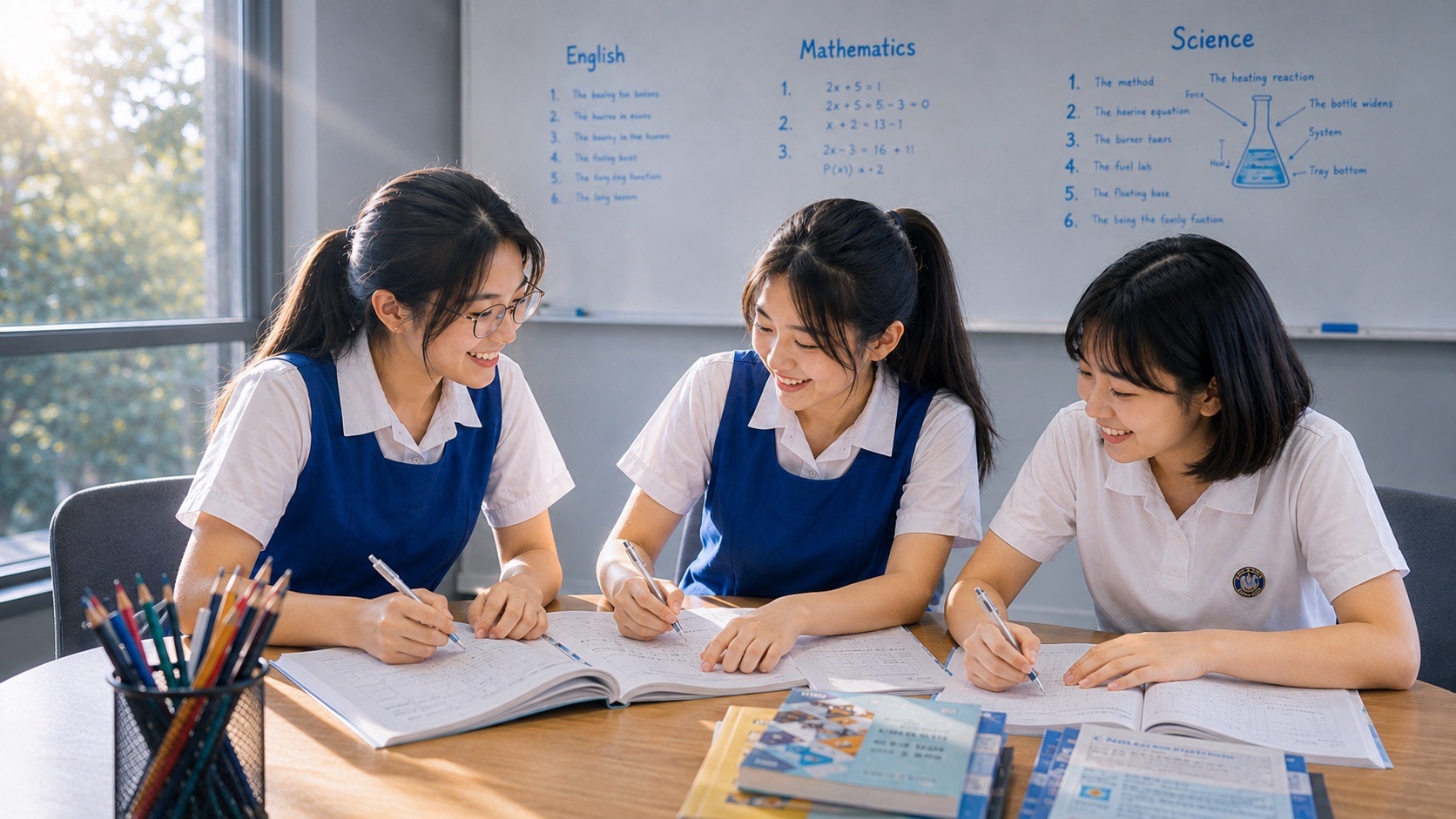
JC1 Chemistry tuition in Changi may be useful when a student can quote a Chemistry rule but cannot decide which conditions make that rule valid. A carefully managed group of three gives the tutor a chance to see how each learner reads the chemical system, chooses a model and justifies the result. Start with the registered H1 Chemistry 8873 or H2 Chemistry 9476 subject, the college’s topic sequence and one uncorrected question.
This Changi article is an information guide, not confirmation that eduKate has a JC1 Chemistry centre, live class, tutor or vacancy in Changi. eduKate’s established small-group teaching locations include Punggol and Bukit Timah. Confirm the actual venue, named tutor, class composition, fee and schedule before planning a journey. Do not assume an estate title proves that lessons are held there.
- Confirm the exact H1/H2 route and examination-year syllabus.
- Bring an uncorrected gas or equilibrium question to identify the first wrong assumption.
- Ask how each learner in a three-student group is tested independently.
- Check that practical-data support is not misrepresented as hands-on laboratory training.
- Review learning transfer and total travel time after four weeks.
Changi students: a formula is only useful after the conditions are read
Gas questions can appear routine because students recognise pV = nRT. The difficulty is often deciding whether the ideal-gas model is appropriate, converting units correctly and identifying which quantities remain constant. A learner who substitutes numbers before understanding the stated conditions may produce a tidy answer that does not describe the system.
Suppose a problem gives pressure 1.00 × 10⁵ Pa, volume 1.50 × 10⁻³ m³ and temperature 300 K. Using R = 8.31 J mol⁻¹ K⁻¹, n = pV/RT ≈ 0.0602 mol. If volume had been supplied as 1.50 dm³, it would need to be converted to 1.50 × 10⁻³ m³ for this version of the gas constant. Mixing units can shift the answer by a factor of one thousand.
The learner should also identify the fixed quantities before making a prediction. For a fixed amount of ideal gas at constant pressure, volume is proportional to absolute temperature. If the volume is fixed, pressure is proportional to absolute temperature. The same equation supports different relationships because the experimental constraints differ.
Real gases may deviate from ideal behaviour under conditions where molecular size and intermolecular interactions matter. But students should not introduce corrections when the question explicitly instructs them to assume ideal behaviour. A good answer follows the stated model and recognises its limits.
Worked comparison: pressure change and the number of gas particles
Consider H₂(g) + I₂(g) ⇌ 2HI(g). There are two moles of gaseous reactants and two moles of gaseous products for the equation as written. Under the simple equilibrium model, a volume change at constant temperature does not favour one side merely because of a difference in total gaseous stoichiometric amount; there is no such difference in this equation.
Now compare N₂O₄(g) ⇌ 2NO₂(g). The product side has more gaseous particles. Compression at constant temperature tends to favour the side with fewer gaseous moles, N₂O₄, under the idealised model. The equilibrium composition changes, but the value of K at that temperature does not change simply because volume changed.
Students sometimes memorise “high pressure favours products.” That shortcut is unreliable. The student must first count gaseous coefficients on both sides and identify which side has fewer particles. A tutor should make the learner annotate the balanced equation before predicting a shift.
A three-student tutorial can assign equation analysis, particle counting and equilibrium reasoning to separate learners. Rotate roles and give each student a new equation with different coefficients. The independent result should state the condition being held constant and avoid treating the rule as universal without qualification.
Temperature and equilibrium constant: a different kind of change
Changing concentration or volume at fixed temperature can alter the equilibrium composition as the system responds, but does not by itself change the equilibrium constant for that reaction at that temperature. Temperature is different because it changes the thermodynamic balance between forward and reverse processes. The direction of the shift depends on whether the forward reaction is exothermic or endothermic.
For an exothermic forward reaction, increasing temperature tends to favour the endothermic reverse direction. For an endothermic forward reaction, the prediction reverses. A learner who writes “higher temperature shifts equilibrium left” for every reaction has memorised one example rather than understood the sign of reaction enthalpy.
Rates also change with temperature. Both forward and reverse reaction rates generally increase as temperature rises, but the final equilibrium composition is determined by the equilibrium thermodynamics. A question about how quickly equilibrium is established is not the same as a question about the final equilibrium yield.
The tutor should separate the four ideas: concentration disturbance, pressure or volume disturbance, temperature change and catalyst effect. A catalyst changes rates of approach but not K at a fixed temperature. A changed question should ask the student to identify which of these applies before writing a prediction.
Worked clinic: read a concentration-time graph correctly
Imagine a fictional graph in which reactant concentration decreases while product concentration rises, and both become constant after a period. This is consistent with the system reaching dynamic equilibrium if the system is closed and the model applies. It does not mean forward and reverse reactions stop. At equilibrium their rates are equal, while the concentrations remain constant macroscopically.
A flat line does not mean that the concentration is zero. It means the plotted value is no longer changing appreciably over the displayed interval. Nor does the graph prove that reactant and product concentrations are equal. Their values depend on the system and its equilibrium constant.
The student should first state what the graph directly shows, then explain the equilibrium interpretation. Avoid inventing a microscopic mechanism from a flat line alone. Additional information may be needed to identify the species or determine K.
A good group exercise asks one learner to describe the axes, another to identify the trend and a third to explain dynamic equilibrium. Roles rotate and each completes a new graph independently. This makes graph interpretation a transferable skill rather than a memorised paragraph.
Wider connection: why operating conditions involve trade-offs
The same reasoning appears in industrial chemical processes. A company may need to balance reaction rate, equilibrium composition, energy use, equipment limitations, separation and safety. A single statement such as “high pressure gives more product” is rarely a complete description of an operating choice. The optimum condition depends on the process and its economic and engineering constraints.
Students can evaluate a fictional process by comparing two sets of conditions. One might provide a higher equilibrium yield but require more expensive equipment; another might operate faster at lower pressure but need additional separation. The question should specify the evidence. Without data, learners should not invent an optimum operating condition for a named plant or airport-related facility in Changi.
This broader application helps a student understand why Chemistry is not just formula substitution. A model predicts tendencies under assumptions, while actual design decisions require more information. The tutor should return the discussion to the syllabus skill: identify what changes, state what remains fixed and make a conclusion the data support.
Four-week Changi Chemistry learning route
Week 1 — check model and condition selection
Confirm H1/H2 and the college topic sequence. Give an uncorrected ideal-gas calculation, a pressure-equilibrium comparison and a graph explanation. Record the first mistaken assumption or unit. Verify the actual teaching venue and tutor before booking.
Week 2 — repair gas laws and units
Convert units before substitution and ask what quantities are fixed. Use new values and a changed condition. Require the learner to explain why the result is physically sensible.
Week 3 — compare equilibrium disturbances
Separate concentration, pressure, temperature and catalyst effects. Connect graph trends to dynamic equilibrium. Use an unfamiliar balanced equation and insist that the student count gaseous coefficients before predicting.
Week 4 — demonstrate independent transfer
Give a combined gas-and-equilibrium question with changed conditions. Compare model selection, calculations, graph reading and number of prompts with Week 1. Review school workload and travel. Continue only if the programme genuinely supports independent learning.
Frequently asked questions about JC1 Chemistry tuition in Changi
Does this page confirm an eduKate Chemistry class in Changi?
No. It does not confirm a physical centre, tutor, timetable or available seat. Check any actual class offering directly.
Does high pressure always increase the product yield?
No. It depends on the balanced gaseous equation and which side has fewer moles of gas, under the stated model and conditions.
Does a catalyst change the equilibrium constant?
No. At a fixed temperature, a catalyst changes the rates of reaching equilibrium, not the equilibrium constant.
Does a flat graph mean the reaction has stopped?
Not in a dynamic equilibrium model. Forward and reverse reactions continue at equal rates while concentrations remain constant macroscopically.
What should parents look for in a small group?
Each student should make an independent attempt, receive targeted correction and solve a changed question without hints. A shared answer alone does not prove individual learning.
The official syllabus comes before the tuition package
Singapore’s 2027 school-candidate A-Level directory lists Chemistry under H1 8873, H2 9476 and H3 9813. Those codes should govern the student’s syllabus and revision materials. H1 and H2 are not identical programmes at different speeds. According to the published 2027 schemes, H1 8873 has a one-hour multiple-choice paper worth 33% and a two-hour structured paper worth 67%. H2 9476 has four components: multiple choice 15%, structured Paper 2 at 30%, structured Paper 3 at 35% and practical Paper 4 at 20%. It follows that a H2 learner must prepare for genuine practical competence, while a H1 learner should not be subjected to arbitrary H2-only demands simply because the tuition calls itself advanced.
Always match the document to the student’s actual examination year. A student in JC1 in 2026 on a usual two-year route would generally take national A-Levels in 2027; a student entering JC1 in 2027 would ordinarily take A-Levels later. The 2027 documents are the latest relevant published reference for this discussion, not an unchangeable promise about all subsequent cohorts. Check the SEAB 2027 school-candidate directory and your college’s notices when planning. The ACJC Chemistry subject overview helps explain H1, H2 and H3 as distinct levels.
H3 9813 is a specialised extension built on H2 and is not an automatic JC1 enrolment decision. It involves further Chemistry, including advanced organic and spectroscopic reasoning, and depends on school offering, selection and workload. Parents should not mistake more difficult notes for better teaching when a learner is still unstable with moles, structure, equilibrium or graph interpretation. Strong H2 foundations and the college’s advice are the sensible first priorities.
What three students can achieve, and what the number cannot promise
The advantage of an effectively taught group of three is that the tutor can observe different thought processes during the same problem. One learner might correctly identify a reaction but misuse the volume; another may know how to calculate but not explain why the balanced equation governs the ratio; a third may derive a numerical answer but overstate what a graph proves. The tutor can make all three decisions visible and guide them separately. That matters more than whether a lesson has impressive slides or dozens of worksheets.
A constructive cycle has five stages. Each learner begins a short task without hints. The tutor examines the first wrong or uncertain move. The group explores contrasting explanations or representations. Learners independently solve a changed example. Finally, the tutor records which skill transferred and which needs delayed retesting. If the tutor speaks continuously while all three copy the same worked solution, the numerical class size alone has not delivered the benefit.
Good group fit is essential. A H1 student and H2 students may share core concepts but cannot be assumed to need identical paper preparation. A student with a major O-Level gap may require an individual bridge before joining peers who can manage integrated H2 questions. A student who is already independent might benefit more from occasional feedback than another fixed weekly commitment. A credible provider should explain its placement criteria and recommend alternatives when the trio is unsuitable.
The tutor should also be able to create a psychologically safe space without abandoning academic challenge. A student who says “I don’t know” supplies useful diagnostic information. Have the learner write an individual starting line before inviting a spoken explanation. Then ask a precise follow-up about the missing assumption. Public embarrassment teaches avoidance; careful questioning teaches the learner to examine their own reasoning.
Chemistry has three languages the student must connect
A chemical phenomenon can be described macroscopically through what is observed, submicroscopically through particles and interactions, and symbolically through formulae, equations or graphs. Strong Chemistry learning moves reliably among these descriptions. For example, effervescence during an acid–carbonate reaction is an observation; an explanation involves chemical transformation and gas formation; a balanced equation records the participating species and mole relationship. The three statements serve different purposes. A student who can write the equation but cannot interpret the observation may have only partial understanding.
This is particularly relevant at junior college because a single prompt can cross all three forms. A graph may imply a change in rate, but the learner still needs to identify the plotted quantity and the chemical cause that is supported by the experimental conditions. A calculation may be correct but refer to the wrong limiting reactant. A molecular diagram may be copied accurately while the learner misunderstands the forces between molecules. The tutor should diagnose the particular bridge that has failed, not simply declare the chapter weak.
A practical way to teach this is to ask three questions before displaying the solution. What would we see or measure? What must be happening at the particle level? How would the relationship be represented with appropriate symbols and units? The learner then answers the same questions for a changed situation. Gradually, the student learns to ask these questions independently whenever an unfamiliar problem appears.
Practical Chemistry must be described accurately
The 2027 H2 Chemistry scheme assigns 20% to a practical paper. Experimental learning includes handling and measuring with apparatus, presenting observations, planning, drawing conclusions and evaluating limitations. Written tuition can develop many valuable supporting abilities, including choosing variables, reading data, analysing uncertainty and interpreting a school experiment afterwards. It cannot honestly claim to replace supervised hands-on experience unless the provider actually has suitable equipment and supervision, which must be independently verified.
A good data-handling task distinguishes observations from hypotheses. Suppose two measurements agree and a third is noticeably different. The student must not simply erase the inconvenient result; they should ask whether it is an outlier under the required reporting convention, whether a procedural problem is documented and what repetition would be appropriate. Likewise, a graph showing that gas collection has stopped does not by itself prove exactly which reactant was limiting. Conclusions should be proportionate to the observations.
Parents should ask about real laboratory safety, not search for ways to recreate experiments with household chemicals. The eduKate Chemistry practical-safety guide can help students understand the reasoning, but the college’s supervised practical lessons remain essential for H2. Safe Chemistry education means respecting the distinction between a theoretical explanation, a classroom simulation and handling chemicals in an actual lab.
A learning report should show changed decisions
“We completed equilibrium” and “we practised 30 questions” are descriptions of lesson activity. More useful is “the student now explains that a catalyst changes the rate of reaching equilibrium but not the equilibrium position at fixed temperature, without referring to notes.” Another useful report is “the student converts cm³ to dm³ consistently before multiplying by mol dm⁻³ and uses the balanced mole ratio correctly in a changed reaction.” These statements can be independently checked.
A short error log might record the original problem, the first invalid step, the repaired principle and the date of a delayed retest. The log should remain concise enough for the student to use, not become a second homework burden. Categories can include conceptual errors, units and mathematics, symbols and structure, data interpretation and exam communication. The right repair depends on the category. Rewriting the same answer repeatedly does little if the underlying model is still wrong.
An intervention should also become lighter as independence grows. If the student can retrieve and transfer the principle without a tutor, the family may be able to rely on a shorter check-in or ordinary school support. Tuition is not more valuable simply because it occupies more hours. A good tutor should help parents recognise when a different approach, such as individual bridging or a study timetable reset, would be more effective.
Ask these questions before paying for any JC1 Chemistry class
- Is the named tutor familiar with the student’s actual H1 8873 or H2 9476 specification and school topic sequence?
- What evidence is used to decide whether this student fits the actual trio?
- Will all three learners answer without hints at the start and end, or will most time be spent copying a group solution?
- What exactly happens if their readiness, school coverage or pace differs?
- How will H2 practical skills be supported honestly without overstating laboratory provision?
- What venue, teacher, fee, schedule and available seat have been confirmed rather than merely advertised?
- What can be measured after four weeks without relying on a guarantee of grades?
- Could a school consultation, short individual bridge or more manageable home practice serve the student better?
Trustworthy next reading
For examination codes, papers and published scope, start at the SEAB 2027 A-Level syllabus directory. For school-side structure and academic commitments, the JC1 first-90-days guide and JC1 promotion guide explain which questions to take to the student’s college. The H1 Chemistry guide and H2 Chemistry guide own the broader syllabus explanations. If mathematical notation is the actual obstacle, use the JC Chemistry maths-skills guide rather than assuming another generic Chemistry worksheet will fix it.
The original eduKate Clementi Secondary 1 Mathematics tutorial reference demonstrates the clarity-first, three-student diagnostic approach in a different subject and age group. It is a format reference, not proof that a JC1 Chemistry class is running at a particular estate. A good information page should help a family make a decision even if the best decision is not to enrol immediately.
Continue through more JC1 Chemistry guides
- JC1 Chemistry tuition Tampines — acid-base calculations and buffer reasoning.
- JC1 Chemistry tuition Pasir Ris — titration, equilibria and experimental data.
- JC1 Chemistry tuition Yio Chu Kang — moles, limiting reagents and gas calculations.