
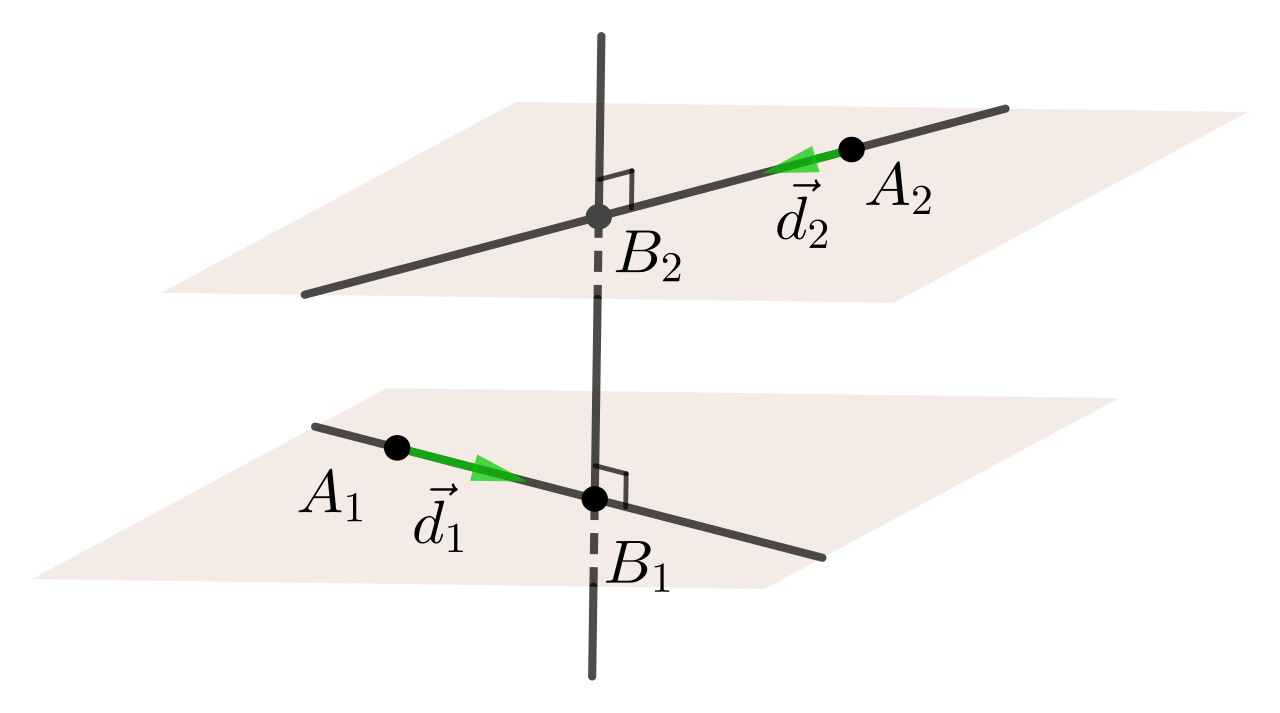
Did you know? In a flat drawing, two straight lines with different directions will meet somewhere if we extend them far enough. In three-dimensional space, that is no longer necessarily true. Two lines can point in different directions and never intersect at all. Such lines are called skew lines.
For a JC1 H2 Mathematics student in Bukit Timah, the distinction becomes important when vectors develop into the A-Level topic of three-dimensional geometry. The 2027 Singapore-Cambridge H2 Mathematics syllabus 9758 includes relationships between two lines—coplanar or skew—along with vector equations of lines and planes. Different junior colleges may teach this later in their two-year sequence, but understanding direction vectors in JC1 helps prepare for it.
This quick guide focuses on one skill: deciding whether two lines in 3D intersect, are distinct parallel lines, coincide, or are skew. It uses exact coordinate examples, explains why two equations are sometimes not enough, includes common mistakes, and ends with five small checks. For the simpler prerequisite, see the JC1 H2 guide to proving collinearity with vectors.
Quick answer: compare directions, then test the point
Write the two lines in vector form:
Line L₁: r = P + s a.
Line L₂: r = Q + t b.
Here P and Q are points on the lines, a and b are non-zero direction vectors, and s and t are independent real parameters.
- If a is a non-zero scalar multiple of b, the direction vectors are parallel. The lines either coincide or are distinct parallel lines.
- If their directions are not parallel, set P + s a = Q + t b and solve the three coordinate equations simultaneously.
- If a consistent pair (s, t) satisfies all three coordinates, the lines intersect at one point.
- If no pair (s, t) satisfies all three coordinates and the directions are not parallel, the lines are skew.
- If directions are parallel and Q is on L₁, the two equations describe the same infinite line; otherwise the lines are distinct and parallel.
The key phrase is all three coordinates. Solving x and y while ignoring z may create a fake intersection.
What skew actually means
Imagine two roads at different heights that pass over or under one another without meeting. Their apparent paths cross on a flat map, but their elevations differ. That is a physical intuition for skew lines: the lines are not parallel, yet they do not occupy the same intersecting plane.
Mathematically, two intersecting lines lie in a common plane. Distinct parallel lines also lie in some common plane. Two skew lines cannot be contained together in a single plane. The distinction is geometric, not a claim that one line is simply “far away.”
You do not need to calculate the shortest distance between skew lines to classify them. In fact, the 2027 H2 Mathematics syllabus explicitly excludes shortest distance between two skew lines and their common perpendicular. Recognising the relationship between lines is the relevant skill here.
Worked example 1: the lines really are skew
Consider two 3D lines.
L₁: (x, y, z) = (0, 0, 0) + s(1, 1, 1).
L₂: (x, y, z) = (1, 0, 2) + t(0, 1, 1).
The first line has direction vector (1, 1, 1); the second has direction vector (0, 1, 1). They are not parallel, because a non-zero scalar cannot turn the first vector’s x-component one into the second vector’s x-component zero while preserving the other components.
To test intersection, equate coordinates. From x, we obtain s = 1. From y, we obtain s = t, so t = 1. Now use z: L₁ has z = s = 1, but L₂ has z = 2 + t = 3. The same alleged point cannot have z equal to both one and three.
That contradiction proves there is no intersection. Since the lines are not parallel, they must be skew.
Notice how deceptive the first two coordinates were. They produced a clean pair s = 1 and t = 1. A student who stops there announces an intersection. The third coordinate is not optional; it is the test that completes the 3D problem.
A reliable three-equation habit
For the example, write the system in a small column:
- x-coordinate: s = 1.
- y-coordinate: s = t.
- z-coordinate: s = 2 + t.
Substitute s = 1 into the second equation to get t = 1. Put both values into the third equation and see the contradiction 1 = 3. There is no exact solution to the complete system.
One check is often enough to decide the case. But if you have solved a pair of equations by elimination, always substitute the results back into the third. The final statement should say “the line directions are not parallel, and the coordinate equations are inconsistent; hence the lines are skew.”
This is clearer than simply writing “no solution” with no explanation of what was solved.
Worked example 2: two lines that intersect
Now consider:
L₁: (x, y, z) = (1, 0, 2) + s(1, 1, −1).
L₂: (x, y, z) = (3, 2, 0) + t(0, 1, 2).
The direction vectors are not proportional, so we test intersection. Comparing x-coordinates gives 1 + s = 3, hence s = 2. Comparing y-coordinates gives s = 2 + t, hence t = 0.
Check z: 2 − s = 2 − 2 = 0 on L₁, while 0 + 2t = 0 on L₂. All three coordinates agree. The lines intersect at (3, 2, 0).
This is the opposite outcome from the skew example. The algebra initially looks similar: there are two parameters and three equations. What changes is whether the same parameter pair satisfies the final equation.
A strong solution states the point explicitly. Students sometimes write “s = 2, t = 0, hence intersection,” but the question may ask for the actual coordinates where the lines meet.
Worked example 3: distinct parallel lines
Take:
L₁: (x, y, z) = (0, 0, 0) + s(1, 2, 0).
L₂: (x, y, z) = (0, 0, 1) + t(2, 4, 0).
The second direction vector is exactly twice the first: (2, 4, 0) = 2(1, 2, 0). Their directions are parallel.
But L₁ consists entirely of points with z = 0, while L₂ consists entirely of points with z = 1. They cannot meet. Therefore the lines are distinct parallel lines, not skew lines.
This distinction matters. “They do not intersect” is not enough by itself to conclude “skew.” Parallel lines also fail to intersect. You need the direction comparison first.
Worked example 4: different equations can be the same line
Consider:
L₁: (x, y, z) = (1, 2, 3) + s(1, −1, 2).
L₂: (x, y, z) = (3, 0, 7) + t(2, −2, 4).
The directions are proportional: (2, −2, 4) = 2(1, −1, 2). Next, see whether the point (3, 0, 7) on L₂ lies on L₁. Setting s = 2 gives (1 + 2, 2 − 2, 3 + 4) = (3, 0, 7).
Thus L₂ starts at a point already on L₁ and moves in the same line direction. The two equations describe coincident lines. They are not two separate parallel tracks; they are one geometric line with different choices of parameter.
This is why the quick statement “proportional direction vectors means parallel lines” is incomplete unless you clarify whether the lines are distinct or coincident.
Why you need two independent parameters
A tempting shortcut is to name the parameter t in both line equations and then put the same t-value into each one. That forces two unrelated journeys to move in synchrony and may incorrectly eliminate a genuine intersection.
Each line has its own rule for reaching points. One line might reach the intersection when s = 2, while the other reaches it when t = 0, as in our worked example. Those different parameter values still describe one shared point.
Use s for the first line and t for the second. Solve for them independently. Matching coordinates is the condition; matching parameter numbers is not.
Does a zero dot product prove the lines intersect?
No. A dot product of zero tells us that the direction vectors are perpendicular. It does not place the lines at the same location in space.
For example, take L₁ as the x-axis: (x, y, z) = (s, 0, 0). Take L₂ as (x, y, z) = (0, 1 + t, 1). Their directions are (1, 0, 0) and (0, 1, 0), whose dot product is zero. Yet L₁ always has z = 0, while L₂ always has z = 1. They are skew.
This can be surprising. We often say two lines are perpendicular when they meet at a right angle. Orthogonal directions alone do not establish that the two geometric lines meet.
A quick decision tree for an examination answer
First, examine the two direction vectors. If they are proportional, inspect a point on the second line to decide coincident versus distinct parallel. There is no need for a full three-equation intersection solve in that branch.
If the directions are not proportional, set the vector equations equal. Use two of the three component equations to find candidate parameters, then check the remaining equation. All three must hold simultaneously.
Once classified, write one concise reason. For example: “The direction vectors are not proportional. The component equations yield s = 1 and t = 1 but contradict the z-equation. Hence the lines are skew.” That is direct, exact and assessable.
Five mini questions with answers
Question 1. Two lines have proportional non-zero direction vectors but are at different fixed z-values. Can they be skew? Answer: No. They are distinct parallel lines if the z-values prevent coincidence.
Question 2. Two 3D lines have nonparallel directions. Their x and y equations give s = 1 and t = 2, but their z equation fails. What are they? Answer: Skew; there is no common point.
Question 3. Two nonparallel lines have the same point P appearing in both line equations, each when its parameter is zero. Are they skew? Answer: No. They intersect at P.
Question 4. Two equations have proportional direction vectors and a point from one equation lies on the other. What is the classification? Answer: Coincident lines.
Question 5. Can two skew lines have direction vectors with dot product zero? Answer: Yes. Orthogonal directions do not guarantee an actual intersection.
These small questions test classification before the learner spends time on heavy coordinate algebra. They help distinguish a geometry misconception from a simple arithmetic mistake.
How a JC1-to-JC2 tutor can repair this topic
Begin with two straight lines on paper. In a plane, nonparallel infinite lines intersect. Then show a 3D sketch of one horizontal line at height zero and another at height one, each pointing in a different direction. The learner sees why the second case is possible.
Next, work with two clean 3D vector equations. Identify the direction vectors and solve the component equations. The tutor deliberately supplies one intersecting example and one skew example whose first two coordinate equations look convincing. This trains the all-three-coordinates check.
Only after the geometry is clear should a graphing calculator be used to support system solving. Technology can help verify values but cannot replace the explanation of why a 3D intersection does or does not exist.
For Bukit Timah parents, a useful diagnostic question is: “Can my child explain why two nonparallel lines might fail to meet in three dimensions, and then show the failed coordinate check?” If yes, the mathematical meaning is becoming stable.
Frequently asked questions
Do nonparallel 3D lines always meet?
No. Unlike lines in one plane, nonparallel lines in 3D may be skew—neither parallel nor intersecting.
Can skew lines lie in the same plane?
No. Two distinct coplanar lines are either parallel or intersect. Skew lines are noncoplanar.
Must I use a cross product to classify skew lines?
No. Direction-vector proportionality and a consistent three-coordinate system are often enough. The vector product can be useful in other 3D geometry tasks, but a simple classification question does not require an elaborate formula.
Is finding the shortest distance between skew lines required?
The 2027 H2 Mathematics syllabus 9758 explicitly excludes shortest distance between two skew lines and their common perpendicular. The relationships between lines themselves remain part of the topic.
Is this necessarily taught in JC1?
Not at every college. The H2 syllabus covers the two-year JC course; schools may order vectors and 3D geometry differently. Learning basic displacement and direction vectors in JC1 makes later line classification easier.
Related learning and JC1 support
For a foundation, start with proving collinearity using proportional vectors; for later calculus skills, see what happens when dx/dt = 0 on a parametric curve. The broader H2 vectors, lines and planes overview connects the ideas to full A-Level work.
The eduKateSG small-group Mathematics tutoring reference describes a diagnostic-first approach in a Secondary 1 programme. JC1 families should confirm current arrangements through the Bukit Timah JC1 tuition guide rather than assuming those class details are transferable.
Remember the principle: different directions do not prove an intersection in 3D. First compare directions, then demand agreement in all three coordinates.
Featured diagram credit: Distance between skew lines by HB, Wikimedia Commons, CC BY-SA 4.0. The accompanying PNG is an unmodified rendering of the original SVG. It illustrates two skew lines in different planes and their shortest perpendicular distance, not a solution to a particular examination question.
