
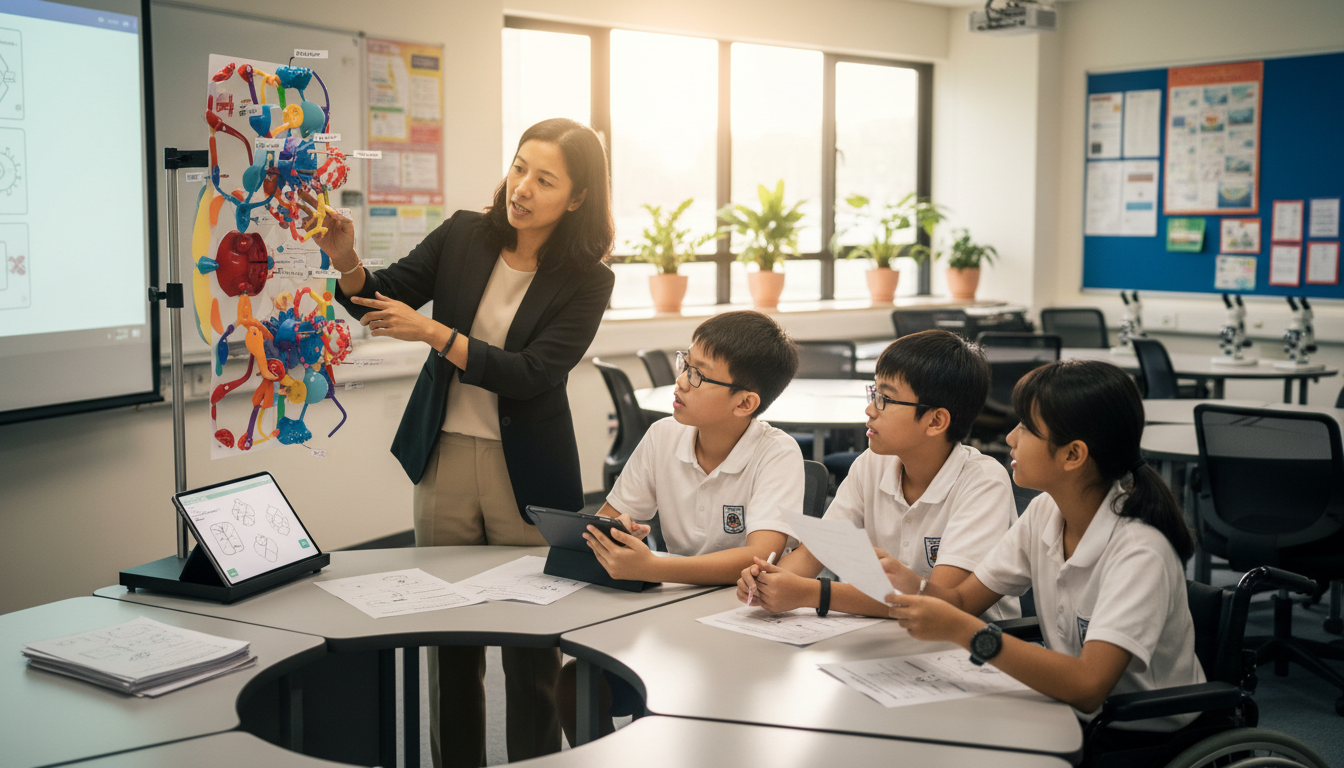
JC1 Physics tuition for Jurong East students is most effective when it teaches them to turn measurements into defensible conclusions. In an A-Level examination, a correct numerical answer is not enough if the student cannot explain which model applies, why a graph has that gradient or whether a measurement justifies the final claim. A carefully matched small group can create time for each learner to test an idea, receive precise feedback and retry without hints.
The main benefit of a well-run three-person tutorial is visibility: the tutor can see the first mistaken assumption, incorrect unit, graph-reading error or mathematical step before it becomes a repeated habit. eduKateSG has a three-pax small-group teaching approach at established locations, but families should separately verify whether an appropriate JC1 H1 or H2 Physics group, tutor, lesson time and teaching venue is currently available for a Jurong East student. This guide does not claim a Jurong East Physics branch is operating.
- 2027 A-Level reference: H1 Physics 8867; H2 Physics 9478; H3 Physics is an advanced, separately selected route.
- What H2 families must not miss: Paper 4 practical is worth 20% in the published 2027 scheme, including data work and spreadsheet analysis.
- Where small groups help: Independent graph interpretation, accurate units, experimental judgement and clearer explanations.
- First meeting: Bring one set of measurements or graph, school corrections, the student’s registered syllabus and the college’s topic sequence.
- Parent’s decision: Compare demonstrated learning benefit with the total cost in fees, commuting, sleep and time for independent revision.
From lecture notes to evidence: the crucial JC1 shift
A learner can watch a lecturer produce a smooth graph and understand the algebra, then become lost when asked to interpret a noisy experimental dataset. The theoretical relationship may still be correct, but the student must decide how the actual measurements relate to it.
This is the difference between reproducing an example and thinking scientifically. Real data contain limited precision, variability and sometimes systematic effects. A perfect line on the whiteboard is a model. Actual readings are observations. The skill is to compare the two without pretending that one is the other.
Consider a fictional student, Jo, who plots a graph accurately but has never asked what the gradient means. A second student, Ryan, can describe the physical relationship but places the wrong quantity on an axis. A third, Clara, handles both tasks but presents too many calculator digits and ignores the precision of the measurements.
A well-matched small group can give each learner a distinct starting task. They can then compare interpretations and explain why their differences matter. The purpose is not to announce that every student is equally advanced; it is to give each one a way to improve within a shared scientific discussion.
The tutor’s central question is: What does this evidence support, and what remains uncertain? That question is useful in Physics examinations and in the much wider world of engineering and technical decisions.
Why group size alone is never enough
A small group offers fewer places for misconceptions to hide. But that advantage disappears if the tutor lectures continuously and students copy a solution. Three-person teaching needs a deliberate structure.
First, every student gives an independent prediction. It can be as simple as deciding whether a gradient should increase or decrease when a variable doubles. Next, each draws a diagram or writes a brief explanation. The tutor inspects these before revealing a model answer.
Then students compare reasoning. One may notice a unit inconsistency; another may challenge an assumption. The tutor helps them distinguish an actual conceptual error from a merely different but valid method. Discussion should lead to a testable conclusion, not a debate decided by confidence or speed.
Finally, each learner completes a changed question alone. If the student can use the principle after the labels and numbers have changed, that is evidence of transfer. If the student cannot, the lesson has located a remaining dependency.
This structure also makes the class more respectful. Students need not be embarrassed by an early wrong answer; it becomes a piece of information that directs instruction. But tutors should still be careful not to turn frequent questioning into pressure. The aim is clarity.
Worked example: use a graph’s units to identify a physical constant
Imagine a spring that obeys Hooke’s law within a chosen elastic range. Write F = kx, where F is the applied force, x is the extension measured in metres and k is the spring constant.
Suppose a simple set of idealised readings is:
- Extension: 0.020 m; force: 1.0 N.
- Extension: 0.040 m; force: 2.0 N.
- Extension: 0.060 m; force: 3.0 N.
- Extension: 0.080 m; force: 4.0 N.
If force is plotted on the vertical axis and extension on the horizontal axis, the gradient from the first and last points is (4.0 − 1.0) N divided by (0.080 − 0.020) m = 50 N/m. Under this ideal model, the gradient is the spring constant k.
Now swap the axes. If extension is plotted against force, the gradient is 0.020 m/N, which equals 1/k for the ideal linear relation. The underlying physics has not changed, but the numerical gradient and its units have.
This is why ‘gradient equals spring constant’ is too vague. It is true only for the appropriate plotted variables and model. A student who memorises the sentence without checking the axes has learned a shape, not the physics.
For real readings, the relationship may have experimental scatter and may stop being linear beyond the range tested. Do not automatically force every point through the origin or assume the spring remains elastic indefinitely. The evidence and task instructions should determine how the graph is interpreted.
Worked example: why a plotted straight line needs an explanation
Suppose a physical model predicts that a measured quantity y is proportional to the square of another quantity x. The equation has the form y = Cx² for a constant C under the model’s assumptions.
A graph of y against x will generally be curved, not a straight line. But a graph of y against x² should be linear if the model is appropriate across the tested range. Its gradient represents C, with units derived from those of y divided by those of x squared.
A student who simply tries different spreadsheet trendlines until one looks attractive has not answered the scientific question. They need to state which transformation the theoretical model predicts, why it is useful and what the measured slope means.
A small group can compare the two plots, ask whether the axis transformation is justified and identify which equation the graph is testing. The tutor can vary the relationship in another problem and see whether students still know what should be plotted.
This is an example of transferable reasoning. The particular physical quantities might concern oscillations, motion or another topic, depending on the syllabus. The important skill is connecting a physical equation to a testable representation of the data.
The 2027 H1 and H2 examination schemes: not the same programme
Official SEAB documents list H1 Physics 8867 and H2 Physics 9478 for the 2027 A-Levels. H1 has two externally assessed theory papers: Paper 1 contributes 33% and Paper 2 contributes 67%. H1 does not have a separately assessed H2-style practical Paper 4.
H2 has four papers. The 2027 weightings are Paper 1 15%, Paper 2 30%, Paper 3 35%, and Paper 4 practical 20%. That final component is a substantial part of H2, and it tests more than following a memorised method.
The H2 practical assessment covers planning, manipulation and measurement, data presentation, and analysis, conclusions and evaluation. The official 2027 syllabus requires candidates to process and analyse data with spreadsheet software. It also assesses the student’s ability to make justified decisions about observations and recognise anomalies.
H3 Physics is an advanced subject available through appropriate college selection arrangements. It does not replace the student’s ordinary H1/H2 registration and should not be treated as a generic extra packet for every enthusiastic learner.
The official references are the SEAB 2027 syllabus catalogue, H1 Physics 8867 PDF and H2 Physics 9478 PDF. Students taking the examination in another year should verify that year’s specifications when published.
The practical skills a tutor can genuinely support
A tutor can teach data judgement without claiming to operate a full laboratory. For example, a student may learn to inspect a table for inconsistent units, plot values correctly, interpret a gradient and explain which observations support a claim.
A useful lesson may involve choosing the appropriate number of significant figures, estimating a gradient from a graph, identifying an anomalous value and discussing plausible reasons for its occurrence. The tutor can ask which procedural improvement might reduce an identified source of uncertainty.
Spreadsheet training can help H2 students organise measurements, check formulas and produce properly labelled graphs. But students should not mistake a polished chart for a sound scientific conclusion. The computer cannot decide whether the underlying experiment used the correct physical model.
Actual manipulation of apparatus, safe experimental setup and assessed laboratory technique require suitable equipment, supervision and school practice. A general small-group tuition venue should not claim to replace those experiences unless it has the appropriate resources. Parents should ask the college for feedback on the specific practical skills their child needs to improve.
An H1 student may still benefit from experimental examples when they clarify the content, but revision should reflect the different H1 assessment scheme. A practical exercise can be educational without being an external H1 Paper 4.
Uncertainty, systematic error and the meaning of an anomaly
Imagine five measured periods of an oscillator. They are close but not identical. The variation may arise from timing limits, setup changes or other influences. Repeating measurements can help characterise variation, but the learner should not claim that repetition eliminates every form of error.
A consistent zero offset in a measuring device creates a different problem. Repeating readings with the same uncorrected offset will not necessarily remove the bias. Calibration or a different method may be required, and the appropriate response depends on the equipment and question.
An unusual data point is not an invitation to delete inconvenient evidence. Students should first ask whether there is a defensible explanation, whether the measurement should be repeated and how the decision affects the conclusion.
These habits develop scientific honesty. The student is learning to say what the data show, how confidently they show it and what further observation might challenge the interpretation.
A small group is well suited to discussing two plausible explanations for an anomaly. The tutor can ask each student what additional measurement would distinguish them. That is more valuable than a memorised list of generic ‘sources of error’ that does not fit the experiment.
Physics and the city: why Jurong East offers useful real-world contexts
Jurong East is associated with transport interchanges, commercial facilities and wider west-side development. These are useful places to *think* about Physics, not claims that an educational experiment can be performed in a public location.
A train’s change of speed invites questions about acceleration and forces. A lift prompts discussion of energy transfers and power. Air-conditioning raises questions about energy use and efficiency. A tall structure creates questions about loads, materials and stability, even though actual structural design requires engineering beyond a JC textbook model.
The purpose of linking Physics to the built environment is to help students recognise the difference between a simplified equation and the many factors in a real system. For instance, an ideal energy calculation may ignore losses; a real machine does not.
These contexts also help readers evaluate claims. An assertion that a building ‘saves energy’ should specify what was measured, against which baseline, and under what conditions. A graph predicting future energy use should acknowledge assumptions and uncertainty.
The habit transfers to questions about technology and public policy. A student who reads measurements carefully is learning a form of evidence-based judgement that matters far beyond a school examination.
Four-week improvement plan for a Jurong East JC1 student
Week 1: Diagnose using actual school work
Bring the student’s H1/H2 subject code, current topic list, recent corrections and one graph- or evidence-based task. Ask for a short independent attempt with no hints. Categorise errors: concept, model, Maths, graph, units, practical reasoning or presentation.
Write a specific baseline. For example: ‘Can calculate a slope but cannot state the physical meaning or units of the gradient.’ Such a statement tells the tutor what to teach and gives parents a way to judge progress later.
Week 2: Repair the connection between the equation and graph
Use an appropriate physical relationship and ask the student to predict the plotted shape before calculating. Have them label both axes and derive the gradient’s dimensions. Change the axis order and ask what happens to the interpretation.
If the student’s issue is algebra or proportional reasoning, repair that prerequisite directly. If the issue is the physical model, use a simpler experiment or diagram. The same incorrect answer can have very different causes.
Week 3: Add real data and ask for a supported conclusion
Introduce a short realistic dataset with measurement variation, rather than a perfectly clean table. Ask the learner whether a proposed trend is supported by the evidence, how an anomaly should be handled and which uncertainty matters most.
The tutor should require each member of a small group to justify an individual conclusion before comparing. Differences can become a reasoned discussion about assumptions and evidence, not a popularity contest.
Week 4: Retest under unfamiliar conditions
Provide a fresh question with changed quantities and graph layout. Ask for an independent solution, a description of what the gradient means and one appropriate limitation of the model. Compare with Week 1 without overclaiming that all skills are now mastered.
Decide what happens next. If the student now explains independently, consider moving to mixed practice or reducing support. If the mistake persists, investigate a different teaching method. If the timetable has become too demanding, consider a shorter, less frequent intervention.
The plan’s value is transparency: parents can see whether the learner has gained a usable skill rather than merely completed four paid sessions.
The Mathematics bridge: ratios, slopes and units
Physics requires students to reason with proportionality. If y = Cx² in a stated model, doubling x multiplies y by four, not two. If a graph measures force against extension, its gradient has different units from a graph of extension against force.
Such questions often reveal whether a student sees Mathematics as a collection of transformations or as a language for relationships. A correct algebraic manipulation is necessary but not sufficient. Students need to interpret the result physically.
Unit conversion deserves regular attention. A student measuring 35 mm of extension should convert it to 0.035 m before using SI-compatible formulas, unless the data treatment explicitly uses a different consistent unit scheme. Unnoticed units can produce errors of powers of ten.
Students should estimate whether results make sense. A computed gradient outside any plausible scale may reveal an inverted ratio or a mistaken axis. Estimation is a safety check for reasoning, not a substitute for precise working.
A tutor should be willing to say when the main issue is Mathematics rather than Physics content, and to recommend direct repair rather than an endless sequence of Physics papers.
What a small group should teach about scientific explanations
A good scientific explanation follows a simple sequence: identify the phenomenon, name the relevant principle, show how the principle applies to this system, and state the conclusion. If assumptions are important, acknowledge them.
In an electricity question, a learner should not simply say ‘the current is bigger because of the formula.’ They should identify which circuit condition changes and how the relationship constrains the result. In a mechanics question, the student should explain the resultant force rather than just list forces separately.
Precise vocabulary matters. ‘Accuracy’, ‘precision’, ‘random error’, ‘systematic error’, ‘velocity’, ‘acceleration’ and ‘energy’ are not interchangeable words. A learner who uses them loosely may produce plausible-looking sentences that do not demonstrate understanding.
A group of three offers room for each student to explain a principle aloud or in writing. Students can compare definitions and challenge a statement with a counterexample. This should be constructive, not humiliating.
The best outcome is a learner who can produce a clear written explanation under examination pressure and use the same logical sequence when examining unfamiliar claims outside school.
School, travel and the full family cost
Jurong East is connected by the East–West and North–South MRT lines. A family considering eduKateSG’s established Bukit Timah small-group teaching area near Sixth Avenue MRT should check the actual route from the student’s college and home before committing to an appointment.
The shortest journey on a map is not always the journey a student can sustain after CCA or a late laboratory session. Include waiting, travel, meals, rest and time for independent homework when evaluating the schedule.
One-to-one tuition, school consultation or structured independent revision may be better options when a student’s needs or availability do not fit a group. A three-pupil class may be preferable when the student benefits from peer comparison and can contribute to a shared pace. Neither choice is universally superior.
The estate title helps Jurong East parents find relevant decision guidance. It should not be read as proof of a dedicated eduKateSG JC1 Physics venue or a currently available place in Jurong East.
How to select a tutor without relying on impressive claims
Ask the tutor to explain a Physics data problem in plain language. They should state what the graph measures, why a relationship is expected and what the observations allow them to conclude. This reveals more about teaching ability than a slogan.
Ask whether the student will work independently during class, how corrections are handled and how understanding is retested later. An answer consisting only of ‘we give many worksheets’ is incomplete.
Ask how the provider distinguishes H1 and H2 course requirements. A strong teacher should know that the 2027 syllabuses have different scope and that H2 includes a separately assessed practical paper.
Ask about limits: What if the learner needs substantial one-to-one remediation? What if a laboratory skill requires college supervision? What if the student is already progressing well without tuition? A responsible answer should allow for alternatives.
Finally, ask the student whether they feel comfortable asking questions and showing unfinished work. Even a knowledgeable tutor cannot correct a misconception the learner feels compelled to hide.
H1, H2, H3 and university choices: plan with real prerequisites
An interest in engineering, physical sciences or technology may make Physics especially meaningful, but entry requirements vary by university, course and admissions year. A tutor should not claim that every technical degree has the same compulsory combination.
Parents and students should consult official university programme pages and their college about subject combinations, rather than choosing tuition based on a generic claim that it guarantees a particular career.
H3 Physics is an advanced option for eligible students, not a mandatory step for every H2 learner. The student’s readiness, interests, other subjects and school rules should guide the choice.
Read eduKate’s H1 vs H2 Physics and university choices guide and JC subject combinations guide for connected planning questions, then verify formal prerequisites with the institution involved.
Common questions from Jurong East parents
Why does my child get Physics graphs wrong despite knowing formulas?
The problem may be interpreting the axes, choosing the plotted relationship or explaining what the slope represents. Diagnose the earliest error before adding more graph worksheets.
Is H2 Paper 4 really worth 20%?
Yes, for the 2027 H2 Physics 9478 examination. It includes practical and data-handling skills. Use the official syllabus for the actual examination year.
Does H1 have the same practical paper?
No. The published 2027 H1 Physics 8867 scheme has two externally assessed theory papers and no separate H2-style Paper 4.
Does a small group replace school laboratory practice?
No. It can develop experimental reasoning and data interpretation but cannot automatically replace actual supervised manipulation and measurement.
Will three students always learn more than one student?
Not necessarily. A well-matched group may improve discussion and accountability. A learner with major gaps or very unusual scheduling needs may be better served individually.
Should we begin H3 Physics tuition in JC1?
First check the student’s current H2 foundation, school eligibility and the actual advanced subject route. H3 should not be treated as a general compulsory extension.
How can we measure progress quickly?
Ask whether the student can now identify a model, interpret a new graph and explain the result without hints. Those are meaningful early indicators even before a major test.
Is eduKateSG running a JC1 Physics class in Jurong East?
This article does not verify a Jurong East class. Enquire directly about current subject availability, the actual teaching venue, group size and timeslot.
What if the student already does well without tuition?
There may be no need to add it. Protect independent study time and ask whether any specific extension or repair is genuinely missing.
Next action: ask for the meaning, not just the number
Have the student choose one marked graph question and explain, without notes, what the axes measure, why the chosen relationship applies and which limitation matters. If the explanation is unstable, the weakness becomes an actionable teaching target.
Continue through JC1 Physics Tuition Clementi | Benefits of Small Groups Tutors for the modelling and Mathematics bridge, H2 Physics Practical Paper 4: Excel, graphs and planning for experimental skills, and JC1 First 90 Days for workload management.
Arrange a consultation with eduKate Singapore or ask whether a JC1 Physics group is available for a Jurong East student. Choose tuition only when the starting position, teacher fit and actual offer are clear.
Sources and editorial verification
- Official SEAB 2027 A-Level school-candidate catalogue
- SEAB 2027 H1 Physics 8867 syllabus
- SEAB 2027 H2 Physics 9478 syllabus
Reviewed November 2026. The numerical examples are explanatory models, not reports of experiments at eduKateSG. College timetables, future syllabus details and tuition availability can change.