
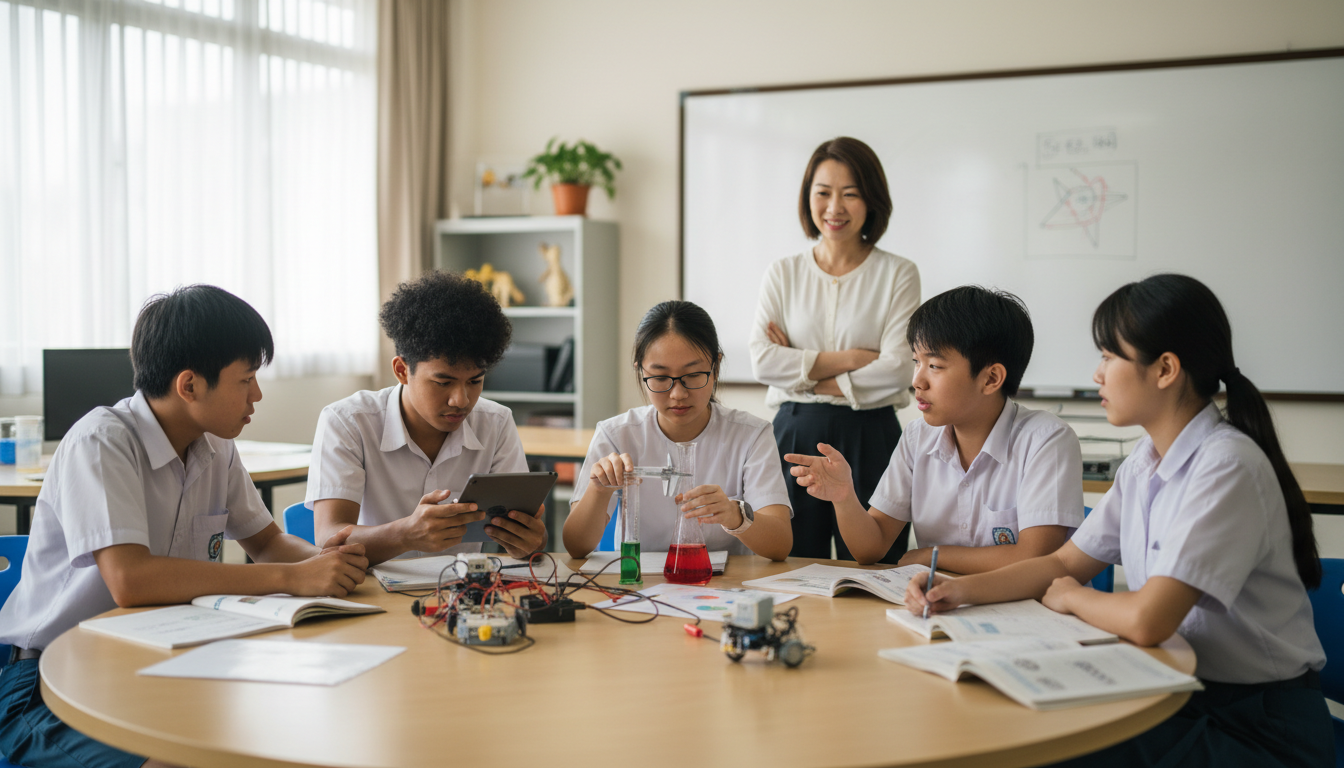
JC1 Physics tuition for Pasir Ris students should help learners understand a physical principle well enough to recognise it in an unfamiliar question. Small-group tutors can be valuable when they listen to each student’s explanation, examine the first diagram and uncover a misunderstanding before it becomes a repeated habit. A tutorial becomes effective when the student can then complete a changed question without the teacher saying which formula to use.
For Pasir Ris families, the relevant choice is not merely between a large class and a class of three. It is between a teaching arrangement that genuinely repairs an identified difficulty and one that consumes precious college-study time without improving independent work. eduKateSG’s established three-learner approach informs this guide, but a currently running JC1 H1 or H2 Physics group, specialist tutor, venue and timetable must be verified directly. This page is not evidence of a separate eduKateSG Physics centre in Pasir Ris.
- Quick answer: Choose a small group when it allows individual diagnosis, explanation, correction, varied practice and delayed retrieval.
- 2027 A-Level syllabus: H1 Physics 8867, H2 Physics 9478 and advanced H3 Physics 9814 are distinct programmes.
- This guide’s Physics focus: Oscillations and simple harmonic motion as H2 learning examples, especially what amplitude, frequency and phase actually mean.
- H1 students: Use the official H1 syllabus and their school sequence; H2 oscillator examples must not be assumed to be H1 exam requirements.
- Parents: Bring two marked school tasks, confirm class availability, and compare travel plus homework against the learner’s full JC week.
What goes wrong when students study equations without physical meaning
A learner can recite the equation for an oscillator’s period and still be uncertain about why the period changes when mass or stiffness changes. The student may remember that something involves a square root but have no intuition about what that relationship says.
This is the difference between remembering a symbolic expression and understanding its role. Physics connects quantities to a real or idealised system. The equation follows from a model and assumptions. Without that link, a learner may substitute values correctly when the question is labelled by chapter but fail the moment the context changes.
Imagine a fictional student, Mira, who thinks doubling the amplitude of a spring oscillator must double its period because the object moves through a larger distance. Another fictional student, Ryan, correctly remembers the ideal period formula but does not notice that the formula assumes an ideal spring-mass system with linear restoring force and negligible damping. Their misconceptions are different.
A productive small-group tutorial makes those assumptions explicit. The tutor asks Mira what controls the frequency in the ideal model, and asks Ryan what changes when friction or nonlinear effects enter. Neither should be given a longer worksheet until the fundamental principle is clear.
The value of the tutorial lies in the student’s eventual independence. The learner should be able to predict a result, explain a model’s limits and use the relationship without having someone name the method first.
Why three learners can strengthen scientific explanation
In a large lecture, a student may understand the explanation while listening but remain unable to generate it later. Recognition is not proof of mastery. A small group creates room for each learner to say what they believe the physical system will do before the tutor supplies the correct answer.
The teacher can give three students the same oscillator diagram and ask them to predict what happens to the period when mass increases. Each writes a short prediction and a reason. After looking at the responses, the tutor explains the model and why the dependence is a square root rather than a direct proportion.
Students can then compare the physical intuition with the mathematical relationship. If one student is comfortable with algebra but confused about the model, the tutor can ask them to describe the restoring force. If another knows the mechanics but struggles to rearrange the period formula, that student needs a different immediate repair.
The next task changes an important variable. Every student must solve it alone. This final individual retry prevents the fastest speaker from carrying the group and exposes whether the explanation has become usable.
Repeating a similar task several days later tests retention and transfer. A learning process should not end with a reassuring ‘Yes, I understand’ spoken immediately after a demonstration.
Worked H2 example: a mass on an ideal spring
Consider a 0.50 kg mass attached to a spring with spring constant k = 200 N/m. Assume the mass oscillates horizontally with a linear restoring force, negligible friction, a massless spring and conditions where the simple harmonic motion model applies.
For the ideal model, angular frequency is the square root of k/m. Here k/m = 200 / 0.50 = 400 s⁻², so angular frequency is 20 rad/s. The period is 2π / 20, approximately 0.314 s, and frequency is about 3.18 Hz.
If the amplitude is 0.040 m, the maximum speed is angular frequency times amplitude: 20 × 0.040 = 0.80 m/s. The maximum acceleration magnitude is angular frequency squared times amplitude: 400 × 0.040 = 16 m/s².
The numerical results are meaningful only under the idealisations. Real springs may have damping, nonlinear stiffness or non-negligible mass. The calculation does not claim that every physical spring behaves exactly this way.
Now double the mass from 0.50 kg to 1.0 kg while keeping the spring constant unchanged. The new angular frequency is the square root of 200, about 14.1 rad/s. The period increases to about 0.444 s. It does not double. Under this ideal relation, doubling mass multiplies period by the square root of two.
This is a good transfer question because students may know the equation but not recognise the relationship. A tutor should ask for a prediction before providing the calculator. The resulting change should make physical sense: a heavier mass under the same spring stiffness oscillates more slowly in the ideal model.
The amplitude question: movement is not the same as timing
In the ideal linear spring-mass model, changing the amplitude does not change the period. If the mass and spring remain the same, the ideal oscillation frequency remains the same even though the object travels a greater distance in each cycle.
That statement needs its conditions. Nonlinear springs, strong damping or other non-ideal effects can change the motion. A student who memorises ‘amplitude never affects period’ without the model qualifier may carry an oversimplified claim into an unfamiliar real-world problem.
What does amplitude affect in the ideal model? It changes the maximum speed, maximum acceleration and total oscillation energy. If amplitude doubles, the maximum speed doubles, and the maximum acceleration magnitude doubles. Total mechanical energy for an ideal spring, one half kA², becomes four times larger.
With k = 200 N/m and amplitude A = 0.040 m, the total oscillation energy is 0.5 × 200 × 0.040² = 0.16 J. At A = 0.080 m under the same ideal model, it becomes 0.64 J.
A tutor can ask learners to distinguish a time-related quantity from an energy-related quantity. The period concerns one full cycle, while amplitude measures the maximum displacement from equilibrium. A change in amplitude has different implications for these different quantities.
This distinction is the kind of precise reasoning that generalises beyond oscillations. Physics becomes more manageable when every symbol is attached to an idea and the learner checks which quantity the question actually asks for.
Graphs of oscillation: three ways to be correct and one way to misread them
A displacement–time graph for simple harmonic motion describes the position of the oscillating object at each instant relative to equilibrium. Its gradient gives velocity. A velocity–time graph describes the changing velocity, and an acceleration–time graph gives acceleration.
The curves are linked but are not interchangeable. At maximum positive displacement, the object’s instantaneous velocity is zero, while acceleration points back towards equilibrium and has its greatest magnitude in that direction for an ideal SHO. At equilibrium, speed is maximum in magnitude and acceleration is zero.
A student who says the speed is greatest at the turning point because that is the highest position on the displacement graph has mistaken graph height for speed. The tutor should ask which quantity is on the vertical axis and what the gradient represents.
Students should also identify the period from repeated corresponding points in the time graph, rather than from the distance between peaks on a graph against position. The axis labels determine whether the interval is a time, a distance or something else.
A useful three-person activity assigns one learner to interpret displacement, another to state velocity and a third to explain acceleration for the same instant. Then everyone independently fills out the full set for a changed instant.
The aim is understanding the physical relationship, not merely memorising three shifted sine curves.
Phase and the misunderstanding behind a beautiful graph
Two oscillations can have the same amplitude and frequency but different phase. Their graphs may look nearly identical while their peaks occur at different times. In an appropriate simple harmonic model, phase determines the point in the cycle at a particular instant.
Students who treat a phase difference as a change in frequency may misinterpret graphical information. A phase difference can change how two oscillations combine without changing either oscillation’s individual period.
In a small-group tutorial, ask students to mark corresponding peaks and measure the time shift. Where the conditions permit, the phase difference can be related to the fraction of one complete period represented by that shift.
A phase difference of half a cycle corresponds to π radians, or 180 degrees. A phase difference of a quarter cycle corresponds to π/2 radians, or 90 degrees. But these numbers should be linked to the actual graph rather than memorised without reference to axes and period.
A learner may need a simpler circular-motion analogy or a time-based sketch before the idea becomes clear. The tutor should choose a representation that repairs the misunderstanding, then return to the syllabus question.
What H1, H2 and H3 actually ask families to decide
The 2027 Singapore-Cambridge A-Level school-candidate catalogue lists H1 Physics 8867, H2 Physics 9478 and H3 Physics 9814. These are distinct registrations. The H2 oscillator examples in this article support H2 study; parents should not assume that they belong to every H1 question bank.
The published 2027 H1 Physics external assessment has Paper 1 worth 33% and Paper 2 worth 67%. There is no separate external H2-style Paper 4. That difference must be understood before planning practical-paper tuition for an H1 student.
H2 Physics has four papers weighted 15%, 30%, 35% and 20%, with the last being practical. Students need appropriate theory, mathematical and experimental reasoning, including spreadsheet-related data work prescribed by the 2027 syllabus.
H3 Physics is an advanced pathway governed by college selection and student readiness. It should not be treated as a compulsory extension for every H2 student. The learner’s other subjects, General Paper, school activities and available rest matter too.
A learner starting JC1 in 2027 may take the A-Levels in 2028 under the normal two-year route, so the family must verify the syllabus for that actual examination year once available. Use the official SEAB 2027 school-candidate catalogue for the published 2027 specifications.
The eduKate guide to 2027 H1 versus H2 Physics provides a reader-friendly comparison.
What a tutor should repair before moving to complex questions
A student who struggles with the oscillator period may have different underlying problems. They may not understand what a period measures. They may struggle to rearrange an expression with a square root. They may misunderstand angular frequency, or they may fail to distinguish amplitude from frequency.
These are not equivalent weaknesses. The tutor should ask for a brief explanation and calculation to locate the first unstable concept. For the student confused about period, begin with timing repeated cycles. For a square-root algebra gap, practise the mathematical transformation separately. For amplitude confusion, contrast ideal model predictions.
A tutor should also check whether the student can work with units. Spring constant has units N/m and mass has units kg. The expression k/m has dimensions of inverse time squared; its square root gives angular frequency with units of inverse time.
Scientific notation and calculator handling can become obstacles too. Those need small targeted repairs before mixing several demands in one long problem.
Once the learner can execute the basics accurately, the teacher can increase complexity and vary the context. More difficult questions are useful when they test newly stable skills, not when they obscure an unresolved prerequisite.
The four-week repair cycle for a Pasir Ris JC1 learner
Week 1: Establish a baseline from genuine school work
Collect two marked Physics tasks, the current college topic sequence and the student’s H1/H2 subject code. Use a short independent assessment matched to the content already taught. Include one conceptual explanation, one numerical question and one graph interpretation task.
Record a specific error. For example: ‘Can calculate frequency but mistakes the highest point of a displacement graph for maximum speed.’ This points to a relationship that needs correction.
Week 2: Build a stable picture of the phenomenon
Use a physical sketch and an idealised graph to connect displacement, velocity and acceleration. If appropriate for the H2 learner, teach how mass and spring stiffness affect angular frequency. Contrast the model with a simple real-world caveat.
Every member of a small group should write an independent prediction. Rotate explanation roles so no one becomes permanently the ‘weak student’ or the one who always supplies answers.
Week 3: Test transfer with variation
Change one variable without announcing which formula to use. Ask how the period changes when mass doubles, how total energy changes when amplitude doubles and why an altered graph still describes the same underlying relationship.
For an H1 learner, substitute syllabus-matched motion, force or graph questions that test the same habits of model choice and explanation. Do not use advanced H2 content to inflate difficulty without a reason.
Week 4: Retest independently and compare
Give a short mixed set with an unfamiliar layout. Require the learner to state the model, identify the variables, calculate carefully and explain the meaning of the result. Revisit the original misconception in a modified question.
If the student can now explain and solve without hints, the class has produced useful evidence. The next plan may involve more challenging work or less frequent support. If the same error persists, reconsider the explanation, prerequisites or class fit.
The family’s goal should be a durable skill, not a fixed number of paid sessions.
H2 practical work and why data analysis deserves its own attention
The 2027 H2 Physics scheme includes Paper 4 practical worth 20%. Students need to plan measurements, manipulate equipment safely, present readings, analyse data and evaluate limitations. The syllabus specifically includes spreadsheet-based processing and analysis.
A tutor can help learners interpret an oscillation dataset, plot an appropriate graph and decide whether a fitted slope matches a proposed model. If a student plots the period against mass and expects a straight line for the ideal spring relationship, they should be taught why a transformed graph such as T² against m is expected to be linear under the stated assumptions.
But the graph must be justified from the equation, not chosen only because software produced a neat trendline. Students should understand what the gradient represents and whether the data support the model within the tested range.
Actual handling of apparatus and experimental safety require properly supervised practical sessions and suitable facilities. A conventional tutoring room cannot automatically replace college laboratory experience.
Parents should distinguish practical *reasoning* offered in an ordinary lesson from supervised laboratory *training*. Ask the student which part they find difficult and obtain school feedback before choosing an external intervention.
Pasir Ris families must count more than the class duration
Pasir Ris sits on the eastern part of Singapore’s rail and bus networks. A family considering lessons in the Bukit Timah teaching area near Sixth Avenue MRT or elsewhere should check the actual trip from school and home. The estate name alone says little about the journey at the end of a college day.
A ninety-minute tutorial might require substantial additional commuting and leave little time for independent application. If a student reaches home exhausted and cannot finish school work, the learning benefit may be smaller than expected.
Some learners thrive with the weekly structure of an in-person group. Others may be better served by one-to-one help, college consultations or a carefully designed independent revision routine close to home.
The correct choice is the one that addresses a real learning obstacle without creating an unsustainable schedule. Families should confirm that a suitable JC1 Physics class actually exists before making plans.
The article’s Pasir Ris label identifies who may find the guidance relevant; it does not verify a dedicated eduKateSG JC1 Physics venue in the estate.
When a small group may be better—and when it may not
A small group may be suitable when the student benefits from frequent questioning and hearing other learners explain. The tutor has enough time to see individual attempts, and the presence of peers can prevent a lesson becoming an uninterrupted teacher monologue.
A one-to-one arrangement can be better when the learner’s foundation is far behind the group’s pace, when scheduling is unusual or when the student requires intensive individual diagnosis. It should still use independent attempts, not only continuous guided solutions.
College consultation is important for school-specific assessments, experiment handling and the next topics that will be taught. Independent study can work well when students can diagnose their errors and use school feedback effectively.
The family should be willing to change formats. A student who completes a focused repair cycle successfully may no longer need weekly extra instruction. Continuing every lesson simply because it is on the calendar is not a learning goal.
Physics outside JC: cycles, engineering and evidence
Oscillations are not limited to a textbook spring. Repeated motion can be relevant to vehicles, structures, instruments and devices. Real systems can dissipate energy, respond strongly to particular forcing frequencies and depart from simple ideal models.
The useful habit for a Physics student is to distinguish model from measurement. A perfect sinusoid is an idealised representation; experimental data will often show limitations. A prediction can be accurate under stated assumptions without describing all of reality.
When reading a claim about vibration control or mechanical performance, a scientifically literate reader asks what was measured, over what conditions and with what uncertainty. A familiar equation is evidence only when the model applies.
This is a broader reason to teach Physics carefully. The student is learning to test explanations against reality, not merely to decorate answers with symbols.
Parent questions worth asking
- Which H1 or H2 syllabus and actual examination year will the group cover?
- Is there a currently available JC1 Physics class, and where does it meet?
- Does the group have three learners, and are their school topics and starting points compatible?
- Can the tutor show how a conceptual misconception is diagnosed?
- Does every student make an independent prediction and attempt before seeing the answer?
- Are worked examples varied so the learner must choose the model again?
- Does the tutor retest understanding after several days?
- How are H2 practical reasoning and real school laboratory experience distinguished?
- What will the entire commitment cost in travel, tuition, homework and rest?
- Under what conditions would the tutor recommend reducing or stopping support?
The answers should describe actual methods, not only promised grades.
Frequently asked questions
Can a student do well in JC1 Physics without tuition?
Yes. School teaching, tutorials, consultation and structured self-study may be enough. Add external help when a specific difficulty remains unresolved.
Is three-person tuition automatically better than one-to-one?
No. The match between teaching, student needs and level matters more than the class-size label alone.
Why is an oscillating object’s speed zero at maximum displacement?
At a turning point in ideal simple harmonic motion, the object reverses direction and instantaneous velocity is zero. Acceleration is not necessarily zero there.
Does doubling a spring oscillator’s mass double its period?
No. In the ideal mass-spring model with fixed stiffness, period scales with the square root of mass; doubling mass multiplies period by the square root of two.
Does the H1 Physics syllabus include every H2 oscillation topic?
No. H1 and H2 have different content. Students should use the official H1 document for examinable requirements.
Does H2 Physics practical count for 20% in 2027?
Yes, under the published H2 Physics 9478 assessment structure.
Should every strong JC1 student take H3 Physics?
No. H3 is an advanced option subject to eligibility, readiness and workload considerations.
Does eduKateSG currently operate JC1 Physics classes in Pasir Ris?
This guide does not establish one. Families must enquire about actual tutor, subject level, location and time.
What should the learner bring to a consultation?
Two marked assignments, the syllabus code, current topics, one problem they cannot start and a realistic weekly timetable.
Next useful step
Ask the student to sketch displacement, velocity and acceleration at a turning point and explain their relationship before looking at notes. If the explanation is uncertain, it provides a clear starting target for tuition or self-study.
For connected reading, see JC2 Physics Tuition Pasir Ris | Benefits of Small Groups Tutors, JC1 Physics Tuition Bedok | Benefits of Small Groups Tutors and The Gold Standard of JC1 Physics Education.
Arrange an eduKate Singapore consultation or ask by WhatsApp about current JC1 Physics options for Pasir Ris. Confirm the real venue and appropriate syllabus before committing.
Official sources and editorial note
- SEAB 2027 A-Level school-candidate syllabus catalogue
- H1 Physics 8867 official 2027 syllabus
- H2 Physics 9478 official 2027 syllabus
Checked November 2026. All learner scenarios and numerical setups are explanatory examples. Actual college syllabus years and tuition availability require separate confirmation.