
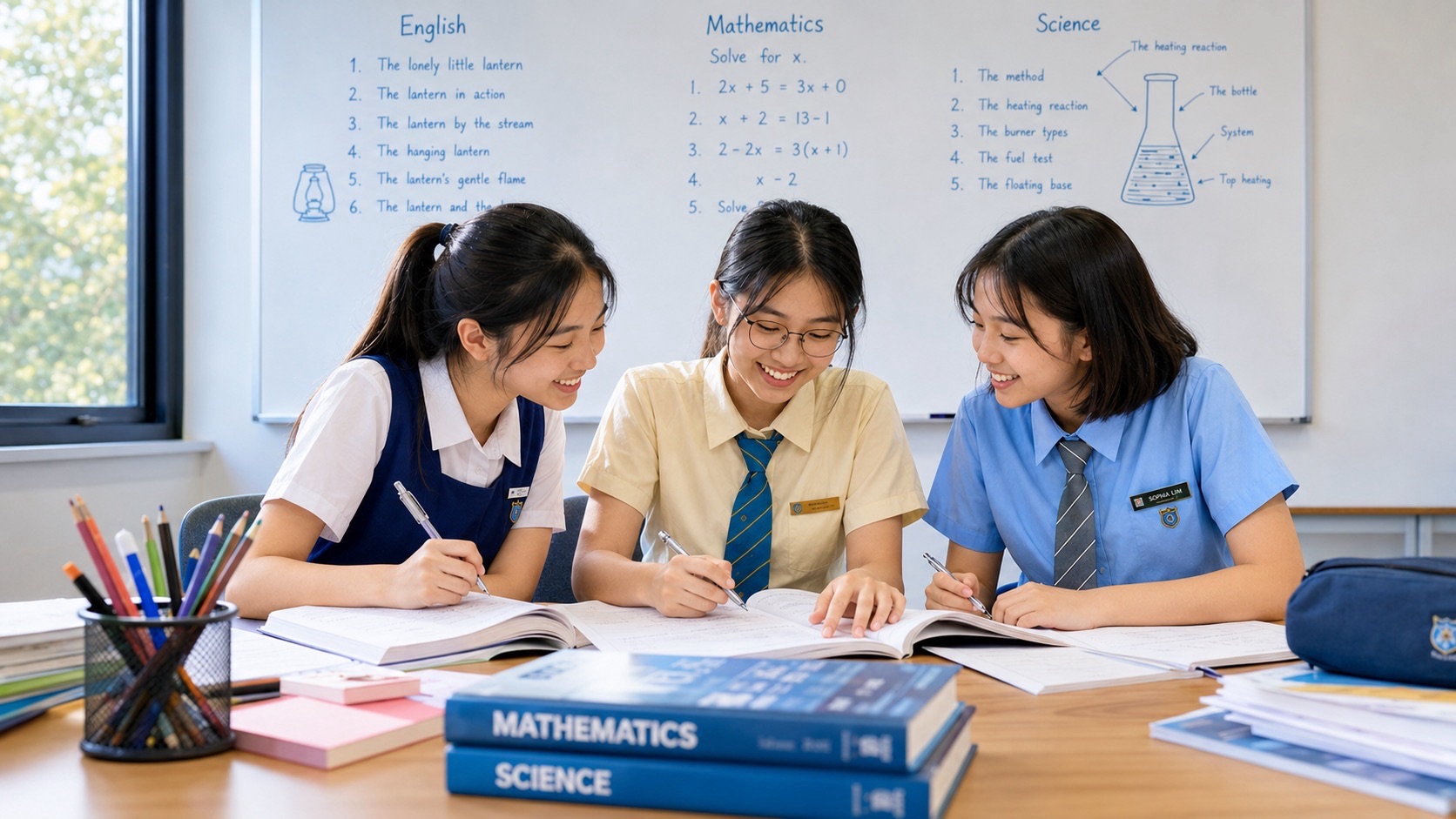
JC2 Physics tuition for Ghim Moh students should improve independent reasoning, not dependence on copied worked answers. A candidate may remember equations but still lose marks when an unfamiliar question requires identifying a system, checking assumptions, drawing a vector diagram or interpreting data. A well-run small group of up to three learners gives a tutor opportunities to inspect every student’s method, ask why it applies and test a correction with a new question. This is a potential advantage of close feedback, not a guarantee of a particular A-Level grade.
Families should begin by confirming the student’s registered subject and examination year. The published 2027 Singapore-Cambridge A-Level Physics syllabuses are H1 Physics 8867, H2 Physics 9478 and H3 Physics 9814. They are not interchangeable. H1 has two written papers; H2 has four papers, including practical Paper 4; H3 is additional advanced study built on H2. A useful tuition plan follows the actual syllabus, the student’s marked school work and the available time for rest and independent practice.
Quick information for Ghim Moh families:
- Confirm H1, H2 or H3 and the actual examination-year syllabus.
- Bring two recent marked scripts with original diagrams, calculations and teacher feedback.
- Ask the tutor to identify the first wrong assumption rather than merely correct the final answer.
- For H1, follow its distinct content scope and two written papers.
- For H2, include Paper 4 practical, measurement, data analysis and spreadsheet skills.
- For H3, check H2 foundations, calculus readiness, JC eligibility and workload.
- Verify the real tutor, teaching venue, class maximum, schedule, fee and travel time before enrolling.
What should a small-group tutorial actually change?
| Observed difficulty | Useful evidence of progress |
|---|---|
| Recognises formulas but cannot start unfamiliar questions | Identifies the system, conditions and governing principle without a chapter hint. |
| Uses a correct formula under invalid assumptions | States when the model applies and notices when conditions change. |
| Gets a numerical answer but loses explanation marks | Connects the principle to a precise physical consequence. |
| Struggles with practical or graph questions | Chooses axes, interprets gradients and evaluates uncertainty appropriately. |
| Works only when a tutor prompts the method | Solves a changed question independently after a delay. |
A realistic Ghim Moh tuition decision includes the whole journey
A JC2 student’s journey may start at a junior college outside Ghim Moh, continue to a teaching venue and then home. Count dismissal, transport, waiting, food, the lesson and the return trip. A class that occupies one hour on paper can consume a large part of an evening. Students also need time to retrieve and practise the concepts independently. A lesson that leaves them too tired to do that may not be sustainable.
eduKate has small-group tuition operations in Punggol and a learning location in Bukit Timah near Sixth Avenue MRT. This page is written for Ghim Moh families; it does not claim a JC2 H1, H2 or H3 Physics class is currently operating in Ghim Moh, nor does it confirm a vacancy at another location. An estate-specific guide is not a live timetable. Confirm the exact subject, tutor, venue, time, class size and fee directly before arranging travel or payment.
Some students need a specialist who can repair a conceptual difficulty affecting several topics. Others need only a short school consultation and focused independent practice. A learner with very different prerequisites may temporarily need one-to-one teaching rather than a mixed group. The best choice is the smallest sustainable intervention that addresses the actual problem, not the one with the most lessons.
Why JC2 Physics tests model selection
Earlier topical exercises often signal the intended method. A JC2 paper may combine principles or place a familiar concept in an unfamiliar setting. Candidates must decide what is being modelled, which variables change, what is held constant and which assumptions allow an equation to be used. Formula recognition is not the same as choosing a valid model.
Constant speed, for example, does not always mean zero acceleration. Velocity includes direction, so circular motion at constant speed still involves acceleration. Likewise, total energy conservation does not mean kinetic energy remains constant in every collision. Momentum conservation depends on the external impulse on the chosen system. Students who remember slogans but cannot state conditions may apply a law incorrectly.
A useful sequence is concise: identify the system; draw forces, fields or energy transfers; state the principle and its conditions; calculate; then check whether the result is reasonable. The learner should be able to explain the method in plain language before becoming faster. This avoids pages of mathematically tidy work built on a mistaken first assumption.
H1, H2 and H3: the published 2027 assessment routes
H1 Physics 8867
H1 Paper 1 is a one-hour multiple-choice paper weighted at 33%. Paper 2 is a two-hour structured paper weighted at 67%, including data-based work and a longer integrative choice. H1 has its own content scope. A tutor should not assign all H2 material simply because the student is in JC2.
H2 Physics 9478
The 2027 H2 structure is Paper 1 multiple choice (15%), Paper 2 structured questions (30%), Paper 3 longer structured questions (35%) and Paper 4 practical (20%). Paper 4 lasts two hours and thirty minutes and assesses planning, apparatus manipulation, measurement, data presentation, analysis and evaluation. Spreadsheet processing and analysis are part of the syllabus. Theory-only revision does not cover the whole H2 assessment.
H3 Physics 9814
H3 is an additional advanced course built on H2, which candidates should simultaneously offer. The 2027 paper lasts three hours and includes demanding structured questions; calculus is required in some questions. H3 is not a replacement for H2 or a remedial route for unstable foundations. Genuine interest, mathematical readiness, JC eligibility and total workload matter.
Use the SEAB 2027 A-Level syllabus directory and the official H1 Physics 8867, H2 Physics 9478 and H3 Physics 9814 documents. Students sitting in another year should use that year’s version.
Energy, forces and the difference between a mathematical answer and a physical answer
A 2.0 kg object starts from rest and descends through a vertical height of 4.0 m. In an ideal frictionless model, the decrease in gravitational potential energy is mgh = 78.4 J. If all becomes kinetic energy, ½mv² = 78.4 J and v ≈ 8.85 m/s. The result depends on the assumption that no mechanical energy is transferred elsewhere.
If 15.0 J is transferred to other forms during descent, final kinetic energy is 63.4 J and v = √(2 × 63.4/2.0) ≈ 7.96 m/s. The frictionless shortcut is no longer complete. Total energy remains accounted for, but mechanical energy of the chosen system has decreased.
A common collision error is similarly to assume kinetic energy is conserved simply because momentum is. The student must name the system and check external impulse before using momentum conservation, then separately decide whether the collision is elastic. A tutor should make these distinctions explicit before asking for more calculation practice.
How three students can learn without one person dominating
Imagine three learners facing the same question. One selects the right equation but overlooks a stated condition. Another understands the principle but draws an incorrect direction. The third reaches the correct number but cannot explain its physical meaning. If the tutor checks only the final answer, these errors remain hidden. A purposeful small group begins with an independent attempt, lets the tutor inspect each method and uses a shared discussion to expose differences.
After the explanation, every learner must solve a changed problem alone. This final step matters: hearing a peer explain a concept is not evidence that the listener can retrieve and apply it independently. The tutor should rotate who draws, calculates, explains and checks so the most confident student does not answer every question.
Peer discussion is useful when it is respectful and tied to evidence. Students can challenge assumptions, compare diagrams and ask what would make a method invalid. The teacher should differentiate follow-up work when necessary. A small group can still fail if learners have incompatible syllabus levels or one student receives little direct attention.
H2 practical Paper 4: classroom support is not laboratory replacement
For the published 2027 H2 syllabus, Paper 4 contributes 20% and includes experimental planning, manipulation and measurement, data presentation, analysis and evaluation. Candidates must process and analyse data using spreadsheet software. These skills should be visible in the revision plan.
A tutor can support the reasoning through supplied datasets, spreadsheet formulas, graph construction and discussion of experimental methods. Desk-based tuition cannot replace appropriate supervised laboratory work, apparatus handling or school safety instruction. Families should ask exactly which skills the tutor covers and how the lessons complement the school’s practical programme.
Repeated readings can help assess random variation but do not automatically remove systematic calibration errors. A fitted line may describe the measured range without proving a universal law. A spreadsheet that displays many decimal places does not mean the experiment supports that precision. A good student states what the evidence supports and what remains uncertain.
Six errors to identify before adding more lessons
- Reading: missing a condition, direction, unit or approximation.
- Model selection: using a familiar law outside its assumptions.
- Representation: inaccurate diagrams, axes, vectors or system boundaries.
- Execution: sign, prefix, algebra or significant-figure errors.
- Explanation: giving a number without the physical reasoning requested.
- Time management: spending too long on one question and missing accessible marks.
Bring two marked scripts and ask the tutor to find the earliest wrong decision. “Weak at Physics” is too broad. A specific diagnosis such as “uses mechanical-energy conservation after a resistive transfer is introduced” gives a clear teaching target. After correction, the student should solve a changed question several days later without being told which equation to use.
Four-week diagnostic and repair plan
Week 1: establish the starting point
Confirm the subject code and examination year. Review two scripts and one unseen diagnostic question. Classify errors and choose one conceptual weakness and one execution habit. Record what the student already does independently.
Week 2: rebuild the principle
Use a labelled diagram, concise explanation and the appropriate equation. Require the learner to state why the model applies before calculating, then complete a changed version independently.
Week 3: transfer to another situation
Change the data, diagram or condition so that the student must choose the method again. H2 students should also complete suitable data and spreadsheet exercises while continuing supervised practical experience at school.
Week 4: retest and decide
Use a short timed selection from the correct paper format and an unseen question on the original weakness. Compare model selection, explanation, units and timing with Week 1. Decide whether the class remains useful or whether school support and independent work now suffice.
Twelve-week A-Level revision runway
Weeks 1–2: audit the syllabus and marked work. Identify recurring errors that affect several question types.
Weeks 3–4: rebuild core ideas with diagrams, explanations and focused problems. Retest corrections after a delay.
Weeks 5–6: increase mixed-topic and data-based applications. H2 students maintain practical and spreadsheet preparation; H1 students follow their own scope; H3 students protect H2 foundations.
Weeks 7–8: practise timed sections and identify where minutes are lost. Use a short model-selection check before calculation.
Weeks 9–10: rehearse appropriate full papers and analyse the first faulty decision behind important errors. Retest ideas in changed contexts without hints.
Weeks 11–12: consolidate reliable methods, official instructions and personal error patterns. Protect sleep, meals and recovery. A student should reach the examination ready to think, not exhausted by an impossible schedule.
For broader planning, see eduKate’s JC2 A-Level twelve-week revision guide.
How parents can support without becoming the Physics tutor
Ask what the student can now explain independently. A specific answer about a corrected misconception is more useful than “we completed two chapters.” Encourage the learner to show an original wrong attempt, the corrected principle and a new problem solved without prompts. A brief error register can record the date, first wrong assumption and next retest, but it should guide practice rather than shame the learner.
Protect time for other subjects, food, sleep and independent retrieval. The purpose of tuition is to make learning more effective, not to fill every evening. If the class creates fatigue but little independent improvement, review the arrangement.
When a small group may not be the right choice
A group may not suit students with incompatible H1/H2/H3 requirements or very different learning speeds. A temporary one-to-one intervention may be better for a narrow foundational gap. School laboratory instruction is essential for supervised apparatus skills. A student already learning and self-correcting reliably may not need another weekly lesson.
Ask how the tutor handles a correct number reached through invalid reasoning, how participation is shared and whether every learner completes independent follow-up. Request the actual tutor, venue, fees, group maximum, duration and absence policies in writing. Do not infer current availability from an estate article.
Frequently asked questions: JC2 Physics tuition in Ghim Moh
Does a group of three guarantee a better A-Level grade?
No. It creates opportunities for close feedback, but teaching quality, syllabus match, starting knowledge and independent work determine whether it helps.
Can H1 students follow a full H2 programme?
Not by default. The courses have different content and assessment requirements. Use material aligned to the candidate’s registered subject and year.
Why is H2 Paper 4 important?
It contributes 20% in the published 2027 assessment and includes experimental and spreadsheet-based data skills. Classroom support complements, rather than replaces, supervised laboratory work.
Should every strong H2 student take H3?
No. H3 is additional advanced study with greater mathematical demands. Interest, readiness, school eligibility and workload matter.
Is a JC2 Physics class confirmed in Ghim Moh?
This guide does not confirm a local branch, live class, tutor or vacancy. Ask eduKate directly about actual H1/H2/H3 availability, venue, timetable and fees.
How can parents judge progress after one month?
Use an unfamiliar question that tests the original weakness. Look for independent model selection, accurate working and a clear explanation without prompts.
Continue reading in the eduKate Physics learning ecosystem
- The Gold Standard of JC2 Physics Tuition
- How to evaluate a JC2 Physics tutor
- The SEAB 2027 H1 and H2 Physics syllabus guide
- H2 Paper 4 practical and spreadsheet preparation
- How Junior College and A-Level pathways work
Final parent decision: choose JC2 Physics tuition only after confirming the registered syllabus, the student’s actual learning difficulty and the proposed teaching method. A worthwhile small group gives every learner direct feedback, builds independent reasoning and fits the wider JC2 timetable.
Reviewed against the published SEAB 2027 H1 Physics 8867, H2 Physics 9478 and H3 Physics 9814 syllabuses. Candidates should use the official requirements for their own examination year and verify live tuition details directly.
Why Physics is useful beyond examinations: model selection, evidence evaluation and clear explanation are relevant in engineering, technology, research and everyday decisions. A good student learns not only how to calculate, but when a conclusion is justified and where a model’s limits begin.