
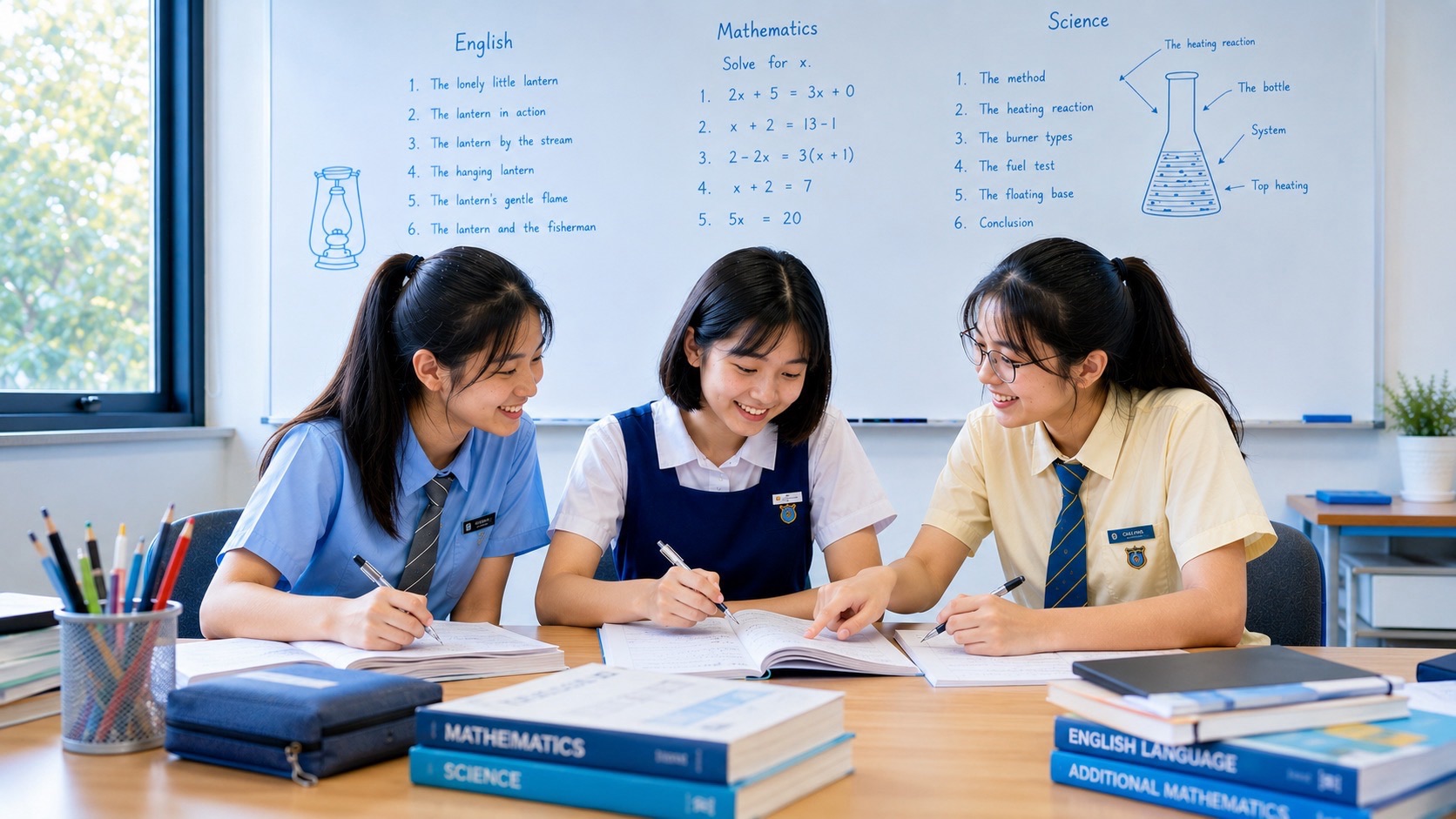
JC2 Physics tuition for Kallang students should help a learner build a physical model before reaching for an equation. At A-Level, a student can remember many formulae and still lose marks because they misread a condition, choose the wrong system, confuse vector direction or cannot interpret a graph. A well-managed small group of up to three learners gives a tutor time to inspect each person’s thinking, ask for a justification and check whether a correction transfers to a new problem. This is a potential advantage of the format, not a guarantee of a distinction.
Kallang families should begin by confirming the student’s actual Physics subject and examination year. The published 2027 Singapore-Cambridge A-Level courses are H1 Physics 8867, H2 Physics 9478 and H3 Physics 9814. They have different content and assessment structures. H1 uses two written papers; H2 has four papers including practical Paper 4; H3 is additional advanced study taken with H2. The family’s tuition decision should be based on marked school work, the student’s specific difficulties, the teacher’s ability to address the correct course and the real time cost of travelling to a lesson.
Quick information for Kallang JC2 parents:
- Confirm H1, H2 or H3 and obtain the syllabus for the actual examination year.
- Bring two recent marked papers with the student’s own workings, not only the total score.
- Ask the tutor to identify the earliest faulty reasoning step behind repeated errors.
- For H1, align practice to its scope and two written papers.
- For H2, include Paper 4 planning, measurement, data analysis, evaluation and spreadsheet skills.
- For H3, check strong H2 foundations, additional mathematical requirements and JC selection.
- Confirm venue, tutor, fees, lesson duration, maximum group size and the student’s complete travel schedule.
At a glance: what should small-group Physics tuition achieve?
| Student difficulty | Evidence of improvement |
|---|---|
| Recognises formulas but cannot select one | Describes the system and assumptions before choosing a principle. |
| Gets vector directions wrong | Labels axes, velocity, acceleration and force distinctly. |
| Writes an answer without explanation | Connects the governing principle to the stated physical conditions. |
| Struggles with practical data | Explains measurement uncertainty, graph choice, gradient and model limitations. |
| Repeats mistakes after revision | Uses targeted correction followed by delayed independent retesting. |
| Already works independently | Can judge whether school support and self-study are adequate without extra tuition. |
Kallang travel and the true cost of an extra class
Kallang is connected to several parts of Singapore, but a student’s journey may begin at a junior college elsewhere before a lesson starts. The right comparison includes dismissal time, transport, waiting, food, lesson duration, the trip home and remaining energy for school work. A class that appears short on a calendar may use much of the student’s evening. If the learner has no time to retrieve and practise a new explanation, the tuition may not deliver its full potential benefit.
eduKate operates small-group tuition in Punggol and has a learning location in Bukit Timah near Sixth Avenue MRT. This Kallang guide is not a claim that a present-day JC2 Physics class, teacher or vacancy is available in Kallang or at either other venue. An estate-specific article helps a family evaluate tuition, but it does not establish a physical branch. Confirm the actual H1/H2/H3 subject, teacher, location, schedule, group size and fee directly before committing.
Sometimes a specialist further away is the right choice because the learner has a persistent conceptual difficulty that needs careful repair. Sometimes a school consultation and a short home-practice plan are enough. If the student needs an unusual pace or one-to-one reconstruction, a shared group may not be appropriate. Parents should look for the smallest sustainable intervention that addresses the real problem rather than assuming more lessons must mean better outcomes.
Why JC2 Physics is about selecting and testing models
In earlier lessons, students often practise one concept at a time. A chapter on mechanics may introduce equations and show how to use them. In JC2, a question may combine several principles without naming the relevant chapter. The candidate must decide what system is being studied and which principle applies. This is different from remembering an equation after the chapter title has already told the student what to do.
Consider an object moving at constant speed around a circular path. Some students conclude that acceleration is zero because the speed has not changed. But velocity includes direction, and the direction is continuously changing. The object is accelerating towards the centre. A student who confuses speed and velocity may make errors in circular motion, orbital questions and magnetic deflection. The tutor should rebuild the vector concept, not simply assign another page of calculations.
Another common difficulty is using a conservation principle without checking its conditions. Momentum conservation depends on external impulse on the chosen system. Mechanical-energy conservation requires work and energy transfers to be treated correctly. A student who writes “energy is conserved” and assumes all lost potential energy becomes kinetic energy may overlook friction or another transfer. The first question is always what system is being considered and where energy can go.
Physics communication matters too. A student may write a number without direction, give an equation without identifying assumptions or describe a measured trend too strongly. A useful tutor helps learners say exactly what the evidence supports, with appropriate units and limitations.
H1, H2 and H3 Physics: the 2027 assessment differences
H1 Physics 8867
The published 2027 H1 assessment comprises Paper 1 multiple choice, one hour and weighted at 33%, and Paper 2 structured questions, two hours and weighted at 67%. Paper 2 includes compulsory structured and data-based questions and a choice of one longer integrative question. H1 is a distinct syllabus, not H2 with a few difficult questions removed. The tuition plan should be aligned to H1 content and written-paper demands.
H2 Physics 9478
The 2027 H2 examination contains Paper 1 multiple choice at 15%, Paper 2 structured questions at 30%, Paper 3 longer structured questions at 35% and Paper 4 practical at 20%. Paper 4 lasts two hours and thirty minutes and includes experimental planning, manipulation and measurement, observations, data presentation, analysis and evaluation. Spreadsheet data processing and analysis are stated requirements. A theory-only revision timetable does not cover the complete H2 assessment.
H3 Physics 9814
H3 Physics is an additional advanced subject that builds upon H2, which candidates should offer simultaneously. The 2027 H3 assessment includes a three-hour written paper with structured questions and more demanding mathematical work, including calculus in some questions. It is not an alternative to H2 and does not automatically improve H2 results. Students need genuine interest, strong foundations, mathematical readiness and enough space in their subject combination and timetable.
Use the official SEAB 2027 A-Level syllabus directory and subject documents: H1 8867, H2 9478, and H3 9814. Candidates in another examination year should use that year’s specification.
What a three-student tutorial looks like when it is working
Imagine three students tackling a circular-motion question. Student A writes the correct formula but places acceleration in the direction of motion. Student B draws an inward acceleration but adds a fictitious extra force to the diagram. Student C calculates the correct magnitude but does not state the direction. A tutor who checks only the number may overlook the conceptual weakness. A tutor who inspects every student’s diagram can give three precise corrections within one shared discussion.
The lesson begins with an independent attempt. Each learner draws the situation, labels directions and explains the first governing principle. The tutor compares the explanations, asks what each assumption means and then assigns a fresh problem. This creates a cycle of attempt, feedback and transfer. The most confident student should not answer everything while the others listen. All three need their own working and a chance to explain.
Peer discussion can help when students are allowed to challenge an idea respectfully. One might ask why a body has acceleration when speed is constant. Another can draw velocity vectors at two points and show that direction changes. The tutor connects that explanation to centripetal acceleration. The exchange makes the idea more memorable because learners have to justify it, not just hear it.
Group size has limits. A class of three may still be ineffective if students are at incompatible syllabus levels, if one learner requires much more foundational support or if the tutor does not differentiate tasks. Parents should ask how individual progress is checked and whether the same error is revisited later. A genuine small-group benefit is visible in the student’s independent work after the lesson.
Worked example: circular motion and acceleration direction
Consider an idealised object of mass 1.2 kg moving at constant speed 8.0 m/s around a circular path of radius 4.0 m. The centripetal acceleration magnitude is a = v²/r = 64/4.0 = 16 m/s² towards the centre. The net inward force is F = ma = 1.2 × 16 = 19.2 N. Constant speed does not mean zero acceleration because the velocity direction changes continuously.
If speed increases to 12.0 m/s with the same radius, acceleration becomes 144/4.0 = 36 m/s². Speed increases by 50%, but acceleration increases by 125%. This follows because speed is squared. A learner who expects a 50% increase in acceleration has treated the formula as linear. The tutor should ask for a prediction before calculation so the student learns to anticipate the physical trend.
The source of inward net force depends on the arrangement. It may be tension, gravity, contact forces or a combination. “Centripetal force” describes the resultant towards the centre; it is not automatically a separate force to add to the free-body diagram. Students should identify actual interactions and resolve the net radial component.
Worked example: current, internal resistance and terminal voltage
Suppose an ideal cell has e.m.f. E = 9.0 V and internal resistance r = 1.0 Ω. It is connected to an external resistor R = 2.0 Ω. The total resistance is 3.0 Ω, so current is I = 9.0/3.0 = 3.0 A. The terminal p.d. across the external resistor is V = IR = 6.0 V. The same result follows from V = E − Ir = 9.0 − 3.0 = 6.0 V.
Now replace the external resistor with 8.0 Ω, keeping E and r unchanged. Current falls to 9.0/(8.0 + 1.0) = 1.0 A. Terminal p.d. rises to 8.0 V. It may seem surprising that voltage rises while current falls, but the voltage lost across the internal resistance has become smaller. A student must specify which voltage is meant and what conditions are held fixed.
Plotting terminal p.d. V against current I gives V = E − Ir. The vertical intercept represents E and the gradient is −r. The negative slope indicates a decreasing terminal p.d. as current increases; it does not mean the physical resistance is negative. The slope’s unit V/A is equivalent to ohms. This is a useful example of the link between an equation, a graph and a physical explanation.
Worked example: average force and momentum change
Suppose a 0.20 kg ball moves towards a wall at 10 m/s and rebounds in the opposite direction at 8.0 m/s. Define the direction towards the wall as positive. Initial momentum is +2.0 kg m/s and final momentum is −1.6 kg m/s. The change in momentum is −3.6 kg m/s. If contact lasts 0.030 s, average net force is Δp/Δt = −3.6/0.030 = −120 N, meaning 120 N opposite to the chosen positive direction.
The sign is meaningful. A student who reports only “120 N” has omitted direction. Another may incorrectly use 10 − 8 = 2 m/s as the velocity change, forgetting that the ball reverses direction. Momentum uses signed velocity, so the correct change in velocity is −8 − 10 = −18 m/s. These errors are easy to miss when a student memorises an impulse formula without drawing the before-and-after motion.
Now change the contact time while keeping the same momentum change. If time doubles, the magnitude of average force halves. This connects the mathematical relationship to cushioning and impact duration without pretending a school-level average-force calculation describes every detail of a real collision.
Graphs and data: how to interpret a slope without guessing
For a straight line y = mx + c, the gradient m is the change in y divided by the change in x. Its units depend on both axes. In a displacement–time graph, the gradient represents velocity; in a velocity–time graph it represents acceleration. A student who reverses the axes or reads the vertical value as the gradient may misinterpret an otherwise correct-looking graph.
For a cell with internal resistance, V = E − Ir. A V-against-I graph has gradient −r and intercept E. The negative slope reflects the fact that terminal voltage decreases as current increases in the ideal model. If the axes are reversed, the slope becomes −1/r. The student must derive this rather than copy a memorised statement.
Experimental data are not perfect. Repeated measurements can help estimate random variation, but a consistent calibration error can remain. A fitted line may represent a trend over the tested interval without proving the same relationship holds outside it. A careful answer identifies what the observations support and any uncertainty that limits the conclusion.
The H2 practical assessment: planning, measurements and spreadsheets
The 2027 H2 Physics assessment includes Paper 4 practical worth 20%. Students are assessed on planning, manipulation and measurement, observations, data presentation, analysis and evaluation. Candidates must process and analyse data using spreadsheet software. This means H2 students need a practical strand in their preparation, not simply more written theory questions.
A tutor can practise data reasoning with supplied tables, ask students to derive a suitable relationship, use spreadsheet formulas and make labelled graphs. But desk-based tuition cannot replace safe hands-on apparatus work under appropriate supervision. Students should continue following the school’s laboratory programme and safety instructions.
Practical questions often test scientific judgment. Learners should distinguish random variation from systematic bias, explain why repeated readings may help, and avoid reporting more precision than the measurements support. A trendline should be physically justified. An anomalous reading should be investigated rather than automatically removed because it makes the graph less neat.
In a class of three, roles can rotate: one checks data entry and units, another explains axis selection and the third evaluates the conclusion. Everyone should eventually perform each task independently. For additional detail, read eduKate’s H2 Physics Paper 4 and spreadsheet guide and the official 2027 H2 syllabus.
Six kinds of mistakes to diagnose
- Question reading: missing a condition, direction or stated approximation.
- System choice: using a conservation principle without checking the system and external influences.
- Diagram: incorrect vector, force, field, polarity or axis.
- Calculation: algebra, sign, prefix or unit error.
- Explanation: a numerical answer with no physical reasoning or evaluation.
- Timing: spending too long on one difficult part and missing manageable marks.
A useful first consultation begins with original student work. “Weak at mechanics” does not tell a tutor what to teach. “Uses the direction of velocity as the direction of acceleration in circular motion” is a precise diagnosis. “Weak at momentum” is broad. “Does not reverse the sign of velocity after rebound” identifies a teachable error.
After correction, test a new problem after a delay. If the learner can independently select the model, draw an accurate diagram and explain the result, the idea has become more transferable. Copying a corrected solution immediately after seeing it is a weaker sign of learning.
Four-week JC2 Physics improvement plan
Week 1: confirm the course and inspect the work
Check the subject code and examination year. Review two marked papers and give one short question without hints. Sort mistakes into knowledge, model selection, diagram, calculation, explanation and timing. Select the most influential conceptual gap and one execution habit.
Week 2: rebuild the underlying principle
Use a clear diagram and explanation before the equation. For motion, distinguish speed, velocity and acceleration. For electricity, identify the whole circuit and the difference between e.m.f. and terminal p.d. For momentum, define direction and the system before calculating. Each student should explain the idea in their own words.
Week 3: change the problem conditions
Provide a variation that changes the radius, external load, collision direction or resistance. Ask students to state which assumptions remain valid. H2 students should also continue the appropriate practical and spreadsheet work within the school’s supervised programme.
Week 4: retest and review
Use a timed selection from the correct paper level and an unseen question on the original weakness. Compare reasoning, units, diagram accuracy and time with the first week. Decide whether the group is still useful or whether school feedback and independent practice now suffice.
Twelve-week A-Level preparation without panic
Weeks 1–2: map the syllabus and repeated mistakes. Identify the concepts that affect several question types, rather than labelling every chapter weak after a difficult paper.
Weeks 3–4: rebuild core reasoning with diagrams, concise explanations and carefully selected examples. Retest a corrected idea later without the previous solution visible.
Weeks 5–6: increase mixed-topic and data questions. H2 students retain practical and spreadsheet preparation; H1 students use their own content scope; H3 candidates protect H2 foundations while studying the additional course.
Weeks 7–8: practise timed sections and review the points at which time is lost. Teach a short model-selection check before calculation and sensible decisions about moving on from an unusually difficult question.
Weeks 9–10: rehearse full papers when appropriate and review the first faulty reasoning step in important errors. Retest the concept later with new numbers or a changed diagram.
Weeks 11–12: consolidate personal error patterns, official exam instructions and stable methods. Protect meals, sleep and recovery. A tired student may find it harder to apply knowledge they already possess.
Use the JC2 A-Level twelve-week revision guide as a broader subject-combination plan.
How parents can support without teaching Physics
Ask the student what they can now explain without a hint. A clear answer such as “I can distinguish the direction of acceleration from the direction of motion” is more informative than “we did twenty questions.” Encourage the learner to show one corrected error and one new problem solved independently.
Keep the timetable manageable. JC2 has demands across several subjects, and extra tuition must leave enough time for independent retrieval, food, sleep and family life. More formal lessons can be counterproductive when the student has no time to practise what was taught. The goal is sustainable improvement, not a crowded timetable.
Why Physics habits matter outside school
Mechanics and electricity support understanding of transport, engineering, power systems and technology. The school models are simplified, but they teach habits: identify the system, check assumptions, distinguish vector quantities and interpret evidence. A learner who does this is better prepared to question a numerical claim rather than accept a formula because it looks familiar.
Graph literacy is useful in public information too. A chart about energy use or device performance should be read with units, axes, measurement range and uncertainty in mind. A mathematically neat result can still be physically misleading if the underlying model is unsuitable. The ability to express limits honestly is part of good scientific communication.
When a small group is not the best intervention
A group may not be suitable if learners study incompatible H1, H2 and H3 syllabuses or have very different starting points. A short one-to-one intervention may be more effective for a narrow foundational gap. School support is essential for practical apparatus and supervised laboratory work. A student who already learns independently may not need tuition at all.
Ask the tutor how they respond when a student gets the right number for the wrong reason. A credible answer describes questioning the assumption, varying the task and retesting the model. Ask how individual participation is ensured and what happens if a student falls behind. These answers are more informative than claims of guaranteed distinctions.
No current JC2 Physics tuition fee, Kallang class slot or vacancy is verified here. Request the full fee, actual venue, teacher, lesson duration, materials, maximum group size and absence policies directly before enrolment.
Frequently asked questions: Kallang JC2 Physics tuition
Does a class of three guarantee a better grade?
No. It creates the possibility of more individual observation and feedback, but teaching quality, syllabus match, starting point and independent work matter more than the number alone.
Can H1 students use all H2 Physics worksheets?
No. The syllabuses and assessment structures differ. Use material that matches the student’s official H1 course and year.
Why does H2 include a practical Paper 4?
The 2027 H2 assessment includes a separate practical component weighted at 20%, with experimental and data-analysis skills including spreadsheets. Appropriate supervised laboratory learning remains important.
Can H3 replace H2 Physics?
No. H3 is additional advanced study built upon H2, which candidates should offer simultaneously.
What if the student is strong in theory but weak in practical work?
Check whether the difficulty is experimental planning, measurement, data handling, spreadsheet operations or evaluation. Maintain supervised school practical learning while targeting the specific gap.
Is there a confirmed eduKate JC2 Physics class in Kallang?
This guide does not confirm a Kallang branch, teacher or available seat. Ask eduKate directly for actual H1/H2/H3 availability, venue, timetable and fees.
How can we tell if four weeks of tuition helped?
Use a new problem testing the original weakness and check independent model selection, diagrams, units and explanation. Attendance alone is not proof of progress.
Should we add another class when the student is exhausted?
Not automatically. Compare the expected gain with travel, sleep and independent study. A shorter intervention or school consultation may be more effective.
Continue reading at eduKateSG
- What good JC2 Physics tuition should accomplish
- How to choose a JC2 Physics tutor
- The SEAB 2027 H1 and H2 Physics syllabus guide
- H2 Paper 4 practical and spreadsheet preparation
- How Junior College and A-Level pathways work
Final parent decision: choose JC2 Physics tuition only after the registered syllabus, the student’s actual difficulty and the proposed teaching method are clear. A small group is worthwhile when it builds independent reasoning and fits the student’s wider JC2 schedule.
Reviewed against the SEAB 2027 H1 Physics 8867, H2 Physics 9478 and H3 Physics 9814 published syllabuses in November 2026. Candidates should use the official documents for their own examination year and verify live tuition details directly.