
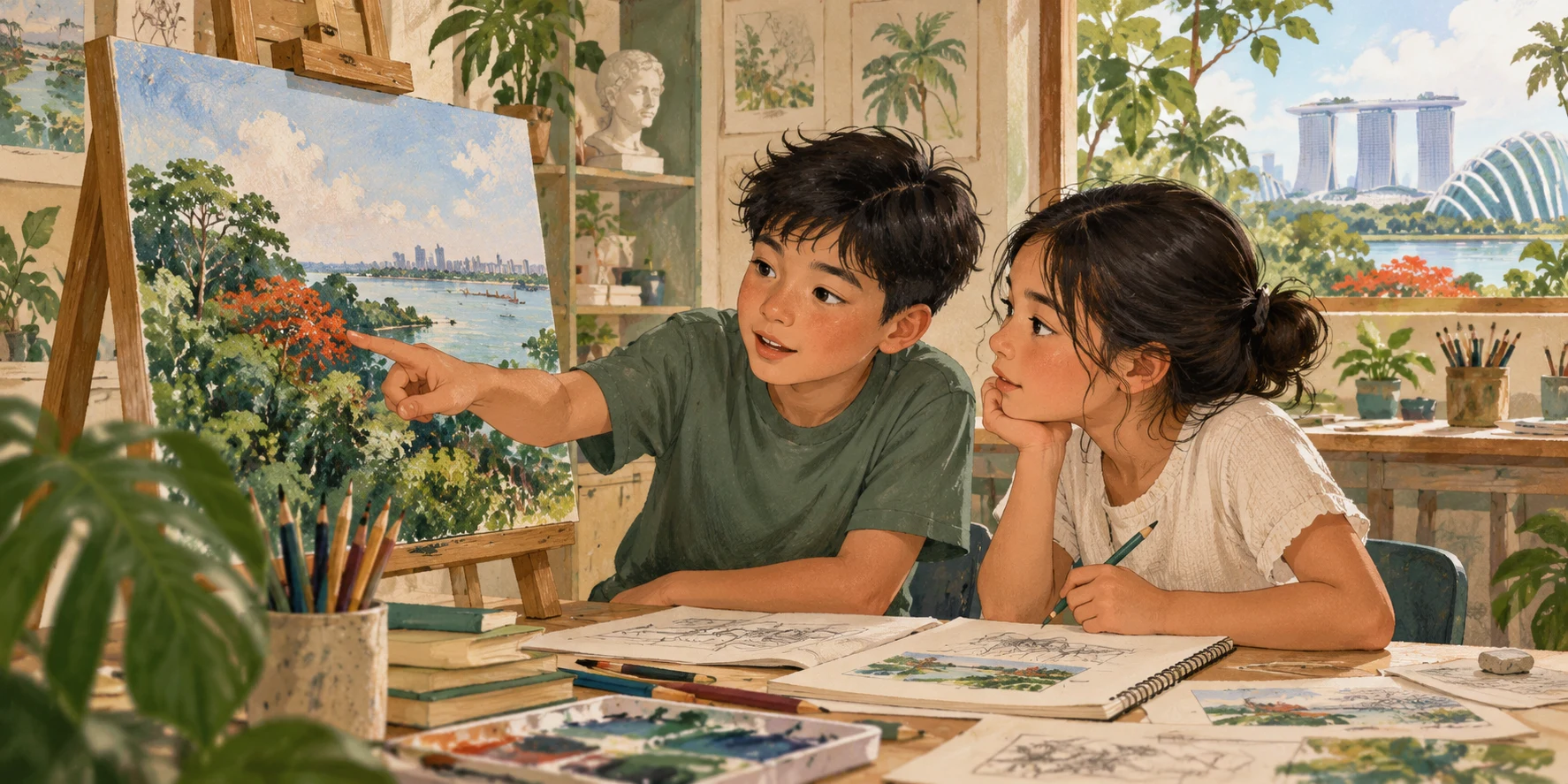
Did you know that G2 Art is assessed through both responding to an unfamiliar artwork and showing how an artistic practice develops? In the 2027 Singapore–Cambridge Secondary Education Certificate, G2 Art is syllabus K236. The examination rewards careful observation, personal interpretation, purposeful exploration and reflection—not simply a polished drawing.
Paper 1 is a 2-hour-15-minute Visual Response assessment worth 50%. Paper 2 is a 30-hour Portfolio completed within twelve weeks and contributes the other 50%. Understanding the written visual-analysis task, the exploratory-sketching requirements and the documented portfolio process can help parents support the learner without taking over the work.
This guide follows the official 2027 SEAB K236 school-candidate syllabus. Every example and suggested practice scenario here is illustrative and not a released national examination task. Portfolio rules and final submission arrangements must be confirmed through the school.
Find the answer you need
- Do you know which 2027 SEC Art subject this guide covers?
- Do you know how the two G2 Art papers contribute to the SEC result?
- Do you know what Paper 1 Section A asks students to do?
- Do you know why exploratory sketching is not a finished painting?
- Do you know which drawing materials the written paper permits?
- Do you know the five skills behind Paper 1 marking?
- Do you know why observing before interpreting matters?
- Do you know what the three Big Ideas are?
- Do you know what the three learning domains mean?
- Do you know why journals, conversations and portfolios appear throughout the course?
- Do you know what Paper 2 Part A requires?
- Do you know why Fine Art and Design or time-based work must both appear?
- Do you know what the maximum of ten screens really means?
- Do you know what Paper 2 Part B asks for?
- Do you know why citations are part of a good Art portfolio?
- Do you know what artistic intent means?
- Do you know why colour, line and space are not just vocabulary lists?
- Do you know how visual strategies deepen an idea?
- Do you know how design concepts appear inside an Art curriculum?
- Do you know what context adds to art interpretation?
- Do you know how to make an art conversation productive?
- Do you know why experimentation sometimes looks unfinished?
- Do you know how to use digital imaging responsibly?
- Do you know why the portfolio must be managed across twelve weeks?
- Do you know how to practise for 2 hours 15 minutes of Paper 1?
- Do you know how to respond to an artwork without one “correct” story?
- Do you know why G2 Art is different from G3 Art?
- Do you know what school candidates and private candidates should check?
- Do you know which mistakes most often limit progress in G2 Art?
- Do you know how an eight-week Art skill plan might work?
- Do you know what parents should ask teachers about K236?
- Do you know the most useful FAQs for G2 Art K236?
Do you know which 2027 SEC Art subject this guide covers?
This guide concerns G2 Art, syllabus K236, under the 2027 Singapore–Cambridge Secondary Education Certificate. Its earlier GCE N(A)-Level reference was 6127. It is a school-candidate subject that develops visual observation, experimentation, artistic intention and informed discussion. It should not be confused with G3 Art K347 or Higher Art K348, whose examination requirements are separate.
Before planning lessons, obtain your child’s exact registered subject code and the 2027 syllabus. A generic “art portfolio” lesson might be valuable creatively, but examination preparation needs to develop the particular skills and documented processes assessed in K236. The purpose is original learning, not an adult-produced portfolio.
Do you know how the two G2 Art papers contribute to the SEC result?
Paper 1, Visual Response, lasts 2 hours 15 minutes and carries 50 marks, representing 50% of the overall grade. Paper 2, Portfolio, is also 50 marks and 50%; its official period is 30 hours within 12 weeks. The portfolio is internally assessed by the school and externally moderated, while Paper 1 is externally marked.
This balanced weighting is important for families. A beautiful existing portfolio cannot replace analysing an unseen artwork and developing an exploratory response under examination conditions. Conversely, quick sketching drills cannot substitute for meaningful exploration, documented growth and reflective commentary accumulated across the portfolio period.
Do you know what Paper 1 Section A asks students to do?
Section A of Paper 1 is Visual Analysis worth 10 marks. It provides one unseen visual stimulus and a question with two sub-parts. Candidates must describe or interpret what is visible and also analyse or evaluate the stimulus or some aspect of it.
A useful preparation routine begins with objective observation: identify shapes, relationships, focal points, composition and other directly supported features. Then explain what those choices may suggest or achieve. A pupil who leaps immediately to “this picture is about loneliness” without citing a visible detail has asserted an interpretation rather than demonstrated close analysis.
Do you know why exploratory sketching is not a finished painting?
Paper 1 Section B carries 40 marks. Candidates develop purposeful sketches and annotations in response to the visual stimulus and a Big Idea, culminating in a concept for a two-dimensional composition or design. The syllabus states that this is not intended as a finished solution. Rendering, shading and colouring are not expected for the exploratory sketches.
Strong practice shows changes in composition, relationships and meaning across alternatives. A clear annotation may explain why enlarging one subject or changing a viewpoint better communicates the idea. Endless polishing of the first sketch can leave little evidence that the candidate explored and evaluated possible directions.
Do you know which drawing materials the written paper permits?
The 2027 K236 syllabus permits items such as pens, markers and HB or B pencils, with coloured pencils and coloured markers allowed. It prohibits dry media such as charcoal, soft graphite, chalk or soft pastels and oil pastels, as well as all wet media for Paper 1.
These are examination-specific rules, not a declaration that other media are unsuitable for art learning. In school studio lessons, a much wider range may be explored. For timed paper practice, however, pupils should become comfortable working within the exact permitted media and any further school or SEAB instructions.
Do you know the five skills behind Paper 1 marking?
Paper 1’s assessment criteria are Visual Analysis, Exploration of Visuals and Ideas, Creative Synthesis, Artistic Perception and Visual Communication, and Personal Interpretation. These criteria explain why a plausible drawing is not necessarily enough. An effective response must engage with the given artwork, develop ideas and communicate a personally meaningful interpretation.
Ask the learner to identify one visual decision they changed and why. If the child cannot explain how an observed quality of the stimulus influenced the concept, that connection may need work. Practice must move beyond copying appearances toward intentional visual reasoning.
Do you know why observing before interpreting matters?
An unseen image can tempt students to write an invented story. Start with what can be noticed: placement, scale, contrast, repetition, overlap, gesture, texture or unusual combinations. Then distinguish observation from inference. “The small figure is positioned beneath much larger forms” is observable; “the figure feels overpowered” is an interpretation requiring explanation.
A parent can use an ordinary photograph or artwork to practise this discipline, without presenting it as an official paper. Ask for three accurate observations and one possible interpretation grounded in them. A different defensible interpretation can also be valid when supported by visible evidence.
Do you know what the three Big Ideas are?
The G2 Art syllabus organises learning around three Big Ideas: Art helps us to see in new ways; Art tells stories about our world; and Art influences how we live. They connect artistic practice to perception, culture, communication and social experience.
For instance, an artist might make a familiar public corridor appear strange by changing scale or viewpoint; another could use images to reflect personal memories of that space; a designer might influence how people navigate it. These are illustrative applications rather than compulsory project topics. The learner’s responsibility is to form a relevant inquiry and express a coherent intention.
Do you know what the three learning domains mean?
The syllabus identifies Perceive, Communicate and Appreciate. Perceive involves gathering and analysing visual information. Communicate involves developing and realising visual or tactile expressions. Appreciate requires reflection, discussion and understanding of art’s relationship with wider society and culture.
These domains overlap. A student who studies a Singaporean artwork may first notice visual details, then develop a response through their own medium and finally evaluate how both works communicate ideas. The learning is a cycle of seeing, making and questioning rather than three disconnected textbook chapters.
Do you know why journals, conversations and portfolios appear throughout the course?
K236 names Art Journalling, Art Conversations and Building Portfolios as core learning experiences. A journal can capture first observations, technical trials, references and revisions. A conversation helps learners articulate, question and refine ideas. A portfolio selects evidence of the learning journey and the relationship between processes and outcomes.
This matters because a polished final picture alone cannot show what the student discovered. Encourage dated, authentic records rather than retrospective stories invented to make the process sound impressive. The best documentation explains what changed between an early experiment and a later decision.
Do you know what Paper 2 Part A requires?
Paper 2 Part A, Selection of Visual Materials, is worth 30 of the portfolio’s 50 marks. The submission is limited to a maximum of ten screens illustrating artistic exploration and processes and must include at least two art forms and media from the specified categories.
Selection matters as much as volume. Instead of displaying twenty near-identical sketches, a learner can choose representative pieces that show influences, experimentation, technical development and changes in intention. Make the sequence understandable to a reader who was not present in the studio. Each selected screen should answer a question about artistic growth.
Do you know why Fine Art and Design or time-based work must both appear?
The syllabus specifies exploration of at least two additional elective art forms, including at least one from Fine Art and one from the Design or time-based categories. Examples of Fine Art include painting, printmaking and mixed media; design-related areas can include illustration, visual communication and product concepts; time-based forms may include animation or video.
The requirement should guide exploration, not trigger an unrelated extra product. The student should explain how the different media enable distinct ways of expressing an idea. Consult the teacher about the school’s approved forms, available resources and expected evidence.
Do you know what the maximum of ten screens really means?
A maximum of ten screens is a selection constraint for the portfolio’s Part A. It is not an instruction to produce only ten pieces of artwork throughout the course. Learners may investigate and create more work as part of development, then select the evidence that best documents growth within the official submission format.
A sensible selection framework asks: Does the item explain an influence? Does it show experimentation or a revision? Does it demonstrate a distinct medium? Does it clarify the final intention? Screens filled with decorative filler can obscure rather than communicate a meaningful process.
Do you know what Paper 2 Part B asks for?
Part B, Commentary, is worth 20 of the portfolio’s 50 marks. It asks the candidate to articulate personal artistic growth through two works, in no more than 500 words and under eight A4-sized pages. The commentary should connect artistic intention, experimentation, learning and the influence of others, using relevant subject language and appropriate attribution.
A useful writing plan identifies an initial intention, a technical or conceptual challenge, evidence of change and what the finished works communicate. It should not simply narrate “first I drew, then I coloured, then I finished”. Reflection requires explaining the significance of decisions.
Do you know why citations are part of a good Art portfolio?
Artists learn from works, photographs, styles and ideas produced by others. The syllabus explicitly asks candidates to acknowledge sources and appropriately identify connections between their work and others’ expressions. Merely pasting an inspiration image without identifying its origin can weaken a portfolio’s credibility.
Teach the student to record an artist or creator, title where known, source and what precisely was learned from that reference. The aim is not to erase influence; it is to demonstrate informed, ethical transformation into original work. Never present traced or copied material as an independent creation.
Do you know what artistic intent means?
Artistic intent is what the candidate is trying to communicate, explore or make an audience consider. It can change as research, observation and experimentation reveal new possibilities. A meaningful intention is more specific than “I want to make something nice”; it connects subject, visual choices and an audience or personal perspective.
A learner might explore how spaces feel crowded or peaceful at different times of day. Their choices of composition, contrast and scale then have a purpose. Ask them to explain why one version achieves the intention more effectively than another.
Do you know why colour, line and space are not just vocabulary lists?
Visual qualities include line, shape, form, colour, texture, space and value. Students should know these terms and use them to analyse how an artwork communicates. For example, a high-contrast focal point may direct attention, while broad negative space can affect the perceived mood or balance.
A good practice task compares two arrangements of the same objects and asks how the visual experience changes. No need to attach a fixed emotion to every colour; meaning depends on context and relationships. Interpret what the work actually shows rather than memorise universal psychological rules.
Do you know how visual strategies deepen an idea?
Beyond elements and principles, the syllabus introduces strategies such as appropriation, juxtaposition, layering and the interaction of text and image. These can reshape how viewers interpret ordinary material. For example, placing a familiar urban object next to an unexpected natural form may invite questions about development and landscape.
Using a strategy is not a shortcut to originality. The student must decide what relationship it creates and why that relationship matters. Practice with invented compositions and document the choices; do not rely on copying a famous artist’s composition without personal exploration.
Do you know how design concepts appear inside an Art curriculum?
K236 also introduces design concepts such as stylisation, typography, visual hierarchy and editorial layout. This helps students see art’s influence on posters, packaging and public communication. A typeface or image placement can prioritise information and affect accessibility, rather than simply make a page decorative.
A child could compare two fictional event posters with the same message. Which can be read quickly? Which uses contrast to clarify the main information? The justification should name visual choices and intended audience. This integrates visual analysis with purposeful design.
Do you know what context adds to art interpretation?
An artwork may reflect the maker’s lived experience, place, culture or historical moment. Context can help explain why a symbol, material or visual choice matters, but the interpretation must remain grounded in the particular work. A Singaporean artwork is not automatically about a single national theme just because the artist is Singaporean.
Invite the learner to distinguish what the work shows, what background information is documented and what personal associations they bring as a viewer. A nuanced response acknowledges that different audiences may understand the same work differently.
Do you know how to make an art conversation productive?
Instead of asking only “Is it nice?”, ask “Where does your eye go first?” and “Which change most affects your understanding?” Encourage the learner to point to specific elements and listen when someone else sees a different possibility. The goal is not to force consensus but to develop accurate observation and articulate reasoning.
A group discussion can reveal unintended effects in a composition. The student can then decide whether to retain, revise or clarify that ambiguity and record the reason. Thoughtful explanation demonstrates growth even when the final choice remains personal.
Do you know why experimentation sometimes looks unfinished?
The process of art involves trial, failure, revision and recombination. A quick material test or awkward sketch may reveal more about what a student is learning than a highly polished but repeated image. The portfolio should document selected evidence of that development.
Families can support experimentation by giving the learner space to test a technique safely and to discuss results. Avoid urging every sketch to become exhibition-ready. A teacher’s assessment is concerned with the quality of inquiry and communication, not simply the number of perfectly finished pages.
Do you know how to use digital imaging responsibly?
Drawing and digital imaging are foundational forms in the K236 syllabus. Digital tools can help with observation, image organisation and testing visual arrangements, subject to school requirements. A digital image may also be reference material whose source and transformations need to be documented.
The presence of editing software does not authorise fabricated evidence or copied work. Students should retain authentic source records and explain which visual decisions were theirs. For assessed submissions, follow the school’s explicit instructions regarding device use, image manipulation and what constitutes the candidate’s own work.
Do you know why the portfolio must be managed across twelve weeks?
The official Paper 2 period is 30 hours within twelve weeks. It is a supervised assessment process, not an invitation to complete all artwork over a weekend or outsource it. Students need time to compare directions, test media, discuss influences and select work for the commentary.
An illustrative plan allocates early time to inquiry and reference gathering, middle sessions to experimentation and iteration, and later time to selecting evidence and writing reflection. Actual schedules and permitted working arrangements come from the school and assessment authority. Leave buffer for practical setbacks and technical issues.
Do you know how to practise for 2 hours 15 minutes of Paper 1?
Timed practice should include both writing and exploratory drawing. A pupil needs to read the stimulus, articulate observations, develop an interpretation and generate annotated alternatives without becoming absorbed in unnecessary rendering. The 10-mark and 40-mark sections suggest different workloads, but no universal minute-by-minute strategy suits every student.
After a timed session, examine where effort was spent. If the written analysis is detailed but sketch development is cursory, practise generating alternatives faster. If sketches are elaborate but unrelated to the stimulus, work on connections between observation, Big Idea and intention.
Do you know how to respond to an artwork without one “correct” story?
Art analysis can allow more than one reasonable interpretation, but evidence still matters. A student should distinguish describing visible details from explaining how a combination of elements shapes meaning. A personal response should not be an untestable guess disconnected from the presented work.
For practice, take a hypothetical image of a nearly empty playground at sunset. One reading might emphasise quiet, another the passage of time. The learner should identify elements that support each and explain which interpretation is most persuasive. The image example is invented, not part of a SEAB paper.
Do you know why G2 Art is different from G3 Art?
The official G2 Art K236 and G3 Art K347 have separate syllabuses, paper structures and expectations. Do not assume that borrowing an older G3 Coursework checklist provides accurate guidance for the K236 portfolio. Even when both develop creativity, their assessment specifications must be read separately.
A student working at G2 can still gain from artist research and sophisticated visual discussions, but their examined paper and portfolio must follow K236. If a family considers a subject-level change, ask the school about eligibility and readiness instead of presuming that a high mark in one studio assignment creates automatic admission to another level.
Do you know what school candidates and private candidates should check?
K236 appears on the 2027 SEAB G2 school-candidate syllabus list but is not listed in the published G2 private-candidate catalogue. A family should not assume that independent registration is possible simply because the curriculum PDF can be downloaded publicly.
Schools organise the portfolio’s internal assessment and moderation. For all entry, assessment and submission questions, use the school’s current instructions and SEAB’s authoritative information. Downloading a specimen or creating a portfolio privately does not by itself establish examination eligibility.
Do you know which mistakes most often limit progress in G2 Art?
Look for several distinctive gaps: sketches not connected to observations, incomplete exploration of alternative concepts, weak explanation of intention, an unfocused portfolio selection, copying without attribution and a commentary that describes activity but does not evaluate growth. Each weakness needs a different type of practice.
A student with strong drawing technique might benefit most from verbal interpretation. A student with strong ideas but unclear visuals may need sketching and composition drills. Diagnose from genuine artwork and teacher feedback, not from a comparison with a friend who uses different media.
Do you know how an eight-week Art skill plan might work?
Weeks 1–2: practise visual description and interpretation using unfamiliar works. Weeks 3–4: experiment with composition, viewpoint and annotated sketches. Weeks 5–6: compare media, analyse artist influences and maintain an honest process journal. Weeks 7–8: practise timed visual responses and explain decisions in short reflections.
This is an independent learning illustration, not a replacement for the fixed 12-week assessed portfolio window. Focus on skills pupils can transfer to new stimuli. Teachers must remain responsible for managing assessed coursework, and the student must author their own portfolio.
Do you know what parents should ask teachers about K236?
Ask which paper skill most needs improvement: observation, visual analysis, idea exploration, creative synthesis or personal interpretation. Ask whether the student understands the allowed Paper 1 materials and the school-supervised Paper 2 deadlines. If work is being selected for the portfolio, ask the teacher what authentic evidence best shows artistic development.
A parent can encourage curiosity, preserve time and provide ordinary art materials, but should not take over the student’s assessed work. Better support means asking useful questions, not producing the final composition or writing the commentary for them.
Do you know the most useful FAQs for G2 Art K236?
Is G2 Art only a drawing examination? No. Paper 1 combines visual analysis and exploratory sketching, while Paper 2 is a portfolio and commentary. Are the papers equally weighted? Yes, 50% each. Is the portfolio unrestricted? No: the 2027 specifications limit Part A to ten screens and Part B to a 500-word commentary on two works under eight A4 pages.
Are pastel or wet media allowed in Paper 1? No; follow the explicit permitted-media list. Can any private learner simply register for K236? No; it is not in the 2027 G2 private-candidate catalogue. Are example projects here exam prompts? No; all suggested scenarios are illustrative learning exercises.
Official 2027 K236 documents and related reading
- SEAB official 2027 G2 Art K236 syllabus
- SEAB 2027 G2 school-candidate syllabuses
- SEAB 2027 G2 private-candidate syllabuses
- Why Study G2 Art? A parent’s perspective
- 2027 G2 Design and Technology K234 curriculum guide
- eduKateSG Clementi small-group tutorial reference (unchanged)
Next parent action: confirm that the subject is K236, request one marked visual-analysis answer and view three authentic exploration sketches with the student. Identify whether observation, interpretation, idea development or reflective communication needs the most targeted practice. The child’s portfolio must remain their own work.