
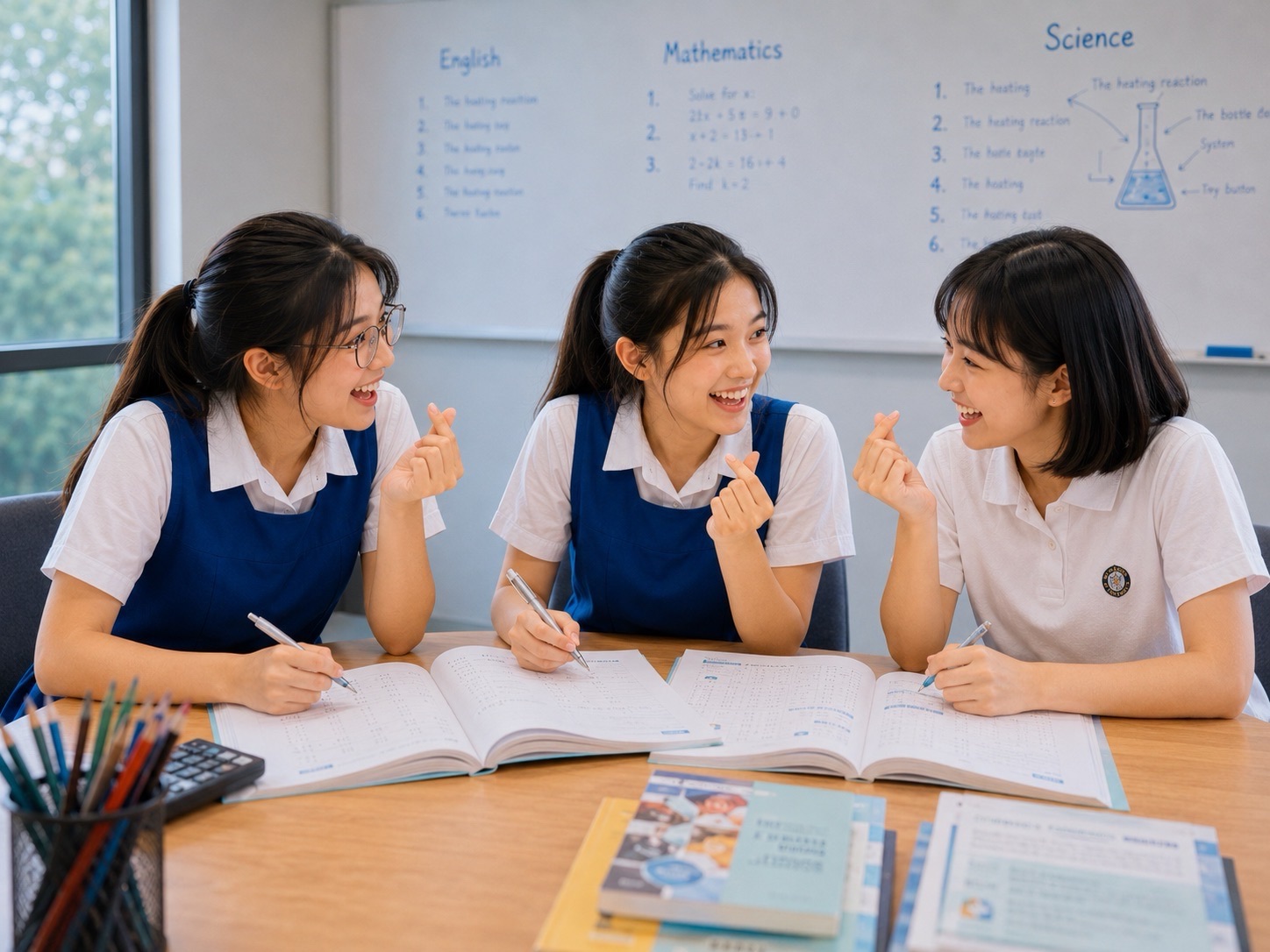
Did you know that sounding fluent is not the same as speaking rapidly? A student who races through five weak points may be less persuasive than a student who develops two well-chosen ideas, uses a specific example and finishes with a clear judgement. Singapore SEC G3 English Oral Communication gives candidates both a planned response to a video and a spoken conversation. The lasting skill is not a memorised speech but the ability to interpret a prompt, make a reasoned contribution and listen actively.
Ministry of Education V3.0 Reference 330 follows the 2027 Singapore–Cambridge SEC G3 English Language K300 syllabus, Paper 4 Oral Communication. Part 1 is a Planned Response worth 15 marks, delivered for up to two minutes after viewing a video clip and prompt. Part 2 is Spoken Interaction worth 15 marks, comprising a discussion on a broadly related topic. The total approximate duration is 20 minutes including ten minutes’ preparation, and the examination is delivered via computer.
This independent eduKateSG guide is not an official MOE, SEAB or Cambridge examination script. All video descriptions, prompts, interviews and sample exchanges here are original fictional teaching simulations, not past-paper material or transcripts of actual candidates. Use them to practise reasoning, timing and self-assessment without pretending that any exact prompt will appear in the examination.
1. The core difference between Part 1 and Part 2
Part 1 asks the candidate to deliver a planned oral response to an accompanying prompt and video. Part 2 asks the candidate to participate in a discussion, respond to questions and develop points. A preparation outline supports both, but the conversational second part requires responsive listening rather than reciting a script.
The examiner’s discussion may be related to the same broad theme as the video. The 2027 document specifically states that candidates will not be asked questions about what people say in the video.
2. The 2027 K300 assessment boundaries
Paper 4 has 30 marks, 15 for each part, and accounts for 20% of the overall English assessment. The planned response lasts up to two minutes, while the approximate 20-minute examination includes ten minutes of preparation.
Avoid confusing Paper 1’s situational-writing word limits with a spoken response. Paper 4 is assessed through oral communication, so natural clarity, development and audience engagement matter more than reciting a 350-word essay.
3. A prompt is a task, not merely a topic label
The broad theme might be community service, digital habits or public transport. But a specific prompt could ask for a preferred activity, an opinion on its benefits or whether a school should adopt a policy.
Underline or mentally identify the actual demand. A candidate who describes a video at length but never answers the opinion question is not fulfilling the task.
4. Watch the video for useful cues, not a complete story
The visual clip may show an activity, setting or interaction that makes a topic concrete. Notice two or three observable details that could support an answer, while distinguishing observations from unsupported claims about hidden thoughts.
If a scene shows people cycling near a park, it does not prove all participants are delighted, safe or committed to sustainability. Phrase inferences proportionately: the scene suggests, rather than proves, a possible benefit.
5. Purpose, audience and situation guide the tone
In an examination, the listener expects an intelligible, appropriate discussion of the prompt. Language should be respectful, measured and confident without sounding like a formal bureaucratic report or a casual private chat full of unexplained slang.
A student can use precise everyday words. Unnecessarily ornate phrases often slow delivery without deepening reasoning.
6. A clear standpoint gives the listener a route
Begin the planned response by answering the prompt directly. Then give two developed reasons, with relevant examples, and a short concluding judgement. This produces a coherent shape even when the topic is unfamiliar.
A weak response opens with generic filler about how everything has advantages and disadvantages. A more useful opening reveals a position that can be qualified later.
7. Two developed points may outperform six labels
Consider a question about community gardening. Saying ‘it is healthy, green, educational, fun, social and cheap’ is a list. Explaining how shared tasks can connect residents who otherwise rarely interact is a developed point.
The second point might concern learning about food growing, with the limitation that maintenance requires regular volunteers. This shows reasoning rather than merely vocabulary breadth.
8. The evidence should match the claim
If you argue that an activity develops responsibility, give an example of repeated planning, attendance or teamwork that would plausibly build responsibility. A beautiful description of trees does not prove the effect on accountability.
A specific invented or personal everyday example can illustrate a general principle, but do not present invented statistics as fact.
9. Distinguish illustration from factual evidence
An illustration might be: ‘If a class plans a monthly collection drive, pupils have to coordinate duties and deadlines.’ That is hypothetical but logically useful. A claim such as ‘ninety per cent of all schools prove this works’ requires verified evidence.
Real oral answers need not contain elaborate numeric research. Appropriate examples and sound causal explanations are often enough.
10. Signposting helps, but formulae can sound mechanical
Phrases like ‘One important reason is…’ and ‘Another concern is…’ guide the listener. Repeating ‘Firstly, secondly, thirdly, lastly’ without explaining links can make the response resemble memorised headings.
Use transitions in moderation and vary them naturally so the listener can follow how ideas connect.
11. Avoid treating a video as a transcript
The 2027 task uses a video clip and accompanying prompt. A student need not invent dialogue or report what each person said, particularly when no authentic statement has been supplied.
Observe what is visible and address the prompt. The Part 2 discussion does not ask candidates to recall exact speech from the clip.
12. Ten minutes of preparation require priorities
During preparation, use an efficient division: read and interpret the prompt, note the central position, choose two points, add one example per point, then mentally rehearse a concise opening and close. The exact allocation should suit the learner.
Do not attempt to write and memorise a full speech in the preparation time. Keywords and arrow links are more adaptable and less likely to cause a breakdown when a word is forgotten.
13. Use a minimal planning map
A simple note might read: Position → Benefit 1 → Example → Benefit 2 → Example → Qualification → Final judgement. For a question about public libraries, the benefits could be equal access to resources and a shared quiet learning space.
One clear line between each idea is better than a page of unreadable notes. In preparation, the candidate needs a retrieval aid, not another essay.
14. Timing should suit a two-minute limit
A speaker might use 15–20 seconds for the opening, roughly 40 seconds for each main idea, and the remaining time for a qualification or closing statement. Individual speaking pace varies, so practise with a clock and adjust.
A response that cuts off at the end of the second point because too many examples were added lacks conclusion. A response that finishes very early may need deeper development, not faster vocabulary.
15. Fluent speaking includes controlled pauses
Natural pauses can signal a change of idea or give the speaker time to choose accurate language. Hesitation becomes problematic when the student loses the response’s structure or repeatedly restarts whole sentences.
A candidate can pause briefly, then continue. Filling every gap with repeated ‘like’ or ‘actually’ makes meaning harder to follow.
16. Good pronunciation supports intelligibility
Pronunciation matters because the listener needs to understand the words. Aim for clear consonants, appropriate word stress and natural rhythm, not a forced imitation of a particular accent.
The goal is effective communication. A Singapore English-speaking pupil need not discard identity or adopt an artificial voice.
17. Intonation changes meaning
Rising or falling intonation, emphasis and pacing can distinguish a thoughtful qualification from an unsupported slogan. Stressing ‘some students’ instead of ‘all students’ makes a useful evidence boundary audible.
Expression should match the content. Overacting each adjective may distract from the argument.
18. Build a bridge from the visual to a wider issue
A short clip of students collecting litter can support a discussion of shared responsibility, community habits or environmental education. The candidate can link visible actions to broader consequences while making reasonable inferences.
Do not claim a particular litter-picking event transformed a city’s recycling rates. Scale your conclusion to the evidence and the task.
19. A strong example has a beginning, mechanism and result
A pupil explaining group exercise might say: ‘If classmates agree to train together twice a week, they may find it easier to stay committed because each expects the others to attend.’ The cause is group accountability.
A vague example such as ‘exercise is good because it is good’ supplies neither a mechanism nor a meaningful outcome.
20. A counterpoint strengthens a well-grounded response
You might support outdoor learning but recognise heat, weather or access challenges. The counterpoint should be relevant and brief, followed by a practical condition, such as planning safe timing and accessibility.
A balanced answer does not need to abandon its position. It can show why the recommendation remains sensible under stated safeguards.
21. A conclusion should answer the prompt again
End with a concise synthesis of the reasons and a clear judgement rather than introducing an unrelated new topic. For example, ‘I would support the project if the school can provide reliable supervision and meaningful roles for every volunteer.’
A conditional conclusion shows maturity because it connects benefits to the circumstances necessary for success.
22. Spoken interaction begins with listening
In Part 2, listen for the question’s actual direction: ‘Why?’, ‘To what extent?’, ‘Should?’, ‘How could?’, or ‘What might happen if?’. Then answer that demand before expanding.
A pre-memorised response about social media may not answer a question about responsibilities of technology companies or effects on elderly residents.
23. Do not treat every question as yes or no only
If asked whether students should have more time outside school, a useful answer states a position and explains trade-offs involving rest, learning and family responsibilities. Simply saying ‘Yes, definitely’ ends the conversation prematurely.
Expand just enough to offer the examiner a developed line of thought, without taking every possible conversational turn at once.
24. Respond directly before broadening
For ‘Which group should benefit first?’ name the group and reason, then widen to other stakeholders if useful. For ‘How would you improve this?’, suggest a concrete action, explain who implements it and assess a constraint.
This gives the conversation coherence and shows independent reasoning.
25. A thoughtful disagreement can be courteous
A candidate can say, ‘I see why some people might prefer that, but I would place greater weight on…’ and then explain an alternative. Agreement or disagreement alone is not the quality being assessed; the explanation matters.
The student is not being tested for obedience to the examiner’s presumed opinion. Respectful, evidence-aware conversation is more valuable.
26. Recovery after a misunderstood question
If a question is unclear, seek clarification politely rather than answer a guessed different question. A brief response such as ‘Do you mean the effect on students or on the wider community?’ may help, when appropriate.
Excessive clarification can interrupt flow, so focus on genuine uncertainty, not every ordinary question.
27. The examiner may ask for a broader perspective
A conversation about cycling may move towards urban design, safety or sustainability. That shift does not require recall of the same video’s spoken dialogue. It requires connecting the broader issue to plausible examples.
Transfer is the goal: can the student adapt a principle to another context without losing the conversational question?
28. Avoid a memorised story for every topic
Practising complete scripts for dozens of hypothetical themes can create brittle responses. If the real question differs, the student may force a rehearsed story into an unsuitable answer.
Practise flexible structures and reasons, then adapt them to new everyday contexts.
29. Concrete vocabulary is better than empty grand language
Words like accessible, affordable, consistent, respectful, crowded and responsible can communicate precise ideas. Long abstract phrases can be useful only when the candidate fully understands them.
Parents and tutors should ask pupils to explain their word choices in plain language. A student who cannot define an impressive term may use it inappropriately.
30. Improve grammar without freezing delivery
Aim for complete, intelligible sentences and sensible tenses, but do not restart every sentence because of one small slip. A correction can be made smoothly where it changes meaning.
Fluency and accuracy work together. Excessive self-monitoring may prevent a child from developing a strong argument.
31. Include different groups in evaluative answers
A transport policy might affect pupils, commuters, drivers, people with disabilities and local businesses differently. Mentioning a relevant stakeholder can deepen a response beyond personal preference.
Do not produce a long stakeholder catalogue when the prompt asks for one reason. Choose groups that make a specific difference to the question.
32. Avoid stereotypes when discussing people
Generalising that all older residents dislike technology or all teenagers are irresponsible weakens reasoning. Use conditional observations based on access, experience and circumstances.
Respectful specificity makes answers more credible and aligns with careful language use.
33. Discuss unknown facts with proportionate confidence
If asked about an unfamiliar science innovation or social issue, say what you can reasonably infer and identify the limitation. No one expects the pupil to fabricate statistics or policy details to sound authoritative.
A useful phrase is ‘One possible concern is…’ followed by a causal explanation, rather than a made-up official figure.
34. Recording practice can help diagnose habits
With appropriate consent and privacy, recording a short personal mock response can reveal excessive fillers, weak transitions or a missing conclusion. Review the recording for organisation as well as delivery.
Do not upload other students’ recordings or identifiable clips without consent. Teachers can also give live feedback without retaining any recording.
35. Feedback should target one change at a time
After a mock, prioritise one improvement: a clearer opening, one more explanation, fewer repeated fillers, better listening or a more concise finish. Correcting every pronunciation and content issue simultaneously can overload a learner.
Repeated low-stakes practice with a specific target is more effective than an intimidating one-off perfect-speech demand.
36. A parent can coach without supplying the child’s opinion
A good tutor asks: ‘What do you think? Why? Could someone disagree? What would change your mind?’ The pupil constructs the ideas; the adult helps test clarity and evidence.
If the adult dictates a polished argument, the child may reproduce it without learning to respond to unexpected questions.
37. A 30-second planning drill
Show a fictional ordinary image or describe a short scenario, present one question, and ask the pupil to write a position and two reasons in 30 seconds. Then allow one minute to add examples before speaking.
The exercise builds fast organisation, but it is not the actual examination’s time format. The official preparation allowance and task should remain clear.
38. A 90-second speaking drill
Ask the pupil to make one clear position, two explained reasons and a concluding sentence in ninety seconds. This creates headroom for a full up-to-two-minute practice and encourages control of pace.
A short drill is useful for rehearsal; the full K300 planned response permits up to two minutes.
39. A five-minute interaction drill
Use a broad fictional topic with five different question types: opinion, explanation, counterargument, practical proposal and future consequence. The student should address each question before expanding.
A practice drill duration is not a statement about the real examination’s Part 2 duration; the syllabus provides only the approximate total Paper 4 timing.
40. Prepare examples from ordinary life
School clubs, public parks, libraries, festivals, family routines, volunteering and transport are flexible contexts for discussion. The student can develop transferable explanations about access, responsibility, community and trade-offs.
Do not memorise a fabricated personal achievement and present it as genuine experience. Hypothetical illustrations are acceptable when framed as hypothetical.
41. Assessing persuasive quality without politics or false certainty
A response may address contested social choices. Explain relevant perspectives fairly, identify which evidence supports each, and make a reasoned judgement rather than relying on stereotypes or inflammatory language.
A strong student can speak firmly without treating disagreement as an attack.
42. The video itself has a limited evidential role
The clip offers a prompt and visible context. It does not necessarily establish how all people in Singapore behave, the success of a national programme or the thoughts of the individuals shown.
Use what can be seen, then draw a reasonable wider example. Visual literacy protects against confident overinterpretation.
43. Twelve-stage oral communication route
- 1 — Read the exact prompt and identify what it asks you to judge.
- 2 — Note two or three observable video details without inventing hidden dialogue.
- 3 — Form a direct position in one clear sentence.
- 4 — Choose two strong reasons rather than many undeveloped labels.
- 5 — Add one relevant everyday or hypothetical example to each reason.
- 6 — State any meaningful condition or counterpoint.
- 7 — Outline an introduction, body and conclusion using keywords.
- 8 — Rehearse mentally with realistic timing and clear pronunciation.
- 9 — Deliver the planned response naturally within the two-minute limit.
- 10 — Listen for the examiner’s precise follow-up question.
- 11 — Answer, explain, extend and qualify in the spoken interaction.
- 12 — Review how clearly ideas, evidence, tone and listening served communication.
44. Original Meridian Oral Studio: fourteen stimulus cards
All video descriptions, prompts and sample responses are fictional, not official examination questions or examiners’ statements. They exist for paper-and-conversation rehearsal without needing access to private student video.
A — A small community garden
Imagined video or discussion stimulus: A clip shows several residents watering plants together, and the question asks whether community gardening is worthwhile.
Planning choice: Take a position and use social connection and practical learning as two distinct reasons.
Useful spoken direction: ‘I would support it because shared work may connect neighbours, provided people can maintain the space.’
What not to assume: The scene does not prove long-term attendance or measured wellbeing.
Transfer question: How could a school make it accessible to pupils with different needs?
B — Students cycling
Imagined video or discussion stimulus: A clip shows riders on a marked park connector, asking about encouraging active travel.
Planning choice: Consider health benefits and route safety; do not pretend roads are uniformly safe.
Useful spoken direction: ‘I support active travel where safe paths and training make participation practical.’
What not to assume: The footage does not establish the safety of every route.
Transfer question: Should schools prioritise cycling facilities or walking access?
C — A library event
Imagined video or discussion stimulus: A clip shows readers using a shared public library, asking if quiet public spaces still matter.
Planning choice: Discuss access and concentration with an example of a pupil lacking study space at home.
Useful spoken direction: ‘Libraries remain valuable because access should not depend on household space or income.’
What not to assume: The clip does not reveal actual library budgets.
Transfer question: What should libraries offer in a digital age?
D — A recycling activity
Imagined video or discussion stimulus: A clip shows pupils sorting labelled items into bins, asking whether school campaigns change habits.
Planning choice: Contrast knowledge with sustained practice and correct sorting.
Useful spoken direction: ‘Campaigns help most when pupils receive clear instructions and regular feedback.’
What not to assume: The scene alone does not establish reduced waste.
Transfer question: How would you measure the campaign’s effect?
E — A food market
Imagined video or discussion stimulus: A clip shows a busy market and asks whether local food traditions should be protected.
Planning choice: Use community identity and access, while noting affordability.
Useful spoken direction: ‘Food traditions matter because shared places connect generations, but vendors also need viable livelihoods.’
What not to assume: No customer survey is shown.
Transfer question: Should preservation rely on subsidies, education or commercial adaptation?
F — An art performance
Imagined video or discussion stimulus: A fictional clip shows young musicians rehearsing and asks if schools should fund performing arts.
Planning choice: Discuss expression, collaboration and fair allocation of school resources.
Useful spoken direction: ‘Arts support communication and teamwork, though budgets must also reflect other pupils’ needs.’
What not to assume: The video does not prove all pupils enjoy performing.
Transfer question: How could a school include hesitant beginners?
G — Volunteers packing supplies
Imagined video or discussion stimulus: A video describes students organising donated school items and asks why service matters.
Planning choice: Emphasise identifying actual needs and reliability, not simply good intentions.
Useful spoken direction: ‘Service is meaningful when helpers listen to recipients and deliver what is needed.’
What not to assume: The clip does not validate the destination or impact.
Transfer question: Should volunteering be compulsory?
H — An accessibility feature
Imagined video or discussion stimulus: A clip shows a wheelchair-accessible path beside a community facility.
Planning choice: Explain independent mobility and inclusion with a concrete user need.
Useful spoken direction: ‘Accessible design allows more residents to participate in everyday activities.’
What not to assume: A single ramp is not proof the whole journey is accessible.
Transfer question: What other barriers could remain?
I — Phones at a table
Imagined video or discussion stimulus: A clip shows friends using phones while eating and asks whether devices harm communication.
Planning choice: Distinguish useful digital connection from attention taken away from the present conversation.
Useful spoken direction: ‘Phones can help organise social life, but agreed device-free moments may protect attention.’
What not to assume: Visible phone use does not show friendships are damaged.
Transfer question: Who should set reasonable digital boundaries?
J — A crowded train
Imagined video or discussion stimulus: A video shows commuters boarding public transport, asking whether car-free journeys should be encouraged.
Planning choice: Explain environmental and access benefits alongside crowding and first-mile connections.
Useful spoken direction: ‘Public transport becomes an attractive choice when services are reliable and routes convenient.’
What not to assume: One crowded train does not establish system-wide unreliability.
Transfer question: How should older residents be considered?
K — A school garden in heat
Imagined video or discussion stimulus: A clip shows an outdoor science lesson on a sunny day.
Planning choice: Balance experiential learning with heat, shade and safety.
Useful spoken direction: ‘Outdoor learning can make concepts memorable if the activity is designed for the conditions.’
What not to assume: The footage does not establish a temperature or medical risk.
Transfer question: What alternatives would work during heavy rain?
L — A group project discussion
Imagined video or discussion stimulus: A clip shows three pupils debating a design and asks what makes teamwork effective.
Planning choice: Explain shared responsibilities and listening rather than saying teamwork is always fun.
Useful spoken direction: ‘A fair group needs clear tasks and a way for quieter members to contribute.’
What not to assume: The clip does not establish unequal work.
Transfer question: How would you handle someone missing deadlines?
M — A technology display
Imagined video or discussion stimulus: A clip shows an automated checkout system and asks if automation benefits society.
Planning choice: Consider convenience and accessibility as well as training and job changes.
Useful spoken direction: ‘Technology can improve service, but businesses should support people who need assistance or new skills.’
What not to assume: One device does not prove an economy-wide employment outcome.
Transfer question: Should older customers have an alternative?
N — A pupil freezes mid-response
Imagined video or discussion stimulus: A fictional speaker loses the next memorised sentence after a strong opening.
Planning choice: Return to the last keyword, pause briefly and develop the next reason in fresh wording.
Useful spoken direction: ‘Another point I would consider is…’ can provide a calm transition.
What not to assume: Examiners’ responses and scoring cannot be predicted from one rehearsal.
Transfer question: How would you redesign preparation notes to be flexible?
45. Full original model planned response: shared public spaces
Imagined video: several residents read, talk quietly and attend a small workshop in a community library. Fictional prompt: ‘Do you think public libraries will remain important for young people?’ This response illustrates a conversational position and two developed points, not an official model answer or actual examination script.
I do think public libraries will remain important, even as students gain access to more digital resources. For me, their value is not just the number of books they hold. A library provides a space where young people can focus and learn without needing to buy something.
My first reason is equal access. Not every student has a quiet room at home, and some may share a desk with siblings. A public library can offer a suitable place to read or complete homework. This means a person’s chance to concentrate is less dependent on their family’s living arrangements.
My second reason is that libraries can help people learn together. Workshops, reading groups and community programmes allow students to meet others who share their interests. For example, a young person curious about writing might discover a group where members exchange ideas and give feedback.
Of course, libraries should adapt. Some people now prefer e-books or online research, so libraries should make digital services easy to use as well. But I would not treat physical libraries as outdated. If they remain accessible, welcoming and relevant, they can continue to support both independent learning and a sense of community.
46. Why this model is an example rather than a template to copy
The model states a position, separates two mechanisms, uses plausible everyday illustrations, acknowledges an opposing consideration and concludes conditionally. A pupil should practise transforming the structure for another issue rather than memorising its exact words.
It also does not claim unverifiable national statistics, describe unshown dialogue or rely on excessively formal phrases.
47. Original spoken-interaction exchange
Examiner-like fictional question: ‘Should a school require every pupil to join a volunteering programme?’ Pupil-like answer: ‘I would encourage participation, but I am not sure a strict requirement is the best starting point. Some students have responsibilities outside school, and a forced activity may not lead to genuine commitment. Schools could offer different kinds of service so pupils can choose something meaningful. For example, a pupil uncomfortable with large public events might help organise donated materials or create accessible information.’
Follow-up fictional question: ‘Would choice make it harder to organise?’ Pupil-like answer: ‘It might, especially if one activity attracts too many students. The school could set a common number of hours but let pupils select from a manageable list. That could protect flexibility while keeping expectations fair.’
This demonstration is not a real transcript and does not imply the actual examiner will use those words. Its purpose is to show direct response, explanation, counterpoint and adaptation after hearing a follow-up.
48. Parent–tutor feedback that promotes independence
After listening, ask three questions: Did you answer the actual prompt? Which explanation was strongest? Which point needed a concrete example or a clearer limitation? Invite the learner to choose their own improvement before giving your suggestion.
This approach encourages ownership of ideas. An adult who supplies every sentence can unintentionally train recitation rather than independent conversation.
49. Depth, Load and Transfer evaluation
Depth: can a pupil explain why one visual detail does not prove a general claim and why a counterpoint can strengthen an argument? Load: can they interpret the prompt, organise two reasons, monitor timing and maintain natural speech? Transfer: can they respond to a new examiner question that shifts the topic without falling back on an irrelevant rehearsed script?
Record what broke first. If ideas disappear, practise quick planning. If answers drift from questions, practise active listening. If delivery is too fast, practise pauses and timing.
50. Common errors and repairs
- ‘I need to describe everything in the video.’ Repair: use only relevant visual cues and answer the prompt.
- ‘More points always mean a better response.’ Repair: develop fewer, stronger reasons.
- ‘A two-minute response must contain a fixed number of words.’ Repair: natural speaking rates vary; manage clarity and timing.
- ‘Pausing briefly is a failure.’ Repair: controlled pauses can help coherence.
- ‘A complicated word always improves marks.’ Repair: precision and appropriateness matter.
- ‘I should invent dialogue that was not supplied in the clip.’ Repair: distinguish observation and inference.
- ‘All speakers must adopt the same accent.’ Repair: focus on intelligibility.
- ‘Spoken Interaction is another memorised speech.’ Repair: listen and address each question.
- ‘Disagreeing with the examiner is forbidden.’ Repair: reasoned, courteous disagreement is possible.
- ‘Every answer needs a statistic.’ Repair: use plausible examples and avoid invented evidence.
- ‘A counterargument means abandoning my position.’ Repair: use qualification and conditions.
- ‘After one slip I must restart the full answer.’ Repair: recover smoothly and proceed.
- ‘The examiner asks what people said in the video.’ Repair: the 2027 syllabus explicitly says such questions will not be asked in Part 2.
51. Independent twelve-question practice checklist
- 1 — How many marks is Paper 4 worth and how are they split?
- 2 — How long may the Planned Response last?
- 3 — What is included in the approximate twenty-minute exam time?
- 4 — Does the syllabus require recalling speech from the video in Part 2?
- 5 — Name the three components of a useful planned-response structure.
- 6 — Why is one developed example stronger than a long list of labels?
- 7 — What should the pupil do if a question shifts the conversation’s direction?
- 8 — Give one way to qualify a confident but unsupported claim.
- 9 — What is the distinction between visual observation and inference?
- 10 — Name two verbal delivery choices that improve understanding.
- 11 — Why might memorising many complete scripts be counterproductive?
- 12 — What does an effective conclusion do?
Answer guide: (1) thirty marks, fifteen each part. (2) up to two minutes. (3) ten minutes’ preparation. (4) no. (5) position, developed reasons and close. (6) it supplies a causal explanation. (7) listen and respond to the actual new question. (8) say ‘under these conditions’ or identify missing evidence. (9) what appears versus what it might mean. (10) clear pronunciation, pacing and controlled pauses. (11) scripts may not fit the actual prompt. (12) returns to the judgement.
52. Frequently asked questions
Is the Planned Response supposed to be exactly two minutes?
The 2027 syllabus says up to two minutes. Practise a complete, well-paced response that fits within the limit.
Can a student discuss a personal experience?
Yes, when relevant and truthful. Hypothetical examples can also illustrate reasoning if clearly presented as hypothetical.
Does Part 2 require remembering what people said in the video?
No. The official document states that candidates will not be asked about what people say in the video clip.
Must the student agree with the examiner’s view?
No. A respectful and well-explained position matters more than assuming one acceptable opinion.
What if a candidate is nervous?
A short position–reason–example plan and controlled pacing can improve clarity. Repeated safe practice can reduce dependence on scripts.
How should a parent practise without an actual examination video?
Use short fictional clips or ordinary age-appropriate scenes with an original prompt, then practise a short response and a related discussion.
Are Paper 1 situational-writing word counts relevant to the oral?
No. Paper 1 and Paper 4 have different modes and requirements.
53. Official source and MOE V3.0 reading route
The SEAB 2027 SEC G3 English Language K300 syllabus, Paper 4 Oral Communication confirms the 15-mark Planned Response, 15-mark Spoken Interaction, video prompt, approximate timing and computer-based delivery. The official 2027 G3 syllabus index is the authoritative entry point.
Previous: Reference 329 — Atomic Structure. Next: Reference 331 — Business Break-even Analysis. For cross-mode language practice read Reference 202 — Situational Writing, Reference 231 — Listening Comprehension and Reference 288 — Narrative Comprehension. Explore the MOE V3.0 Library and the immutable Clementi teaching reference.
Editorial review: 25 October 2026, Singapore. All Meridian Oral Studio clips and dialogues are original fictional examples. The lifelong skill is to listen carefully, give reasons, engage fairly and revise one’s argument when the question changes.