
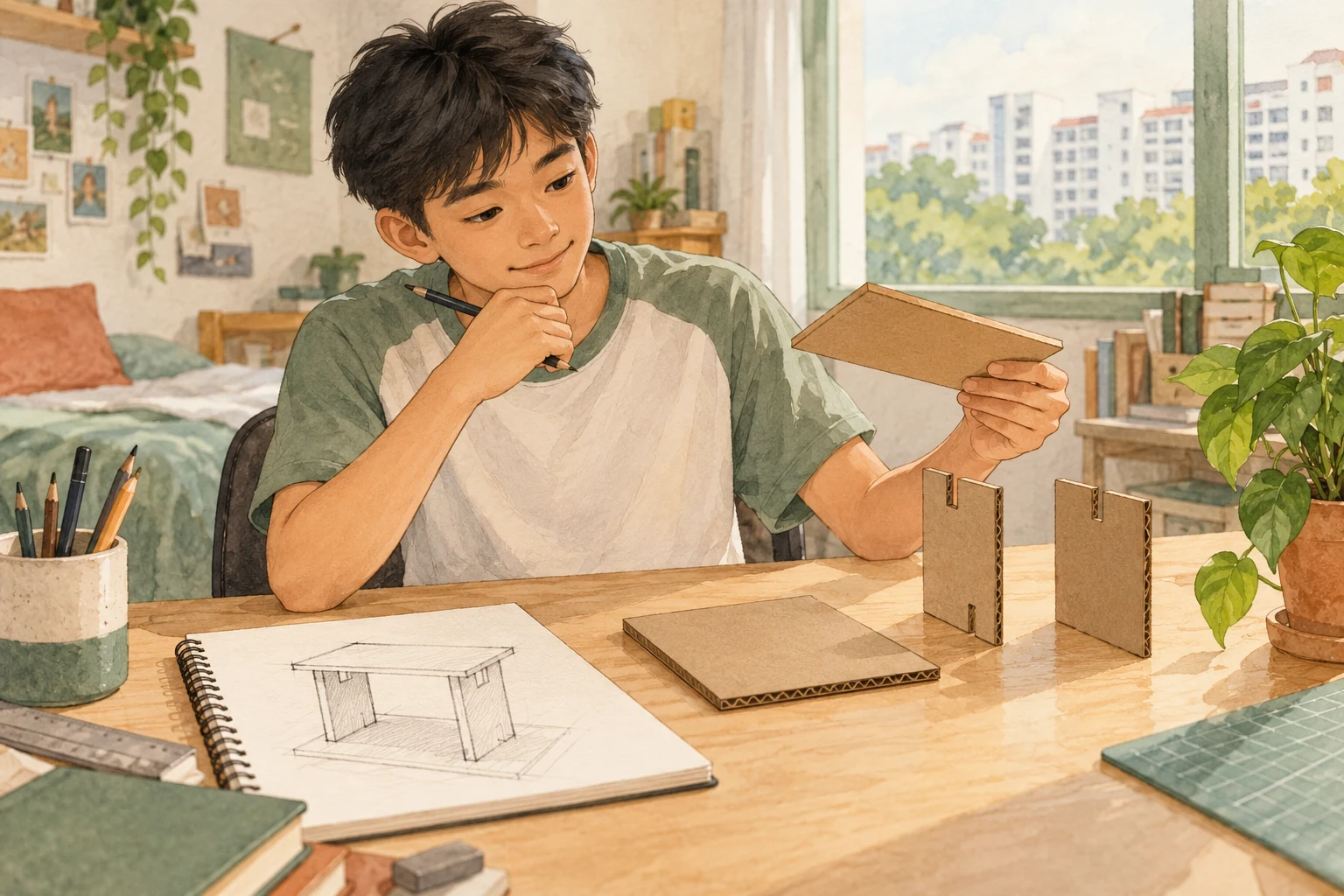
Did you know that seeing a detail in an artwork and interpreting its meaning are not the same skill? A student may observe a crowded doorway, a red umbrella and a distant skyline, then claim that the artist is celebrating urban life. The observation could be accurate while the interpretation is unsupported. Art literacy begins by distinguishing what is actually visible from how arrangement, materials, scale and context invite a viewer to construct meaning.
This independent Ministry of Education V3.0 reference explains Singapore’s 2027 SEC G3 Art K347 Paper 1 Visual Response: careful visual analysis, discussion of meaning, purposeful exploratory sketching, annotations and concept development. It connects these to foundational drawing, digital imaging, investigation of diverse media and the separate candidate-authored Portfolio. Twenty-six original diagnostic examples, a twelve-stage Observe–Interpret–Develop process, a three-pupil workshop and independent transfer exercises build sound reasoning without giving candidates a pre-made assessed visual response.
The practice artworks and scenes below are fictional descriptions, not examination stimuli or candidate submissions. This eduKateSG article is not an official MOE/SEAB paper or a generator of portfolio work. Final assessed sketches, artistic investigations, visual materials and personal commentary must be produced and authenticated by candidates according to school and examination requirements. Never present copied or AI-generated visual material as personal exploration.
A quick 60-second route
- Observe the actual artwork before guessing its intention: name the subject, visible forms and design choices.
- Explain a visual relationship, such as contrast, focus, repetition or viewpoint, using concrete evidence.
- Interpret carefully and separate the artist’s possible intention from your own response or an unsupported claim.
- For exploratory sketching, investigate alternative ways to communicate one idea rather than simply embellish one first drawing.
- Show a chain from stimulus to deliberate choices; keep assessed responses and portfolio commentary authentically candidate-made.
1. The 2027 K347 assessment boundaries
The official 2027 G3 Art K347 syllabus, Scheme of Assessment on page 7, makes Paper 1 Visual Response and Paper 2 Portfolio worth 50% each. Paper 1 lasts 2 hours 15 minutes and has Section A Visual Analysis (10 marks), built around an unseen image, and Section B Exploratory Sketching (40 marks). Paper 2 has a 30-hour, 12-week portfolio process; Part A allows up to 15 screens showing investigation including at least three art forms and media, and Part B is a candidate’s commentary based on three works, not more than 800 words and fewer than 10 A4-sized pages. Paper 1 is externally marked; Paper 2 is internally assessed and externally moderated. These details matter more than generic advice that the art examination is just a long drawing test.
2. Art education asks both looking and making
The K347 aims are to cultivate students as active artists and informed audiences. A response to an unseen image requires observation, formal analysis and contextual discussion, while exploratory sketching develops the student’s visual idea. The core connection is that interpretation informs making: a pupil who notices an unusual perspective can choose whether to retain, challenge or transform that visual strategy. A rapid sketch alone is not proof that the idea has been considered.
3. The three big ideas ground inquiry
The syllabus expresses the Big Ideas as art helping us see in new ways, art telling stories about our world, and art influencing how we live. Students can explore identity, society, culture or everyday design through that frame. Big Ideas should guide genuine inquiry; a pupil should not paste the phrase ‘art influences society’ next to any photograph and assume that they have explained the work’s meaning.
4. Observation is description with evidence
A useful first sentence names what can be checked by another viewer: a seated figure occupies the left third, a row of windows recedes to the right, and the strongest light comes from an open doorway. It avoids attributing motives until evidence has been examined. Accurate spatial language gives later interpretation a reliable basis.
5. Visual qualities can carry an idea
Line, shape, form, colour, tone, texture, scale and space provide a vocabulary for description, but they do not communicate in isolation. A repeated small rectangle might create rhythm; one bright shape among muted forms might establish emphasis; an elongated shadow might evoke a particular time of day. The answer must link the choice to an observed effect without claiming every viewer reads the symbol identically.
6. Composition guides attention
Foreground, middle ground, background, cropping, overlap, balance, contrast and perspective can direct the eye. A central figure may appear important, but the artist could deliberately place the focus off-centre. A strong analysis identifies a route of attention and asks which elements redirect or interrupt it. The aim is not merely to name the rule of thirds.
7. Context can deepen interpretation without replacing it
Knowledge of an artist, community or historical event may explain a visual decision. But an unseen paper stimulus might give limited context, and students should not fabricate the artist’s biography or intentions. State what the image supports, what contextual information was supplied, and which inference is plausible rather than certain.
8. Exploratory sketching is purposeful inquiry
K347 Section B asks candidates to investigate and develop visual responses to a stimulus, with annotations culminating in a concept sketch. A series of near-identical neat copies would show less exploration than well-judged alternatives in scale, viewpoint, material, or arrangement. The key question is how a visual experiment helps communicate an idea better, not whether every preliminary sketch is polished.
9. Foundational drawing and digital imaging
The K347 content treats drawing and digital imaging as central to ideation and concept development, and students explore at least three additional elective art forms and media during the course, including at least one Fine Art and one Design/Time-based selection. Those learning experiences support inquiry. Digital work still needs authorship, provenance and acknowledgement, not simply a downloaded image with a filter.
10. Eight rooms of Art reasoning
Room one defines the visual stimulus; room two records objective features; room three analyses elements and visual relationships; room four considers possible ideas and context; room five proposes alternative concepts; room six evaluates experiments and material suitability; room seven communicates intent and citations; room eight transfers the process to an unfamiliar image without copying a model response.
11. Twelve-stage Observe–Interpret–Develop protocol
Stage 1 — Read the task and source
Is the prompt asking for objective visual analysis, evaluation of artistic effectiveness, personal interpretation or exploratory drawing? The command determines what evidence and medium matter.
Stage 2 — Inventory visible features
Name composition, subject, colour relationships, spatial positions and material clues before making claims about social message or artist intention.
Stage 3 — Choose two meaningful visual relationships
Focus on a contrast, repetition, directional line, grouping or scale difference that genuinely contributes to the image’s effect. Do not list every formal term known.
Stage 4 — Distinguish observation and inference
Write ‘the red figure stands alone’ as observation if true; reserve ‘isolation’ as a supported reading, not a fact about the artist’s personal feelings.
Stage 5 — Connect meaning to the Big Ideas
Ask whether the work changes perception, tells a contextual story or influences everyday choices. Use the syllabus concepts only where the image supports them.
Stage 6 — Consider alternative readings
One dark shadow might suggest secrecy, shelter or late-afternoon light. Weigh which interpretation has the strongest supporting visual evidence.
Stage 7 — Identify a concept for the sketch response
State the idea in a short phrase, such as ‘shared space and unequal access’, then choose a visual strategy to develop it.
Stage 8 — Experiment with composition
Try a different viewpoint, scale, cropping or relationship between subjects in exploratory sketches. Annotate the purpose of change, not simply ‘improved’.
Stage 9 — Test media and technique
Consider how drawing, collage, painting, digital imagery or other suitable studied media would support the intended visual effect, while respecting available time and safety.
Stage 10 — Refine based on visual evidence
Compare alternatives and explain why a change helps or weakens the central idea. A record of experimentation is more meaningful than a hidden final choice.
Stage 11 — Communicate ideas and attribution
Use appropriate art vocabulary and acknowledge sources or influences as required. Artist influences are not a licence to pass off another’s image as the student’s work.
Stage 12 — Transfer independently
Respond to a different unseen artwork and make a new exploratory plan. If the student only repeats the first fictional example, the technique has not transferred.
12. Original fictional stimulus: The Last Seat
For practice only, imagine a fictional artwork titled ‘The Last Seat’. It shows an empty bench near a window, with four overlapping silhouettes beyond the glass and one folded umbrella near the bench’s edge. The bench is painted in warm tones but the corridor is largely muted. No real artwork or actual examination paper is reproduced here. The exercise is to distinguish what the imaginary viewer might see from what different contexts could mean.
An observer can confidently describe the warm bench and muted corridor. A viewer might interpret them as an invitation to rest amid busy movement or as an emblem of loneliness; neither interpretation is uniquely proven by colour alone. A useful paper 1 response would connect composition, spatial relationships and repeated silhouettes with an argued reading. For an exploratory exercise, a pupil might investigate a shifted viewpoint or altered bench scale rather than copy the imaginary bench exactly.
13. Twenty-six worked visual decisions
Worked Example A — Describe first
The bench is empty and placed near the image’s centre. That statement is observable. ‘The artist hates city life’ is not, unless a source provides further evidence. Separation protects accuracy.
Worked Example B — Colour as contrast
Warm orange on the bench contrasts with muted blues elsewhere. Explain how that contrast may attract attention, rather than claim orange always means happiness.
Worked Example C — Repetition
Four similar silhouettes beyond the glass create a repeated visual pattern. Consider whether the grouping implies activity, anonymity or movement, with evidence.
Worked Example D — Foreground and background
An umbrella lies in the foreground while distant people appear beyond a window. Their position can guide the viewer’s path through the composition.
Worked Example E — Cropping
A crop that removes part of the bench may increase tension or curiosity. The specific effect depends on what information is left visible and the chosen focal point.
Worked Example F — Perspective
A low viewpoint can enlarge the bench relative to people. A high viewpoint may instead emphasise surrounding floor patterns. Neither is universally better.
Worked Example G — Negative space
Empty space around a single object can isolate it or invite a pause. Explain what occupies the space and how that affects viewing.
Worked Example H — Line direction
Strong converging floor lines guide attention toward the window. Describe the actual direction of those lines before assigning an emotional effect.
Worked Example I — Texture
A rough chalk surface can contrast with smooth digital-looking imagery. Discuss how material treatment influences perception rather than confusing tactile texture with any visible pattern.
Worked Example J — Scale
Making the umbrella unusually large could become a metaphor for preparedness or vulnerability. Such an interpretation needs relation to the rest of the design.
Worked Example K — Balance
An off-centre object can still form a balanced composition if another element provides visual weight. Symmetry is not the only route to cohesion.
Worked Example L — Social context
A crowded station image may prompt questions about public space, but without further information one cannot attribute a particular policy stance to the artist.
Worked Example M — Cultural interpretation
A visual symbol may have several cultural meanings. Avoid imposing a single universal interpretation where no relevant contextual source has been given.
Worked Example N — Distinguish two intentions
A bench might suggest hospitality or neglect. Cite warm lighting or damaged surfaces to support competing readings and explain why one is stronger.
Worked Example O — Annotate an experiment
A pupil shifts the bench to the left to create a larger empty foreground. A useful annotation states what new visual effect this change is intended to test.
Worked Example P — Exploratory variety
Three sketches vary viewpoint, scale and light direction. That provides a genuine inquiry into alternatives more than three copies with differently coloured borders.
Worked Example Q — Concept sketch focus
A final concept drawing should make the intended relationship among bench, people and umbrella visible. Neat presentation cannot compensate for an undefined idea.
Worked Example R — Materials decision
Charcoal might make tonal contrasts easy, whereas flat-colour digital shapes may produce strong graphic clarity. Match the choice to meaning, available competence and safe process.
Worked Example S — Source acknowledgement
A pupil uses a published photograph as research inspiration. Record the source and distinguish the original photographer’s contribution from the pupil’s own investigation.
Worked Example T — A forced symbol
Declaring that every red object means danger is too rigid. Examine context and other design choices before asserting symbolic significance.
Worked Example U — Reflection on change
An experimental sketch makes the corridor more crowded and obscures the bench. The pupil should explain whether that helps or hinders the original concept, not call the result better merely because it took longer.
Worked Example V — Paper 1 Section A purpose
A visual-analysis response should interpret the unseen stimulus with evidence from the work. Do not use a prewritten artist biography or an invented title.
Worked Example W — Paper 1 Section B purpose
Exploratory sketches should investigate a visual concept, annotate reasoning and culminate in an idea. The task is not only a test of photorealistic drawing speed.
Worked Example X — Portfolio evidence
A sequence of material trials can demonstrate artistic development. The candidate’s assessed portfolio must contain their own selection and authentic observations rather than copied website commentary.
Worked Example Y — Commentary versus captions
An artistic commentary discusses growth, influences and decisions across actual works. Merely listing dates and media does not show evaluated development.
Worked Example Z — Independent transfer
For a new imaginary image of a crowded stairwell, identify two observed formal qualities, develop one defensible interpretation and design alternative explorations without recycling the bench.
14. Paper 1 Section A is an evidence discipline
Section A presents an unseen stimulus and asks visual analysis and discussion. Students should distinguish the artwork’s actual features from their own reactions. A sentence built around a visible formal choice and an argued interpretation is more valuable than an attractive generic paragraph claiming the image is ‘deep’ or ‘powerful’.
15. Paper 1 Section B is not simply another writing question
Exploratory Sketching requires visual thinking, annotation, investigation and a concept sketch. An idea can change while being drawn. That process is different from writing a final prose answer about an image. The student should allocate attention to multiple genuine alternatives while still developing a coherent final concept.
16. One hour spent perfecting an early sketch may hurt exploration
A highly polished first drawing can be less useful than clear experiments that compare forms and spatial relationships. Exploration has a distinct purpose: to discover possibilities, not to prove the first choice was correct. A student can work with simple marks while showing precise reasoning about what changed.
17. Art questions are not solved by one master symbol dictionary
Red does not invariably mean passion, a diagonal line does not invariably mean conflict, and a solitary figure does not always mean loneliness. Context and arrangement help build meaning. Pupils should state interpretations tentatively when several readings are plausible and justify the chosen reading with a combination of visual details.
18. Formal analysis can support social understanding without stereotyping
A work about community life can show differences in access, space and social relationships. Those ideas invite discussion, but the viewer must not invent the identity, socioeconomic class or intentions of depicted people from appearance alone. Separate representation from unfounded judgments about real groups.
19. Art influences should be credited properly
Research and study of other artists can inform a student’s visual strategy. A portfolio should acknowledge source works and describe what was learned rather than secretly using another artist’s photograph or composition as an uncredited final piece. Attribution supports the authenticity of the student’s investigation.
20. Digital imaging is not automatically more original
Software can support experiments in cropping, layering, colour and format. However, changing filters on downloaded images without meaningful transformation or attribution does not demonstrate a clear artistic inquiry. Authentic authorship remains central whether the medium is charcoal or digital.
21. The 2027 Portfolio has a defined evidence window
Paper 2 contains up to 15 screens for selected visual materials across at least three art forms and media, and a commentary associated with three works. It is completed in 30 hours within 12 weeks. The point is not to fill every screen with generic decoration: pupils should present genuine investigation, meaningful decisions and personal learning.
22. Commentary requires the candidate’s own growth
The official maximum is 800 words and fewer than 10 A4-sized pages. It discusses personal artistic growth based on three works. Because this is assessed individual work, a tutor or AI should not manufacture that reflection. We can teach what evidence and reasoning look like, while the actual account must be the candidate’s authentic experience.
23. Visual analysis versus response
One part of a question might ask how contrast directs attention; another might invite discussion of meaning or effectiveness. Keep the first anchored in visible structure and the second connected to an explanation of possible effect. Combining the two properly avoids a list of disconnected art terms.
24. A student may disagree with a proposed reading
A sophisticated response can acknowledge an alternative interpretation and argue against it using the image’s strongest evidence. Art discussion rewards engagement with ambiguity, not simply agreement with the teacher’s preferred story.
25. A limited medium can be a productive choice
A pencil sketch may explore tone and line efficiently, while an assemblage might test physical space. Different media invite different questions. A pupil should consider constraints and strengths before switching tools simply to appear technically advanced.
26. A safe classroom can cultivate creativity
Learners can sketch, compare photographs with proper attribution and explore teacher-approved materials without using hazardous solvents or cutting processes. Schools manage media-specific safety. This reference describes reasoning; it does not replace trained supervision or permission for specialist equipment.
27. The three-pupil visual inquiry workshop
Pupil A lists observable features, pupil B proposes a defensible interpretation with evidence, and pupil C develops one alternative spatial idea and tests its purpose. Rotate roles for another imaginary stimulus. Each pupil then responds individually to a new unseen scene; collaboration is useful only if independent skills grow.
28. A ninety-minute workshop route
Ten minutes retrieve visual vocabulary; fifteen minutes describe an unfamiliar image; twenty minutes compare interpretations; twenty minutes explore alternative compositions; fifteen minutes conduct independent visual-analysis and sketch-planning; ten minutes diagnose the first unsupported claim. Keep the student’s authentic assessable portfolio separate from these guided exercises.
29. The eduKate Depth–Load–Transfer diagnostic
Depth: Can the learner explain how a visual decision supports an interpretation rather than guessing symbolism? Load: Can they coordinate observation, formal analysis, alternative concepts and material reasoning in one response? Transfer: Can they investigate a different unseen image independently? This follows the Clementi three-pupil diagnose–repair–guided-practice standard, applied to the K347 visual tasks.
30. Parent and tutor questions
Ask what can be seen, which relationship directs attention, what alternative interpretation is possible and what a specific sketch change is meant to test. Encourage students to explain both the intention and evidence of effect. Avoid selecting or writing their final coursework choices for them.
31. Common mistakes and targeted repairs
Mistake: a confident reading counts as visual evidence. Repair: identify a visible form. Mistake: every sketch must be polished. Repair: investigate alternatives. Mistake: a caption is artistic reflection. Repair: identify the actual changed decision. Mistake: using reference images requires no attribution. Repair: record provenance. Mistake: portfolio screens are a substitute for authentic learning. Repair: show inquiry and honest development.
32. What good progress looks like
The student’s descriptions become more specific, interpretations more defensible, exploratory drawings more varied in meaningful ways, and revisions easier to justify. Progress is not measured solely by how attractive the final image seems to one adult. Independent transfer to a new visual task is essential.
33. Two modes of evidence must remain separate
A written response can cite the observed arrangement of an unseen image. Portfolio commentary can cite the student’s actual trials, feedback and changes over time. These are different evidential activities. Borrowing a polished explanation from an unrelated example would not prove the candidate experienced the stated artistic learning.
34. Big Ideas should sharpen, not flatten, an artwork
An artwork about a shared corridor may connect to ‘Art tells stories about our world’, while a reimagined everyday object might connect to ‘Art influences how we live’. These are lenses, not predetermined conclusions. Pupils should explain why the particular work fits the idea rather than stamp one phrase onto every picture.
35. The difference between visual strategy and technique
Technique is how an effect is materially produced, such as layering ink or drawing with hatching. Visual strategy is how relationships among forms, space and emphasis communicate. A strong response can discuss both but should not confuse software choice with a reason for the composition.
36. An unfamiliar prompt can still be manageable
When faced with a new stimulus, the student can identify the focal point, the relationship of parts, the scale or perspective and the possible significance. The same reasoning generates potential sketches without knowing the ‘right’ answer in advance. This is precisely the kind of independent visual thinking the study method is designed to foster.
37. Frequently asked questions
What does Paper 1 assess?
Unseen Visual Analysis and an Exploratory Sketching task, together contributing half of G3 Art’s assessment.
How long is K347 Paper 1?
Two hours and fifteen minutes, according to the official 2027 syllabus.
How many marks are in Section A?
Ten of the fifty raw Paper 1 marks are allocated to Visual Analysis.
How many marks are in Section B?
Forty of the fifty raw Paper 1 marks are allocated to Exploratory Sketching.
What does the portfolio require?
Up to fifteen visual-material screens across at least three art forms/media and a personal commentary on three works within stated limits.
What are the portfolio commentary limits?
No more than 800 words and fewer than ten A4-sized pages.
Is a sketch just a smaller final painting?
Not necessarily. Exploratory sketches test and develop concepts, compositions, viewpoints and material approaches.
Can a student use other artists for research?
Yes, with appropriate attribution and meaningful investigation; assessed work must remain authentically the candidate’s.
Will a polished drawing alone guarantee success?
No. Reasoned inquiry, communication of ideas, exploration, visual choices and task fulfilment matter.
What should parents ask?
Ask what the student noticed, why they interpret it that way, what they changed and what evidence informed the change.
38. Independent depth and transfer practice
Exercise 1 — Observation challenge
Describe an unfamiliar street artwork in five verifiable statements without assigning motives to the depicted figures.
Exercise 2 — Formal relationship
Select a strong colour contrast and explain how it affects the focal point, using visible evidence.
Exercise 3 — Alternative readings
Give two plausible interpretations of an isolated object, identifying an additional feature that would strengthen one interpretation.
Exercise 4 — Composition experiment
Plan three thumbnail sketches varying viewpoint, cropping and scale. State what each change tests instead of producing cosmetic copies.
Exercise 5 — Material choice
Explain why pencil tone, collage or digital layering might support three distinct visual effects, considering the limits of each.
Exercise 6 — Response to feedback
Given a fictional observer’s comment that the focal point is unclear, identify one specific revision and a way to test whether it helped.
Exercise 7 — Source provenance
Describe how to acknowledge a photograph or artist influence without claiming it is the pupil’s original image.
Exercise 8 — Independent unseen transfer
Using a different imaginary stimulus—a crowded staircase—produce a concise observation ledger, two justified interpretations and an original concept route, but not a candidate coursework submission.
39. Closing principle
Art analysis begins by seeing accurately and grows into interpretation supported by visual choices. Exploratory sketching tests ideas rather than simply decorating them. The independent K347 learner observes, analyses, experiments, credits sources and communicates authentic decisions. The same principles transfer beyond one examination stimulus into thoughtful viewing and making.
Related eduKateSG references and official sources
Connect Reference 175 — Art Observation and Critique, Reference 335 — Prototyping, the MOE V3.0 hub, the immutable Clementi instructional standard, and the official 2027 G3 Art K347 syllabus. This independent reference supports methods only and does not supply assessed Portfolio content.
MOE V3.0 Reference Sequence Navigation
Previous: Reference 350 · MOE V3.0 Library.