
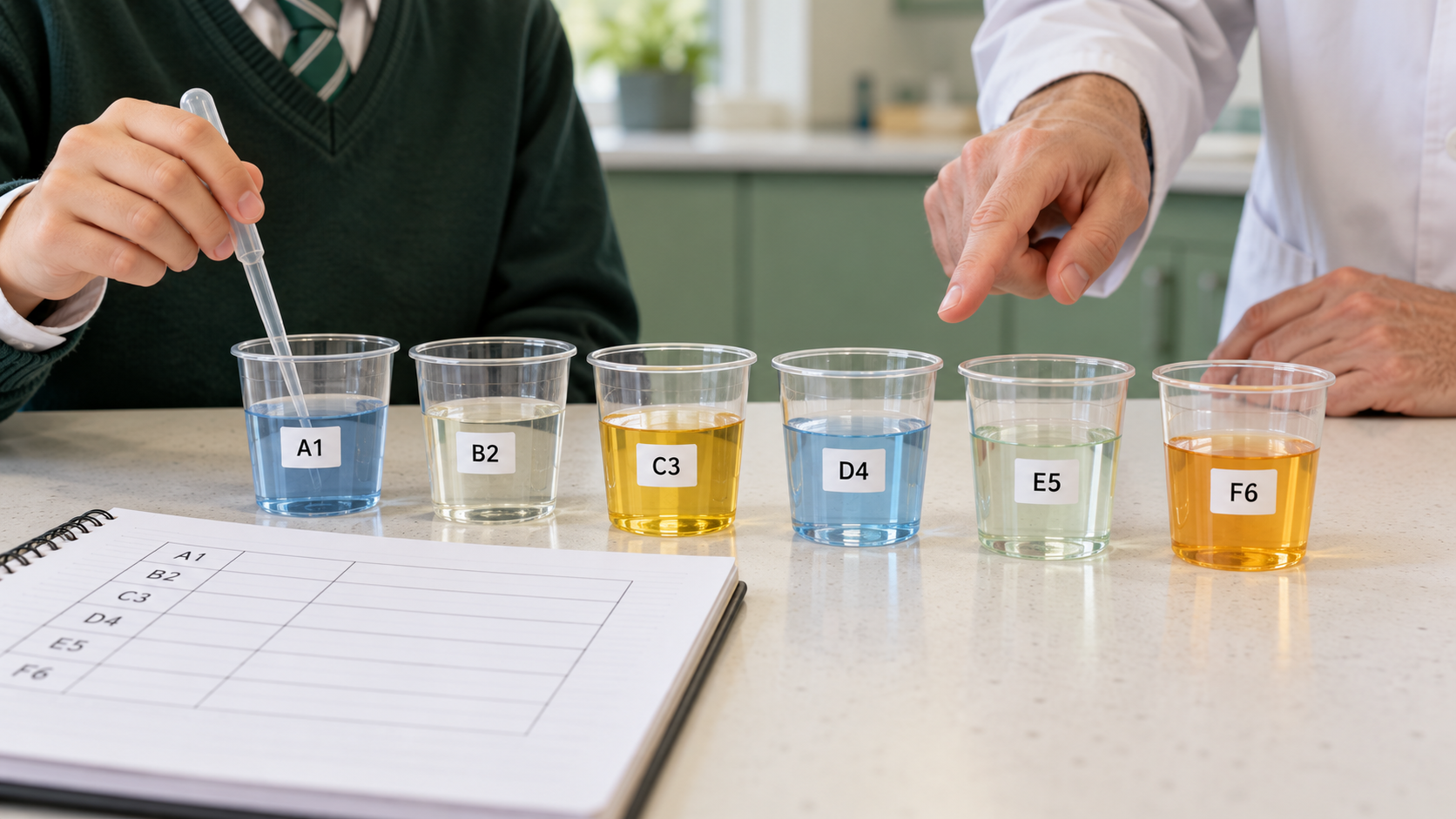
A reaction may contain more grams of one reactant than another while the smaller mass is not the limiting reactant. The balanced equation determines required mole proportions; raw masses alone do not. This independent 2027 G3 Chemistry K324 Topic 4 reference teaches formula masses, moles, limiting reactants, gas volumes at room temperature and pressure, concentrations and empirical formula with exact calculations, error diagnosis and original teaching cases. It follows the immutable Clementi first-principles tutorial standard without changing the source page.
1. Begin with the exact 2027 K324 Topic 4
The official G3 Chemistry K324 Section 4 Chemical Calculations includes formulae, equations and ionic equations; relative atomic and molecular mass; mole and the Avogadro constant; percentage mass of an element; empirical and molecular formulae; reacting masses; gas volumes at room temperature and pressure using 24 dm³ per mole; and calculations involving limiting reactants. Gas-law calculations at varying temperature or pressure are excluded from this objective. A complete solution should use the balanced chemical equation as evidence, not merely a sequence of calculator operations. When a question changes the limiting species, the product amount and excess remaining may change even if total starting mass seems similar.
2. A balanced equation gives particle-number proportions
For 2H₂+O₂→2H₂O, the coefficient ratio hydrogen:oxygen:water is 2:1:2. It refers to particles and moles, not 2 grams of hydrogen to 1 gram of oxygen. Coefficients do not describe the physical masses directly because different molecules have different relative masses. A pupil must distinguish the subscript ₂ inside H₂ from the coefficient 2 placed before H₂. The subscript defines each molecule’s composition, while the coefficient scales how many such molecules are involved. If the equation is not balanced, later mole proportions cannot be trusted.
3. Relative masses convert chemistry to quantities
Relative atomic mass Ar expresses an element’s comparative atomic mass, and relative molecular mass Mr is the sum of the relative atomic masses in a formula. For water H₂O with H=1 and O=16, Mr=18. For carbon dioxide with C=12 and O=16, Mr=44. These relative masses are dimensionless; molar mass has corresponding units of g mol⁻¹ when those numerical values are applied. In calculations, write the formula first, count the atoms correctly, then compute the mass per mole. A missing subscript can create a systematic error throughout the answer.
4. A mole is a counting quantity
One mole corresponds to the Avogadro constant of elementary entities, approximately 6.02×10²³. It is a count, just as a dozen is a count, but much larger. A mole of helium atoms is not the same mass as a mole of iron atoms, because the masses of individual atoms differ. The relation n=m/M connects amount n in mol, mass m in grams and molar mass M in g mol⁻¹. This conversion is the bridge between a measured mass and the coefficient ratio in a balanced equation.
5. Convert grams into moles before comparing reactants
Suppose a balanced equation requires two moles of A for one mole of B. Twenty grams of A and ten grams of B do not reveal which is limiting until their molar masses are known. If A has M=10 g/mol and B has M=10 g/mol, amounts are 2 mol and 1 mol, exactly matched. If instead A has M=40 g/mol, its 20 g gives only 0.5 mol and it becomes limiting. The raw gram comparison was never chemically decisive. A first-principles student converts each available mass into an amount before judging which supply can satisfy the ratio.
6. The limiting reactant is consumed first in the model
A limiting reactant is the one that runs out first if the reaction proceeds according to the stated stoichiometric model and the reactants are available to react. Once it is exhausted, the maximum extent of reaction is constrained; other reagents may remain in excess. The phrase ‘limiting’ refers to the ratio demanded by the balanced equation, not the reactant with the smallest measured mass or lowest mole amount in every possible reaction. A formal check divides available moles by the stoichiometric coefficient for each reactant. The smaller resulting extent identifies the limiting one.
7. Divide by the coefficient to compare reaction extents
For aA+bB→products, if n_A moles of A and n_B moles of B are available, compare n_A/a and n_B/b. These numbers indicate how many stoichiometric reaction extents each supply can support. The smaller is limiting. In 2H₂+O₂→2H₂O with 3 mol H₂ and 2 mol O₂, compare 3/2=1.5 against 2/1=2. Hydrogen is limiting, even though oxygen has fewer moles than hydrogen. This method is especially useful when coefficients are unequal and intuition about the smaller number is unreliable.
8. Find maximum product from the limiting amount
Once the limiting reactant has been identified, use its mole amount and equation coefficient to calculate the theoretical product. In 2H₂+O₂→2H₂O with 3 mol H₂ and 2 mol O₂, each mole of hydrogen produces one mole of water under the balanced ratio, so 3 mol H₂O can form in the ideal model. The oxygen required is 1.5 mol; 0.5 mol O₂ remains. The maximum product must not be calculated independently from the excess reagent and then added to the limiting-reagent result. One reaction extent controls the entire stoichiometric prediction.
9. Excess reactant has a meaningful remaining amount
If an exercise asks how much reagent remains, subtract the amount actually required by the limiting amount from the starting supply. Using the previous 3 mol H₂ and 2 mol O₂ example, oxygen used is 1.5 mol and oxygen remaining is 0.5 mol. Report the unit and do not write a negative amount if the correct limiting reagent was chosen. The calculation assumes the reaction progresses completely with respect to the limiting species in the ideal model. Real laboratory conversion can be less complete for other reasons, which should not be confused with the stoichiometric definition.
10. Mass conservation does not mean equal molar masses
A balanced chemical equation conserves each kind of atom and therefore total mass in a closed model. It does not mean that the grams of each reactant are equal. For 2Mg+O₂→2MgO, using relative masses Mg=24 and O=16, 48 g magnesium reacts with 32 g oxygen to make 80 g magnesium oxide. The coefficients are two, one and two, but the gram quantities are 48, 32 and 80. A student who simply copies the coefficients into a mass ratio has overlooked molar mass.
11. The mole ratio may be inverted during a calculation
In Zn+2HCl→ZnCl₂+H₂, one mole of zinc requires two moles of hydrochloric acid and produces one mole of hydrogen gas. If 0.10 mol zinc reacts completely, it needs 0.20 mol HCl, not 0.05 mol. The safe method is to write ‘required HCl / given Zn = 2/1’ before multiplying. If the pupil instead divides by two, a dimensional check using the equation can expose the reversal. Reading the coefficient ratio in the direction of the question prevents a common error.
12. A gas volume at RTP is an amount conversion
The official 2027 K324 syllabus uses one mole of gas occupying 24 dm³ at room temperature and pressure for its school calculations. Therefore a 0.50 mol gas sample has volume 12 dm³ under that condition. Conversely 6 dm³ corresponds to 0.25 mol. This is not permission to use the same numerical molar volume at an arbitrary high pressure or changing temperature; gas-law calculations under different conditions are outside this topic. Always write RTP and dm³ before using the factor 24.
13. Gas volume ratios follow mole ratios at matching conditions
At the same temperature and pressure in an idealised gaseous reaction, equal mole amounts occupy equal volumes. In 2H₂+O₂→2H₂O, the volumes of gaseous reactants before reaction follow 2:1 at identical conditions. But if the water product condenses, its liquid volume cannot be compared using the gas-volume ratio. State the physical states and measurement conditions in any volume calculation. The coefficients only translate to gas volume proportions when those species are being considered as gases under the same conditions.
14. Cubic centimetres and cubic decimetres must be reconciled
One dm³ equals 1000 cm³. A gas volume of 240 cm³ is 0.240 dm³, not 2.40 dm³. At RTP, 0.240/24=0.0100 mol. The number of zeros matters: using 240 dm³ would yield a thousand times more moles than intended. When a question mixes cm³ of solution with dm³ of gas, label each conversion separately. This unit habit is as important as the stoichiometric ratio and is a frequent source of otherwise avoidable calculation errors.
15. Concentration supplies moles through volume
For a solution with molar concentration c in mol dm⁻³ and volume V in dm³, n=cV. Thus a 0.200 mol dm⁻³ solution occupying 50.0 cm³ contains 0.200×0.0500=0.0100 mol of solute. Using 50.0 instead of 0.0500 gives an impossible amount for the specified small volume. A concentration alone cannot determine moles; the total solution volume is required. When relating this to a reaction, compare the resulting moles using the balanced equation rather than equating solution volumes automatically.
16. Reacting solution volumes need not be equal
For an equation with a 1:2 mole requirement, two solutions of equal concentration may need volumes in a 1:2 ratio. If concentrations differ, the necessary volume ratio changes again. Therefore ‘same concentration’ and ‘same volume’ are independent properties. In a fictional acid-base calculation, start with n=cV for each reactant, identify the limiting mole supply, then calculate how much product can form or what remains. Volume similarity by itself does not establish a completed neutralisation.
17. Relative formula mass applies to ionic compounds
An ionic compound is not always made of discrete molecules, so relative formula mass is an appropriate term for the sum of relative atomic masses in its formula unit. For CaCO₃ with Ca=40, C=12 and O=16, relative formula mass is 100. Hence 10 g pure CaCO₃ corresponds to 0.10 mol. A student who counts three oxygen atoms as one or omits the calcium contribution will miscalculate reacting masses later. Use correct chemical formulae and check electrical charge in ionic formula-writing questions.
18. Empirical and molecular formulae solve different tasks
An empirical formula gives the simplest whole-number ratio of atoms in a compound, while the molecular formula gives actual numbers of atoms per molecule. A compound with empirical formula CH₂O may have molecular formula C₆H₁₂O₆ when its relative molecular mass and formula mass justify a factor of six. Convert elemental masses to mole amounts, divide by the smallest, and scale to whole-number ratios. Do not divide raw element mass percentages directly into subscripts, because different elements have different relative atomic masses.
19. Molecular formula needs a relative molecular mass
Suppose a compound’s empirical formula is CH₂O with empirical formula mass 12+2+16=30. If its measured relative molecular mass is 180, the multiplication factor is 180/30=6, so molecular formula is C₆H₁₂O₆. Without the Mr, the empirical formula alone does not identify the molecular formula. A student should not choose six because it is a familiar glucose formula. The factor has to follow from the data. This example illustrates why chemistry requires both experimental composition and a measured or supplied molecular mass.
20. Percentage mass of an element is a ratio
For water H₂O, the mass contribution of oxygen is 16 out of relative molecular mass 18, giving 16/18×100%≈88.9%. The calculation concerns mass fraction, not the number fraction of atoms. Although one third of the three atoms in the formula is oxygen, oxygen accounts for most of its mass because it is much heavier than hydrogen. Use a full formula mass denominator, then multiply by 100%. In a larger compound, include all occurrences of the named element and all elements in the total.
21. Theoretical product is not a measured experimental yield
Stoichiometric calculations generally predict the maximum product from the stated limiting reagent under the ideal reaction model. An actual experiment can yield less because of incomplete reaction, losses during transfer, side reactions or measurement constraints. Do not invent a percentage yield if the problem supplies only a balanced equation and initial amounts. If a question gives actual product mass, its relation to theoretical mass is a separate comparison. Maintain the distinction between predicted maximum, observed outcome and reasons for discrepancy.
22. Pure substance mass is not necessarily sample mass
A sample described as 80% of a particular compound by mass contains only 80 g of that compound per 100 g sample under the stated definition. A 50 g sample at 80% would contain 40 g of the reactive compound. A stoichiometric calculation should therefore use the mass of the actual reactant, not the mass of inert material mixed with it. If purity is not stated, do not invent an impurity. Reading the composition statement correctly is a useful extension of percentage mass reasoning and may be important in relevant word problems.
23. A negative excess amount signals a setup error
After identifying the limiting species, the calculated moles used of any other reactant should not exceed its starting moles under the ideal complete-reaction model. If the subtraction gives a negative excess, the student may have reversed a coefficient ratio or chosen the wrong limiting reactant. A reaction table listing start, used and remaining is a powerful check. The results should also conserve atoms and mass within the stated closed model. A negative quantity might have meaning in other contexts, but negative moles of material remaining is not a valid physical stock.
24. Transfer to a different reaction without a prompt
After practising 2H₂+O₂→2H₂O, give a new formula such as CaCO₃+2HCl→CaCl₂+CO₂+H₂O with both starting amounts stated. The method stays the same: balance the equation, convert mass or solution volume into moles, compare available moles per coefficient, determine the limiting supply, use it to calculate product, and interpret any excess. The student should be able to explain why the coefficient ratio matters even if the numbers, materials and physical states are unfamiliar. This is the difference between transferable chemistry and copying the last worked problem.
25. Twelve-stage Moles–Ratio–Check protocol
Stage 1 — Balance the chemical equation
Check each element’s atom count and state symbols where given.
Stage 2 — Choose the requested quantity
Mass, moles, gas volume, concentration, formula or remaining reactant.
Stage 3 — Compute relative masses
Use the right chemical formula and supplied atomic masses.
Stage 4 — Convert each starting amount into moles
Use n=m/M, n=cV or V/24 at RTP as appropriate.
Stage 5 — Write reaction mole ratios
Read coefficients, not raw masses, for proportions.
Stage 6 — Compare available amounts per coefficient
The smaller n/coefficient constrains reaction extent.
Stage 7 — Name the limiting reactant
State why the other starting reactant is in excess.
Stage 8 — Calculate product from the limiting supply
Use the product coefficient against the selected extent.
Stage 9 — Calculate excess used and remaining
Subtract stoichiometrically required moles from its original amount.
Stage 10 — Convert moles into requested units
Use appropriate molar mass or gas molar volume.
Stage 11 — Check balance and plausibility
Product mass, units and remaining nonnegative quantities should make sense.
Stage 12 — Transfer independently
Solve another reaction with changed coefficients and inputs.
26. Fictional three-pupil stoichiometry tutorial
Three fictional G3 pupils examine a balanced equation for hydrogen and oxygen. One checks formula masses and converts the supplied reactants to moles; the second divides moles by stoichiometric coefficients and identifies the limiting reactant; the third calculates maximum product and remaining excess. Their answers are then challenged with a changed starting quantity that reverses which species is limiting. They rotate responsibilities before each independently solves an unfamiliar carbonate–acid equation. The teacher diagnoses the earliest error—formula, gram-to-mole conversion, ratio direction, volume unit or interpretation—and repairs that step before adding more practice. No unsupervised laboratory reaction is required.
27. Twenty-six original worked examples
Worked Example 1 — Water’s relative molecular mass
For H₂O, relative atomic masses H=1 and O=16, so Mr=2×1+16=18. A water molecule contains two hydrogen atoms, not two oxygen atoms. This is the first check before converting a water sample’s grams into moles.
Worked Example 2 — Carbon dioxide molecular mass
CO₂ contains one carbon and two oxygen atoms. With C=12 and O=16, Mr=12+2×16=44. The stoichiometric coefficient in a reaction does not belong inside this molecular formula mass calculation.
Worked Example 3 — Calcium carbonate formula mass
For CaCO₃, using Ca=40, C=12, O=16, relative formula mass is 40+12+48=100. Therefore 10 g of pure CaCO₃ is 0.10 mol. The carbonate group’s three oxygen atoms must all be counted.
Worked Example 4 — Mass to amount conversion
A hypothetical sample contains 9 g H₂O. With molar mass 18 g mol⁻¹, its amount is n=9/18=0.50 mol. A mole is a count of entities, not a liquid volume.
Worked Example 5 — Amount to mass conversion
A 0.25 mol CO₂ sample has theoretical mass 0.25×44=11 g. Multiplying rather than dividing follows from m=nM. Keep units attached to catch an inverted conversion.
Worked Example 6 — One mole of carbon atoms
A 12 g sample of carbon with molar mass 12 g mol⁻¹ contains 1 mol of carbon atoms in the simple model. The number of elementary entities is approximately Avogadro’s constant, not 12 individual atoms.
Worked Example 7 — Half a mole and particle count
One-half mole corresponds to about 0.50×6.02×10²³=3.01×10²³ specified particles. State whether those entities are molecules, atoms or formula units, because the distinction affects what is counted.
Worked Example 8 — Iron and sulfur reacting masses
For Fe+S→FeS with Fe=56 and S=32, 5.6 g iron provides 0.10 mol and needs 0.10 mol sulfur, or 3.2 g, for full ideal reaction. Their masses are unequal despite a 1:1 mole ratio.
Worked Example 9 — Magnesium oxide mass balance
The equation 2Mg+O₂→2MgO gives 48 g Mg plus 32 g O₂ yielding 80 g MgO when Mg=24 and O=16. Every atom is conserved. The coefficient ratio is not the mass ratio.
Worked Example 10 — Oxygen-limited magnesium reaction
If 3 mol Mg reacts with 1 mol O₂, oxygen is limiting because 3/2=1.5 but 1/1=1. The model forms 2 mol MgO, or 80 g, and leaves 1 mol Mg, or 24 g.
Worked Example 11 — Hydrogen-limited water formation
With 3 mol H₂ and 2 mol O₂, compare 3/2=1.5 with 2. Hydrogen is limiting. The reaction forms 3 mol H₂O, equivalent to 54 g, and leaves 0.5 mol oxygen, equivalent to 16 g.
Worked Example 12 — Exactly matched hydrogen and oxygen
For 2 mol H₂ and 1 mol O₂, both supply one reaction extent. Neither is in excess under the ideal model. Product is 2 mol H₂O or 36 g. A balanced supply need not have equal starting moles.
Worked Example 13 — Hydrochloric acid limits zinc
In Zn+2HCl→ZnCl₂+H₂, take 0.10 mol Zn and 0.12 mol HCl. Compare 0.10/1 with 0.12/2=0.06. HCl limits; 0.06 mol Zn reacts, 0.04 mol Zn remains and 0.06 mol H₂ forms.
Worked Example 14 — Calcium carbonate with acid
In CaCO₃+2HCl→CaCl₂+CO₂+H₂O, start with 0.20 mol carbonate and 0.30 mol HCl. HCl limits the extent to 0.15, producing 0.15 mol CO₂, or 3.6 dm³ at RTP. Carbonate remaining is 0.05 mol.
Worked Example 15 — Carbon and oxygen supply
For C+O₂→CO₂, 12 g carbon is 1 mol but 16 g oxygen is only 0.50 mol. Oxygen limits the reaction and 0.50 mol CO₂ forms, with mass 22 g. Comparing raw grams alone would be misleading.
Worked Example 16 — Methane and insufficient oxygen
In CH₄+2O₂→CO₂+2H₂O, suppose 1 mol methane and 1.5 mol oxygen are available. The ideal complete-combustion stoichiometric extent is constrained by O₂ at 1.5/2=0.75, giving 0.75 mol CO₂. This is a theoretical balance exercise, not an instruction to perform combustion.
Worked Example 17 — Aluminium oxide stoichiometry
For 4Al+3O₂→2Al₂O₃ with 4 mol Al and 1.5 mol O₂, oxygen supports 0.5 reaction extent, so 1 mol Al₂O₃ forms. Aluminium used is 2 mol, leaving 2 mol. Coefficients must be applied before identifying the excess.
Worked Example 18 — Carbonate decomposition gas volume
A fictional 8.4 g MgCO₃ sample has Mr=84, so 0.10 mol. In MgCO₃→MgO+CO₂, the ideal 1:1 ratio yields 0.10 mol CO₂, which occupies 2.4 dm³ at RTP. This is a paper calculation, not a lab heating procedure.
Worked Example 19 — One mole of gas at RTP
Under the 2027 K324 numerical convention, 1 mol of gas occupies 24 dm³ at RTP. The particular gas need not be oxygen for this school molar-volume conversion, provided the stated condition and simplifying model apply.
Worked Example 20 — Cubic centimetres to moles
A gas volume of 600 cm³ is 0.600 dm³. At RTP, n=0.600/24=0.0250 mol. Dividing 600 directly by 24 without converting units gives a thousandfold error.
Worked Example 21 — Concentration and fifty cubic centimetres
For 50.0 cm³ of 0.200 mol dm⁻³ solution, V=0.0500 dm³ and n=cV=0.0100 mol. This is amount of solute, not solvent mass. Converting cubic centimetres first is essential.
Worked Example 22 — Equal moles in different solution volumes
For 25.0 cm³ of 0.400 mol dm⁻³ solution, amount is 0.400×0.0250=0.0100 mol. It matches the preceding 50.0 cm³ example despite having half the volume, because concentration doubled.
Worked Example 23 — Empirical formula from masses
An invented compound sample contains 12 g C, 2 g H and 16 g O. Using Ar values 12,1,16, the mole amounts are 1,2,1. The simplest whole-number ratio is CH₂O. Do not use the gram ratios 12:2:16 as subscripts.
Worked Example 24 — Molecular formula from empirical unit
The empirical formula CH₂O has formula mass 30. If the compound has Mr=180, the whole-unit factor is 180/30=6. Thus its molecular formula is C₆H₁₂O₆. The measured Mr is essential to this conclusion.
Worked Example 25 — Percentage oxygen mass in water
Water H₂O has Mr=18 and oxygen contributes 16. Percentage mass of oxygen is 16/18×100%≈88.9%. This differs from the fraction of atoms that are oxygen, one of three.
Worked Example 26 — Independent limiting-reactant transfer
A new 2Mg+O₂→2MgO question supplies 0.30 mol Mg and 0.10 mol O₂. Oxygen limits (0.10 versus 0.15 extents); 0.20 mol MgO forms, or 8.0 g, while 0.10 mol Mg remains. The method transfers without copying earlier masses.
28. Ten frequent errors and precise repairs
1. Comparing starting grams
Convert each reactant mass to moles, then compare relative to coefficients. Smaller mass need not be limiting.
2. Comparing moles without coefficients
Divide available moles by the appropriate balanced-equation coefficient. This determines the reaction extent.
3. Using an unbalanced equation
Balance atom counts before using any mole ratios; incorrect coefficients propagate into every product amount.
4. Confusing formula subscript with coefficient
A subscript describes the composition of each molecule or formula unit, while a coefficient scales particle count.
5. Forgetting molar mass
Convert between moles and grams with n=m/M; formula mass is not the same as the sample mass.
6. Mixing cm³ and dm³
One dm³ is 1000 cm³. Convert before using gas molar volume or molar concentration.
7. Using gas molar volume at the wrong conditions
The simple 24 dm³/mol factor belongs to RTP, not arbitrary temperature and pressure.
8. Producing a negative excess
A negative remaining amount signals a ratio or limiting-reactant error in an ordinary complete-reaction model.
9. Mixing empirical and molecular formula
Use the mole ratio for empirical formula, then Mr to find a whole-number multiplication factor.
10. Treating theoretical product as observed yield
A stoichiometric maximum does not guarantee an experiment recovers exactly that amount.
29. A ninety-minute chemistry tutorial
Begin with Ar, Mr and n=m/M retrieval. Give three imaginary pupils a balanced equation and different reactant quantities: the first converts grams to moles, the second checks mole amounts against coefficients, and the third computes the theoretical product. Rotate their roles before using a different reaction. In the second part, include gas volumes at RTP and solution concentration with cm³-to-dm³ conversions. Introduce an empirical formula task using masses, then finish with an unfamiliar mixed-input limiting-reagent question. The tutor identifies whether a failure begins with formula, unit, mole concept, balanced ratio or interpretation, and gives targeted feedback before retesting.
30. Independent practice and checking
For independent work: calculate the Mr of CO₂ and CaCO₃; convert 36 g water into moles; find the RTP volume of 0.25 mol gas; find moles in 100 cm³ of 0.50 mol dm⁻³ solution; identify the limiting reactant for 2H₂+O₂ with 1 mol of each; calculate how much oxygen remains; and obtain an empirical formula from 24 g carbon, 4 g hydrogen and 32 g oxygen. In every answer, show the chemical formula, balanced equation when relevant, unit conversions and ratio justification. Correct method choice matters more than immediate numerical speed.
31. Frequently asked questions
What is a mole?
A count equal to Avogadro’s constant of specified elementary entities.
What is limiting reactant?
The reactant whose available mole amount relative to its coefficient constrains the ideal reaction extent.
Can the heavier mass be limiting?
Yes; chemical reaction ratios concern moles and coefficients, not raw grams.
Which gas volume is used in K324?
One mole is taken as 24 dm³ at room temperature and pressure for the syllabus calculations.
How is concentration converted to moles?
Use n=cV with V in dm³ when c is mol dm⁻³.
How is mass converted to moles?
Use n=m/M with consistent gram and g mol⁻¹ units.
What is a molecular formula?
Actual numbers of atoms per molecule, determined using empirical composition and molecular mass where supplied.
What is an empirical formula?
The simplest whole-number atom ratio of elements in a compound.
Are gas-law calculations at other conditions needed?
The 2027 K324 Topic 4 syllabus explicitly excludes calculations of volumes at different temperatures and pressures.
Is this an official examination paper?
No. It is independently written eduKateSG instructional material grounded in the official syllabus.
32. Closing principle
Stoichiometry turns chemical equations into accountable quantities. The limiting reactant is determined by available moles relative to coefficients, not by which container holds fewer grams. A reliable pupil balances the equation, converts into moles, finds the limiting extent, calculates product and checks excess with consistent units. The same method can move between masses, solutions and gas volumes at RTP. The gold standard is independent transfer to a different reaction, coupled with an honest distinction between theoretical prediction and an actual measurement.
Official syllabus and connected eduKateSG references
SEAB 2027 G3 syllabus directory · Official 2027 G3 Chemistry K324, Topic 4 Chemical Calculations · Reference 365 — Electrolysis · Reference 373 — Esters · MOE V3.0 reference library · Immutable Clementi small-group teaching reference.