
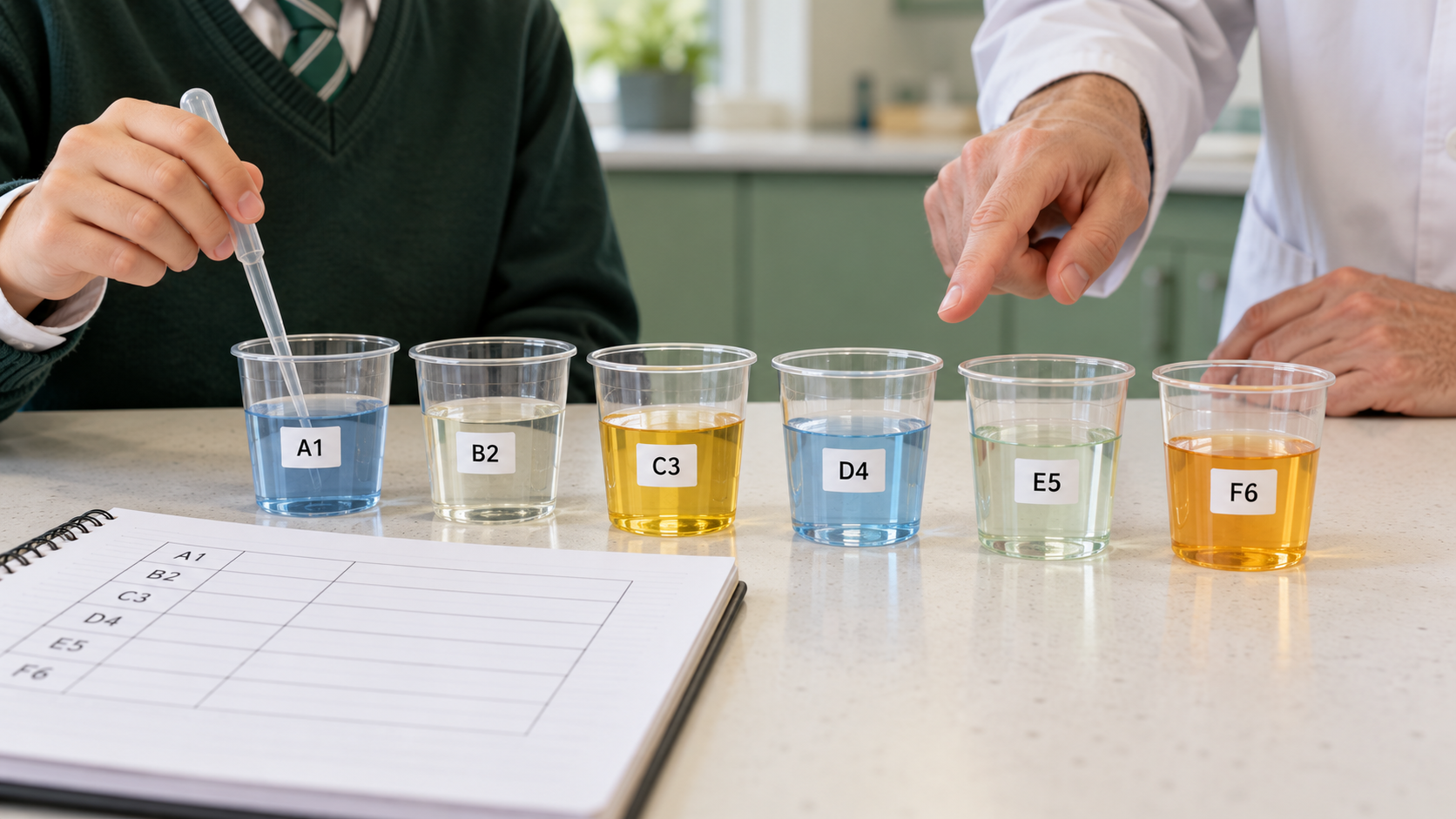
Two groups on the same table, opposite trends
Did you know that moving down Group 1 generally makes the named alkali metals more reactive, but moving down Group 17 makes the familiar halogens less reactive in their displacement comparisons? The contrast is not a contradiction. Alkali metals tend to lose an outer electron, while halogens tend to gain one. Their outer electron arrangements and changing distances from the nucleus help explain why their patterns differ. A pupil who understands the electron exchange can reconstruct the trend even if a comparison table has been forgotten.
Exact 2027 SEC G3 Chemistry K324 scope
This independent eduKateSG Ministry of Education V3.0 Reference 381 develops the Periodic Trends and Group Properties portions of K324 Topic 8 for the 2027 Singapore–Cambridge SEC G3 Chemistry syllabus. It focuses on the first-twenty-element shell model, Group 1 lithium, sodium and potassium, Group 17 chlorine, bromine and iodine, halogen displacement, Group 18 noble gases and the direction of metallic character across a period. The official syllabus also includes transition elements and the metal reactivity series as separate outcomes. The twenty-six fictional worked examples here are original learning tasks, not examination extracts. Hazardous chemical handling must remain under qualified laboratory supervision.
1. Atomic number determines the table order
The Periodic Table is arranged in increasing proton number, not simply alphabetical order or rising relative atomic mass. Proton number defines an element’s identity. A neutral atom has the same number of electrons as protons, while ions may gain or lose electrons without changing their proton number. A student given an atomic number should first identify the element and its electron arrangement at the school level. The element does not change identity merely because its outer electron has been transferred during a reaction.
2. Group and period mean different things
For the familiar main-group first-twenty shell model, a period indicates the number of occupied electron shells, while the group often reflects the number of outer electrons. Sodium with arrangement 2,8,1 is in Period 3 and Group 1. Chlorine with 2,8,7 is in Period 3 and Group 17. The model is a useful school simplification, not a full description of electron orbitals for all elements. Read position, atomic number and outer electrons together rather than infer chemical behaviour from a number alone.
3. Group 1 shares one outer electron
Lithium, sodium and potassium have one outer electron in their respective simple shell arrangements: 2,1; 2,8,1; and 2,8,8,1. They commonly form +1 ions by losing that electron. This similarity explains why their chemistry has related features even as reaction intensity varies down the group. The resulting metal ion is not a new element: sodium becoming Na⁺ retains its proton number. A student should name the transfer of one electron and link it to the ionic charge instead of declaring that the atom ‘lost its nucleus’.
4. Group 17 shares seven outer electrons
The named halogens chlorine, bromine and iodine have seven outer electrons in the ordinary shell-level comparison, and tend to gain one electron when becoming halide ions such as Cl⁻, Br⁻ or I⁻. The 2027 syllabus identifies elemental chlorine, bromine and iodine as diatomic nonmetals, meaning their pure molecular forms are Cl₂, Br₂ and I₂. The formula of a halogen molecule is not the same as the formula of its halide ion. This distinction is critical when balancing displacement equations.
5. Electron loss and gain yield opposite broad trends
As Group 1 atoms become larger down the group, their outer electron is generally less strongly held by the nucleus because it is farther away and screened by inner electrons. Electron loss becomes easier, supporting increased reactivity of the named alkali metals. For the halogens down Group 17, the attraction for an incoming electron weakens in the school model, supporting a decrease in oxidising displacement ability. These are qualitative trends, not an invitation to calculate ionisation energies beyond the stated syllabus.
6. Lithium, sodium and potassium are reactive metals
The named Group 1 elements are relatively soft, low-density metals in the standard school comparison, with melting-point and water-reactivity trends. Their reactions with water can produce alkaline metal-hydroxide solutions and hydrogen. Reaction intensity generally increases from lithium to sodium to potassium under comparable conditions. This is a syllabus observation to interpret from authorised teaching records, not a practical experiment for pupils or families to reproduce. Water-reactive metals and generated hydrogen pose significant hazards.
7. Group 1 metal ions carry +1 charge
Lithium loses one electron to become Li⁺, sodium forms Na⁺ and potassium forms K⁺ in their familiar ionic compounds. The + sign means the ion has one more proton than electron, not that a new proton has arrived. A balanced compound with an O²⁻ ion requires two Group 1 cations, giving a formula such as Na₂O. The electron-accounting explanation generalises across the group. It is more reliable than memorising a list of ion charges disconnected from atomic structure.
8. Group 17 halide ions carry −1 charge
Chlorine gains one electron to form chloride Cl⁻, bromine forms Br⁻, and iodine forms I⁻ in suitable reactions. One metal cation of charge +1 pairs with one halide ion of charge −1 in a neutral simple salt such as NaCl. A magnesium ion Mg²⁺ pairs with two chloride ions to give MgCl₂. The numeral two is a subscript indicating particle ratio, not an oxidation number copied into the formula. Count total positive and negative charge to check the result.
9. Halogen reactivity decreases down Group 17
In the named school comparison, chlorine is more reactive as a halogen oxidising agent than bromine, which is more reactive than iodine. Thus Cl₂ can displace bromide ions from a suitable solution, and Br₂ can displace iodide; iodine does not displace chloride or bromide under the comparable model. The trend should be explained through electron-gaining tendency and charge transfer, not through the visible colour of the liquid. A coloured solution alone cannot prove which redox reaction occurred without the stated reactants and conditions.
10. Halogen displacement is an electron-transfer process
In Cl₂+2Br⁻→2Cl⁻+Br₂, chlorine molecules gain electrons and are reduced to chloride ions; bromide ions lose electrons and are oxidised to bromine molecules. The reaction is redox, with both atom and electrical-charge totals conserved. The more reactive molecular halogen oxidises ions of a less reactive halogen in the suitable comparison. Writing ‘chlorine replaces bromine atoms because it is above’ may identify the broad order but misses what happens to electrons and ion charges.
11. Diatomic molecules require balanced coefficients
Elemental halogens in these school cases are Cl₂, Br₂ and I₂, containing two atoms per molecule. Therefore a displacement equation includes two halide ions for every one halogen molecule in the simplified half-reactions: Cl₂+2e⁻→2Cl⁻ and 2Br⁻→Br₂+2e⁻. A common error is Cl₂+Br⁻→Cl⁻+Br₂, which balances neither atoms nor charge. The fastest check counts each element on both sides and compares electrical charge. The coefficients arise from conservation, not cosmetic equation formatting.
12. Noble gases show the importance of full outer shells
Group 18 includes helium, neon and argon as familiar monoatomic gases with relatively low chemical reactivity in ordinary school conditions. Helium has a full first shell of two electrons; neon and argon have full outer shells of eight in the shell model. Do not claim that every noble gas has eight outer electrons without recognising helium. The group provides a useful contrast with alkali metals that readily lose one electron and halogens that tend to gain one. Applications depend on inertness, such as suitable protective atmospheres and lamps.
13. Physical-state trends are distinct from reactivity
At ordinary room conditions, elemental chlorine is a greenish-yellow gas, bromine a reddish-brown liquid, and iodine a grey-black solid. The physical states relate to molecular interactions and boiling or melting behaviour, whereas halogen displacement reactivity concerns electron transfer. A pupil should not explain the reactivity order only by saying iodine is solid or chlorine is green. The observations are useful for identification under stated conditions, but colour or state alone cannot replace an electron-based explanation. These materials are hazardous and must never be handled by pupils outside authorised laboratory procedures.
14. Chlorine can displace iodide as well as bromide
The reaction Cl₂+2I⁻→2Cl⁻+I₂ is predicted under suitable conditions because chlorine is more reactive than iodine in the familiar school comparison. The chlorine molecule gains two electrons to form two chloride ions, while two iodide ions lose electrons to form iodine. Potassium or sodium ions in a complete salt equation may be spectator ions and do not determine the halogen order. A student should identify the actual species losing and gaining electrons before writing the full equation.
15. Bromine cannot displace chloride in the ordinary model
Because bromine is less reactive than chlorine as the named halogens, Br₂ is not expected to oxidise chloride ions to chlorine in the usual classroom displacement comparison. A pupil who writes Br₂+2Cl⁻→2Br⁻+Cl₂ has forced a balanced but chemically unsupported direction. Balancing atoms and charge is necessary, not sufficient, to establish that a reaction is expected. Check the relative order before assuming that any two halogen and halide names can be exchanged.
16. Iodine is not a stronger oxidant because it is heavier
Iodine atoms have larger mass and more occupied electron shells than chlorine atoms, but greater atomic mass does not imply greater halogen displacement reactivity. In the named Group 17 comparison the electron-gaining tendency decreases down the group. Students must separate mass, atomic size and reactivity instead of treating them as one property. This also explains why the direction of Group 17 trend contrasts with the Group 1 tendency to lose an outer electron more readily as the atoms become larger.
17. A no-reaction observation is evidence
Suppose a fictional controlled comparison shows chlorine displacing an unknown halide, while bromine does not. Among chloride, bromide and iodide, bromide is consistent with both results: chlorine displaces it, but bromine cannot displace its own halide. A pupil who only uses the successful chlorine result may also allow iodide, which fails the second observation. Negative evidence can eliminate candidates and should be recorded rather than ignored. State the allowed set of possible ions so the inference is not overclaimed.
18. The first twenty elements connect shells to ions
Lithium (2,1) and sodium (2,8,1) commonly form +1 ions; magnesium (2,8,2) commonly forms Mg²⁺, and chlorine (2,8,7) forms Cl⁻. These simple shell configurations help predict the formulas of ionic compounds from ion charges. However the group-number shorthand is not a substitute for full chemistry of transition elements, where oxidation states may vary. The syllabus explicitly treats transition elements separately. A student should use the first-twenty model where applicable and not force every element into the same octet-only explanation.
19. Across a period, metallic character generally decreases
Moving from left to right across a period such as Period 3, elements generally shift from more metallic to more non-metallic character. Their valence electron counts and bonding tendencies change. This is not the same as saying every physical property changes steadily, or that the melting points form a simple straight line. Different bonding structures cause different behaviour. To explain a property, name the actual type of particles and chemical bonding rather than relying on position alone. Group and period patterns are predictors to be interpreted, not guarantees without context.
20. Transition elements form a useful contrast
The official Topic 8.3 notes typical transition elements as metals with high melting points, high density, variable oxidation states and coloured compounds; their elements or compounds often act as catalysts. These are typical descriptions rather than inviolable properties of every atom or compound. Do not describe iron as belonging to Group 1 because it forms positive ions, or assume every metal forms a single +1 ion. The topic’s point is to recognise that the simple first-twenty main-group pattern is not a universal account of all metallic chemistry.
21. Group 18 is relatively inert, not chemically nonexistent
Helium, neon and argon are often described as relatively unreactive, monoatomic gases because their outer electron shells are complete in the school model. This property can be useful where a nonreactive atmosphere is desirable. The word ‘inert’ is relative to typical conditions; it is not evidence that no noble-gas compound can ever exist in advanced chemistry. School explanations should correctly identify ordinary behaviour and the electron-shell reason without introducing unnecessary exotic exceptions into a basic question.
22. Reaction trend is not an instruction to perform experiments
Group 1 metals can react dangerously with water, producing heat and flammable hydrogen. Chlorine and bromine are toxic or corrosive and iodine requires appropriate controls. School learners can interpret written observations, balanced equations and diagrams without handling or generating these substances. A good practical discussion describes the variables and observations from approved teacher-led work or supplied data. It does not instruct pupils to mix halogens, halides or reactive metals at home. Scientific understanding includes recognising when the risk exceeds educational benefit.
23. Electron transfer explains both ion formation and displacement
A Group 1 metal atom loses an electron when forming a +1 ion. A halogen molecule gains electrons when it displaces the ions of a less reactive halogen. These are opposite electron-transfer roles, but both are chemically coherent: losing electrons is oxidation and gaining electrons is reduction. In a redox equation, electrons must balance across the two processes. A student can check this conservation rather than recite a reactivity ranking without explaining the mechanism. The school models link Periodic Table organisation to actual equations.
24. Transfer means predicting a new comparison
After learning lithium, sodium and potassium water-reactivity trends, the pupil should explain the underlying loss-of-electron idea, then switch to chlorine, bromine and iodine and correctly reverse the direction of increasing reactivity. Next give an unknown halide in a fictional displacement table and ask what the positive and negative observations permit. A student who can make these decisions independently has learned periodic reasoning rather than memorised two separate lists. The first error to repair might be group position, shell arrangement, molecule versus ion, reaction direction or electron accounting.
25. Twelve-stage Shell–Trend–Transfer method
Stage 1 — Read atomic number and element
Identify the correct chemical species before applying trends.
Stage 2 — Write the shell arrangement
Use the first-twenty model where relevant.
Stage 3 — Identify group and period
Distinguish occupied shells from outer-electron count.
Stage 4 — Recognise electron transfer
Group 1 loses one electron; Group 17 commonly gains one.
Stage 5 — State the correct ion
Use +1 for named alkali ions and −1 for halides.
Stage 6 — Rank the named group members
Group 1 increases reactivity down; Group 17 decreases.
Stage 7 — Distinguish molecule and ion
Cl₂ and Cl⁻ are not interchangeable.
Stage 8 — Predict displacement
A more reactive halogen displaces a less reactive halide.
Stage 9 — Balance atoms and charge
Use electron half-equations where helpful.
Stage 10 — Interpret negative observations
No reaction can eliminate a candidate in a controlled comparison.
Stage 11 — State safety and evidential limits
No unauthorised experiments, no ungrounded claim from colour alone.
Stage 12 — Transfer independently
Reverse the trend or test an unseen unknown with new evidence.
26. Fictional three-pupil chemistry tutorial
Three fictional G3 learners compare printed Group 1 electron diagrams with a halogen displacement table. Pupil A identifies the common outer electron and predicts ion charge; pupil B explains why sodium reacts more readily than lithium in the named school water comparison; pupil C tracks electrons in Cl₂+2Br⁻→2Cl⁻+Br₂. They rotate roles and separately solve an unknown-halide task using both a successful displacement and a no-reaction observation. The tutor repairs the first unstable step—group, electron count, direction of trend or equation balance—and retests independent reasoning. All exercises use paper rather than hazardous reactive metals or halogens.
27. Twenty-six original worked examples
Worked Example 1 — Lithium’s first two electron shells
Lithium has proton number 3 and neutral-atom shell arrangement 2,1 in the first-twenty model. Its one outer electron links it with Group 1. When forming a lithium ion, it loses that electron and becomes Li⁺, while the nucleus retains three protons.
Worked Example 2 — Sodium’s occupied shells
Sodium has atomic number 11 and arrangement 2,8,1. It is in Period 3 because it has three occupied shells and Group 1 because it has one outer electron. Its tendency to lose that electron leads to Na⁺ in common ionic compounds.
Worked Example 3 — Potassium’s fourth shell
Potassium has atomic number 19 and arrangement 2,8,8,1 in the simple school shell model. Its one outer electron sits in a fourth occupied shell. The generally easier loss of this electron helps explain why potassium is more reactive than sodium in the named comparison.
Worked Example 4 — Sodium oxidation as electron loss
The half-equation Na→Na⁺+e⁻ shows sodium losing one electron. The left and right total charges are both zero because +1 and −1 add to zero. This process is oxidation. A positive ion does not mean a mobile proton entered the atom.
Worked Example 5 — Sodium oxide ion balance
Sodium typically forms Na⁺ and oxide forms O²⁻. Two sodium ions are needed for each oxide ion to make a neutral compound, so its formula is Na₂O. The subscript records ion proportion, not the charge on one oxygen atom.
Worked Example 6 — Lithium chloride formula
Lithium forms Li⁺ and chloride forms Cl⁻. Their opposite unit charges balance in a 1:1 ratio, producing LiCl. A student who writes LiCl₂ has not balanced total electrical charge in the formula unit.
Worked Example 7 — Magnesium chloride as a contrast
Magnesium forms Mg²⁺ in the first-twenty-element model. It therefore requires two chloride ions, each Cl⁻, to form neutral MgCl₂. This is a useful contrast with Group 1 salts, which often have a one-to-one cation–halide ratio.
Worked Example 8 — Chlorine’s seventh outer electron
Neutral chlorine has proton number 17 and shell arrangement 2,8,7. It is in Period 3 and Group 17. It tends to gain one electron in forming Cl⁻. Do not confuse the neutral atom Cl with the diatomic elemental molecule Cl₂.
Worked Example 9 — Comparing halogen electron shells
Chlorine, bromine and iodine belong to Group 17 and have seven outer electrons. Moving down the group adds occupied electron shells and increases the typical distance of outer electrons from the nucleus. In the named school displacement comparison, their oxidising ability decreases.
Worked Example 10 — Chloride ion formation
The reduction half-equation Cl+e⁻→Cl⁻ shows a chlorine atom gaining an electron. On the left, one electron adds charge −1, matching the chloride ion on the right. The proton number is unchanged; ion formation does not turn chlorine into another element.
Worked Example 11 — Diatomic chlorine versus chloride
Elemental chlorine is represented as Cl₂, with two chlorine atoms per molecule, whereas chloride is Cl⁻, a negative ion. The different formulae matter in a displacement equation. Writing Cl instead of Cl₂ for the molecular halogen upsets atom conservation.
Worked Example 12 — Lithium’s reaction with water
The ideal school equation 2Li+2H₂O→2LiOH+H₂ is balanced, describing lithium hydroxide and hydrogen formation. It is an educational equation only; reactive alkali metals and hydrogen must never be handled in unsupervised demonstrations.
Worked Example 13 — Sodium’s reaction with water
The comparable equation is 2Na+2H₂O→2NaOH+H₂. Sodium is generally more reactive than lithium toward water in the named Group 1 comparison. Balanced coefficients do not measure reaction speed; the trend requires a separate chemical explanation.
Worked Example 14 — Potassium’s reaction with water
The school equation is 2K+2H₂O→2KOH+H₂. Potassium reacts more vigorously than sodium under comparable conditions. This describes hazardous chemistry for theoretical understanding and not a practical instruction.
Worked Example 15 — Group 1 direction of reactivity
For the named metals under comparable water-reaction conditions, the expected increasing order is lithium, sodium, potassium. Easier loss of the single outer electron down the group explains the trend. The order is not determined by which sample has the largest mass.
Worked Example 16 — Chlorine displacing bromide
The ionic equation is Cl₂+2Br⁻→2Cl⁻+Br₂. Chlorine gains electrons to become chloride while bromide loses electrons to become bromine. Both atoms and net charge balance. The reaction is a paper example, not a request to mix chemicals.
Worked Example 17 — Chlorine displacing iodide
The ionic equation Cl₂+2I⁻→2Cl⁻+I₂ is predicted in the school halogen reactivity comparison. Chlorine is more reactive than iodine as an oxidising halogen, so it can displace iodide under suitable conditions.
Worked Example 18 — Bromine displacing iodide
Br₂+2I⁻→2Br⁻+I₂ is a valid school displacement prediction. Bromine is more reactive than iodine but less reactive than chlorine. This gives an intermediate ranking without requiring hazardous experiments.
Worked Example 19 — Bromine added to chloride
In the standard halogen displacement comparison, Br₂ does not displace chloride ions to produce chlorine. Bromine’s lower reactivity than chlorine means the proposed reverse equation is not expected, even if its atoms could be balanced on paper.
Worked Example 20 — Iodine added to bromide
In a comparable school solution, I₂ does not displace Br⁻ to form Br₂ because iodine is the less reactive halogen. A no-reaction result can be as important to interpretation as a positive displacement observation.
Worked Example 21 — Identify oxidation and reduction
In Cl₂+2Br⁻→2Cl⁻+Br₂, Br⁻ loses electrons and is oxidised; Cl₂ gains electrons and is reduced. Chlorine acts as the oxidising agent in this comparison. The agent promotes oxidation of the other substance while itself undergoing reduction.
Worked Example 22 — Identify an unknown halide from two results
Suppose an unknown among Cl⁻, Br⁻ and I⁻ is displaced by chlorine but not by bromine under comparable school conditions. Br⁻ is consistent: chlorine displaces it, bromine does not. Iodide would be displaced by both, so the second observation rules it out.
Worked Example 23 — Spectator potassium in a displacement
The molecular equation Cl₂+2KBr→2KCl+Br₂ contains potassium ions unchanged on both sides. The net ionic equation is Cl₂+2Br⁻→2Cl⁻+Br₂. Removing spectators reveals the actual electron-transfer chemistry.
Worked Example 24 — Noble gases and outer shells
Helium has two electrons filling its first shell; neon is 2,8 and argon is 2,8,8. All are monoatomic and relatively unreactive under familiar conditions. A student must not claim every noble gas has eight outer electrons, because helium is the important exception.
Worked Example 25 — Across Period 3
Sodium (2,8,1) is a typical reactive metal, while chlorine (2,8,7) is a nonmetal. The progression across Period 3 generally moves toward nonmetallic character. This is not proof that every individual physical property follows a straight-line trend.
Worked Example 26 — Independent halogen transfer
An unknown molecular halogen X₂ displaces iodide but is itself displaced by chlorine, with choices chlorine, bromine and iodine. Bromine is the consistent identity: it lies between chlorine and iodine in the named reactivity series. The student must use both observations instead of guessing from one.
28. Ten common mistakes and their precise repairs
1. Treating Group 1 and Group 17 as having the same trend
The named alkali metals become more reactive down the group in the water comparison, while halogens become less reactive in displacement. Explain electron loss versus electron gain instead of applying one unexamined ranking.
2. Calling a molecule the same as an ion
Cl₂ is a neutral diatomic molecule and Cl⁻ is a chloride ion. They have different formulas, particles and electron balances. Label each species before writing a redox equation.
3. Saying metals gain protons to form cations
A sodium atom loses an electron when it becomes Na⁺; its number of protons does not change. Track mobile electrons rather than inventing changes inside the nucleus.
4. Balancing halogen formulas as monatomic
Elemental chlorine, bromine and iodine are Cl₂, Br₂ and I₂ in these examples. Use two halide ions to balance the electron exchange and count atoms and charges on both sides.
5. Using a reverse displacement that is not predicted
Even a correctly balanced equation may be chemically unsupported. Check the relative Group 17 order before claiming bromine displaces chloride or iodine displaces bromide.
6. Mistaking no reaction for missing evidence
Under suitable controlled conditions, a no-displacement observation can eliminate candidate ions. Use both positive and negative results in an unknown-halide table.
7. Confusing ion charge with group number
The common alkali-metal ion has +1 and the halide ion −1, but magnesium has +2. Use shell arrangements and charge balance rather than copying a group numeral mechanically.
8. Calling every noble gas an octet case
Helium has a filled first shell containing two electrons, unlike neon and argon with eight in their outer shells. Describe the actual first-shell exception.
9. Interpreting halogen colour as proof of redox
Colour and state help describe substances, but they do not establish the electron-transfer reaction on their own. Use the named reactants, conditions and balanced equation.
10. Treating hazardous reactions as home experiments
Group 1 metals and halogens can be dangerous; use supervised school observations or paper scenarios only. A correct examination explanation never needs unsafe replication.
29. A ninety-minute small-group tutorial
Begin with retrieval of proton number, electron shell arrangement and ion charge for lithium, sodium, potassium and chlorine. Use an initial diagnostic to distinguish a neutral chlorine atom, a Cl₂ molecule and a Cl⁻ ion. Next let each pupil explain why Group 1 and Group 17 trends run in opposite directions using electron transfer rather than a memorised arrow. Analyse written halogen displacement observations, identify oxidised and reduced species and verify balanced equations. Close with an unknown-halide puzzle whose solution requires both a reaction and a no-reaction result. The teacher should repair the earliest mistaken concept and retest it using a different hypothetical element comparison.
30. Independent practice and answer checks
Practice these original exercises on paper: write 2,8,1 for sodium; identify +1 as the charge of a sodium ion; derive Na₂O by balancing two +1 ions against one −2 oxide ion; distinguish Cl₂ from Cl⁻; rank chlorine, bromine and iodine in decreasing halogen reactivity; predict the direction of Br₂ reacting with iodide; show why iodine cannot displace chloride in the standard model; and explain why helium does not fit the ‘all noble gases have eight outer electrons’ shortcut. For each answer, state the electron-transfer or shell reason rather than giving a naked list.
31. Frequently asked questions
Why does Group 1 reactivity increase down the group?
The named metal atoms’ outer electron becomes more easily lost under the school shell model because its attraction to the nucleus is weakened by distance and shielding.
Why does Group 17 reactivity decrease down the group?
The familiar halogens become less effective at gaining electrons and displacing halide ions as their atoms get larger and have more occupied shells.
Which elements are compared in Group 1?
The specified common comparisons involve lithium, sodium and potassium.
Which halogens are compared?
The 2027 K324 scope names chlorine, bromine and iodine for properties and displacement.
What is the formula of elemental chlorine?
Cl₂, a diatomic molecule, as distinct from Cl⁻, the chloride ion.
Can bromine displace iodide?
Yes, in the standard school comparison: Br₂+2I⁻→2Br⁻+I₂.
Can iodine displace bromide?
No, not in the usual displacement comparison because iodine is less reactive than bromine.
What about noble gases?
Helium, neon and argon are familiar relatively unreactive monoatomic gases with filled outer shells; helium has two rather than eight.
Do transition metals always form +1 ions?
No. Typical transition metals may display variable oxidation states and coloured compounds.
Are these official examination questions?
No. They are independently composed eduKateSG learning examples anchored to the official 2027 syllabus.
32. Depth–Load–Transfer conclusion
Depth means explaining opposite trends through electron loss and gain and recognising that charge is conserved in balanced equations. Load requires coordinating group, period, outer electron, ionic charge, diatomic halogen formula and the direction of a displacement reaction in one problem. Transfer means inferring an unknown halide from two observations without being told the reactivity order in the question wording. A first-principles tutor can diagnose whether a wrong answer begins in atomic structure, molecule versus ion, trend selection, charge balance or evidence interpretation. Correct that one weakness and then test with changed inputs.
Official syllabus and connected eduKateSG references
Official SEAB 2027 G3 Chemistry K324 Topic 8 Periodic Table · Reference 365 — Electrolysis and Electron Transfer · Reference 325 — Metals and Reactivity · MOE V3.0 reference library · Immutable Clementi first-principles teaching standard.