
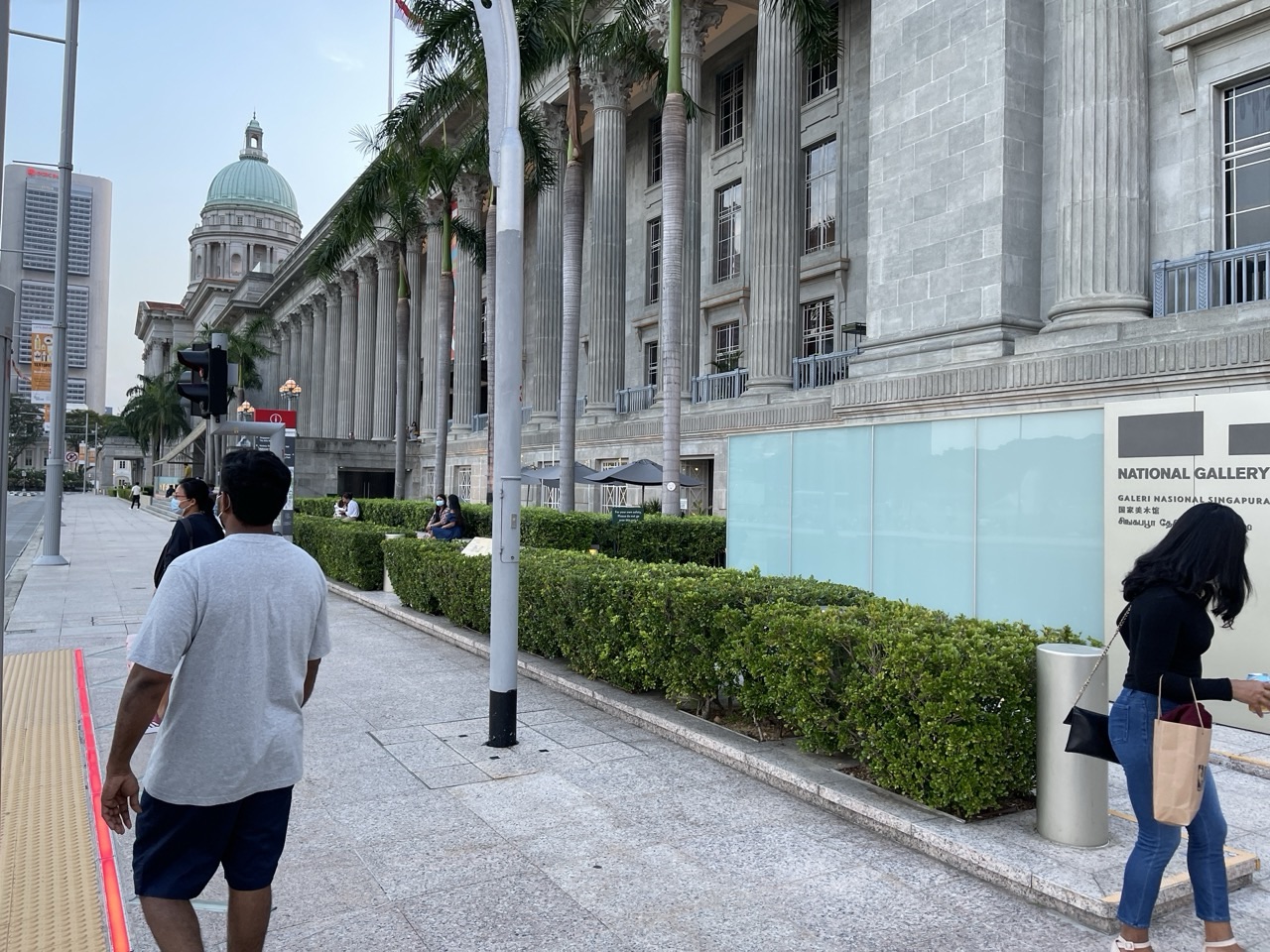
City Hall MRT Station (NS25/EW13) is one of the easiest gateways to Singapore’s Civic District. Choose Exit B for National Gallery Singapore, St Andrew’s Cathedral and the Padang; Exit A for Raffles City, CHIJMES and Raffles Hotel; Exit D for Capitol Singapore and Funan; or Exit C for CityLink Mall and a longer route towards Esplanade. For a first visit, an art gallery and a short civic-history walk are more satisfying than rushing through every landmark around the station.
The most important current visitor update is that National Gallery Singapore’s UOB Southeast Asia Gallery is temporarily closed until late 2027. The museum itself remains open, with other National Collection works on display, but an older guide that promises that gallery as an available stop is misleading. The museum normally opens 10am–7pm daily with last admission at 6.30pm; Singapore citizens and permanent residents enjoy free general admission, while ticket rules vary for other visitors and special exhibitions.
This City Hall MRT guide gives the exit choices, practical walking plans, free versus paid experiences and important accessibility details. A typical visitor can spend an hour exploring one street-side landmark, two hours combining civic architecture and a gallery visit, or half a day learning about Singaporean art and public history. Information reviewed 1 November 2026; always check current operator notices before travelling.
- Station: City Hall NS25/EW13, interchange between North–South and East–West Lines
- Exit A: Raffles City, CHIJMES, Raffles Hotel and War Memorial Park
- Exit B: National Gallery Singapore, St Andrew’s Cathedral and the Padang
- Exit C: CityLink Mall and a longer indoor connection towards Esplanade
- Exit D: Capitol Singapore and Funan
- National Gallery: around 7-minute walk from Exit B, 10am–7pm, last admission 6.30pm
- Important 2026 change: UOB Southeast Asia Gallery temporarily closed until late 2027

City Hall MRT is a transport gateway, not a single building
The station lies between several parts of central Singapore. On one side are the main civic monuments and National Gallery Singapore. On another are malls, hotels and conserved institutional buildings now used for dining or public activities. Beyond them lie the Esplanade waterfront and Singapore River, which are worthwhile but require a more extended walk.
Many visitors arrive by MRT with only one destination in mind and then become distracted by the number of places visible on the map. The easiest way to have a good day is to choose the central reason for coming, then add no more than one or two stops that fit comfortably.
An art-focused afternoon can stay around the National Gallery. A family wanting a meal and an architectural walk can use Raffles City and CHIJMES. Someone interested in civic history can observe the Padang and St Andrew’s Cathedral from appropriate public areas. The proximity of the names does not make every venue equally accessible or open at the same hour.
Four exits: what the railway operator actually identifies
SMRT’s official City Hall station directory lists Exit A for Raffles City Shopping/Convention Centre, CHIJMES, Raffles Hotel, Bras Basah Complex, War Memorial Park and several surrounding hotels and educational destinations. It is a practical starting point for retail, food and the northern side of the Civic District.
Exit B serves National Gallery Singapore, the Padang, St Andrew’s Cathedral, Parliament House, the Arts House and several court and heritage buildings. This is the most useful choice when a visitor wants art or civic landmarks. National Gallery’s own visitor directions also specify Exit B.
Exit C serves CityLink Mall and onward connections towards Esplanade, Marina Square and Suntec City. These are extensions, not attractions immediately at the City Hall platform. If your main destination is Esplanade, consider whether Esplanade MRT on the Circle Line is a simpler overall journey.
Exit D is associated with Capitol Singapore, Funan, the Treasury and adjacent civic buildings. Choose it for a shopping destination or a route on the Coleman Street side.
These are destination lists, not a guarantee that every route is fully step-free. Check the operator’s current lift signs, especially if you need to reach the National Gallery via its accessible Coleman Street approach.
Stop 1: National Gallery Singapore—the main cultural reason to visit
National Gallery Singapore is at 1 St Andrew’s Road, Singapore 178957. It brings together the former City Hall and former Supreme Court buildings and is devoted to art from Singapore and Southeast Asia. Its architecture is itself a major part of the visitor experience.
The Gallery’s official visitor information says the museum opens daily from 10am until 7pm with final entry at 6.30pm, and estimates many visitors spend roughly three hours. The Gallery is about a seven-minute walk from City Hall Exit B through the Art Connector, although the actual time varies with your pace and any need for accessible lifts.
An art gallery should not be treated as a shopping mall where every room is free and unrestricted. The General Admission ticket is free for Singapore citizens and permanent residents, and selected public areas can be enjoyed without a ticket, but special exhibitions and foreign-visitor admission have their own pricing. Check the current exhibition and ticket information.
Visitors who want to see art can select a small number of works rather than rushing through every room. Read the artist label, observe what is actually shown, and consider how the work relates to its place and time. A thoughtful fifteen minutes with one painting can be more valuable than an hour of photographs of labels.
For families, the Keppel Centre for Art Education provides a child-oriented introduction to art, subject to its current rules and programmed activities. Do not promise a particular interactive installation or workshop without checking the timetable.
2026 closure that matters: the UOB Southeast Asia Gallery
The museum’s current visitor page prominently states that the UOB Southeast Asia Gallery is temporarily closed and is expected to reopen in late 2027. It adds that artworks from the National Collection remain on view elsewhere in the Gallery.
This distinction is important. It means the National Gallery is still worthwhile, but the specific UOB gallery should not be listed as an operating visitor attraction in November 2026. A travel blog that uses an older photograph of the gallery and calls it open throughout the year can lead to disappointment.
Before purchasing a ticket or arranging an educational visit, choose a particular exhibition or publicly available space. If the Southeast Asia collection was your main reason for travelling, check the current display arrangements first. You may find related art elsewhere in the museum, or it may be sensible to return after reopening.
An expected late-2027 reopening is not a confirmed exact date. Treat it as the museum’s current planning window rather than a promise that the gallery will be available on any chosen day in 2027.
A free way to understand the Gallery building
National Gallery’s Building Highlights tour is listed as free to all visitors, with no admission ticket required. The usual English programme runs Thursday to Sunday at 10.30am, while Mandarin tours are listed on weekends at 11.30am. The tour lasts about an hour and explores the history of the former civic buildings.
The tour is limited by availability and requires same-day registration; the operator recommends registering at least thirty minutes before the start. A place is not guaranteed simply because the tour is free. The museum may cancel programmes due to operational circumstances.
This is a particularly useful choice for visitors interested in history or architecture rather than collecting art. You can learn how public buildings were adapted into a modern national gallery while preserving parts of their earlier character.
The museum also lists certain public spaces and rooftop areas that can be enjoyed without a paid exhibition ticket. Check the current visitor information and access boundaries, because some exhibitions remain ticket-controlled.
Stop 2: the Padang—public space with important national history
The Padang is the open field at the centre of the Civic District, surrounded by landmark buildings. It is associated with sporting, military, public and nation-building events across different periods of Singapore’s history and has been designated a national monument.
Visit it as a civic landscape, not merely an empty lawn. Look at how the field relates to the former City Hall, the Supreme Court building, Parliament House and St Andrew’s Cathedral. The alignment of these institutions reveals the organisation of public space in the centre of the city.
Do not assume the field is available for unrestricted recreational games or private events at every hour. Official ceremonies, sports activities and temporary closures may limit public access. Observe from permitted viewpoints and follow posted boundaries.
An educational question for a child is why a city might preserve a large open area where land is valuable. The answer connects historical memory, public events and the symbolic relationship between the city and its residents.
Photography is usually straightforward from lawful pedestrian areas, but a national monument is not an excuse to ignore security barriers or the movements of people attending official events.
Stop 3: St Andrew’s Cathedral—living worship and architecture
St Andrew’s Cathedral is near City Hall Exit B and is one of the Civic District’s notable ecclesiastical landmarks. Its light-coloured Gothic Revival design stands in contrast with the surrounding modern office towers and civic buildings.
The cathedral is not only a historic façade. It remains an active church with worship services, pastoral work and events. A visitor should check its current visiting guidance rather than treating all church interiors as open tourist exhibition halls throughout the day.
If entering, dress and behave respectfully, observe any photography restrictions and avoid interrupting services. An exterior look from a permitted area may be sufficient when the main sanctuary is being used for worship.
Ask what architectural features distinguish the building: arches, windows, height, the spire and the arrangement of open space. These visible details are suitable for a beginner’s observation without requiring a long lecture about ecclesiastical history.
A family can compare the cathedral with the former civic buildings across the road. Why do the structures look different, and what purpose did each serve? The question gives a small heritage walk a clear learning focus.
Stop 4: Raffles City Shopping Centre—food and indoor comfort
Raffles City is directly linked with City Hall MRT and is one of the most practical nearby destinations for shopping, dining and meeting friends. CapitaLand’s visitor page identifies the station’s East–West and North–South interchange as the rail access and lists Level 1 concierge hours of 10am–10pm.
This can be a convenient base for families who want an indoor break before a museum or heritage walk. The mall offers shops and restaurants with varied pricing, but each retailer has its own hours. Check a specific business in the directory if it is the main reason for coming.
The operator lists visitor facilities including loans of strollers, umbrellas and wheelchairs through the concierge. These are subject to availability and operating conditions, so a family should not assume that the desired item will always be ready on arrival.
Raffles City connects with convention and hotel facilities, but those are different spaces with their own access requirements. A shopper should not mistake an event registration area or hotel floor for a public shopping walkway.
One useful arrangement is to meet at a named concierge or public retail level, eat, then walk to one outdoor landmark. The mall is not the destination everyone has to pass through, but it can make the day more comfortable.
Stop 5: CHIJMES—historic architecture and modern dining
CHIJMES is at 30 Victoria Street, Singapore 187996. Its operator describes an approximately three-minute walk from City Hall MRT. The complex occupies restored buildings associated with the former Convent of the Holy Infant Jesus and now contains restaurants, event spaces and conserved architecture.
The attraction is the contrast between old institutional forms and modern use. A visitor can appreciate the architecture, courtyard and public-facing spaces without assuming that every interior is available for photography or self-guided entry. Some areas host private events, weddings and commercial functions.
Dining and event spaces operate under their own hours. CHIJMES is not one restaurant with a single universal menu or price. If a particular meal or chapel event is your goal, verify the relevant venue before travelling.
History is best understood through interpretation rather than appearances alone. Ask why a school or convent complex might be preserved and adapted rather than demolished, and what can be gained or lost when the use of a historic building changes.
For families and photography enthusiasts, keep walkways clear and respect people attending private events. A conserved landmark remains a working place, not a free backdrop for any group activity.
Stop 6: Capitol Singapore—a shopping and historic-building option
Capitol Singapore sits near City Hall Exit D and brings together retail, dining and the conserved Capitol Theatre precinct. Its exterior and shared spaces can make a good short stop for visitors interested in the history of entertainment and commercial architecture.
An operating theatre has scheduled programmes rather than continuous public performances. Do not promise a show simply because the building is visible, and do not confuse a public shopping entrance with a ticketed theatre door. Check the current calendar and admission terms for any event.
A modest visit might consist of a short look at the conserved building, a meal and a return to the MRT. An interested student can compare its purpose with that of National Gallery: both reuse heritage buildings but create different kinds of experiences.
Individual businesses set their own hours. An article should avoid claiming every unit is open whenever the centre’s public area can be entered.
Stop 7: Funan—technology, retail and a different kind of urban space
Funan, associated with the Coleman Street and North Bridge Road side of City Hall, offers retail and dining with a strong emphasis on technology, lifestyle and community facilities. It makes a useful destination for a specific technology shop or meal rather than a compulsory extra stop after every museum visit.
The building has a distinct pedestrian experience, with connections to nearby streets and civic destinations. Choose the entrance that suits your journey and be attentive to cycling or shared-space arrangements where applicable.
If your main objective is electronics shopping, compare actual specifications and prices rather than assuming the name Funan guarantees the lowest prices. Commercial retail claims change faster than the history of a district.
For a family, one shop and a meal can be enough. Adding a long circuit around the Padang afterwards may be pleasant, but should be a deliberate choice rather than an afterthought when everyone is tired.
Stop 8: War Memorial Park—read a memorial respectfully
War Memorial Park contains the Civilian War Memorial and lies within the walking landscape served by City Hall and Raffles City. It is a place to remember civilian suffering during the Japanese Occupation of Singapore, rather than a recreational sculpture intended for casual play.
The memorial is an important public-history stop because it focuses on people whose lives were affected by war outside the armed services. A visitor can appreciate the solemn design and read the interpretive information without needing a ticketed programme.
Keep voices and behaviour respectful, particularly if a ceremony is taking place. Do not climb the memorial, stage commercial photographs that interfere with remembrance or treat the space as a playground.
For a school-age learner, a short explanation of the difference between a public memorial and a museum can be valuable: one is designed for collective remembrance, while the other presents interpretation through curated objects and displays. Both contribute to historical understanding in different ways.
Stop 9: CityLink Mall and the longer Esplanade connection
CityLink Mall provides underground pedestrian connections from the City Hall area towards the Marina and Esplanade precincts. SMRT identifies CityLink Mall with Exit C. It can be useful on a wet day, but the presence of a connecting route should not be used to promise a two-minute arrival at every destination.
If your main goal is Esplanade – Theatres on the Bay, the dedicated Esplanade MRT guide covers the arts centre’s own direct station approach. Walking from City Hall may still be appropriate for people arriving on the North–South or East–West Line, but it is a distinct route.
CityLink also connects with shopping and commercial areas that have their own entrances. Be careful not to mistake every underground corridor for a fully public shortcut at all hours, particularly when adjacent buildings close or hold events.
Use the route if it helps your actual itinerary. Do not add the entire Marina waterfront to a short City Hall gallery visit simply because the connection appears on the map.
A 60-minute City Hall MRT outing
Choose a small focus: Raffles City and a short view of the civic landmarks, or an exterior walk around the Padang and St Andrew’s Cathedral. A full National Gallery visit is generally more demanding than one hour, so an art-focused short outing should select a public space or a limited exhibition route rather than claim the entire museum has been explored.
From the station, follow the exit linked to your chosen destination. Leave enough time for safe road crossings, rest and the return. A short outing is satisfying when it includes a moment to look, not only the movement between two points.
If the weather is poor, a mall meal or a properly open indoor gallery space can make a good alternative. Do not use a church or memorial as an uninvited shelter during a ceremony.
A two-hour art-and-history plan
Begin with Exit B and follow the official Art Connector towards National Gallery Singapore. Choose a limited gallery experience based on the current admission policy, or explore publicly accessible architectural spaces. Afterwards, spend a short period observing the Padang from a permitted public viewpoint.
Two hours can be sufficient for a selective introduction, but National Gallery itself estimates many visitors spend closer to three hours. If the art is the main reason for coming, give it priority and remove the optional second stop.
A family might prefer the building’s free educational spaces or a Building Highlights tour if places are available. A booked or limited-capacity tour should not be assumed without same-day registration.
A half-day Civic District learning walk
With half a day, spend time in National Gallery Singapore, then take a gentle walk around civic architecture such as the Padang and St Andrew’s Cathedral. Choose lunch or an afternoon break at Raffles City or a confirmed-open dining venue.
An alternative architecture-focused route can include CHIJMES or Capitol Singapore, showing different approaches to restoring old buildings. Do not attempt all the sites simply because they are walkable in principle. The time spent looking and understanding is the reason for the outing.
For a school field trip, ask students to select one building and explain what it was designed for, how it changed and what it now contributes to public life. That gives the visit a meaningful purpose without a long and exhausting checklist.
A rainy-day plan from City Hall
Start with a confirmed-open indoor destination: a current National Gallery exhibition or Raffles City. The gallery has its own opening and ticket conditions, while shops and restaurants use separate hours. Check those before treating the venue as a guaranteed alternative.
CHIJMES and the outdoor civic landmarks can be postponed. During lightning, avoid exposed walking paths and memorial lawns. A tourist itinerary is not a reason to ignore ordinary weather safety.
If a special exhibition is sold out, the Gallery’s free non-ticketed spaces or a mall meal may still support a worthwhile short visit. Do not assume every ticketed gallery can be entered spontaneously.
Admission and budget: free does not mean unrestricted
Public city streets, permissible exterior viewpoints and some National Gallery public spaces can be enjoyed without a museum admission charge. The Gallery’s general admission is free for Singapore citizens and permanent residents, while visitors from other categories should check the current price and special-exhibition ticketing.
Raffles City, CHIJMES, Funan and Capitol Singapore are commercial environments, with meals and shopping charged separately. A building tour may be free but still require registration and a limited place. A public memorial is not a ticketed attraction, but respectful conduct is still required.
The best budget starts with transport and the one experience you genuinely want. Do not purchase several tickets simply to complete a list if one gallery visit will fill the available time.
Accessibility: the specific Gallery route matters
National Gallery Singapore gives a particularly helpful access detail: its sheltered Art Connector on North Bridge Road leads to the Coleman Street Entrance. The Gallery states that the accessible MRT approach involves taking the lift at City Hall Exit D and making your way to the start of the Art Connector near Exit B.
This is more precise than simply telling a wheelchair user to take the closest-looking stairs at Exit B. The Gallery also lists wheelchair loans at its visitor services counters and accessible toilets and lifts throughout the building, subject to on-site conditions.
At Raffles City, the concierge lists loan items such as wheelchairs and strollers, subject to availability. A complete outing should include the accessible route between the station, mall, museum and street crossing rather than judging each building in isolation.
Older visitors and families with strollers may prefer one primary destination. Choose shorter walking loops, allow seated breaks and do not rely on the shortest map estimate for everyone.
How to make civic history understandable for children
A useful activity is to ask a child to identify three different purposes for buildings: art, government and worship. The National Gallery, nearby civic buildings and cathedral are good examples. Then ask how a building’s design shows its use, both originally and today.
At the Padang, explain why a large open field can matter in the history of a city. At War Memorial Park, discuss how communities remember the people who lived through difficult events. Keep explanations age-appropriate and avoid unnecessary graphic descriptions.
Inside a museum, choose one work to discuss in detail. What is visible? What does the label say? What does the viewer infer? Distinguishing these questions develops careful thinking and better writing.
Do not require a worksheet at every location. Children often learn more when they have time to notice one genuinely interesting detail and ask their own questions.
Crowds, festivals, road closures and practical travel
The Civic District hosts performances, parades, art programmes and national events. These can affect road crossings, the Padang, museum approaches and buses. A familiar route may be temporarily restricted while an event is operating.
If attending a major public event, consult the organiser’s latest transport and access information. Do not treat a past event schedule as an annual standing arrangement. Large crowds can also make a station-to-museum walk slower than usual.
Take care with photographs near busy roads. Stop away from pedestrian crossings before checking a map, and avoid blocking accessibility ramps or entrance doors. The public space serves workers, residents and visitors at the same time.
The most common City Hall MRT mistakes
Using Exit A for National Gallery without checking the specific route. Exit B is the museum’s recommended general approach, with an accessible lift strategy via Exit D.
Assuming UOB Southeast Asia Gallery is open. The current museum notice identifies temporary closure until late 2027.
Thinking the whole National Gallery is free to every visitor. General admission and special exhibition conditions differ by eligibility.
Confusing a public building exterior with an unrestricted interior. Churches, theatres and civic offices have their own access rules.
Adding Marina Bay and Esplanade to a one-hour walk. They are a longer extension, not immediately beside every City Hall exit.
Using a museum’s broad opening hours for restaurant reservations or scheduled tours. Specific businesses and guided activities have their own calendars.
Frequently asked questions about City Hall MRT
Which MRT lines serve City Hall? North–South Line NS25 and East–West Line EW13.
Which exit goes to National Gallery Singapore? Exit B for the general Art Connector approach; the Gallery has specific accessible lift instructions via Exit D.
How far is National Gallery from the station? The Gallery estimates about seven minutes via Exit B, excluding individual mobility or stopping needs.
Is National Gallery open every day? Normally 10am–7pm, with last admission 6.30pm, subject to current notices.
Is UOB Southeast Asia Gallery currently open? No. The operator says it is temporarily closed until late 2027.
What is the best exit for CHIJMES? Exit A is a practical route; the operator estimates approximately three minutes from City Hall MRT.
Can I visit St Andrew’s Cathedral? Check its current worship and visitor arrangements, and behave respectfully.
Is there an indoor shopping option? Raffles City is directly linked to City Hall MRT; Capitol Singapore and Funan are separate nearby options.
What is the best short visit? A selective civic walk or one gallery/public-space experience rather than a full district circuit.
Why this guide is different from a general Civic District article
The focus here is the arrival decision at City Hall MRT: exit choice, practical walking distance, current museum closure, whether a ticket is needed and which experiences fit a real timetable. A general Civic District guide may list many landmarks but provide less help to somebody stepping off the train.
The important updates are verified against National Gallery Singapore’s present visitor and accessibility pages, SMRT’s exit directory and each attraction’s operator. Individual events and route changes should always be checked close to travel.
Official sources and related reading
- SMRT: City Hall Exit A–D destination lists
- National Gallery Singapore: hours, Exit B, current Southeast Asia Gallery closure
- National Gallery: accessible Art Connector via lift at Exit D
- National Gallery: free Building Highlights tour and schedule
- National Gallery: current ticket and non-ticketed access information
- CHIJMES: 30 Victoria Street and MRT walk
- Raffles City: City Hall access, visitor facilities and hours
- National Heritage Board: the Padang national monument
- eduKateSG: Civic District area companion guide
- eduKateSG: Esplanade MRT for a separate arts-and-waterfront outing
Independent editorial guide, 1 November 2026. Opening hours, museum galleries, events and pedestrian routes can change; confirm with the operator before setting out.