
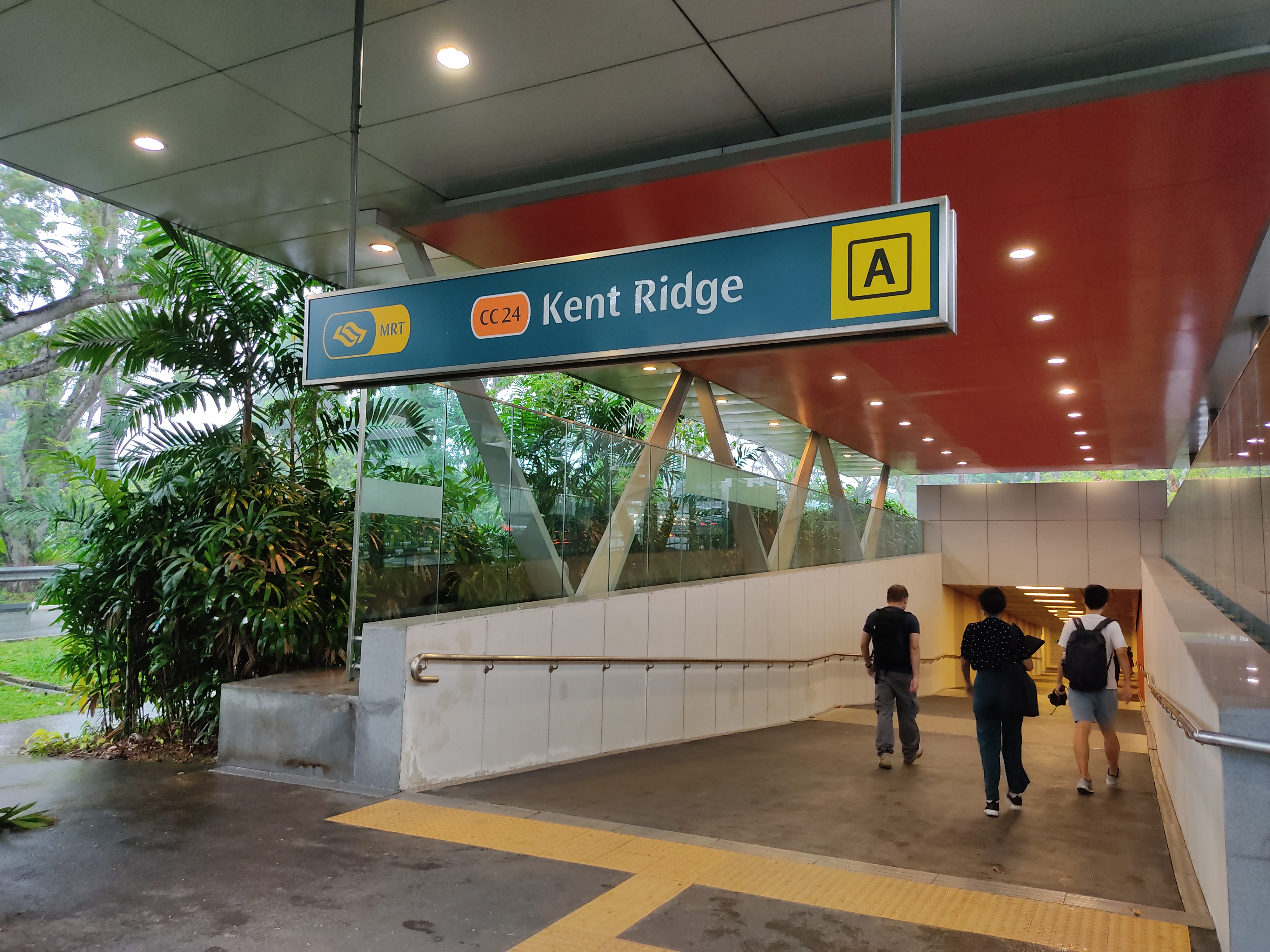
Kent Ridge MRT Station (CC24) serves several very different destinations on Singapore’s Circle Line. Exit A leads towards the National University Hospital (NUH) main buildings and public bus connection into the National University of Singapore (NUS). Exit C links directly to the NUH Medical Centre, useful for patients attending specialist appointments. Exit B serves the Singapore Science Park side and an approach towards the 47-hectare Kent Ridge Park. For natural history, the Lee Kong Chian Natural History Museum at 2 Conservatory Drive is an excellent separately planned campus destination, not an exhibit directly inside the station.
Important late-2026 museum update: Lee Kong Chian Natural History Museum currently opens Tuesday–Sunday 10am–6pm, with last admission at 4.30pm. It closes on Mondays, including most public-holiday Mondays, and uses three admission sessions at 10am, 1pm and 4pm. The museum warns that its Mammal Zone is being cleared for renovation and will close in late November 2026, with a refreshed presentation planned for 2027. Choose the visit date and ticket with this specific restriction in mind, especially if you are travelling to see mammal specimens.
This Kent Ridge MRT guide explains medical wayfinding, current station exits, the difference between public buses and NUS campus shuttles, forest-and-heritage trails in Kent Ridge Park and ticketed museums. Reflections at Bukit Chandu at 31-K Pepys Road tells the story of the Battle of Pasir Panjang, with different opening and admission rules from the natural history museum. For families, a museum or one manageable park section is a better plan than combining the entire NUS campus, NUH and Southern Ridges in one short visit. Reviewed 2 November 2026.
- Station: Kent Ridge CC24, Circle Line between one-north CC23 and Haw Par Villa CC25
- Exit A: NUH Main Building, Kent Ridge Wing, NUHkids and the NUS public-bus stop
- Exit C: direct connection to NUH Medical Centre and some specialist clinics
- Exit B: Singapore Science Park I side and direction of Kent Ridge Park
- Natural history: Lee Kong Chian Natural History Museum, 2 Conservatory Drive, ticketed, Tuesday–Sunday 10am–6pm
- Museum 2026 warning: Mammal Zone closing for renovations from late November into 2027
- Park: Kent Ridge Park, 47 hectares, free public grounds, steep paths; only Tembusu Grove and Canopy Walk are wheelchair-accessible
- War history: Reflections at Bukit Chandu, 31-K Pepys Road, Tuesday–Sunday 9.30am–5pm
- Transport: SBS Transit service 95 and NUS internal shuttles have different passenger rules; don’t assume tourists may use campus shuttles


Kent Ridge is a hospital, campus, science and nature gateway
The name Kent Ridge has several overlapping meanings. It refers to an MRT station, the NUH medical campus, the main NUS campus region and a substantial public park on a ridge associated with the final battles for Singapore in 1942.
That mixture makes it especially important to choose the right destination. A patient cannot be sent to a park entrance because it looks close on a map. A museum visitor should not assume the museum is immediately above the train platform. A hiker needs a suitable trail and return route rather than a hospital building as a meeting place.
The first decision is practical: healthcare, science learning, natural history or a park walk. Once the main purpose is clear, the station exit and transport route become much easier.
Public access also differs. Hospitals have patient privacy and clinical restrictions, campus facilities have security and visitor rules, museums sell tickets, and NParks maintains public park paths. A guide should not treat them as interchangeable tourist attractions.
Understanding CC24 and the current Circle Line
Kent Ridge is CC24 on the Circle Line, between one-north CC23 and Haw Par Villa CC25. The station is not an interchange with the East–West Line, despite its connection to the university and hospital.
Travellers arriving from the main East–West Line can transfer to the Circle Line at Buona Vista and then continue toward Kent Ridge. Other routes use different interchanges depending on where the journey begins.
Since the Circle Line was completed into a full loop in July 2026, travellers should use current directional signs and station displays rather than rely on old descriptions of an unfinished ring. The correct platform and transfer depend on the origin.
Allow time for station lifts and the final campus or park journey. A medical appointment or museum booking may have a fixed reporting time that requires more than the travel time shown between railway stations.
Station exits: the most useful four choices
SMRT’s official station guide lists Exit A for NUH Main Building, Kent Ridge Wing, emergency facilities and NUS connections. This is appropriate for people heading towards the main clinical campus and the bus stop serving the university.
Exit C has a direct pedestrian connection to the NUH Medical Centre. The hospital and its specialist institutes specifically direct patients attending Medical Centre clinics to this exit.
Exit D also serves the Medical Centre zone under the station guide, while Exit B is more useful towards Singapore Science Park I and the general Kent Ridge Park direction.
A newer additional development connection may appear on some public station maps. Always follow the live exit signs and the specific institution’s current instructions rather than rely on an old photograph showing four exits.
Accessible routes matter. A street entrance’s proximity to a building does not prove that its staircase is the appropriate route for somebody who needs a lift or a shorter sheltered connection.
Stop 1: NUH Medical Centre—Exit C is a precise medical instruction
National University Hospital Medical Centre is directly connected with Kent Ridge station through Exit C, according to the hospital’s official page and the National University Cancer Institute Singapore.
This direct approach is particularly helpful to patients, carers and visitors who want to minimise unnecessary walking. It can also help a person who has to attend a time-specific diagnostic or specialist appointment.
However, the Medical Centre contains multiple specialist clinics and levels. The exact unit, zone and appointment time must be read from the hospital’s confirmation. An MRT exit is only the first step; it is not the name of a clinical room.
NUH’s digital wayfinding service, NUHGo!, provides updated guidance around the campus. Use it or ask an information counter when the actual destination is unclear.
Do not assume general retail or museum hours describe hospital clinic access. A clinical service may operate under a different schedule, and some areas require authorisation.
NUH Main Building and Kent Ridge Wing use different approaches
NUH includes a Main Building, Kent Ridge Wing, specialist facilities, emergency services and campus-related buildings. The station Exit A area is associated with the Main Building and certain hospital entrances.
A person with an appointment should confirm whether the building is the Main Building, Kent Ridge Wing or Medical Centre. Their names and entrances are not interchangeable, and some connecting linkways may be on different levels.
If someone has mobility needs, contact the hospital about accessible entry. A short-looking shortcut that requires stairs may be less appropriate than a longer sheltered link.
Follow hospital instructions about appointment arrival, registration and any pre-visit preparation. A travel guide should not contradict directions given for clinical care.
Hospital visitor conduct and privacy
NUH is a working healthcare institution. Patients may be unwell, and families may be under stress. Keep doors, lifts, registration desks and emergency vehicle routes clear.
Do not take photographs of identifiable patients, medical records or restricted clinical procedures. Hospital staff have duties that take precedence over a tourist’s desire to record a video.
If you accompany someone to a consultation, the most appropriate plan may be to attend the appointment and go home. Nearby museums and parks are optional opportunities, not expectations.
A useful travel guide should respect that this station is a healthcare gateway for many people.
Stop 2: the public bus 95 and university access
SBS Transit service 95 runs through the Kent Ridge campus area, and the university’s official transportation page identifies it as serving Kent Ridge MRT and Buona Vista MRT along routes to university buildings.
This is useful for an eligible visitor attending a campus event, lecture, research appointment or museum. The main campus spreads across a hilly area and cannot be treated as one compact building at the MRT entrance.
Before boarding, check the bus stop number, direction and the name of the destination. A university lecture theatre, museum and residence can be on different sides of the campus.
Do not use the phrase ‘NUS shuttle bus’ as if it automatically includes public bus service 95. They are distinct operations with different passenger conditions.
NUS Internal Shuttle Bus: a crucial visitor-access distinction
NUS operates an Internal Shuttle Bus (ISB) network with routes including A1/A2, D1/D2, K and R services under a revised network introduced in January 2026. It supports movement within the university.
The university’s official maps show stops close to Kent Ridge MRT, but a route being shown on a map is not a guarantee of unrestricted access to tourists. NUS has imposed visitor controls and may require identification or evidence of authorised campus business before allowing a person to use its internal shuttles.
If attending a university appointment or approved event, confirm your eligibility, invitation and the current shuttle instructions. If simply visiting a public museum, check the museum’s preferred public buses or other permitted connections rather than assume any internal shuttle may be boarded.
This is an important practical correction to older travel guides that describe NUS buses as universal free tourist transport. A campus shuttle service exists to serve university activity and should not be misrepresented as a public sightseeing hop-on service.
Stop 3: Lee Kong Chian Natural History Museum
Lee Kong Chian Natural History Museum is at 2 Conservatory Drive, Singapore 117377 on the NUS campus. It preserves and displays specimens related to biodiversity, evolution and the natural history of Southeast Asia.
The museum is an excellent destination for students and families who genuinely want to learn about animals, plants, fossils and ecological relationships. Its displays may include striking large skeletons and many smaller specimens that reward careful observation.
However, it is not directly at the MRT fare gates. The museum’s official visitor page recommends the public bus 96 from Clementi MRT or public bus 151 to the appropriate campus bus stops. From Kent Ridge MRT, campus or public-bus routing should be checked according to visitor eligibility and current access.
A visitor who arrives at Kent Ridge assuming a short escalator ride will lead to the museum may be disappointed. Plan the actual last-mile route and reserve enough time to return.
The museum’s admission is ticketed, unlike an ordinary public library or free park. Read the current ticket categories and booking terms before travelling.
Natural History Museum hours and time slots
The museum’s normal hours are Tuesday–Sunday, 10am–6pm, with last admission at 4.30pm. Monday is closed even when it is a public holiday, unless the operator specifically announces an exception.
To manage visitor capacity, it uses three entry sessions: 10am, 1pm and 4pm. This does not mean a visitor has exactly one hour to explore; the museum says there is no fixed time restriction once inside before the 6pm closing.
A useful family plan should allow around ninety minutes for the galleries, plus the transport and ticketing. A group that arrives at 5pm should not expect to purchase an ordinary ticket after last admission.
Online admission transactions may use SISTIC and include a booking fee. Large groups of thirteen or more have a separate enquiry process.
Check current exhibits and non-operating notices close to travel. A specialist museum’s display schedule is not fixed forever.
Late November 2026: the Mammal Zone closure
An especially important current notice appears on the museum’s official visitor page: selected Mammal Zone displays are being cleared, and the entire Mammal Zone will temporarily close for renovation starting in late November 2026.
The museum intends to present a refreshed exhibition in 2027. This is a future goal rather than a confirmed exact reopening date, and the rest of the museum’s operation should be considered separately.
Families who particularly want mammal specimens should check which displays remain before purchasing a ticket. A visitor primarily interested in fossils, birds, biodiversity and other collections may still find a visit worthwhile.
This is why a live attraction guide should name both general hours and specific gallery closures. A museum can be open while one popular section is unavailable.
What to learn inside the natural history museum
Choose one object and ask what evidence scientists used to describe it. A specimen may have a collection history, identification, habitat and an explanation of why it matters for research.
An older student can connect the exhibits to questions about Southeast Asian biodiversity. Why are some animals endemic? What makes a species vulnerable to habitat loss? How are specimens curated for long-term scientific use?
A younger child might enjoy comparing the size and shape of two organisms and asking how those features relate to their environments.
Do not handle specimens unless the exhibit specifically invites interaction. Museum objects may be fragile, irreplaceable or scientifically valuable.
One careful conversation is more meaningful than rushing from one dramatic skeleton to the next simply to collect photographs.
Museum visits and responsible science communication
Natural history museums often contain labels explaining how evidence was collected and classified. A visitor should distinguish a scientific observation from speculation and understand that knowledge can change with new research.
The presence of a fossil or preserved specimen does not imply it was collected under modern conditions or that every similar living animal can be seen in Singapore today. Historical collection contexts should be read carefully.
Students can practise asking where an object came from, when it was documented and what interpretation is supported by the displayed evidence.
A museum is not a wildlife petting facility. Respect exhibit barriers and staff instructions.
Stop 4: Kent Ridge Park, the largest outdoor experience nearby
Kent Ridge Park covers approximately 47 hectares along a ridge above the southern part of the NUS/Science Park district. NParks lists it as open 24 hours and part of the Southern Ridges network.
The park is associated with the Battle of Pasir Panjang in February 1942, as well as woodland paths, lookout points, ponds and planted areas that support birds and other wildlife.
Although SMRT lists Kent Ridge Park as a destination served from Exit B, the route to the hill can be steep and substantially longer than a simple station-side stroll. Choose the park entrance and section before departing rather than treating the whole forty-seven hectares as one compact destination.
Different visitors need different plans: a short Canopy Walk is not the same as a long forest loop, and a historical museum visit is not the same as outdoor exercise.
Always follow current NParks notices and permitted paths. The general 24-hour park listing does not prove that every trail is suitable for night walking.
The specific accessibility limit at Kent Ridge Park
NParks marks Kent Ridge Park as wheelchair-accessible but immediately adds a critical qualification: only Tembusu Grove and the Canopy Walk are wheelchair-accessible.
The remaining areas contain staircases or terrain too steep for wheelchairs and strollers. That detail should be stated prominently rather than hidden behind an accessibility icon.
A parent with a stroller or a companion using a wheelchair should plan to enter the suitable section and turn back before encountering steep stairs or unpaved trails. A family can have a rewarding nature visit without traversing the entire ridge.
For visitors who enjoy a more strenuous hike, choose the appropriate longer route and allow ample time for climbs, rest and return.
Stop 5: the 280-metre Kent Ridge Canopy Walk
Kent Ridge Park’s Canopy Walk is a roughly 280-metre boardwalk through secondary forest that links towards Reflections at Bukit Chandu.
The elevated route provides an opportunity to observe trees and forest structure at a different height from the ordinary path. Depending on weather and wildlife activity, visitors may notice birds, insects or unusual leaves.
The boardwalk is not a guarantee of seeing a rare animal. Choose one place to stop without blocking others and observe quietly. The best nature experiences often involve patience rather than a checklist of species.
Keep to the boardwalk and follow any maintenance closures. Do not climb railings, reach into branches or attempt to feed wildlife for a photograph.
For a family wanting a manageable outdoor stop, the Canopy Walk may be a more suitable focus than the entire Southern Ridges trail.
The dragonfly ponds and other nature features
NParks describes a pond and dragonfly pond in Kent Ridge Park’s north-eastern sections. The area supports aquatic plants and animals that make an interesting contrast with the surrounding forest.
A short observation can include looking at water plants, birds and the way dragonflies move. Do not enter the pond or collect insects.
The park is also known for a range of native and planted trees, including tembusu, and for forest bird species such as the racket-tailed drongo. These are possibilities, not guaranteed sightings.
Children can learn how ponds and forests provide different habitats without touching or disturbing the animals. A quiet outing can be a useful ecology lesson.
Stop 6: Reflections at Bukit Chandu—a separate museum
Reflections at Bukit Chandu is at 31-K Pepys Road, Singapore 118458, within the Kent Ridge historical landscape. It explains the Battle of Pasir Panjang and the resistance of the Malay Regiment during the final days before Singapore’s fall in 1942.
The gallery has a different focus from Lee Kong Chian Natural History Museum. One is about wartime history and remembrance; the other is about biodiversity and biological science.
The National Heritage Board lists normal visitor hours Tuesday–Sunday 9.30am–5pm, last admission 4.30pm, closed Mondays except public holidays. Its admission is free for Singapore citizens and permanent residents under the applicable policy; foreign visitors have separate standard and concession tickets.
Do not assume that museum hours equal the surrounding park’s 24-hour access. The building is not open all night, and entry may be affected by public programmes.
A meaningful visit should allow time to read the stories of soldiers and civilians rather than rush through the displays.
Understanding the Battle of Pasir Panjang respectfully
The 1942 fighting in the area was part of Singapore’s wartime history and included determined resistance by troops of the Malay Regiment. Their experiences are commemorated through interpretation at Bukit Chandu.
Visitors should separate documented events from legend or dramatic retellings. A museum exists partly to provide sources and context that help people understand difficult historical experiences responsibly.
For school-age children, a simple explanation of courage, duty and the cost of war may be more suitable than graphic descriptions. Parents and teachers can decide how much detail is appropriate.
Respect the memorial character of the site. Loud play or insensitive photographs inside commemorative displays can interfere with other visitors.
Stop 7: Singapore Science Park I and nearby public-facing spaces
Singapore Science Park I lies on the Exit B side of the Kent Ridge interchange and contains offices, research-related businesses and newer commercial developments such as the Geneo precinct.
These facilities support employment and innovation, but they are not automatically public science museums. Private laboratories and office floors require authorisation, even when their buildings appear prominently on a map.
Some public-facing dining, retail or event spaces may be appropriate for visitors. Confirm the actual business and its operating hours rather than assume all buildings remain open as tourist galleries.
A student interested in careers or science can learn how research workplaces cluster near the university and transport. The educational value lies in understanding the ecosystem, not entering restricted laboratories.
NUS Central Library and University Town: separate campus destinations
The National University of Singapore has libraries, teaching buildings, University Town and other facilities across its large campus. Kent Ridge MRT is a common arrival for eligible students, staff and authorised visitors.
However, an NUS library is not automatically the same as a public NLB branch. Access may depend on institutional affiliation, visitor registration and the purpose of the visit.
University Town is also a separate campus zone requiring a bus or longer walk. A visitor should not assume that every NUS facility is within five minutes of the station.
If attending a public lecture, campus event or meeting, use its actual invitation and directions. An address ending in NUS is not precise enough by itself.
NUS travel etiquette and visitor boundaries
A university is a working educational environment. Teaching spaces, residence areas, laboratories and student amenities can be private or restricted, while certain public museums and events welcome outside visitors.
Use public footpaths and permitted transit. Do not enter a residence building, student study room or laboratory simply to photograph an impressive campus interior.
For a museum visit, the museum’s ticket should establish your right to enter that museum, not unrestricted permission to explore every university facility.
Respect students and staff who are studying or working. Visitors should avoid filming strangers at close range.
Stop 8: HortPark as a longer Southern Ridges extension
HortPark at 33 Hyderabad Road is a public gardening and horticultural hub in the wider Southern Ridges landscape. It covers roughly 10.7 hectares and lists general park opening 6am–11pm.
It is connected conceptually and through longer park routes with Kent Ridge Park, but not immediately at CC24’s fare gates. A visitor who wants HortPark as the main destination may find a different MRT-and-bus connection more convenient depending on the chosen entrance.
Do not add it as a ten-minute detour after an NUH appointment or museum visit. A dedicated gardening visit deserves its own timetable.
Particular horticultural programmes, visitor services or workshops have shorter hours than the general grounds and may require booking.
A one-hour Kent Ridge MRT outing
For a brief trip, choose a specific purpose. If you have a medical appointment, go directly to the correct NUH building. If you are simply meeting someone for food, use a confirmed-open campus or Science Park public-facing outlet.
A significant Kent Ridge Park hike or visit to a campus museum needs more than one hour once transit and admission are included.
Do not treat the Circle Line station as a tourist attraction in itself. Its convenience is its ability to connect to the right destination when you have planned it.
Two-hour natural history museum plan
Book an appropriate Lee Kong Chian Natural History Museum session, then plan a lawful public or authorised campus route. Allow a comfortable ninety minutes inside and a margin for reaching the museum and returning.
If the Mammal Zone is the primary interest, check the late-November renovation notice before purchasing. A family can also focus on the remaining biodiversity galleries when the mammal section is unavailable.
Do not combine this museum with a long nature trail simply because both are labelled Kent Ridge. The walking distance and museum timetable make that plan unnecessarily ambitious for many families.
A half-day Kent Ridge Park and wartime history plan
Make the park the main destination, choosing an appropriate accessible or hiking section. Use the Canopy Walk or a selected ridge path, then visit Reflections at Bukit Chandu during its museum hours if the group has time and interest.
This combines nature with historical learning, but the hill can be physically demanding. Allow for rests, water, the return route and any ticket or gallery closing time.
Visitors using wheelchairs should plan specifically around Tembusu Grove and the Canopy Walk; the rest of the park is not uniformly accessible.
An alternative is to visit only the museum and one nearby public viewpoint. A shorter route can be more thoughtful and enjoyable.
A family learning visit: two different kinds of science
Natural history at LKCNHM concerns evidence from specimens, ecology and evolution. A public nature walk in Kent Ridge Park concerns live organisms and habitat observation. Both can teach science, but they should not be confused.
A student might study a preserved plant or animal specimen in the museum, then compare the interpretation with living vegetation on a public park path.
Do not collect wildlife or botanical material to bring home. Observation and photography from permitted positions are enough.
The most useful lesson may be distinguishing what a museum label explains from what a person can see in nature today.
A separate wartime learning visit
Reflections at Bukit Chandu provides a focused route into the Battle of Pasir Panjang and the history of the Malay Regiment. It can be paired with a short Canopy Walk when the weather and museum timetable permit.
For students, choose one historical source or exhibit and explain what it supports. Avoid turning a place of remembrance into a series of sensational photographs.
Visiting thoughtfully can be more meaningful than covering several other museums across Singapore on the same day.
Admission, free spaces and transport costs
Kent Ridge Park has free general public access, while Lee Kong Chian Natural History Museum and Reflections at Bukit Chandu have separate ticket arrangements and eligibility rules.
Campus food and commercial venues charge for meals or products. Public buses require their normal fare, while the university’s internal bus network has passenger and visitor conditions that should be confirmed.
Do not assume a museum admission includes a campus tour, hospital access or all special exhibits. Read the exact ticket and venue policy.
A low-cost nature outing is possible if you choose an accessible park section, travel by public transport and bring an appropriate meal or snack.
Accessibility: do not mistake a regional label for a complete route
Kent Ridge station and NUH Medical Centre offer a direct linked path through Exit C, useful for patients needing accessible travel. However, individual clinical wards and campus buildings still have their own internal wayfinding.
Kent Ridge Park is not uniformly accessible. NParks identifies only the Canopy Walk and Tembusu Grove as wheelchair-accessible; other sections are too steep or contain stairs.
An NUS museum or event can have its own accessible entrance, but reaching it from the station requires a lawful route and suitable transport. Contact the venue for special assistance when needed.
Choose the full journey before setting off, especially if travelling with children, wheelchairs or older people.
Weather, hills and protected forest safety
Kent Ridge Park contains hills, forest areas and paths that can be slippery after heavy rain. Carry water and appropriate footwear, and avoid exposed or forested areas during lightning.
Do not attempt a long night forest hike merely because NParks lists the park as open twenty-four hours. Lighting, terrain and wildlife considerations vary.
Follow conservation rules: do not feed animals, remove plants, disturb habitats or leave litter. The value of an urban forest depends on the care shown by visitors.
During haze or extreme heat, shorten outdoor activity as appropriate and consult current public advisories.
Common Kent Ridge MRT mistakes
Using Exit A for every NUH appointment. The hospital directs Medical Centre patients to Exit C; the Main Building and other zones have separate approaches.
Assuming all NUS shuttle buses accept unrestricted tourists. Confirm campus eligibility and public-bus alternatives.
Expecting LKCNHM directly outside the station. It is at 2 Conservatory Drive and needs a last-mile route.
Ignoring the late-November Mammal Zone closure. Check current gallery availability before buying a ticket.
Assuming all 47 hectares of Kent Ridge Park are wheelchair-accessible. NParks limits suitable routes to Tembusu Grove and Canopy Walk.
Confusing Reflections at Bukit Chandu with the natural history museum. They have different themes, hours and tickets.
Adding the full Southern Ridges circuit to a short NUH visit. Choose an appropriate dedicated park itinerary.
Frequently asked questions about Kent Ridge MRT
Which MRT line serves Kent Ridge? Circle Line CC24.
Which exit goes to NUH Medical Centre? The hospital recommends Exit C.
Where is the NUH Main Building approach? The station guide associates it with Exit A, but check your actual clinic.
Which exit is closest to Science Park I? Exit B serves the Science Park side.
Can I visit NUS libraries freely? Institutional libraries may have access rules; check the specific library and authorisation.
Can all tourists use NUS internal shuttles? Do not assume so. Confirm current eligibility and use public services where appropriate.
Where is Lee Kong Chian Natural History Museum? 2 Conservatory Drive on NUS campus, requiring a separate last-mile journey.
When is the natural history museum open? Tuesday–Sunday 10am–6pm, last admission 4.30pm.
Is the Mammal Zone open throughout late 2026? The museum has announced a late-November closure for renovation.
How big is Kent Ridge Park? Approximately 47 hectares.
Is the Canopy Walk accessible? NParks lists the 280-metre Canopy Walk and Tembusu Grove as wheelchair-accessible.
What is Reflections at Bukit Chandu? A museum interpreting the Battle of Pasir Panjang, at 31-K Pepys Road.
What is a sensible first visit? One museum or one manageable park section, not the whole NUS/NUH/Southern Ridges area.
Why the station-specific distinction matters
Kent Ridge can be a place for urgent medical care, serious research, school learning or a relaxed nature walk. Sending everyone towards the same exit and itinerary would be neither useful nor considerate.
This guide prioritises verified medical access, explains museum transport and current gallery changes, and separates public park paths from the wider university’s restricted spaces. That is the practical information a first-time visitor needs.
Official sources and related reading
- SMRT: Kent Ridge CC24 exits and main destination list
- NUH: Exit C connection, campus wayfinding and public transport
- NCIS: Exit C and Medical Centre specialist clinics
- NUS: public buses 95/96 and campus approaches
- NUS: 2026 internal shuttle network; verify visitor eligibility
- LKCNHM: admission sessions, 2026 Mammal Zone renovation and directions
- LKCNHM: museum last admission, large groups and guided tours
- NParks: park size, canopy walk and important accessibility limits
- Reflections at Bukit Chandu: hours and ticket rates
- NParks: HortPark as a separate Southern Ridges extension
- eduKateSG: Labrador Park MRT for a different Southern Ridges approach
Independent visitor guide reviewed 2 November 2026. Hospital instructions, campus transport, museum galleries and trail access can change; follow official venue information for medical or booked visits.