
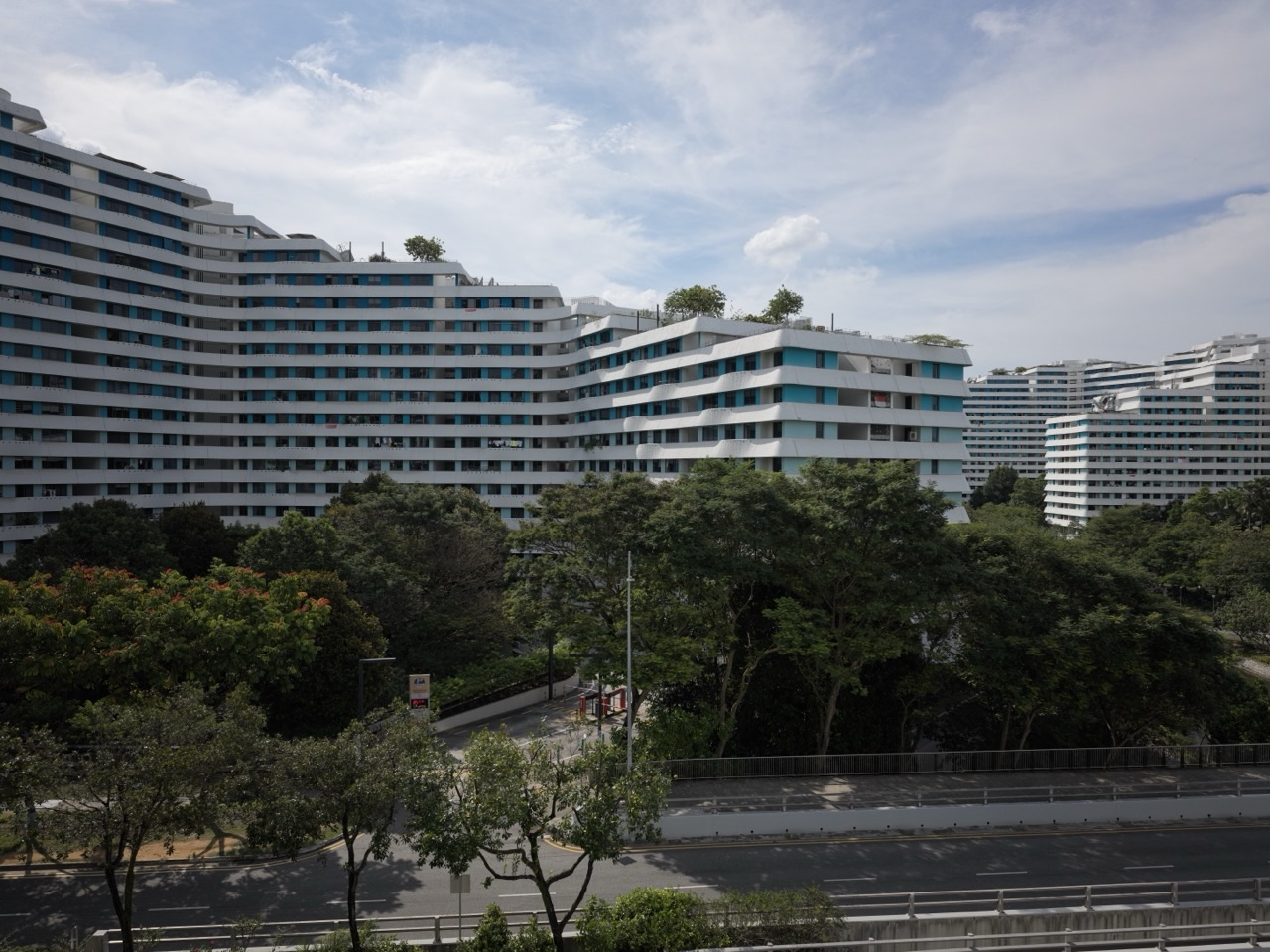
Aurelle of Tampines is an actual 760-home Executive Condominium at Tampines Street 62 by Sim Lian Group, not an HDB BTO launch. Its sales opening on 8 March 2025 saw 682 homes purchased, or about 90% of the total, at an average of S$1,766 per square foot. Initial indicative prices started from approximately S$1.417 million for three bedrooms, S$1.689 million for four bedrooms and S$2.258 million for five bedrooms. Reports on 12 April 2025 stated that all 760 units had been booked, but later URA-based monthly developer sales analysis showed 757 recorded sold and three unsold as of September–October 2026. That is a dated reporting difference—not proof that any specific apartment can be booked today.
The project comprises fourteen 14-storey blocks, with three- to five-bedroom layouts of approximately 840 to 1,356 square feet, a 99-year lease and extensive private shared facilities. Sim Lian describes its location as about a five-minute walk from the future Tampines North Integrated Hub, including an MRT station on Cross Island Line Phase 1, which LTA currently targets for 2030—not 2028. Early project material describes an anticipated 2028 vacant-possession horizon, but exact Temporary Occupation Permit and keys require authorised confirmation. Because Aurelle’s original land tender predates the May 2026 EC rules, the older five-year Minimum Occupation Period from actual TOP and ten-year full-privatisation framework apply. This guide separates historical sales, current recorded transactions, public transport and actual buyer responsibilities.
- Project: Aurelle of Tampines at Tampines Street 62, a new Executive Condominium developed by Sim Lian Group
- Residential inventory: 760 units across fourteen blocks of 14 storeys, with three- to five-bedroom layouts
- Sizes in developer’s project description: approximately 840–1,356 sq ft
- Actual retail launch: 8 March 2025; 682 homes sold that day, about 90% of total supply
- Developer opening average sale price: S$1,766 psf, not a fixed price for any individual apartment
- February 2025 indicative starting prices: three-bedroom from S$1.417m, four-bedroom from S$1.689m, five-bedroom from S$2.258m
- Industry reports on 12 April 2025 described all 760 units booked, including 52 remaining units sold during a second-timer booking session
- URA-based monthly developer sales records later showed 757 of 760 sold and three not recorded as sold at end-September/October 2026
- Options and reported unit sales can change; do not infer that three particular units are legally available without current authorised developer confirmation
- Sim Lian describes roughly 70 private facilities including seven pools, clubhouse, play areas, tennis and recreation space
- 99-year leasehold; specific private facilities and ongoing management fees require actual approved project documents
- Original EC ownership cohort: generally five-year MOP from actual TOP, full privatisation after ten years
- Original new-unit income ceiling S$16,000, not the higher S$18,000 applied to later 2026 land tender cohorts
- Potential new-EC CPF Housing Grant up to S$30,000 for eligible buyers, separate from HDB’s Enhanced CPF Housing Grant
- Early project materials referred to vacant possession around end-2028; actual TOP and legal key date must be checked
- Tampines North MRT is NOT operating in November 2026; LTA targets Cross Island Line Phase 1 for 2030
- Tampines North Integrated Hub and ParkTown Mall are separate development and operating programmes; check actual opening of each facility
- Nearby established Tampines services and schools can be helpful, but proximity does not guarantee admissions, centre places or short journeys
- Private EC original purchases and later eligible resales are distinct stages, with HDB legal restrictions before MOP
- Research date 7 November 2026; official developer, HDB, LTA and dated URA records control later revisions
Facts reviewed 7 November 2026. April 2025 fully-booked reports and later URA-derived sales statistics are dated snapshots, not a live unit offer. The 2028 possession horizon and 2030 railway opening are different milestones. Actual TOP and EC resale eligibility require authoritative confirmation.
Guide chapters: actual sales, future transport, EC rules and a practical home decision
- 1. Why two different sales totals can both be reported
- 2. The March 2025 launch and its real pricing context
- 3. Three-, four- and five-bedroom starting prices in February 2025
- 4. Fourteen 14-storey blocks: why layout matters more than a headline
- 5. Seventy facilities and seven pools: benefit and maintenance
- 6. Why April 2025 was reported as fully sold
- 7. Reading URA’s later 757-of-760 sales records
- 8. The earlier five-year EC MOP applies to Aurelle
- 9. Full privatisation after ten years, not at the MOP
- 10. The original S$16,000 new EC income ceiling
- 11. The EC CPF Housing Grant versus HDB’s EHG
- 12. Why Tampines North MRT is a future station, not an existing one
- 13. The Cross Island Line 2030 target and wider east connectivity
- 14. The future Integrated Hub, ParkTown Mall and community facilities
- 15. Existing Tampines facilities and the real daily journey
- 16. Three- to five-bedroom homes and multigenerational planning
- 17. What the expected 2028 possession horizon really tells us
- 18. How to prepare for handover and defect inspection
- 19. Comparing Aurelle with Rivelle Tampines and other ECs
- 20. A private condominium is not the same as a new EC
- 21. The right approach when only a few units appear unsold
- 22. A dated release tracker for 2027 and 2028
- 23. Conclusion: near-total sales, future transport and an older EC ownership framework
- Household examples and decisions
- Frequently asked questions
- Official and dated sources
1. Why two different sales totals can both be reported
Aurelle’s sales record demonstrates why property information should always carry a date and method of measurement. Sim Lian’s launch on 8 March 2025 produced 682 sales among 760 homes, around ninety percent. A subsequent 12 April report said the developer had booked every apartment after the remaining units were taken up during a second-timer session. Those were genuine reports of sales activity at the time.
Later project-level analysis of URA’s monthly developer sales figures, however, recorded 757 sold and three not recorded as sold at the end of September or October 2026. The difference does not necessarily mean the earlier reports were false. Options may lapse, arrangements can change, and different reporting systems count sales at different stages. The sources do not establish the particular reason for each of Aurelle’s reported changes.
The crucial buyer warning is that a count of three not recorded as sold is not a public reservation list identifying available apartment numbers. A family must check with the authorised developer to know whether a unit is genuinely available under applicable EC rules.
A useful release guide explains both historical milestones and later recorded figures without pretending that one screenshot is a live inventory. The latest legal purchasing opportunity is an individual unit confirmed by the developer, not the arithmetic difference between two published tallies.
2. The March 2025 launch and its real pricing context
Sim Lian launched Aurelle of Tampines on 8 March 2025, with 682 of its 760 units purchased on the first day at an average of S$1,766 per square foot. Strong demand was reported across the offered apartment types, with the four- and five-bedroom categories taken up during the initial launch. The event was a genuine residential sale, unlike a Government Land Sales tender that merely establishes developer rights.
The launch average is a historical project-level statistic, not the same as the actual price of any particular apartment today. Even among homes of the same bedroom count, floor area, orientation and layout can vary. A family should use an authorised current price for the specific unit it is considering, rather than multiply an old average by a loosely understood floor-area figure.
Launch demand also does not guarantee future resale appreciation. Housing prices, loan interest rates and other developments can change over the many years an EC remains subject to occupation conditions.
For a reader considering 2027/2028 housing, the useful information is that Aurelle is a real, mostly or entirely taken-up project in the original launch. What remains uncertain is whether a particular lawful developer unit is available today and when every home will be ready for occupation.
3. Three-, four- and five-bedroom starting prices in February 2025
Before sales opened, market reporting based on Sim Lian’s preview listed indicative starting prices of about S$1.417 million for an 840-square-foot three-bedroom home, S$1.689 million for a 1,023-square-foot four-bedroom and S$2.258 million for a 1,356-square-foot five-bedroom. These are dated entry examples, not a promise that the same units and terms remain available over a year later.
A buyer should inspect the full cost. An apartment with a lower headline price may require a long mortgage and still incur buyer’s stamp duty, management contributions, property tax, insurance, furniture and moving costs. A larger home can be practical for a growing family but impose more financing pressure than is comfortable.
Unit-level design also matters. An efficient three-bedroom layout may offer sufficient space for a couple and child, while a five-bedroom apartment may provide more flexibility for study or care of an older relative. Neither is automatically the right choice.
The useful decision rule is to choose an actual available unit based on household finances and floor-plan usability. The 2025 prices explain launch conditions, but they should not be advertised as a new 2027 quotation.
4. Fourteen 14-storey blocks: why layout matters more than a headline
Sim Lian’s official project description identifies fourteen residential buildings of fourteen storeys and a total of 760 homes. Apartment floor areas range from around 840 to 1,356 square feet, with designs from three to five bedrooms. This is a substantial family-oriented EC rather than an unapproved land estimate.
Individual units can have different views, light exposure and proximity to shared facilities. A home facing a play area may suit parents who enjoy that activity, while another family may prefer a quieter orientation away from common spaces. The approved site and stack plans are more informative than an overall artist’s impression.
The layout also needs to support everyday use. Storage, circulation, bedroom privacy, balcony space and the distance from the lift can affect whether the apartment remains comfortable as the household grows or ages.
A prospective buyer should use actual unit dimensions when planning furniture and financing. The fact that an apartment belongs to a popular 760-home development cannot substitute for the simple question of whether the specific space fits the people who will live there.
5. Seventy facilities and seven pools: benefit and maintenance
Sim Lian’s project description emphasises approximately seventy condominium facilities, including seven pools, a grand clubhouse, play and recreation areas, a tennis court and landscaped spaces. These can support everyday exercise and community interaction for households that use them regularly.
But private shared amenities have recurring operating and maintenance costs. Pool treatment, lifts, landscaping, security and shared equipment require funding through the relevant management arrangements. A family should assess the expected maintenance contributions alongside the mortgage instead of assuming the facilities are free extras.
Different residents also value amenities differently. Parents with young children may enjoy playgrounds, while an older resident might prefer quiet walks and accessible seating. A family that rarely swims should still recognise that ownership includes obligations to support common property.
The right comparison asks whether these facilities suit the household and whether the monthly costs remain manageable. An impressive list can enrich life, but it cannot fix an unaffordable purchase or an impractical internal layout.
6. Why April 2025 was reported as fully sold
Industry coverage dated 12 April 2025 reported that all 760 Aurelle apartments had been booked after a second-timer booking session, with the remaining 52 units taken up in little over an hour. This followed the initial strong March launch. The episode illustrated buyer interest in ECs and the effect of first- and second-timer allocation rules in the earlier policy cohort.
The event should be described as a dated booking milestone, not a guarantee that every option remains exercised forever. Sales status can evolve with contract progression and cancellations. URA-based later tallies that show slightly fewer recorded sales should be reported in their own dated context.
A buyer should therefore avoid either extreme: claiming hundreds of units remain unsold because the launch was once only ninety percent sold, or asserting that no unit could ever reappear because the project was once fully booked. Both statements ignore the need for a current, authorised unit-by-unit status.
The useful takeaway is to rely on Sim Lian’s actual sales process and current terms. A public article can explain the history and the statistical nuance but should not function as a reservation service.
7. Reading URA’s later 757-of-760 sales records
Aurelle’s URA-based developer sales reporting showed approximately 757 units recorded sold and three not recorded as sold by the end of September or October 2026. The reporting method differs from a real-time sales gallery’s list of options and payment status. A home may be booked, released or under contractual processing on dates that do not align perfectly with monthly statistics.
The number is useful for understanding near-total recorded take-up, but it cannot identify which floor or apartment, if any, a buyer may legally select. A person should not transfer money to someone claiming that the arithmetic automatically guarantees access to three specific units.
Comparing project uptake also requires consistency. A figure measured by options issued is not necessarily directly comparable to caveated resale transactions or an industry article’s opening-day bookings. The exact data source and reference month matter.
The best practice is to display the known figures with dates and a clear caution: 2025 launch and fully-booked reports, followed by a later URA-based tally. If the buyer needs a live unit, ask the authorised developer for confirmation and actual sale documents.
8. The earlier five-year EC MOP applies to Aurelle
Aurelle was sold before the EC policy changes announced in May 2026. Its underlying land tender belongs to the earlier cohort, so the ordinary Minimum Occupation Period is generally five years from the project’s actual Temporary Occupation Permit. It does not begin on the 8 March 2025 retail launch or on the date a purchaser paid the booking fee.
The distinction is important because some newer EC land parcels have a ten-year MOP. A buyer should not assume every EC marketed in 2027 or 2028 follows one universal rule. The land tender closing date determines the applicable cohort, while the actual TOP date starts the occupation clock.
If Aurelle eventually receives TOP around the project’s expected late-2028 or early-2029 horizon, a five-year ordinary resale milestone would fall years later. That is only illustrative until TOP is confirmed. An owner cannot simply offer the unit in unrestricted ordinary resale during 2028.
The safe approach is to read HDB’s EC conditions and the actual purchase agreement. Legal flexibility should be understood before any financial decision, especially if the household may need to relocate for work or family care.
9. Full privatisation after ten years, not at the MOP
The older EC framework generally provides full privatisation ten years after TOP. The first eligible ordinary resale after a five-year MOP is not the same event as unrestricted private-market status. Singapore Citizen and Permanent Resident purchaser eligibility conditions can continue between those milestones.
This matters for anyone projecting future resale demand. A household planning to sell after MOP may face an eligible buyer pool that differs from the unrestricted market after full privatisation. It also matters to foreign buyers who may see listings for ECs and incorrectly assume all are equivalent to ordinary private condominiums.
Aurelle’s timeline must begin with actual TOP, not its 2025 launch. A future buyer should not be told that it becomes fully private in 2035 by simply adding ten years to retail sales; that would use the wrong starting point.
The best reason to buy remains daily residential suitability. Future legal flexibility and possible resale value are secondary factors, and neither can replace a sustainable financial plan for the years the family must occupy the home.
10. The original S$16,000 new EC income ceiling
Aurelle’s original new-unit buyers applied under the earlier Executive Condominium income ceiling of S$16,000 per month for the relevant household. HDB’s August 2026 policy changes increased the ceiling to S$18,000 for certain newer EC projects based on their land tender closing dates. The later increase does not automatically rewrite Aurelle’s March 2025 purchase conditions.
A couple earning above the old threshold should therefore not assume it can take advantage of a cancelled unit merely because its current income is below the revised ceiling for a different EC. The correct application requirements need to be verified for Aurelle’s legal cohort and any new transaction.
Income also does not settle eligibility by itself. Citizenship, family nucleus, age, previous housing subsidies and private property history can affect whether an applicant can buy. The ability to obtain sufficient bank financing is another separate test.
A responsible buyer should ask the developer for the exact current eligibility procedure, not rely on a general social-media statement that EC income ceilings have changed nationally. The original site cohort matters.
11. The EC CPF Housing Grant versus HDB’s EHG
Eligible new-EC first-timer families may receive an EC-specific CPF Housing Grant up to S$30,000, depending on income, citizenship and other conditions. This is different from the Enhanced CPF Housing Grant used for qualifying new or resale HDB flat purchases. The two grants cannot simply be treated as interchangeable cash deductions.
An EC buyer should not put the highest EHG amount into a spreadsheet for Aurelle and conclude that a three-bedroom unit will be far cheaper than its real authorised selling price. The grant applies through CPF arrangements and may be smaller or unavailable for a particular household.
The purchase also involves mortgage payments, buyer’s stamp duty, property tax, legal fees, furnishings, management contributions and a reserve for emergencies. The correct calculation uses the actual apartment price and the household’s personally assessed support.
A useful financial plan protects the family if income temporarily falls or interest expense rises. No subsidy, however welcome, can make a mortgage sustainable if every other necessary expense has been ignored.
12. Why Tampines North MRT is a future station, not an existing one
Sim Lian describes Aurelle as around a five-minute walk from the planned Tampines North Integrated Hub, whose transport component includes Tampines North MRT. LTA’s Cross Island Line Phase 1 is currently targeted for completion in 2030. That means the planned MRT station cannot honestly be described as operating in November 2026 or as guaranteed open at a 2028 residential move.
This is a major everyday consideration for households who rely on trains. Until the new line is operational, residents may need bus connections to existing MRT stations or other working transport options. The commute should be calculated from actual bus stops and accessible paths rather than from an unbuilt station symbol.
The phrase five-minute walk also depends on the final route, crossing arrangements and individual walking ability. A short distance on a map can differ from a continuous sheltered or barrier-free journey in reality.
A good 2027/2028 guide makes two transport plans: the first-year route using services that actually operate, and the later route after LTA confirms the new station’s opening. That is more useful than promising future commuting convenience prematurely.
13. The Cross Island Line 2030 target and wider east connectivity
The Cross Island Line will be built in phases, with Phase 1 targeted for 2030, its Punggol Extension and Phase 2 for 2032, and later western stages beyond. Tampines North is within the first-phase corridor, but the date remains an infrastructure target subject to construction, testing and official service approval.
When operating, the line can create more options for residents travelling across eastern, north-eastern and central Singapore. However, a specific household’s time savings depend on destination, transfers, frequency and the last-mile route. A new MRT is not evidence that every worker will have a much shorter commute.
The line also should not be used as a guaranteed property-price multiplier. Housing values can respond to many factors, including financing, competing supply and the quality of the actual home. A future rail benefit may be real without determining any individual resale outcome.
For buyers, the practical priority is to understand existing transport first. The opening of Tampines North should be recorded when LTA confirms it, not treated as an operating service simply because it appears in current marketing.
14. The future Integrated Hub, ParkTown Mall and community facilities
Sim Lian’s project information describes an upcoming Tampines North Integrated Hub with an MRT station, bus interchange, ParkTown Mall, a community club and a hawker centre. These facilities could strengthen local convenience, especially for residents who prefer to combine transport and ordinary errands in one trip.
But they are separate components with their own construction, tenant, operating and public-access arrangements. A mall can be structurally complete before every shop begins trading, and an interchange can require transport-service changes after construction. A proposed hawker centre does not establish the opening day or stallholder list.
A family should identify actual operating groceries, childcare and healthcare options while the hub matures. This is particularly important if the EC reaches occupation before the Cross Island Line station opens. A realistic first-year routine should not depend on every planned service being ready at once.
The best way to value a master-plan benefit is through practical use. A future mixed-use centre can be important without becoming a private amenity included in the EC’s maintenance or legal ownership.
15. Existing Tampines facilities and the real daily journey
Tampines is an established regional centre with operating shopping areas, food options, transport and healthcare. Tampines North is an expanding part of that town, not necessarily within a short walk of every facility available in Tampines Central. A household should be careful with advertisements that describe attractions across the entire planning area as being at the doorstep.
For a family, daily routes may include school, work, supermarkets and grandparents who provide care. Those journeys should be calculated from the actual apartment entrance using services operating at the relevant time. A car journey, bus transfer and long walk are different experiences even when they all occur within Tampines.
Seniors may place more weight on medical appointments, step-free routes and safe sheltered pickup, while young professionals may focus on train access once it opens. The same location can work differently for different households.
The right home choice compares the entire family schedule with the property’s cost and layout. A familiar regional town can offer substantial amenities without guaranteeing that all of them are immediately accessible from one specific EC.
16. Three- to five-bedroom homes and multigenerational planning
Aurelle’s unit mix from three to five bedrooms can suit many different household arrangements, including couples planning children, families needing study rooms and some multigenerational situations. Yet the label five-bedroom does not automatically mean a unit is universally suitable for elderly care or home working. Door widths, bathroom placement, circulation and accessible transport need attention.
A household considering a larger apartment should examine whether the extra space will be useful regularly and how much additional mortgage, tax and maintenance it requires. Buying unnecessary area can strain family savings, while buying too little room may create future moving pressure.
Original purchasers can plan furniture and renovations based on their actual unit floor plan, not an illustrative brochure photo. Storage, kitchen layout and balcony use can determine how comfortably the family lives day to day.
The strongest decision combines physical needs and financing. A home that suits the household for many years is more valuable than a bedroom count that looks impressive but makes every monthly payment difficult.
17. What the expected 2028 possession horizon really tells us
Some Aurelle project materials have described expected vacant possession around the end of 2028, while marketing sources may use estimated TOP periods that vary slightly. These are not necessarily identical milestones. The contract, actual regulatory approval and developer’s handover instructions should determine what an individual purchaser can rely on.
A sales launch in March 2025 does not permit immediate occupation, and an estimated future year should not be treated as a fixed date for school admission, moving contractors or sale of an existing home. Construction, inspections and legal completion can affect the sequence.
For original purchasers, a sensible plan includes remaining payment obligations, the current home or lease, defects inspection, renovation and the time required for utilities and furnishings. The family should reserve a buffer for delays and unexpected costs.
The five-year EC MOP begins from actual TOP, not a predicted year on a marketing site. Therefore even if the property becomes ready in late 2028, a buyer should wait for the confirmed TOP before calculating the earliest ordinary resale date.
18. How to prepare for handover and defect inspection
Once a purchaser receives legitimate developer handover instructions, it is useful to inspect the unit systematically. Doors, windows, balconies, water pressure, drainage, kitchen and bathroom fittings, electrical points and finishing should be checked against the approved plans. Record issues with photographs and submit them through the proper defects process.
A new condominium also has management procedures for movers, renovations, access cards and common facilities. A family should plan work within permitted hours and coordinate lift bookings or loading arrangements. These small details can affect the cost and smoothness of occupation.
Outside the apartment, test the actual first-year travel route using existing buses and rail rather than the unbuilt Tampines North MRT. Identify working groceries, medical facilities and childcare options before moving.
The best approach is to prepare early but commit to irreversible expenses only when the actual possession date is known. A 2028 headline can guide rough planning without becoming an unsupported promise that everything will be ready on one day.
19. Comparing Aurelle with Rivelle Tampines and other ECs
Rivelle Tampines is a separate 572-unit Executive Condominium at Tampines Street 95 that launched in March 2026, while Aurelle has 760 homes and launched a year earlier. Both belong to earlier EC land tender cohorts, though their actual layouts, sites, price histories and expected completion can differ.
A buyer should not use Rivelle’s launch sales count as Aurelle’s current stock or assume both projects are at the same stage of construction. Property names beginning with Tampines can refer to different sites several kilometres apart, with different transport and school journeys.
The EC policy cohort should also be checked against newer sites such as Canberra Drive or Admiralty Walk, where post-May-2026 land tenders trigger ten-year MOPs and later full privatisation. The retail year alone does not establish the ownership restrictions.
Compare legal eligibility, actual individual home price, usable layout and time to occupation. An apartment is a household purchase, not a contest over which project had the highest opening-weekend take-up rate.
20. A private condominium is not the same as a new EC
An Executive Condominium is developed privately but has special initial HDB buyer requirements, including qualifying households, relevant income ceilings and occupation restrictions. It differs from a conventional private condominium in those areas. A person who can freely purchase a normal private apartment may not qualify to buy a new EC direct from the developer.
The original Aurelle sales also had first- and second-timer allocation arrangements, which shaped the opening booking period. A later policy revision for new EC land tender cohorts should not be applied retroactively to the original launch. Buyers need site-specific legal conditions, not generic housing explanations.
This distinction affects financing and the ability to dispose of a property. An HDB flat has its own grants and MOP; a new EC has its own CPF grant and occupation pathway; a normal private condo is governed by another arrangement.
A useful housing guide first identifies the product and then explains how to buy and occupy it lawfully. A similar-looking tower or shared swimming pool does not make every form of housing interchangeable.
21. The right approach when only a few units appear unsold
The URA-based figure of 757 sold out of 760 as of the later 2026 reporting period is very close to full take-up. It may attract readers hoping for a specific remaining developer unit, but a data count does not establish lawful booking availability. An option can be pending, reissued or otherwise reflected differently in public statistics and developer inventory.
The correct step for a genuinely interested eligible household is to seek current authorised project information. Verify the exact unit, approved price, payment scheme, eligibility and purchase documents. Do not pay an intermediary simply because an online article says three units might exist.
For a family with a strict moving deadline, remember that purchase and occupation are different stages. Even a legitimate current developer unit may not be completed for some time. Interim accommodation and financing must be managed.
An informative article is not less helpful when it refuses to invent live availability. Readers deserve a clear distinction between public statistics, historical booking reports and a specific home that can actually be purchased today.
22. A dated release tracker for 2027 and 2028
The historical record should begin with Sim Lian’s March 2025 launch: 760 units, 682 first-day sales at S$1,766 psf average and indicative starting prices by room type. Add the April 2025 report of 760 bookings as a separate date. Then record the later URA-based monthly tally of 757 sold, with the reference month and a warning that this is not a live unit availability list.
Keep building completion and transport in separate rows. The project’s expected late-2028 possession horizon is not actual TOP. Tampines North MRT belongs to the Cross Island Line Phase 1, currently planned for 2030, and must not be marked operating in 2028 without a new LTA notice.
Add household decision fields: original contract, current mortgage, CPF, cash reserve, school and childcare, commuting and EC MOP end calculated only from actual TOP. These turn a sales history into practical planning information.
Update only when a genuine developer, HDB, URA or LTA source changes the facts. Readers can then return repeatedly without needing to disentangle an old fully-sold headline from a newer sales-record count.
23. Conclusion: near-total sales, future transport and an older EC ownership framework
Aurelle of Tampines is a genuinely launched 760-home Executive Condominium by Sim Lian, with a strong March 2025 sales response and extensive shared facilities. Its later developer sales record has been close to full take-up, although different dated reporting stages show slightly different counts. That difference should be explained rather than concealed.
The next major household questions concern actual keys, continuing mortgage and the development of Tampines North. The future Cross Island Line station is targeted for 2030, which may be later than the project’s expected residential occupation. The old five-year EC MOP begins at actual TOP, not the 2025 sales launch or the expected 2028 moving horizon.
Existing purchasers should focus on finance, handover and practical daily services. Households considering any remaining authorised unit need real eligibility and price details. Others should compare housing that is genuinely available rather than rely on a possibly outdated unit chart.
Reliable 2027/2028 coverage states these distinctions quickly and helps readers act only on verified opportunities. The quality of the household’s future life matters more than the excitement surrounding a nearly sold-out new launch.
Household examples and decisions
A buyer confused by ‘fully sold’ versus ‘757 sold’
The April 2025 reports described all 760 units booked, while URA-based monthly developer sales analysis later showed 757 recorded sold. These measurements are from different dates and may involve options or reporting changes, but the specific reason for the difference is not established. Neither headline alone identifies a currently available apartment. Verify the exact unit with the authorised developer before acting.
A first-time EC couple earning S$17,000
Aurelle’s original EC land tender predates the August 2026 higher-ceiling policy, so its new-unit buyer rules are from the older S$16,000 income cohort. The couple should not assume the newer S$18,000 ceiling applies retroactively. Citizenship, family nucleus, previous property history and finance also matter. If ineligible, compare other lawful housing choices rather than trying to create an exception from a general headline.
A family planning to move when the new MRT opens
LTA targets Cross Island Line Phase 1, including Tampines North, for 2030. A project possession estimate in 2028 does not make the station operational two years earlier. The family should map real bus and operating MRT routes and treat the future CRL connection as an improvement after LTA confirms passenger service.
A buyer using the S$1.417 million three-bedroom quote
That was a February 2025 indicative starting price, not a November 2026 live unit quote. The actual apartment, floor and layout could cost differently or be unavailable. Calculate financing, duties, maintenance and usable space from authorised current documents. A historical launch price can inform research without establishing a present purchasing right.
An original purchaser preparing for late-2028 possession
Use the individual sale agreement and the developer’s actual progress notices, not a generic TOP estimate. Prepare a financing and defects checklist while maintaining current housing until keys are confirmed. Check transport and grocery services that are operating at the actual moving date, as the CRL station may not yet be open.
A household wanting a five-bedroom apartment
Aurelle includes five-bedroom units in a broad range of family layouts, but reports said four- and five-bedroom stock was taken up early in 2025. The household should not assume such units remain available because a later sales tally shows a small unsold count. Check actual authorised inventory and compare other real homes if none fits.
A family with children using the future integrated hub
ParkTown Mall, a bus interchange, community facilities and the future MRT can make the district more convenient, but they may open at different times. The family should confirm which shops, care services and transport operate when the EC is ready. A master-plan drawing cannot guarantee childcare vacancies or a particular commuter route.
A senior seeking barrier-free transit
The developer describes the future hub as nearby, but the person should check an accessible route from the apartment, bus stops, crossings and healthcare. A five-minute marketing estimate may not represent the journey of someone using a mobility aid. Prioritise real end-to-end access rather than the existence of a planned station.
An HDB upgrader planning to sell before EC keys
Selling an existing HDB flat can involve mortgage redemption, CPF refunds, relevant disposal and subsidy obligations. A household should model the full transaction sequence and temporary accommodation rather than assume the entire headline sale proceeds become cash for Aurelle. Selling prematurely can create avoidable financial pressure.
A couple who thinks the MOP started in March 2025
The older EC five-year MOP starts from actual Temporary Occupation Permit, not the retail sales launch. Even if the project becomes ready in 2028 or 2029, ordinary resale comes years after that. The family should use the confirmed TOP date for legal planning rather than simply adding five years to the booking date.
A buyer assuming full privatisation after five years
Aurelle’s older EC framework generally allows eligible ordinary resale after five years from TOP, but full privatisation comes after ten years from TOP. Purchaser citizenship eligibility can remain restricted in between. Understanding both dates is important before predicting future buyer demand or planning a sale.
An owner trying to rent out the whole apartment immediately
EC owner-occupation restrictions apply during the MOP. A rental-income model beginning at TOP cannot be assumed permissible. Review HDB’s actual conditions and maintain a mortgage plan that works while the household occupies the home. The presence of resort facilities does not remove housing eligibility rules.
A family attracted to seventy condominium facilities
A large selection of pools and activity areas can be valuable to families that use them, but maintenance fees, management rules and access matter. Budget the ongoing costs and consider what the household actually needs. A facility-rich EC should still be judged by internal layout, monthly affordability and reliable everyday transport.
A parent hoping a nearby primary school guarantees a place
School enrolment follows MOE’s independent phases and address conditions. A future EC purchase or marketing map does not confer automatic admission. Check the child’s registration year against actual occupation, and plan transport and childcare alternatives when a preferred school is not available.
An investor using strong launch demand to forecast resale profits
The March 2025 ninety-percent take-up was a dated buyer response, not an official forecast of future resale value. Mortgage costs, changing supply, eligible buyer rules and unit condition all matter. A family should purchase only if it can afford and use the home through the MOP, even without capital gains.
Someone comparing Aurelle with Rivelle Tampines
Aurelle has 760 units at Tampines Street 62 and launched in March 2025. Rivelle has 572 at Tampines Street 95 and launched in March 2026. Both are older EC cohort projects, but their locations, prices, designs and completion estimates differ. Use exact project documents rather than mixing sales counts because both are in Tampines.
A buyer reading a chart that says ‘three unsold’
A URA-derived count may be accurate for its reference month but does not tell whether the specific apartments are presently bookable or whether an option has been issued. Ask the authorised developer for the latest unit number, price and eligibility information before paying or sharing sensitive details.
A household worried about traffic near the future mall
An integrated hub may bring deliveries, visitors and transport activity. The experience of different EC blocks can vary by orientation and local roads. The family should examine approved access, noise and crossing arrangements and weigh the benefits of shops against its needs for quiet and safe movement.
Frequently asked questions
What is Aurelle of Tampines?
A 760-home Executive Condominium at Tampines Street 62 developed by Sim Lian.
When did developer sales begin?
8 March 2025.
How many units sold on the first day?
682 of 760, about ninety percent.
What was the original average sale price?
S$1,766 psf in the March 2025 launch reports.
What were the initial indicative three-bedroom prices?
From about S$1.417 million in February 2025.
And four-bedroom prices?
From about S$1.689 million in that preview.
And five-bedroom prices?
From about S$2.258 million.
How many blocks are in the development?
Fourteen residential blocks of fourteen storeys.
What sizes were marketed?
Approximately 840 to 1,356 square feet.
How many private facilities are described?
Sim Lian says about seventy, including seven pools.
Was the project fully booked in April 2025?
Contemporary reports said all 760 were booked on 12 April 2025.
Why did a later dataset show only 757 sold?
It uses a later reporting period and potentially different booking status; the cause of each discrepancy is not confirmed.
Does 757 sold prove three units can be bought now?
No. Current authorised developer inventory must be checked directly.
When is possession expected?
Some marketing materials indicate late 2028; actual TOP and contractual handover require confirmation.
Is Tampines North MRT operating in 2026?
No. It is part of the future Cross Island Line.
When is Tampines North MRT targeted?
LTA targets Cross Island Line Phase 1 for 2030.
Does Aurelle have the new ten-year EC MOP?
No. It belongs to the older cohort, generally five years after actual TOP.
When does it become fully private?
Generally ten years after actual TOP under the older EC framework.
Does the S$18,000 new-EC ceiling apply retroactively?
No. The higher ceiling is tied to newer land tender closing dates.
Are HDB EHG grants available for this EC?
A different EC-specific CPF Housing Grant applies where eligible.
How does Aurelle differ from Rivelle Tampines?
Different sites, apartment totals, original launches and prices; do not combine their sales records.
Can owners rent out the entire EC during MOP?
Ordinary whole-unit rental is restricted under applicable EC owner-occupation rules.
What should an existing purchaser do next?
Follow the developer for handover, finance, defects and current transport, and HDB for EC conditions.
Official and dated sources
Sim Lian’s project information establishes the development. HDB controls EC policy, LTA controls Cross Island Line opening and URA market data needs dated interpretation. A live apartment purchase requires actual authorised unit availability, price and legal terms.
Sim Lian official Aurelle project: 760 homes, fourteen blocks and facilities
The Straits Times 10 March 2025 — 682 launch-day sales and S$1,766 psf
EdgeProp 27 February 2025 — Initial bedroom-type asking prices
Aurelle independent October 2026 analysis referencing URA developer sales
URA property market information and developer sales reporting
HDB official EC rules: MOP and full privatisation
HDB original and revised new-EC income eligibility
LTA Cross Island Line Phase 1 and Tampines North 2030