
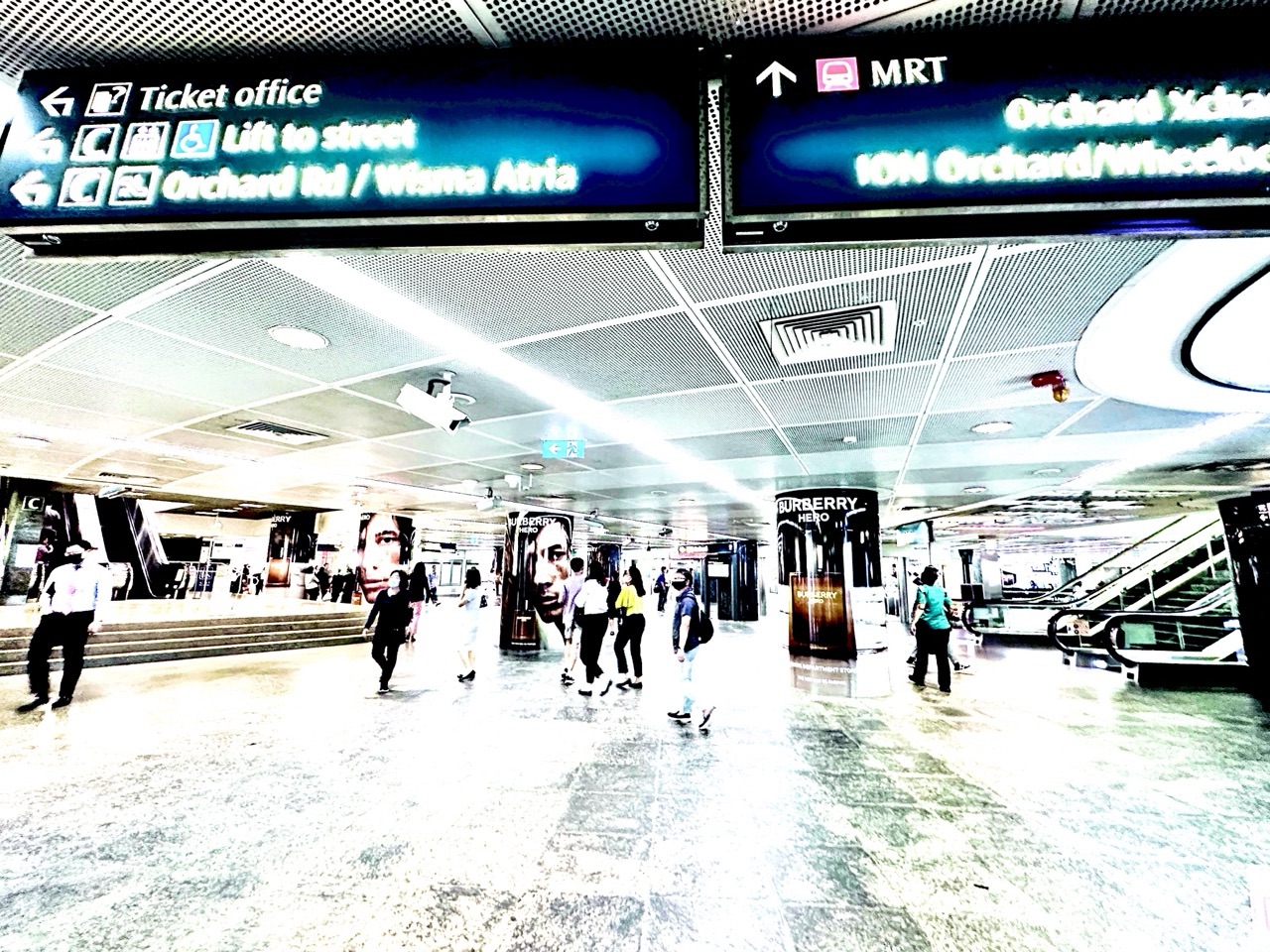
Orchard MRT is one of Singapore’s most useful stations to know when you are exploring the city’s famous shopping street. Step off the train and you are close to ION Orchard, Wisma Atria, Wheelock Place, TANGS, Shaw House, Ngee Ann City and plenty of cafés, restaurants and public places to wander. The only slightly tricky part? A major interchange with many exits can feel like a puzzle when you are meeting friends or trying to find one specific mall.
Here is the answer straight away. Orchard MRT station is NS22 on the North South Line and TE14 on the Thomson–East Coast Line. SMRT’s official station directory currently lists Exit 3 for Wisma Atria and Ngee Ann City, Exit 4 for ION Orchard, Exit 5 for ION Orchard and Wheelock Place, and Exit 1 for the Tang Plaza, Shaw House and Scotts Road cluster. There are other exits too, so always follow the numbered signs for your actual destination and check the station’s live wayfinding when accessibility matters.
This is a practical, reader-friendly guide to choosing an exit, changing trains, arranging a meeting place and continuing to the main Orchard Road landmarks. It also includes October 2026 photographs from eduKateSG’s Orchard media library, showing a real station foyer, mall entrance connections, underpasses and crossings. The pictures are intended to make navigation easier, not just make the page look pretty.
Orchard MRT at a glance
- Official station name: Orchard.
- North South Line code: NS22.
- Thomson–East Coast Line code: TE14.
- Station type: underground interchange between two rail lines.
- Best-known nearby retail landmark: ION Orchard, immediately beside the station.
- Other destinations: Wisma Atria, Wheelock Place, Ngee Ann City, TANGS, Shaw House, Scotts Square, hotels and nearby office buildings.
- Best source for exact exit lists: SMRT’s official Orchard station exit directory.
- Helpful planning rule: choose your destination and meeting point before leaving the station; do not assume every nearby mall is reached through the same exit.
One more detail is worth remembering: Orchard MRT is not the same station as Orchard Boulevard on the Thomson–East Coast Line. They are separate stops. Likewise, Somerset and Dhoby Ghaut are useful for different parts of the long Orchard Road shopping corridor. Choose your station for the activity you actually have in mind.

Orchard MRT station exits: which number leads where?
SMRT’s official directory gives the clearest starting answer. The exit numbers matter because they distinguish different underground links and street-level approaches. Some exits take you towards a mall interior, while others lead to roads or a particular side of the junction. Use the information below as an orientation guide, and confirm the exact route using the signs you see on the day.
- Exit 1: SMRT lists the Tang Plaza, Shaw House, Scotts Road, Scotts Square, Lucky Plaza and several hotel, retail and medical destinations in the wider cluster. The full list is extensive; it is not a promise that every building is immediately beside the exit.
- Exit 2: Orchard Road.
- Exit 3: Wisma Atria and Ngee Ann City.
- Exit 4: ION Orchard.
- Exit 5: Wheelock Place and ION Orchard.
- Exit 6: ION Orchard.
- Exit 7: Orchard Turn and Orchard Boulevard.
- Exits 8 and 9: ION Orchard.
- Exit 10: Paterson Road and ION Orchard.
- Exit 11: Wheelock Place, Orchard Boulevard, Liat Towers and a group of other nearby destinations, including certain hotels.
- Exit 12: Paterson Road.
- Exit 13: Orchard Boulevard.
This list reflects the SMRT Orchard station directory as checked in October 2026. An exit directory helps you orient yourself, but the exact shortest route may depend on which entrance you need, whether a linkway is open and whether you require lifts. Do not treat a numbered exit as a guarantee of step-free access to every location listed nearby.
If you are travelling with someone who gets anxious in large stations, make the instructions small and clear. Instead of sending the entire exit list, write: “Take Orchard MRT Exit 3 for Wisma Atria; we will meet at the Level 1 concierge.” One destination and one meeting point is much easier than a cluster of names and numbers.
Where is Orchard MRT, and why is it so useful?
Orchard station sits in the heart of the shopping belt, close to several prominent buildings and the Orchard Road/Paterson Road/Orchard Boulevard area. Its importance comes from both position and connectivity. It serves the North South Line, a major rail corridor through Singapore, and the Thomson–East Coast Line, which links other neighbourhoods to the central area.
For a visitor, this means you can arrive without relying on a car or trying to navigate an unfamiliar one-way road system. You can also change trains inside the paid station area instead of travelling to a separate platform at another stop. But the station is substantial, and changing lines can involve escalators, lifts and some walking; give yourself time when catching a connection.
There is a difference between arriving at Orchard Road and arriving at a particular shop. The first is easy: use Orchard MRT. The second requires a little precision because the shopping belt is long and full of buildings. Someone heading to Wheelock Place needs a different final route from someone going to Takashimaya Shopping Centre or a hotel off Scotts Road.
That is why exit information belongs in an Orchard Road travel guide. A useful answer is not simply “take the MRT”. It is “take Orchard MRT, find the exit for your destination, then choose a clear, comfortable route for your group.”
NS22 versus TE14: what do the station codes mean?
The letters tell you which line you are using. NS stands for North South Line, shown in red on Singapore’s rail map. TE refers to the Thomson–East Coast Line, shown in brown. Orchard carries both codes because it is an interchange.
The station’s North South Line service dates to December 1987, while the Thomson–East Coast Line interchange opened for passengers in November 2022 as part of the line’s third stage. That second connection made Orchard more convenient for travellers using different parts of the network, and it also brought new station circulation and wayfinding arrangements.
If you are changing lines, follow the platform signs for the direction you actually need. Do not simply take the first escalator bearing a familiar line colour. The train direction and destination displayed on the sign are important. The code helps identify the line; the station names and destination labels help identify the correct direction.
For a group travelling together, wait until everybody has followed the right signs before moving onward. The transfer may feel straightforward to frequent commuters but confusing to a first-time visitor carrying luggage. There is no reason to rush through the interchange if your journey is not time-sensitive.
How to get to ION Orchard from Orchard MRT
ION Orchard is one of the easiest nearby landmarks. SMRT lists several exits for ION, including Exits 4, 6, 8 and 9, with ION also appearing under other relevant exits. The mall’s official visitor information identifies Orchard MRT (NS22/TE14) as the directly adjacent station.
Why so many exits? A large retail development can connect to a station at different levels or points. The best exit may depend on whether you are trying to reach an outdoor entrance, a basement shop, a concierge, a restaurant or a specific lift. Choosing only the name of the mall may still leave you farther from your precise destination than expected.
If you want a photograph of the building, follow the signs towards the appropriate street-level area and find a safe public spot with enough space around you. If you want food, check the mall directory and head for the correct level. If you are meeting someone, agree on a counter or store rather than trying to find each other in a busy concourse.
For deeper detail about ION’s visitor facilities, ION Art, ION Sky and dining, see our ION Orchard Singapore guide. The current page focuses on the rail and exit decisions that get you there.

Orchard MRT Exit 3: how to reach Wisma Atria
If your destination is Wisma Atria, the best starting instruction is Exit 3. That is the route identified by both SMRT and Wisma Atria’s own official contact page. The mall stands at 435 Orchard Road and is known for its distinctive frontage and broad exterior steps.
Follow the current signs from the station. If a route branches, check whether you are heading towards a mall entrance or the street. This matters when you are meeting someone outdoors or carrying a stroller. An underground arrival may put you on a different level from the steps you can see in photographs.
Once you have arrived, find your destination in the store directory. Wisma Atria currently lists Food Republic on Level 4 as well as restaurants and other retail options, making it a handy place for a meal before or after a shopping trip. Its Level 1 concierge is another useful landmark for meeting friends.
Our Wisma Atria guide covers dining, retail and the building’s place in Orchard Road. That guide is a good companion if you have already found the right station exit and want to plan the rest of the visit.

Exit 3 and Ngee Ann City: how to continue to Takashimaya
SMRT lists Ngee Ann City alongside Wisma Atria under Exit 3. That helps orient you towards the shopping district’s important Takashimaya complex. However, the two destinations are not identical and do not necessarily share the same entrance or internal level.
Ngee Ann City is at 391 Orchard Road and includes Takashimaya Shopping Centre, the department store and other businesses. If you are going to Books Kinokuniya, a restaurant or a specific specialty store, make a note of the relevant level. “Takashimaya” is too broad to serve as a precise meeting location for some visitors.
Follow any current pedestrian or mall-link signs, and look out for wayfinding changes caused by temporary works. If your route involves going above ground, use the designated paths and crossings. A short walk can become a pleasant introduction to Orchard Road when you allow time to look around.
If you want a fuller outing, the Ngee Ann City and Takashimaya guide explains the bookstore, dining, architecture and historical background. For a first-time tourist, that makes Exit 3 a useful starting point for more than one destination.
Exit 5: Wheelock Place and ION Orchard
SMRT’s directory lists both ION Orchard and Wheelock Place under Exit 5. That is helpful because these neighbouring destinations form part of the Orchard MRT shopping cluster. Depending on where you are heading, the appropriate underground connection may be more comfortable than emerging outside into heat or rain.
The eduKateSG photo collection includes an October 2026 image of shoppers walking through a link between ION Orchard and Wheelock Place. It shows the kind of corridor that can make Orchard Road easier to explore during a wet afternoon. But do not assume every nearby development is joined by one continuous open passage: follow current signs and respect closures or redirections.
Wheelock Place has a distinctive exterior and its own set of shops and cafés. If your priority is photography, a safe street-level view may be more satisfying than remaining entirely underground. If your priority is an appointment or a meal, reaching the correct internal level may be the better choice.
Our Wheelock Place guide explains what to look for outside and how to turn the visit into an enjoyable neighbourhood stop.

Exit 1: Tang Plaza, Shaw House and the Scotts Road side
SMRT’s official Exit 1 listing covers a wide group of places around the Tang Plaza and Scotts Road area, including Shaw House, Scotts Square and several hotels, medical destinations and shopping centres. It is an important direction for visitors who are not simply entering ION Orchard or the mall cluster directly attached to the station.
The best approach is to identify your exact destination before following the exit. For example, somebody going to a hotel around Scotts Road has different needs from somebody going to a cinema or meeting a friend at TANGS. The general cluster is shared, but the final few minutes of walking may differ.
At street level, look for familiar landmarks: the TANGS/Tang Plaza area, Shaw House and the busy road junction. These buildings are recognisable in photographs and help you confirm that you are heading in the expected direction. Use marked crossings, even if the destination looks close on the other side.
If you are visiting during a busy weekend or a major festive event, leave extra time around the junction. It is often full of pedestrians waiting for traffic lights, and there may be more stopping and photography than on an ordinary weekday.

Exit 11: Wheelock Place and the Orchard Boulevard side
Exit 11 serves a different collection of nearby destinations, with SMRT listing Wheelock Place, Orchard Boulevard, Liat Towers and several hotels and retail buildings. This can be useful if your outing is focused on that side of the shopping belt rather than the Wisma Atria and Ngee Ann City direction.
The best exit is not always the one with the shortest walking distance printed on a map. Ask whether you need a specific door, lift route or vehicle drop-off. Two entrances to the same large building may serve different purposes, and a street-side approach can feel quite different from an underground mall connection.
For tourists, the many hotel names around Exit 11 can make the directory look overwhelming. Do not memorise them all. Find the specific hotel you need, check its actual address and follow the local signs. A name near the station on the exit directory does not mean the lobby begins immediately outside the fare gates.
If your plans include Orchard Boulevard farther west, be careful not to confuse the road name with Orchard Boulevard MRT station (TE13). That is a separate rail station on the Thomson–East Coast Line. Confirm which part of the boulevard you actually need before deciding where to alight.
Using Exit 7, Exit 10, Exit 12 and Exit 13
Not every visitor wants a famous mall. SMRT lists Exit 7 for Orchard Turn and Orchard Boulevard, Exit 10 for Paterson Road and ION Orchard, Exit 12 for Paterson Road and Exit 13 for Orchard Boulevard. These exits can be useful for road-level destinations, workplaces or other buildings in the surrounding district.
Because the Orchard interchange contains different internal routes, choose based on the address rather than the broad name “Orchard Road”. You may be aiming for a residence, office, taxi point or hotel instead of the shopping centre. Check the actual building number and your preferred street-side access.
When accessibility is a priority, consult current station signage or seek help from station staff. An exit being listed for a road does not by itself establish that every nearby pavement or building entrance is step-free. If an escalator is out of service, the most comfortable alternative may require a different route.
One useful habit is to screenshot the destination address before entering the station. Mobile coverage and navigation apps are generally convenient, but a precise saved address and a known meeting point make the last part of the journey simpler.
How to transfer between the North South Line and Thomson–East Coast Line
Orchard is a genuine interchange, so you can transfer within the station between NS22 and TE14. Follow the signs for the correct line and direction, staying within the paid area when changing trains. The station’s layout may require walking and changes of level; allow enough time and do not assume both platforms are immediately beside each other.
If you are travelling north on the North South Line, the neighbouring station in that direction is Newton. In the opposite direction is Somerset. On the Thomson–East Coast Line, Orchard Boulevard is the adjacent stop towards the northwestern side of the line, while Great World is the next station towards the southeastern side. Current service patterns and train destinations should always be read from the station display.
The line colours are helpful, but they are not enough. Look for the destination shown on the platform information and confirm that the train is travelling in the right direction. An interchange can feel busy because commuters arriving from different trains are making different choices at the same time.
If you are accompanying children or older relatives, move together and stop in a safe area if you need to check directions. Do not block escalator landings or the fare gates. Station staff and the operator’s travel tools are the right sources when a temporary disruption changes the usual route.
Why Orchard MRT became an interchange in 2022
Orchard was part of Singapore’s early MRT development, with its original service opening in 1987. Decades later, the Thomson–East Coast Line’s third stage opened on 13 November 2022, bringing new stations and interchange possibilities to the central area. The Land Transport Authority identifies Orchard as a connection between the new line and the North South Line.
That addition changed the way residents and visitors could approach the shopping district. Journeys that once required other transfers gained another rail option. It also required new wayfinding, circulation and station interfaces to bring the two lines together in a busy urban environment.
From a visitor’s perspective, the important result is flexibility. You can choose a route based on where you started, rather than assuming the red North South Line is the only way to reach Orchard. If you are unsure which line to take, use SMRT’s journey planner or another reliable live route planner.
From a city-planning perspective, the interchange demonstrates the value of building transport around major destinations. Shops and office buildings gain more options for their workers and customers, while travellers have another way to reach the district without driving.
Orchard MRT station history: a small timeline
Singapore’s original MRT network began passenger service in November 1987. Orchard station opened on 12 December 1987 as the early network expanded. It has therefore been part of the shopping district’s public transport story for almost four decades.
The station’s surroundings have changed substantially since then. Major retail projects, new office buildings, updated pedestrian links and the growth of the shopping belt brought different kinds of journeys to the area. An Orchard MRT guide written in the 1990s would not describe exactly the same station arrangement or collection of destinations that a visitor sees today.
The 2022 Thomson–East Coast Line extension is especially important because it transformed Orchard into an interchange. This is a reminder that transport infrastructure is not fixed forever: a station can acquire new connections, and its signage and pedestrian flow must adapt.
When reading older advice, pay particular attention to exit references. Historical lettered exits may not match the current numbered exit system. For a present-day trip, SMRT’s latest station directory and the signs on the ground should take priority.
Which MRT station is best: Orchard, Somerset or Dhoby Ghaut?
Orchard Road is long enough that one station cannot be the nearest to every destination. Orchard MRT is particularly useful for the ION Orchard, Wisma Atria, Wheelock Place, TANGS and nearby Ngee Ann City cluster. If you are headed farther towards the Somerset side of the shopping district, Somerset MRT (NS23) may make more sense.
Dhoby Ghaut is another significant interchange towards the eastern end of the broader Orchard Road corridor. It is useful for a different set of destinations, including the Plaza Singapura area. Travellers sometimes confuse an article about “Orchard Road” with an instruction to use Orchard MRT regardless of where along the road they need to go.
A helpful rule is to identify the exact building first, then choose the nearest convenient station. The right answer depends on walking distance, station connections, weather, mobility and the rest of your itinerary.
For a casual sightseeing walk, you can arrive at Orchard MRT and finish near Somerset, making the journey one way rather than retracing your path. Our Orchard Road walking guide provides a suggested route through the key shopping areas.
Orchard MRT and buses: how to plan a combined journey
MRT trains are not the only way to reach the neighbourhood. Orchard Road and neighbouring streets have many bus stops, but services and stop names vary by direction. If your journey begins on a bus route that already serves the area, switching to rail may not be necessary.
Use a current journey planner to compare total travel time, including the walk between the bus stop and your destination. A bus stop opposite a shopping centre is not the same as its entrance; you may still need to use a pedestrian crossing. Always verify the safe direction of travel.
A photograph of a nearby bus or crossing can help you recognise the area, but an image cannot verify a current bus route number. Services change when the transport network evolves. Rely on SMRT, LTA and live service information for time-sensitive journey details.
If you have several shopping bags, travel with young children or need accessible transport, choose the combination that minimises uncomfortable transfers. The fastest theoretical route is not always the best practical route.
A comfortable Orchard MRT trip with a stroller or wheelchair
The station has lifts and accessible provisions, but the specific route to a particular mall entrance matters. Some station connections may require navigating several levels or selecting a different lift from the escalator used by most other passengers. Follow accessibility signs and ask staff if the intended route is unclear.
For a stroller, plan the meeting point at an accessible location rather than a staircase or a narrow escalator landing. Large malls such as ION Orchard and Wisma Atria also have their own building layouts, so reaching the correct internal floor is part of the journey.
If you are travelling with somebody whose mobility is limited, consider where they will need to rest after leaving the station. A café, an indoor seating area or a concise shopping plan can make the outing much more pleasant than an ambitious route through several buildings.
Do not assume that a station exit automatically guarantees a barrier-free approach to every place named on the directory. Construction work, temporary equipment outages and building-specific access can change the best route. Current local guidance always takes precedence.
Orchard MRT with children: make the navigation part of the fun
A busy interchange can be a learning experience when children are given one simple, age-appropriate responsibility. Ask an older child to identify the line code, find the right exit number or read a clear wayfinding sign. Then explain why the chosen route is right for the destination.
Younger children may enjoy counting how many different types of signs they can see, such as lifts, exits, trains, shops and toilets. It is a gentle introduction to the way public information helps people move around a city without needing to ask for directions at every corner.
Set safety rules before the journey. Stay together near fare gates, hold the hand of a small child on escalators or use a lift when suitable, and choose a visible meeting point if someone becomes separated. Do not turn a crowded platform into a playground or photo session.
After arriving, encourage the child to compare the station map with the real street. Which building do you see? Where is the crossing? How did the exit number help? These small observations build confidence and make city travel feel understandable.
Photographing Orchard MRT and the pedestrian links
Station and linkway photographs work best when they show how a place is used. A clear image of an exit foyer tells a reader what to look for. A photo of an underground passage can explain the feeling of moving between malls. An outdoor shot helps visitors recognise the landmarks above ground.
Observe photography rules and the directions of station staff. Do not use tripods or professional equipment where permission is required, and avoid photographing sensitive areas or causing concern to other passengers. A public station is a working transport environment first and a photography subject second.
Try to minimise identifiable close-up images of strangers, especially children. A wider architectural or wayfinding photograph usually conveys the information more respectfully. It also remains useful long after the people in the frame have moved on.
The October 2026 photo below shows ION Orchard’s exterior entrance. When used with the station foyer images, it forms a sequence: arrive, follow the signage and recognise the destination outside. That sequence is more practical than an unrelated generic city skyline.

Pedestrian crossings: how to move safely around the Orchard junction
The Orchard MRT area is surrounded by busy roads and pedestrian routes. Even if a destination looks directly across the street, you still need to use the marked crossings and follow traffic signals. Do not attempt to cross through moving vehicles or step into the carriageway to take a photograph.
Near Shaw House and TANGS, the junction can feel especially active. Pedestrians gather while waiting for the light, and the entire group moves during the green phase. Allow room for people walking at different speeds, including those using mobility aids or pushing strollers.
If you want a photograph of the crossing, take it from a safe, stationary location on the pavement. It is not necessary to stand in the middle of the road to show the building. In fact, including part of the footpath and waiting crowd often makes a more informative image.
When travelling with children, agree that everybody waits together for the proper signal. Even if other people move differently, follow the safe and lawful route. Orchard Road offers many beautiful views; none requires a risky shortcut.

Orchard MRT on a rainy day or a hot afternoon
A major advantage of arriving by MRT is that your journey begins close to indoor destinations. On a rainy afternoon, you can choose to enter ION Orchard or Wisma Atria and enjoy a meal, a bookstore visit or shopping before heading outside. This flexibility is useful when Singapore’s weather changes quickly.
However, do not assume every part of Orchard Road is connected by a weatherproof underground passage. Some mall visits require street-level walking or crossings, and temporary works may change pedestrian links. Keep a compact umbrella and follow current station and mall signs.
If the weather is very hot, plan your outdoor walk in manageable sections. Take water breaks and avoid standing unnecessarily in exposed areas with small children or older adults. You can appreciate the architecture in short periods without trying to remain outdoors for hours.
During haze episodes, check official air-quality guidance and consider reducing outdoor activity when advised. The station and nearby malls can support an indoor-first plan, but no ordinary shopping venue should be assumed to provide a particular health level of filtered air.
A low-cost Orchard Road afternoon using the MRT
You can plan an enjoyable afternoon with very little shopping expenditure. Arrive at Orchard MRT, choose an exit leading to a landmark you want to see and spend time observing the streetscape. Admire ION Orchard’s exterior, compare the different mall façades and choose one snack or café stop within your budget.
Window-shopping is a perfectly legitimate activity. The display windows, architecture and people-watching offer plenty of interest without requiring a large purchase. If you have children with you, ask them to choose a favourite design detail and explain why they like it.
A fixed budget makes decisions easier. Decide what you want to spend on transport, food and optional purchases. The temptation of a beautiful shop window is easier to enjoy calmly when you already know your priorities.
When you finish, return to Orchard MRT or continue to Somerset MRT for a one-way walk. This simple idea can make the day feel like a small adventure rather than a repetitive trip through the same corridor.
A Mathematics exercise: finding the best MRT exit
Imagine a family comparing two fictional routes from Orchard MRT to a shop. Route A involves four minutes of indoor walking and two minutes waiting for a pedestrian crossing. Route B involves seven minutes of indoor walking but no crossing. Which is faster? Route A takes six minutes, while Route B takes seven. But which feels more comfortable in heavy rain or with a stroller?
That second question is just as useful as the calculation. The quickest route is not necessarily the easiest, safest or most accessible. Students can learn to compare multiple constraints rather than focusing on one number.
For an English exercise, ask a child to write a concise instruction: “Take Orchard MRT Exit 3, follow signs to Wisma Atria and meet at the Level 1 concierge.” Then ask what would happen if the exit number or meeting point were missing. Clear writing matters in everyday navigation.
For Geography, compare the way station exits distribute people across different parts of the shopping district. Why does an interchange need several connections? How does good wayfinding help reduce crowding and confusion? These questions bring a public transport lesson into a real urban setting.
The best Orchard MRT meeting points for groups
The best meeting point is a fixed landmark that everybody can identify. A concierge inside a mall, a named shop on a particular floor or a clearly signposted station location is usually much better than “near Orchard MRT”. Make sure it is accessible for the people in your group.
Avoid waiting directly in front of escalators, fare gates or busy shop entrances. These are movement areas and need to remain clear. A comfortable place nearby is less stressful for the group and more considerate to other travellers.
When several people are arriving from different lines, use a common landmark outside the paid station area if that is appropriate for the plan. Sending a location screenshot and the exact floor can help. Be sure everyone has mobile connectivity or an alternative meeting arrangement.
If one person is delayed, agree on what the others should do. A relaxed outing should not begin with everybody searching for each other across multiple exits. Two clear messages before the trip can save ten confusing phone calls later.
Frequently asked questions about Orchard MRT station
What lines stop at Orchard MRT?
The North South Line (NS22) and the Thomson–East Coast Line (TE14).
Which MRT exit should I use for ION Orchard?
SMRT’s station directory lists several ION Orchard exits, including 4, 6, 8 and 9. Choose the one that fits your destination level and accessibility requirements.
Which Orchard MRT exit is for Wisma Atria?
Exit 3. This is the exit identified by both SMRT and Wisma Atria’s own official directions.
What exit should I use for Ngee Ann City and Takashimaya?
SMRT lists Ngee Ann City under Exit 3, alongside Wisma Atria. Check the final pedestrian route and the particular building entrance you need.
What is the Orchard MRT exit for Wheelock Place?
SMRT lists Wheelock Place under both Exit 5 and Exit 11. Choose the one most suitable for the specific entrance and route you need.
Which exit is for TANGS or Shaw House?
Exit 1 covers the Tang Plaza and Shaw House cluster in SMRT’s official directory. The exact final walking route depends on the entrance you need.
Is Orchard MRT connected to ION Orchard?
Yes. ION Orchard is directly beside the station and connected through the shopping complex, with multiple exit options.
Can I transfer between NS22 and TE14 without leaving the station?
Yes. Orchard is an interchange and allows changes between the North South and Thomson–East Coast lines within the station.
Is Orchard Boulevard MRT the same as Orchard MRT?
No. Orchard Boulevard is a separate Thomson–East Coast Line station, TE13. Orchard interchange is NS22/TE14.
Is Somerset MRT near Orchard MRT?
Yes. Somerset (NS23) is the next stop on the North South Line in the direction of Marina South Pier, and it serves a different part of Orchard Road.
When did Orchard MRT open?
The original station began service on 12 December 1987. The Thomson–East Coast Line platforms opened on 13 November 2022.
Is Orchard MRT suitable for strollers and wheelchairs?
The station has accessibility facilities, but the best step-free route depends on the exit and destination. Follow current signs and ask station staff for assistance if necessary.
What time is the last train from Orchard MRT?
Last-train times depend on line, direction and date and can change with service arrangements. Check SMRT’s current timetable and service notices instead of relying on a single fixed time in a travel article.
Is it better to get off at Orchard or Somerset for shopping?
Orchard is convenient for ION, Wisma Atria, Wheelock and the upper Orchard Road cluster. Somerset may suit the Somerset end of the shopping belt. Choose based on your actual destination.
Can I walk from Orchard MRT to Paragon?
Yes. Paragon is a nearby Orchard Road landmark. Follow legal pedestrian routes and crossing signals rather than cutting across busy roads.
Can I use Orchard MRT for a walking tour without shopping?
Absolutely. The station is a convenient starting point for an architecture and neighbourhood walk, and you can finish at Somerset or return to Orchard station later.
The simplest way to navigate Orchard MRT confidently
Start with one question: where exactly do you want to go? Once you know the building and entrance, the exit numbers become much easier. Exit 3 points towards Wisma Atria and Ngee Ann City. Several exits serve ION Orchard. Exit 5 is useful for Wheelock Place, while Exit 1 covers the Tang Plaza and Shaw House side.
For everything else, follow the operator’s current numbered signs, not an old screenshot. Build a little extra time into your journey if you have luggage, children or accessibility needs. Meet at a specific place rather than a broad mall name. And once you emerge into Orchard Road, enjoy the walk—you are in one of Singapore’s most recognisable urban districts.
More Orchard Road guides and official transport information
- Orchard Road walking guide: from Orchard MRT to Somerset.
- ION Orchard guide: food, art and photo spots.
- Wisma Atria guide: Exit 3, food and shopping.
- Wheelock Place guide: shopping and architecture.
- Ngee Ann City and Takashimaya guide.
- Paragon guide: family stops, food and photo locations.
- Things to do in Singapore | Orchard.
- SMRT: official Orchard station exit directory.
- SMRT: Orchard station map.
- LTA: opening of Thomson–East Coast Line Stage 3 and Orchard interchange.
- ION Orchard official visitor information.
- Wisma Atria official exit and contact information.
Updated October 2026. Station layout, access arrangements, operating hours, service patterns and exit signage may change; consult SMRT and LTA for time-sensitive travel details. Photos were selected from eduKateSG’s October 2026 Singapore media library.