
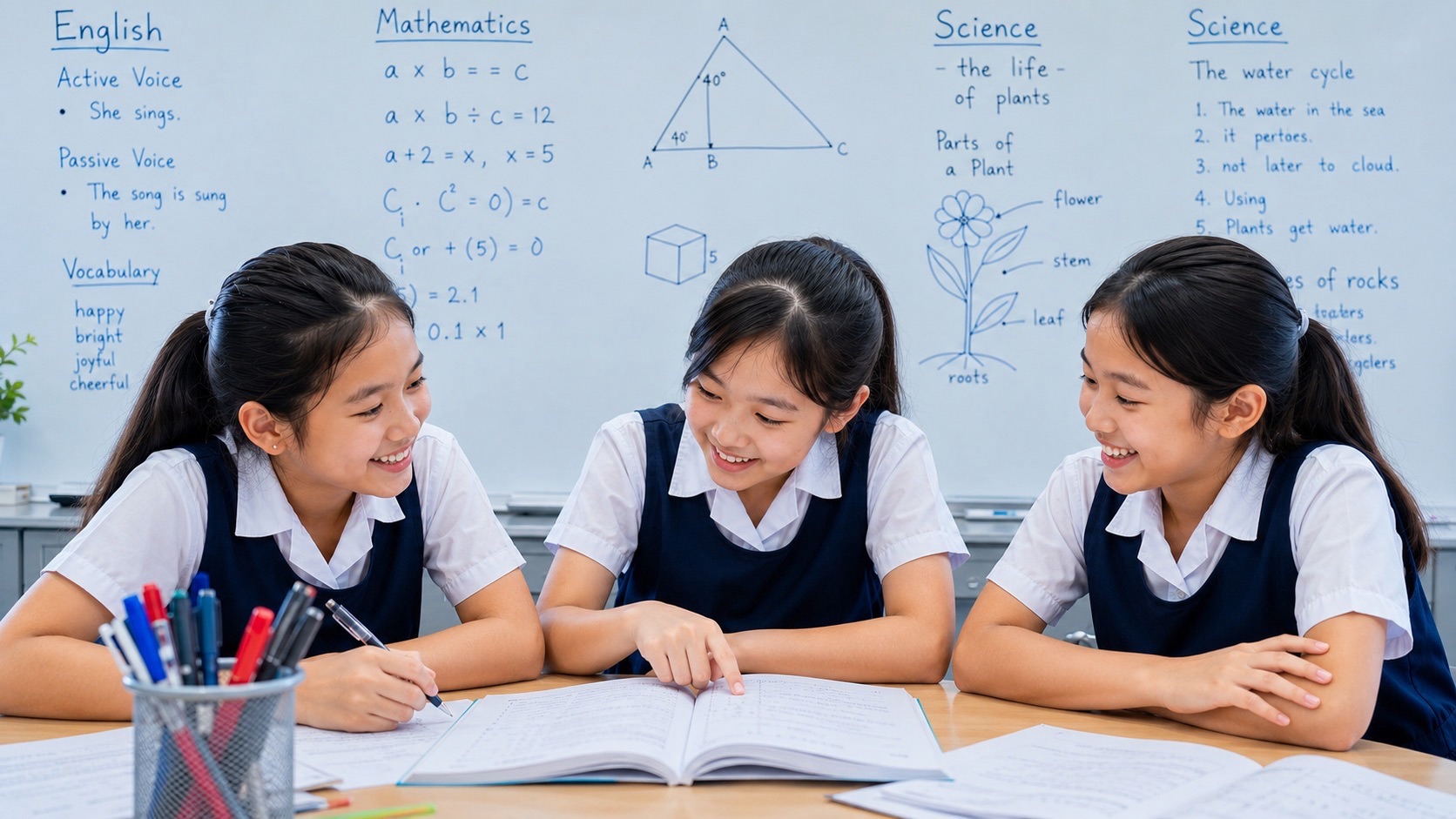
Primary 1 Mathematics Tuition | Jurong West is about building the first reliable mathematical floor: number sense, operations, spatial thinking, clear language, accurate working and the confidence to try. At eduKateSG, our small-group approach keeps the class deliberately small so the tutor can see how each child is thinking, not merely whether the final answer is right.
For Jurong West families, Primary 1 Mathematics should establish a strong and calm beginning. Children are learning not only new content, but how to read a Mathematics page, how to represent a relationship, how to work independently and how to respond when the first answer is wrong.
Primary 1 is the year when school Mathematics stops being only informal counting and becomes a structured language. A child may appear comfortable because the numbers are still small, yet hidden weaknesses can already form: counting without quantity sense, memorising facts without relationships, guessing word problems from keywords, reversing symbols, or depending on an adult for every next step. We prefer to repair those habits while the mathematical system is still young.
Primary 1 Is Not “Easy Mathematics”
The arithmetic itself is introductory, but the intellectual job is large. Children must learn that a number is a quantity, a position, a label and sometimes a measurement. They must learn that “=” expresses balance, that a drawing can represent a situation, that a word problem can be translated into a mathematical relationship, and that a written method is a way of communicating reasoning.
The Singapore MOE Primary Mathematics syllabus organises learning around Number and Algebra, Measurement and Geometry, and Statistics. At Primary 1, children meet foundational number ideas, addition and subtraction, early multiplication and division concepts, money and other introductory mathematical experiences. The aim in tuition is not to race beyond the level. It is to make the level stable enough that later Mathematics has something dependable to stand on.
Primary 1 and Primary 2 also sit in a school environment with reduced formal assessment pressure. That gives children space to learn, but it means adults should not wait for a dramatic examination score before noticing a conceptual leak. We look at behaviour: Does the child understand why? Can the child explain? Can the child start independently? Can the child recover after an error?
The Hidden Primary 1 Problem: Counting Must Become Number Sense
A child who can count aloud is not automatically secure with number. Number sense means seeing relationships. Eight is not merely the word after seven. It can be five and three, four and four, ten minus two, or two groups of four. When children see these relationships, calculation becomes less fragile because they are no longer carrying every answer as a separate memory.
If a learner depends on counting-on for everything, later work becomes cognitively expensive. If the learner understands part–whole relationships, place value and decomposing numbers, later addition, subtraction, multiplication, division, fractions and algebra have a much cleaner route.
Why Jurong West Families Choose 3-Pax Mathematics Tutorials
A Primary 1 learner needs attention, but not necessarily isolation. A well-run group of three can create useful comparison, discussion and independence while still allowing the tutor to observe each child closely. The small group gives us enough social energy for mathematical talk without letting quiet errors hide inside a large class.
The advantages of three students
- The tutor can listen to each child explain a method rather than checking only answers.
- Different methods can be compared in real time, helping children see that Mathematics has structure rather than magic tricks.
- A hesitant learner can hear another child verbalise a thought process and then try the language independently.
- A stronger learner can be stretched through explanation, generalisation and alternative methods instead of receiving only more pages.
- The tutor can notice hesitation, finger-counting, symbol confusion, skipped working and fragile vocabulary before they become entrenched.
Jurong West offers plenty of everyday opportunities to notice number and structure: bus routes, block numbers, prices, groups, time, distance and repeated patterns. These familiar situations are useful when they help a child move from concrete experience to mathematical representation.
A Jurong West learner may be fluent at oral counting but uncertain with place value. Another may know number bonds but guess operations from keywords. A third may need richer challenge than routine repetition. A three-student class allows each child to stay active while the tutor changes the level of support around the same core concept.
A Jurong West Primary 1 Mathematics Learning Map
For Jurong West parents, we focus on foundations that compound: quantity, tens and ones, part–whole thinking, addition and subtraction meaning, early grouping, spatial reasoning and named checking habits. A stronger foundation now reduces the amount of emergency repair needed later.
What We Teach in Primary 1 Mathematics
Numbers as quantities
We begin with the meaning of number. Children compare sets, estimate, count reliably, recognise small quantities and learn that the same quantity can look different when objects are rearranged.
Place value
Place value is the architecture of our number system. We use bundles, drawings and structured representations so a child understands tens and ones rather than simply reading digits.
Number bonds
Number bonds are treated as relationships. Children should know not only that two numbers combine to make a total, but that the same relationship can be reversed and recomposed.
Addition and subtraction
We connect operations to joining, increasing, separating, comparing and finding a missing part. The child learns to identify the relationship rather than react to one keyword.
Early multiplication and division
When grouping and sharing ideas appear, we keep them concrete. Equal groups, repeated structure and fair sharing matter more than racing into tables.
Money, measurement and time
These topics bring Mathematics into daily life. We focus on reading information carefully, comparing quantities, choosing appropriate units and explaining decisions.
Shapes and spatial reasoning
Children learn to notice attributes rather than memorise one picture. A shape remains the same kind of shape when rotated or shown in an unfamiliar orientation.
Simple data
Reading a picture or table is an early lesson in evidence. We ask children what the information shows, what it does not show, and how they know.
Concrete → Representational → Abstract
Our teaching often moves through three forms. First the child touches or sees the quantity. Next the child draws or uses a structured representation. Finally the child works with numbers and symbols. This progression is a diagnostic bridge, not a rigid ritual.
The final goal is transfer. Manipulatives reveal structure, drawings compress thinking and symbols carry the relationship. None should become an empty routine.
The Fencing Method in Primary 1 Mathematics
We use the Fencing Method to keep a problem inside a clear boundary. What information belongs to the problem? What is being asked? Which quantities are known? Which relationship connects them?
At Primary 1, fencing can be very visual: circle the question, mark the quantities, draw the relationship and say the problem in the child’s own words.
Why We Do Not Teach Word Problems Through Trigger Words
“More” does not always mean add. “Left” does not always mean subtract. Keyword tricks are fragile. We teach the child to identify whether quantities are being combined, compared, removed, repeated, shared or completed.
Equality Is Balance, Not “The Answer Comes Next”
The equal sign states that both sides have the same value. Understanding equality structurally prepares the child for missing-number questions and, much later, algebra.
Written Working Should Begin as Communication
Working tells another person what the child did. A clear number sentence, useful diagram or organised calculation is mathematical communication, not punishment after the answer.
Checking Should Be Specific
“Check your work” is too vague. We teach concrete checks: copy check, operation check, question check, reasonableness check and, where appropriate, opposite-operation check.
Retrieval Builds Fluency
Useful facts should become easier to access because working memory is limited. We use short retrieval routines for known facts and relationships while keeping understanding in view.
Interleaving Begins Gently
We mix earlier ideas in small doses so the child must choose a method rather than simply repeat the last demonstrated procedure.
Everyday Mathematics Examples for Jurong West
- Arrange the same number of objects in different layouts and ask whether the quantity changed.
- Use two or three different number bonds to make the same total.
- Estimate a simple total before calculating it exactly.
- Represent a comparison story with a drawing and explain what each part stands for.
What Happens During a 90-Minute Primary 1 Mathematics Lesson
Warm-up retrieval
We begin with short, achievable retrieval and watch the method as closely as the answer.
New learning
A new concept is introduced through the clearest representation available. Vocabulary is explicit and meaning comes before volume.
Guided practice
The child works with support while the tutor deliberately fades prompts so control passes to the learner.
Independent attempt
Each student attempts work without immediate rescue. This reveals whether the concept has transferred.
Correction
Errors are classified: concept, copying, arithmetic, language, attention or method. Different errors need different repairs.
Mixed review
Earlier ideas return so the learner practises selection and retrieval.
Focused continuation
We end with a short next step appropriate to the child. Continuity matters more than bulk.
Three Primary 1 Student Pathways
Repair
Repair revisits the first unstable point: counting principles, quantity, comparison, tens and ones, language or part–whole relationships.
Stabilise
Stabilisation strengthens independent starts, reliable methods, clearer working, checking and retrieval.
Extend
Extension uses richer reasoning, multiple methods, missing-number relationships, generalisation and explanation rather than premature acceleration.
How Parents Can Help Without Becoming the Second Tutor
Ask “How did you know?” more often than “Why did you get this wrong?” Invite the child to explain a small idea, compare prices, read a clock or estimate a quantity. Stop while the interaction is still positive.
When homework becomes difficult, note the point of difficulty instead of supplying the whole method. Specific observations help the tutor repair the real problem.
What Progress Should Look Like
- The child starts familiar questions with less adult prompting.
- Counting becomes more efficient and number relationships become visible.
- The learner can explain why an operation fits a situation.
- Written work becomes easier to follow.
- Errors become more specific and easier to repair.
- Previously learned ideas can be retrieved after a gap.
- Confidence becomes calmer: less guessing, less avoidance, more willingness to try.
When Should a Jurong West Family Consider Primary 1 Mathematics Tuition?
Consider support when the child persistently struggles with quantities, relies heavily on counting, cannot explain operations, becomes anxious around word problems, needs constant adult prompting, or is so far ahead that ordinary repetition is reducing engagement. Tuition should solve a real learning need.
Planning Access from Jurong West to Sixth Avenue
Families travelling from Jurong West to Sixth Avenue should choose a regular slot with enough transition time. At Primary 1, consistency and energy management are part of the learning plan.
Class Details
- Class size: up to 3 students.
- Lesson duration: 1.5 hours.
- Approach: diagnosis, concept building, guided practice, independent application, retrieval and correction.
- Pacing: taught ahead of school when the child is ready, without sacrificing foundations.
- Support: WhatsApp communication for parents and learning continuity.
- Long-term aim: build the mathematical capability needed for strong Primary and eventual PSLE performance, including the possibility of AL1-level work, without promising grades.
- First step: a parent–student consultation rather than a generic trial lesson.
What Parents Can Bring to the Consultation
- Recent school worksheets or classwork that shows typical mistakes.
- A short description of what homework looks like at home.
- Examples of questions the child avoids or repeatedly misreads.
- Any teacher feedback about attention, number sense, language or independence.
- Your practical weekly schedule so the learning routine is sustainable.
Frequently Asked Questions
Is Primary 1 too early for Mathematics tuition?
Not necessarily, but tuition should have a reason. If the child is secure, happy and progressing independently, more tuition is not automatically better. If there is a clear conceptual, confidence or pacing need, a small class can address it before the gap widens.
Should a Primary 1 child learn multiplication early?
Understanding equal groups and repeated structure is useful. Rushing into memorisation for its own sake is less important than understanding what multiplication represents.
Do you use bar models in Primary 1?
We introduce representations appropriate to the child and the problem. The goal is to clarify relationships, not force one diagram onto every question.
How much homework should a six- or seven-year-old receive?
Enough to retrieve and consolidate, not enough to make Mathematics consume the evening. We prefer focused continuation to bulk worksheets.
What if my child is already very strong?
We extend depth before speed through comparison, explanation, patterns, missing values and unfamiliar problems.
How do you reduce careless mistakes?
We classify mistakes and teach specific checks. Different causes need different responses.
Do you teach ahead of school?
Yes, when the prerequisite floor is secure. Teaching ahead should reduce future cognitive load, not create a second race through the syllabus.
Will Primary 1 tuition guarantee AL1 later?
No responsible tutor can guarantee a future grade. We build the foundations that make high performance more reachable later.
Why travel from Jurong West for a small group?
Families should compare the learning fit with the practical travel cost. A three-student class is valuable when close observation and individual pacing matter for the child.
Can my child join during the school term?
Yes. We first identify what is secure, what is unstable and what school is currently teaching, then sequence the work from the actual starting state.
Helpful Reading for Jurong West Parents
- Mathematics Learning Hub | Primary, PSLE, Secondary, A-Math and JC Mathematics
- Singapore Mathematics Tuition by Area Index
- How to be Good at Mathematics
- The Gold Standard of Mathematics
- Primary 4 Mathematics Tuition | Jurong West
- Primary 5 Mathematics Tuition | Jurong West
- Primary 6 Mathematics Tuition | Jurong West
- Singapore Area Learning & Tuition Article Hub
References
- Ministry of Education, Singapore — Primary Mathematics Syllabus
- Ministry of Education, Singapore — Education Conversations
Primary 1 Mathematics Tuition for Jurong West Families
The best Primary 1 Mathematics tuition is not the one that produces the thickest file. It is the one that helps a child see quantities more clearly, use symbols more meaningfully, explain relationships more confidently and recover from mistakes more independently.
For Jurong West families considering eduKateSG, our aim is simple: build the floor before asking the child to climb. When the floor is stable, speed, complexity and later examination performance can grow on top of something real.
Arrange a Parent–Student Consultation
A consultation allows us to look at the child’s current work, learning behaviour and practical schedule before recommending a pathway. We prefer this to a generic trial because the first useful question is what this child actually needs next.