
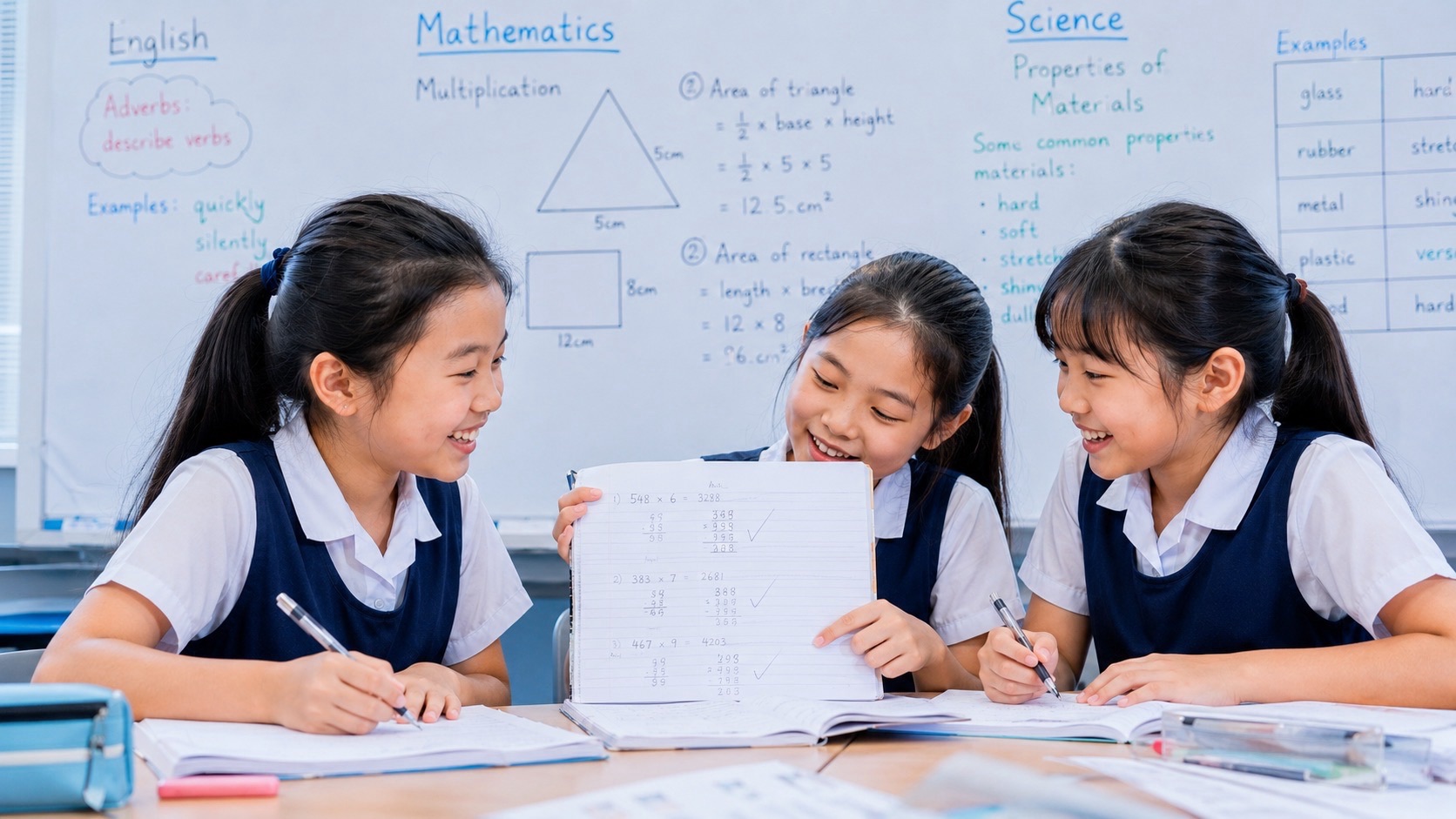
Primary 1 Mathematics tuition for Keong Saik families should build a reliable first mathematical system rather than simply add more worksheets. Parents searching for P1 Maths tuition in Singapore often compare small-group classes, MOE-aligned teaching, conceptual understanding, problem-solving skills, confidence and personalised attention. Those are useful filters, but the educational starting point is diagnostic: what does the child already understand, which ideas still depend on counting or guessing, and where does adult prompting enter the solution?
The current Singapore Primary Mathematics syllabus places mathematical problem solving at the centre of learning. For Primary 1, that means building number sense, place value, addition and subtraction, early multiplication and division, measurement, geometry, money, time, data handling, mathematical language and the habits of representing and checking thought. Strong tuition should develop meaning, fluency and independence together rather than treat them as separate goals.
This Keong Saik guide owns local Primary 1 discovery only. It does not imply that eduKateSG operates a physical branch in Keong Saik, and it does not replace the broader Primary 1 Mathematics Tuition owner or the Mathematics Learning Hub.
Number sense
seeing quantity, order and composition is part of the Primary 1 foundation. A useful warning sign appears when the learner recounts from one even for familiar facts. That symptom does not define the learner; it tells the tutor which mechanism should be tested first.
A practical intervention is to use ten-frames, number bonds and structured quantities. The learner explains what each number, object, symbol or diagram represents so the method stays connected to meaning rather than becoming a copied sequence.
The next question changes numbers, wording, orientation or representation while preserving the same relationship. Immediate repetition can produce familiarity, but changed and delayed retrieval provides stronger evidence that the idea can travel.
For Keong Saik families, useful progress should be visible in behaviour as well as marks: quicker starting, clearer working, fewer repeated error categories, better method selection and stronger recovery after a mistake. The goal is increasing independence, not permanent tutor dependence.
A good tutor also preserves what is already secure. If understanding is sound but retrieval is slow, practise access. If the relationship is misunderstood, return to representation. If the child knows the Mathematics but waits for reassurance, work on task initiation instead of reteaching the chapter.
Conservation of quantity
knowing quantity remains stable when rearranged is part of the Primary 1 foundation. A useful warning sign appears when the learner thinks spread-out sets are larger. That symptom does not define the learner; it tells the tutor which mechanism should be tested first.
A practical intervention is to rearrange equal sets and ask what changed. The learner explains what each number, object, symbol or diagram represents so the method stays connected to meaning rather than becoming a copied sequence.
The next question changes numbers, wording, orientation or representation while preserving the same relationship. Immediate repetition can produce familiarity, but changed and delayed retrieval provides stronger evidence that the idea can travel.
For Keong Saik families, useful progress should be visible in behaviour as well as marks: quicker starting, clearer working, fewer repeated error categories, better method selection and stronger recovery after a mistake. The goal is increasing independence, not permanent tutor dependence.
Place value
understanding tens and ones is part of the Primary 1 foundation. A useful warning sign appears when the learner reverses digits or compares ones before tens. That symptom does not define the learner; it tells the tutor which mechanism should be tested first.
A practical intervention is to use bundles, place-value cards and expanded notation. The learner explains what each number, object, symbol or diagram represents so the method stays connected to meaning rather than becoming a copied sequence.
The next question changes numbers, wording, orientation or representation while preserving the same relationship. Immediate repetition can produce familiarity, but changed and delayed retrieval provides stronger evidence that the idea can travel.
For Keong Saik families, useful progress should be visible in behaviour as well as marks: quicker starting, clearer working, fewer repeated error categories, better method selection and stronger recovery after a mistake. The goal is increasing independence, not permanent tutor dependence.
Comparing numbers
deciding greater and smaller through place value is part of the Primary 1 foundation. A useful warning sign appears when the learner chooses by the visually larger digit. That symptom does not define the learner; it tells the tutor which mechanism should be tested first.
A practical intervention is to compare the highest place first. The learner explains what each number, object, symbol or diagram represents so the method stays connected to meaning rather than becoming a copied sequence.
The next question changes numbers, wording, orientation or representation while preserving the same relationship. Immediate repetition can produce familiarity, but changed and delayed retrieval provides stronger evidence that the idea can travel.
For Keong Saik families, useful progress should be visible in behaviour as well as marks: quicker starting, clearer working, fewer repeated error categories, better method selection and stronger recovery after a mistake. The goal is increasing independence, not permanent tutor dependence.
Ordering numbers
placing several numbers in sequence is part of the Primary 1 foundation. A useful warning sign appears when the learner can compare pairs but loses track with three or more. That symptom does not define the learner; it tells the tutor which mechanism should be tested first.
A practical intervention is to use number lines and left-to-right comparison. The learner explains what each number, object, symbol or diagram represents so the method stays connected to meaning rather than becoming a copied sequence.
The next question changes numbers, wording, orientation or representation while preserving the same relationship. Immediate repetition can produce familiarity, but changed and delayed retrieval provides stronger evidence that the idea can travel.
For Keong Saik families, useful progress should be visible in behaviour as well as marks: quicker starting, clearer working, fewer repeated error categories, better method selection and stronger recovery after a mistake. The goal is increasing independence, not permanent tutor dependence.
Addition as joining
combining parts into a whole is part of the Primary 1 foundation. A useful warning sign appears when the learner knows a fact but not the matching story. That symptom does not define the learner; it tells the tutor which mechanism should be tested first.
A practical intervention is to connect objects, number bonds and equations. The learner explains what each number, object, symbol or diagram represents so the method stays connected to meaning rather than becoming a copied sequence.
The next question changes numbers, wording, orientation or representation while preserving the same relationship. Immediate repetition can produce familiarity, but changed and delayed retrieval provides stronger evidence that the idea can travel.
For Keong Saik families, useful progress should be visible in behaviour as well as marks: quicker starting, clearer working, fewer repeated error categories, better method selection and stronger recovery after a mistake. The goal is increasing independence, not permanent tutor dependence.
A good tutor also preserves what is already secure. If understanding is sound but retrieval is slow, practise access. If the relationship is misunderstood, return to representation. If the child knows the Mathematics but waits for reassurance, work on task initiation instead of reteaching the chapter.
Addition as increase
an existing quantity grows is part of the Primary 1 foundation. A useful warning sign appears when the learner hesitates when one starting quantity is already present. That symptom does not define the learner; it tells the tutor which mechanism should be tested first.
A practical intervention is to use before-and-after representations. The learner explains what each number, object, symbol or diagram represents so the method stays connected to meaning rather than becoming a copied sequence.
The next question changes numbers, wording, orientation or representation while preserving the same relationship. Immediate repetition can produce familiarity, but changed and delayed retrieval provides stronger evidence that the idea can travel.
For Keong Saik families, useful progress should be visible in behaviour as well as marks: quicker starting, clearer working, fewer repeated error categories, better method selection and stronger recovery after a mistake. The goal is increasing independence, not permanent tutor dependence.
Subtraction as removal
taking part from a whole is part of the Primary 1 foundation. A useful warning sign appears when the learner depends only on take-away stories. That symptom does not define the learner; it tells the tutor which mechanism should be tested first.
A practical intervention is to name the whole, removed part and remainder. The learner explains what each number, object, symbol or diagram represents so the method stays connected to meaning rather than becoming a copied sequence.
The next question changes numbers, wording, orientation or representation while preserving the same relationship. Immediate repetition can produce familiarity, but changed and delayed retrieval provides stronger evidence that the idea can travel.
For Keong Saik families, useful progress should be visible in behaviour as well as marks: quicker starting, clearer working, fewer repeated error categories, better method selection and stronger recovery after a mistake. The goal is increasing independence, not permanent tutor dependence.
Subtraction as comparison
finding the gap between quantities is part of the Primary 1 foundation. A useful warning sign appears when the learner fails how-many-more questions. That symptom does not define the learner; it tells the tutor which mechanism should be tested first.
A practical intervention is to align quantities and show the difference. The learner explains what each number, object, symbol or diagram represents so the method stays connected to meaning rather than becoming a copied sequence.
The next question changes numbers, wording, orientation or representation while preserving the same relationship. Immediate repetition can produce familiarity, but changed and delayed retrieval provides stronger evidence that the idea can travel.
For Keong Saik families, useful progress should be visible in behaviour as well as marks: quicker starting, clearer working, fewer repeated error categories, better method selection and stronger recovery after a mistake. The goal is increasing independence, not permanent tutor dependence.
Subtraction as missing part
finding an unknown part is part of the Primary 1 foundation. A useful warning sign appears when the learner does not see subtraction because no action happens. That symptom does not define the learner; it tells the tutor which mechanism should be tested first.
A practical intervention is to use part-whole models. The learner explains what each number, object, symbol or diagram represents so the method stays connected to meaning rather than becoming a copied sequence.
The next question changes numbers, wording, orientation or representation while preserving the same relationship. Immediate repetition can produce familiarity, but changed and delayed retrieval provides stronger evidence that the idea can travel.
For Keong Saik families, useful progress should be visible in behaviour as well as marks: quicker starting, clearer working, fewer repeated error categories, better method selection and stronger recovery after a mistake. The goal is increasing independence, not permanent tutor dependence.
Inverse operations
using addition and subtraction together is part of the Primary 1 foundation. A useful warning sign appears when the learner memorises facts separately. That symptom does not define the learner; it tells the tutor which mechanism should be tested first.
A practical intervention is to build fact families. The learner explains what each number, object, symbol or diagram represents so the method stays connected to meaning rather than becoming a copied sequence.
The next question changes numbers, wording, orientation or representation while preserving the same relationship. Immediate repetition can produce familiarity, but changed and delayed retrieval provides stronger evidence that the idea can travel.
For Keong Saik families, useful progress should be visible in behaviour as well as marks: quicker starting, clearer working, fewer repeated error categories, better method selection and stronger recovery after a mistake. The goal is increasing independence, not permanent tutor dependence.
A good tutor also preserves what is already secure. If understanding is sound but retrieval is slow, practise access. If the relationship is misunderstood, return to representation. If the child knows the Mathematics but waits for reassurance, work on task initiation instead of reteaching the chapter.
Making ten
using ten as a benchmark is part of the Primary 1 foundation. A useful warning sign appears when the learner counts one-by-one for near-ten facts. That symptom does not define the learner; it tells the tutor which mechanism should be tested first.
A practical intervention is to complete ten first then add the remainder. The learner explains what each number, object, symbol or diagram represents so the method stays connected to meaning rather than becoming a copied sequence.
The next question changes numbers, wording, orientation or representation while preserving the same relationship. Immediate repetition can produce familiarity, but changed and delayed retrieval provides stronger evidence that the idea can travel.
For Keong Saik families, useful progress should be visible in behaviour as well as marks: quicker starting, clearer working, fewer repeated error categories, better method selection and stronger recovery after a mistake. The goal is increasing independence, not permanent tutor dependence.
Counting on
preserving a known start is part of the Primary 1 foundation. A useful warning sign appears when the learner restarts from one. That symptom does not define the learner; it tells the tutor which mechanism should be tested first.
A practical intervention is to start at the larger known quantity. The learner explains what each number, object, symbol or diagram represents so the method stays connected to meaning rather than becoming a copied sequence.
The next question changes numbers, wording, orientation or representation while preserving the same relationship. Immediate repetition can produce familiarity, but changed and delayed retrieval provides stronger evidence that the idea can travel.
For Keong Saik families, useful progress should be visible in behaviour as well as marks: quicker starting, clearer working, fewer repeated error categories, better method selection and stronger recovery after a mistake. The goal is increasing independence, not permanent tutor dependence.
Doubles and near-doubles
using related facts is part of the Primary 1 foundation. A useful warning sign appears when the learner stores every fact independently. That symptom does not define the learner; it tells the tutor which mechanism should be tested first.
A practical intervention is to build doubles then adjust. The learner explains what each number, object, symbol or diagram represents so the method stays connected to meaning rather than becoming a copied sequence.
The next question changes numbers, wording, orientation or representation while preserving the same relationship. Immediate repetition can produce familiarity, but changed and delayed retrieval provides stronger evidence that the idea can travel.
For Keong Saik families, useful progress should be visible in behaviour as well as marks: quicker starting, clearer working, fewer repeated error categories, better method selection and stronger recovery after a mistake. The goal is increasing independence, not permanent tutor dependence.
Early multiplication
seeing equal groups is part of the Primary 1 foundation. A useful warning sign appears when the learner skip-counts without group meaning. That symptom does not define the learner; it tells the tutor which mechanism should be tested first.
A practical intervention is to build arrays and equal groups. The learner explains what each number, object, symbol or diagram represents so the method stays connected to meaning rather than becoming a copied sequence.
The next question changes numbers, wording, orientation or representation while preserving the same relationship. Immediate repetition can produce familiarity, but changed and delayed retrieval provides stronger evidence that the idea can travel.
For Keong Saik families, useful progress should be visible in behaviour as well as marks: quicker starting, clearer working, fewer repeated error categories, better method selection and stronger recovery after a mistake. The goal is increasing independence, not permanent tutor dependence.
Early division
sharing and grouping equally is part of the Primary 1 foundation. A useful warning sign appears when the learner confuses quotient meaning. That symptom does not define the learner; it tells the tutor which mechanism should be tested first.
A practical intervention is to use concrete sharing and grouping. The learner explains what each number, object, symbol or diagram represents so the method stays connected to meaning rather than becoming a copied sequence.
The next question changes numbers, wording, orientation or representation while preserving the same relationship. Immediate repetition can produce familiarity, but changed and delayed retrieval provides stronger evidence that the idea can travel.
For Keong Saik families, useful progress should be visible in behaviour as well as marks: quicker starting, clearer working, fewer repeated error categories, better method selection and stronger recovery after a mistake. The goal is increasing independence, not permanent tutor dependence.
A good tutor also preserves what is already secure. If understanding is sound but retrieval is slow, practise access. If the relationship is misunderstood, return to representation. If the child knows the Mathematics but waits for reassurance, work on task initiation instead of reteaching the chapter.
Mathematical language
understanding relational words is part of the Primary 1 foundation. A useful warning sign appears when the learner calculates but misreads wording. That symptom does not define the learner; it tells the tutor which mechanism should be tested first.
A practical intervention is to restate the problem before calculating. The learner explains what each number, object, symbol or diagram represents so the method stays connected to meaning rather than becoming a copied sequence.
The next question changes numbers, wording, orientation or representation while preserving the same relationship. Immediate repetition can produce familiarity, but changed and delayed retrieval provides stronger evidence that the idea can travel.
For Keong Saik families, useful progress should be visible in behaviour as well as marks: quicker starting, clearer working, fewer repeated error categories, better method selection and stronger recovery after a mistake. The goal is increasing independence, not permanent tutor dependence.
Word-problem entry
translating language into Mathematics is part of the Primary 1 foundation. A useful warning sign appears when the learner starts calculating before understanding. That symptom does not define the learner; it tells the tutor which mechanism should be tested first.
A practical intervention is to identify knowns, unknown and relationship. The learner explains what each number, object, symbol or diagram represents so the method stays connected to meaning rather than becoming a copied sequence.
The next question changes numbers, wording, orientation or representation while preserving the same relationship. Immediate repetition can produce familiarity, but changed and delayed retrieval provides stronger evidence that the idea can travel.
For Keong Saik families, useful progress should be visible in behaviour as well as marks: quicker starting, clearer working, fewer repeated error categories, better method selection and stronger recovery after a mistake. The goal is increasing independence, not permanent tutor dependence.
Keyword traps
avoiding one-word rules is part of the Primary 1 foundation. A useful warning sign appears when the learner chooses methods from vocabulary alone. That symptom does not define the learner; it tells the tutor which mechanism should be tested first.
A practical intervention is to compare similar wording with different structures. The learner explains what each number, object, symbol or diagram represents so the method stays connected to meaning rather than becoming a copied sequence.
The next question changes numbers, wording, orientation or representation while preserving the same relationship. Immediate repetition can produce familiarity, but changed and delayed retrieval provides stronger evidence that the idea can travel.
For Keong Saik families, useful progress should be visible in behaviour as well as marks: quicker starting, clearer working, fewer repeated error categories, better method selection and stronger recovery after a mistake. The goal is increasing independence, not permanent tutor dependence.
Useful drawings
using representations that carry information is part of the Primary 1 foundation. A useful warning sign appears when the learner draws decoration instead of structure. That symptom does not define the learner; it tells the tutor which mechanism should be tested first.
A practical intervention is to use quick sketches and number bonds. The learner explains what each number, object, symbol or diagram represents so the method stays connected to meaning rather than becoming a copied sequence.
The next question changes numbers, wording, orientation or representation while preserving the same relationship. Immediate repetition can produce familiarity, but changed and delayed retrieval provides stronger evidence that the idea can travel.
For Keong Saik families, useful progress should be visible in behaviour as well as marks: quicker starting, clearer working, fewer repeated error categories, better method selection and stronger recovery after a mistake. The goal is increasing independence, not permanent tutor dependence.
Shapes by properties
classifying by invariant features is part of the Primary 1 foundation. A useful warning sign appears when the learner misidentifies rotated shapes. That symptom does not define the learner; it tells the tutor which mechanism should be tested first.
A practical intervention is to rotate and resize examples. The learner explains what each number, object, symbol or diagram represents so the method stays connected to meaning rather than becoming a copied sequence.
The next question changes numbers, wording, orientation or representation while preserving the same relationship. Immediate repetition can produce familiarity, but changed and delayed retrieval provides stronger evidence that the idea can travel.
For Keong Saik families, useful progress should be visible in behaviour as well as marks: quicker starting, clearer working, fewer repeated error categories, better method selection and stronger recovery after a mistake. The goal is increasing independence, not permanent tutor dependence.
A good tutor also preserves what is already secure. If understanding is sound but retrieval is slow, practise access. If the relationship is misunderstood, return to representation. If the child knows the Mathematics but waits for reassurance, work on task initiation instead of reteaching the chapter.
Spatial language
describing relative position is part of the Primary 1 foundation. A useful warning sign appears when the learner knows shapes but not location words. That symptom does not define the learner; it tells the tutor which mechanism should be tested first.
A practical intervention is to reproduce arrangements from verbal instructions. The learner explains what each number, object, symbol or diagram represents so the method stays connected to meaning rather than becoming a copied sequence.
The next question changes numbers, wording, orientation or representation while preserving the same relationship. Immediate repetition can produce familiarity, but changed and delayed retrieval provides stronger evidence that the idea can travel.
For Keong Saik families, useful progress should be visible in behaviour as well as marks: quicker starting, clearer working, fewer repeated error categories, better method selection and stronger recovery after a mistake. The goal is increasing independence, not permanent tutor dependence.
Measurement
identifying the attribute is part of the Primary 1 foundation. A useful warning sign appears when the learner focuses on appearance instead of length, mass or capacity. That symptom does not define the learner; it tells the tutor which mechanism should be tested first.
A practical intervention is to name the attribute and estimate first. The learner explains what each number, object, symbol or diagram represents so the method stays connected to meaning rather than becoming a copied sequence.
The next question changes numbers, wording, orientation or representation while preserving the same relationship. Immediate repetition can produce familiarity, but changed and delayed retrieval provides stronger evidence that the idea can travel.
For Keong Saik families, useful progress should be visible in behaviour as well as marks: quicker starting, clearer working, fewer repeated error categories, better method selection and stronger recovery after a mistake. The goal is increasing independence, not permanent tutor dependence.
Money
composing and comparing value is part of the Primary 1 foundation. A useful warning sign appears when the learner recognises coins but cannot build totals flexibly. That symptom does not define the learner; it tells the tutor which mechanism should be tested first.
A practical intervention is to make one amount in several ways. The learner explains what each number, object, symbol or diagram represents so the method stays connected to meaning rather than becoming a copied sequence.
The next question changes numbers, wording, orientation or representation while preserving the same relationship. Immediate repetition can produce familiarity, but changed and delayed retrieval provides stronger evidence that the idea can travel.
For Keong Saik families, useful progress should be visible in behaviour as well as marks: quicker starting, clearer working, fewer repeated error categories, better method selection and stronger recovery after a mistake. The goal is increasing independence, not permanent tutor dependence.
Time
reading clocks and sequencing events is part of the Primary 1 foundation. A useful warning sign appears when the learner reads a time but struggles with before or after. That symptom does not define the learner; it tells the tutor which mechanism should be tested first.
A practical intervention is to use timelines and daily routines. The learner explains what each number, object, symbol or diagram represents so the method stays connected to meaning rather than becoming a copied sequence.
The next question changes numbers, wording, orientation or representation while preserving the same relationship. Immediate repetition can produce familiarity, but changed and delayed retrieval provides stronger evidence that the idea can travel.
For Keong Saik families, useful progress should be visible in behaviour as well as marks: quicker starting, clearer working, fewer repeated error categories, better method selection and stronger recovery after a mistake. The goal is increasing independence, not permanent tutor dependence.
Patterns
finding a repeating rule is part of the Primary 1 foundation. A useful warning sign appears when the learner copies the next item without naming the rule. That symptom does not define the learner; it tells the tutor which mechanism should be tested first.
A practical intervention is to identify the repeating unit. The learner explains what each number, object, symbol or diagram represents so the method stays connected to meaning rather than becoming a copied sequence.
The next question changes numbers, wording, orientation or representation while preserving the same relationship. Immediate repetition can produce familiarity, but changed and delayed retrieval provides stronger evidence that the idea can travel.
For Keong Saik families, useful progress should be visible in behaviour as well as marks: quicker starting, clearer working, fewer repeated error categories, better method selection and stronger recovery after a mistake. The goal is increasing independence, not permanent tutor dependence.
A good tutor also preserves what is already secure. If understanding is sound but retrieval is slow, practise access. If the relationship is misunderstood, return to representation. If the child knows the Mathematics but waits for reassurance, work on task initiation instead of reteaching the chapter.
Working
externalising thinking is part of the Primary 1 foundation. A useful warning sign appears when the learner gives final answers with no recoverable path. That symptom does not define the learner; it tells the tutor which mechanism should be tested first.
A practical intervention is to use short equations and diagrams. The learner explains what each number, object, symbol or diagram represents so the method stays connected to meaning rather than becoming a copied sequence.
The next question changes numbers, wording, orientation or representation while preserving the same relationship. Immediate repetition can produce familiarity, but changed and delayed retrieval provides stronger evidence that the idea can travel.
For Keong Saik families, useful progress should be visible in behaviour as well as marks: quicker starting, clearer working, fewer repeated error categories, better method selection and stronger recovery after a mistake. The goal is increasing independence, not permanent tutor dependence.
Accuracy
using routines to reduce errors is part of the Primary 1 foundation. A useful warning sign appears when the learner is labelled careless without diagnosis. That symptom does not define the learner; it tells the tutor which mechanism should be tested first.
A practical intervention is to classify the first wrong decision. The learner explains what each number, object, symbol or diagram represents so the method stays connected to meaning rather than becoming a copied sequence.
The next question changes numbers, wording, orientation or representation while preserving the same relationship. Immediate repetition can produce familiarity, but changed and delayed retrieval provides stronger evidence that the idea can travel.
For Keong Saik families, useful progress should be visible in behaviour as well as marks: quicker starting, clearer working, fewer repeated error categories, better method selection and stronger recovery after a mistake. The goal is increasing independence, not permanent tutor dependence.
Checking
testing answers with another source of evidence is part of the Primary 1 foundation. A useful warning sign appears when the learner rereads without verifying. That symptom does not define the learner; it tells the tutor which mechanism should be tested first.
A practical intervention is to use inverse relations or reasonableness. The learner explains what each number, object, symbol or diagram represents so the method stays connected to meaning rather than becoming a copied sequence.
The next question changes numbers, wording, orientation or representation while preserving the same relationship. Immediate repetition can produce familiarity, but changed and delayed retrieval provides stronger evidence that the idea can travel.
For Keong Saik families, useful progress should be visible in behaviour as well as marks: quicker starting, clearer working, fewer repeated error categories, better method selection and stronger recovery after a mistake. The goal is increasing independence, not permanent tutor dependence.
Alicia: slow reconstruction
moving from counting to structured facts is part of the Primary 1 foundation. A useful warning sign appears when the learner gets answers right but slowly. That symptom does not define the learner; it tells the tutor which mechanism should be tested first.
A practical intervention is to strengthen counting-on, doubles and making ten. The learner explains what each number, object, symbol or diagram represents so the method stays connected to meaning rather than becoming a copied sequence.
The next question changes numbers, wording, orientation or representation while preserving the same relationship. Immediate repetition can produce familiarity, but changed and delayed retrieval provides stronger evidence that the idea can travel.
For Keong Saik families, useful progress should be visible in behaviour as well as marks: quicker starting, clearer working, fewer repeated error categories, better method selection and stronger recovery after a mistake. The goal is increasing independence, not permanent tutor dependence.
Tricia: weak problem entry
separating arithmetic from story interpretation is part of the Primary 1 foundation. A useful warning sign appears when the learner guesses the operation. That symptom does not define the learner; it tells the tutor which mechanism should be tested first.
A practical intervention is to require representation before calculation. The learner explains what each number, object, symbol or diagram represents so the method stays connected to meaning rather than becoming a copied sequence.
The next question changes numbers, wording, orientation or representation while preserving the same relationship. Immediate repetition can produce familiarity, but changed and delayed retrieval provides stronger evidence that the idea can travel.
For Keong Saik families, useful progress should be visible in behaviour as well as marks: quicker starting, clearer working, fewer repeated error categories, better method selection and stronger recovery after a mistake. The goal is increasing independence, not permanent tutor dependence.
A good tutor also preserves what is already secure. If understanding is sound but retrieval is slow, practise access. If the relationship is misunderstood, return to representation. If the child knows the Mathematics but waits for reassurance, work on task initiation instead of reteaching the chapter.
Kai Kai: prompt dependence
building task initiation is part of the Primary 1 foundation. A useful warning sign appears when the learner waits for confirmation. That symptom does not define the learner; it tells the tutor which mechanism should be tested first.
A practical intervention is to use a self-start routine. The learner explains what each number, object, symbol or diagram represents so the method stays connected to meaning rather than becoming a copied sequence.
The next question changes numbers, wording, orientation or representation while preserving the same relationship. Immediate repetition can produce familiarity, but changed and delayed retrieval provides stronger evidence that the idea can travel.
For Keong Saik families, useful progress should be visible in behaviour as well as marks: quicker starting, clearer working, fewer repeated error categories, better method selection and stronger recovery after a mistake. The goal is increasing independence, not permanent tutor dependence.
Three-student small groups
peer explanation with individual visibility is part of the Primary 1 foundation. A useful warning sign appears when the learner copies a stronger peer. That symptom does not define the learner; it tells the tutor which mechanism should be tested first.
A practical intervention is to follow discussion with solo transfer. The learner explains what each number, object, symbol or diagram represents so the method stays connected to meaning rather than becoming a copied sequence.
The next question changes numbers, wording, orientation or representation while preserving the same relationship. Immediate repetition can produce familiarity, but changed and delayed retrieval provides stronger evidence that the idea can travel.
For Keong Saik families, useful progress should be visible in behaviour as well as marks: quicker starting, clearer working, fewer repeated error categories, better method selection and stronger recovery after a mistake. The goal is increasing independence, not permanent tutor dependence.
Ninety-minute lesson design
balancing retrieval, teaching, practice and review is part of the Primary 1 foundation. A useful warning sign appears when the learner stays on one worksheet too long. That symptom does not define the learner; it tells the tutor which mechanism should be tested first.
A practical intervention is to cycle through cognitive modes. The learner explains what each number, object, symbol or diagram represents so the method stays connected to meaning rather than becoming a copied sequence.
The next question changes numbers, wording, orientation or representation while preserving the same relationship. Immediate repetition can produce familiarity, but changed and delayed retrieval provides stronger evidence that the idea can travel.
For Keong Saik families, useful progress should be visible in behaviour as well as marks: quicker starting, clearer working, fewer repeated error categories, better method selection and stronger recovery after a mistake. The goal is increasing independence, not permanent tutor dependence.
Spaced retrieval
revisiting after delay is part of the Primary 1 foundation. A useful warning sign appears when the learner performs only immediately after teaching. That symptom does not define the learner; it tells the tutor which mechanism should be tested first.
A practical intervention is to return to old ideas later. The learner explains what each number, object, symbol or diagram represents so the method stays connected to meaning rather than becoming a copied sequence.
The next question changes numbers, wording, orientation or representation while preserving the same relationship. Immediate repetition can produce familiarity, but changed and delayed retrieval provides stronger evidence that the idea can travel.
For Keong Saik families, useful progress should be visible in behaviour as well as marks: quicker starting, clearer working, fewer repeated error categories, better method selection and stronger recovery after a mistake. The goal is increasing independence, not permanent tutor dependence.
Mixed practice
choosing methods when topics are interleaved is part of the Primary 1 foundation. A useful warning sign appears when the learner depends on chapter labels. That symptom does not define the learner; it tells the tutor which mechanism should be tested first.
A practical intervention is to mix operations and representations. The learner explains what each number, object, symbol or diagram represents so the method stays connected to meaning rather than becoming a copied sequence.
The next question changes numbers, wording, orientation or representation while preserving the same relationship. Immediate repetition can produce familiarity, but changed and delayed retrieval provides stronger evidence that the idea can travel.
For Keong Saik families, useful progress should be visible in behaviour as well as marks: quicker starting, clearer working, fewer repeated error categories, better method selection and stronger recovery after a mistake. The goal is increasing independence, not permanent tutor dependence.
A good tutor also preserves what is already secure. If understanding is sound but retrieval is slow, practise access. If the relationship is misunderstood, return to representation. If the child knows the Mathematics but waits for reassurance, work on task initiation instead of reteaching the chapter.
School assessment diagnosis
using marked work as evidence is part of the Primary 1 foundation. A useful warning sign appears when the learner reacts only to total score. That symptom does not define the learner; it tells the tutor which mechanism should be tested first.
A practical intervention is to classify recurring error mechanisms. The learner explains what each number, object, symbol or diagram represents so the method stays connected to meaning rather than becoming a copied sequence.
The next question changes numbers, wording, orientation or representation while preserving the same relationship. Immediate repetition can produce familiarity, but changed and delayed retrieval provides stronger evidence that the idea can travel.
For Keong Saik families, useful progress should be visible in behaviour as well as marks: quicker starting, clearer working, fewer repeated error categories, better method selection and stronger recovery after a mistake. The goal is increasing independence, not permanent tutor dependence.
Home practice
reinforcing Mathematics without overload is part of the Primary 1 foundation. A useful warning sign appears when the learner turns home into another long lesson. That symptom does not define the learner; it tells the tutor which mechanism should be tested first.
A practical intervention is to use short calm everyday numeracy. The learner explains what each number, object, symbol or diagram represents so the method stays connected to meaning rather than becoming a copied sequence.
The next question changes numbers, wording, orientation or representation while preserving the same relationship. Immediate repetition can produce familiarity, but changed and delayed retrieval provides stronger evidence that the idea can travel.
For Keong Saik families, useful progress should be visible in behaviour as well as marks: quicker starting, clearer working, fewer repeated error categories, better method selection and stronger recovery after a mistake. The goal is increasing independence, not permanent tutor dependence.
Independent starting
beginning without adult organisation is part of the Primary 1 foundation. A useful warning sign appears when the learner waits when a layout looks unfamiliar. That symptom does not define the learner; it tells the tutor which mechanism should be tested first.
A practical intervention is to read, identify one known and attempt one step. The learner explains what each number, object, symbol or diagram represents so the method stays connected to meaning rather than becoming a copied sequence.
The next question changes numbers, wording, orientation or representation while preserving the same relationship. Immediate repetition can produce familiarity, but changed and delayed retrieval provides stronger evidence that the idea can travel.
For Keong Saik families, useful progress should be visible in behaviour as well as marks: quicker starting, clearer working, fewer repeated error categories, better method selection and stronger recovery after a mistake. The goal is increasing independence, not permanent tutor dependence.
Error recovery
repairing mistakes is part of the Primary 1 foundation. A useful warning sign appears when the learner needs the tutor to replace the answer. That symptom does not define the learner; it tells the tutor which mechanism should be tested first.
A practical intervention is to locate the first unreliable step. The learner explains what each number, object, symbol or diagram represents so the method stays connected to meaning rather than becoming a copied sequence.
The next question changes numbers, wording, orientation or representation while preserving the same relationship. Immediate repetition can produce familiarity, but changed and delayed retrieval provides stronger evidence that the idea can travel.
For Keong Saik families, useful progress should be visible in behaviour as well as marks: quicker starting, clearer working, fewer repeated error categories, better method selection and stronger recovery after a mistake. The goal is increasing independence, not permanent tutor dependence.
Twelve-week foundation cycle
diagnosing, repairing, retrieving and retesting is part of the Primary 1 foundation. A useful warning sign appears when the learner chases weekly worksheets reactively. That symptom does not define the learner; it tells the tutor which mechanism should be tested first.
A practical intervention is to protect time for the highest-leverage weak link. The learner explains what each number, object, symbol or diagram represents so the method stays connected to meaning rather than becoming a copied sequence.
The next question changes numbers, wording, orientation or representation while preserving the same relationship. Immediate repetition can produce familiarity, but changed and delayed retrieval provides stronger evidence that the idea can travel.
For Keong Saik families, useful progress should be visible in behaviour as well as marks: quicker starting, clearer working, fewer repeated error categories, better method selection and stronger recovery after a mistake. The goal is increasing independence, not permanent tutor dependence.
A good tutor also preserves what is already secure. If understanding is sound but retrieval is slow, practise access. If the relationship is misunderstood, return to representation. If the child knows the Mathematics but waits for reassurance, work on task initiation instead of reteaching the chapter.
Extension without rushing
deepening current-level ideas is part of the Primary 1 foundation. A useful warning sign appears when the learner equates challenge with next-year content. That symptom does not define the learner; it tells the tutor which mechanism should be tested first.
A practical intervention is to use multiple methods, puzzles and explanations. The learner explains what each number, object, symbol or diagram represents so the method stays connected to meaning rather than becoming a copied sequence.
The next question changes numbers, wording, orientation or representation while preserving the same relationship. Immediate repetition can produce familiarity, but changed and delayed retrieval provides stronger evidence that the idea can travel.
For Keong Saik families, useful progress should be visible in behaviour as well as marks: quicker starting, clearer working, fewer repeated error categories, better method selection and stronger recovery after a mistake. The goal is increasing independence, not permanent tutor dependence.
When tuition may not be necessary
matching support to actual need is part of the Primary 1 foundation. A useful warning sign appears when the learner assumes every learner needs extra classes. That symptom does not define the learner; it tells the tutor which mechanism should be tested first.
A practical intervention is to define the job tuition must perform. The learner explains what each number, object, symbol or diagram represents so the method stays connected to meaning rather than becoming a copied sequence.
The next question changes numbers, wording, orientation or representation while preserving the same relationship. Immediate repetition can produce familiarity, but changed and delayed retrieval provides stronger evidence that the idea can travel.
For Keong Saik families, useful progress should be visible in behaviour as well as marks: quicker starting, clearer working, fewer repeated error categories, better method selection and stronger recovery after a mistake. The goal is increasing independence, not permanent tutor dependence.
Preparing for Primary 2
stabilising the first-year foundation is part of the Primary 1 foundation. A useful warning sign appears when the learner moves ahead while basics remain fragile. That symptom does not define the learner; it tells the tutor which mechanism should be tested first.
A practical intervention is to consolidate place value, operation meaning and self-starting. The learner explains what each number, object, symbol or diagram represents so the method stays connected to meaning rather than becoming a copied sequence.
The next question changes numbers, wording, orientation or representation while preserving the same relationship. Immediate repetition can produce familiarity, but changed and delayed retrieval provides stronger evidence that the idea can travel.
For Keong Saik families, useful progress should be visible in behaviour as well as marks: quicker starting, clearer working, fewer repeated error categories, better method selection and stronger recovery after a mistake. The goal is increasing independence, not permanent tutor dependence.
Keong Saik Primary 1 Routes
Continue to Primary 2 Mathematics Tuition | Keong Saik, Primary 3 Mathematics Tuition | Keong Saik, or SEC Examination Mathematics Tuition | Keong Saik as the learner’s stage changes.
Primary 1 Mathematics Tuition | Keong Saik: Closing Principle
The official MOE Primary Mathematics syllabus remains the curriculum reference. Tuition should strengthen school Mathematics through diagnosis, representation, retrieval and transfer rather than create a parallel curriculum.
For Keong Saik families, the strongest signs of progress are concrete: clearer number relationships, faster entry into familiar tasks, more meaningful working, fewer repeated error categories and greater ability to recover from mistakes without immediate adult rescue.