
Primary 1 Mathematics tuition for families using Nicoll Highway as a local search anchor should do more than provide extra worksheets. Strong P1 Math tuition in Singapore needs MOE-aligned teaching, number sense, place value, number bonds, addition and subtraction fluency, early model drawing, word problems, problem-solving, accuracy, conceptual understanding and careful diagnostic gap repair. These foundations matter because lower-primary Mathematics is cumulative: a child who appears to cope by counting or copying may struggle later when school questions demand faster retrieval, clearer representations and more independent reasoning.
Current Singapore search language around Primary 1 Math tuition repeatedly stresses strong foundations, small-group or personalised support, MOE syllabus alignment, confidence, problem-solving and readiness for school assessments. Those phrases are useful only when they describe a real teaching system. The eduKateSG approach therefore treats speed as an outcome of structure, not a substitute for it: students learn what a quantity means, how numbers are composed, why an operation fits a relationship, how a drawing represents a problem and how to check whether an answer makes sense.
This Nicoll Highway guide is a local discovery page inside the existing eduKateSG Mathematics architecture; it is not a claim that eduKateSG operates a physical branch at Nicoll Highway. The broad Primary 1 Mathematics Tuition owner and Mathematics Learning Hub remain the main curriculum routes. This page is deliberately narrower: it explains how Primary 1 Mathematics can be taught, diagnosed and strengthened for parents searching around Nicoll Highway while routing broader Mathematics questions back to the established owners.
Primary 1 Mathematics Tuition | Nicoll Highway: What This Page Owns
This page owns the local Nicoll Highway discovery intent for Primary 1 Mathematics. It does not replace the national curriculum owner, broader Singapore Primary Mathematics material, year-specific pages for other locations, or later Primary 4–6 and PSLE Mathematics routes. Its role is to help a parent searching locally understand what strong P1 teaching should actually build and then move cleanly through the established eduKateSG architecture.
MOE’s updated Primary Mathematics syllabus keeps mathematical problem solving at the centre of the curriculum, supported by concepts, skills, processes, metacognition and attitudes. In practical P1 teaching, that means concept understanding and fact fluency should develop together. A child should learn to represent and communicate, not merely imitate a procedure. Parents can verify the current national framework in the MOE Primary Mathematics syllabus.
Number sense before speed
At Primary 1, Number sense before speed is best treated as a capability system. The central mechanism is seeing quantity as a relationship rather than a sequence of symbols. A child may obtain a correct answer once and still have an unstable foundation if the relationship disappears when numbers, wording or representation changes. Tuition should therefore make the learner’s thinking observable: what did the child notice, how was the quantity represented, which operation or strategy was chosen, and can the child explain why the answer is reasonable? This is the difference between producing a result and building Mathematics that can transfer.
A useful diagnostic signal is when the learner counts every set from one, guesses from visual length, or cannot explain why two arrangements can show the same amount. That signal should not automatically trigger a larger worksheet. The tutor first isolates the earliest unreliable decision. For example, show eight as five-and-three, six-and-two and four-and-four; ask which partition makes 8+7 easier and why. The explanation matters as much as the answer because it reveals whether the weak link is conceptual, linguistic, representational, retrieval-based, procedural or simply an isolated slip. Different causes need different repairs.
Practice should then use ten-frames, dot patterns, counters, fingers and number lines with the same quantity represented in several ways. The principle is controlled variation: preserve the underlying relationship while changing surface features so the child cannot succeed by memorising the page. After immediate success, the same idea should return later in a mixed set without a heading that announces the method. A delayed transfer item is the real regression test; if the same error returns, the repair is not yet stable.
The payoff is faster later calculation because the child recognises structure instead of rebuilding every answer from counting. For Nicoll Highway families, the local search term should not change the national curriculum; it should help parents reach the right teaching route quickly. The tutor’s job is to build a P1 learner who can recognise structure, choose a sensible representation, calculate accurately, communicate enough working for the level and recover when the first approach does not work.
Counting, cardinality and stable quantity
The purpose of Counting, cardinality and stable quantity is not to create another isolated chapter. It strengthens the wider P1 network because coordinating one-to-one counting, the final count word as the total, and the idea that rearrangement does not change quantity. When the network is secure, a student can move between numbers, pictures, spoken language and symbols without losing the mathematical relationship. That movement matters in Singapore school work, where a familiar idea may appear as a short computation in one question and as a word problem or diagram in the next.
Watch for the learner who skips objects, counts one item twice, or thinks a more spread-out row must contain more items. Instead of labelling the child careless or weak in Math, test the component parts. One compact probe is to build two sets of nine in different shapes, count each once, then rearrange one set without adding or removing anything. If the student improves after a representation cue but not after a calculation cue, the diagnosis is different from a student who understands the diagram but cannot retrieve a basic fact. The repair should follow the evidence, not the label.
A productive practice cycle uses short object counts mixed with estimation, subitising and explain-what-stayed-the-same questions. The tutor can begin with a worked example, reduce support, change the numbers, change the context and finally remove the topic label. The child should eventually solve without waiting for the original cue. Errors are corrected by returning to the first wrong decision, not by erasing the whole solution and starting over without understanding what failed.
This strand contributes to reliable entry into addition, comparison and measurement because quantity remains stable in the learner’s mind. It also supports examination confidence in the most useful sense: the child recognises that unfamiliar-looking work can still be entered through known relationships. Confidence becomes a record of successful retrieval, representation, checking and correction rather than a promise that every question will feel easy.
Place value in tens and ones
In a strong lower-primary programme, Place value in tens and ones develops through explanation, action and retrieval. The core idea is understanding that a two-digit number is composed from units of different value. The teacher should expect the child to move from supported manipulation to independent recognition, because Mathematics becomes increasingly compact as students progress. What is physically obvious with objects today may later need to be seen mentally from a few symbols.
The most informative mistake is often the first one. A learner who reads 42 as unrelated digits, reverses digits, or compares 39 and 41 by looking only at the ones digit may have a different problem from a learner who chooses the correct representation but calculates inaccurately. A short diagnostic example is to build 34 with three tens and four ones, rename it as 30+4, then exchange one ten for ten ones without changing total value. The tutor listens to the language used, watches where hesitation begins and checks whether the same relationship survives a small change. This prevents unnecessary reteaching of material the child already understands.
For consolidation, use bundles, place-value cards, expanded notation, number lines and oral comparison. Mix successful old material with the new target so retrieval has to compete with alternatives. Keep some questions easy enough for fluency, some changed enough for transfer and one or two designed to expose the original misconception. A learner who can explain a correction and then solve a fresh item independently has stronger evidence of repair than one who merely copies the corrected working.
Over time this builds later regrouping becomes understandable rather than a rule that has to be copied blindly. That is the standard for useful Primary 1 tuition around Nicoll Highway: not a race through pages, but a deliberate reduction in fragile decisions. The student should need fewer prompts, make cleaner starts, use representations more purposefully and carry core number relationships into new school contexts.
Comparing and ordering numbers
Comparing and ordering numbers belongs to the foundations of P1 mathematical independence. Its mechanism is using magnitude, place value and number-line position to decide greater, smaller and equal relationships. If tuition treats only the final answer, the tutor misses the decisions that produced it; if tuition exposes the decisions, a small error becomes useful evidence. This is especially important in the first school year, when habits of starting, representing, checking and asking precise questions are still being formed.
One sign to investigate is when the child relies on the final digit, confuses the direction of comparison language, or cannot place a number between nearby benchmarks. A focused worked probe is to compare 47 and 52 by locating both around 50, then explain why the tens place settles the comparison before the ones place matters. The point is not to trick the learner. It is to change one variable at a time until the tutor can tell whether the issue sits in meaning, language, representation, fact retrieval, procedure or checking. Once the weak link is visible, intervention can be much shorter and more specific.
Use number-line placement, missing-number intervals, greater-than/less-than language and quick estimation for the repair. Then remove the support that made the first success possible. Ask the learner to solve a changed example, explain the reason for one step and check the result through a different representation or inverse relationship where appropriate. Revisit it later, because immediate fluency after teaching can overstate how much has actually been retained.
A stable result supports stronger reasonableness checking because the child has an internal scale for number size. It also gives parents a clearer progress signal than a single mark: the child starts sooner, asks more precise questions, depends less on repeated prompting and can explain why a method fits. Those behaviours are early indicators that the P1 foundation is becoming portable.
Number bonds as a connected fact system
At Primary 1, Number bonds as a connected fact system is best treated as a capability system. The central mechanism is composing and decomposing a whole into useful parts. A child may obtain a correct answer once and still have an unstable foundation if the relationship disappears when numbers, wording or representation changes. Tuition should therefore make the learner’s thinking observable: what did the child notice, how was the quantity represented, which operation or strategy was chosen, and can the child explain why the answer is reasonable? This is the difference between producing a result and building Mathematics that can transfer.
A useful diagnostic signal is when the learner memorises isolated facts but cannot derive a nearby fact or recover when one fact is forgotten. That signal should not automatically trigger a larger worksheet. The tutor first isolates the earliest unreliable decision. For example, use 10=6+4 to derive 10-6, 10-4, 9+4 through make-ten thinking and 13-4 by reversing the relationship. The explanation matters as much as the answer because it reveals whether the weak link is conceptual, linguistic, representational, retrieval-based, procedural or simply an isolated slip. Different causes need different repairs.
Practice should then use fact families, missing parts, make-ten combinations and changing one component while tracking the whole. The principle is controlled variation: preserve the underlying relationship while changing surface features so the child cannot succeed by memorising the page. After immediate success, the same idea should return later in a mixed set without a heading that announces the method. A delayed transfer item is the real regression test; if the same error returns, the repair is not yet stable.
The payoff is flexible mental arithmetic and more efficient written work in later primary years. For Nicoll Highway families, the local search term should not change the national curriculum; it should help parents reach the right teaching route quickly. The tutor’s job is to build a P1 learner who can recognise structure, choose a sensible representation, calculate accurately, communicate enough working for the level and recover when the first approach does not work.
Addition as combining and increasing
The purpose of Addition as combining and increasing is not to create another isolated chapter. It strengthens the wider P1 network because linking concrete combination, counting on, part-whole relationships and efficient mental strategies. When the network is secure, a student can move between numbers, pictures, spoken language and symbols without losing the mathematical relationship. That movement matters in Singapore school work, where a familiar idea may appear as a short computation in one question and as a word problem or diagram in the next.
Watch for the learner who starts from one for every sum or treats commutative pairs such as 6+3 and 3+6 as unrelated. Instead of labelling the child careless or weak in Math, test the component parts. One compact probe is to solve 8+5 by moving two from five to complete ten, then compare that method with counting on five steps. If the student improves after a representation cue but not after a calculation cue, the diagnosis is different from a student who understands the diagram but cannot retrieve a basic fact. The repair should follow the evidence, not the label.
A productive practice cycle uses two-method questions, quick number-bond retrieval and short explanation prompts. The tutor can begin with a worked example, reduce support, change the numbers, change the context and finally remove the topic label. The child should eventually solve without waiting for the original cue. Errors are corrected by returning to the first wrong decision, not by erasing the whole solution and starting over without understanding what failed.
This strand contributes to fluency that still survives when the question wording or representation changes. It also supports examination confidence in the most useful sense: the child recognises that unfamiliar-looking work can still be entered through known relationships. Confidence becomes a record of successful retrieval, representation, checking and correction rather than a promise that every question will feel easy.
Subtraction as removal, comparison and missing part
In a strong lower-primary programme, Subtraction as removal, comparison and missing part develops through explanation, action and retrieval. The core idea is building more than one meaning for subtraction so the operation is not tied to one story template. The teacher should expect the child to move from supported manipulation to independent recognition, because Mathematics becomes increasingly compact as students progress. What is physically obvious with objects today may later need to be seen mentally from a few symbols.
The most informative mistake is often the first one. A learner who assumes every subtraction question means taking away objects or reverses numbers whenever the wording feels unfamiliar may have a different problem from a learner who chooses the correct representation but calculates inaccurately. A short diagnostic example is to for 13-8, compare removing eight, finding the difference between eight and thirteen, and asking what must be added to eight to make thirteen. The tutor listens to the language used, watches where hesitation begins and checks whether the same relationship survives a small change. This prevents unnecessary reteaching of material the child already understands.
For consolidation, use mixed stories using left, difference, how many more and missing-part language. Mix successful old material with the new target so retrieval has to compete with alternatives. Keep some questions easy enough for fluency, some changed enough for transfer and one or two designed to expose the original misconception. A learner who can explain a correction and then solve a fresh item independently has stronger evidence of repair than one who merely copies the corrected working.
Over time this builds better word-problem translation because the child recognises relationships rather than trigger words. That is the standard for useful Primary 1 tuition around Nicoll Highway: not a race through pages, but a deliberate reduction in fragile decisions. The student should need fewer prompts, make cleaner starts, use representations more purposefully and carry core number relationships into new school contexts.
Addition and subtraction as inverses
Addition and subtraction as inverses belongs to the foundations of P1 mathematical independence. Its mechanism is connecting two operations through fact families and whole-part structure. If tuition treats only the final answer, the tutor misses the decisions that produced it; if tuition exposes the decisions, a small error becomes useful evidence. This is especially important in the first school year, when habits of starting, representing, checking and asking precise questions are still being formed.
One sign to investigate is when the child knows 7+5=12 but cannot use that fact when asked 12-7 or 12-5. A focused worked probe is to derive all four related equations from one part-whole diagram and then hide a different number each time. The point is not to trick the learner. It is to change one variable at a time until the tutor can tell whether the issue sits in meaning, language, representation, fact retrieval, procedure or checking. Once the weak link is visible, intervention can be much shorter and more specific.
Use paired equations, self-checking through inverse operations and missing-number sentences for the repair. Then remove the support that made the first success possible. Ask the learner to solve a changed example, explain the reason for one step and check the result through a different representation or inverse relationship where appropriate. Revisit it later, because immediate fluency after teaching can overstate how much has actually been retained.
A stable result supports greater accuracy and a built-in checking mechanism during school work. It also gives parents a clearer progress signal than a single mark: the child starts sooner, asks more precise questions, depends less on repeated prompting and can explain why a method fits. Those behaviours are early indicators that the P1 foundation is becoming portable.
Mental calculation strategies
At Primary 1, Mental calculation strategies is best treated as a capability system. The central mechanism is choosing a route that reduces cognitive load rather than counting mechanically. A child may obtain a correct answer once and still have an unstable foundation if the relationship disappears when numbers, wording or representation changes. Tuition should therefore make the learner’s thinking observable: what did the child notice, how was the quantity represented, which operation or strategy was chosen, and can the child explain why the answer is reasonable? This is the difference between producing a result and building Mathematics that can transfer.
A useful diagnostic signal is when the learner uses the same slow method for every question and becomes inaccurate when quantities grow. That signal should not automatically trigger a larger worksheet. The tutor first isolates the earliest unreliable decision. For example, compare 9+6 as 10+5, 7+8 as double-seven-plus-one and 14-6 as subtract-four-then-two. The explanation matters as much as the answer because it reveals whether the weak link is conceptual, linguistic, representational, retrieval-based, procedural or simply an isolated slip. Different causes need different repairs.
Practice should then use strategy sorting, explain-the-shortcut prompts and quick mixed retrieval. The principle is controlled variation: preserve the underlying relationship while changing surface features so the child cannot succeed by memorising the page. After immediate success, the same idea should return later in a mixed set without a heading that announces the method. A delayed transfer item is the real regression test; if the same error returns, the repair is not yet stable.
The payoff is more working-memory capacity for language-heavy word problems and later multi-step tasks. For Nicoll Highway families, the local search term should not change the national curriculum; it should help parents reach the right teaching route quickly. The tutor’s job is to build a P1 learner who can recognise structure, choose a sensible representation, calculate accurately, communicate enough working for the level and recover when the first approach does not work.
Arithmetic fluency without empty speed
The purpose of Arithmetic fluency without empty speed is not to create another isolated chapter. It strengthens the wider P1 network because making core facts available quickly while retaining meaning and recoverability. When the network is secure, a student can move between numbers, pictures, spoken language and symbols without losing the mathematical relationship. That movement matters in Singapore school work, where a familiar idea may appear as a short computation in one question and as a word problem or diagram in the next.
Watch for the learner who answers familiar drills fast but collapses when numbers are reordered, embedded in a story or delayed. Instead of labelling the child careless or weak in Math, test the component parts. One compact probe is to use a short timed set, then repeat the same facts in a different representation and again after a delay. If the student improves after a representation cue but not after a calculation cue, the diagnosis is different from a student who understands the diagram but cannot retrieve a basic fact. The repair should follow the evidence, not the label.
A productive practice cycle uses spaced retrieval, mixed fact families and brief cumulative review rather than massed repetition alone. The tutor can begin with a worked example, reduce support, change the numbers, change the context and finally remove the topic label. The child should eventually solve without waiting for the original cue. Errors are corrected by returning to the first wrong decision, not by erasing the whole solution and starting over without understanding what failed.
This strand contributes to speed that supports problem solving instead of hiding a fragile memory trace. It also supports examination confidence in the most useful sense: the child recognises that unfamiliar-looking work can still be entered through known relationships. Confidence becomes a record of successful retrieval, representation, checking and correction rather than a promise that every question will feel easy.
Equality and missing-number thinking
In a strong lower-primary programme, Equality and missing-number thinking develops through explanation, action and retrieval. The core idea is understanding the equals sign as a relationship between two expressions rather than a command to write an answer. The teacher should expect the child to move from supported manipulation to independent recognition, because Mathematics becomes increasingly compact as students progress. What is physically obvious with objects today may later need to be seen mentally from a few symbols.
The most informative mistake is often the first one. A learner who accepts 7+3=10 but is confused by 10=7+3 or 6+□=10 may have a different problem from a learner who chooses the correct representation but calculates inaccurately. A short diagnostic example is to balance 6+4 and 7+3 as two different expressions of the same total, then move the missing box to several positions. The tutor listens to the language used, watches where hesitation begins and checks whether the same relationship survives a small change. This prevents unnecessary reteaching of material the child already understands.
For consolidation, use true/false equations, missing-part tasks and verbal explanations of what must stay equal. Mix successful old material with the new target so retrieval has to compete with alternatives. Keep some questions easy enough for fluency, some changed enough for transfer and one or two designed to expose the original misconception. A learner who can explain a correction and then solve a fresh item independently has stronger evidence of repair than one who merely copies the corrected working.
Over time this builds early algebraic thinking that makes later symbolic work less abrupt. That is the standard for useful Primary 1 tuition around Nicoll Highway: not a race through pages, but a deliberate reduction in fragile decisions. The student should need fewer prompts, make cleaner starts, use representations more purposefully and carry core number relationships into new school contexts.
Concrete-pictorial-symbolic movement
Concrete-pictorial-symbolic movement belongs to the foundations of P1 mathematical independence. Its mechanism is preserving one mathematical relationship while the representation changes. If tuition treats only the final answer, the tutor misses the decisions that produced it; if tuition exposes the decisions, a small error becomes useful evidence. This is especially important in the first school year, when habits of starting, representing, checking and asking precise questions are still being formed.
One sign to investigate is when the child can solve with counters but not a drawing, or copy a number sentence without understanding what it represents. A focused worked probe is to model 12-5 with objects, a bar or part-whole drawing and the equation 12-5=7; ask what information each form makes easiest to see. The point is not to trick the learner. It is to change one variable at a time until the tutor can tell whether the issue sits in meaning, language, representation, fact retrieval, procedure or checking. Once the weak link is visible, intervention can be much shorter and more specific.
Use rapid translation among objects, sketches, diagrams, words and symbols for the repair. Then remove the support that made the first success possible. Ask the learner to solve a changed example, explain the reason for one step and check the result through a different representation or inverse relationship where appropriate. Revisit it later, because immediate fluency after teaching can overstate how much has actually been retained.
A stable result supports transfer because the learner is not trapped inside one presentation format. It also gives parents a clearer progress signal than a single mark: the child starts sooner, asks more precise questions, depends less on repeated prompting and can explain why a method fits. Those behaviours are early indicators that the P1 foundation is becoming portable.
Early model drawing
At Primary 1, Early model drawing is best treated as a capability system. The central mechanism is using simple visual models to make parts, wholes and comparisons explicit. A child may obtain a correct answer once and still have an unstable foundation if the relationship disappears when numbers, wording or representation changes. Tuition should therefore make the learner’s thinking observable: what did the child notice, how was the quantity represented, which operation or strategy was chosen, and can the child explain why the answer is reasonable? This is the difference between producing a result and building Mathematics that can transfer.
A useful diagnostic signal is when the learner draws decorative pictures that do not encode quantities or chooses bars without matching them to the story. That signal should not automatically trigger a larger worksheet. The tutor first isolates the earliest unreliable decision. For example, represent eight red counters and five blue counters with two aligned bars and ask how the diagram shows both total and difference. The explanation matters as much as the answer because it reveals whether the weak link is conceptual, linguistic, representational, retrieval-based, procedural or simply an isolated slip. Different causes need different repairs.
Practice should then use short bar models, labelled part-whole diagrams and explain-the-diagram questions. The principle is controlled variation: preserve the underlying relationship while changing surface features so the child cannot succeed by memorising the page. After immediate success, the same idea should return later in a mixed set without a heading that announces the method. A delayed transfer item is the real regression test; if the same error returns, the repair is not yet stable.
The payoff is preparation for increasingly complex Singapore Mathematics word problems without turning model drawing into a ritual. For Nicoll Highway families, the local search term should not change the national curriculum; it should help parents reach the right teaching route quickly. The tutor’s job is to build a P1 learner who can recognise structure, choose a sensible representation, calculate accurately, communicate enough working for the level and recover when the first approach does not work.
Reading Mathematics word problems
The purpose of Reading Mathematics word problems is not to create another isolated chapter. It strengthens the wider P1 network because translating ordinary language into quantities, relationships and a mathematical goal. When the network is secure, a student can move between numbers, pictures, spoken language and symbols without losing the mathematical relationship. That movement matters in Singapore school work, where a familiar idea may appear as a short computation in one question and as a word problem or diagram in the next.
Watch for the learner who hunts for numbers and an operation word before identifying what is known and what is being asked. Instead of labelling the child careless or weak in Math, test the component parts. One compact probe is to read a one-step story once for meaning, cover the numbers, state the relationship in words, then reveal the numbers and solve. If the student improves after a representation cue but not after a calculation cue, the diagnosis is different from a student who understands the diagram but cannot retrieve a basic fact. The repair should follow the evidence, not the label.
A productive practice cycle uses given/asked/relationship notes, sentence paraphrase and changed-context practice. The tutor can begin with a worked example, reduce support, change the numbers, change the context and finally remove the topic label. The child should eventually solve without waiting for the original cue. Errors are corrected by returning to the first wrong decision, not by erasing the whole solution and starting over without understanding what failed.
This strand contributes to less guessing when the same operation appears under different wording. It also supports examination confidence in the most useful sense: the child recognises that unfamiliar-looking work can still be entered through known relationships. Confidence becomes a record of successful retrieval, representation, checking and correction rather than a promise that every question will feel easy.
One-step problem-solving discipline
In a strong lower-primary programme, One-step problem-solving discipline develops through explanation, action and retrieval. The core idea is building a repeatable start routine: understand, represent, choose, execute and check. The teacher should expect the child to move from supported manipulation to independent recognition, because Mathematics becomes increasingly compact as students progress. What is physically obvious with objects today may later need to be seen mentally from a few symbols.
The most informative mistake is often the first one. A learner who freezes before starting or rushes into an operation that does not match the relationship may have a different problem from a learner who chooses the correct representation but calculates inaccurately. A short diagnostic example is to for a comparison problem, ask the child to say the known quantities, draw the comparison, select an operation and predict whether the answer should be larger or smaller than each given number. The tutor listens to the language used, watches where hesitation begins and checks whether the same relationship survives a small change. This prevents unnecessary reteaching of material the child already understands.
For consolidation, use mixed one-step questions where the operation is not announced in advance. Mix successful old material with the new target so retrieval has to compete with alternatives. Keep some questions easy enough for fluency, some changed enough for transfer and one or two designed to expose the original misconception. A learner who can explain a correction and then solve a fresh item independently has stronger evidence of repair than one who merely copies the corrected working.
Over time this builds confidence based on a controllable process rather than familiarity with one worksheet type. That is the standard for useful Primary 1 tuition around Nicoll Highway: not a race through pages, but a deliberate reduction in fragile decisions. The student should need fewer prompts, make cleaner starts, use representations more purposefully and carry core number relationships into new school contexts.
Mathematical language
Mathematical language belongs to the foundations of P1 mathematical independence. Its mechanism is using precise words such as more, fewer, total, difference, before, after, longer and shorter as relational information. If tuition treats only the final answer, the tutor misses the decisions that produced it; if tuition exposes the decisions, a small error becomes useful evidence. This is especially important in the first school year, when habits of starting, representing, checking and asking precise questions are still being formed.
One sign to investigate is when the child can calculate after a tutor demonstrates the sum but cannot interpret the sentence independently. A focused worked probe is to contrast ‘five more than eight’ with ‘five less than eight’ and ask the child to build each situation before writing a number sentence. The point is not to trick the learner. It is to change one variable at a time until the tutor can tell whether the issue sits in meaning, language, representation, fact retrieval, procedure or checking. Once the weak link is visible, intervention can be much shorter and more specific.
Use oral explanation, sentence matching, vocabulary-in-context and rephrasing for the repair. Then remove the support that made the first success possible. Ask the learner to solve a changed example, explain the reason for one step and check the result through a different representation or inverse relationship where appropriate. Revisit it later, because immediate fluency after teaching can overstate how much has actually been retained.
A stable result supports better comprehension of school questions and clearer communication of reasoning. It also gives parents a clearer progress signal than a single mark: the child starts sooner, asks more precise questions, depends less on repeated prompting and can explain why a method fits. Those behaviours are early indicators that the P1 foundation is becoming portable.
Geometry through properties
At Primary 1, Geometry through properties is best treated as a capability system. The central mechanism is noticing defining features rather than identifying shapes only by a familiar orientation. A child may obtain a correct answer once and still have an unstable foundation if the relationship disappears when numbers, wording or representation changes. Tuition should therefore make the learner’s thinking observable: what did the child notice, how was the quantity represented, which operation or strategy was chosen, and can the child explain why the answer is reasonable? This is the difference between producing a result and building Mathematics that can transfer.
A useful diagnostic signal is when the learner fails to recognise a shape when it is rotated or classifies by appearance instead of properties. That signal should not automatically trigger a larger worksheet. The tutor first isolates the earliest unreliable decision. For example, rotate a rectangle, compare it with a square and ask which properties stayed the same even though the picture looks different. The explanation matters as much as the answer because it reveals whether the weak link is conceptual, linguistic, representational, retrieval-based, procedural or simply an isolated slip. Different causes need different repairs.
Practice should then use sorting, constructing, tracing, rotating and describing shapes with property language. The principle is controlled variation: preserve the underlying relationship while changing surface features so the child cannot succeed by memorising the page. After immediate success, the same idea should return later in a mixed set without a heading that announces the method. A delayed transfer item is the real regression test; if the same error returns, the repair is not yet stable.
The payoff is spatial reasoning that supports later geometry and diagram interpretation. For Nicoll Highway families, the local search term should not change the national curriculum; it should help parents reach the right teaching route quickly. The tutor’s job is to build a P1 learner who can recognise structure, choose a sensible representation, calculate accurately, communicate enough working for the level and recover when the first approach does not work.
Measurement as comparison
The purpose of Measurement as comparison is not to create another isolated chapter. It strengthens the wider P1 network because connecting measurement to a chosen unit and to the idea of comparing quantities consistently. When the network is secure, a student can move between numbers, pictures, spoken language and symbols without losing the mathematical relationship. That movement matters in Singapore school work, where a familiar idea may appear as a short computation in one question and as a word problem or diagram in the next.
Watch for the learner who focuses on a numeral without remembering what is being measured or changes units mid-comparison. Instead of labelling the child careless or weak in Math, test the component parts. One compact probe is to measure the same object with identical units, then with larger units, and discuss why the numerical answer changes while the object does not. If the student improves after a representation cue but not after a calculation cue, the diagnosis is different from a student who understands the diagram but cannot retrieve a basic fact. The repair should follow the evidence, not the label.
A productive practice cycle uses direct comparison, informal units, estimation and reasonableness checks. The tutor can begin with a worked example, reduce support, change the numbers, change the context and finally remove the topic label. The child should eventually solve without waiting for the original cue. Errors are corrected by returning to the first wrong decision, not by erasing the whole solution and starting over without understanding what failed.
This strand contributes to a stronger sense that numbers describe quantities in context, not just abstract marks. It also supports examination confidence in the most useful sense: the child recognises that unfamiliar-looking work can still be entered through known relationships. Confidence becomes a record of successful retrieval, representation, checking and correction rather than a promise that every question will feel easy.
Time and sequence
In a strong lower-primary programme, Time and sequence develops through explanation, action and retrieval. The core idea is linking clock reading and everyday sequencing to duration and order. The teacher should expect the child to move from supported manipulation to independent recognition, because Mathematics becomes increasingly compact as students progress. What is physically obvious with objects today may later need to be seen mentally from a few symbols.
The most informative mistake is often the first one. A learner who reads a clock face mechanically but confuses before/after relationships or cannot connect an event to elapsed experience may have a different problem from a learner who chooses the correct representation but calculates inaccurately. A short diagnostic example is to place familiar events on a simple daily timeline and connect the relevant clock representations to those events. The tutor listens to the language used, watches where hesitation begins and checks whether the same relationship survives a small change. This prevents unnecessary reteaching of material the child already understands.
For consolidation, use clock faces, timelines, sequencing language and short schedule questions. Mix successful old material with the new target so retrieval has to compete with alternatives. Keep some questions easy enough for fluency, some changed enough for transfer and one or two designed to expose the original misconception. A learner who can explain a correction and then solve a fresh item independently has stronger evidence of repair than one who merely copies the corrected working.
Over time this builds later readiness for duration, timetable and multi-step time problems. That is the standard for useful Primary 1 tuition around Nicoll Highway: not a race through pages, but a deliberate reduction in fragile decisions. The student should need fewer prompts, make cleaner starts, use representations more purposefully and carry core number relationships into new school contexts.
Money as quantity and equivalence
Money as quantity and equivalence belongs to the foundations of P1 mathematical independence. Its mechanism is treating coins and notes as values that can be composed in different ways. If tuition treats only the final answer, the tutor misses the decisions that produced it; if tuition exposes the decisions, a small error becomes useful evidence. This is especially important in the first school year, when habits of starting, representing, checking and asking precise questions are still being formed.
One sign to investigate is when the child counts pieces instead of value or assumes more coins must mean more money. A focused worked probe is to make the same amount using two different coin combinations and compare which uses more pieces without changing total value. The point is not to trick the learner. It is to change one variable at a time until the tutor can tell whether the issue sits in meaning, language, representation, fact retrieval, procedure or checking. Once the weak link is visible, intervention can be much shorter and more specific.
Use equivalent combinations, simple buying contexts and change-as-missing-part thinking for the repair. Then remove the support that made the first success possible. Ask the learner to solve a changed example, explain the reason for one step and check the result through a different representation or inverse relationship where appropriate. Revisit it later, because immediate fluency after teaching can overstate how much has actually been retained.
A stable result supports stronger decimal and equivalence reasoning when money becomes more formal later. It also gives parents a clearer progress signal than a single mark: the child starts sooner, asks more precise questions, depends less on repeated prompting and can explain why a method fits. Those behaviours are early indicators that the P1 foundation is becoming portable.
Data and simple representations
At Primary 1, Data and simple representations is best treated as a capability system. The central mechanism is reading a representation by identifying category, count and comparison rather than scanning for the largest picture. A child may obtain a correct answer once and still have an unstable foundation if the relationship disappears when numbers, wording or representation changes. Tuition should therefore make the learner’s thinking observable: what did the child notice, how was the quantity represented, which operation or strategy was chosen, and can the child explain why the answer is reasonable? This is the difference between producing a result and building Mathematics that can transfer.
A useful diagnostic signal is when the learner answers from visual impression without checking labels or one-symbol meaning. That signal should not automatically trigger a larger worksheet. The tutor first isolates the earliest unreliable decision. For example, build a small class preference chart, ask total, difference and comparison questions, then rearrange category order without changing data. The explanation matters as much as the answer because it reveals whether the weak link is conceptual, linguistic, representational, retrieval-based, procedural or simply an isolated slip. Different causes need different repairs.
Practice should then use pictorial displays, tallies and short verbal summaries. The principle is controlled variation: preserve the underlying relationship while changing surface features so the child cannot succeed by memorising the page. After immediate success, the same idea should return later in a mixed set without a heading that announces the method. A delayed transfer item is the real regression test; if the same error returns, the repair is not yet stable.
The payoff is careful evidence reading that later supports tables, graphs and statistics. For Nicoll Highway families, the local search term should not change the national curriculum; it should help parents reach the right teaching route quickly. The tutor’s job is to build a P1 learner who can recognise structure, choose a sensible representation, calculate accurately, communicate enough working for the level and recover when the first approach does not work.
Patterns and structure
The purpose of Patterns and structure is not to create another isolated chapter. It strengthens the wider P1 network because identifying what changes, what stays invariant and how a rule generates the next item. When the network is secure, a student can move between numbers, pictures, spoken language and symbols without losing the mathematical relationship. That movement matters in Singapore school work, where a familiar idea may appear as a short computation in one question and as a word problem or diagram in the next.
Watch for the learner who continues a visual sequence by guessing rather than stating the rule. Instead of labelling the child careless or weak in Math, test the component parts. One compact probe is to compare 2,4,6,8 with 3,5,7,9 and ask what operation generates each next term. If the student improves after a representation cue but not after a calculation cue, the diagnosis is different from a student who understands the diagram but cannot retrieve a basic fact. The repair should follow the evidence, not the label.
A productive practice cycle uses number sequences, repeating visual patterns and missing-term reasoning. The tutor can begin with a worked example, reduce support, change the numbers, change the context and finally remove the topic label. The child should eventually solve without waiting for the original cue. Errors are corrected by returning to the first wrong decision, not by erasing the whole solution and starting over without understanding what failed.
This strand contributes to early functional thinking and stronger attention to mathematical regularity. It also supports examination confidence in the most useful sense: the child recognises that unfamiliar-looking work can still be entered through known relationships. Confidence becomes a record of successful retrieval, representation, checking and correction rather than a promise that every question will feel easy.
Accuracy as a system
In a strong lower-primary programme, Accuracy as a system develops through explanation, action and retrieval. The core idea is using layout, rereading, estimation and inverse checks to catch avoidable errors. The teacher should expect the child to move from supported manipulation to independent recognition, because Mathematics becomes increasingly compact as students progress. What is physically obvious with objects today may later need to be seen mentally from a few symbols.
The most informative mistake is often the first one. A learner who makes correct conceptual choices but loses marks through copying, skipped signs or unchecked arithmetic may have a different problem from a learner who chooses the correct representation but calculates inaccurately. A short diagnostic example is to after solving 16-7, check with 9+7 and explain why the check is logically connected rather than an unrelated second calculation. The tutor listens to the language used, watches where hesitation begins and checks whether the same relationship survives a small change. This prevents unnecessary reteaching of material the child already understands.
For consolidation, use one-step-per-line working, answer-unit checks and short end-of-question routines. Mix successful old material with the new target so retrieval has to compete with alternatives. Keep some questions easy enough for fluency, some changed enough for transfer and one or two designed to expose the original misconception. A learner who can explain a correction and then solve a fresh item independently has stronger evidence of repair than one who merely copies the corrected working.
Over time this builds school assessment performance that better reflects actual understanding. That is the standard for useful Primary 1 tuition around Nicoll Highway: not a race through pages, but a deliberate reduction in fragile decisions. The student should need fewer prompts, make cleaner starts, use representations more purposefully and carry core number relationships into new school contexts.
Diagnostic gap repair
Diagnostic gap repair belongs to the foundations of P1 mathematical independence. Its mechanism is locating the first unreliable decision instead of responding to every error with more worksheets. If tuition treats only the final answer, the tutor misses the decisions that produced it; if tuition exposes the decisions, a small error becomes useful evidence. This is especially important in the first school year, when habits of starting, representing, checking and asking precise questions are still being formed.
One sign to investigate is when the child shows the same wrong answer for different reasons or improves only while the tutor is prompting. A focused worked probe is to use three near-identical questions that separately test reading, representation and calculation to isolate where performance first changes. The point is not to trick the learner. It is to change one variable at a time until the tutor can tell whether the issue sits in meaning, language, representation, fact retrieval, procedure or checking. Once the weak link is visible, intervention can be much shorter and more specific.
Use error classification, minimal prompts, immediate transfer and delayed regression checks for the repair. Then remove the support that made the first success possible. Ask the learner to solve a changed example, explain the reason for one step and check the result through a different representation or inverse relationship where appropriate. Revisit it later, because immediate fluency after teaching can overstate how much has actually been retained.
A stable result supports faster remediation because practice targets the mechanism that is actually failing. It also gives parents a clearer progress signal than a single mark: the child starts sooner, asks more precise questions, depends less on repeated prompting and can explain why a method fits. Those behaviours are early indicators that the P1 foundation is becoming portable.
Using school work as evidence
At Primary 1, Using school work as evidence is best treated as a capability system. The central mechanism is turning worksheets, spelling-like fact tests and class assessments into diagnostic information rather than a pile of scores. A child may obtain a correct answer once and still have an unstable foundation if the relationship disappears when numbers, wording or representation changes. Tuition should therefore make the learner’s thinking observable: what did the child notice, how was the quantity represented, which operation or strategy was chosen, and can the child explain why the answer is reasonable? This is the difference between producing a result and building Mathematics that can transfer.
A useful diagnostic signal is when the learner receives repeated corrections but cannot describe the recurring error pattern. That signal should not automatically trigger a larger worksheet. The tutor first isolates the earliest unreliable decision. For example, sort a week of mistakes into concept, language, representation, retrieval, execution and checking categories. The explanation matters as much as the answer because it reveals whether the weak link is conceptual, linguistic, representational, retrieval-based, procedural or simply an isolated slip. Different causes need different repairs.
Practice should then use error logs, corrected examples and one fresh transfer question after each repair. The principle is controlled variation: preserve the underlying relationship while changing surface features so the child cannot succeed by memorising the page. After immediate success, the same idea should return later in a mixed set without a heading that announces the method. A delayed transfer item is the real regression test; if the same error returns, the repair is not yet stable.
The payoff is better alignment between tuition time and the learner’s real classroom needs. For Nicoll Highway families, the local search term should not change the national curriculum; it should help parents reach the right teaching route quickly. The tutor’s job is to build a P1 learner who can recognise structure, choose a sensible representation, calculate accurately, communicate enough working for the level and recover when the first approach does not work.
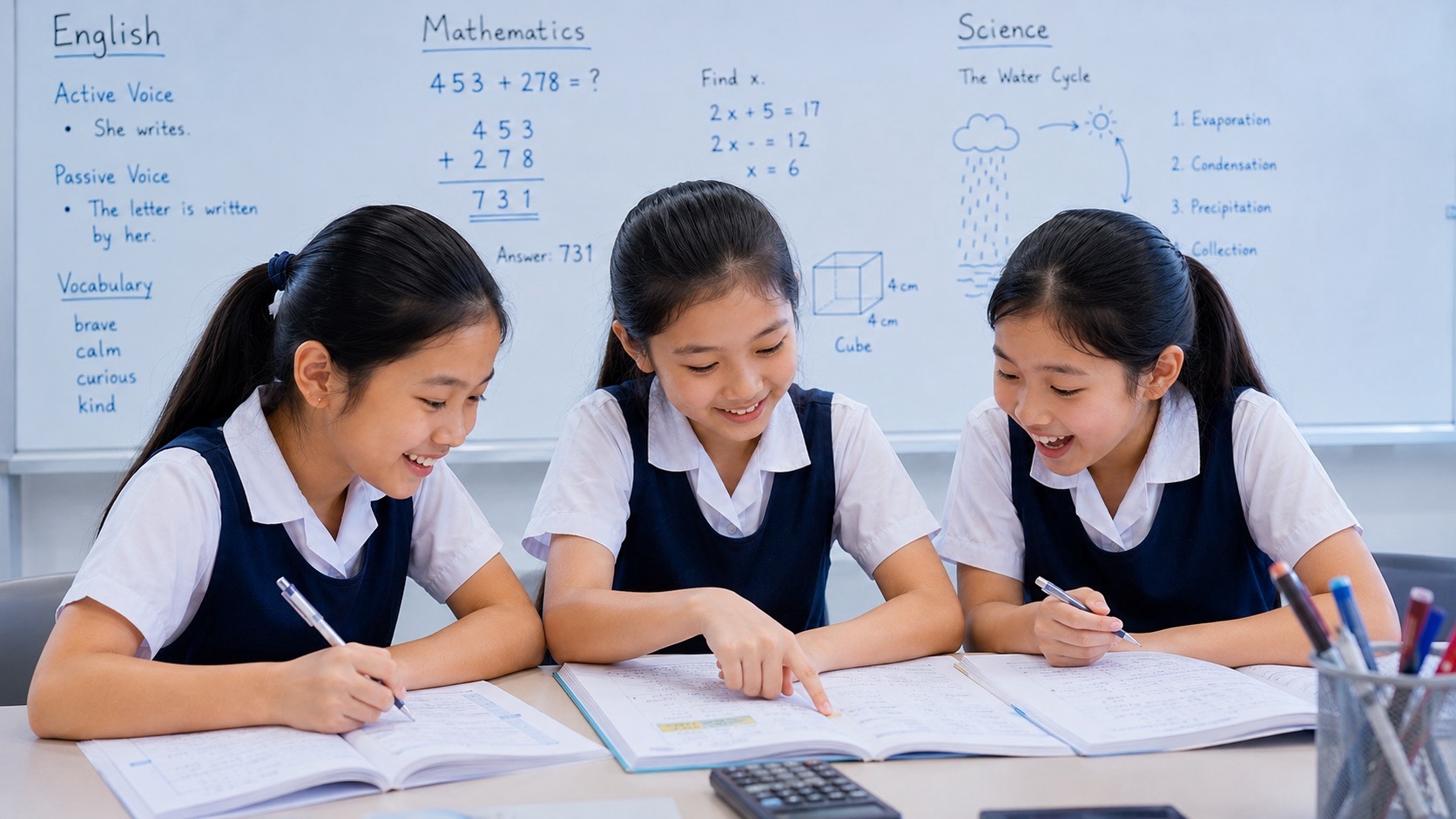
Three-student tutorials
The purpose of Three-student tutorials is not to create another isolated chapter. It strengthens the wider P1 network because keeping a shared mathematical focus while giving each learner a different diagnostic constraint. When the network is secure, a student can move between numbers, pictures, spoken language and symbols without losing the mathematical relationship. That movement matters in Singapore school work, where a familiar idea may appear as a short computation in one question and as a word problem or diagram in the next.
Watch for the learner who one confident child dominates explanations while another copies and a third waits for hints. Instead of labelling the child careless or weak in Math, test the component parts. One compact probe is to let Alicia explain a quantity relationship, Tricia draw it and Kai Kai solve a changed-number version independently before roles rotate. If the student improves after a representation cue but not after a calculation cue, the diagnosis is different from a student who understands the diagram but cannot retrieve a basic fact. The repair should follow the evidence, not the label.
A productive practice cycle uses brief common instruction followed by individual questions, tutor observation and separate transfer checks. The tutor can begin with a worked example, reduce support, change the numbers, change the context and finally remove the topic label. The child should eventually solve without waiting for the original cue. Errors are corrected by returning to the first wrong decision, not by erasing the whole solution and starting over without understanding what failed.
This strand contributes to small-group interaction without sacrificing evidence of each child’s independent control. It also supports examination confidence in the most useful sense: the child recognises that unfamiliar-looking work can still be entered through known relationships. Confidence becomes a record of successful retrieval, representation, checking and correction rather than a promise that every question will feel easy.
A 1.5-hour Primary 1 lesson
In a strong lower-primary programme, A 1.5-hour Primary 1 lesson develops through explanation, action and retrieval. The core idea is balancing retrieval, new learning, guided reasoning, independent practice and review. The teacher should expect the child to move from supported manipulation to independent recognition, because Mathematics becomes increasingly compact as students progress. What is physically obvious with objects today may later need to be seen mentally from a few symbols.
The most informative mistake is often the first one. A learner who a lesson becomes either nonstop explanation or nonstop worksheet completion may have a different problem from a learner who chooses the correct representation but calculates inaccurately. A short diagnostic example is to begin with ten minutes of cumulative retrieval, teach one relationship deeply, practise it across representations, run a short mixed set and finish with a changed transfer problem. The tutor listens to the language used, watches where hesitation begins and checks whether the same relationship survives a small change. This prevents unnecessary reteaching of material the child already understands.
For consolidation, use predictable lesson architecture with flexible time for the diagnosed weak link. Mix successful old material with the new target so retrieval has to compete with alternatives. Keep some questions easy enough for fluency, some changed enough for transfer and one or two designed to expose the original misconception. A learner who can explain a correction and then solve a fresh item independently has stronger evidence of repair than one who merely copies the corrected working.
Over time this builds steadier progress because each session both repairs the past and prepares the next school demand. That is the standard for useful Primary 1 tuition around Nicoll Highway: not a race through pages, but a deliberate reduction in fragile decisions. The student should need fewer prompts, make cleaner starts, use representations more purposefully and carry core number relationships into new school contexts.
Home practice that does not become a second tuition centre
Home practice that does not become a second tuition centre belongs to the foundations of P1 mathematical independence. Its mechanism is using short, regular retrieval and conversation instead of exhausting repetition. If tuition treats only the final answer, the tutor misses the decisions that produced it; if tuition exposes the decisions, a small error becomes useful evidence. This is especially important in the first school year, when habits of starting, representing, checking and asking precise questions are still being formed.
One sign to investigate is when the child parents feel forced to reteach entire topics at home or the child avoids Mathematics after long drill sessions. A focused worked probe is to use five-minute number talks, quick fact retrieval and one word-problem explanation rather than another full worksheet. The point is not to trick the learner. It is to change one variable at a time until the tutor can tell whether the issue sits in meaning, language, representation, fact retrieval, procedure or checking. Once the weak link is visible, intervention can be much shorter and more specific.
Use small doses, spaced revisiting and praise for clear reasoning and correction for the repair. Then remove the support that made the first success possible. Ask the learner to solve a changed example, explain the reason for one step and check the result through a different representation or inverse relationship where appropriate. Revisit it later, because immediate fluency after teaching can overstate how much has actually been retained.
A stable result supports greater independence and lower friction around everyday practice. It also gives parents a clearer progress signal than a single mark: the child starts sooner, asks more precise questions, depends less on repeated prompting and can explain why a method fits. Those behaviours are early indicators that the P1 foundation is becoming portable.
Confidence built from control
At Primary 1, Confidence built from control is best treated as a capability system. The central mechanism is linking confidence to successful starts, clear methods, checking and recovery after mistakes. A child may obtain a correct answer once and still have an unstable foundation if the relationship disappears when numbers, wording or representation changes. Tuition should therefore make the learner’s thinking observable: what did the child notice, how was the quantity represented, which operation or strategy was chosen, and can the child explain why the answer is reasonable? This is the difference between producing a result and building Mathematics that can transfer.
A useful diagnostic signal is when the learner says ‘I cannot do maths’ after one unfamiliar format or waits for reassurance before every step. That signal should not automatically trigger a larger worksheet. The tutor first isolates the earliest unreliable decision. For example, track whether the child can begin within a reasonable time, choose a representation, explain one decision and correct an error after feedback. The explanation matters as much as the answer because it reveals whether the weak link is conceptual, linguistic, representational, retrieval-based, procedural or simply an isolated slip. Different causes need different repairs.
Practice should then use visible progress records based on behaviours as well as marks. The principle is controlled variation: preserve the underlying relationship while changing surface features so the child cannot succeed by memorising the page. After immediate success, the same idea should return later in a mixed set without a heading that announces the method. A delayed transfer item is the real regression test; if the same error returns, the repair is not yet stable.
The payoff is resilience that is grounded in evidence rather than generic encouragement. For Nicoll Highway families, the local search term should not change the national curriculum; it should help parents reach the right teaching route quickly. The tutor’s job is to build a P1 learner who can recognise structure, choose a sensible representation, calculate accurately, communicate enough working for the level and recover when the first approach does not work.
Transition from Primary 1 to Primary 2
The purpose of Transition from Primary 1 to Primary 2 is not to create another isolated chapter. It strengthens the wider P1 network because ensuring core quantity, place-value and operation relationships remain available when new content is layered on. When the network is secure, a student can move between numbers, pictures, spoken language and symbols without losing the mathematical relationship. That movement matters in Singapore school work, where a familiar idea may appear as a short computation in one question and as a word problem or diagram in the next.
Watch for the learner who finishes P1 worksheets successfully but forgets basic relationships after a holiday or needs the original worksheet format. Instead of labelling the child careless or weak in Math, test the component parts. One compact probe is to retest number bonds, tens-and-ones, addition/subtraction inverses and one-step problems using changed numbers and changed wording. If the student improves after a representation cue but not after a calculation cue, the diagnosis is different from a student who understands the diagram but cannot retrieve a basic fact. The repair should follow the evidence, not the label.
A productive practice cycle uses cumulative mixed review during the final term and early P2. The tutor can begin with a worked example, reduce support, change the numbers, change the context and finally remove the topic label. The child should eventually solve without waiting for the original cue. Errors are corrected by returning to the first wrong decision, not by erasing the whole solution and starting over without understanding what failed.
This strand contributes to a cleaner transition because new multiplication, division and richer word problems do not have to sit on fragile foundations. It also supports examination confidence in the most useful sense: the child recognises that unfamiliar-looking work can still be entered through known relationships. Confidence becomes a record of successful retrieval, representation, checking and correction rather than a promise that every question will feel easy.
How Alicia, Tricia and Kai Kai can share one lesson without receiving identical work
Alicia, Tricia and Kai Kai may sit in the same three-student lesson and still need different mathematical constraints. Suppose the shared focus is addition within an appropriate P1 range. Alicia may already know many facts but rush through the relationship language; Tricia may represent accurately yet depend on counting; Kai Kai may understand when a model is supplied but hesitate to choose one independently. The tutor can open with one common demonstration, then give each learner a question that exposes the next decision that needs work.
The group becomes useful when students compare methods after they have each attempted the problem. Alicia can explain why make-ten reduces steps, Tricia can show the part-whole relationship, and Kai Kai can test whether the same method survives a changed number pair. The teacher then gives a silent transfer item. That final independent attempt prevents discussion from being mistaken for mastery. Small-group tuition is strongest when collaboration produces more evidence, not less.
This is also how a three-student format can remain calm. The tutor does not need three unrelated lesson plans. One mathematical structure is shared, while the prompt level, representation, number choice and transfer demand are adjusted. Over several weeks, those adjustments should shrink as each student gains control. Progress is visible when the learner needs fewer cues and can explain a method that still works after the surface features change.
School assessments: what to read beyond the mark
A Primary 1 school assessment is most useful when the script is treated as evidence. Look for clusters: does the child lose marks mainly when wording changes, when tens and ones must be coordinated, when facts must be retrieved quickly, when a diagram must be read, or when working is rushed? A score alone cannot separate these mechanisms. Two students with the same total can need completely different next lessons.
For each repeated error, record the first failed decision, the corrective example, and one later transfer question. This keeps tuition aligned with school demand without simply reproducing the school paper. If a child corrects every mistake immediately after explanation but repeats the same type a week later, the problem is retention or retrieval, not initial comprehension. Spaced return is therefore part of assessment preparation, not an optional extra.
Examination confidence at P1 should be modest and concrete. The child knows how to begin, can read a question without immediate panic, can choose a representation, performs core arithmetic with growing fluency and knows one or two ways to check. Those behaviours reduce the chance that a small surprise becomes a complete stop.
A practical 12-week P1 repair-and-build cycle
Weeks 1–2: baseline number sense, counting, tens-and-ones and core language; collect evidence before increasing difficulty. The sequence should bend around school pace and the child’s diagnostic evidence; it is a framework for coverage and retention, not a rigid promise that every learner needs the same number of lessons.
Weeks 3–4: number bonds, addition and subtraction relationships, with short daily retrieval and multiple representations. The sequence should bend around school pace and the child’s diagnostic evidence; it is a framework for coverage and retention, not a rigid promise that every learner needs the same number of lessons.
Weeks 5–6: word-problem translation, early model drawing and missing-number thinking; separate reading failures from calculation failures. The sequence should bend around school pace and the child’s diagnostic evidence; it is a framework for coverage and retention, not a rigid promise that every learner needs the same number of lessons.
Weeks 7–8: measurement, time, money, shapes, patterns and data through connected problem contexts rather than isolated vocabulary. The sequence should bend around school pace and the child’s diagnostic evidence; it is a framework for coverage and retention, not a rigid promise that every learner needs the same number of lessons.
Weeks 9–10: mixed school-style questions, accuracy routines and delayed retrieval of earlier concepts. The sequence should bend around school pace and the child’s diagnostic evidence; it is a framework for coverage and retention, not a rigid promise that every learner needs the same number of lessons.
Weeks 11–12: transfer, cumulative review, independent starts and a transition check for the next school phase. The sequence should bend around school pace and the child’s diagnostic evidence; it is a framework for coverage and retention, not a rigid promise that every learner needs the same number of lessons.
Frequently asked questions from Nicoll Highway families
Does a Primary 1 child need tuition if school marks are acceptable?
Not automatically. Tuition is useful when there is a clear need for stronger explanation, more deliberate practice, diagnostic repair or a learning environment that helps the child become more independent. Acceptable marks can coexist with fragile counting, weak language or high prompting, so the decision should use work samples and behaviour rather than fear.
Should P1 Mathematics focus on speed?
Fluency matters, but speed should grow from secure number relationships and retrieval. Rushing a child who still rebuilds every fact through counting may increase errors without strengthening Mathematics. Teach structure first, then shorten retrieval through spaced practice.
Is model drawing necessary in Primary 1?
Simple visual modelling can be useful when it makes part-whole and comparison relationships visible. The point is not to force a formal bar model onto every question. The child should learn when a drawing clarifies the relationship and when a direct mental or symbolic method is more efficient.
What if my child can calculate but cannot do word problems?
Treat it as a translation problem until evidence shows otherwise. Ask the learner to state what is known, what is asked and how the quantities relate before choosing an operation. Then check whether calculation is still a problem after the relationship is clear.
What if my child keeps making careless mistakes?
Replace the broad label with an error type. Copying errors, skipped signs, weak checking, rushed reading, uncertain facts and poor layout look similar on a marked page but need different interventions.
How much home practice is useful?
Short, regular and cumulative practice is usually more informative than occasional long sessions. A few minutes of number facts, one explanation and one mixed problem can expose more about retention than a large worksheet completed with repeated help.
How should parents read confidence?
Look for productive behaviour: willingness to start, ability to explain one step, tolerance of correction, independent checking and recovery after an error. These are stronger indicators than simply saying the child likes or dislikes Mathematics.
How is this Nicoll Highway page different from the main P1 Mathematics page?
This page owns local discovery for Nicoll Highway. The main P1 owner remains the broad curriculum route. The local article therefore links outward instead of trying to become another national P1 hub.
Continue the Nicoll Highway Mathematics route
For the next lower-primary stages, continue to Primary 2 Mathematics Tuition | Nicoll Highway and Primary 3 Mathematics Tuition | Nicoll Highway. For the secondary national-examination transition, use SEC Examination Mathematics Tuition | Nicoll Highway. For the complete subject map, return to the Mathematics Learning Hub.
Closing principle
Primary 1 Mathematics is the first chance to make quantity, place value, operations, representation and problem solving work as one system. The strongest tuition is not the one that produces the thickest file. It is the one that steadily removes fragile decisions: fewer guessed operations, fewer counting-by-one dependencies, fewer unexplained diagrams, fewer repeated errors after correction and fewer waits for the tutor to start the question.
For families searching around Nicoll Highway, that is the useful standard. Keep the national curriculum stable, diagnose the individual learner precisely, practise with variation, revisit after delay and build confidence from reliable control.