
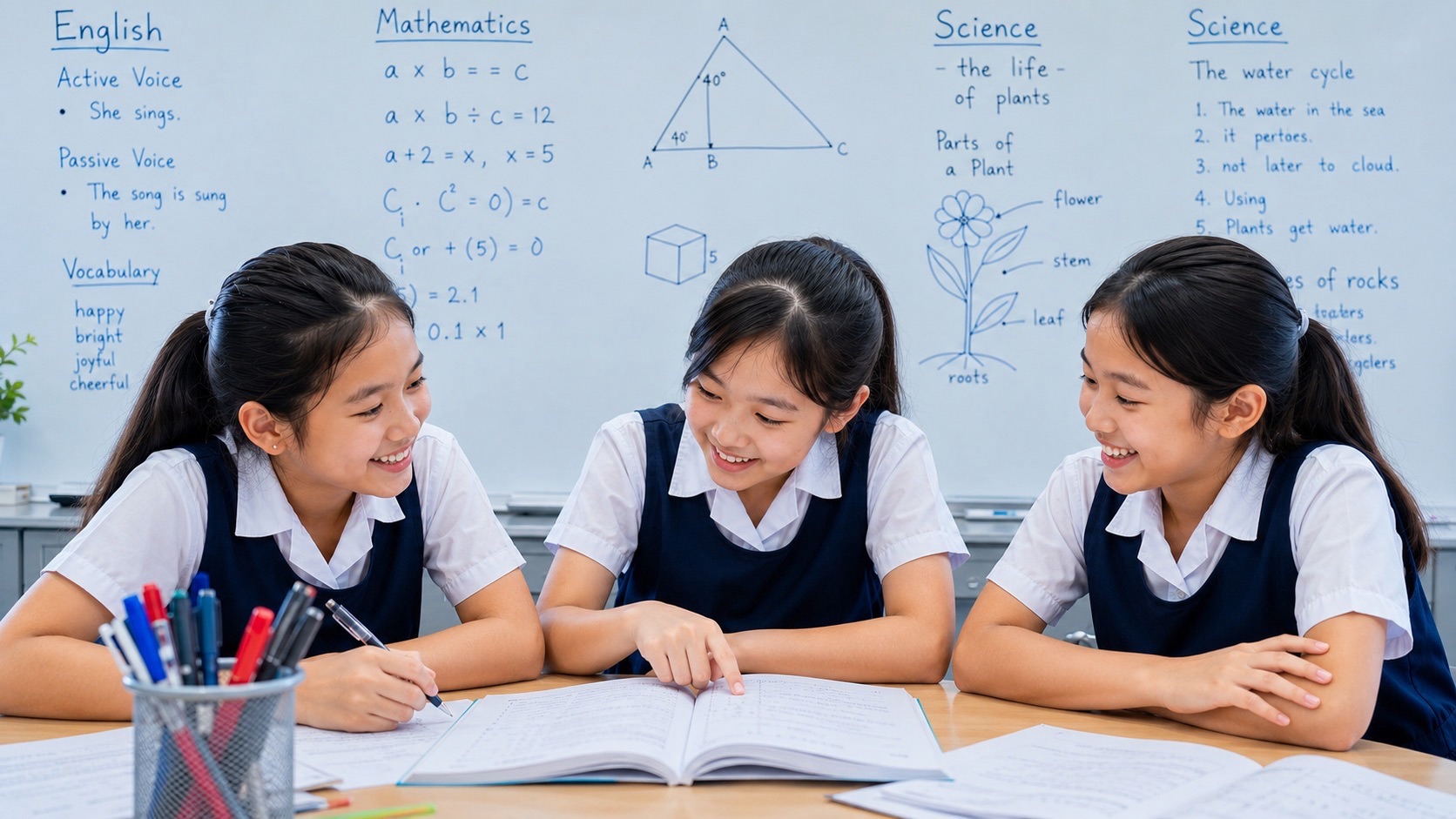
Primary 1 Mathematics tuition in Toa Payoh should do something more important than make a six-year-old complete more worksheets. It should help the child understand what school Mathematics is, how numbers represent quantity, why symbols mean what they mean, and how to think calmly when the question looks unfamiliar.
At eduKateSG, our premium 3-pax Primary 1 Mathematics tutorials are designed as a foundation year. We teach from first principles, connect concrete experiences to pictures and symbols, and build the habits that later support Primary 2, Primary 3, upper-primary problem solving and eventually PSLE Mathematics.
The current MOE Primary Mathematics syllabus organises learning around Number and Algebra, Measurement and Geometry, and Statistics, with mathematical problem solving at the centre of the wider framework. For Primary 1, this means the child is not merely learning to count. The child is beginning to build a mathematical language.
Our Primary 1 Mathematics tutorials are suitable for students who need to:
- build secure number sense rather than rely on counting by habit;
- understand place value and the meaning of tens and ones;
- connect addition and subtraction to real relationships;
- read simple word problems without hunting for trigger words;
- learn to represent thinking with objects, drawings, number bonds and simple models;
- develop accurate written working and checking habits;
- gain confidence with shapes, measurement, time and data; or
- start Primary Mathematics with a calm, teachable system.
Class size is limited to three students. Lessons are 1.5 hours weekly, with materials, guided practice, retrieval, correction and focused continuation work.
Arrange a parent–student consultation with eduKate Singapore
Chat with eduKateSG on WhatsApp
Primary 1 Is Not “Easy Mathematics”
Primary 1 content is elementary to an adult, but the cognitive transition is enormous for a young child.
The learner must understand that a written numeral stands for a quantity. The child must move from touching and counting objects to recognising number relationships mentally. Symbols such as +, − and = become a compact language. A short sentence problem requires the student to hold a story in mind, identify quantities and decide what changed.
This is why early Mathematics should not be judged only by how quickly the child can finish a page.
A child can complete routine sums while still having fragile number sense.
The more useful question is: can the child reconstruct the idea when the surface changes?
The Hidden Primary 1 Problem: Counting Must Become Number Sense
Counting is a useful beginning.
It is not the destination.
A child who solves 8 + 5 by restarting from 1 every time is working much harder than a child who sees 8 + 2 = 10 and then adds the remaining 3.
Both may get 13.
But the second child has begun to use structure.
Number sense means seeing useful relationships: one more, one less, part and whole, make ten, doubles, near doubles, difference, order and magnitude.
These relationships later support mental arithmetic, multiplication, fractions, algebra and estimation.
Why a 3-Pax Mathematics Tutorial Can Suit Young Learners
A Primary 1 child needs to be seen.
The tutor must notice whether the student is counting every object, reversing digits, misreading the operation sign, guessing from the picture or understanding the relationship.
In a three-student group, each learner has frequent opportunities to explain, manipulate objects, draw, answer and correct.
What three students make possible
- close observation of number strategies;
- frequent oral explanation;
- hands-on work without a large-class rush;
- immediate correction of misconceptions;
- short turns that keep attention active;
- peer examples without allowing one child to dominate;
- pacing that can slow down or extend; and
- visible confidence-building across small steps.
The small group also allows children to hear another way of thinking. One student may see a number bond. Another may draw. A third may count on. The tutor can compare the strategies and help the class move towards more efficient thinking.
What We Teach in Primary 1 Mathematics
Numbers as quantities
Students connect numerals to actual quantities and positions. We use objects, ten-frames, drawings, number lines and verbal comparisons.
The aim is to know that 17 is not merely the symbols 1 and 7. It is one ten and seven ones, a quantity larger than 16 and smaller than 18, and a number that can be decomposed in many useful ways.
Place value
Tens and ones are the first major compression system in school Mathematics.
Students learn that the digit 3 in 34 means three tens, not simply “three.”
We build, draw and write quantities so that place value is experienced before it becomes a written rule.
Number bonds
Part-whole thinking helps children see that 10 can be 7 and 3, 6 and 4, 8 and 2, and many other combinations.
This matters because addition and subtraction become connected rather than memorised as unrelated facts.
Addition
Addition is taught as combining, increasing and finding a total.
Students learn several strategies: count on, make ten, doubles and decomposition.
The strategy is chosen because it suits the numbers, not because one method is forced onto every sum.
Subtraction
Subtraction can mean taking away, finding a difference or finding the missing part.
These are related but not identical stories.
We deliberately vary the context so students learn the relationship rather than the keyword.
Simple word problems
The child learns to identify what is known, what changed and what is being asked.
We use drawings, objects, number bonds and simple bar representations when they make the relationship clearer.
Shapes and spatial reasoning
Students identify and describe common two-dimensional and three-dimensional shapes, compare their properties and build spatial vocabulary.
We encourage children to explain why a shape belongs to a category instead of relying only on one familiar picture.
Measurement, time and money
Young learners connect Mathematics to the world through length, mass, time and money.
We emphasise meaning before notation: what is longer, what is heavier, what time comes before another, what coins or notes represent.
Simple data
Students begin to read organised information, compare quantities and answer direct questions from pictures or tables.
This is the start of mathematical literacy: read the representation before calculating.
Concrete → Representational → Abstract
Our early-primary teaching follows a Concrete–Representational–Abstract progression.
First the child handles or imagines quantities.
Then the child draws or reads a representation.
Finally the child works with symbols.
For example, 7 + 5 may begin with counters. The counters can be reorganised into 10 and 2. A drawing can show the same regrouping. Only then does the written equation become a compact summary.
The objective is not to keep children dependent on objects.
The objective is to make the symbols meaningful enough that the concrete support can gradually disappear.
The Fencing Method in Primary 1 Mathematics
A new skill begins inside a narrow, safe boundary.
If the child is learning number bonds to 10, the first tasks stay within that relationship. Once secure, we vary the order, remove pictures, place the missing number in a different position and mix the skill with another familiar idea.
The fence widens one demand at a time.
This helps the child experience difficulty as a progression rather than a surprise.
Why We Do Not Teach Word Problems Through Trigger Words
Children often learn shortcuts such as “altogether means add” and “left means subtract.”
Those shortcuts eventually fail.
A question can contain the word altogether and still ask for a missing part. A story about something left can ask for the starting quantity.
We teach the relationship.
What quantities are present? What happened? Which quantity is unknown?
The student may draw, build or describe the situation before choosing the operation.
This is slower in the beginning and much faster later because the child is learning a reusable system.
Equality Is Balance, Not “The Answer Comes Next”
Young learners often think the equal sign means “now write the answer.”
A stronger idea is that both sides have the same value.
So 7 + 3 = 6 + 4 is true even though no final single number appears on the right.
This early balance idea becomes important later in missing-number problems and eventually algebra.
We introduce it gently through number bonds and equivalent expressions.
Written Working Should Begin as Communication
Primary 1 children do not need elaborate formal solutions.
But they should begin to show enough thinking that a mistake can be inspected.
A drawing, number bond, short equation or labelled answer can make the reasoning visible.
This prevents the habit of treating Mathematics as a secret mental performance where nobody can see how the answer was obtained.
Checking Should Be Specific
“Check your work” is too vague for many young learners.
We give small checking actions.
- Did I copy the number correctly?
- Did I answer what the question asked?
- Does my answer make sense for the story?
- Did I write the correct unit or label?
- Can I solve it a second way?
- Can I use the opposite operation to check?
As students mature, these checks become internal habits.
Retrieval Builds Fluency
A child who has just practised a number bond may appear fluent because the pattern is still active in working memory.
We return to the idea after a delay.
Can the child still make ten tomorrow? Next week? During a different topic?
Short retrieval reveals whether learning has become available rather than merely familiar.
Interleaving Begins Gently
We do not mix everything before the child understands anything.
But once several skills are secure, we begin to place them together.
An addition question may be followed by subtraction, then a shape question, then a word problem.
The child must recognise the demand instead of receiving a whole page of identical cues.
That recognition is an early form of method selection.
What Happens During a 90-Minute Primary 1 Mathematics Lesson
Warm-up
A short retrieval activity revisits number facts, place value or a previous correction.
New learning
The tutor introduces one important relationship using concrete or visual support.
Guided practice
Students answer with prompts while explaining what the numbers mean.
Independent attempt
A fresh question removes some of the support.
Correction
The child identifies what changed and tries again.
Mixed review
Older and newer skills appear together in a small set.
Focused continuation
Home practice is short enough to remain purposeful and directly connected to the lesson.
Three Primary 1 Student Pathways
Repair
The child may be uncertain with counting, quantity, place value or basic operation meaning. We return to concrete representations and rebuild the first missing relationship.
Stabilise
The child understands when guided but becomes confused when wording or layout changes. We vary the surface while preserving the idea.
Extend
The child is fluent and ready for richer reasoning. We ask for multiple methods, missing-number reasoning, explanation and more demanding word problems without turning Primary 1 into an accelerated race.
What Progress Should Look Like
- the child counts less and recognises more;
- tens and ones become clearer;
- addition and subtraction feel connected;
- word problems cause less guessing;
- representations become simpler and more purposeful;
- the student explains a method in ordinary language;
- mistakes are corrected without emotional collapse;
- older number facts remain available; and
- confidence becomes attached to understanding rather than speed alone.
These are strong early indicators because they show the learning system becoming more independent.
When Should a Toa Payoh Family Consider Primary 1 Mathematics Tuition?
Support may be useful when the child is consistently confused by number relationships, depends heavily on finger counting for every calculation, reverses place value, cannot explain simple addition or subtraction stories, or has begun to avoid Mathematics.
Tuition is not automatically necessary for every Primary 1 child.
A student who is learning confidently in school, practising calmly and progressing independently may already have enough support.
The purpose of tuition should be to solve a defined learning problem, not to make childhood feel like an endless examination year.
Convenient Access from Toa Payoh to Sixth Avenue
Toa Payoh MRT is on the North-South Line. A practical rail route is Toa Payoh → Newton, transfer to the Downtown Line, then continue to Sixth Avenue MRT.
eduKateSG is at 8 Fourth Avenue, Singapore 268674, near Sixth Avenue MRT. Lessons are held there, not in Toa Payoh. Consultations are by appointment.
For a young child, travel and energy matter. Families should consider school dismissal time, meals, rest and the complete journey when choosing a suitable lesson slot.
Class Details
Format: Premium 3-pax small-group tutorials
Level: Primary 1 Mathematics
Duration: 1.5 hours weekly
- number sense;
- place value;
- number bonds;
- addition and subtraction;
- word-problem relationships;
- CRA teaching;
- shapes, measurement and data;
- active recall;
- mixed practice; and
- carefully paced preparation for Primary 2.
Materials may include manipulatives, diagrams, number lines, lesson notes, practice sets, short word problems, retrieval activities and focused continuation work.
The usual first step is a parent–student consultation. Limited trial lessons may occasionally be available when a suitable 3-pax slot exists.
What Parents Can Bring to the Consultation
- recent Mathematics worksheets;
- school assessment or review work where available;
- the school textbook or current topic list;
- teacher comments;
- examples of questions the child avoids;
- homework completed independently; and
- the child’s own description of what feels difficult.
We are looking for patterns, not trying to label the child from one worksheet.
Frequently Asked Questions
Is Primary 1 too early for Mathematics tuition?
Not every child needs tuition. It can be useful when a specific gap in number sense, place value, operation meaning or confidence needs more direct teaching.
Should a Primary 1 child learn multiplication early?
Only when the foundations and school sequence make it appropriate. Strong number sense, grouping and addition relationships matter more than racing into procedures without meaning.
Do you use bar models in Primary 1?
We introduce simple representations when they genuinely clarify part-whole or comparison relationships. The representation should serve the child’s understanding, not become a drawing ritual.
How much homework should a six- or seven-year-old receive?
Enough to retrieve and practise the lesson without overwhelming the week. Short, purposeful work is usually more useful than large repetitive stacks.
What if my child is already very strong?
We deepen reasoning, ask for multiple methods and develop explanation rather than simply pushing many years ahead.
How do you reduce careless mistakes?
We replace the label careless with a visible behaviour: copying, sign reading, place value, skipped question information or incomplete checking. Then we train the specific prevention routine.
Helpful Reading for Toa Payoh Parents
- Mathematics Learning Hub
- Singapore Mathematics Tuition by Area Index
- Primary 4 Mathematics Tuition | Toa Payoh
- Education and Tuition | Toa Payoh
- MOE Primary Mathematics Syllabus
Primary 1 Mathematics Tuition for Toa Payoh Families
Primary 1 Mathematics should build a child who understands quantities, sees relationships and feels that a difficult question can be explored rather than feared.
At eduKateSG, our 3-pax tutorials teach from the ground up.
We use concrete experiences when the symbols are still too abstract.
We represent the relationship so the child can see it.
We practise until the method becomes available.
Then we vary the question and check whether the understanding survives.
The objective is not a Primary 1 child who looks like a Primary 6 student.
It is a Primary 1 child with foundations strong enough to keep growing.
Arrange a Parent–Student Consultation
eduKateSG
8 Fourth Avenue
Singapore 268674
Near Sixth Avenue MRT
Premium 3-pax small-group tuition
By appointment
Properly taught kids shine a bright light into the future.