
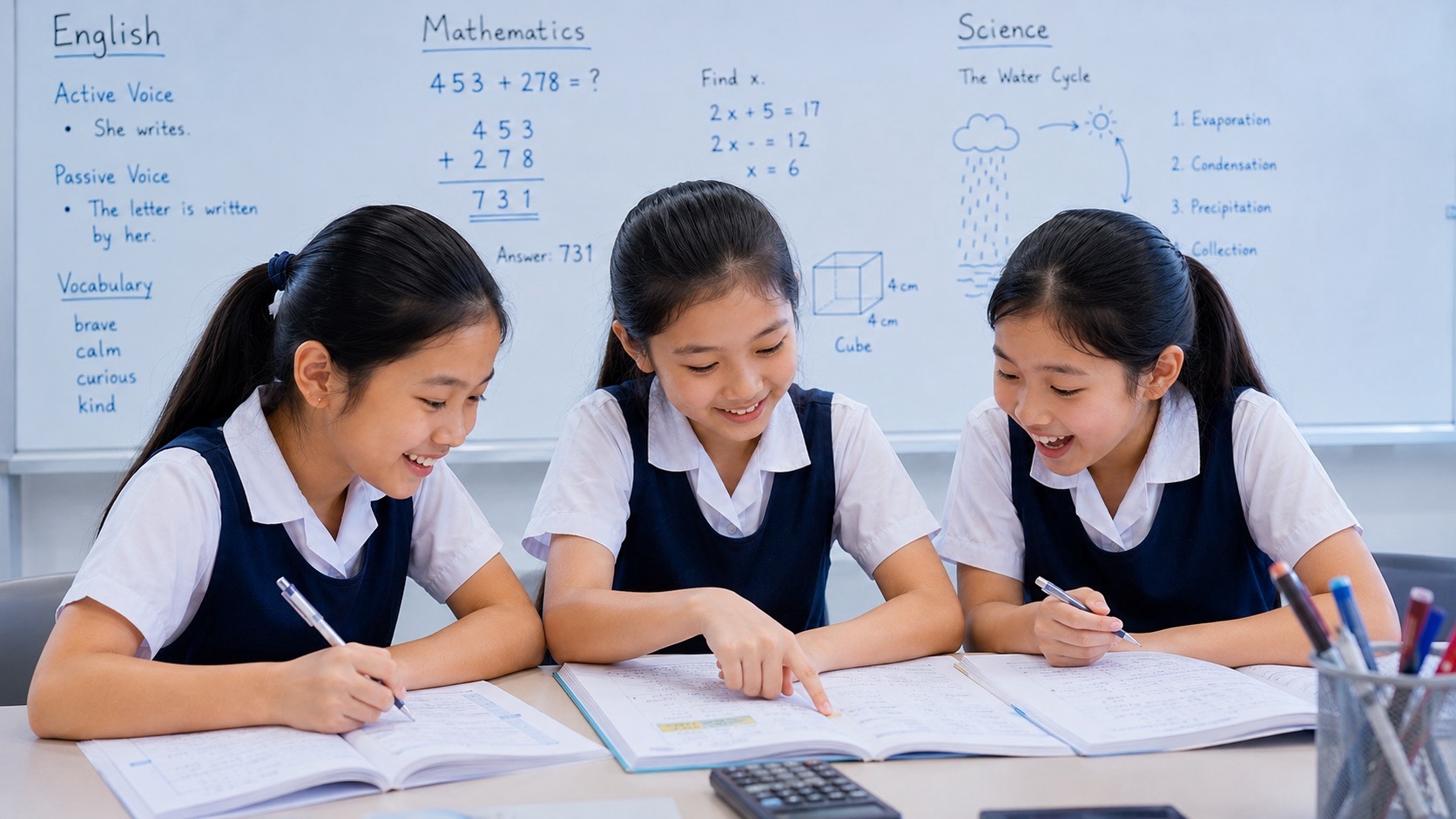
Primary 2 Mathematics tuition for families searching around Kallang Basin should strengthen the bridge between early number understanding and the more demanding problem-solving that arrives later in primary school. Useful P2 Math tuition in Singapore is MOE-aligned and builds place value, addition and subtraction accuracy, multiplication and division meaning, arithmetic fluency, bar-model reasoning, word problems, simple fractions, measurement, mathematical language and diagnostic gap repair. The goal is not to accelerate blindly into upper-primary content; it is to make the P2 system reliable enough that later complexity has something stable to sit on.
Singapore Primary 2 Math tuition pages currently compete heavily on phrases such as strong foundations, MOE syllabus alignment, small-group support, multiplication and division, model drawing, word problems, confidence, problem-solving and school readiness. Those search terms point to a real parent concern: P2 is often where a child can no longer rely only on counting and simple addition facts. The learner must begin organising equal groups, interpreting more varied stories, coordinating written methods with place value and working more independently.
This Kallang Basin article is a local discovery route, not a claim of a physical eduKateSG branch at Kallang Basin. The Mathematics Learning Hub remains the broad owner. The P2 local page is deliberately narrower: it explains how to diagnose and build Primary 2 Mathematics for families using Kallang Basin as their search anchor, while linking to the Kallang Basin P1, P3 and SEC siblings instead of creating another competing general Mathematics hub.
Primary 2 Mathematics Tuition | Kallang Basin: Scope and ownership
This page owns the Kallang Basin local-discovery intent for Primary 2 Mathematics only. It routes backward to Primary 1 Mathematics Tuition | Kallang Basin, forward to the P3 sibling and outward to the existing Mathematics hub. It does not attempt to replace national Primary Mathematics owners or later examination pages.
MOE’s current Primary Mathematics framework places problem solving at the centre and connects concepts, skills, processes, metacognition and attitudes. That framework supports a P2 teaching principle: procedural fluency and conceptual understanding should reinforce one another. Parents can check the current framework in the MOE Primary Mathematics syllabus. Exact school sequencing should still follow the child’s current school materials and teacher guidance.
Place value beyond reading numbers
Place value beyond reading numbers matters because P2 Mathematics is becoming a network rather than a sequence of isolated chapters. The mechanism is treating tens and ones as units that can be composed, decomposed, compared and renamed. When that relationship is secure, a learner can meet the same idea in a computation, a diagram, a story or a school assessment and still recognise what is happening. That recognition reduces dependence on cues from the page heading or the tutor.
A common diagnostic sign is when the child reads a number correctly but cannot explain its size, regroup it or compare it reliably with a nearby number. The response should be a probe, not an accusation of carelessness. For example, represent 68 as 6 tens and 8 ones, then as 5 tens and 18 ones, and ask why the total is unchanged. Watch where the learner slows, what language is used and whether a representation helps. The earliest point of failure distinguishes a concept gap from a retrieval problem, a language problem or an execution slip.
Consolidate through place-value cards, bundles, expanded notation, number lines and comparison questions. The strongest sequence moves from supported understanding to changed examples and finally to a mixed question where the topic is not announced. Immediate success is only one data point. Return later and ask the child to reconstruct the idea without the original cue. That delayed transfer is what turns practice into evidence of learning.
The wider outcome is stronger regrouping, estimation and mental arithmetic because place value becomes operational rather than decorative. For Kallang Basin families, this is the useful meaning of a strong foundation: the learner needs fewer prompts, can explain why a method fits and can recover from a mistake without losing the whole question.
Number bonds that support larger calculations
At P2, Number bonds that support larger calculations should be taught as a decision process. Its core is using known part-whole relationships as building blocks for less familiar sums and differences. If a child learns only a surface routine, the method may disappear when numbers get larger or wording changes. If the child understands the invariant relationship, procedures become easier to remember because they have a reason.
Investigate the learner who relies on counting for facts that should be increasingly accessible or cannot adapt a known fact to a nearby one. A compact worked diagnostic is to start from 7+3=10 and use it to solve 27+3, 17+4 and 13-7 through connected reasoning. Change one feature at a time and compare performance. The tutor is looking for the boundary between what the child can control and what still requires external support. That boundary should determine the next exercise.
Use fact families, make-ten work, near-doubles and missing parts revisited after delay to repair the gap. Ask for a fresh example after explanation, and later place the same mechanism among other topics so recognition must be independent. Correct work should be checked through estimation, inverse relationships or a second representation where appropriate. The learner should increasingly be able to describe what the answer means, not only state it.
Over several weeks, this supports more efficient calculation without sacrificing understanding. It also makes school-assessment preparation less frantic because cumulative knowledge remains active instead of needing to be retaught at every test.
Addition with regrouping meaning
A strong P2 programme uses Addition with regrouping meaning to connect understanding, fluency and problem solving. The mathematical engine is understanding regrouping as renaming ten ones as one ten rather than carrying a mysterious digit. The teacher should make the decision chain visible: interpret the quantity, choose a representation, select a method, execute accurately and check the result. Each link can be taught and diagnosed.
When a student copies a written algorithm but misplaces the carried value or cannot explain why it belongs in the tens column, avoid increasing volume before diagnosis. One useful probe is to build 28+17 with tens and ones, combine 15 ones, rename ten ones as one ten and connect every move to the written working. If a small cue changes performance dramatically, record which cue mattered. That information is more useful than a broad label such as weak foundation because it identifies the next teaching move.
Practice with concrete place-value models, vertical notation and estimation before calculation. Vary numbers, context, diagram orientation and question order while preserving the same relationship. Later remove scaffolds and measure independent start time. A child who can begin, explain and check a changed problem has stronger control than one who completes ten near-identical examples immediately after demonstration.
This produces a written algorithm the child can reconstruct and check instead of merely memorise. The local Kallang Basin route therefore values precise repair and cumulative retention over worksheet quantity.
Subtraction with regrouping meaning
Subtraction with regrouping meaning is a useful P2 checkpoint because it reveals whether early Mathematics has become portable. The mechanism is renaming one ten as ten ones while preserving total value. Portability means the idea survives a different picture, wording, order or set of numbers. Without that, apparent fluency may be only familiarity.
Look closely when the learner borrows mechanically, changes digits inconsistently or loses track of which place was renamed. Test the idea by asking the child to represent 42-18, rename four tens two ones as three tens twelve ones, then connect the model to the written steps. The answer, explanation and hesitation pattern show whether the main obstacle lies in meaning, language, retrieval, representation or working accuracy. A precise diagnosis allows a smaller and more effective intervention.
The repair should use place-value equipment, expanded subtraction, inverse checks and changed-number practice. Follow guided success with an independent version and a delayed version. Encourage the child to state what changed and what stayed mathematically the same. This language of invariance helps students notice structure instead of memorising page layouts.
The long-term benefit is greater accuracy and better readiness for later multi-digit computation. That is how P2 tuition prepares for P3 without prematurely turning every lesson into upper-primary drilling.
Multiplication as equal groups
Multiplication as equal groups matters because P2 Mathematics is becoming a network rather than a sequence of isolated chapters. The mechanism is seeing multiplication as structured repeated quantity rather than a chant of tables. When that relationship is secure, a learner can meet the same idea in a computation, a diagram, a story or a school assessment and still recognise what is happening. That recognition reduces dependence on cues from the page heading or the tutor.
A common diagnostic sign is when the child recites facts but cannot build or interpret equal groups, arrays or repeated addition. The response should be a probe, not an accusation of carelessness. For example, show 4 groups of 3 objects, write 3+3+3+3 and 4×3, then rotate the array to discuss 3×4. Watch where the learner slows, what language is used and whether a representation helps. The earliest point of failure distinguishes a concept gap from a retrieval problem, a language problem or an execution slip.
Consolidate through arrays, equal groups, skip counting and grouping stories. The strongest sequence moves from supported understanding to changed examples and finally to a mixed question where the topic is not announced. Immediate success is only one data point. Return later and ask the child to reconstruct the idea without the original cue. That delayed transfer is what turns practice into evidence of learning.
The wider outcome is times-table knowledge connected to meaning, making later multiplication more flexible. For Kallang Basin families, this is the useful meaning of a strong foundation: the learner needs fewer prompts, can explain why a method fits and can recover from a mistake without losing the whole question.
Division as sharing and grouping
At P2, Division as sharing and grouping should be taught as a decision process. Its core is building both quotitive and partitive meanings of division. If a child learns only a surface routine, the method may disappear when numbers get larger or wording changes. If the child understands the invariant relationship, procedures become easier to remember because they have a reason.
Investigate the learner who treats every division question as one memorised routine or cannot tell whether the answer describes group size or number of groups. A compact worked diagnostic is to use 12 objects to make 3 equal groups, then ask how many groups of 3 can be made from the same 12. Change one feature at a time and compare performance. The tutor is looking for the boundary between what the child can control and what still requires external support. That boundary should determine the next exercise.
Use sharing tasks, grouping tasks, inverse links to multiplication and remainder-free examples before extension to repair the gap. Ask for a fresh example after explanation, and later place the same mechanism among other topics so recognition must be independent. Correct work should be checked through estimation, inverse relationships or a second representation where appropriate. The learner should increasingly be able to describe what the answer means, not only state it.
Over several weeks, this supports stronger word-problem interpretation and better preparation for later division algorithms. It also makes school-assessment preparation less frantic because cumulative knowledge remains active instead of needing to be retaught at every test.
Multiplication and division as inverses
A strong P2 programme uses Multiplication and division as inverses to connect understanding, fluency and problem solving. The mathematical engine is organising facts into connected families. The teacher should make the decision chain visible: interpret the quantity, choose a representation, select a method, execute accurately and check the result. Each link can be taught and diagnosed.
When a student knows a multiplication fact but cannot use it to solve a related division question, avoid increasing volume before diagnosis. One useful probe is to from 4×5=20 derive 5×4=20, 20÷4=5 and 20÷5=4, then hide one value. If a small cue changes performance dramatically, record which cue mattered. That information is more useful than a broad label such as weak foundation because it identifies the next teaching move.
Practice with fact-family triangles, arrays, missing-number equations and oral explanations. Vary numbers, context, diagram orientation and question order while preserving the same relationship. Later remove scaffolds and measure independent start time. A child who can begin, explain and check a changed problem has stronger control than one who completes ten near-identical examples immediately after demonstration.
This produces faster retrieval and a natural checking method. The local Kallang Basin route therefore values precise repair and cumulative retention over worksheet quantity.
Times-table fluency with structure
Times-table fluency with structure is a useful P2 checkpoint because it reveals whether early Mathematics has become portable. The mechanism is making multiplication facts accessible through patterns and related facts rather than isolated recitation. Portability means the idea survives a different picture, wording, order or set of numbers. Without that, apparent fluency may be only familiarity.
Look closely when the learner can chant a table in order but cannot answer a fact out of sequence or apply it in a story. Test the idea by asking the child to derive 6×4 from 5×4+4, compare doubling strategies and use commutativity where appropriate. The answer, explanation and hesitation pattern show whether the main obstacle lies in meaning, language, retrieval, representation or working accuracy. A precise diagnosis allows a smaller and more effective intervention.
The repair should use spaced mixed retrieval, arrays, pattern noticing and one-step application questions. Follow guided success with an independent version and a delayed version. Encourage the child to state what changed and what stayed mathematically the same. This language of invariance helps students notice structure instead of memorising page layouts.
The long-term benefit is usable fluency that survives random order and problem contexts. That is how P2 tuition prepares for P3 without prematurely turning every lesson into upper-primary drilling.
Mental addition strategies
Mental addition strategies matters because P2 Mathematics is becoming a network rather than a sequence of isolated chapters. The mechanism is selecting efficient decompositions based on number structure. When that relationship is secure, a learner can meet the same idea in a computation, a diagram, a story or a school assessment and still recognise what is happening. That recognition reduces dependence on cues from the page heading or the tutor.
A common diagnostic sign is when the child writes every small calculation vertically or counts on inefficiently. The response should be a probe, not an accusation of carelessness. For example, solve 36+9 as 36+10-1, then compare with splitting nine into four and five to bridge a ten. Watch where the learner slows, what language is used and whether a representation helps. The earliest point of failure distinguishes a concept gap from a retrieval problem, a language problem or an execution slip.
Consolidate through compensation, partitioning, bridging tens and explain-your-choice prompts. The strongest sequence moves from supported understanding to changed examples and finally to a mixed question where the topic is not announced. Immediate success is only one data point. Return later and ask the child to reconstruct the idea without the original cue. That delayed transfer is what turns practice into evidence of learning.
The wider outcome is greater speed and working-memory capacity for multi-step reasoning. For Kallang Basin families, this is the useful meaning of a strong foundation: the learner needs fewer prompts, can explain why a method fits and can recover from a mistake without losing the whole question.
Mental subtraction strategies
At P2, Mental subtraction strategies should be taught as a decision process. Its core is using difference, compensation and known bonds instead of one fixed route. If a child learns only a surface routine, the method may disappear when numbers get larger or wording changes. If the child understands the invariant relationship, procedures become easier to remember because they have a reason.
Investigate the learner who subtracts by counting backwards one by one or becomes confused around a ten boundary. A compact worked diagnostic is to solve 52-9 as 52-10+1 and 43-38 by counting up from 38 to 43. Change one feature at a time and compare performance. The tutor is looking for the boundary between what the child can control and what still requires external support. That boundary should determine the next exercise.
Use number lines, compensation, counting-up differences and inverse checks to repair the gap. Ask for a fresh example after explanation, and later place the same mechanism among other topics so recognition must be independent. Correct work should be checked through estimation, inverse relationships or a second representation where appropriate. The learner should increasingly be able to describe what the answer means, not only state it.
Over several weeks, this supports flexible calculation and improved reasonableness. It also makes school-assessment preparation less frantic because cumulative knowledge remains active instead of needing to be retaught at every test.
Equality and missing-number equations
A strong P2 programme uses Equality and missing-number equations to connect understanding, fluency and problem solving. The mathematical engine is treating equality as balance across two expressions. The teacher should make the decision chain visible: interpret the quantity, choose a representation, select a method, execute accurately and check the result. Each link can be taught and diagnosed.
When a student expects the blank to appear only after an equals sign or adds all visible numbers automatically, avoid increasing volume before diagnosis. One useful probe is to compare 14+6=12+8 and solve 17=□+9 by preserving equality. If a small cue changes performance dramatically, record which cue mattered. That information is more useful than a broad label such as weak foundation because it identifies the next teaching move.
Practice with true/false equations, balance-style diagrams and missing boxes in varied positions. Vary numbers, context, diagram orientation and question order while preserving the same relationship. Later remove scaffolds and measure independent start time. A child who can begin, explain and check a changed problem has stronger control than one who completes ten near-identical examples immediately after demonstration.
This produces early algebraic control and fewer operation-selection errors. The local Kallang Basin route therefore values precise repair and cumulative retention over worksheet quantity.
Bar models for part-whole problems
Bar models for part-whole problems is a useful P2 checkpoint because it reveals whether early Mathematics has become portable. The mechanism is representing quantity structure before choosing an operation. Portability means the idea survives a different picture, wording, order or set of numbers. Without that, apparent fluency may be only familiarity.
Look closely when the learner draws bars without proportional meaning or starts calculation before identifying the whole and parts. Test the idea by asking the child to model a total of 27 with one known part 12 and ask what the missing segment represents before calculating. The answer, explanation and hesitation pattern show whether the main obstacle lies in meaning, language, retrieval, representation or working accuracy. A precise diagnosis allows a smaller and more effective intervention.
The repair should use labelled bars, part-whole diagrams and changed wording with the same underlying structure. Follow guided success with an independent version and a delayed version. Encourage the child to state what changed and what stayed mathematically the same. This language of invariance helps students notice structure instead of memorising page layouts.
The long-term benefit is more reliable translation from story language into Mathematics. That is how P2 tuition prepares for P3 without prematurely turning every lesson into upper-primary drilling.
Bar models for comparison problems
Bar models for comparison problems matters because P2 Mathematics is becoming a network rather than a sequence of isolated chapters. The mechanism is making ‘more than’, ‘less than’ and difference relationships visible. When that relationship is secure, a learner can meet the same idea in a computation, a diagram, a story or a school assessment and still recognise what is happening. That recognition reduces dependence on cues from the page heading or the tutor.
A common diagnostic sign is when the child confuses which quantity is larger or subtracts the wrong way round. The response should be a probe, not an accusation of carelessness. For example, draw two aligned bars for 24 and 17, mark the excess and state the unknown before writing 24-17. Watch where the learner slows, what language is used and whether a representation helps. The earliest point of failure distinguishes a concept gap from a retrieval problem, a language problem or an execution slip.
Consolidate through aligned comparison models, verbal paraphrase and inverse checking. The strongest sequence moves from supported understanding to changed examples and finally to a mixed question where the topic is not announced. Immediate success is only one data point. Return later and ask the child to reconstruct the idea without the original cue. That delayed transfer is what turns practice into evidence of learning.
The wider outcome is stronger word-problem accuracy as linguistic complexity increases. For Kallang Basin families, this is the useful meaning of a strong foundation: the learner needs fewer prompts, can explain why a method fits and can recover from a mistake without losing the whole question.
Word problems without trigger-word guessing
At P2, Word problems without trigger-word guessing should be taught as a decision process. Its core is identifying the relationship instead of matching one word to one operation. If a child learns only a surface routine, the method may disappear when numbers get larger or wording changes. If the child understands the invariant relationship, procedures become easier to remember because they have a reason.
Investigate the learner who sees ‘more’ and always adds, or sees ‘left’ and always subtracts regardless of structure. A compact worked diagnostic is to cover the numbers, retell the situation, name what is known and asked, then reveal numbers and choose a model. Change one feature at a time and compare performance. The tutor is looking for the boundary between what the child can control and what still requires external support. That boundary should determine the next exercise.
Use relationship sorting, changed contexts and operation-unknown mixed sets to repair the gap. Ask for a fresh example after explanation, and later place the same mechanism among other topics so recognition must be independent. Correct work should be checked through estimation, inverse relationships or a second representation where appropriate. The learner should increasingly be able to describe what the answer means, not only state it.
Over several weeks, this supports transfer when familiar operations appear under unfamiliar language. It also makes school-assessment preparation less frantic because cumulative knowledge remains active instead of needing to be retaught at every test.
Two-stage thinking before formal multi-step load
A strong P2 programme uses Two-stage thinking before formal multi-step load to connect understanding, fluency and problem solving. The mathematical engine is learning to preserve an intermediate result and the reason it is needed. The teacher should make the decision chain visible: interpret the quantity, choose a representation, select a method, execute accurately and check the result. Each link can be taught and diagnosed.
When a student solves the first visible calculation but cannot explain what that result is for, avoid increasing volume before diagnosis. One useful probe is to in a simple buy-and-change story, identify the subtotal as an intermediate quantity before finding the final difference. If a small cue changes performance dramatically, record which cue mattered. That information is more useful than a broad label such as weak foundation because it identifies the next teaching move.
Practice with short chained problems, annotated steps and what-does-this-number-mean questions. Vary numbers, context, diagram orientation and question order while preserving the same relationship. Later remove scaffolds and measure independent start time. A child who can begin, explain and check a changed problem has stronger control than one who completes ten near-identical examples immediately after demonstration.
This produces readiness for the multi-step demands that become much more visible from Primary 3 onward. The local Kallang Basin route therefore values precise repair and cumulative retention over worksheet quantity.
Mathematical language in P2
Mathematical language in P2 is a useful P2 checkpoint because it reveals whether early Mathematics has become portable. The mechanism is understanding terms for grouping, comparison, value, sequence and measurement as mathematical relations. Portability means the idea survives a different picture, wording, order or set of numbers. Without that, apparent fluency may be only familiarity.
Look closely when the learner needs the tutor to translate ordinary school wording before starting. Test the idea by asking the child to contrast ‘3 groups of 4’ with ‘4 groups of 3’ and ask what changes and what remains equal. The answer, explanation and hesitation pattern show whether the main obstacle lies in meaning, language, retrieval, representation or working accuracy. A precise diagnosis allows a smaller and more effective intervention.
The repair should use oral restatement, diagram matching and sentence-to-equation tasks. Follow guided success with an independent version and a delayed version. Encourage the child to state what changed and what stayed mathematically the same. This language of invariance helps students notice structure instead of memorising page layouts.
The long-term benefit is independent reading of a wider range of school questions. That is how P2 tuition prepares for P3 without prematurely turning every lesson into upper-primary drilling.
Length and measurement reasoning
Length and measurement reasoning matters because P2 Mathematics is becoming a network rather than a sequence of isolated chapters. The mechanism is connecting measurement numbers to units, benchmarks and comparison. When that relationship is secure, a learner can meet the same idea in a computation, a diagram, a story or a school assessment and still recognise what is happening. That recognition reduces dependence on cues from the page heading or the tutor.
A common diagnostic sign is when the child reports a number without a unit or accepts an implausible answer because the arithmetic was correct. The response should be a probe, not an accusation of carelessness. For example, estimate an object against a familiar benchmark, measure it, then discuss the difference between estimate and result. Watch where the learner slows, what language is used and whether a representation helps. The earliest point of failure distinguishes a concept gap from a retrieval problem, a language problem or an execution slip.
Consolidate through estimation, unit choice, direct comparison and conversion only where the school sequence requires it. The strongest sequence moves from supported understanding to changed examples and finally to a mixed question where the topic is not announced. Immediate success is only one data point. Return later and ask the child to reconstruct the idea without the original cue. That delayed transfer is what turns practice into evidence of learning.
The wider outcome is better quantitative sense and checking habits. For Kallang Basin families, this is the useful meaning of a strong foundation: the learner needs fewer prompts, can explain why a method fits and can recover from a mistake without losing the whole question.
Mass and capacity language
At P2, Mass and capacity language should be taught as a decision process. Its core is building meaning for heavier/lighter and holds more/less through comparison and representation. If a child learns only a surface routine, the method may disappear when numbers get larger or wording changes. If the child understands the invariant relationship, procedures become easier to remember because they have a reason.
Investigate the learner who uses everyday words inconsistently or confuses the attribute being compared. A compact worked diagnostic is to compare two containers for capacity and two objects for mass, then ask which number or observation answers each question. Change one feature at a time and compare performance. The tutor is looking for the boundary between what the child can control and what still requires external support. That boundary should determine the next exercise.
Use hands-on comparison, labelled quantities and short story problems to repair the gap. Ask for a fresh example after explanation, and later place the same mechanism among other topics so recognition must be independent. Correct work should be checked through estimation, inverse relationships or a second representation where appropriate. The learner should increasingly be able to describe what the answer means, not only state it.
Over several weeks, this supports clearer separation of different measurable attributes. It also makes school-assessment preparation less frantic because cumulative knowledge remains active instead of needing to be retaught at every test.
Time as a measured interval
A strong P2 programme uses Time as a measured interval to connect understanding, fluency and problem solving. The mathematical engine is moving from clock reading toward reasoning about order and simple duration. The teacher should make the decision chain visible: interpret the quantity, choose a representation, select a method, execute accurately and check the result. Each link can be taught and diagnosed.
When a student can state a displayed time but cannot connect two times in a sequence, avoid increasing volume before diagnosis. One useful probe is to place a start and end event on a timeline and count equal intervals between them. If a small cue changes performance dramatically, record which cue mattered. That information is more useful than a broad label such as weak foundation because it identifies the next teaching move.
Practice with clock faces, timelines, daily schedules and before/after language. Vary numbers, context, diagram orientation and question order while preserving the same relationship. Later remove scaffolds and measure independent start time. A child who can begin, explain and check a changed problem has stronger control than one who completes ten near-identical examples immediately after demonstration.
This produces better preparation for later elapsed-time problems. The local Kallang Basin route therefore values precise repair and cumulative retention over worksheet quantity.
Money and equivalence
Money and equivalence is a useful P2 checkpoint because it reveals whether early Mathematics has become portable. The mechanism is using value, composition and change to reinforce place value and additive reasoning. Portability means the idea survives a different picture, wording, order or set of numbers. Without that, apparent fluency may be only familiarity.
Look closely when the learner counts coins rather than value or cannot make the same amount in another way. Test the idea by asking the child to make one amount with several combinations, then buy an item and treat change as the missing part back to the amount paid. The answer, explanation and hesitation pattern show whether the main obstacle lies in meaning, language, retrieval, representation or working accuracy. A precise diagnosis allows a smaller and more effective intervention.
The repair should use coin-note combinations, simple transactions and inverse checks. Follow guided success with an independent version and a delayed version. Encourage the child to state what changed and what stayed mathematically the same. This language of invariance helps students notice structure instead of memorising page layouts.
The long-term benefit is everyday application that strengthens number relationships. That is how P2 tuition prepares for P3 without prematurely turning every lesson into upper-primary drilling.
Fractions as equal parts
Fractions as equal parts matters because P2 Mathematics is becoming a network rather than a sequence of isolated chapters. The mechanism is understanding that fractional parts depend on equal partitioning and the same whole. When that relationship is secure, a learner can meet the same idea in a computation, a diagram, a story or a school assessment and still recognise what is happening. That recognition reduces dependence on cues from the page heading or the tutor.
A common diagnostic sign is when the child labels any shaded piece a half or quarter without checking equal size. The response should be a probe, not an accusation of carelessness. For example, compare two shapes each cut into four parts, one equal and one unequal, and decide which can meaningfully represent quarters. Watch where the learner slows, what language is used and whether a representation helps. The earliest point of failure distinguishes a concept gap from a retrieval problem, a language problem or an execution slip.
Consolidate through folding, partitioning, shading and naming unit fractions in varied shapes. The strongest sequence moves from supported understanding to changed examples and finally to a mixed question where the topic is not announced. Immediate success is only one data point. Return later and ask the child to reconstruct the idea without the original cue. That delayed transfer is what turns practice into evidence of learning.
The wider outcome is a conceptual base for later fraction comparison and operations. For Kallang Basin families, this is the useful meaning of a strong foundation: the learner needs fewer prompts, can explain why a method fits and can recover from a mistake without losing the whole question.
Geometry through properties and composition
At P2, Geometry through properties and composition should be taught as a decision process. Its core is recognising shapes from defining properties and seeing how shapes combine. If a child learns only a surface routine, the method may disappear when numbers get larger or wording changes. If the child understands the invariant relationship, procedures become easier to remember because they have a reason.
Investigate the learner who identifies only prototype orientations or calls a shape by visual resemblance. A compact worked diagnostic is to rotate and combine simple shapes, then ask which properties remain unchanged and which new figure is formed. Change one feature at a time and compare performance. The tutor is looking for the boundary between what the child can control and what still requires external support. That boundary should determine the next exercise.
Use sorting, drawing, composing, decomposing and property descriptions to repair the gap. Ask for a fresh example after explanation, and later place the same mechanism among other topics so recognition must be independent. Correct work should be checked through estimation, inverse relationships or a second representation where appropriate. The learner should increasingly be able to describe what the answer means, not only state it.
Over several weeks, this supports stronger spatial reasoning for later geometry and model interpretation. It also makes school-assessment preparation less frantic because cumulative knowledge remains active instead of needing to be retaught at every test.
Data reading with questions
A strong P2 programme uses Data reading with questions to connect understanding, fluency and problem solving. The mathematical engine is reading simple displays as evidence rather than decoration. The teacher should make the decision chain visible: interpret the quantity, choose a representation, select a method, execute accurately and check the result. Each link can be taught and diagnosed.
When a student chooses an answer from picture size without checking category labels or counts, avoid increasing volume before diagnosis. One useful probe is to build a class chart, then ask total, difference, most/least and how-many-more questions. If a small cue changes performance dramatically, record which cue mattered. That information is more useful than a broad label such as weak foundation because it identifies the next teaching move.
Practice with simple charts, tally-style records and verbal summaries. Vary numbers, context, diagram orientation and question order while preserving the same relationship. Later remove scaffolds and measure independent start time. A child who can begin, explain and check a changed problem has stronger control than one who completes ten near-identical examples immediately after demonstration.
This produces careful evidence use that prepares for later graph and table interpretation. The local Kallang Basin route therefore values precise repair and cumulative retention over worksheet quantity.
Accuracy routines for P2
Accuracy routines for P2 is a useful P2 checkpoint because it reveals whether early Mathematics has become portable. The mechanism is protecting correct reasoning from avoidable execution errors. Portability means the idea survives a different picture, wording, order or set of numbers. Without that, apparent fluency may be only familiarity.
Look closely when the learner loses marks through copied numbers, regrouping slips, missing units or unchecked totals. Test the idea by asking the child to require an estimate before computation and an inverse or reasonableness check after selected questions. The answer, explanation and hesitation pattern show whether the main obstacle lies in meaning, language, retrieval, representation or working accuracy. A precise diagnosis allows a smaller and more effective intervention.
The repair should use clean vertical alignment, unit checks, rereading and one deliberate final check. Follow guided success with an independent version and a delayed version. Encourage the child to state what changed and what stayed mathematically the same. This language of invariance helps students notice structure instead of memorising page layouts.
The long-term benefit is assessment scores that better reflect real understanding. That is how P2 tuition prepares for P3 without prematurely turning every lesson into upper-primary drilling.
Diagnostic repair: concept versus procedure
Diagnostic repair: concept versus procedure matters because P2 Mathematics is becoming a network rather than a sequence of isolated chapters. The mechanism is separating whether the child lacks meaning or merely executes a step unreliably. When that relationship is secure, a learner can meet the same idea in a computation, a diagram, a story or a school assessment and still recognise what is happening. That recognition reduces dependence on cues from the page heading or the tutor.
A common diagnostic sign is when the child can perform a familiar algorithm but cannot explain or represent it. The response should be a probe, not an accusation of carelessness. For example, ask for the same relationship with objects, a drawing and symbols to see where performance changes. Watch where the learner slows, what language is used and whether a representation helps. The earliest point of failure distinguishes a concept gap from a retrieval problem, a language problem or an execution slip.
Consolidate through minimal prompts, one-variable-at-a-time probes and fresh transfer items. The strongest sequence moves from supported understanding to changed examples and finally to a mixed question where the topic is not announced. Immediate success is only one data point. Return later and ask the child to reconstruct the idea without the original cue. That delayed transfer is what turns practice into evidence of learning.
The wider outcome is more efficient remediation because the tutor fixes the true source of failure. For Kallang Basin families, this is the useful meaning of a strong foundation: the learner needs fewer prompts, can explain why a method fits and can recover from a mistake without losing the whole question.
Diagnostic repair: retrieval versus recognition
At P2, Diagnostic repair: retrieval versus recognition should be taught as a decision process. Its core is testing whether knowledge is available without a cue. If a child learns only a surface routine, the method may disappear when numbers get larger or wording changes. If the child understands the invariant relationship, procedures become easier to remember because they have a reason.
Investigate the learner who answers immediately after a worked example but cannot start later in a mixed set. A compact worked diagnostic is to give one problem with a topic cue and one without, then compare latency and method selection. Change one feature at a time and compare performance. The tutor is looking for the boundary between what the child can control and what still requires external support. That boundary should determine the next exercise.
Use delayed mixed retrieval and cumulative review to repair the gap. Ask for a fresh example after explanation, and later place the same mechanism among other topics so recognition must be independent. Correct work should be checked through estimation, inverse relationships or a second representation where appropriate. The learner should increasingly be able to describe what the answer means, not only state it.
Over several weeks, this supports better independence in school assessments where methods are not announced. It also makes school-assessment preparation less frantic because cumulative knowledge remains active instead of needing to be retaught at every test.
Three-student P2 tutorials
A strong P2 programme uses Three-student P2 tutorials to connect understanding, fluency and problem solving. The mathematical engine is combining shared content with individual evidence. The teacher should make the decision chain visible: interpret the quantity, choose a representation, select a method, execute accurately and check the result. Each link can be taught and diagnosed.
When a student one learner’s fast answers cause the others to follow without thinking, avoid increasing volume before diagnosis. One useful probe is to let Alicia build an array, Tricia explain a multiplication-division family and Kai Kai solve a changed word problem before rotating roles. If a small cue changes performance dramatically, record which cue mattered. That information is more useful than a broad label such as weak foundation because it identifies the next teaching move.
Practice with brief common teaching, individual working and separate exit questions. Vary numbers, context, diagram orientation and question order while preserving the same relationship. Later remove scaffolds and measure independent start time. A child who can begin, explain and check a changed problem has stronger control than one who completes ten near-identical examples immediately after demonstration.
This produces peer explanation plus preserved accountability. The local Kallang Basin route therefore values precise repair and cumulative retention over worksheet quantity.
A 1.5-hour P2 lesson
A 1.5-hour P2 lesson is a useful P2 checkpoint because it reveals whether early Mathematics has become portable. The mechanism is balancing cumulative retrieval, one core concept, application and transfer. Portability means the idea survives a different picture, wording, order or set of numbers. Without that, apparent fluency may be only familiarity.
Look closely when the learner spends the full session on one worksheet or jumps across many topics without depth. Test the idea by asking the child to use retrieval warm-up, explicit concept work, guided examples, independent mixed practice, error review and a final unfamiliar transfer item. The answer, explanation and hesitation pattern show whether the main obstacle lies in meaning, language, retrieval, representation or working accuracy. A precise diagnosis allows a smaller and more effective intervention.
The repair should use predictable lesson structure adjusted by current school evidence. Follow guided success with an independent version and a delayed version. Encourage the child to state what changed and what stayed mathematically the same. This language of invariance helps students notice structure instead of memorising page layouts.
The long-term benefit is steady progress across understanding, fluency and assessment readiness. That is how P2 tuition prepares for P3 without prematurely turning every lesson into upper-primary drilling.
Home practice and parent evidence
Home practice and parent evidence matters because P2 Mathematics is becoming a network rather than a sequence of isolated chapters. The mechanism is keeping practice short enough to be sustainable and diagnostic. When that relationship is secure, a learner can meet the same idea in a computation, a diagram, a story or a school assessment and still recognise what is happening. That recognition reduces dependence on cues from the page heading or the tutor.
A common diagnostic sign is when the child homework becomes a nightly struggle or parents supply so many hints that independence cannot be measured. The response should be a probe, not an accusation of carelessness. For example, use ten minutes of mixed facts plus one explain-your-model problem and record where prompting was needed. Watch where the learner slows, what language is used and whether a representation helps. The earliest point of failure distinguishes a concept gap from a retrieval problem, a language problem or an execution slip.
Consolidate through spaced practice, low-friction review and parent notes on help required. The strongest sequence moves from supported understanding to changed examples and finally to a mixed question where the topic is not announced. Immediate success is only one data point. Return later and ask the child to reconstruct the idea without the original cue. That delayed transfer is what turns practice into evidence of learning.
The wider outcome is better tutor decisions and less repetitive reteaching. For Kallang Basin families, this is the useful meaning of a strong foundation: the learner needs fewer prompts, can explain why a method fits and can recover from a mistake without losing the whole question.
Transition from P2 to P3
At P2, Transition from P2 to P3 should be taught as a decision process. Its core is making multiplication, division, place value and word-problem entry stable before complexity rises. If a child learns only a surface routine, the method may disappear when numbers get larger or wording changes. If the child understands the invariant relationship, procedures become easier to remember because they have a reason.
Investigate the learner who appears fluent only on chapter-labelled worksheets or forgets core facts after a break. A compact worked diagnostic is to run a mixed checkpoint with addition/subtraction, equal groups, division, simple fractions and model-based word problems. Change one feature at a time and compare performance. The tutor is looking for the boundary between what the child can control and what still requires external support. That boundary should determine the next exercise.
Use cumulative mixed sets with changed wording and delayed retrieval to repair the gap. Ask for a fresh example after explanation, and later place the same mechanism among other topics so recognition must be independent. Correct work should be checked through estimation, inverse relationships or a second representation where appropriate. The learner should increasingly be able to describe what the answer means, not only state it.
Over several weeks, this supports a stronger start to P3 where larger numbers, more formal methods and multi-step reasoning become more demanding. It also makes school-assessment preparation less frantic because cumulative knowledge remains active instead of needing to be retaught at every test.
Alicia, Tricia and Kai Kai: three P2 learners, one mathematical structure
Suppose Alicia, Tricia and Kai Kai are all learning multiplication. Alicia may know many facts but have weak story interpretation; Tricia may understand arrays but retrieve facts slowly; Kai Kai may answer routine products yet become uncertain when division is presented as grouping rather than sharing. A three-student lesson can keep one common mathematical structure while assigning different next steps. The tutor observes each student’s first independent attempt before group discussion, so peer explanation supplements rather than replaces individual evidence.
After a shared example, Alicia can translate a word problem into an array, Tricia can derive a new fact from a known fact and Kai Kai can write the inverse division family. Then roles rotate and each child receives a changed-number question alone. This sequence gives the group useful contrast: students see several representations of the same relationship while the tutor can still identify who needs what.
The aim is not to keep the three learners permanently different. As a repair becomes stable, prompts should be removed and tasks should converge toward ordinary school conditions. Individualisation is successful when the child needs less of it.
School assessment preparation in P2
P2 assessment preparation should begin with script reading, not panic. Sort repeated mistakes by mechanism: place-value misunderstanding, fact retrieval, operation choice, word-problem language, model construction, written alignment, unit omission or checking failure. The same mark can hide very different profiles, so a next-step plan should name the mechanism before naming the worksheet.
A four-week cycle can move from diagnosis to repair, then to mixed work and finally to timed or school-like sections if the school uses them. The important progression is support removal. In week one the tutor may cue the representation; by week four the learner should recognise when it is useful without being told. A repaired skill should reappear among unrelated questions, because assessment papers do not announce the strategy in advance.
Confidence should be read as reliability: the learner starts with less hesitation, can explain one relationship, writes more legibly, checks an answer and continues after a mistake. Those behaviours create examination confidence more sustainably than repeated easy success.
A 12-week Primary 2 development cycle
Weeks 1–2: audit place value, addition/subtraction fluency, number bonds and question language; establish a small error taxonomy. Adjust the pacing to the learner’s school programme and actual evidence; the structure is a diagnostic cycle, not a fixed commercial syllabus.
Weeks 3–4: build multiplication and division meaning with arrays, equal groups, inverse relationships and mixed retrieval. Adjust the pacing to the learner’s school programme and actual evidence; the structure is a diagnostic cycle, not a fixed commercial syllabus.
Weeks 5–6: connect arithmetic to bar models and word problems; train the child to identify knowns, unknowns and relationships before calculating. Adjust the pacing to the learner’s school programme and actual evidence; the structure is a diagnostic cycle, not a fixed commercial syllabus.
Weeks 7–8: integrate money, time, measurement, fractions, geometry and data according to school sequence, always preserving units and meaning. Adjust the pacing to the learner’s school programme and actual evidence; the structure is a diagnostic cycle, not a fixed commercial syllabus.
Weeks 9–10: run mixed cumulative practice with deliberate checking routines and delayed retrieval of earlier targets. Adjust the pacing to the learner’s school programme and actual evidence; the structure is a diagnostic cycle, not a fixed commercial syllabus.
Weeks 11–12: test transfer under less prompting, repair remaining regressions and check readiness for the larger-number and multi-step demands of P3. Adjust the pacing to the learner’s school programme and actual evidence; the structure is a diagnostic cycle, not a fixed commercial syllabus.
Frequently asked P2 Mathematics questions
Is Primary 2 too early for Mathematics tuition?
It depends on the learner. Extra teaching is useful when it solves a defined problem: fragile number foundations, unclear multiplication and division meaning, persistent word-problem difficulty, weak independence or a need for more focused explanation. Tuition should not exist only because other children have it.
Should a P2 child memorise multiplication tables?
Retrieval matters, but meaning should accompany memory. Arrays, equal groups, skip-count patterns, commutativity and inverse division facts make tables more connected and easier to recover when memory fails.
What is the difference between model drawing and drawing pictures?
A useful model encodes the mathematical relationship. Decorative pictures may help engagement but do not necessarily show which quantity is the whole, which is a part or how two amounts compare.
My child is good at worksheets but weak in tests. Why?
The child may depend on chapter cues, immediate examples or repeated question forms. Test with mixed delayed problems where the strategy is not named. If performance drops, retrieval and method selection need training.
How do we reduce careless mistakes?
Identify the actual error. Regrouping, copying, unit, reading and fact-retrieval mistakes require different fixes. Then install one small checking routine and verify that it reduces that error across several topics.
How much P2 homework should tuition give?
Enough to create spaced retrieval and independent evidence, not so much that every task is completed under fatigue or parental prompting. Quality of feedback and revisiting usually matters more than raw page count.
Does P2 tuition need to teach ahead?
Not necessarily. A secure current foundation often creates more future advantage than shallow exposure to later chapters. Teach ahead only when present concepts are stable and there is a clear reason.
What should be secure before P3?
The child should have increasingly reliable place value, addition and subtraction, multiplication/division meaning and growing fact fluency, basic fraction understanding, word-problem entry routines, and habits of checking and explaining.
Continue the Kallang Basin Mathematics route
Use Primary 1 Mathematics Tuition | Kallang Basin for the earlier foundation, Primary 3 Mathematics Tuition | Kallang Basin for the next stage, and SEC Examination Mathematics Tuition | Kallang Basin for the G1/G2/G3 national-examination transition. The Mathematics Learning Hub remains the broad route.
Closing principle
Primary 2 is where early number knowledge starts to become a more connected operating system. Place value has to support written calculation; addition and subtraction have to become more efficient; multiplication and division must carry meaning; models must represent relationships; word problems must be read for structure; and accuracy must become a habit rather than a reminder.
For Kallang Basin families, the useful question is not how far ahead a child can be pushed. It is whether today’s Mathematics remains available tomorrow, in a different form, without the original cue. That is the foundation P2 tuition should build.