
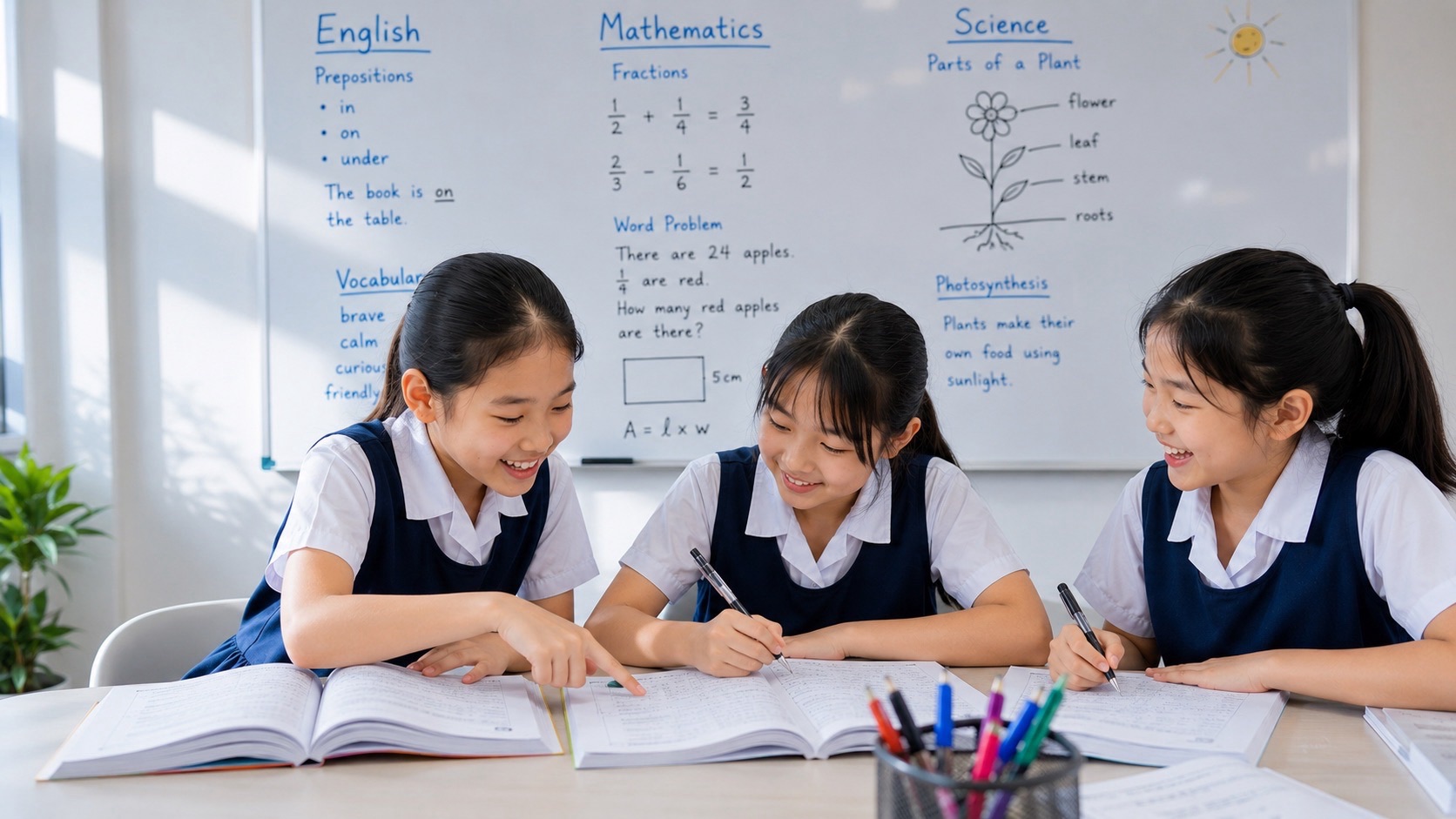
Primary 2 Mathematics Tuition | Mei Chin is a local route for families in and around Mei Chin who want MOE-aligned support as early arithmetic develops into a more connected mathematical system. Primary 2 Mathematics tuition should strengthen place value, addition and subtraction, multiplication and division, arithmetic fluency, early bar-model reasoning, fractions, measurement, graphs, two-step word problems, accuracy, conceptual understanding and confident independent problem solving. The important question is not how many worksheets a child can finish. It is whether the learner can see the relationship in a problem, choose a useful representation, calculate reliably and explain why the method fits.
Current Singapore search language around Primary 2 Mathematics repeatedly emphasises multiplication and division, bar models, word-problem planning, fluency and the transition toward the more demanding Primary 3 year. Those terms are useful because they describe real pressure points, but they become meaningful only when the teaching mechanism is clear. A child can recite multiplication tables without retrieving facts flexibly. A learner can draw a bar without using it to reason. Another can perform column subtraction on a chapter worksheet but fail to recognise the same operation inside a story. For Mei Chin families, effective tuition should diagnose these differences rather than treating every low mark as a need for more practice.
The programme is anchored to the current MOE Primary Mathematics syllabus and to the broader Singapore Mathematics framework in which problem solving is supported by concepts, skills, processes, metacognition and attitudes. Primary 2 is a building year: numbers become larger, multiplication and division relationships become more explicit, tables begin to matter, early bar models become useful, fractions become more structured and two-step problems ask the child to plan rather than react. The aim is to build enough fluency that routine calculations stop consuming all available attention, while preserving the conceptual understanding needed to handle unfamiliar wording.
Quick route for Mei Chin families
- Use the Mathematics Learning Hub for the full Primary, PSLE, Secondary, Additional Mathematics and JC route.
- Use the official MOE Primary Mathematics syllabus as the curriculum source.
- See Primary 1 Mathematics Tuition | Mei Chin for the earlier number-sense foundation.
- Continue to Primary 3 Mathematics Tuition | Mei Chin for the next step into larger numbers, table automaticity, fractions, heuristics and formal assessment habits.
MOE alignment at Primary 2
MOE alignment means that content, progression and problem-solving intent come from the national curriculum, while the route through the material responds to the learner’s evidence. If a child is studying multiplication but cannot reliably partition hundreds, tens and ones, a short place-value repair may be necessary. If the child understands equal groups but cannot retrieve key multiplication facts, the next priority may be fluency rather than another conceptual lecture. Alignment is therefore not rigid pacing. It is keeping the curricular destination fixed while repairing the prerequisite that currently prevents the learner from reaching it.
We also distinguish understanding from performance. A student may know what multiplication means but be too slow to use facts inside a two-step problem. Another may calculate quickly yet choose the wrong operation because the story structure is unclear. A third may understand both but lose marks through units, copying or unfinished statements. These learners need different interventions. Diagnostic teaching prevents the tuition lesson from becoming a generic second school lesson that repeats content without explaining why the first attempt failed.
Place value extends beyond the first hundred
Primary 2 extends whole-number understanding into larger values. The challenge is not merely reading more digits. The child has to preserve the base-ten structure: hundreds, tens and ones relate through groups of ten, zero can hold a place, and regrouping changes representation without changing value. A learner may read 305 correctly yet compare it with 350 from the wrong side, omit the zero in working or perform a written algorithm without understanding why one hundred can be exchanged for ten tens.
We move between base-ten models, expanded notation, number lines and written methods. Students explain why regrouping preserves value. They compare numbers using the highest place first and estimate the likely size of an answer before calculating. This place-value control supports addition, subtraction, money, measurement and the transition to Primary 3 numbers up to the thousands. Weak place value is one of the reasons a child can appear to “forget” arithmetic procedures when the numbers get larger: the written method was memorised without a stable numerical structure underneath.
Addition and subtraction with larger numbers
P2 arithmetic requires more reliable written and mental methods. Students need to choose when mental calculation is efficient, when a written algorithm is safer and how to estimate before accepting an answer. A child may align digits incorrectly, forget a regrouping step or use a lengthy written method even when a simple mental adjustment would be faster. The opposite problem also occurs: attempting a difficult calculation mentally and losing track of intermediate values.
We teach both execution and method choice. Inverse operations are used for checking, estimation is used to test plausibility and place-value language remains visible whenever an algorithm begins to look mechanical. The goal is not one perfect method for every question. It is controlled calculation: the learner can select a sensible method, carry it out accurately and know enough about the expected result to detect an obvious error.
Multiplication as equal groups, arrays and scaling
Primary 2 is a major multiplication year. Tables matter, but multiplication should first be understood as a relationship. Equal groups, arrays and repeated addition help the child see what a multiplication statement represents. A learner can know that 4 × 5 = 20 yet be unable to show four groups of five, five groups of four or explain how the two arrangements are related. That gap matters because later division and word problems depend on meaning, not only on a remembered product.
We connect arrays, groups, skip counting, commutativity and equations. Table practice is spaced and cumulative rather than one memorisation sprint. Facts are eventually asked out of order and placed inside problems so retrieval becomes flexible. The child learns both why a product has its value and how to recall it efficiently. Concept without retrieval becomes slow; retrieval without concept becomes brittle. Primary 2 needs both.
Division as sharing and grouping
Division has two useful early meanings. Sharing asks how many items each group receives when a total is distributed equally among a known number of groups. Grouping asks how many groups of a known size can be made from the total. Children often understand one interpretation and become confused by the other. This matters because the quotient counts something different in each situation.
We build both meanings with counters, arrays, diagrams and equations, then link every division fact to multiplication. The learner states what the answer represents: items per group or number of groups. That verbal step looks simple, but it prevents division from becoming an unexplained keypress or a keyword reaction. The same conceptual foundation later supports fractions, ratio, rate and algebraic thinking.
Multiplication tables with meaning and retrieval
P2 is where table knowledge begins to become an important working-memory tool. Slow retrieval is not a moral problem and should not be treated as laziness. It is a cognitive cost. If a child has to rebuild 4 × 6 by counting from zero each time, a multi-step word problem becomes much harder because the calculation interrupts the plan. At the same time, forcing rapid memorisation before the equal-group meaning is understood can produce facts that disappear or fail to transfer.
We therefore move from meaning to retrieval. Arrays and groups establish the relationship. Known facts are used to derive nearby facts. Mixed oral and written recall then makes the facts accessible out of sequence. Division is interleaved so the learner sees fact families rather than isolated products. By Primary 3, more of these facts should be available without long pauses, freeing attention for multi-step reasoning, larger calculations and fractions.
Bar models: part-whole and comparison
Primary 2 is a good time for bar models to become a regular mathematical language. Part-whole models show how parts combine. Comparison models show how two quantities differ. The value of the model is not the drawing itself; it is that the relationship becomes visible before the operation is selected. A common failure is drawing equal bars when the quantities are unequal, placing the unknown in the wrong part or drawing a model only after the calculation because the child thinks the picture is a required decoration.
We ask students to label first and then decide what each bar represents. The model must answer three questions: what is known, what is unknown and how are the quantities related? If the model does not clarify those questions, it should be changed. Early model fluency reduces keyword dependence and makes Primary 3 multi-step word problems easier because the learner already has a visual language for part-whole and comparison structures.
Two-step word problems require a plan
Primary 2 begins to demand more planning because one result may become an input to the next step. The child must keep a final goal in mind rather than calculate the first operation that appears possible. A learner may solve the first sentence and stop, combine all numbers in one operation or perform two individually correct calculations that do not answer the question. The arithmetic can be fine while the plan is wrong.
We teach a simple planning routine: identify the final target, work backwards to what must be known first, represent the relationship, then calculate in a deliberate order. Intermediate results are labelled. The learner should be able to say why the first calculation is necessary before performing it. This habit is central to Primary 3 and beyond, where multi-step questions become normal rather than occasional.
Fractions as equal parts of a whole
Early fraction work requires a strong idea of equal partitioning. A fraction is not merely two numbers separated by a line. The denominator tells how many equal parts make the whole; the numerator tells how many of those parts are being considered. Children may count pieces without checking whether they are equal or think a larger denominator automatically means a larger fraction. These are understandable whole-number intuitions applied in the wrong domain.
We use folding, fraction strips, shapes and sets. Students identify the whole explicitly and compare representations of halves, thirds and quarters. Counterexamples are useful: if four pieces are unequal, one piece is not automatically one quarter of the original whole. A secure visual foundation makes later equivalent fractions and fraction operations easier because the symbols already refer to a clear relationship.
Money, mass, length and time
Measurement topics require students to connect arithmetic to quantities. The learner must read units, interpret scales, compare values and decide which operation fits the situation. Errors often come from ignoring units, treating every measurement problem as a routine sum or misunderstanding the scale on a ruler or clock. The numerical operation can be correct while the quantity reasoning is wrong.
We teach estimation, unit checking and diagram reading as part of calculation. Students state what a number measures before manipulating it. In money work, they compare equivalent amounts rather than raw digits. In time, they connect clock representation to duration and sequence. The discipline of quantity-plus-unit prepares learners for more complex measurement, area, volume, speed and Science calculations later.
Graphs and data interpretation
Data questions teach children to extract information from a representation rather than from a sentence alone. A learner must read titles, labels, scales and categories accurately before calculating. Some students look at the tallest bar or largest symbol and answer from appearance, missing the exact scale or question. Others copy a value incorrectly and then perform flawless arithmetic on the wrong data.
We use a three-pass routine: read the title and labels, extract only the values needed, then perform the requested comparison or calculation. The final answer is checked back against the graph. This develops graph literacy and trains the careful reading habits that become increasingly important across Mathematics and Science.
Alicia, Tricia and Kai Kai: the same score can hide different needs
Alicia often understands after explanation but hesitates when the story wording changes. Her repair emphasises representation and transfer. She compares problems with different surfaces but the same relationship, then explains why the same model works. The objective is not to memorise more phrases. It is to recognise mathematical structure beneath language.
Tricia is quick and often correct, but speed sometimes outruns checking. Her repair emphasises digit alignment, copied values, units, labels and final question targets. She learns that a two-second check at a known risk point can save more time than redoing an entire solution after an avoidable error.
Kai Kai is careful but slow because table facts and arithmetic still require too much reconstruction. His plan may be correct, yet he loses it while calculating. His repair therefore combines fact retrieval with visible intermediate steps. As routine knowledge becomes more automatic, more attention is available for the actual problem.
Worked diagnostic pattern: tables are recited but not retrieved
Alicia can chant the 5-times table from start to finish, yet pauses when asked 5 × 7 out of sequence. In division she often returns to repeated subtraction. The sequence has been memorised as a song rather than as a flexible set of facts. We mix multiplication facts, reverse their order, pair them with division and use arrays to preserve meaning. Retrieval becomes short and frequent rather than one long recitation.
Worked diagnostic pattern: regrouping works only in one format
Tricia completes a standard column-subtraction page but fails when the same numbers appear in a word problem or when zero occurs in a place-value position. Her procedure is context-bound. We return to expanded form and base-ten language, then solve the same subtraction in several representations. The algorithm stays, but the steps are reconnected to value so the method survives changes in layout.
Worked diagnostic pattern: division is always sharing
Kai Kai understands twelve objects shared among three children but finds “How many groups of three can be made from twelve?” strangely different. He knows the sharing interpretation but not grouping. We present matched story pairs and ask what the quotient counts in each case. The same equation appears, but the meaning of the answer is stated explicitly. This prevents later confusion in rate, measurement and fraction contexts.
Worked diagnostic pattern: two-step questions become one operation
Alicia reads a two-step problem, circles two numbers and immediately adds them. She rarely pauses to identify the final target. The main gap is planning, not arithmetic. We ask her to state what must be found at the end and what information is still missing. The first calculation is chosen only after the route is visible. Over time she learns that a problem can require an intermediate quantity that is not itself the final answer.
Worked diagnostic pattern: bar models are copied from examples
Tricia draws the same part-whole bar for comparison questions because that is the diagram she remembers. She has memorised a shape rather than learned to read the relationship. We compare part-whole and comparison stories side by side. She must label the entities before drawing the bars. This forces the model to emerge from meaning rather than from memory of the previous page.
Worked diagnostic pattern: fractions are counted but not understood
Kai Kai sees a shape divided into four unequal pieces and calls one shaded piece one-quarter because there are four pieces. He is counting regions but ignoring the equal-part condition. We use counterexamples deliberately. He sorts diagrams into valid and invalid halves, thirds and quarters and explains why. Only then do we compress the visual idea into fraction notation.
Accuracy is a teachable system
Accuracy improves when checking is attached to specific risk points. We teach students to check copied numbers, place alignment, operation signs, units, bar labels and the final question target. “Be careful” is too vague. A learner with digit-alignment errors needs a different checklist from one who repeatedly answers the intermediate step instead of the final question. Over time the visible checklist becomes an internal habit.
Conceptual understanding and procedural fluency belong together
A child who understands multiplication but cannot retrieve common facts will struggle when multiplication appears several times in a long problem. A child who knows the facts but does not understand equal groups will struggle when the context changes. We teach both sides deliberately. Concrete and visual models establish meaning; retrieval and written methods increase efficiency; mixed problems require the learner to select and transfer. The goal is not to choose between understanding and fluency. It is to make each support the other.
Why we sometimes revisit Primary 1 foundations
Repairing an earlier foundation is not moving backwards in a negative sense. If place value, number bonds or addition facts remain unstable, multiplication, division and two-step problems carry unnecessary cognitive load. A brief targeted return to the missing prerequisite can produce faster progress than repeatedly practising the current topic on top of a weak base. The return should be narrow and purposeful, and the student should be brought back to Primary 2 work quickly so the repair has an immediate application.
Oral explanation reveals whether the relationship is available
Short oral explanations show whether a child can connect a calculation to meaning. We might ask why 24 ÷ 6 gives the number of groups in one story but the number in each group in another, or why one comparison bar must be longer. The answer does not need polished language. We listen for the mathematical relationship. Oral explanation is especially useful when written work is accurate but transfer is weak, because it reveals whether a procedure has become a rule without a model underneath.
Retrieval practice should be short and targeted
Retrieval practice in Primary 2 makes important facts available without rebuilding them from scratch. Multiplication and division facts, number bonds, mental calculation and familiar unit relationships can all benefit. We keep retrieval brief enough that it does not replace conceptual teaching. Weak fact families are revisited after a delay and mixed with secure facts. This creates flexible recall rather than a performance that works only when the table is recited from the beginning.
Spacing and interleaving create durable learning
A method that works immediately after teaching may still disappear a week later. Spacing allows forgetting to reveal what has not yet become durable. Interleaving adds a different challenge: the learner must decide which method applies. We use blocked practice first when a new skill needs repetition, then mix multiplication, division, addition, subtraction, measurement and word problems. The child no longer receives the method from the page heading. Selection becomes part of the learning.
Worked examples should fade into independent work
Worked examples are valuable when a new idea places too many demands on working memory. The danger is permanent dependence. We therefore fade support. A modelled two-step problem may be followed by one with a partly completed bar, then one where the child must decide whether a bar is useful at all. The teacher’s explanation is progressively removed. The learner should eventually recognise the structure, choose the representation and complete the solution without being told what comes next.
Correction must end with a new successful attempt
Reading a correction is not the same as repairing an error. After explanation, the child completes a fresh question that requires the corrected idea. Sometimes we delay the retry so that immediate memory cannot carry the answer. If the same error returns, the repair needs another cycle. This approach also changes the emotional meaning of mistakes: an error becomes a source of information followed by a successful reconstruction, not simply a red mark.
School assessments should produce a next-action list
A school assessment is more useful when every lost mark is translated into a teaching category. Was the concept unknown? Was the operation selected incorrectly? Was the arithmetic slow or inaccurate? Was the unit omitted? Did the child answer the intermediate result instead of the target? The review ends with a small next-action list such as “make 6-times facts faster,” “label comparison bars before calculating” or “check the final question after two-step work.” The score shows the outcome; the action list shows what to teach.
Confidence should follow competence
Mathematics confidence becomes durable when it is built from successful independent action. We create tasks that are challenging enough to require thought but not so difficult that the child only waits for rescue. The learner experiences a progression from guided explanation to partially supported practice to independent transfer. A child who once froze at a two-step problem but can now identify the target, draw a sensible model and begin has gained a form of confidence that can survive the next unfamiliar question.
What parents can notice during homework
Notice whether multiplication facts are retrieved, reconstructed from skip counting or counted physically. All can produce a correct answer, but they place different demands on attention. When the child draws a bar model, ask what each bar represents. If the learner cannot answer, the drawing may be decorative. In a two-step problem, ask why the first calculation is needed. If the child can state the final target and explain how the intermediate result helps reach it, planning is developing.
Units are another useful observation point. A correct number without a unit can reveal weak quantity awareness. Encourage the child to say the unit aloud before the final statement. Also watch what happens after a correction. A fresh question after a delay is more informative than immediately repeating the same calculation while the teacher’s explanation is still active in memory.
Choosing the right level of difficulty
Practice should sit in a useful zone: secure enough that the learner can apply known ideas, demanding enough that attention and reasoning are required. If every question is routine, fluency may improve while transfer remains weak. If every question is far beyond current understanding, the student spends the lesson guessing. We adjust difficulty by changing number size, number of steps, amount of language, type of representation and degree of independence. Challenge is therefore a teaching variable, not a badge of prestige.
How a typical Primary 2 lesson can run
A lesson normally begins with a short retrieval or diagnostic check. The teacher then addresses the main concept using an example that makes the relationship visible. Guided practice follows with explanation questions, not only answer checks. Independent work includes at least one transfer problem where the wording or representation changes. The lesson closes with error classification and a small amount of next-step practice. One learner may need more table retrieval, another more model drawing, and another more control over units and two-step planning.
A four-stage repair cycle
- See it: identify the specific failure from actual school or tuition work.
- Explain it: rebuild the relationship using language, objects, diagrams or symbols.
- Practise it: use enough focused repetition to make the corrected method reliable.
- Transfer it: mix the repaired skill into a different-looking problem so the learner must recognise when to use it.
Frequently asked questions
Does every Primary 2 child in Mei Chin need tuition?
No. Tuition should have a reason. A secure child who works independently may need little additional teaching. A learner with recurring table, place-value, two-step, model-drawing or accuracy gaps may benefit from targeted support.
Should multiplication tables be memorised?
They should become increasingly retrievable, but recall should sit on top of meaning. Equal groups, arrays and inverse division relationships help facts remain usable rather than becoming a disconnected chant.
Does every word problem need a bar model?
No. The model is a tool. It is useful when it clarifies a part-whole, comparison or multi-step relationship. Routine questions may be solved more efficiently without one. The student should learn when the representation earns its place.
How do you repair a child who is slow?
We first identify what is slow. It may be fact retrieval, written calculation, reading, planning or uncertainty about method selection. Each cause requires a different repair. Timing a child without diagnosing the bottleneck can make the learner faster at guessing rather than faster at Mathematics.
How should school assessment papers be used?
They are diagnostic evidence. We classify lost marks, identify recurring mechanisms and turn them into a short teaching plan. A total score alone cannot tell us what to reteach.
What if a strong student is already ahead?
Extension should deepen reasoning, transfer and non-routine problem solving, not only move the child into the next textbook. Strong foundations allow richer comparisons, multiple methods and explanation of why a strategy works.
Why use Alicia, Tricia and Kai Kai?
They are resident fictional learners who show that similar marks can arise from different mechanisms. Their cases make diagnosis visible without exposing any real student’s private school work.
Sibling Mathematics routes for Mei Chin
- Primary 1 Mathematics Tuition | Mei Chin
- Primary 2 Mathematics Tuition | Mei Chin
- Primary 3 Mathematics Tuition | Mei Chin
- SEC Examination Mathematics Tuition | Mei Chin
Official reference and final teaching principle
The official MOE Primary Mathematics syllabus is the curriculum source. The purpose of this Mei Chin page is to make a Primary 2 route visible: diagnose the actual constraint, teach multiplication and division as relationships, make useful facts retrievable, use bar models when they clarify structure, build two-step planning, protect units and accuracy, and test transfer under mixed conditions. That is how Primary 2 becomes a stable bridge into the more demanding reasoning of Primary 3 rather than a year of disconnected worksheets.