
Primary 2 Mathematics tuition for families searching around Whampoa should strengthen the bridge between early number understanding and the more structured Mathematics that follows. Strong P2 Math tuition in Singapore develops place value to 1,000, addition and subtraction with renaming, multiplication and division meaning, arithmetic fluency, bar-model reasoning, word problems, simple fractions, measurement, accuracy and diagnostic gap repair. The aim is not to rush into upper-primary content; it is to make the P2 system reliable enough that the Primary 3 step-up does not expose avoidable gaps.
Current Singapore Primary 2 Math tuition pages repeatedly emphasise multiplication and division, times-table fluency, bar models, word problems, numbers to 1,000, small-group support and preparation for P3. Those search terms reflect a real transition: P2 is where many children can no longer rely on counting alone. Equal groups, inverse operations, renaming, simple fractions and two-step word problems require a more organised mathematical language.
This Whampoa article is a local discovery route, not a claim of a physical eduKateSG branch at Whampoa. The Primary 2 Mathematics Tuition owner and the Mathematics Learning Hub remain the broad curriculum routes. Existing Whampoa P4–PSLE Mathematics owners keep their stage-specific scope; this page fills only the missing P2 local intent.
Primary 2 Mathematics Tuition | Whampoa: MOE alignment
MOE’s Primary Mathematics framework places problem solving at the centre and connects concepts, skills, processes, metacognition and attitudes. That supports a P2 principle: conceptual understanding and procedural fluency should reinforce one another. Parents can consult the MOE Primary Mathematics syllabus for the current national framework.
The Whampoa label changes discovery, not curriculum. Exact topic order should still follow the learner’s school programme and current school evidence.
Numbers to 1,000
Numbers to 1,000 matters because the mechanism is coordinating hundreds, tens and ones as place-value units. Primary 2 is the stage where lower-primary familiarity must become a more organised Mathematics system. A child who succeeds only when the chapter cue is visible has not yet secured the relationship for independent use.
A diagnostic sign is when the learner reads a three-digit number but cannot explain its size or compare nearby values. Instead of increasing worksheet volume, the tutor can build 642 in hundreds, tens and ones and compare it with 624. The first place where performance changes reveals whether the issue is conceptual, linguistic, representational, retrieval-based or procedural.
Consolidate through place-value charts, expanded notation and number lines. Move from supported understanding to changed examples and delayed mixed retrieval. The learner should be able to solve without the original cue and explain what stayed mathematically the same.
The wider result is that larger-number reasoning becomes stable. For Whampoa families, progress is visible when the child needs fewer prompts and can retrieve, represent, calculate and check under ordinary school conditions.
Addition with renaming
At P2, Addition with renaming should be taught as a decision process. Its engine is understanding regrouping as exchanging ten ones for one ten or ten tens for one hundred. When meaning and method remain linked, the child can reconstruct a procedure rather than depending on exact memory of a worked example.
Investigate the learner who carries a digit mechanically and misplaces its value. A focused probe is to model 268+157 with place-value structure before compact working. Change only one feature at a time and observe what changes performance. This keeps remediation smaller and more accurate.
Use concrete-pictorial-symbolic comparison and aligned notation for repair. Follow immediate success with a fresh independent version and later place the same mechanism among unrelated topics. Assessment papers do not announce the strategy, so method selection must be practised as well as execution.
Over time, the standard algorithm becomes reconstructable. This reduces the need for frantic reteaching before assessments because more of the year’s Mathematics remains accessible.
Subtraction with renaming
A strong P2 programme connects Subtraction with renaming to understanding, fluency and application. The mechanism is preserving total value while exchanging units. The tutor makes the sequence visible: interpret, represent, choose, execute and check.
When the child borrows mechanically and loses track of which place changed, do not label the whole problem as weak Mathematics. Instead, represent 432-178 using place-value renaming before standard notation. The explanation and time-to-start often reveal more than the final mark.
Practice with expanded subtraction, inverse checks and changed-number practice. Vary numbers, context and presentation while preserving the underlying relationship. Later remove the topic heading and ask the learner to identify the structure independently.
This produces regrouping errors reduce. The local Whampoa route therefore values stable transfer over quick success on one familiar worksheet.
Mental addition
Mental addition matters because the mechanism is choosing efficient decompositions. Primary 2 is the stage where lower-primary familiarity must become a more organised Mathematics system. A child who succeeds only when the chapter cue is visible has not yet secured the relationship for independent use.
A diagnostic sign is when the learner writes every small sum vertically or counts inefficiently. Instead of increasing worksheet volume, the tutor can compare 36+9 as 36+10-1 with direct counting. The first place where performance changes reveals whether the issue is conceptual, linguistic, representational, retrieval-based or procedural.
Consolidate through bridging tens, compensation and partitioning. Move from supported understanding to changed examples and delayed mixed retrieval. The learner should be able to solve without the original cue and explain what stayed mathematically the same.
The wider result is that working memory remains available for word problems. For Whampoa families, progress is visible when the child needs fewer prompts and can retrieve, represent, calculate and check under ordinary school conditions.
Mental subtraction
At P2, Mental subtraction should be taught as a decision process. Its engine is using difference and compensation flexibly. When meaning and method remain linked, the child can reconstruct a procedure rather than depending on exact memory of a worked example.
Investigate the learner who counts backwards one by one. A focused probe is to solve 52-9 as 52-10+1 and compare with counting up. Change only one feature at a time and observe what changes performance. This keeps remediation smaller and more accurate.
Use number lines, compensation and inverse reasoning for repair. Follow immediate success with a fresh independent version and later place the same mechanism among unrelated topics. Assessment papers do not announce the strategy, so method selection must be practised as well as execution.
Over time, calculation becomes more flexible. This reduces the need for frantic reteaching before assessments because more of the year’s Mathematics remains accessible.
Multiplication as equal groups
A strong P2 programme connects Multiplication as equal groups to understanding, fluency and application. The mechanism is seeing multiplication as structured repeated quantity. The tutor makes the sequence visible: interpret, represent, choose, execute and check.
When the child recites a table but cannot build groups or interpret a story, do not label the whole problem as weak Mathematics. Instead, show four groups of three, then connect repeated addition to 4×3. The explanation and time-to-start often reveal more than the final mark.
Practice with arrays, equal groups and skip counting. Vary numbers, context and presentation while preserving the underlying relationship. Later remove the topic heading and ask the learner to identify the structure independently.
This produces times-table knowledge rests on meaning. The local Whampoa route therefore values stable transfer over quick success on one familiar worksheet.
Division as sharing and grouping
Division as sharing and grouping matters because the mechanism is understanding both common meanings of division. Primary 2 is the stage where lower-primary familiarity must become a more organised Mathematics system. A child who succeeds only when the chapter cue is visible has not yet secured the relationship for independent use.
A diagnostic sign is when the learner uses one routine without knowing what the quotient describes. Instead of increasing worksheet volume, the tutor can use 12 objects as three equal groups and as groups of three. The first place where performance changes reveals whether the issue is conceptual, linguistic, representational, retrieval-based or procedural.
Consolidate through sharing, grouping and inverse multiplication. Move from supported understanding to changed examples and delayed mixed retrieval. The learner should be able to solve without the original cue and explain what stayed mathematically the same.
The wider result is that division stories are easier to interpret. For Whampoa families, progress is visible when the child needs fewer prompts and can retrieve, represent, calculate and check under ordinary school conditions.
Multiplication and division facts
At P2, Multiplication and division facts should be taught as a decision process. Its engine is linking facts into inverse families. When meaning and method remain linked, the child can reconstruct a procedure rather than depending on exact memory of a worked example.
Investigate the learner who knows 4×5 but cannot use it for 20÷4. A focused probe is to derive four related equations from one array. Change only one feature at a time and observe what changes performance. This keeps remediation smaller and more accurate.
Use fact families, arrays and missing factors for repair. Follow immediate success with a fresh independent version and later place the same mechanism among unrelated topics. Assessment papers do not announce the strategy, so method selection must be practised as well as execution.
Over time, retrieval and checking reinforce one another. This reduces the need for frantic reteaching before assessments because more of the year’s Mathematics remains accessible.
Times-table fluency
A strong P2 programme connects Times-table fluency to understanding, fluency and application. The mechanism is making core multiplication facts available in random order. The tutor makes the sequence visible: interpret, represent, choose, execute and check.
When the child chants tables in sequence but stalls in mixed questions, do not label the whole problem as weak Mathematics. Instead, ask random facts followed by one related inverse. The explanation and time-to-start often reveal more than the final mark.
Practice with spaced retrieval, known-fact derivation and mixed application. Vary numbers, context and presentation while preserving the underlying relationship. Later remove the topic heading and ask the learner to identify the structure independently.
This produces facts become useful tools rather than recitations. The local Whampoa route therefore values stable transfer over quick success on one familiar worksheet.
Fractions as equal parts
Fractions as equal parts matters because the mechanism is understanding halves and quarters through equal partitioning. Primary 2 is the stage where lower-primary familiarity must become a more organised Mathematics system. A child who succeeds only when the chapter cue is visible has not yet secured the relationship for independent use.
A diagnostic sign is when the learner calls any shaded piece a fraction without checking equality. Instead of increasing worksheet volume, the tutor can compare equal and unequal partitions of the same whole. The first place where performance changes reveals whether the issue is conceptual, linguistic, representational, retrieval-based or procedural.
Consolidate through folding, partitioning and shading. Move from supported understanding to changed examples and delayed mixed retrieval. The learner should be able to solve without the original cue and explain what stayed mathematically the same.
The wider result is that fraction notation gains meaning. For Whampoa families, progress is visible when the child needs fewer prompts and can retrieve, represent, calculate and check under ordinary school conditions.
Equality and missing values
At P2, Equality and missing values should be taught as a decision process. Its engine is treating equations as balanced relationships. When meaning and method remain linked, the child can reconstruct a procedure rather than depending on exact memory of a worked example.
Investigate the learner who expects the blank only on the right. A focused probe is to solve 17=□+9 and compare 8+6 with 9+5. Change only one feature at a time and observe what changes performance. This keeps remediation smaller and more accurate.
Use true-false equations and missing boxes for repair. Follow immediate success with a fresh independent version and later place the same mechanism among unrelated topics. Assessment papers do not announce the strategy, so method selection must be practised as well as execution.
Over time, early algebraic control grows. This reduces the need for frantic reteaching before assessments because more of the year’s Mathematics remains accessible.
Bar models for part-whole
A strong P2 programme connects Bar models for part-whole to understanding, fluency and application. The mechanism is showing whole and parts before choosing an operation. The tutor makes the sequence visible: interpret, represent, choose, execute and check.
When the child draws a bar after calculating instead of using it to understand the problem, do not label the whole problem as weak Mathematics. Instead, represent a total of 27 with one known part 12. The explanation and time-to-start often reveal more than the final mark.
Practice with labelled bars and equation links. Vary numbers, context and presentation while preserving the underlying relationship. Later remove the topic heading and ask the learner to identify the structure independently.
This produces word-problem structure becomes visible. The local Whampoa route therefore values stable transfer over quick success on one familiar worksheet.
Bar models for comparison
Bar models for comparison matters because the mechanism is aligning quantities to expose a difference relationship. Primary 2 is the stage where lower-primary familiarity must become a more organised Mathematics system. A child who succeeds only when the chapter cue is visible has not yet secured the relationship for independent use.
A diagnostic sign is when the learner confuses which amount is larger. Instead of increasing worksheet volume, the tutor can draw aligned bars for 24 and 17 before calculating. The first place where performance changes reveals whether the issue is conceptual, linguistic, representational, retrieval-based or procedural.
Consolidate through comparison models, paraphrase and inverse checks. Move from supported understanding to changed examples and delayed mixed retrieval. The learner should be able to solve without the original cue and explain what stayed mathematically the same.
The wider result is that comparison language becomes easier to translate. For Whampoa families, progress is visible when the child needs fewer prompts and can retrieve, represent, calculate and check under ordinary school conditions.
Two-step word problems
At P2, Two-step word problems should be taught as a decision process. Its engine is preserving the meaning of an intermediate result. When meaning and method remain linked, the child can reconstruct a procedure rather than depending on exact memory of a worked example.
Investigate the learner who completes the first operation but answers with the intermediate number. A focused probe is to ask what the first answer represents and why the second step is needed. Change only one feature at a time and observe what changes performance. This keeps remediation smaller and more accurate.
Use annotated steps and dependency chains for repair. Follow immediate success with a fresh independent version and later place the same mechanism among unrelated topics. Assessment papers do not announce the strategy, so method selection must be practised as well as execution.
Over time, multi-step thinking becomes deliberate. This reduces the need for frantic reteaching before assessments because more of the year’s Mathematics remains accessible.
Word-problem decoding
A strong P2 programme connects Word-problem decoding to understanding, fluency and application. The mechanism is identifying knowns, unknowns and relationships instead of keyword matching. The tutor makes the sequence visible: interpret, represent, choose, execute and check.
When the child sees ‘more’ and always adds, do not label the whole problem as weak Mathematics. Instead, cover the numbers, retell the story and identify the relationship. The explanation and time-to-start often reveal more than the final mark.
Practice with given-asked-relationship notes and changed contexts. Vary numbers, context and presentation while preserving the underlying relationship. Later remove the topic heading and ask the learner to identify the structure independently.
This produces operation choice becomes less fragile. The local Whampoa route therefore values stable transfer over quick success on one familiar worksheet.
Mathematical language
Mathematical language matters because the mechanism is using grouping, comparison, value and measurement language precisely. Primary 2 is the stage where lower-primary familiarity must become a more organised Mathematics system. A child who succeeds only when the chapter cue is visible has not yet secured the relationship for independent use.
A diagnostic sign is when the learner needs the tutor to translate school wording. Instead of increasing worksheet volume, the tutor can contrast three groups of four with four groups of three. The first place where performance changes reveals whether the issue is conceptual, linguistic, representational, retrieval-based or procedural.
Consolidate through oral restatement and diagram matching. Move from supported understanding to changed examples and delayed mixed retrieval. The learner should be able to solve without the original cue and explain what stayed mathematically the same.
The wider result is that independent reading improves. For Whampoa families, progress is visible when the child needs fewer prompts and can retrieve, represent, calculate and check under ordinary school conditions.
Length, mass and volume
At P2, Length, mass and volume should be taught as a decision process. Its engine is connecting measured numbers to the correct attribute and unit. When meaning and method remain linked, the child can reconstruct a procedure rather than depending on exact memory of a worked example.
Investigate the learner who computes with a number but forgets what it measures. A focused probe is to estimate and compare real quantities before attaching a unit. Change only one feature at a time and observe what changes performance. This keeps remediation smaller and more accurate.
Use measurement activities, estimation and unit labels for repair. Follow immediate success with a fresh independent version and later place the same mechanism among unrelated topics. Assessment papers do not announce the strategy, so method selection must be practised as well as execution.
Over time, unit errors reduce. This reduces the need for frantic reteaching before assessments because more of the year’s Mathematics remains accessible.
Time to the minute
A strong P2 programme connects Time to the minute to understanding, fluency and application. The mechanism is coordinating clock reading with intervals. The tutor makes the sequence visible: interpret, represent, choose, execute and check.
When the child reads a time but cannot reason between two times, do not label the whole problem as weak Mathematics. Instead, place start and end times on a timeline. The explanation and time-to-start often reveal more than the final mark.
Practice with clock faces, timelines and schedule questions. Vary numbers, context and presentation while preserving the underlying relationship. Later remove the topic heading and ask the learner to identify the structure independently.
This produces duration reasoning gains structure. The local Whampoa route therefore values stable transfer over quick success on one familiar worksheet.
Money and change
Money and change matters because the mechanism is using addition and subtraction in transactions. Primary 2 is the stage where lower-primary familiarity must become a more organised Mathematics system. A child who succeeds only when the chapter cue is visible has not yet secured the relationship for independent use.
A diagnostic sign is when the learner aligns money amounts poorly or treats change as unrelated. Instead of increasing worksheet volume, the tutor can estimate a purchase total and treat change as a missing part. The first place where performance changes reveals whether the issue is conceptual, linguistic, representational, retrieval-based or procedural.
Consolidate through coin-note combinations and inverse checks. Move from supported understanding to changed examples and delayed mixed retrieval. The learner should be able to solve without the original cue and explain what stayed mathematically the same.
The wider result is that place value becomes practical. For Whampoa families, progress is visible when the child needs fewer prompts and can retrieve, represent, calculate and check under ordinary school conditions.
Shapes and spatial relationships
At P2, Shapes and spatial relationships should be taught as a decision process. Its engine is recognising properties and compositions. When meaning and method remain linked, the child can reconstruct a procedure rather than depending on exact memory of a worked example.
Investigate the learner who relies on prototype orientations. A focused probe is to rotate and sort shapes before composing larger figures. Change only one feature at a time and observe what changes performance. This keeps remediation smaller and more accurate.
Use sorting, composing and property language for repair. Follow immediate success with a fresh independent version and later place the same mechanism among unrelated topics. Assessment papers do not announce the strategy, so method selection must be practised as well as execution.
Over time, visual reasoning strengthens. This reduces the need for frantic reteaching before assessments because more of the year’s Mathematics remains accessible.
Simple data reading
A strong P2 programme connects Simple data reading to understanding, fluency and application. The mechanism is using labels, scales and category counts carefully. The tutor makes the sequence visible: interpret, represent, choose, execute and check.
When the child chooses an answer by visual impression, do not label the whole problem as weak Mathematics. Instead, ask total, difference and comparison questions from one display. The explanation and time-to-start often reveal more than the final mark.
Practice with picture graphs and verbal summaries. Vary numbers, context and presentation while preserving the underlying relationship. Later remove the topic heading and ask the learner to identify the structure independently.
This produces data reading becomes evidence-based. The local Whampoa route therefore values stable transfer over quick success on one familiar worksheet.
Accuracy routines
Accuracy routines matters because the mechanism is protecting sound reasoning from copying and renaming errors. Primary 2 is the stage where lower-primary familiarity must become a more organised Mathematics system. A child who succeeds only when the chapter cue is visible has not yet secured the relationship for independent use.
A diagnostic sign is when the learner loses marks despite a correct plan. Instead of increasing worksheet volume, the tutor can estimate first and use an inverse or unit check afterwards. The first place where performance changes reveals whether the issue is conceptual, linguistic, representational, retrieval-based or procedural.
Consolidate through clean layout, rereading and targeted checks. Move from supported understanding to changed examples and delayed mixed retrieval. The learner should be able to solve without the original cue and explain what stayed mathematically the same.
The wider result is that school marks better reflect understanding. For Whampoa families, progress is visible when the child needs fewer prompts and can retrieve, represent, calculate and check under ordinary school conditions.
Concept versus procedure diagnosis
At P2, Concept versus procedure diagnosis should be taught as a decision process. Its engine is separating weak meaning from unstable execution. When meaning and method remain linked, the child can reconstruct a procedure rather than depending on exact memory of a worked example.
Investigate the learner who can perform an algorithm but cannot explain it. A focused probe is to ask for the same relationship with objects, a drawing and symbols. Change only one feature at a time and observe what changes performance. This keeps remediation smaller and more accurate.
Use one-variable-at-a-time probes and fresh transfer for repair. Follow immediate success with a fresh independent version and later place the same mechanism among unrelated topics. Assessment papers do not announce the strategy, so method selection must be practised as well as execution.
Over time, remediation becomes more precise. This reduces the need for frantic reteaching before assessments because more of the year’s Mathematics remains accessible.
Recognition versus retrieval
A strong P2 programme connects Recognition versus retrieval to understanding, fluency and application. The mechanism is testing whether knowledge is available without a cue. The tutor makes the sequence visible: interpret, represent, choose, execute and check.
When the child solves after an example but cannot begin later, do not label the whole problem as weak Mathematics. Instead, compare one cued item with one delayed uncued item. The explanation and time-to-start often reveal more than the final mark.
Practice with spaced mixed retrieval and cue fading. Vary numbers, context and presentation while preserving the underlying relationship. Later remove the topic heading and ask the learner to identify the structure independently.
This produces independence improves. The local Whampoa route therefore values stable transfer over quick success on one familiar worksheet.
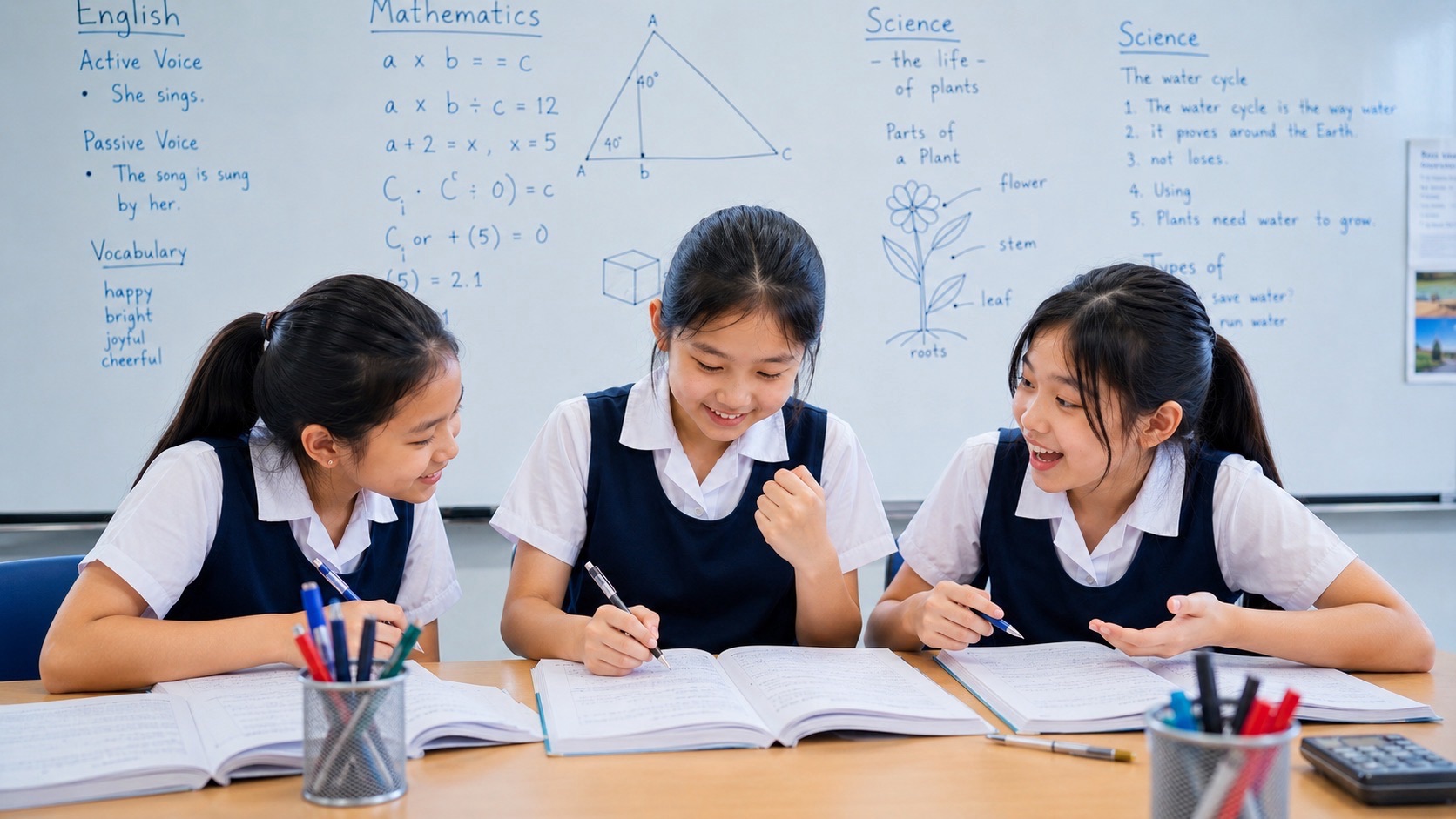
Three-student P2 tutorials
Three-student P2 tutorials matters because the mechanism is using peer contrast while keeping individual evidence. Primary 2 is the stage where lower-primary familiarity must become a more organised Mathematics system. A child who succeeds only when the chapter cue is visible has not yet secured the relationship for independent use.
A diagnostic sign is when the learner one learner answers first and the others imitate. Instead of increasing worksheet volume, the tutor can let Alicia build an array, Tricia explain inverse facts and Kai Kai solve a changed problem. The first place where performance changes reveals whether the issue is conceptual, linguistic, representational, retrieval-based or procedural.
Consolidate through silent first attempts and individual exit questions. Move from supported understanding to changed examples and delayed mixed retrieval. The learner should be able to solve without the original cue and explain what stayed mathematically the same.
The wider result is that discussion strengthens rather than hides reasoning. For Whampoa families, progress is visible when the child needs fewer prompts and can retrieve, represent, calculate and check under ordinary school conditions.
A 1.5-hour P2 lesson
At P2, A 1.5-hour P2 lesson should be taught as a decision process. Its engine is balancing cumulative retrieval, concept learning and transfer. When meaning and method remain linked, the child can reconstruct a procedure rather than depending on exact memory of a worked example.
Investigate the learner who spends the entire lesson on one worksheet chapter. A focused probe is to use retrieval, one core concept, guided practice, mixed review and transfer. Change only one feature at a time and observe what changes performance. This keeps remediation smaller and more accurate.
Use stable lesson architecture with diagnostic flexibility for repair. Follow immediate success with a fresh independent version and later place the same mechanism among unrelated topics. Assessment papers do not announce the strategy, so method selection must be practised as well as execution.
Over time, understanding and access improve together. This reduces the need for frantic reteaching before assessments because more of the year’s Mathematics remains accessible.
Home practice
A strong P2 programme connects Home practice to understanding, fluency and application. The mechanism is keeping practice short and independent enough to be informative. The tutor makes the sequence visible: interpret, represent, choose, execute and check.
When the child work appears correct only after repeated parent hints, do not label the whole problem as weak Mathematics. Instead, mark where help was needed and revisit later. The explanation and time-to-start often reveal more than the final mark.
Practice with short mixed review and spaced return. Vary numbers, context and presentation while preserving the underlying relationship. Later remove the topic heading and ask the learner to identify the structure independently.
This produces the tutor sees true retrieval. The local Whampoa route therefore values stable transfer over quick success on one familiar worksheet.
Transition to P3
Transition to P3 matters because the mechanism is stabilising place value, operations, fractions and problem entry before complexity rises. Primary 2 is the stage where lower-primary familiarity must become a more organised Mathematics system. A child who succeeds only when the chapter cue is visible has not yet secured the relationship for independent use.
A diagnostic sign is when the learner does well only on chapter-labelled worksheets. Instead of increasing worksheet volume, the tutor can run a cumulative checkpoint without method labels. The first place where performance changes reveals whether the issue is conceptual, linguistic, representational, retrieval-based or procedural.
Consolidate through mixed retrieval and changed wording. Move from supported understanding to changed examples and delayed mixed retrieval. The learner should be able to solve without the original cue and explain what stayed mathematically the same.
The wider result is that the P3 step-up becomes more manageable. For Whampoa families, progress is visible when the child needs fewer prompts and can retrieve, represent, calculate and check under ordinary school conditions.
Alicia, Tricia and Kai Kai in a P2 multiplication lesson
Alicia may retrieve products quickly but misread a sharing problem. Tricia may understand arrays yet retrieve facts slowly. Kai Kai may know routine facts but become uncertain when division is presented as grouping. One shared mathematical relationship can therefore support three different diagnostic demands.
The students work silently first. Alicia translates a story into an array, Tricia derives a new fact from a known fact and Kai Kai writes the inverse division family. Only after the independent attempts do they compare methods. The lesson closes with changed questions completed alone.
The aim is convergence toward independence. Individualisation is successful when the need for individual prompting decreases.
School assessments and P2 confidence
P2 school evidence should be classified by mechanism: place value, fact retrieval, renaming, operation choice, language, model construction, units, copying or checking. A score tells how much was lost; the script often tells why.
After repair, use unseen questions and delayed return. If an error disappears immediately but returns a week later, the learning is not yet stable. Spaced retrieval and mixed review therefore belong inside ordinary tuition.
Confidence follows reliable behaviour: the learner starts, explains what the question asks, selects a method, writes enough working to inspect and can correct a mistake after feedback.
A 12-week Whampoa P2 cycle
Weeks 1–2: audit place value, addition/subtraction fluency and question language. Adjust pacing to the learner’s actual school materials and diagnostic evidence.
Weeks 3–4: build multiplication and division meaning with arrays, equal groups and inverse facts. Adjust pacing to the learner’s actual school materials and diagnostic evidence.
Weeks 5–6: connect arithmetic to bar models and two-step word problems. Adjust pacing to the learner’s actual school materials and diagnostic evidence.
Weeks 7–8: integrate fractions, money, time, measurement, geometry and data according to school sequence. Adjust pacing to the learner’s actual school materials and diagnostic evidence.
Weeks 9–10: run cumulative mixed practice with explicit accuracy and checking routines. Adjust pacing to the learner’s actual school materials and diagnostic evidence.
Weeks 11–12: test uncued transfer and prepare for the larger-number, fraction and multi-step demands of P3. Adjust pacing to the learner’s actual school materials and diagnostic evidence.
Frequently asked P2 questions
Should P2 students memorise times tables?
Yes, retrieval should become increasingly fluent, but facts should be connected to equal groups, arrays, commutativity and inverse division.
Why use bar models in P2?
They make part-whole and comparison relationships visible before word problems become much more complex.
Why can homework look strong while tests are weak?
Homework may contain recent examples, chapter cues or parent prompts. Mixed delayed practice tests independent retrieval and method selection.
How do we fix repeated careless errors?
Name the actual error category and install a targeted routine. Renaming, copying, fact, unit and reading errors need different repairs.
Should P2 tuition teach ahead?
Not automatically. A secure current foundation often creates more future advantage than shallow exposure to later chapters.
What should parents practise at home?
Short cumulative review, a few mixed facts and one explain-your-model problem can be enough.
How much tuition is enough?
Enough to repair the identified weak links and build independence. More hours are not automatically better if the practice is poorly targeted.
What should be secure before P3?
Place value, addition/subtraction with renaming, multiplication/division meaning and growing fact fluency, simple fractions, model-based problem entry, units and checking.
Continue the Whampoa Mathematics route
Use Primary 1 Mathematics Tuition | Whampoa for the earlier foundation and Primary 3 Mathematics Tuition | Whampoa for the next stage. Continue later through the existing Primary 4, Primary 5, Primary 6 and PSLE Mathematics owners. For secondary examination preparation use SEC Examination Mathematics Tuition | Whampoa.
Closing principle
Primary 2 is where early number knowledge starts behaving like a connected operating system. Place value must support renaming, multiplication and division must carry meaning, models must expose relationships and word problems must be read for structure.
For Whampoa families, the useful question is whether today’s Mathematics remains available later in a different form. If the child can retrieve the relationship, choose a representation, calculate accurately and check with less prompting, the P2 foundation is becoming durable.
The Primary 2 Mathematics diagnostic lab: what strong tuition should reveal
1. Place value must become a system, not a counting trick
At Primary 2, place value is the organising structure behind almost every later arithmetic decision. A child may be able to read 347 aloud and still not understand that the 3 represents three hundreds, that 340 is 34 tens, or that regrouping changes the form of a number without changing its value. Strong Primary 2 Mathematics tuition should therefore test the same quantity in several representations: base-ten diagrams, expanded form, number lines, missing-number equations and short word situations. When a learner can move between these forms, addition and subtraction with renaming become understandable rather than procedural. When the learner cannot, repeated vertical sums can hide the weakness. For a Whampoa family comparing P2 Math tuition, the useful evidence is not how many worksheets were completed but whether the child can explain why a regrouping step is valid and recover when the numbers are presented differently.
2. Addition and subtraction errors need to be classified
A wrong subtraction answer can come from very different causes. The child may misread the operation, lose place alignment, reverse the subtraction order, forget a regrouping step, miscalculate a basic fact or copy a digit incorrectly. Treating all six as ‘careless mistakes’ produces poor remediation. A Clementi-style diagnostic lesson records the error type, gives a nearby contrast question and checks whether the mistake repeats. If the child repeatedly loses tens after renaming, the repair returns to place-value decomposition. If the concept is secure but facts are slow, the lesson builds retrieval fluency. If the child chooses subtraction when the story describes a part-part-whole relationship, the repair is representational and linguistic. This distinction lets a tutor choose the smallest useful intervention instead of giving an entire chapter again.
3. Multiplication begins with structure before tables
Primary 2 multiplication is often introduced through equal groups, repeated addition and arrays. The goal is not merely to chant facts early. The child needs to see that 4 × 3 can describe four groups of three, that an array can be read in more than one direction, and that a multiplication statement represents a relationship between quantities. Strong tuition connects concrete groups, drawings, number sentences and short stories. It also watches language carefully: ‘four groups of three’ and ‘three groups of four’ have the same product but can describe different arrangements. Once the structure is secure, retrieval practice becomes efficient because facts are attached to meaning rather than memorised as disconnected sounds.
4. Division should be taught through both sharing and grouping
Division at this stage has two important interpretations. Twelve objects shared equally among three children asks how many each child receives; twelve objects arranged in groups of three asks how many groups can be made. Both can produce 12 ÷ 3 = 4, but the story logic is different. Children who know only one interpretation often struggle when a word problem changes its wording. Good P2 Mathematics tuition deliberately contrasts sharing and grouping questions, links them back to multiplication facts and asks the child to draw or model the situation before calculating. This is early transfer training: the learner sees that the operation is selected from the relationship in the story, not from one keyword.
5. Bar models should represent relationships, not decorate answers
The model method becomes powerful only when the diagram carries information. A child who draws bars after solving has not necessarily learned modelling. In a useful P2 lesson, the bar model comes before the calculation and makes the known and unknown quantities visible. Part-whole situations, comparison situations and simple change stories should look different enough that the learner can reason from the picture. The tutor should ask what each bar means, why one is longer, where the unknown sits and what operation follows from that structure. This prepares the child for Primary 3 and Primary 4, where more steps and more complex comparisons make a meaningful representation much more valuable than a memorised heuristic.
6. Word-problem language is part of Mathematics
Many P2 errors are not arithmetic errors. The learner can calculate 56 − 18 but fails to recognise that the story requires subtraction, or can multiply equal groups but loses the relationship inside a sentence. Strong tuition therefore teaches mathematical language explicitly: altogether, difference, fewer, more than, left, each, groups, shared equally, before and after. It also teaches children not to rely on keywords mechanically. The word ‘more’ can appear in a question where subtraction is needed to find the difference. A short routine helps: identify the quantities, state their relationship in simple language, draw the relationship, choose the operation, calculate, then check the answer against the story.
7. Fractions need an equal-parts foundation
Primary 2 fraction work should make ‘equal parts’ non-negotiable. A shape cut into four pieces is not automatically quarters if the pieces are unequal. Likewise, one quarter describes a relationship between one selected equal part and a whole, not merely the presence of the number four. Useful tuition moves between shapes, sets and simple number contexts so the child learns the concept rather than one picture type. Comparisons such as one half versus one quarter should be tied to the same whole. This prevents an early misconception that a larger denominator means a larger piece. These foundations matter because upper-primary fractions become much more algebraic and procedural; weak meaning at P2 makes later algorithms fragile.
8. Measurement and money test whether units stay attached
Length, mass, volume, time and money are early opportunities to teach a habit that remains important throughout Mathematics: numbers carry units and contexts. A correct-looking calculation can still answer the wrong question if centimetres and metres are confused, dollars and cents are mixed, or a clock interval is interpreted incorrectly. A strong P2 programme uses estimation before calculation—should this object be measured in centimetres or metres?—and checks units after calculation. Money problems also combine arithmetic with notation, making them a useful diagnostic for place value and decimal-like thinking before formal decimals are taught in later years.
9. Fluency should reduce cognitive load, not create panic
Basic-fact fluency matters because slow counting consumes working memory that should be available for reasoning. But fluency is not the same as forcing speed before understanding. A better sequence is accurate strategy, increasingly efficient strategy, then retrieval. Number bonds, doubles and near-doubles, making tens, skip counting and known multiplication facts can all become retrieval anchors. Short, spaced practice is more diagnostic than one long worksheet because the tutor can see which facts return after delay. The aim is a child who can retrieve common facts comfortably and still explain the relationships underneath them.
10. The weekly loop should mix new learning with old retrieval
A P2 child can appear to have mastered a topic when questions arrive immediately after teaching and in one chapter order. The stronger test is whether the idea can be retrieved a week later and recognised in a mixed set. A Clementi-style weekly loop therefore includes a small amount of cumulative retrieval, one current concept, one representation task, one word-problem transfer task and a brief correction cycle. The tutor should deliberately bring older place-value, addition and subtraction knowledge into later multiplication, division and measurement lessons. This keeps the curriculum connected and exposes forgetting before school assessments do.
11. Parents should receive evidence, not generic reassurance
A useful progress update can be specific without being long. It might report that the child now regroups correctly in two-digit addition, still confuses grouping division with sharing division, and solves comparison word problems only when a model is provided. That information tells the parent what has changed, what remains unstable and what the next teaching step is. Generic comments such as ‘doing better’ or ‘needs more practice’ do not support decisions. For local tuition discovery, this is an important quality signal: the programme should be able to explain the learner’s mathematics in observable terms.
12. Primary 2 readiness means more than completing the P2 syllabus
The end point is not simply chapter completion. A child ready for Primary 3 should have stable place value, reliable addition and subtraction, meaningful multiplication and division foundations, basic fraction understanding, usable model-drawing habits and enough language control to enter a word problem without guessing. The child should also have a correction routine: notice an unreasonable answer, revisit the representation, check the operation and repair the working. That combination of knowledge, fluency, representation and self-correction is what makes the P2-to-P3 transition resilient.
Four worked transfer checks for Primary 2 Mathematics
Transfer check: renaming in an unfamiliar format
A child who completes 63 − 28 vertically may still fail when the same relationship appears as 28 + □ = 63 or inside a money problem. A useful transfer check keeps the arithmetic relationship but changes the representation. The tutor asks the learner to explain how the unknown-addend form connects to subtraction, then solve a third version on a number line. If performance collapses when the format changes, the issue is not simply calculation speed. The child has learned a procedure tied to one layout. Repair should reconnect place value and inverse operations before more routine practice is added.
Transfer check: multiplication without the multiplication sign
Instead of showing 4 × 5, present four trays with five cups on each tray, or a bar divided into four equal groups of five. Ask for the total and then ask the child to write two number sentences that describe the structure. A learner who can calculate only after seeing × is relying on notation as a cue. Strong P2 tuition gradually removes that cue so equal groups are recognised in pictures, sentences and practical situations. The same task can then be reversed for division: if 20 cups are placed five per tray, how many trays are needed? This connects multiplication and division as one family of relationships.
Transfer check: comparison language with misleading keywords
Give two matched problems: ‘Sara has 8 more beads than Jia’ and ‘Jia has 8 fewer beads than Sara.’ Ask the child to draw both before calculating. If the diagrams differ, the language has not yet been mapped to the same comparison structure. This is why keyword teaching alone is dangerous. Words change perspective; the quantitative relationship does not. The tutor can then vary names, object types and sentence order while preserving the same bars. Repeated successful transfer shows that the learner is reading the relationship rather than hunting for a trigger word.
Transfer check: delayed retrieval after the chapter is over
Two weeks after a fractions lesson, include one equal-parts question inside a mixed warm-up with arithmetic, money and word problems. Do not announce the topic. If the child recognises the fraction structure and solves it accurately, the knowledge is becoming retrievable. If the child says ‘we haven’t done fractions today,’ the memory is still dependent on chapter context. This small delayed test is more informative than another immediate worksheet and gives the tutor a reason to revisit the concept before P3 adds further demands.