
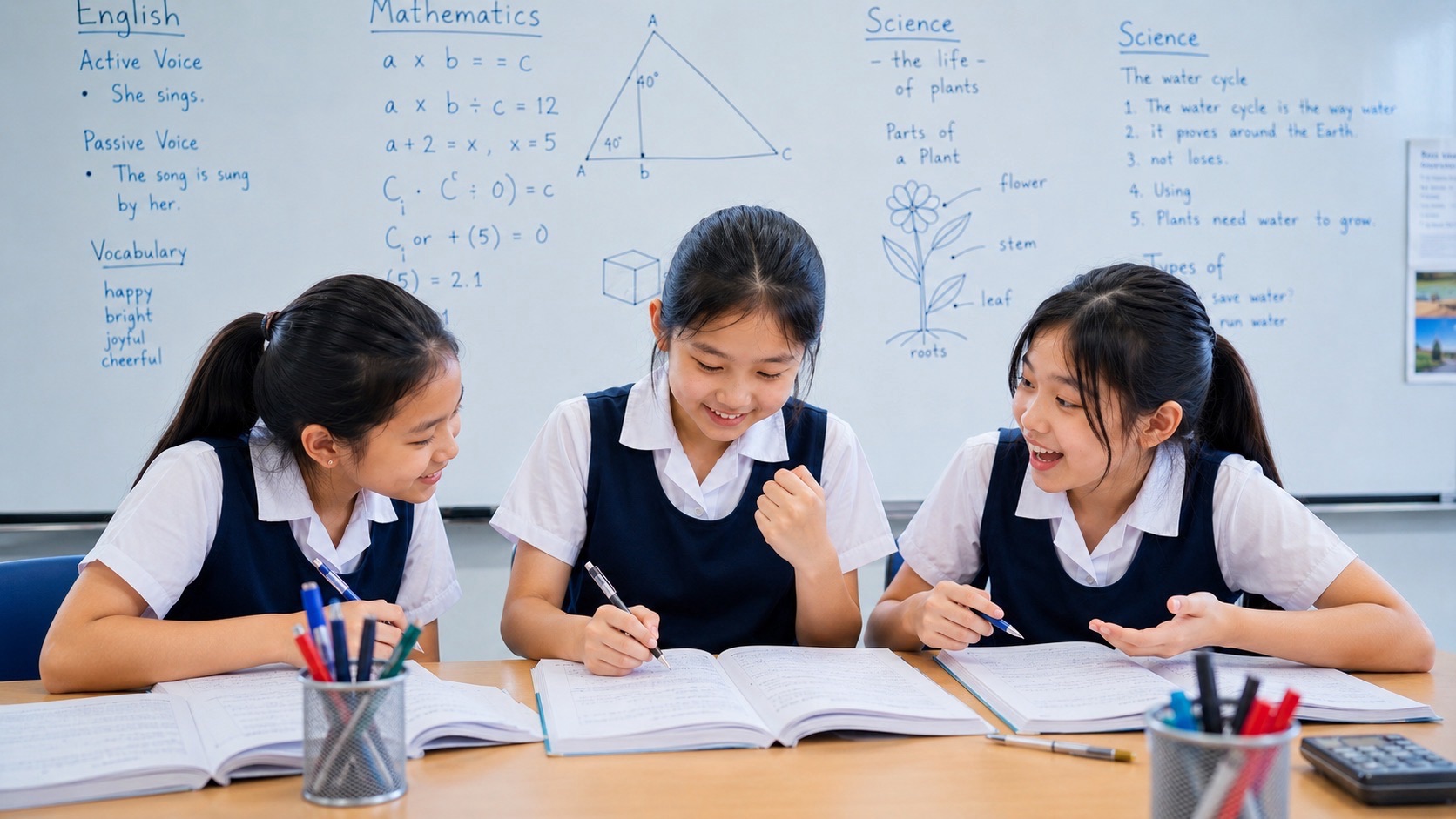
Primary 4 Science small groups tuition for Bukit Batok students can be helpful when a child can state that “matter has mass and occupies space” but struggles to interpret a question about an invisible gas, a container or an experiment measuring different quantities. The difficulty is not necessarily poor memory: the learner may be using the right words without understanding the scientific distinction.
A good three-pupil tutorial makes the misunderstanding visible. Each child attempts the question before receiving hints, explains the observation and learns why a conclusion is justified—or unsupported. The teacher can then provide targeted practice rather than treating every wrong answer as a reason to assign more worksheets.
Bukit Batok parents should consider the benefits and consequences together. A small group may increase meaningful individual feedback, participation and careful thinking. It can also create cost, travel, dependence on prompting and an unsuitable pace if the children have very different needs. A parent should measure whether independent understanding improves instead of assuming a small group guarantees marks.
- When to consider tuition: persistent confusion about matter, evidence or scientific language despite ordinary school correction.
- What Primary 4 covers: plant functions, digestion, matter, light and heat within MOE’s primary curriculum.
- Potential three-pax benefit: frequent chances to explain and receive feedback specific to each learner.
- Possible consequence: fees, journey time, lost recreation, peer comparison and incorrect confidence after hints.
- Evidence of learning: the pupil handles a new question about mass or volume without a chapter cue.
- Local fact check: this is a Bukit Batok information article, not confirmation of a Bukit Batok eduKateSG branch.
Why “matter has mass and volume” is not enough
A child might memorise that matter has mass and occupies space. Then, when shown a closed jar that appears empty, the pupil says there is no matter inside because nothing is visible. This suggests a mistaken assumption that visibility determines whether something exists.
A teacher can correct the statement, but real understanding requires the child to apply the idea. Ask what the apparently empty jar ordinarily contains, whether the air occupies space and why it is not appropriate to infer absence from invisibility alone.
Now place the concept into a different context. Air trapped in an inverted cup can prevent water from occupying the same space while the cup is held in a suitable position. The pupil should recognise the role of air rather than remember only a balloon illustration.
When a child can explain the same scientific principle across different situations, the learning has progressed beyond copying a definition.
Primary 4 Science and its place in Singapore education
The MOE Primary Science Teaching and Learning Syllabus is organised across Primary 3 to Primary 6 under Diversity, Cycles, Systems, Interactions and Energy. At Primary 4, pupils study plant parts and functions, the human digestive system, matter, light and heat.
Primary 3 learning introduces relevant foundations about living and non-living things, materials, life cycles and magnets. When a child struggles with a P4 question, a short return to a missing prerequisite can sometimes be more effective than pushing forward with difficult applications.
The MOE syllabus also includes practices of scientific inquiry: observing, making reasoned conclusions, recognising fair comparisons and communicating accurately. Children need to learn what an observation establishes and what claims require additional evidence.
The SEAB PSLE Science information covers the national examination at the end of Primary 6. Its interest in knowledge and application helps explain why P4 reasoning matters, but there is no national PSLE Science paper in P4. Early drilling of P6 papers should not replace age-appropriate foundations.
Worked example: an “empty” container
Ask a pupil what is inside a jar with no visible object or liquid. A common answer is “nothing.” In ordinary circumstances, the jar contains air.
The child should know that air is matter. It occupies space and has mass, even though we normally cannot see it. The tutor can invite a prediction and then compare the explanation with an appropriate diagram or safe demonstration.
A useful follow-up is to ask whether an inflated balloon occupies more space than before inflation. Yes, as an everyday observation, the balloon has expanded. But the visible size change alone does not tell us the exact mass of air inside.
This distinction protects children from making a false inference: an observation relating to space does not automatically provide a numerical mass measurement.
The teacher then presents a different set-up, such as a trapped pocket of air in a transparent container. The pupil must select the same idea without seeing the earlier jar or balloon picture.
Mass and volume are different quantities
Children may use the words mass, weight, size and volume interchangeably in everyday speech. In a Science question, however, the measured quantity and unit matter.
Mass is a measure related to the amount of matter in an object. Volume is the space that the object occupies. A large-looking object does not necessarily have a greater mass than a smaller-looking one made of a different material.
Ask a child whether a large empty-looking plastic container must be more massive than a small solid metal object. Appearance alone is insufficient. The relevant masses must be measured or otherwise supplied.
Similarly, a container’s capacity does not tell us the mass of its contents without information about what is inside and how much of it there is. A tutor should avoid teaching a rigid slogan such as “larger means heavier”.
A good P4 exercise uses accurate labels and simple comparisons rather than importing complex secondary-level formulas that the school has not yet taught.
An experiment can show one thing without proving another
Consider a balloon placed on a table before and after inflation. The pupil observes that the balloon became larger. That supports a discussion about air occupying space.
If the child claims the balloon now contains exactly a specified mass of air, ask where that mass was measured. Without a balance or other relevant data, the precise value is not established by the picture.
This is the difference between observation and inference. An observation reports what was directly seen or measured. An inference uses scientific knowledge to interpret an observation.
Not every inference is wrong. A correct inference is one that follows from the observations, the scientific model and the information available. The pupil should learn to distinguish justified explanations from plausible guesses.
A three-pupil group can compare interpretations, but the tutor should insist that each learner identify the evidence before adopting another child’s conclusion.
Worked example: water displacement and the idea of space
Imagine a solid object being placed completely under the surface of water in a suitable container. The water level rises because the object occupies space that water previously occupied.
A child may conclude that the rise demonstrates something about the object’s volume in that arrangement. That is a relevant application of space occupation.
But the water-level change does not by itself tell the pupil the material’s identity or the exact mass of the object. Those claims require other measurements or information.
Now show another object of a different shape. A child should recognise that different shapes can occupy comparable volumes, and the visible outline alone is not proof of mass.
The tutor can use pictures, not necessarily a physical set-up, to teach the reasoning safely and clearly. The point is what the evidence supports, not the theatrical quality of the demonstration.
When a fair test becomes unfair
Suppose two containers are compared to investigate how different materials affect heat transfer. One is placed in very warm water while the other is placed in slightly warm water. The child attributes the observed difference entirely to the container materials.
That conclusion is not justified by the comparison alone, because starting temperatures also differ. The tutor should ask what factor the investigation intends to vary and what other conditions ought to remain comparable.
At Primary 4, recognising a fair test is a suitable foundation. The lesson need not demand a complex laboratory protocol. A simple pair of labelled pictures can demonstrate why changing more than one relevant factor prevents a clear single-cause conclusion.
The skill extends beyond matter. In shadows, the distances between the source, object and screen matter; in plant growth, light and water conditions can both matter.
Learning this reasoning pattern gives the child a tool to use across chapters instead of memorising separate rules for each experiment.
How a class of three can work better than generic practice
The tutor gives the same unfamiliar picture to all three pupils, but asks each to answer privately. Pupil A may confuse mass with volume. Pupil B may know the difference but read the label incorrectly. Pupil C may draw an inference not supported by the observation.
Their marked answers may appear similarly wrong, but they require different instruction. One needs the concept clarified, one needs more careful reading, and the third needs an evidence check.
A well-managed three-pupil tutorial can share a short explanation and then assign different follow-ups. The purpose is to make each child independently competent at the relevant task.
Small group size creates the opportunity for this differentiation; it does not guarantee that it happens. Parents should ask the tutor to describe how the group is managed when the learners have different needs.
The no-hint attempt is the crucial evidence
A correct answer written after the teacher says “remember that air is matter” is not the same as a correct answer selected independently in an unfamiliar problem.
Hints are useful while teaching an idea. But the teacher needs to reduce them gradually and record what the pupil can do when the prompts disappear.
One practical approach is to classify an answer as not yet accurate, accurate with help or accurate independently. Later, ask the same type of question in a changed context after several days.
This avoids confusing immediate imitation with lasting understanding. A child may be cheerful and active during tuition yet still need more support to answer alone at school.
Parents can ask to see an unaided answer before and after teaching rather than rely only on a summary stating that many worksheets were completed.
A reasonable 90-minute tutorial
A sample lesson opens with short retrieval from earlier P4 topics without notes. The child may answer one matter question and another from a previous chapter. The tutor records what has been retained.
The next segment identifies a repeated misunderstanding in current schoolwork. A small diagram or safe demonstration helps explain the relevant quantity, process or variable.
Students then attempt questions matched to their errors. A brief group comparison allows them to explain why two answers differ and which information supports the conclusion.
The final task removes hints and changes the example. The tutor records what each child can now do and what should be revisited next week. This is an illustrative instructional sequence, not a fixed timetable claim about any current Bukit Batok class.
Benefits of small-group tuition for a matter misconception
Closer observation. The tutor can see when a child switches from talking about occupied space to talking about mass, and correct the mistake at that point.
Meaningful participation. In a well-run three-pupil group, every learner can make a prediction and give a reason instead of listening to only one student.
Targeted correction. A pupil who misreads a unit can receive different practice from a child whose scientific model is wrong.
Peer reasoning. Students can compare claims against evidence and learn that confidence alone does not make a conclusion correct.
Better transfer. A tutor can replace the familiar balloon with a jar or a different volume comparison and check whether the principle still works.
These are potential benefits. They should be demonstrated through independent tasks, not guaranteed in advance as a score increase.
Consequences of choosing the wrong group
A three-pupil class may contain one child needing Primary 3 prerequisites, another mastering P4 matter and a third ready for advanced applications. If all three receive the same worksheet, the class may be inefficient.
A shy pupil may stop contributing when one classmate always speaks first. The tutor should use quiet first attempts and respectful correction, but some learners may need one-to-one support.
Another risk is a timetable that overwhelms the child. A ninety-minute session plus travel and homework can consume much of an afternoon, leaving less time for sleep, sport, reading and rest.
Families should ask about full fees, transport, replacement arrangements and how homework fits school commitments. The extra time must be justified by a genuine learning benefit.
Finally, the child may already be learning well through school. Tuition is not compulsory and should not be purchased simply because friends are enrolled.
Choosing between three-pax, one-to-one and home support
A larger revision class can suit a pupil who needs organised topical practice but relatively little individual diagnosis. A one-to-one tutorial can provide personal pacing for substantial foundational gaps or a child who needs privacy.
A three-pupil group may balance individual attention with the opportunity to hear another learner’s scientific explanation. That combination is useful only when the pupils are reasonably compatible and the teacher actively checks everyone’s work.
School-based feedback should be used first when available. The teacher knows which topics and scientific practices the child has studied and may offer a short corrective task or explanation.
Parents can also practise at home with a few precise questions each week. An independent attempt, one correction and a new example several days later may resolve a narrow misconception without paid lessons.
The right option is the one that closes the gap with the least unnecessary burden.
A short parent-led diagnostic
Give the child an unfamiliar picture of a container with air, a balloon before and after inflation, and a question comparing the sizes of two objects. Do not announce a chapter heading or provide a first keyword.
Ask what is observed and what conclusion is supported in each case. Watch whether the pupil confuses mass, volume and visibility. Keep the first answers.
After a brief correction, ask the child to explain each concept in ordinary language and then write a concise scientific response.
Several days later, replace the examples. If the learner now answers independently, a light home routine may be sufficient. If the same misunderstanding remains despite appropriate teaching, a targeted tutor may help.
A six-week progress test for tuition
Baseline: keep unaided answers about matter, an unfamiliar table or diagram, and one question requiring a fair comparison. Note any hints.
Weeks one and two: repair the largest conceptual confusion and practise accurate scientific language. Avoid judging success by how many repeated questions are completed.
Weeks three and four: revisit the idea after a delay and place it in different contexts. A child should identify air as matter in more than one illustration.
Week five: mix topics so that the student must choose between matter, light and heat principles without being told which one is relevant.
Week six: compare new, equally demanding questions with the baseline. Look for accurate quantity and unit use, justified conclusions and fewer prompts.
One better school result is encouraging but does not by itself establish the effect of tuition. Assessment difficulty, classroom teaching and ordinary development also contribute.
If improvement is absent, discuss the diagnosis, teacher method and group match rather than extending the programme automatically.
Bukit Batok location and travel considerations
This article is written for Bukit Batok families, not as confirmation that eduKateSG runs a Bukit Batok classroom or currently has P4 Science places in the estate.
The site’s public information has included teaching or contact locations around Punggol and Bukit Timah. Parents need to confirm the exact venue, tutor, timetable, fees and group composition for any particular class.
Count travel from school or home, not only the tuition session itself. An academically useful class may become impractical if the journey removes substantial rest time after a long school day.
When a distant class is not sustainable, a suitable nearby provider, school support or a short home routine may be the better choice. Convenience matters, but so do teaching quality and an accurate diagnosis.
Questions Bukit Batok parents should ask
- Does my child confuse visibility, mass and volume, or is the problem mainly reading the diagram?
- What evidence will show that the misconception has actually changed?
- Will every child answer independently before hearing other pupils’ explanations?
- Can the tutor assign different tasks when three pupils have different weaknesses?
- How often are earlier concepts retested after several days?
- What happens if the child becomes dependent on hints or uncomfortable with peers?
- What are the actual venue, tutor, fees, attendance rules and available places?
- At what point would the tutor recommend lighter support or stopping tuition?
Frequently asked questions
Is invisible air really matter?
Yes. Air occupies space and has mass. The tutor should help a child distinguish an observation demonstrating occupied space from a separate measurement of mass.
Is a larger object always heavier?
No. Size or volume alone does not determine mass, especially when materials and contents differ. Use the measured or stated quantities rather than guessing from appearance.
Does three-pax tuition guarantee better exam results?
No. The smaller group creates opportunities for more individual feedback, but progress depends on the tutor, the learner’s needs and the sustainability of the work.
Should P4 Science be mostly PSLE papers?
No. Primary 4 children should master their own syllabus concepts and scientific practices first. The national PSLE is at the end of Primary 6.
What is a good sign that a concept has been learned?
The child applies it to an unfamiliar question, supports the conclusion with relevant evidence and can still explain it accurately after a delay.
Primary sources and useful next reading
The MOE Primary Science syllabus is the official reference for Primary 4 matter and other topics. The SEAB PSLE Science information explains the later national assessment. Related decision guides include Primary 4 Science Small Groups Tuition Bukit Panjang and Choa Chu Kang.
To ask about a real child’s schoolwork and confirm current lesson venue, group, fees and vacancy, contact eduKate Singapore or WhatsApp the team.
The objective is not to make a child repeat the words “matter has mass and occupies space”. It is to make those words useful when a new question appears.