
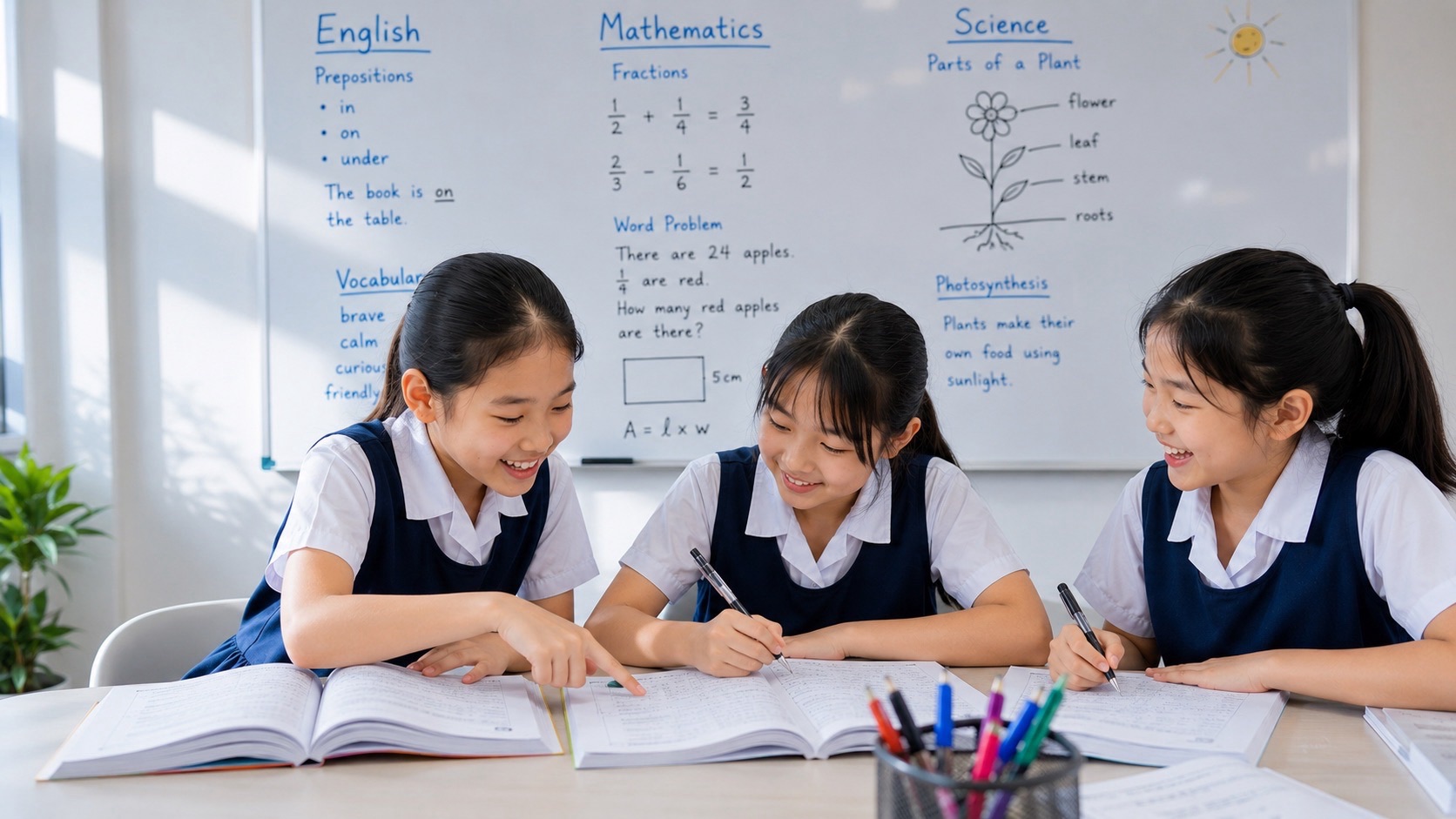
Primary 4 Science small groups tuition for Kallang families can help when a child knows the subject facts but cannot tell whether an experiment is fair. The student may see two objects being tested, identify which one changed, and overlook that the starting temperatures, distances or observation times also differ. The resulting conclusion sounds scientific but is not supported by the comparison.
Primary 4 Science small groups tuition can be used to repair that reasoning before it becomes a habit. A tutor working with three pupils can ask each learner to predict the outcome, identify the changed factor and explain why the observations justify—or fail to justify—the stated conclusion.
For Kallang parents, the benefits and consequences deserve equal weight. An effective class gives more individual diagnostic attention and structured inquiry practice. A weak class may teach formulaic vocabulary without real understanding, while adding weekly fees, homework and commuting. This guide is for families in Kallang; it does not imply that an eduKateSG classroom operates there.
- Priority skill: recognise fair comparisons and distinguish what was deliberately changed from what was kept the same.
- Curriculum position: P4 Science includes plant systems, digestion, matter, light and heat, with age-appropriate scientific practices.
- Three-pax benefit: the tutor can inspect three separate predictions and explain why different conclusions are or are not justified.
- Risk: copying the best pupil’s answer can hide a weaker pupil’s misunderstanding.
- Progress check: ask the child to evaluate a new investigation without a chapter heading or a tutor hint.
- Practical check: confirm class venue and actual fees before deciding whether the commute is worthwhile.
What a fair test means to a Primary 4 child
A fair test changes a factor of interest while keeping other important factors comparable so that the effect can be interpreted more reliably. At Primary 4, recognising whether an investigation is fair and identifying changed or unchanged factors is an appropriate foundation.
This does not mean nothing may change. If every relevant condition stayed identical, the investigation would not compare the factor of interest. Nor does it mean a child can claim one factor caused a result when multiple relevant conditions changed together.
The tutor should use accessible diagrams and concrete questions. The child needs to ask: what is being compared, what else could affect the result, and what evidence supports the conclusion?
These skills matter across P4 topics. A light experiment involves relative positions; a heat comparison involves starting temperatures and materials; a plant observation can involve different conditions such as water supply and exposure to light.
The MOE and SEAB boundaries
The MOE Primary Science Teaching and Learning Syllabus sets the content and practices for Primary 3 to Primary 6. Primary 4 covers plant parts and functions, the human digestive system, matter, light and heat.
The syllabus develops Science inquiry progressively. For P4, the useful target is recognising a fair test and distinguishing factors changed from those held constant. More demanding independent investigation design develops with later learning and should not be falsely presented as a universal P4 test requirement.
The SEAB PSLE Science syllabus for examinations from 2026 assesses knowledge, application and scientific inquiry at the end of Primary 6. It explains the longer-term value of inquiry skills without making every P4 lesson a rehearsal of a P6 paper.
Different schools may teach the P4 units in different orders. Work from the child’s actual school topics and mistakes when choosing the lesson sequence.
Worked example: comparing shadows with two different torches
Two groups investigate how the distance of an object from a torch affects its shadow size on a screen. In the first arrangement, the torch is close to the object. In the second, the torch is farther away—but the screen is also moved.
A student concludes that the change in shadow size was caused only by the distance between the torch and the object. The conclusion may not be justified because more than one geometrical distance changed.
Ask which distance the investigation intended to compare and what other conditions should be held constant. Use a simple drawing with the torch, object and screen in each arrangement so the child can see the differences.
The important idea is not to memorise "closer equals larger" in every imaginable picture. It is to reason using the actual arrangement and the fact that light travels in straight lines, with an opaque object blocking light from reaching part of the screen.
A small-group lesson can use one pupil to identify the intended changed factor, another to spot an uncontrolled condition and a third to propose how the drawings could be made comparable. All three must then annotate a new example independently.
Worked example: two spoons and unequal water temperature
Imagine a metal spoon in hot water and a plastic spoon in only warm water. A pupil says that the difference in how rapidly the handles warm proves which material conducts heat better.
The water’s starting temperature differs, so the comparison does not isolate material. The child should recognise that the investigation changed more than the intended factor.
A better comparison would keep the starting water temperature and relevant arrangements as similar as possible while comparing the spoon materials, using a safe age-appropriate setup.
The tutor should also distinguish heat transfer from temperature. Heat transfers from a hotter object or region towards a cooler one. The temperature tells us how hot or cold something is. The words describe related but different ideas.
It may be safer and clearer to use an illustrated experiment instead of having children handle hot water. A diagram is sufficient to test reasoning about fair comparisons.
Worked example: plant growth and missing controls
Two plants are shown after a week. One received more water than the other, but it also had more light. A child says the difference in appearance proves that water alone caused the change.
That conclusion overlooks the different light conditions. Ask what was intentionally varied and what additional condition differed. The pupil should recognise that the evidence cannot isolate one cause.
At P4, the point is to notice that two factors changed. It is not necessary to demand an advanced experimental protocol or treat one drawing as proof of a universal rule about plant growth.
A changed situation can test transfer: compare two plants that receive the same amount of water but differ in one other condition. Ask the child what can reasonably be investigated and what still needs to be controlled.
Through examples from light, heat and plants, the child learns a general inquiry habit rather than three unrelated answers.
Observation, inference and cause
An observation reports what the pupil saw or measured, such as a difference in shadow size or a change in temperature. An inference interprets the observation. A causal claim explains why the change occurred.
These are not interchangeable. A measured change may be real while the proposed explanation is unsupported because the experiment varied two important conditions.
A tutor should ask the child to mark the evidence separately from the conclusion. Then ask whether another plausible explanation exists and what additional comparison would distinguish it.
This does not require a long written response. Often one accurate sentence identifying the uncontrolled condition is more scientific than a paragraph filled with the right-sounding topic words.
Why a three-pupil group is useful for scientific inquiry
Three pupils can propose different explanations for the same result. The tutor can ask each one to defend the claim against the information supplied, rather than accept the loudest or most confident opinion.
Because the class is small, the teacher can inspect every student’s first written choice before discussing the answer. That prevents the group discussion from hiding who understands and who guessed.
After a common explanation, one learner may need help recognising the changed factor, another may need better question-reading and a third may need to explain why the evidence is limited.
The teacher should vary tasks accordingly. The benefit lies in individual feedback coupled with peer discussion, not simply having three chairs around a table.
When a child is learning from peers rather than copying them
A child genuinely learns from another pupil by listening to the reasoning, checking it against the evidence and then producing an independent answer. Copying the final conclusion without being able to justify it is not the same outcome.
One practical technique is silent prediction. Give every pupil the diagram and two minutes to record which comparison is fair, with no discussion. The tutor can see the starting interpretations.
Then let the children compare claims, noting the specific variables that differ. The tutor can correct misunderstandings and insist on respectful argument rather than competition.
Finally, each child answers a new experiment question without a hint. This separates the value of collaboration from the ability to reason independently.
A ninety-minute tutorial organised around inquiry
A possible 1.5-hour session starts with ten minutes of delayed retrieval from an older topic. That shows whether the learner can choose the scientific idea without the worksheet heading.
Next, the tutor uses an experiment diagram that contains a tempting but flawed comparison. Each pupil identifies the intended changed factor and any uncontrolled condition. The tutor then explains the precise error.
During practice, questions vary in context. A student may begin with a clear light diagram, then apply the same fair-comparison reasoning to heat or plants. The aim is transfer, not finishing many identical items.
The class closes with an unfamiliar independent question and a record of which misconception needs revisiting later. This is an illustration of a useful lesson, not a claim about the current timetable of a Kallang group.
Benefits: what can be demonstrated
Earlier detection of false causal claims: a tutor can see that a child assigns the result to material or distance even though several conditions changed.
Better scientific language: children learn to distinguish an observation from a conclusion and explain why evidence supports or limits a claim.
More opportunities for thinking: all three students can predict, explain and revise rather than passively watch the teacher solve questions.
Targeted correction: a pupil who overlooked the screen’s position receives different practice from one who misunderstands straight-line travel of light.
Preparation for upper-primary inquiry: strong P4 foundations can support later work involving more complex experiments, without promising a particular PSLE result.
Consequences that should not be hidden
The three pupils may be too different in readiness. A child who needs to revisit basic light concepts may struggle while another is analysing complex comparisons. The tutor should adapt or recommend a different group.
A child can become dependent on prompts such as "look at the water temperature" and fail to spot the condition alone. Periodic no-hint tasks are necessary.
Peer interaction can be discouraging if one student finishes first or errors are treated as personal failures. A tutor should protect the dignity of every learner and use respectful scientific discussion.
Fees and transport are recurring costs. A 90-minute tutorial may take much longer door to door, especially after a full school day. The child still needs rest, recreation and space for curiosity.
Tuition can also be unnecessary. If school feedback and short practice already resolve the inquiry problem, there is no reason to add a class merely because others do so.
How to decide between three-pax and other formats
A larger revision class may be enough when the child simply needs organised topical review. A one-to-one lesson may suit substantial prerequisite gaps, a highly individual pace or anxiety about answering before peers.
A three-pupil tutorial can offer both peer hypotheses and more frequent teacher feedback, provided the children’s learning needs are compatible.
School support should not be overlooked. The teacher knows which inquiry skills are expected in the current unit and may be able to supply examples of the child’s recurring errors.
Parents can also practise at home by asking the child to compare two simple pictures and identify what changed and what stayed the same. Short, consistent explanation often helps more than an additional bundle of papers.
A four-week home check before committing
Week one: show two light arrangements and ask the child to list the relevant differences. Keep the unaided response.
Week two: compare two heat experiment diagrams. Ask which factor is supposed to be tested and which other conditions would need to stay comparable.
Week three: use a plant situation. Ask whether the conclusion is justified when both light and water differ. Do not reveal the intended answer before the child attempts it.
Week four: return to an unfamiliar comparison from an earlier topic. If the child now notices uncontrolled conditions without prompts, continue the lighter home routine. If the same misunderstanding persists, targeted tuition may be appropriate.
The purpose is to test whether an intervention is necessary, not to reproduce formal school assessments at home.
A six-week test of the tutoring itself
Before starting, keep an original independent response to a fair-test question. Note whether the pupil correctly identifies what changed, what stayed constant and whether the conclusion is supported.
During the tutorial weeks, practise one inquiry move at a time. Do not mask the child’s performance by guiding every answer.
At weeks three and four, return to the same ideas with different experiments and a delay. At week six, use a fresh P4-level scenario and compare the child’s reasoning with the original.
Progress may be shown by fewer unprompted errors, clearer evidence use and a more accurate explanation. School marks are secondary evidence and cannot by themselves prove that tuition caused improvement.
If the group does not make a difference, reconsider its fit rather than continuing automatically.
Kallang logistics and choosing a sustainable schedule
This is an information article for Kallang families, not proof of a physical eduKateSG Kallang branch, a current P4 Science group or an open seat. The exact teaching address, tutor and timetable must be verified directly.
The site’s public materials have described contact or lesson locations in Punggol and Bukit Timah. That background cannot confirm which specific Primary 4 Science class is now running where.
Count the complete trip from school or home, including pickup and waiting time. If a long commute turns a useful lesson into a tiring evening, the arrangement may be wrong for the child.
A nearby qualified tutor, suitable school support or home practice may be preferable when travel becomes the dominant cost. Convenience matters, but the content and teaching method also have to suit the pupil.
Questions a Kallang parent should ask
- Which inquiry skill is weak: reading the diagram, identifying the changed factor or evaluating the conclusion?
- Will the tutor first examine a real school question rather than assign generic practice?
- Does every child write an independent prediction before discussion?
- How will the teacher differentiate tasks when pupils have different conceptual gaps?
- Can the student explain why an experiment is unfair in a changed situation?
- How does the class reduce hints over time?
- What is the full price, actual venue, assigned teacher and group availability?
- When would no tuition, fewer lessons or a different format be more appropriate?
Frequently asked questions
Does Primary 4 Science require students to design elaborate experiments?
The MOE syllabus develops inquiry progressively. P4 pupils should recognise fair comparisons and relevant changed or unchanged factors; later years develop more demanding investigation capabilities.
Does a small class automatically make Science easier?
Not necessarily. It creates time for the tutor to hear each pupil, but the quality of questioning and corrections determines whether understanding improves.
Must pupils include the phrase “fair test” in every answer?
No. They need to identify the actual conditions and answer the question. A phrase without explanation does not show comprehension.
Is a wrong hypothesis a bad thing?
Not when it is examined carefully. A prediction is an opportunity to compare a model with evidence and correct it. Children should feel safe proposing an idea that may need revision.
What result should parents look for?
The child independently identifies what was tested, which variables differed and whether the evidence justifies the conclusion in unfamiliar P4-level cases.
Curriculum references, related guides and contact
The MOE Primary Science syllabus provides the official Primary 4 content and practices. The SEAB PSLE Science syllabus explains the later Primary 6 assessment’s emphasis on application and scientific inquiry. For connected parent reading, see Primary 4 Science Small Groups Tuition Bedok and Primary 4 Science Small Groups Tuition Toa Payoh.
To discuss a child’s actual Science work and confirm the class location, fees and available group, contact eduKate Singapore or WhatsApp the teaching team.
Good Science tuition should make a learner more careful about evidence, not simply more confident in a memorised answer.