
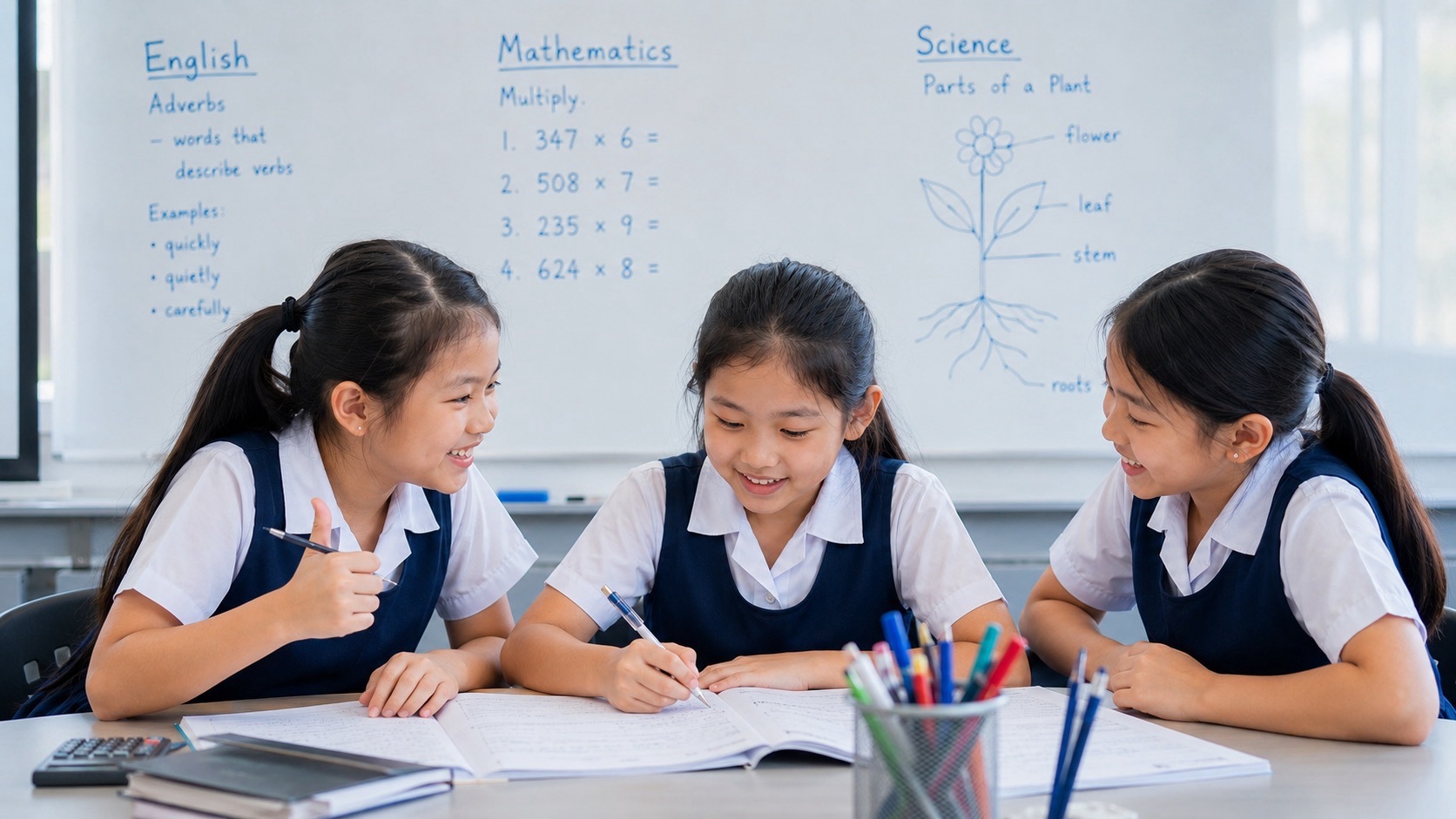
Primary 6 Mathematics Tuition Kaki Bukit is for families searching for P6 Math tuition, Primary 6 Maths tuition, a Primary 6 Mathematics tutor around Kaki Bukit, Bedok Reservoir, Ubi, Eunos or MacPherson, small-group Mathematics lessons, MOE-aligned revision, PSLE Mathematics preparation, model drawing, heuristics, fractions, percentage, ratio, algebra, circles, average, school prelim support, targeted practice, timed work, Paper 1 accuracy and Paper 2 problem solving. Current Singapore Mathematics tuition providers repeatedly foreground small classes, personalised learning, targeted revision, model method, problem sums, diagnostic feedback, exam strategy and PSLE readiness. Those phrases matter only when they become a coherent final-year learning system.
Effective P6 Mathematics tuition for Kaki Bukit families should identify what is stopping knowledge from converting into marks. One student may know the syllabus but read too quickly. Another may understand ratio yet attach units to the wrong quantity. Another may solve topical exercises and fail when a mixed paper hides the topic. Another may reach the correct method but cannot complete enough of the paper within time. Primary 6 therefore needs cumulative retrieval, error diagnosis, strategy selection, visible working, timing control and increasingly independent correction—not simply a larger volume of worksheets.
This guide owns the Kaki Bukit Primary 6 local-discovery intent while preserving eduKateSG’s broader canonical Mathematics owners. Kaki Bukit is the family’s origin and search context—Kaki Bukit Avenue, Kaki Bukit Road, Bedok Reservoir, Ubi, Eunos, MacPherson and nearby east-central neighbourhoods—and not a claim that eduKateSG operates a physical Kaki Bukit branch. Families who choose eduKateSG travel to three-student Mathematics lessons near Sixth Avenue MRT. The wider subject route remains the Mathematics Learning Hub. The current MOE Primary Mathematics syllabus, updated in October 2025, applies through Primary 6 from 2026, and the SEAB 2026 PSLE examination format is the official reference for the national examination.
Kaki Bukit Primary 6 Mathematics: turn the final year into a controlled system
Kaki Bukit families can compare centre-based, home-tuition and online Mathematics options around Bedok Reservoir, Ubi, Eunos and MacPherson. Current providers often highlight small classes, model method, heuristics, diagnostic work, school-paper practice, full-syllabus revision, exam technique and timed practice. In Primary 6, the useful comparison is not whether those terms appear on a page, but whether the programme converts the child’s actual evidence into a smaller set of high-value repair targets.
Adrian may need to slow the first reading without becoming slow overall. Jo may need a representation that makes an invariant visible. Ben may need arithmetic fluency so a correct method survives. Aisha may need mixed-topic transfer. Ryan may need concise working that remains inspectable. Mira may need unit and calculator discipline. Clara may need a checking limit. Ethan may need a recovery rule when a difficult question refuses to yield. The same school score can hide very different systems.
A successful P6 programme coordinates curriculum completion, retrieval of earlier Primary Mathematics, targeted repair, mixed practice, timed sections and full-paper simulation. The Kaki Bukit cluster keeps the P6 learning system distinct from the examination-specific PSLE owner while preserving the broad Mathematics Learning Hub as the canonical subject route.
Primary 6 is an integration problem, not a worksheet-volume contest
The final primary year can tempt families into measuring preparation by the number of papers completed. Papers are useful, but they are measurement instruments as much as practice. If a student completes ten papers and repeats the same percentage-base error in all ten, volume has documented the weakness without repairing it. The more important question is whether each practice cycle changes future behaviour.
A coherent P6 programme alternates between learning, diagnosis, targeted repair, transfer and simulation. Early in the year, current syllabus teaching and prerequisite repair dominate. As the year develops, mixed retrieval and school-paper analysis increase. Later, timed sections and full-paper simulations become more valuable because there is now a more complete system to test.
Adrian, Jo, Ben, Aisha, Ryan, Mira, Clara and Ethan illustrate why this sequencing matters. Adrian may need reading discipline. Jo may need representation. Ben may need arithmetic control. Aisha may need transfer. Ryan may need visible working. Mira may need unit and calculator discipline. Clara may need pacing. Ethan may need a recovery routine. A single pile of papers cannot target all eight mechanisms equally well.
The current MOE syllabus should shape P6 preparation accurately
The current MOE syllabus applies to Primary 6 from 2026. Primary 6 content extends fraction work, percentage, ratio and introductory algebra while developing geometry, measurement and statistics further. The year also brings together knowledge from earlier primary levels, because school and PSLE questions can require older concepts inside new combinations.
Important current P6 ideas include division of a fraction by a whole number, percentage applications involving finding the whole and percentage increase or decrease, ratio including two- and three-part relationships, simple algebraic expressions and equations, circles and composite figures, volume relationships, angle reasoning in composite figures and average. These topics depend on earlier number, fraction, decimal, geometry and data foundations.
Accurate syllabus positioning matters. Tuition should teach the Mathematics actually required while using enrichment selectively. Adding unrelated or outdated topic labels does not make a programme more rigorous. Depth, connection and transfer matter more than artificial breadth.
The revised 2026 PSLE format changes how the final year should be organised
SEAB lists Mathematics syllabus 0008 as revised for the 2026 PSLE. The current format contains two written papers comprising three booklets, 45 questions and 100 marks over 2 hours 30 minutes. Paper 1 lasts 1 hour 10 minutes and does not allow calculators. Paper 2 lasts 1 hour 20 minutes and permits an approved calculator.
This structure reinforces an important tuition principle. Paper 1 and Paper 2 share the same Mathematics but place different demands on execution. P6 preparation should therefore develop a common conceptual system first, then train paper-specific behaviours such as non-calculator fluency, calculator discipline, visible working, timing and recovery.
Students should also become familiar with the current official rules rather than rely on memories of older examination formats. The PSLE page should be treated as an operational reference, not a rumour passed from one cohort to the next.
Build a P6 diagnostic map before increasing pressure
A useful final-year map classifies knowledge into states. Secure: accurate, retrievable and transferable. Slow: understood but inefficient. Fragile: works only with familiar wording or prompts. Missing: concept or procedure not yet reliably available. These states are more informative than a single overall percentage.
Suppose Jo is secure in fractions, slow in ratio, fragile in algebra and missing a geometry property. Her week should not allocate equal time to every topic. The missing and fragile high-dependency areas need focused teaching. Slow topics need fluency and decision practice. Secure topics need spaced retrieval so they stay available without consuming the whole timetable.
This map also reduces noise. “Everything is weak” becomes a small set of specific jobs. Progress becomes visible when a topic moves from missing to fragile, fragile to slow, and slow to secure. That movement is a better indicator of readiness than the emotional swing created by one unusually easy or difficult paper.
Fractions: division should preserve meaning before the algorithm
Primary 6 extends fraction work into division of a fraction by a whole number. Students can memorise a procedure, but the meaning of division remains important. If three quarters is shared equally among three groups, each group must be one quarter. The result can be represented with a bar or area model before symbolic manipulation.
Ben can execute the algorithm but sometimes loses magnitude sense. We ask him to predict whether the answer should be larger or smaller than the starting fraction. Dividing a positive quantity by a whole number greater than one should produce a smaller positive quantity. This expectation becomes a check.
Fraction work in P6 should stay connected to division, part-whole reasoning and later ratio relationships. Procedures are more stable when students know what the numbers mean.
Fractions, decimals and percentages should behave like one quantity system
By Primary 6, the student should move flexibly among fractions, decimals and percentages. These are not three unrelated chapters. They are different representations of quantity. The best representation depends on the problem. A fraction may expose part-whole structure. A decimal may support measurement or calculator work. A percentage may make comparison intuitive.
Clara sees 0.375, 3/8 and 37.5% as three separate facts. We connect them through division and equivalence. Once the forms are linked, she can select whichever representation simplifies the next step. This flexibility reduces cognitive load in mixed questions.
The key danger is reference-base confusion. “40% of the remainder” does not use the original total. “Three quarters of the girls” does not use the whole class unless girls are the whole being referenced. Students should name the base before calculating.
Percentage: make the 100% quantity explicit
Primary 6 percentage work includes finding the whole when a percentage part is known and working with percentage increase or decrease. These questions become difficult when students lose track of what represents 100%.
Aisha’s routine is to write “100% = ?” before any multi-step percentage calculation. If a price rises by 25%, the original is 100% and the final is 125%. If a quantity decreases by 20%, the remaining amount is 80% of the original. Once the relationship is explicit, a unitary, fractional or algebraic route can be selected.
Students who memorise shortcuts without understanding the base may succeed on one template and fail when wording changes. A P6 programme should therefore vary the surface form while preserving the underlying relationship.
Reverse percentage: reconstruct the original whole carefully
When the final quantity is known after a percentage change, the student may need to reconstruct the original. The final quantity is not automatically 100%. It may represent 120%, 80% or another proportion of the original.
Mira sees that a discounted price is 80% of the original. Instead of subtracting 20% from the discounted price again, she treats the known amount as 80 units and finds the value of 100 units. The unitary relationship makes the direction clear.
This is another reason base labels matter. They prevent the child from applying a familiar percentage operation to the wrong quantity.
Ratio: track units, totals, differences and changing groups
Primary 6 ratio problems can combine several stages. A ratio is given, one group changes, a new ratio appears, and the student must infer an original or final quantity. The central challenge is not writing 3:5. It is tracking what each unit represents before and after the change.
Ethan draws a bar model but sometimes assumes the ratio units remain directly comparable after a change. We ask what quantity is invariant. Perhaps one group stays constant. Perhaps the total stays constant while objects transfer. Perhaps the difference is preserved. The invariant anchors the comparison.
This is a general mathematical habit. Difficult multi-stage questions often become solvable when the student identifies what stays unchanged while other quantities move.
Ratio with two and three parts: total units matter
A ratio of 2:3 represents five equal ratio units in total. A ratio of 2:3:5 represents ten units. Students should be able to move among individual parts, combined parts and total quantities without losing track of the unit value.
Jo may know that red:blue:green is 2:3:5 but forget that the combined group contains ten units. We teach her to annotate the total units immediately. If ten units correspond to 240 objects, one unit is 24 and the three groups follow naturally.
This unit model also connects ratio to fractions. The first group is two tenths of the total, the second three tenths and the third five tenths. Representation becomes a tool rather than a barrier.
Ratio to fraction and percentage: use the network
If boys:girls is 3:5, boys are 3/8 of the total and girls are 5/8. Those fractions can be converted to percentages if useful. These connections allow a student to move from ratio language to part-whole language when the problem becomes easier in another form.
Jo initially resists conversion because she thinks changing representation means changing the problem. We show that the relationship stays the same. Three parts out of eight is another way of describing the same group structure. This is mathematical compression, not a new fact.
In unfamiliar problem solving, the ability to change representation is often more valuable than memorising another named heuristic.
Algebra in Primary 6: symbols compress relationships students already know
Primary 6 algebra should not feel like a foreign language. Students have already used boxes, units and unknown quantities in model drawing. A symbol simply gives an unknown a compact name. If three equal units and five more make 26, the relationship can be represented with a bar model or an equation such as 3x + 5 = 26.
Mira is comfortable with models but nervous about letters. We translate familiar models into equations. The quantity does not change when the representation changes. This bridge reduces symbolic anxiety and prepares the child for Secondary 1, where algebra becomes central.
Students should also learn that equality is a relationship, not an instruction to produce an answer. Both sides of an equation must remain equal after a valid operation.
Simple algebraic expressions: distinguish a value from a relationship
An expression such as 3a + 5 describes a quantity in terms of a variable. It is not an equation until it is set equal to another quantity. Students can confuse the two and try to “solve” an expression that has no stated equality.
Ryan learns to ask whether the task is to simplify, substitute or solve. If a has a known value, substitution is appropriate. If an equation is given, the objective is to find the value that keeps both sides equal. Naming the task prevents premature manipulation.
This precise language is a useful bridge into Secondary Mathematics, where symbolic notation becomes more compressed.
Average: preserve the total-count relationship
Average is best understood through the relationship among total value, number of values and equal-share value. The familiar formula average = total ÷ number is only one direction. Students should also reconstruct the total from average × number.
Ethan sees that five scores average 72, so the total is 360. If one score is replaced, the number of values stays the same but the total changes by the difference between old and new scores. If another score is added, both total and count change.
This structural view handles many variants without memorising separate formulas. It also creates a checking mechanism because the average should lie in a plausible range relative to the data.
Average problems: think through total change before recalculating
Many average problems become easier when the student asks how the total changes. If the average of five values rises by three while the count remains five, the total must rise by fifteen. This reasoning can avoid unnecessary reconstruction of every individual value.
Adrian tends to reach for a formula immediately. We ask him first which quantities are fixed: count, total, or average. Once the changing relationship is named, the calculation often becomes shorter.
Again, the aim is not a trick. It is structural recognition.
Circles: attach formulae to meaning
Circle work introduces radius, diameter, circumference and area relationships. Students often memorise formulae without building a clear picture of what each measurement means. Radius travels from centre to circumference. Diameter spans the circle through the centre and equals twice the radius. Circumference measures boundary length. Area measures surface.
Clara sometimes substitutes the diameter where a radius is required. We require a labelled diagram first. The label creates a visual check before arithmetic begins. Estimation can also help: if a circle fits inside a 10-by-10 square, an answer wildly exceeding the scale of that square deserves inspection.
The formula should be a compressed relationship, not a string of symbols detached from the shape.
Composite figures with circles: identify which boundaries and areas are included
Composite figures can combine rectangles, semicircles, quadrants and other familiar components. The difficult step is often deciding which arcs or regions belong to the requested quantity.
Ben may calculate the circumference of an entire circle when only a semicircular arc belongs to the external boundary. We ask him to trace the requested perimeter with a pencil before choosing formulae. For area, he shades the included region and identifies whether addition or subtraction is cleaner.
This turns the diagram into a reasoning object rather than a picture to be scanned quickly.
Volume relationships: base area can reveal height changes
Primary 6 volume questions can involve rectangular solids, liquid levels and relationships among volumes. When a container has a fixed base, the base area becomes the bridge between a change in volume and a change in height.
Ryan labels the base area first. If a known amount of liquid is added to a tank, the rise in water level can be found from added volume ÷ base area. This reasoning is cleaner than repeatedly rebuilding the full cuboid formula from scratch.
Composite solids still benefit from decomposition: identify known cuboids, label missing dimensions, calculate component volumes and combine carefully.
Angles in composite figures: evidence should replace appearance
Primary 6 geometry can combine triangles, special quadrilaterals and composite figures. Students often lose marks because they trust appearance, omit a property or assume an angle relationship that was never justified.
Adrian’s rule is “mark what is known, justify what is inferred.” If two angles are equal because of a property, state the property. If opposite sides of a rectangle are equal, mark them. If lines are parallel or perpendicular, identify the consequences.
This habit also supports checking. An answer that contradicts a known angle sum or shape property should trigger review.
Data, tables, graphs and pie charts: the whole matters before the part
Data questions reward disciplined reading. Title, axes, scale, unit, total and category should be inspected before arithmetic begins. A pie chart shows proportions of a whole. Two equal-sized sectors from different charts do not necessarily represent the same number if the totals differ.
Jo sees a 40% sector in one chart and a 35% sector in another and assumes the first represents more people. We ask for each chart’s total. A smaller percentage of a much larger total can represent more people.
The same mathematical habit appears across percentage, fractions, ratio and data: a part has meaning only relative to its whole.
Problem sums: identify structure before selecting a heuristic
Parents often search for PSLE Math heuristics because the hardest questions feel unfamiliar. Useful heuristics include model drawing, working backwards, making a table, simplifying, identifying a pattern, guess-and-check and finding an invariant. But the method should follow the structure.
Aisha reads a long problem and wants to know which heuristic name applies. We redirect her to the quantities. What is known? What changes? What remains constant? What is being compared? Is the relationship additive, multiplicative, part-whole, percentage-based, ratio-based or geometric? Once the structure is visible, a representation usually becomes easier to choose.
The goal is not to build a bigger bag of tricks. It is to make the child more capable of reconstructing a route when the exact template has not been seen before.
Model drawing: translate when the model becomes too heavy
Bar models remain useful in Primary 6, especially for ratios, fractions, percentage and before-and-after relationships. But some problems become cumbersome if every quantity is drawn. Students should learn when to translate the model into an equation or table.
Mira starts with a bar because it makes the relationship visible. After identifying one unit, she switches to arithmetic. Adrian sees the same structure quickly and writes an equation. Both methods can be valid. The quality criterion is whether the representation reduces mental load and preserves correctness.
This flexibility is an important bridge to Secondary Mathematics. Primary representations should not be discarded; they should become stepping stones toward more compact symbolic forms.
Mixed-topic questions: recognition is now part of the assessment
A topical worksheet tells the child what chapter is being practised. A PSLE paper does not. By Primary 6, students need regular mixed practice so identifying the relevant idea becomes part of the task.
Clara solves percentage questions well in a percentage chapter but hesitates when percentage appears inside a money or multi-stage context. We mix topics deliberately. Her first performance may drop because the cue has been removed. That difficulty reveals whether the concept is independently retrievable.
Mixed practice should be introduced progressively. Too much randomness before concepts are secure creates noise. Once a topic is reasonably stable, mixing strengthens recognition and transfer.
Retrieval: keep the whole primary course available
PSLE Mathematics can draw on learning across the primary years. A P6 schedule therefore needs systematic retrieval of earlier content. This does not mean repeating every worksheet from P1 onward. It means identifying high-dependency ideas and bringing them back often enough that they remain accessible.
Factors and multiples support fractions. Place value supports decimals. Multiplication and division support ratio and rate reasoning. Area and perimeter support composite figures. Basic graph reading supports more complex data interpretation. A short retrieval set can sample these dependencies efficiently.
Students often experience retrieval as harder than rereading notes because it requires memory to work. That effort is precisely why it is useful.
School preliminary examinations: turn the script into a final repair map
Prelims are valuable because they provide a recent sample of performance under school conditions. A low score can feel alarming, but the paper contains far more useful information than the total mark. Which topics failed? Which errors repeated? Where did time disappear? Which long-answer questions began correctly? Which mistakes would have been caught by checking?
We classify lost marks by mechanism: K for knowledge, R for reading or representation, M for method, C for calculation, T for timing, U for units or completion, X for execution such as calculator entry. These are practical teaching labels rather than formal diagnoses.
If most losses come from two repeated mechanisms, the final weeks can be sharply targeted. If losses are spread across many basic concepts, the repair plan needs different priorities. The prelim is not a prophecy; it is high-resolution evidence.
Practice papers: every paper should create a repair cycle
A useful paper cycle is simple. Sit the paper under defined conditions. Mark it accurately. Identify the first wrong decision in each lost-mark question. Group errors by mechanism. Repair the highest-value categories. Solve fresh transfer questions. Retest the same distinction later.
Ben used the wrong base in three percentage questions. Copying three correct solutions is not enough. His repair cue becomes “name the 100% quantity first.” He then solves a new set with different stories. Two weeks later, a mixed paper tests whether the cue has become independent.
This is how practice papers turn into learning rather than score collection.
Paper 1 preparation: protect non-calculator fluency
The official 2026 Paper 1 is non-calculator. This makes number sense, arithmetic fluency, fraction manipulation, estimation and efficient recognition important. The child should not need heroic mental arithmetic. The objective is to complete routine computation accurately without a calculator consuming attention that should be used for interpretation.
Adrian is fast but impulsive. His Paper 1 routine includes an estimate before exact work on selected questions. Clara is accurate but slow. Her routine includes a time checkpoint and a rule against repeatedly re-solving routine items. Paper strategy is individual even though the paper is shared.
P6 tuition should include non-calculator sets throughout the year rather than discovering late that calculator dependence has grown.
Paper 2 preparation: calculator use does not replace number sense
Paper 2 permits approved calculators, but a calculator only executes the input. A wrong setup can produce a precise wrong answer. Students need disciplined entry, bracket use, sensible storage of intermediate results and estimation to detect implausible outputs.
Mira enters a long expression and gets a value far outside the expected range. Instead of trusting the screen, she compares it with a rough estimate. The mismatch triggers review. Calculator fluency therefore includes number sense, not merely button speed.
Families can check the current SEAB approved calculators page when preparing examination equipment.
Written working: visibility protects method and self-correction
The revised 2026 PSLE Mathematics format makes visible working important. Relevant short-answer and structured questions can require or reward method evidence, and clear working gives the student a route to self-correction.
Ryan tends to compress too much. We ask him to record the equation, model or relationship that carries the method, then the necessary intermediate value and final answer. The page remains efficient but inspectable.
Visible working also helps when something goes wrong. The child can locate the first divergence rather than restart the entire question.
Timed practice: train the clock progressively
Full-paper timing is useful only when the underlying Mathematics is sufficiently stable. We begin with short timed sets, then booklet-sized sections, then half papers, then full Paper 1 or Paper 2 simulations. Later, the same-day sequence can be rehearsed selectively.
The objective is not to create stress. It is to teach resource allocation. A low-mark question should not consume the time needed for several accessible marks later. Students need checkpoints and a maximum-stall rule.
Aisha’s timing problem is indecision. Ben’s is arithmetic rework. Clara’s is overchecking. The same slow paper time can therefore require different interventions.
The skip-and-return protocol: one hard question must not own the paper
Students sometimes interpret leaving a difficult question temporarily as failure. That emotional commitment can cost many marks elsewhere. We train a deliberate protocol. Make one honest attempt to identify the structure. Write any useful relationship or setup. Mark the question. Move on before the time cost becomes disproportionate. Return later.
Jo benefits from this because she can become locked to a question she believes she should solve. The protocol reframes moving on as strategy, not surrender. When she returns later, the reduced pressure often makes the structure easier to see.
Recovery is part of examination performance. A strong student is not someone who never gets stuck; it is someone who knows what to do next when they do.
Checking: prioritise personal error patterns
A final instruction to “check everything” is too broad. We teach named checks: copy, operation, magnitude, unit, target, calculator and method visibility. Students then prioritise the checks that correspond to their history.
Mira checks units and calculator entries first. Adrian rereads the target statement. Ben checks arithmetic with estimation or inverse operations. Clara checks only the highest-risk questions because unrestricted checking would consume too much time.
This creates a personalised finishing routine. The aim is not perfection; it is to catch repeatable preventable errors at a cost that fits the paper.
The final eight weeks: narrow the problem rather than expand the workload
As the examination approaches, preparation should become more selective. Which four or five mechanisms still account for most lost marks? Which topics are fragile? Which Paper 1 sections are slow? Which Paper 2 problem structures cause freezing? The evidence should determine the final emphasis.
Secure topics move into maintenance. Fragile high-value topics receive concentrated transfer practice. Timed sections measure whether the repair survives pressure. Full papers remain in the mix, but every full paper should still produce targeted follow-up.
This is not the time to collect every worksheet in Singapore. It is the time to make the existing system dependable.
The final two weeks: sharpen, retrieve and protect attention
In the last fortnight, students should continue practising but avoid burying themselves under random volume. Review personal error cues. Retrieve high-frequency facts and relationships. Revisit representative questions from weak categories. Run selected timed sections. Confirm calculator habits. Protect sleep and recovery.
A tired student can create new errors that look like conceptual collapse. The final goal is accessibility. The Mathematics should be available when needed, and the student should trust the routines built during the year.
Confidence at this stage should come from evidence: fewer repeat errors, more stable timing, clearer working and better recovery—not from slogans alone.
After PSLE: translate Primary Mathematics into Secondary algebra
When the PSLE is over, the Mathematics does not reset. Many familiar relationships are about to be expressed more symbolically. Bar models can become equations. Unknown units can become variables. Number patterns can become algebraic expressions. Geometric reasoning becomes more formal.
Ethan takes a familiar model problem and writes an equation for it. The exercise shows that algebra is not an alien subject but a more compact language for relationships he already knows. This bridge can make Secondary 1 less abrupt.
The working habits developed in P6—label quantities, preserve equality, show transformations, check units and recover from difficult questions—remain valuable.
How parents can read a P6 practice paper
Do not ask only, “What was the score?” Ask where the marks went. A 74 produced by two concept gaps is different from a 74 produced by six execution slips and incomplete final questions. One requires teaching; the other may require checking and timing.
Keep a simple loss map across several papers. Patterns are more reliable than one performance. If ratio and percentage interpretation errors repeat, target them. If Paper 1 completion remains slow despite high accuracy, build fluency. If the final structured questions are always blank, inspect time allocation.
Share the pattern with the tutor. The paper becomes a communication tool rather than a report card.
For Kaki Bukit families, convenience and examination precision should be compared separately
Current Singapore P6 and PSLE tuition pages repeatedly emphasise heuristics, model drawing, targeted practice, full-syllabus consolidation, problem sums, paper technique, timed practice, small groups and diagnostic support. Kaki Bukit families can use those terms to compare programmes around Bedok Reservoir, Ubi, Eunos and MacPherson, but the nearest or most loudly advertised option is not automatically the best fit.
If ratio is conceptually weak, another full paper may simply reproduce the weakness. If the Mathematics is sound but Paper 1 is slow, the intervention is fluency and pacing. If Paper 2 structured answers collapse after a correct start, the student may need better intermediate labelling and recovery. If calculator outputs are trusted without estimation, the child may need magnitude checks rather than more calculator use.
Adrian may need a controlled non-calculator pace. Jo may need a smaller first step in long problems. Ben may need computation repair. Aisha may need unfamiliar transfer questions. Ryan may need method visibility. Mira may need calculator discipline. Clara may need to stop overchecking. Ethan may need a skip-and-return rule. A three-student environment is useful when the tutor can see those behaviours before they disappear into the final score.
The strongest P6 programme narrows the problem as the year progresses. Early months may still contain syllabus repair. Later months should increasingly show fewer repeated error categories, more stable mixed-topic recognition, better timing and clearer working. By the final stretch, the student should know not only the Mathematics but also how to respond when a question does not yield immediately.
How to compare Primary 6 Mathematics tuition in Kaki Bukit
- Ask how the programme balances current syllabus teaching with PSLE preparation.
- Ask how older P4 and P5 gaps are diagnosed and prioritised.
- Ask how Paper 1 non-calculator fluency is trained.
- Ask how Paper 2 calculator use is taught alongside estimation and reasoning.
- Ask how practice papers generate targeted repair.
- Ask how problem sums are represented before heuristics are selected.
- Ask how timed practice progresses from short sets to full papers.
- Ask what happens when a student freezes on a difficult question.
- Ask how checking routines are personalised to repeated errors.
- Ask how the programme bridges from PSLE Mathematics into Secondary Mathematics.
Kaki Bukit is the family’s discovery context, not a physical branch claim
Families often search by neighbourhood because travel and weekly routines matter. This page therefore answers the local search intent for Primary 6 Mathematics Tuition Kaki Bukit while stating the teaching location accurately. eduKateSG does not claim a Kaki Bukit branch here. Three-student Mathematics lessons are near Sixth Avenue MRT for families who decide the route is practical.
The architecture stays narrow to prevent cannibalisation. Use Primary 5 Mathematics Tuition | Kaki Bukit for the preceding year, this page for the full P6 learning system, PSLE Mathematics Tuition | Kaki Bukit for examination execution, and the Mathematics Learning Hub for the broad subject map.
Frequently asked questions about Primary 6 Mathematics Tuition | Kaki Bukit
Should P6 tuition mostly be practice papers?
No. Papers are valuable for integration, timing and diagnosis, but concept gaps still require teaching. The strongest cycle alternates simulation with targeted repair and fresh transfer questions.
When should timed practice begin?
Short timed sets can begin once the relevant methods are reasonably stable. Full-paper timing becomes more useful later when the student needs to integrate pacing, accuracy and stamina.
What if prelim results are poor?
Use the paper as a diagnostic map. Separate concept gaps from representation, arithmetic, timing and checking losses. Prioritise repeated high-value mechanisms and retest them in fresh questions.
Can a strong student still benefit from P6 tuition?
Yes. Strong students can work on transfer, efficiency, alternative methods, unfamiliar structures, error prevention and examination execution rather than simply accelerating chapters.
How does P6 tuition differ from PSLE Mathematics tuition?
This page owns the whole final-year learning system: syllabus completion, gap repair, revision and the bridge to Secondary Mathematics. The PSLE page focuses more narrowly on examination format, paper execution, timing, method visibility, checking and recovery.
Does eduKateSG have a Kaki Bukit branch?
No Kaki Bukit branch is claimed. Kaki Bukit is the family’s local discovery context. eduKateSG’s three-student Mathematics lessons are near Sixth Avenue MRT.
Continue the Kaki Bukit Mathematics route
For examination-specific preparation, continue to PSLE Mathematics Tuition | Kaki Bukit. For the preceding year, use Primary 5 Mathematics Tuition | Kaki Bukit. For the full subject map, use the Mathematics Learning Hub.
The Primary 6 objective: make correct Mathematics repeatable under pressure
A successful P6 student does not need to have seen every possible problem. The student needs a reliable operating system: read precisely, identify quantities, represent relationships, choose a method, calculate accurately, show enough working, check intelligently, manage time and recover from difficulty.
That system is what turns years of Mathematics learning into examination performance without reducing Mathematics to examination tricks. For Kaki Bukit families comparing P6 Math tuition, the useful standard is whether the programme makes the child more independent, more diagnosable and more dependable as the final primary year moves toward the PSLE.