
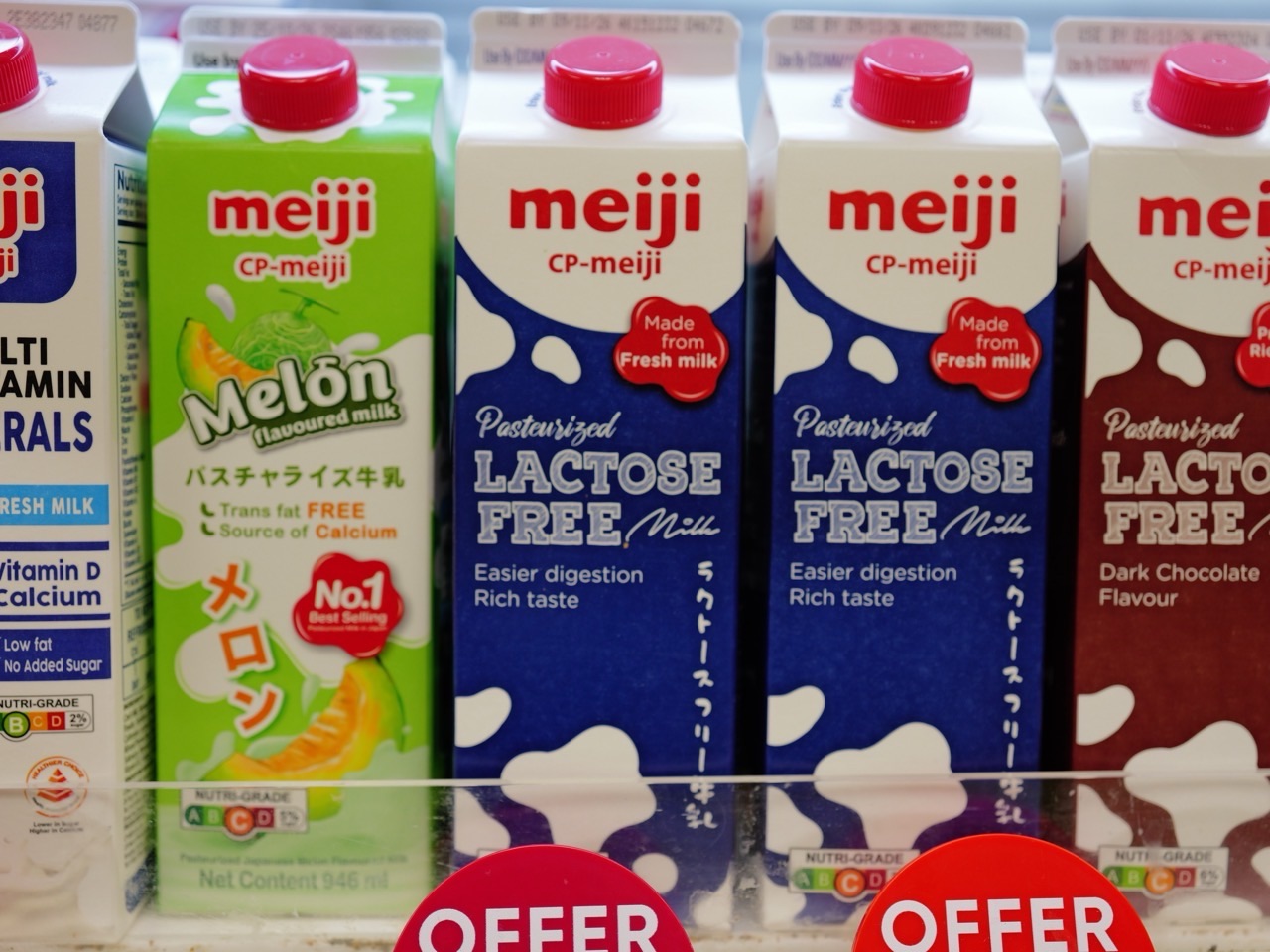
Food can give school learning in Tampines an immediate purpose: a label contains words, units, quantities and claims that a reader needs to interpret. It is a small text with surprisingly many opportunities for careful thinking.
Junyuan Secondary School’s Applied Learning Programme centres on Food, Innovation, Science and Health, or FISH. Its local example helps us explore how families can practise reading and numeracy without turning every meal into a lesson.
The label activity below is an independent eduKate exercise, not a school assignment or dietary advice. It teaches comparison and explanation, not calorie tracking, weight management or judging a child’s food choices.
eduKateSG · Neighbourhood education
Choose your next learning step
Understand the local example, try a manageable task and connect it with school learning.
Understand the school connection · Try the family activity · Find your next step
Full contents · Tampines school journeys and family learning
Contents
Explore, practise and connect · Five chapters
CHAPTER 1 OF 5
1. A local school connection: knowledge meets daily life
Junyuan’s official FISH description connects classroom knowledge with practical food and health contexts. It describes lower-secondary learning about eating habits and upper-secondary exploration of food science, sustainability and future pathways.
The school publishes examples involving food preparation, cultural tea appreciation and sustainable foods. These are opportunities to investigate a field, not a guarantee of a particular career or a substitute for the wider curriculum.
Junyuan Secondary is at 11 Tampines Street 84 according to its official contact page. Families should check current school arrangements directly; published programme information is not permission to enter its facilities.
The useful idea for home is simple: use a familiar object to make a reading or mathematical skill visible. A child who understands a unit on a page can begin to ask better questions about comparisons.
Official information: Junyuan Secondary: FISH Applied Learning Programme · Junyuan Secondary: official contact and location.
CHAPTER 2 OF 5
2. Read the unit before comparing the number
Use two fictional labels on paper. Product A lists 8g of sugar per 100g. Product B lists 5g per 50g serving. These numbers are invented solely for practising comparison.
Comparing 8 with 5 immediately would be misleading because the reference quantities differ. Scaling Product B to 100g gives 10g. On that common basis, A’s stated amount is lower.
The lesson is not that A is therefore the right food for a person. It is that a fair numerical comparison needs the same basis. A real food decision involves much more information and individual needs.
Ask the child to underline the unit and reference quantity before calculating. This habit is useful in school problems too: two numbers can look comparable while describing different amounts.
CHAPTER 3 OF 5
3. Explain the calculation in ordinary English
Try this sentence: “B lists 5g per 50g, so twice that amount of product would contain 10g on the stated basis.” The explanation identifies what changed and why multiplication was used.
A younger child can compare equal-sized pretend packets without decimals. An older learner can discuss scaling, proportions and how the wording limits the conclusion. Match the task to understanding, not the label’s complexity.
Keep a clear distinction between amount per serving and amount in the whole package. If a fictional 200g package contains four 50g servings, one serving’s figure does not describe the entire package.
Check the answer by returning to the original relationship. If doubling the reference quantity has left the stated amount unchanged, something in the reasoning needs attention. Corrections are easier when the child can point to the step.
CHAPTER 4 OF 5
4. Ask what the evidence does not tell us
A short label exercise cannot establish whether a product is suitable for someone with an allergy or a medical condition. Do not use a child’s calculation to replace professional advice or current product instructions.
Likewise, a large word on the front of a package is a claim to investigate, not a complete explanation. Ask what it means, which information supports it and what still needs checking.
For a non-food extension, compare fictional household-item prices per equal quantity. The same reasoning transfers without making nutrition the centre of attention. The skill is fair comparison.
During an ordinary Tampines shopping trip, a family can read one package together if time allows. Avoid photographing other customers, blocking aisles or asking the child to evaluate every purchase. One good question is plenty.
CHAPTER 5 OF 5
5. Keep curiosity separate from pressure
Ask the school how its programme develops inquiry, safe practical work and reflection. Find out what your child actually experiences at their level rather than treating a programme title as a complete timetable.
Should every family do this after shopping? No. Use it occasionally when the child is interested and rested. A friendly two-minute comparison can be more useful than a long compulsory worksheet.
Will this make a child a food scientist? It offers a glimpse of useful reasoning, not a career prediction. Curiosity can grow through many different subjects and contexts.
Finish with one takeaway: compare like with like, then explain the conclusion carefully. Our Tampines primary-school and neighbourhood-learning guide provides a broader route into daily school life, library learning and local exploration.
Sources and scope
Official programme and location information reviewed on 12 October 2026, Singapore time. Programmes and participation arrangements can change; confirm details with the school. This article is an independent eduKate guide, not a school endorsement, exhaustive directory or admissions guarantee.
Junyuan Secondary: FISH Applied Learning Programme · Junyuan Secondary: official contact and location