
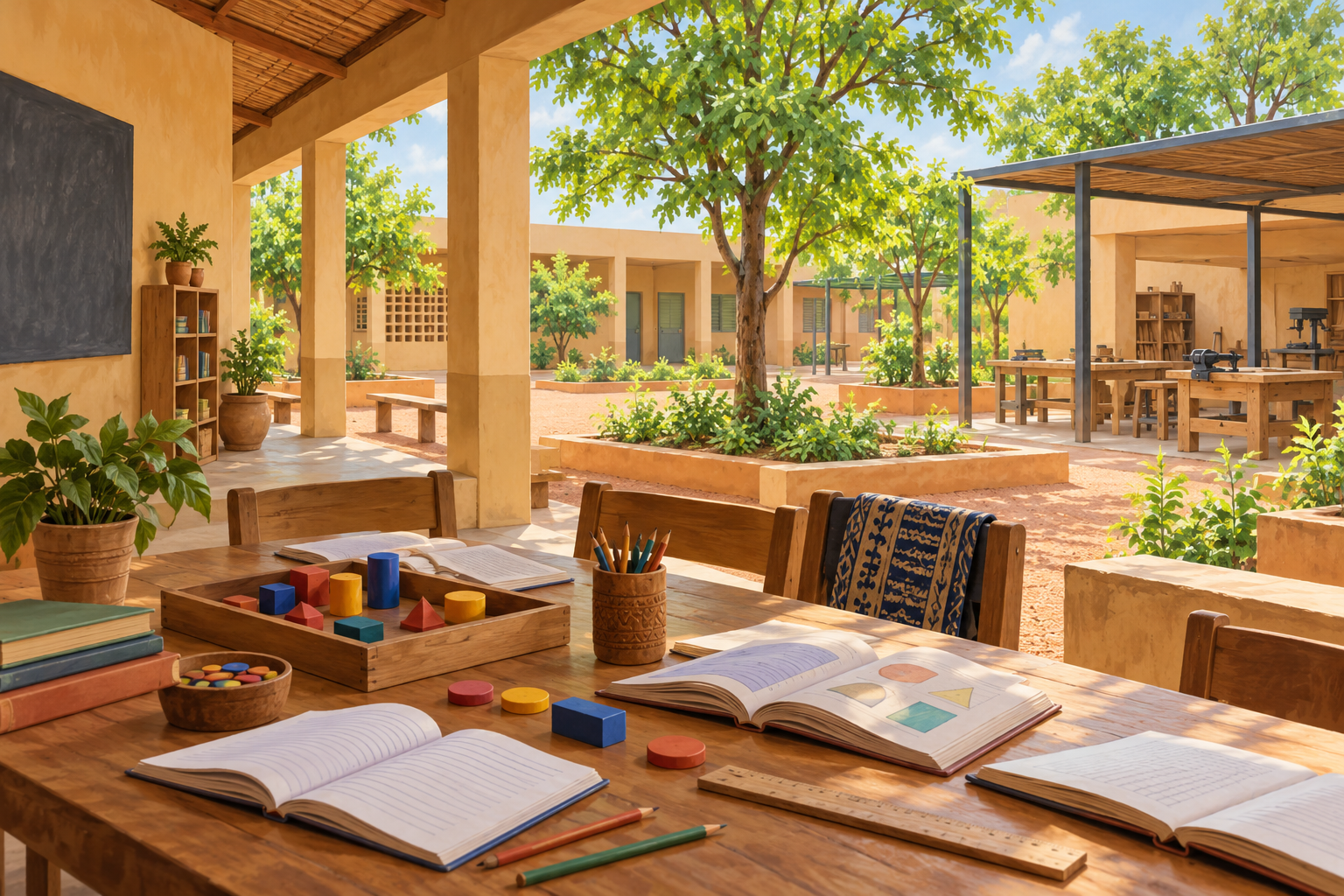
Schools of Burkina Faso normally follow a six–four–three general-school ladder: primary school from CP1 to CM2, four years of post-primary schooling from sixième to troisième, then three years of upper-secondary education from seconde to terminale. The major examinations are the Certificat d’Études Primaires (CEP), Brevet d’Études du Premier Cycle (BEPC) and baccalauréat (BAC). Technical, vocational and professional routes can lead to other awards, including CAP, BEP and professional qualifications, with different requirements.
The institutional picture matters more than an international grade chart. A pupil may attend a public primary school, a private primary school, a collège d’enseignement général (CEG), a lycée, a technical or professional establishment, a vocational centre, or schooling arranged to continue learning during displacement. These cannot be assessed as though every centre teaches the same programme or awards an identical certificate. Burkina Faso’s framework defines compulsory basic education between ages six and sixteen, but the ability to attend consistently can be affected by insecurity, displacement, school disruption and practical costs.
Important in 2026: On 7 May, the Council of Ministers adopted revised rules for post-primary and secondary school organisation, including closer links with technical/professional teaching. On 29 May, it approved a framework for regulating private education fees. Two detailed orders dated 10 July 2026 then addressed fees separately for preschool/primary and post-primary/secondary private establishments. These changes make the school’s actual status, approved courses and fee schedule essential to a family comparison.
This guide uses Burkina Faso’s education-system overview, the education law, and official May and July 2026 government decisions, with the learner’s safety and educational continuity at the centre.
Burkina Faso school types at a glance
| Institution or stage | Typical classes or programme | What to verify |
|---|---|---|
| Preschool / jardin d’enfants | Before CP1 | Registration, age, safeguarding, language and cost |
| École primaire | CP1, CP2, CE1, CE2, CM1, CM2 | Teaching, national primary curriculum and CEP |
| CEG / post-primary | 6e, 5e, 4e, 3e | BEPC route, current programmes, student placement |
| Lycée d’enseignement général | Seconde, première, terminale | BAC series, science and language options |
| Technical secondary establishment | Varies by programme | Technical certificates, professional modules and safety |
| Vocational / professional training centre | Varies by occupation | CAP, BEP, CQP or other precise award, approval and progression |
| Private school | Legally authorised stages | Actual fee order, approved charges and course recognition |
| Temporary / host-community learning arrangement | Location-specific | Safety, curriculum continuity and documents for progression |
Navigate directly to: [primary](#primary-school-cp1-to-cm2) · [post-primary](#post-primary-schools-sixieme-to-troisieme) · [general lycée](#general-lycees-seconde-to-terminale) · [2026 reform](#the-may-2026-post-primary-and-vocational-reform) · [fees](#july-2026-private-school-fee-regulation) · [displacement](#school-disruption-displacement-and-continuity) · [qualifications](#cep-bepc-bac-and-professional-awards).
Start with the school’s level, not its brand
The most useful school-identification question in Burkina Faso is which levels the specific institution is authorised to teach. An école primaire generally serves the six-year primary phase. A CEG may cover post-primary. A lycée can offer upper secondary and potentially other authorised programmes. A technical or professional institution may lead to certification on a different schedule.
Parents should not assume that every establishment with the word lycée awards exactly the same BAC series or includes identical workshop facilities. An institution that says “technical” might be registered for particular occupations, not for every profession a family has seen on the internet.
Likewise, a facility serving displaced learners can provide necessary continuity without automatically being an examination centre or awarding a complete secondary qualification. Ask how the learner’s progress is recorded and how a move to a recognised school or examination arrangement is handled.
The IFADEM education-system overview provides stable stage names. Dated notices from the school, regional service and relevant ministry are still required for actual admission, examination and fees.
Understand six primary, four post-primary and three secondary years
A normal uninterrupted pupil may begin CP1 around age six, finish six primary years around age twelve, finish post-primary around sixteen and then study another three years in upper secondary. Those ages illustrate a route; they are not a limit beyond which an older child has lost the right to learn.
Sixième is the first post-primary year, not the sixth primary year. After CM2, the pupil moves into a different stage with more differentiated subjects and increasing academic demands. The final post-primary year, troisième, leads to BEPC and decisions about general or vocational routes.
Seconde is the beginning of the upper-secondary general stage. The academic route reaches terminale, where BAC preparations matter. Technical and professional programmes may align to other levels or use different durations and examinations.
This distinction protects international pupils from false grade conversions. Someone who completed Burkina Faso’s quatrième has studied a particular post-primary class; a foreign school must inspect what that means academically rather than automatically assign the same English grade number.
Legal compulsory education is not a guarantee of attendance
Burkina Faso’s education framework, Law No. 013-2007/AN, establishes compulsory basic education for the relevant six-to-sixteen age group and the principle of free public basic education. However, those legal statements describe rights and state obligations, not proof of an available seat in every village.
A child’s actual school journey may be interrupted by safety threats, displacement, distance, teacher shortages, costs or the loss of documents. These are critical educational facts, particularly for families who move to host communities or return after an interruption.
The 2025 UNICEF Innocenti study describes the system and continuity challenges. Humanitarian situation reports can add context, but any numerical count of closed or reopened schools must retain its observation date.
An honest school-choice guide therefore asks not only “is education compulsory?” but can this child reach a safe, functioning learning programme regularly and progress with recognised evidence?
Preschool and the first school transition
Before CP1, early-childhood settings can develop language, cooperation, curiosity, motor coordination and number sense. A child should not have to demonstrate advanced examination ability to benefit from appropriate early education.
A good setting makes room for stories, conversation, sorting, counting, drawing, movement, play and observation. If a child speaks a national language at home and meets school French for the first time, the educator can build on what the child already understands while helping them communicate in the language of the classroom.
Families should check staff qualifications, safeguarding, water and sanitation, accessible facilities, hours, fees and the expected next school. A provider advertising bilingual learning should explain which languages are actually used and for what purposes.
The July 2026 fee order for private preschool and primary education means that the family’s cost inquiry should include the current regulatory framework, not only a prospectus written several years ago.
Primary school: CP1 to CM2
The six primary years are CP1, CP2, CE1, CE2, CM1 and CM2. This stage should establish reading comprehension, writing, numeracy, elementary science, social knowledge and useful study habits. The official primary curriculum and prescribed materials provide structure, but quality depends on what happens in real lessons.
A pupil may recognise words without understanding a paragraph. Another may understand a spoken explanation but struggle to write the answer in French. These are different needs and should be diagnosed separately.
In mathematics, children develop counting, place value, operations, multiplication and division, fractions, shapes, measurement and word-problem reasoning. The most dangerous weakness is copying a method that works only when the worksheet looks familiar.
A parent comparing two primary schools can ask for an actual example of marked work: What error did the teacher find? How was it explained? Did the child succeed with a new task afterward? A school that can answer those questions provides more educational information than a declaration of “100% excellence”.
CP1 and CP2: building number meaning
At the beginning of primary education, children should connect numbers to groups of objects and written language to comprehensible ideas. A student who writes 13 + 8 = 111 may be concatenating the digits rather than understanding place value.
The teacher can use a bundle of ten and loose counters: thirteen is one ten and three ones. Adding eight ones creates eleven ones, regrouped as another ten and one. The answer is 21. The written notation is then linked to the real quantity.
For reading, ask the child to tell the main event from a short, simple story. A pupil who repeats the sentence without understanding may need vocabulary and comprehension work; a pupil who understands the spoken story but struggles with print may need decoding practice.
This approach is important when school language differs from home language. It shows what the child knows instead of treating all hesitation as inability.
CE1 and CE2: the move from decoding to understanding
In middle primary, children need to use reading to learn, not only learn the sound of written words. A science paragraph about rain or soil can become a task in finding a cause, identifying a sequence or drawing a simple conclusion.
Arithmetic becomes more connected to real problems. For example: five families receive four notebooks each, making 20 notebooks. If one family receives two extra books, the total becomes 22. A pupil who calculates five times four correctly but then adds two to every family has misunderstood the wording.
The teacher should ask the learner to draw the families and explain who receives the extra books. That identifies the first faulty decision.
This is the teaching principle behind the immutable eduKate Clementi model: diagnose the exact unstable point, rebuild understanding, practise deliberately and test transfer. It applies to foundational primary learning in any country without pretending that the local syllabus is identical to Singapore’s.
CM1 and CM2: the bridge to sixième
The upper primary years require better fractions, measurement, multi-step reasoning and reading across subjects. Children need to summarise an unfamiliar passage, interpret a table, explain a scientific observation and organise short independent work.
Suppose a pupil calculates that 3/4 of 32 = 24, but fails when the same relationship is described as 32 litres of water with a tank three-quarters full. The obstacle may be recognising that a fraction can describe a real quantity. A model of four equal parts can repair the concept.
CM2 also precedes the CEP primary examination and the administrative move into post-primary school. Families should gather records and investigate the nearest suitable CEG, lycée or other recognised institution in advance.
A student’s preparation should include the actual syllabus and exam guidance, but it should not sacrifice broad foundational understanding in favour of repetitive test papers.
The CEP: primary completion, not secondary certification
The Certificat d’Études Primaires is a primary-level qualification. A passing result demonstrates attainment under a defined examination, but it is not the BEPC or BAC and should never be described as a university credential.
Burkina Faso’s Council of Ministers announcement of 21 May 2026 reported dates and candidates for the 2026 examinations, including the CEP beginning on 2 June 2026. Those dates are historical by October, not a standing 2027 timetable.
A parent should check subject requirements, examination centre, candidature eligibility and documentation for the learner’s real session. A school should provide a learning plan based on reading and numeracy needs, not merely collect exam fees without a transparent route.
For internationally mobile pupils, the original CEP document and a primary transcript can help explain completed learning. A receiving school must still make its own lawful placement decision.
Post-primary schools: sixième to troisième
General post-primary education covers four years: sixième, cinquième, quatrième and troisième. Its curriculum develops deeper mathematics, science, languages and social learning. The student moves from relatively guided primary work to greater subject differentiation and independent study.
The school may be a CEG or another institution authorised for the stage. A family should verify whether all four classes are offered, who supervises the school, and whether the appropriate BEPC assessment route is supported.
A learner entering sixième may be confident in arithmetic yet insecure with fraction concepts. That gap can later affect algebra, rate, geometry and science measurements. The most efficient help is to identify and repair the prerequisite, not introduce advanced exercises prematurely.
Safety and access remain critical. A school can have a legitimate curriculum yet not be reachable during a period of disruption. Families should ask the local education authority about operating status and safe alternative provision when necessary.
A worked post-primary algebra example
A pupil is asked to solve 4(x − 3) = 20. They write 4x − 3 = 20, having multiplied only the first term. The correct expansion is 4x − 12 = 20, so 4x = 32 and x = 8.
The teacher can model four identical bags each containing an unknown quantity minus three counters. The pupil should recognise that subtracting three in each bag means twelve counters removed across four bags.
Then change the problem to 3(x + 2) = 21. The student should divide by three to get x + 2 = 7 and hence x = 5. If they can explain both tasks without copying, the distributive and equality concepts are becoming stable.
This example is original and illustrative. It is not an official BEPC question and does not claim to reproduce the Burkina Faso examination syllabus verbatim.
BEPC and the choice after troisième
The Brevet d’Études du Premier Cycle (BEPC) marks an important end-of-post-primary milestone. Depending on qualifications and admission rules, students can seek general upper-secondary, technical or vocational pathways.
The 2026 government examination briefing separates BEPC, BEP and CAP examination arrangements. This demonstrates why a parent’s question “which secondary exam?” needs the specific programme name. These are different awards, even when the candidates are of similar ages.
Career guidance should compare subjects, practical content and later recognition. A student interested in technical work may benefit from a relevant vocational route, but should first understand the credential and whether it allows their intended further study.
A promising adolescent should not be reduced to one BEPC score. Strong counselling considers actual capabilities, the effect of interrupted schooling and the conditions under which the learner can complete a programme safely.
General lycées: seconde to terminale
The general academic upper-secondary stage runs through seconde, première and terminale. It prepares students for the baccalauréat in an applicable series and supports further education or other opportunities.
A pupil interested in engineering may need solid mathematics and physics. One interested in health-related study needs suitable science preparation; another planning law or journalism will need sustained reading and writing. These are broad learning needs, not a promise that any particular series automatically grants a university place.
A good lycée teaches more than past-paper repetition. Students should reason across several steps, use correct scientific units, construct evidence-based arguments and identify why a result might be wrong. A school should explain the actual subjects, facilities, teachers and assessment requirements available in the desired programme.
For 2026, the government reported the BAC examination period in the same May examination preparation statement. A student applying in 2027 must use the 2027 announcements, not copied 2026 dates.
A secondary science example using evidence
A student observes that water in a shallow open dish decreases more quickly in a warm, ventilated place than in a cool, still room. A weak answer simply says, “The water disappears.” A stronger answer explains that liquid water can evaporate into the surrounding air, and that temperature and airflow may influence the rate.
The teacher then asks how the experiment could be made fair: keep the container shape and initial water quantity consistent, vary one condition, measure over the same period, and interpret results cautiously. These are habits of scientific inquiry, not merely memorising one definition.
A further written task asks the learner to distinguish observation from inference. “The water level fell by two centimetres” describes the observation; “the difference may be linked to increased evaporation” is an explanation that needs evidence.
The example is original and not a claim about a named BAC examination problem. It demonstrates the level of thinking families should look for in secondary teaching.
Technical and vocational schools: different awards, different purposes
Burkina Faso’s technical and professional routes may prepare students for qualifications such as CAP, BEP, CQP, BQP, BPT or BPTS, depending on programme and responsible authority. These abbreviations are not interchangeable. Their admission requirements, content, assessment and progression may differ.
Some technical programmes involve general subjects and advanced technical study. Practical training can also occur through vocational centres or apprenticeships. A family should ask exactly what award the provider can issue, not treat all skills courses as equivalent to a general BAC.
A student interested in carpentry might need measurement, geometry, reading technical drawings, safe tool use and supervised practical work. Someone pursuing vehicle maintenance needs mechanics and diagnostic skills. Both benefit from literacy and mathematical reasoning.
Examine the equipment, teacher preparation, safety rules, assessed projects and local industry relevance. A school that promises guaranteed employment should supply credible evidence and clearly explain the limits of its claims.
The May 2026 post-primary and vocational reform
On 7 May 2026, the Council of Ministers adopted a decree reorganising post-primary and secondary education. The official account states that the changes reflect an effort to promote technical and professional education and create possibilities for more polyvalent forms of teaching.
The government also described reforms intended to reduce barriers among general, technical and professional structures, permitting a wider combination of offerings where authorised. But a national enabling decree is not proof that every CEG or lycée has already acquired new workshops, qualified trade teachers and every type of certification.
For families in 2026–2027, ask which new programmes the actual school is authorised and equipped to deliver. A school’s promise of an additional profession must be supported by curriculum, staffing, materials and an approved examination route.
The reform matters because school choice may become more flexible. Its implementation still requires precise local verification.
Private schools: where costs and authorisation matter
Private education can offer different management and learning options within the national regulatory framework. Families may encounter preschool, primary, post-primary, general secondary and technical providers. Private ownership alone does not establish stronger teaching or an internationally recognised credential.
Before paying, request the registered institution name, levels offered, current approval, full written fee schedule, examination body and policies for additional charges. A school that markets a cheap headline tuition price but adds unclear mandatory charges may impose a higher real cost.
School safety, transport, textbook availability, teacher continuity and learning support should carry substantial weight in the decision. An authorised school with weak instruction is not necessarily the best fit; an attractive campus with an unverified certificate may create even more serious difficulties.
This is especially relevant following the new 2026 rules for private-school fees, which require attention to the type of institution.
July 2026 private-school fee regulation
On 29 May 2026, Burkina Faso’s government approved a decree regulating tuition and other fees at private institutions. The official Council report explains concerns about inconsistent charging and calls for control and sanctions.
Detailed orders dated 10 July 2026 cover preschool and primary private establishments and post-primary and secondary private establishments separately. The government has published Order No. 2026-101 and Order No. 2026-159.
This is a regulatory change, not a claim that every private school is free. Parents should read the order applicable to the institution’s level, request an itemised price and ask which fees are lawful. Do not extrapolate a price cap or included service from an unrelated education level.
Household cost includes uniforms, materials, meals, transport and the risk of interruption. A family should plan sustainably rather than rely on an advertising promise.
School disruption, displacement and continuity
Security-related displacement has disrupted schooling in parts of Burkina Faso. Some families may move repeatedly, lose documents, stay in temporary settlements or seek school placement in host communities. These conditions alter the meaning of a normal grade progression.
The government acknowledged emergency education needs in May 2026, including the supply and equipment of temporary educational shelters such as Sahelian tents, and support for examination certification in affected regions. See the 21 May 2026 Council report.
Humanitarian organisations also report efforts to restore classrooms and support vulnerable pupils. Such work can improve access, but the presence of an aid project does not prove that every child has a safe or fully staffed school today. A local educational authority and trusted humanitarian provider should confirm actual operating arrangements.
Safety comes before academic optimisation. A family should not be encouraged to make a hazardous journey merely to reach a school with a higher advertised examination pass rate.
Learning after an interrupted school year
A student who has missed months of lessons may have learning gaps without having low ability. A pupil may retain strong number sense but lose fluency with written mathematics; another may read well in a home language but need vocabulary for a new instructional language.
The first step is to reconstruct an approximate learning history: last institution, classes attended, subjects, period of interruption, available records and current safe learning options. The second is to diagnose reading, numeracy and a small sample of subject understanding without shaming the learner.
Then build a sequence. If the first obstacle is fraction meaning, teach that before algebraic ratios. If science concepts are secure but French reading is weak, teach language through meaningful subject content. Review after a few weeks instead of forcing the learner into an unchangeable label.
Temporary and alternative educational services should record progress carefully, and families should ask how learning is recognised when formal schooling resumes. Support teaching and official certification are different tasks.
Languages in schools: French, national languages and English
French is a central language of formal schooling and school assessment, while Burkina Faso’s communities use multiple national languages. Bilingual and national-language initiatives play an important role in educational debate and practice. A school programme may also introduce or expand English under current reforms.
However, a policy announcement about expanding English is not proof that every child already receives an identical number of English-language lessons in 2026. Parents must inspect the actual syllabus, teacher supply and teaching language of the school.
A pupil who can explain rainfall or farming practices in Mooré, Dioula or another familiar language may need time to express the same scientific idea in formal French. The school should distinguish linguistic expression from conceptual understanding.
Academic vocabulary develops more effectively when taught with diagrams, observations and meaningful texts than when pupils are expected to memorise lists with no connection to ideas.
Primary and secondary school quality: what to inspect
Good schools diagnose problems rather than merely display rankings. A parent can ask to see how teachers provide feedback on a short writing sample, a fraction problem or a science explanation. Can a student identify why the answer was wrong and demonstrate improvement on a different task?
A school may be strong in one subject but need more resources in another. For technical programmes, inspect actual workshops and teacher expertise. For science-heavy programmes, ask whether practical learning is safe and available. For younger pupils, foundational reading and numeracy are decisive.
Schools should also communicate attendance expectations, safeguarding, disability support, disciplinary procedures, material charges and administrative contacts. Educational quality includes both what happens during a lesson and whether the learner can attend it consistently.
Do not make a final decision from one examination pass rate or one testimonial without its date and context.
An example: CM2 pupil in a host community
A CM2 learner has moved after an interruption and hopes to enter post-primary school. The family can recover a photo of the previous report but not the original paper certificate. It would be wrong to assume that missing documentation means the child has learned nothing.
The receiving authority should explain how records or prior study can be verified and which lawful placement route is available. Meanwhile, a short educational diagnostic can identify the pupil’s literacy and mathematics readiness.
A teacher asks: “A rectangular field measures 30 m by 20 m. What is its perimeter?” The correct answer is 100 m. A pupil calculating 600 square metres has found the area rather than the boundary. A drawing reveals the difference and allows immediate targeted support.
The family also asks about safe travel, available places, classroom language and how new records will be maintained. Academic support is important, but safety and official recognition are indispensable.
An example: BEPC learner comparing a lycée and training centre
A teenager passes BEPC and is interested in electrical installation. A general lycée, a technical programme and a vocational centre may all appear possible, depending on local provision and entry rules.
The family should compare the exact qualification, programme length, necessary mathematics and science, workshop safety, practical competencies, total costs and recognised destinations. An academy promising a diploma should identify the authority that awards it.
The learner can practise a basic hypothetical circuit problem: 24 volts across 8 ohms gives 3 amperes in the simplified Ohm’s-law model. If the student knows the calculation but not what the units represent, the technical programme should build that understanding.
The family should not assume a CQP or CAP automatically equals a BAC. Each award’s recognition needs to be checked with the relevant receiving institution.
An example: a student preparing for BAC after a move
A student changes location during upper secondary and wants to sit the BAC. First identify the previous and current series, subjects studied, available transcripts and examination requirements. The actual authority determines eligibility and whether changes in school create additional conditions.
A teacher can assess what the learner knows through short mathematics, reading and science tasks. If a missing unit on a physics calculation is a recurring error, repair the concept. If academic French writing is weak, support concise explanations using subject evidence.
Preparation should then follow the current candidate’s syllabus and a realistic timetable. Repeating old papers without checking changes can waste precious learning time.
There is no educational benefit in promising that one private tutor can override national examination registration, deadlines or eligibility rules.
CEP, BEPC, BAC and professional awards
The names sound familiar across Francophone countries, but their jurisdiction and curriculum are specific. In Burkina Faso, CEP relates to primary completion, BEPC to post-primary, and BAC to upper secondary. CAP, BEP and additional professional qualifications correspond to particular technical or vocational routes.
A certificate, a school report and an admission offer are different items. A student may have strong skills but still need a recognised award for a particular receiving institution. Another may possess a certificate and need extra subject prerequisites for further study.
Families should preserve original-language documents, examination year, subjects and issuing authority. A receiving institution abroad must decide official equivalence. The translation “high-school diploma” is too vague for technical certification or partial schooling.
Current-year regulations are the source of exam dates and eligibility; a 2026 schedule is not automatically valid for 2027.
Four-week school-readiness and recovery plan
Week 1 — Establish a safe educational starting point. Identify the learner’s last grade, school, language, period of interruption, available papers and current authorised education option. Ask for a short reading sample and two mathematics explanations.
Week 2 — Repair one first weak link. If the obstacle is fractions, use physical models and meaningful quantities. If it is French comprehension, support language through relevant school subjects. Do not add harder topics before the necessary foundation is reasonably secure.
Week 3 — Transfer to unfamiliar tasks. A proportion learned with notebooks should also work with distance, money or a science table. Ask the learner to explain how they know rather than merely reproduce a trained sequence.
Week 4 — Review, document and plan. Repeat comparable tasks, record progress and consult the responsible school or authority about examination, placement and fees. A pedagogical plan is not an official certificate and cannot guarantee access in a disrupted area.
Common errors when describing Burkina Faso schools
“Primary education is followed immediately by three years of secondary.” The ordinary route includes four post-primary years before three upper-secondary years.
“Sixième is the last primary class.” No. It is the first post-primary class; CM2 finishes primary.
“All secondary awards are the BAC.” BEPC and vocational qualifications are distinct.
“A 2026 reform means every lycée is now technical.” No. New authorisations and practical capacity must be verified institution by institution.
“Public basic schooling is compulsory, therefore attendance is guaranteed everywhere.” Law and access are different, especially during displacement.
“All private tuition fees are unregulated.” Government fee rules changed in 2026, with level-specific July orders.
“A child who has missed lessons is incapable of secondary study.” Interrupted schooling calls for supportive assessment and targeted teaching.
“An excellent examination score automatically secures a university place.” The receiving institution applies its own eligibility and selection rules.
Frequently asked questions
What are Burkina Faso’s six primary classes?
What is post-primary school?
How long is general upper secondary?
What is CEP?
What is BEPC?
What is BAC?
Is basic education compulsory?
Do private schools have regulated fees?
Can a learner continue during displacement?
Is a vocational certificate the same as a general BAC?
Continue the world schools library
For the broader national education system, read Understanding the Education System of Burkina Faso. Compare its six–four–three structure with Schools of Benin and the Schools of Bulgaria transition to vocational gymnasiums. The eduKateSG education hub connects this national knowledge to learning diagnostics and practical family decisions.
A family should start by documenting the functioning school, exact class, safe access, recognised programme, qualification and actual learning needs. That is more useful than a generic ranking that ignores local conditions.
Official sources and editorial review
- Burkina Faso education-system overview — IFADEM — stage names and established route.
- Education Law No. 013-2007/AN — compulsory basic education framework.
- Government, 7 May 2026 — post-primary and secondary organisation — current vocational integration changes.
- Government, 21 May 2026 — examinations and emergency education — dated examination session and disruption-related measures.
- Government, 29 May 2026 — private fees regulation — national framework.
- Order 2026-101, 10 July — preschool and primary private fees — level-specific fee rules.
- Order 2026-159, 10 July — post-primary and secondary private fees — level-specific rules.
- UNICEF Burkina Faso humanitarian appeal — education access and continuity context.
- UNICEF Innocenti, 2025 — education system and compulsory ages — structural evidence.
- eduKateSG — Understanding the Education System of Burkina Faso — companion national-system article.
Reviewed 18 October 2026. The guide separates statutory access from functioning availability, reforms from confirmed school delivery, academic certificates from vocational awards, and private fee regulation from claims of cost-free private schooling. Mathematical and science examples are original educational demonstrations, not claimed CEP, BEPC or BAC papers.