
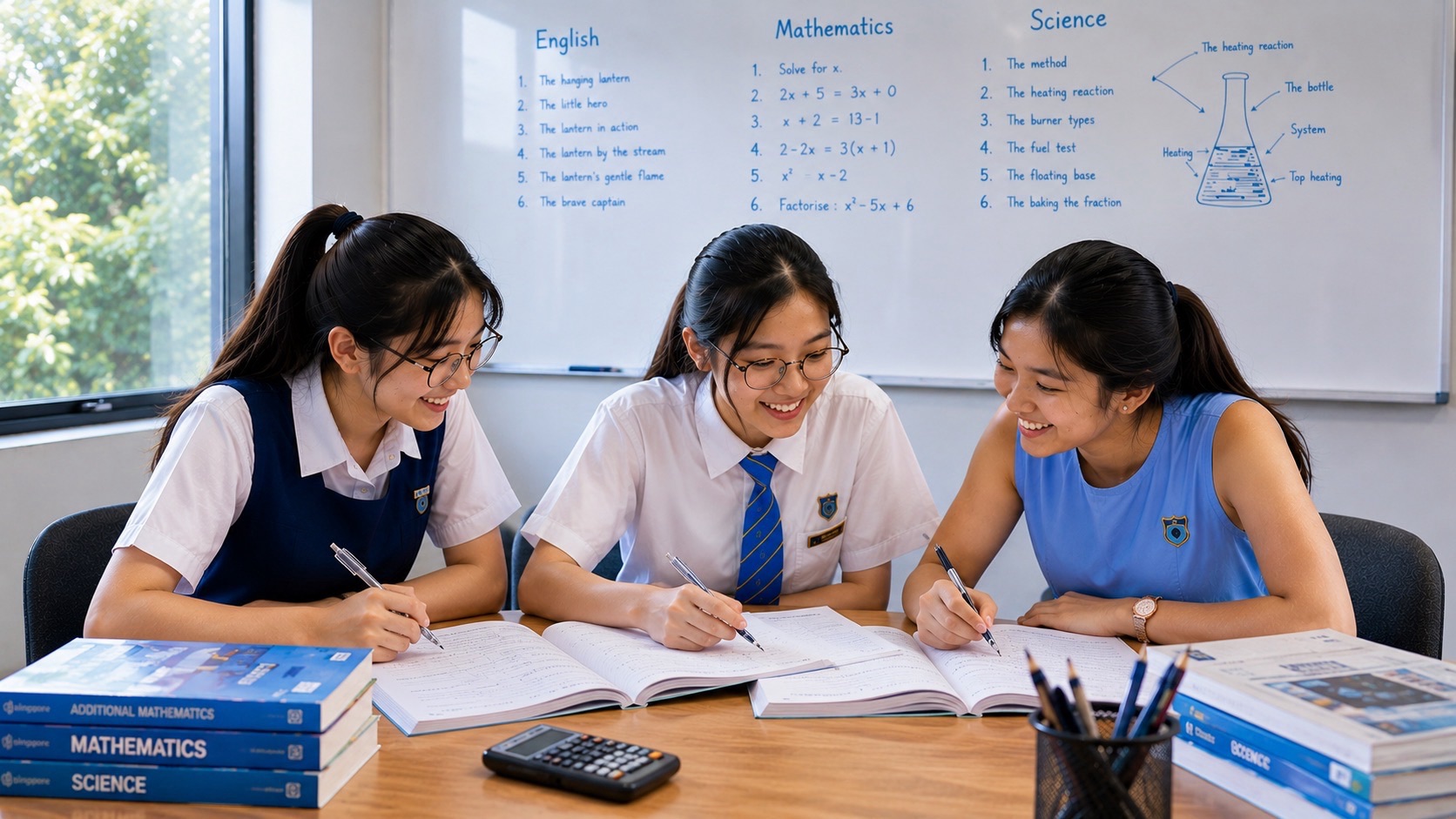
SEC Examination Mathematics tuition for Jalan Besar families should prepare students for the Mathematics subject level they will actually sit while addressing the search needs parents commonly express as G1 Mathematics tuition, G2 Mathematics tuition, G3 Mathematics tuition, SEC Maths exam preparation, small-group Mathematics, algebra support, problem-solving, accuracy and examination confidence. From 2027, the Singapore-Cambridge Secondary Education Certificate replaces the former separate N(T), N(A) and O-Level certificates, but students still sit individual subjects at G1, G2 or G3. The certificate structure changes; the need for precise level-specific Mathematics preparation does not disappear.
SEAB lists 2027 Mathematics as K110 at G1, K210 at G2 and K310 at G3. The common SEC certificate therefore must not be treated as one common Mathematics paper. Effective tuition begins by confirming the student’s actual subject level and school evidence, then diagnosing conceptual understanding, numerical fluency, algebraic control, problem interpretation, written working, calculator use, accuracy, checking and time management. The official SEAB SEC overview and the 2027 G1, G2 and G3 syllabus listings remain the examination references.
This Jalan Besar guide is a local examination-discovery route within eduKateSG. It does not replace the existing Secondary 1, Secondary 2, Secondary 3 or Secondary 4 Mathematics owners, Additional Mathematics owners or broad examination-preparation pages, and it does not imply a physical eduKateSG branch in every locality named for discovery. The Mathematics Learning Hub remains the subject map and the Examinations & Assessment Hub remains the assessment map. This page stays focused on SEC G1/G2/G3 Mathematics examination reliability for Jalan Besar search intent.
What SEC Changes—and What It Does Not
SEC changes the certification structure from 2027. Students receive one Singapore-Cambridge Secondary Education Certificate that reflects the subjects and subject levels they sat. It does not collapse G1, G2 and G3 Mathematics into one syllabus or one common standard. That distinction should be clear before any tuition programme is planned.
For tuition, “SEC Maths” names the examination family but not yet the exact paper. The first operational question is which subject level the student is taking. Preparation that ignores this can produce the illusion of relevance while using the wrong depth, pacing, question architecture or expected techniques.
SEAB also states that there is no change in the overall standards of examinations under SEC merely because the qualification is combined and renamed. Students therefore still need the underlying mathematical work: concepts must be understood, procedures stabilised, unfamiliar problems interpreted, working communicated and answers checked.
G1, G2 and G3 Are Subject Levels, Not Labels of Worth
G1, G2 and G3 describe subject levels. They should be treated as curriculum and assessment specifications, not as identities. A student taking Mathematics at one level needs teaching calibrated to that syllabus, the student’s current school evidence and the actual mechanisms limiting performance.
The same visible error can arise from different causes. A student may get an algebraic question wrong because the concept is missing, because a basic manipulation is not retrievable, because signs are handled inaccurately, because the question is misread, or because time pressure causes rushed work. The subject level tells us which mathematical field matters; diagnosis tells us what to repair inside it.
A useful tuition system therefore avoids prestige language around levels and focuses on mastery. The goal is to help the learner become reliable at the Mathematics they are actually studying, while preserving the possibility of progression where the school and student’s evidence support it.
Examination Preparation Begins with a Performance Map
Before prescribing more papers, tuition should build a performance map. Recent school scripts, topical tests, homework and timed work reveal where marks are being lost. The map should separate content knowledge from execution. Without that distinction, tuition can spend months reteaching topics the learner already understands while ignoring the actual source of lost marks.
A practical map can classify errors as conceptual, retrieval, algebraic, numerical, interpretive, representational, procedural, organisational, calculator-related, checking-related or timing-related. The categories do not need to be perfect. They need to be specific enough that the next lesson changes.
For example, if a student repeatedly loses marks because a calculator answer is copied incorrectly, more topic explanation is unlikely to help. If the student cannot construct an equation from a verbal relationship, timed practice is premature. The diagnosis should determine the intervention.
Conceptual Understanding Is Still the Core
Examination preparation can become dominated by technique: memorise this pattern, use this formula, apply this shortcut. Techniques are useful when they sit on conceptual understanding. Without that base, the student becomes vulnerable when a familiar idea appears in unfamiliar wording or in a multi-step application.
Strong tuition asks whether the learner can explain relationships, not only perform procedures. Why does an inverse operation preserve an equation? What does gradient represent? Why must a probability stay within an allowable range? What does a ratio compare? Why does a negative sign change a quantity or a graph? Explanation exposes the structure beneath the procedure.
This does not mean every examination solution should contain an essay. The point is that the learner’s internal model should be strong enough to generate the procedure. When understanding is secure, concise exam working becomes safer because each line has mathematical meaning.
Number Sense Does Not End in Primary School
Secondary students still need number sense. It now appears as magnitude judgement, sign awareness, percentage intuition, proportional reasoning, sensible rounding and the ability to notice when a calculator output is implausible. A learner who treats every displayed decimal as trustworthy has outsourced too much mathematical judgement to the device.
Place value also remains active. Scientific notation, decimal approximation, standard form, percentage change and measurement all depend on understanding magnitude and positional value. A misplaced decimal point can create an answer that is numerically neat but conceptually impossible.
Strong tuition therefore continues to ask estimation questions. Should this answer be greater or smaller than the original quantity? Is the percentage change plausible? Is a length of 0.004 kilometres sensible in the stated context? These quick checks connect secondary procedures back to the same number sense that began in Primary Mathematics.
Numerical Fluency and Retrieval
Secondary Mathematics depends on fluent foundational knowledge. Fractions, percentages, ratios, indices, signed numbers, basic algebra and standard transformations appear inside larger questions. If these elements require excessive attention, working memory is consumed before the higher-level reasoning begins.
Retrieval should therefore be diagnosed separately from understanding. A student may understand a law of indices but apply it slowly. Another may perform it quickly in isolation but fail to recognise when it is relevant inside an algebraic expression. The first needs fluency; the second needs recognition and transfer.
Short, repeated retrieval can be more effective than redoing an entire chapter. The practice should target the weak operation and then return it to mixed contexts. Examination fluency means the knowledge is available when needed, not merely when a worksheet title announces it.
Algebraic Control
Algebra is one of the major reliability bottlenecks in Secondary Mathematics. Students can understand a problem and still lose marks through sign errors, mishandled brackets, weak fraction manipulation or incomplete transformations. Algebraic control is therefore both conceptual and procedural.
A useful diagnostic method is to remove the surrounding problem and test the algebraic kernel directly. If a student fails the isolated manipulation, the repair belongs in algebra. If the isolated manipulation is secure but the student cannot form the equation from context, the gap lies in modelling or interpretation.
Clear line-by-line working matters because it makes algebra auditable. Skipping too many steps may look sophisticated but can make sign changes invisible. The best amount of working is enough to preserve logic, expose high-risk transformations and support checking without turning every solution into unnecessary detail.
Equations, Formulae and Symbolic Meaning
Many students can manipulate an equation while losing sight of what it represents. Tuition should periodically reconnect symbols with meaning. If x represents a length, a negative answer may be algebraically obtained but contextually impossible. If a formula expresses a rate, changing one variable should have a sensible effect on the others.
Substitution is more than plugging numbers into boxes. The learner must preserve brackets, units and order of operations. A frequent examination error occurs when a negative quantity is substituted without brackets and the sign is lost. A specific prevention routine—rewrite the substituted expression clearly before calculating—can remove an entire class of mistakes.
Rearranging formulae should also be taught as maintaining equality rather than “moving” terms magically across a line. When the student understands that the same operation is applied to both sides, procedures become easier to reconstruct if memory fails.
Problem Interpretation Before Calculation
Many examination questions are difficult not because the arithmetic is advanced but because the learner must translate words, diagrams, tables or graphs into mathematical relationships. The student must determine what is known, what is unknown and what constraints govern the situation before choosing a method.
Tuition should therefore include interpretation-only tasks. Give a problem and ask the student to state the relationships without solving. Ask what each quantity represents, which information is relevant and what a sensible answer range might be. Removing calculation temporarily makes the modelling process visible.
This is especially useful for students who rush. They often begin manipulating numbers before the mathematical structure is stable. A short planning pause can save more time than it costs because it prevents a long solution built on the wrong interpretation.
Model Drawing and Representation Still Matter at Secondary Level
Model drawing is strongly associated with Primary Mathematics, but the deeper habit—externalising a relationship—remains valuable in Secondary Mathematics. A ratio diagram, number line, annotated geometry figure, graph, table or algebraic model can reduce working-memory load and make the unknown visible.
Students who abandon representation too early can become overly dependent on symbolic manipulation. When a word problem is unfamiliar, drawing a simple relational sketch may reveal the equation more quickly than staring at the text. Representation is not childish; it is a general mathematical tool.
The representation should be economical. A useful diagram keeps the mathematical relationships and removes decorative details. The learner should be able to point to each label and explain what it means. If not, the representation has become another copied procedure.
Working Is Part of the Examination Product
Mathematics examinations assess more than a final number. Working communicates method, preserves mathematical state and can protect method marks when a later arithmetic slip occurs. SEAB syllabus documents make clear that essential working matters. Students should therefore treat working as part of the answer, not as private scratch space.
Good working has structure. Equations line up logically. Intermediate values are labelled when needed. Calculator outputs are not copied without context. Units appear where relevant. Exact forms are preserved until approximation is appropriate. These habits reduce both marking risk and self-generated confusion.
The tutoring goal is not aesthetic perfection. It is auditability. A student should be able to return to a solution and see what was done, why it was done and where an error entered. That makes correction far more educational than simply comparing the final answer with a key.
Calculator Use Is a Mathematical Skill
Approved calculators reduce arithmetic burden, but they introduce their own failure modes: incorrect mode, mistyped expression, premature rounding, copied digits, hidden brackets and failure to judge whether an output is plausible. Calculator fluency should therefore be taught as part of examination execution.
Students should know when mental estimation is useful before entering a calculation. If an output is several orders of magnitude away from expectation, the calculator should not be trusted merely because it produced a precise-looking number. Technology does not remove the need for number sense.
Another useful habit is to retain sufficient precision through intermediate steps and round at the end according to the question and syllabus expectations. Premature rounding can create avoidable drift in multi-step work.
Exactness, Approximation and Units
Students need to distinguish exact answers from approximations. A fraction, surd, multiple of pi or algebraic form may carry exact information that is lost when converted too early to a decimal. Conversely, some contexts require a numerical approximation in an appropriate form.
Units also matter. A correct numerical calculation can still be incomplete or misleading if the unit is absent or wrong. Area, volume, speed, time, angle and currency each impose different conventions. Unit awareness should therefore be part of the problem representation, not an afterthought.
A simple final-answer routine can protect marks: check sign, magnitude, unit, required form and rounding. This takes seconds once internalised and catches several common error classes.
Geometry and Diagram Discipline
Geometry creates a different kind of examination pressure because students must coordinate visual information, properties and calculation. Diagrams may suggest relationships that are not actually given. Learners should distinguish what is stated, what can be inferred and what merely looks true.
Tuition can train this by asking students to annotate diagrams before solving. Mark known angles, equal lengths, parallel lines, right angles and other explicit conditions. Then identify which theorem or relationship is justified. This turns the diagram from a picture into a mathematical representation.
Students should also avoid relying on scale unless the question permits it. An angle that looks acute may not be intended as evidence. Examination confidence grows when the learner trusts stated properties and derived relationships rather than visual guesswork.
Graphs, Tables and Data
Graphs and tables compress information. They test whether a learner can read scales, identify variables, interpret trends and translate between representations. A student may know the underlying algebra but lose marks because an axis is read incorrectly or a value is extracted from the wrong series.
One useful routine is to read the representation before the question: identify axes, units, scale, labels and the type of relationship shown. This small investment reduces impulsive reading later. When several data series are present, the student should explicitly identify which one the question refers to.
Interpretation questions also require language precision. “Increasing”, “constant”, “maximum”, “rate of change” and “difference” describe different mathematical observations. Tuition should connect these words to visual evidence.
Statistics and Probability
Statistics and probability often appear accessible because the arithmetic can be straightforward. The conceptual traps are different. Students must define the relevant population or set of outcomes, interpret averages appropriately, distinguish frequency from probability and recognise when a result should lie within a logical range.
Probability answers should be checked against basic constraints. A probability cannot be negative or greater than one. A calculated value outside that range is an immediate signal that something went wrong. This kind of domain check is an efficient form of mathematical monitoring.
For statistics, students should avoid treating one summary number as the entire story. Mean, median, range and spread answer different questions. Even where syllabus depth differs between G1, G2 and G3, the habit of asking what a statistic actually represents improves interpretation.
Real-World and Contextual Problems
Contextual questions are designed to make the learner select and coordinate Mathematics rather than repeat a visible template. They may combine rates, percentages, geometry, data or algebra inside a practical situation. The challenge is often route selection.
A strong approach separates the story from the mathematical state. Identify the quantities, units, constraints and target. Build the mathematical model. Solve. Then return to the context and ask whether the answer is meaningful. This final return matters because a mathematically valid intermediate result may not be the answer the context requires.
Students should also learn to reject impossible contextual answers. A negative length, an impossible number of whole objects or a percentage outside the relevant context can expose an error immediately. Reasonableness is part of problem-solving.
Diagnostic Gap Repair at SEC Level
When a Secondary student loses marks, the topic label is rarely specific enough. “Weak in algebra” may mean difficulty forming equations, expanding brackets, manipulating fractions, handling signs, substituting values or choosing an algebraic route. “Weak in geometry” may mean the theorem is unknown, the diagram is misread, or algebra fails after the geometry has already been solved.
The first wrong move should guide the repair. If the student misreads the question before writing anything, more calculation practice is low-value. If the equation is correct but the manipulation fails, interpretation does not need reteaching. If everything is correct until the final calculator entry, the bottleneck is execution.
A strong repair uses reduced complexity first. Remove difficult numbers while preserving the relationship. Isolate the algebraic kernel. Simplify the diagram. Once the mechanism is stable, rebuild full examination complexity and retest after a delay. This is diagnostic gap repair rather than indiscriminate revision.
Timing: Protect the Whole Paper
Examination timing is not simply a matter of working faster. It is the management of limited attention across the whole paper. One difficult question should not consume the time needed for several accessible questions later.
A useful timing system includes recognition of a stall point. If progress has stopped despite a genuine attempt, the student marks the question, preserves any useful working and moves on. Returning later with fresh attention is often better than forcing a solution while anxiety rises.
Timed practice should be introduced after enough knowledge is stable. Timing an unlearned skill only measures failure under pressure. Once the Mathematics is reasonably secure, timed segments can help students calibrate pace, switching and recovery.
Checking: Use the Right Check for the Right Risk
“Check your work” is too vague unless the student knows what to check. Different questions support different verification methods. Algebra may be checked by substitution. Numerical work may be checked by estimation or an inverse operation. Geometry may be checked against angle or length constraints. Probability may be checked against its allowable range.
Students should learn to identify high-risk points in their own work. Alicia may frequently lose signs. Tricia may round too early. Kai Kai may omit units or stop after finding an intermediate quantity. Personal error patterns tell each student where checking attention has the highest return.
Checking should be built into normal practice rather than introduced only before examinations. Habits formed under calm conditions are more likely to survive time pressure.
Alicia: Strong Knowledge, Weak Route Selection
Alicia knows many formulas and completes topical worksheets quickly. Her marks drop in mixed papers because she commits to the first familiar-looking method. The error occurs before calculation. Her tuition should therefore delay execution. She first identifies the target, lists relevant relationships and explains why the chosen route fits.
For Alicia, more formula memorisation may increase confidence without solving the real problem. Mixed problem sets, interpretation-only drills and comparison of multiple solution routes are more useful. The goal is to make method selection deliberate.
Her improvement should be measured by fewer wrong starts, not merely faster completion. Once route selection stabilises, speed can be rebuilt without sacrificing judgement.
Tricia: Conceptually Sound, Retrieval Too Expensive
Tricia can explain the Mathematics well but spends too long on basic manipulations. Signed numbers, fraction arithmetic and algebraic transformations require repeated conscious effort. By the time she reaches the deeper part of a question, working memory is already taxed.
Her tuition should preserve conceptual understanding while making common operations more retrievable. Short fluency sets, repeated algebraic kernels and spaced retrieval can reduce the cost of routine work. The practice then returns to mixed examination questions so that fluency transfers into real performance.
Tricia’s progress is visible when the same reasoning can be executed with less mental friction. She should not merely become faster; she should have more attention available for interpretation and checking.
Kai Kai: Accurate with Support, Fragile Alone
Kai Kai produces strong work in guided tuition but becomes uncertain in school tests. He frequently asks whether a method is correct before completing it. The limiting mechanism is not necessarily content knowledge. It is dependence on external confirmation.
His repair is gradual removal of reassurance. He completes a short section independently, marks the questions he is uncertain about, performs one check and only then receives feedback. This trains self-monitoring rather than tutor monitoring.
Timed work can be useful later, but the first objective is autonomous decision-making. Examination confidence grows when the learner has evidence that they can choose, execute and check without immediate external approval.
Small-Group SEC Mathematics: What Makes It Useful
A small group is educationally useful when the tutor can observe each student’s working and give mechanism-specific feedback. Class size alone is not a method. The value comes from visibility, comparison of routes and enough individual attention to distinguish understanding from execution.
Alicia, Tricia and Kai Kai can work on the same broad problem while receiving different constraints. Alicia may have to justify route choice before calculating. Tricia may complete a retrieval warm-up before the task. Kai Kai may work without confirmation until the solution is complete. Shared content does not require identical intervention.
Peer explanation can expose hidden assumptions. When students compare solutions, the tutor can ask which route is valid, which is efficient and where each method is vulnerable. The discussion should remain mathematical rather than competitive.
School Assessments as a Diagnostic Stream
School common tests, weighted assessments, preliminary examinations and practice papers provide a stream of evidence. Tuition should not wait for a major examination before analysing patterns. Every script can update the performance map.
The tutor can record the first wrong move for each lost mark and look for recurrence. If sign errors appear across algebra, coordinate geometry and trigonometry, the shared mechanism may be algebraic control rather than three separate topic weaknesses. If blank questions cluster near the end, pacing may be more important than content.
This approach prevents overreaction to one score. A single difficult paper may produce a lower mark without indicating broad decline. Trends across mechanisms are more useful than isolated percentages.
Paper Corrections Should Produce a New Rule
Redoing a question correctly after seeing the solution is not enough. A correction should answer three questions: What was the first wrong move? Why did it happen? What will the student do differently next time?
The new rule should be specific. “Be careful” is weak. “Write the negative sign on a separate line when expanding this bracket” is actionable. “Check the axis scale before reading a coordinate” is actionable. “Label the intermediate quantity before the next operation” is actionable.
After the correction, the same mechanism should appear in a changed question. If the student succeeds only on the original problem, the correction may be memory rather than transfer.
Topic Practice, Mixed Practice and Full Papers
These three practice modes serve different purposes. Topic practice is useful when a concept or procedure is being learned or repaired. Mixed practice tests recognition and method selection. Full papers add pacing, switching, endurance and strategic attention.
A common mistake is to move directly to full papers because examinations are approaching. If the student has a stable repeated weakness, full papers simply reproduce it at scale. Repair the mechanism first, then test it inside mixed work, then expose it to full-paper conditions.
Another mistake is to remain in topical work too long. A student can become excellent at a chapter while remaining unable to recognise it when the cue disappears. The practice mode should evolve with the purpose.
Building Examination Stamina
Longer Mathematics papers require sustained attention. Stamina is not built by repeatedly forcing exhausted students through full papers. It is built progressively. Begin with accurate untimed work, then timed sections, then mixed blocks, then full-paper simulations.
Students should learn how their attention changes over time. Some rush at the start, others slow excessively after one difficult problem, and others lose checking discipline near the end. Simulations are useful because they expose these patterns.
Recovery routines matter. If the student notices fixation, the next action should be known: mark the question, move, reset, start the next accessible item, then return later. The Mathematics paper is a system; one local difficulty should not damage the entire attempt.
G1 Examination Preparation: Protect Fundamental Reliability
For a G1 Mathematics student, preparation should protect the foundational numeracy and contextual reasoning that the actual syllabus requires. The student should not be given harder material simply because it appears more advanced. Difficulty should come from mastering the correct syllabus more reliably: interpreting practical situations, maintaining numerical accuracy, showing necessary working and applying known concepts without excessive prompting.
Diagnostic work should identify whether the student loses marks through basic operations, language, units, calculator use, formula selection or uncertainty about how to begin. A G1 student can make substantial progress when routine mathematical actions become dependable and the learner develops a clear method for recovering from unfamiliar wording.
Confidence at G1 should therefore be grounded in successful independent execution. A student who can interpret, calculate, label, check and move on when stuck is developing a more valuable examination system than one who merely recognises familiar worksheet formats.
G2 Examination Preparation: Build Breadth and Transfer
For G2 Mathematics, the student must coordinate a broader set of concepts while preserving reliable numerical and algebraic execution. The challenge is often not one isolated chapter but moving between topics. A learner may handle algebra well in a topical exercise and then fail to recognise the same structure inside a geometry or data question.
G2 preparation should therefore move deliberately from topic repair to mixed practice. School evidence should determine where that transition happens. The aim is not to make the student imitate G3 work; it is to make G2 Mathematics increasingly secure, transferable and exam-ready at the correct subject level.
As confidence grows, timed mixed sections can test whether the learner selects methods efficiently. If performance drops only under time, the next intervention may be pacing or retrieval rather than more conceptual teaching.
G3 Examination Preparation: Preserve Method Under Complexity
G3 Mathematics places heavier demands on algebraic control, modelling, geometry, statistics, probability and extended problem-solving. The student needs enough fluency that routine manipulation does not consume the attention required for route selection. Clear working becomes increasingly important because longer solutions create more places for a small error to enter.
G3 tuition should therefore train both mathematical depth and paper management. The student must recognise structures in mixed questions, decide when a method is justified, preserve exactness where appropriate, manage calculator use, communicate essential working and keep one difficult question from absorbing the entire paper.
The strongest G3 preparation does not confuse difficulty with learning. A hard question is useful when it exposes a reasoning or execution mechanism that can be improved. Random difficulty for its own sake can generate frustration without producing diagnostic value.
Worked Example: Diagnose the Algebraic Kernel
Alicia loses a mark while solving a contextual problem because she expands 3(2x – 5) as 6x – 5. The surrounding problem may involve rates or geometry, but the first wrong move is algebraic. The tutor removes the context and tests several short bracket-expansion items. If the error repeats, the repair belongs in distributive multiplication rather than in the original application topic.
After the kernel is repaired, the algebra returns to mixed contexts. That return matters. A student who can expand brackets only on an algebra worksheet may still fail when the same operation is embedded inside a larger question. Transfer completes the repair.
Worked Example: Timing as Decision-Making
Tricia reaches a difficult question and spends twelve minutes trying different routes without making progress. The issue is not simply speed. It is failure to recognise a stall point. In timed practice, she learns a decision rule: after a genuine attempt with no productive change, mark the question, preserve the useful working, move to an accessible item and return later.
The improvement is measured across the whole paper. Tricia may not solve that difficult question immediately, but she protects marks elsewhere and often returns with a clearer view. Paper strategy is successful when it improves total examination performance, not when it proves persistence on one item.
Worked Example: Checking as a Personal System
Kai Kai repeatedly omits units in measurement and speed questions. Telling him to “check everything” spreads attention too thinly. His final-answer routine becomes specific: sign, magnitude, unit, required form, rounding. He writes a small cue at the top of practice pages until the sequence becomes internalised.
Alicia’s checking system may be different because her high-risk area is sign handling. Tricia may need to guard against premature rounding. Effective checking is partly personal because error histories differ. The common principle is to direct limited attention to predictable failure points.
Worked Example: A Word Problem That Is Really a Reading Problem
A student knows percentage change but repeatedly chooses the wrong base quantity. The arithmetic is correct; the interpretation is not. The tutor temporarily removes all calculation and presents several short scenarios asking only, “What is the original amount? What is the new amount? Which quantity is the percentage measured against?” This exposes the relational structure without numerical noise.
Only after the base quantity is consistently identified does calculation return. The learner then solves mixed percentage problems where increase, decrease, reverse percentage and repeated change appear in changing order. The repair targets reading first and computation second.
Worked Example: Calculator Output versus Mathematical Sense
Alicia enters a compound calculation and gets 4827.6 for a quantity that should clearly be below 50. Instead of immediately checking the keys, the tutor asks what range she expected before calculation. That expectation becomes the first diagnostic signal: if no expected range exists, number sense has been disconnected from calculator use.
She then reconstructs the expression, checks brackets and finds the entry error. The lasting habit is to predict magnitude before trusting output. A calculator should accelerate Mathematics, not replace judgement.
Jalan Besar Study Routines: School Evidence Before Extra Volume
For a family searching from Jalan Besar, examination preparation should fit the student’s actual school cycle. When common tests, weighted assessments or preliminary examinations are approaching, it can be tempting to add large stacks of papers. Volume is useful only if the papers generate information and the information changes practice.
A student who completes five papers with the same sign error has not necessarily done five units of learning. One carefully analysed paper followed by targeted algebraic repair, mixed retesting and a second timed section may produce more progress. School evidence should determine what happens next.
A local tuition decision should therefore be based on diagnostic quality, subject-level accuracy, visibility of working and the ability to connect correction with retesting. Convenience is useful, but examination reliability is built by the teaching system.
How to Read a School Script Properly
A school script should be read chronologically through the learner’s thinking, not only numerically through the marks. Start with the first line where the solution diverges from a valid route. Everything after that may be a consequence rather than a separate weakness.
If the student selected the wrong formula but then calculated perfectly, the main repair is formula recognition. If the formula was correct but substitution failed because a negative value lost its bracket, the repair is substitution discipline. If the whole solution is mathematically sound but unfinished, pacing becomes more important.
Over several scripts, repeated first failures form a profile. That profile is more actionable than a list of percentages by chapter because it shows what the learner does under real assessment conditions.
Revision Planning: Separate Maintenance from Repair
Not every topic needs equal revision time. Some topics are already secure and only require maintenance. Others contain active misconceptions or repeated execution failures and need repair. Treating all topics equally can waste scarce revision time.
A useful weekly plan has three lanes: maintenance of secure knowledge, targeted repair of current weaknesses, and mixed examination practice that tests integration. The balance shifts as the examination approaches. Early in the cycle, repair may dominate. Later, mixed performance and pacing become more important.
The plan should remain responsive to evidence. If a repaired error returns in a mixed paper, it moves back into targeted practice. If it remains stable across several papers, it can return to maintenance. Revision is therefore a feedback system rather than a fixed timetable.
The Final Weeks Before an SEC Mathematics Examination
Late preparation should become increasingly evidence-driven. The question is no longer “What chapters have we covered?” but “Which mechanisms are still costing marks?” A short list of recurring weaknesses is more useful than a large undifferentiated revision pile.
Students should maintain retrieval of core skills, revisit high-value misconceptions, complete mixed sections and practise realistic timing. New material should be introduced cautiously if it displaces consolidation of skills that are already close to reliable.
Sleep, routine and materials also matter. Examination confidence is weakened when the student arrives tired, unsure about calculator readiness or unfamiliar with their own pacing plan. Preparation includes reducing avoidable uncertainty.
Examination Confidence Comes from Evidence
Confidence is strongest when it is supported by repeated evidence. A student who has solved unfamiliar questions, recovered after mistakes, completed timed sections and corrected recurring weaknesses has reasons to trust the process. Encouragement matters, but confidence becomes durable when the learner has experienced successful recovery.
This is why tuition should sometimes preserve productive uncertainty. If the tutor immediately rescues every hesitation, the learner never experiences the process of choosing a route, checking it and discovering that it works. Controlled independence is part of exam preparation.
The aim is not emotional invulnerability. Students can still feel nervous. The stronger target is procedural confidence: even when nervous, the learner knows how to read, represent, calculate, check, move on and return.
What Parents Can Ask Without Becoming the Tutor
Parents can ask useful process questions: Which G-level Mathematics are you sitting? Which three error types are currently costing the most marks? What do you do when you are stuck? How do you check algebra? When do you move on from a difficult question? These reveal whether the student has an examination operating system.
Parents can also ask to see one corrected script. The goal is not to inspect every mark. Look for whether the learner understands the errors and can describe the prevention rule. A pile of completed corrections with no change in future performance is low-value work.
Support should remain proportionate. Excessive monitoring can unintentionally increase dependence. The aim is for the student to own the performance map and the revision plan increasingly as the examination approaches.
Jalan Besar SEC Mathematics: Local Discovery, Level-Specific Examination Work
Jalan Besar is the family’s discovery context; examination preparation still has to be calibrated to the student’s actual G1, G2 or G3 Mathematics syllabus. That separation is important for both teaching and search architecture. A local page can help a family find the right entry point without becoming a second broad SEC owner or displacing year-specific Secondary Mathematics teaching.
The diagnostic job is to find the first point where performance stops being reliable. That point may be concept knowledge, number sense, retrieval, algebraic control, problem interpretation, representation, written working, calculator use, checking, pacing or confidence under independent conditions. The score is evidence; the mechanism determines the repair.
Strong SEC Mathematics tuition therefore remains disciplined: confirm the subject level, map the errors, repair the first weak link, retest under variation, add time pressure only after enough stability exists, and protect the whole paper through deliberate checking and pacing.
Frequently Asked Questions
Is SEC Mathematics one common paper?
No. SEC is the common certificate framework, while Mathematics continues at subject levels G1, G2 and G3. For 2027, SEAB lists Mathematics as K110 at G1, K210 at G2 and K310 at G3.
Does SEC lower examination standards?
SEAB states that there is no change in the overall standards of examinations under SEC simply because the former certificates are combined and renamed. Preparation should therefore remain aligned to the actual syllabus and subject level.
Should students start with full papers?
Not automatically. Full papers are useful for pacing and integration, but a repeated mechanism-level weakness is often repaired more efficiently with targeted practice first. Move from repair to mixed practice to timed full papers.
How do we reduce careless mistakes?
Identify the error class. Sign mistakes, calculator entry, copied numbers, omitted units and wrong operation choice need different prevention routines. Replace “be careful” with an observable checking action.
What does examination confidence look like?
Reliable confidence means the student can start unfamiliar questions, recover after a stall, choose when to move on, preserve clear working and use checking methods without needing immediate reassurance.
Continue Through the Jalan Besar Mathematics Routes
- Primary 1 Mathematics Tuition | Jalan Besar
- Primary 2 Mathematics Tuition | Jalan Besar
- Primary 3 Mathematics Tuition | Jalan Besar
- Mathematics Learning Hub
- Examinations & Assessment Hub
Continue the Jalan Besar Mathematics route: Primary 4 to PSLE
- Primary 4 Mathematics Tuition | Jalan Besar
- Primary 5 Mathematics Tuition | Jalan Besar
- Primary 6 Mathematics Tuition | Jalan Besar
- PSLE Mathematics Tuition | Jalan Besar
For the complete subject map, use the Mathematics Learning Hub.