
SEC Examination Mathematics tuition in Queensway should help a student understand the Mathematics they are actually sitting, repair prerequisite gaps and execute accurately under examination conditions. Families searching for SEC Mathematics tuition around Queensway, Queenstown, Alexandra and the central-west corridor may now encounter new language around the Singapore-Cambridge Secondary Education Certificate, Full Subject-Based Banding and G1, G2 or G3 subject levels. The labels are changing, but the practical work remains demanding: conceptual understanding, algebraic and numerical fluency, problem-solving, accuracy, interpretation, timing and disciplined checking.
From 2027, SEAB states that the former N(T), N(A) and O-Level certificates are combined into the Singapore-Cambridge Secondary Education Certificate, or SEC. Students continue to sit individual subjects at their respective G1, G2 or G3 levels, and SEAB states that there is no overall lowering of examination standards. For 2027 school candidates, Mathematics is listed as K110 at G1, K210 at G2 and K310 at G3. Tuition therefore needs to be level-accurate while avoiding the false idea that every secondary student is preparing for one identical Mathematics paper.
This Queensway page is an examination-transition and local-discovery route. It does not replace existing Secondary 1, Secondary 2, Secondary 3 or Secondary 4 Mathematics owners, and it does not replace specialised Additional Mathematics or broader exam-preparation pages. The Mathematics Learning Hub remains the broad Mathematics map, while the Examinations & Assessment Hub remains the wider assessment router. This page focuses narrowly on SEC Mathematics preparation, G1/G2/G3 transition, diagnostic repair and examination execution for families finding eduKateSG through Queensway.
SEC Mathematics: New Certificate Structure, Continuing Mathematical Demands
The change to SEC matters because parents and students will see different labels on syllabus pages, registration information and examination certificates. The learner still needs to prepare for the Mathematics subject level actually taken. A useful tuition conversation therefore begins with the student’s current subject level, school pathway, syllabus requirements, recent performance and specific error patterns rather than with an old broad assumption such as “everyone is doing O-Level Maths”.
The transition should be explained clearly without turning every lesson into policy discussion. Students need enough context to know what G1, G2 or G3 means for their subject, then teaching should return quickly to Mathematics. The examination still rewards accurate understanding and execution. A new certificate name does not remove the need to manipulate expressions, reason from data, interpret graphs, solve problems or check whether answers fit the conditions given.
The 2027 G1, G2 and G3 Mathematics Codes
For 2027 school candidates, SEAB lists Mathematics as K110 at G1, K210 at G2 and K310 at G3. These codes matter operationally because they identify different subject-level syllabuses. They should not be treated as three names for one identical paper. A tutor should confirm the level and current syllabus before selecting practice material, interpreting a school result or deciding which examination techniques are relevant.
The older reference codes remain visible on SEAB syllabus pages for comparison with 2026 and earlier systems, but the 2027 SEC codes are the relevant new identifiers. Students do not benefit from vague preparation. The right question is: which Mathematics level is this learner taking, what knowledge and skills does that syllabus expect, and which prerequisite gaps prevent the learner from demonstrating those expectations reliably under examination conditions?
Do Not Confuse Subject Level with Student Ability
G1, G2 and G3 are subject levels within the new system, not personality labels. A learner should not be described as mathematically weak simply because one subject is taken at a particular level. The productive focus is the current syllabus and the next achievable improvement. Tuition works best when errors are treated as information about knowledge, representation and execution rather than as evidence of fixed ability.
This matters especially during transition years because families may carry older assumptions from N(T), N(A) and O-Level pathways. The SEC structure changes how the certificate is organised while preserving differentiated subject levels. A diagnostic approach is more useful than inherited labels: identify what the student can already do, locate the first unstable prerequisite and build forward from evidence rather than teaching to an identity.
SEC Preparation Should Not Displace Year-Specific Secondary Mathematics
A Secondary 1 student needs a different learning plan from a Secondary 4 student even if both eventually sit SEC subjects. Year-specific owners should therefore continue to carry progression, topic sequencing and age-stage teaching. An SEC page has a narrower purpose: examination transition, subject-level awareness, diagnostic readiness, paper execution, revision and confidence. This keeps the information architecture aligned with the actual learning journey.
If a student has a Secondary 2 algebra gap, the repair belongs in the Secondary Mathematics progression even though the longer-term destination is SEC. If a Secondary 4 student understands algebra but loses marks from timing and checking, SEC examination preparation becomes more immediately relevant. The same learner may need both routes at different moments. Separating these roles prevents local SEC pages from competing with existing year-specific owners.
Start with a Diagnostic Map, Not a Stack of Papers
Past papers and timed papers are useful only when the results are interpreted. Giving repeated papers without analysis can make a student practise the same weaknesses at examination speed. A diagnostic map should separate concept knowledge, procedure, retrieval, interpretation, representation, accuracy, checking and timing. The score is only the top layer. The tutor needs to know why those marks were lost and whether the same cause appears across topics.
For each error, ask where correct reasoning stopped. Did the student misunderstand the question? Choose an invalid method? Forget a formula? Manipulate algebra incorrectly? Copy a sign? Use the calculator poorly? Omit a unit? Stop because of time? These categories lead to different interventions. Diagnosis turns an examination script into a learning plan and prevents the vague instruction to “do more papers” from replacing targeted teaching.
Number Sense Still Matters in Secondary Mathematics
Secondary students sometimes assume number sense is a primary-school skill. It remains essential. Estimation, sign awareness, magnitude and proportional reasoning help students detect impossible answers and choose efficient methods. A calculator can produce a decimal, but it cannot decide whether the input represented the intended Mathematics. A student who has an expected range is much more likely to catch a keying or setup error.
Before pressing keys, students should have a rough expectation. Should the answer be positive or negative? Larger or smaller than one? Around tens, hundreds or thousands? If a percentage change produces an absurd magnitude, number sense should trigger a review. These quick checks prevent small input mistakes from becoming accepted final answers and reduce dependence on the appearance of a calculator display.
Place Value and Arithmetic Gaps Can Survive into Secondary School
Some secondary errors originate in primary foundations: decimal place value, fraction equivalence, ratio interpretation, percentage meaning or order of operations. A student may appear to have an algebra problem when the actual weakness is numerical. For example, an equation can be manipulated correctly until a fraction calculation breaks the solution. The visible secondary symptom can therefore sit above a much older prerequisite gap.
Repair should move backwards only as far as necessary. If decimal place value is unstable, fix it directly and reconnect it to the current topic. The purpose is not to send a teenager through primary worksheets. It is to restore the prerequisite so secondary reasoning can proceed without repeated breakdown. Efficient tuition repairs the first broken dependency and then rebuilds forward into the current syllabus.
Arithmetic Fluency Still Protects Working Memory
Even when calculators are permitted for parts of a syllabus, fluent basic arithmetic remains valuable. Students need to simplify expressions, recognise factors, estimate, manipulate fractions and notice numerical patterns. Slow basic processing consumes attention that should be used for algebraic structure or problem interpretation. Fluency matters because it reduces the cognitive cost of routine work and leaves capacity for the actual reasoning demand.
Fluency at secondary level does not mean returning to endless basic drills. Target the specific bottleneck. If integer signs are unstable, practise them in short mixed sets and then return them to algebra. If fraction operations cause errors, rebuild equivalence and common denominators before placing fractions back inside equations. Fluency practice should support the current syllabus rather than exist separately as a disconnected exercise.
Algebra: Meaning Before Symbol Manipulation
Algebra becomes fragile when students learn transformations as unexplained moves. “Move it across and change the sign” may work temporarily, but it hides the principle of maintaining equality. A stronger student understands that the same valid operation is applied to both sides of an equation. That meaning provides a recovery path when the familiar layout changes or when an unfamiliar coefficient appears.
Diagnostic questions should vary form. Put the unknown on either side. Include fractions, brackets or negative coefficients where syllabus-appropriate. Ask the student to explain why a transformation preserves equality. If understanding survives variation, symbolic manipulation is more likely to transfer under examination pressure. If performance collapses when the layout changes, the procedure may be memorised more strongly than the relationship.
Expressions: Simplify Without Losing Structure
Simplifying expressions requires attention to like terms, signs, factors and order of operations. Many errors are not deep conceptual failures but small structural losses: a negative sign disappears, a bracket is expanded incorrectly or unlike terms are combined. These mistakes are costly because they can invalidate several later lines and make a correct overall method appear wrong.
Teach students to inspect the expression before operating. Which terms are alike? Where are the brackets? Which sign belongs to which term? Can a factor be taken out? This short pause creates a plan. Accuracy often improves more from deliberate structure reading than from trying to write each line faster, and a clean structure makes later checking easier.
Equations: Check the Solution by Substitution
An equation solution can usually be checked by substituting the value back into the original equation. This is one of the clearest examples of mathematical self-verification. Students should use it selectively, especially after complicated manipulation or when a sign error is plausible. A final answer is stronger when it survives an independent test rather than merely looking familiar.
The check should return to the original equation, not only the final simplified line. A correct value should make both sides equal. When substitution fails, the student has evidence that something went wrong and can trace backward. This is more productive than staring at the final answer and hoping it looks right, and it trains examination confidence based on proof rather than reassurance.
Ratio and Proportion: Keep the Quantities Attached
Ratio errors often occur because students manipulate numbers while forgetting what each number represents. A ratio compares quantities in a particular order. Scaling requires both quantities to change consistently. Proportion problems may also involve units that must be aligned before a relationship is used. Numbers should therefore stay attached to their meanings for as long as possible.
Label quantities during diagnosis. Ask what a ratio term represents, what stays constant and what changes. Use a table, bar representation or equation depending on the level and question. Strong proportion reasoning is not about memorising cross-multiplication; it is about recognising a multiplicative relationship and preserving it accurately across equivalent forms.
Percentage: More Than a Formula
Percentage means “per hundred” and connects naturally to fractions, decimals and proportional reasoning. Students who treat every percentage question as a formula-selection exercise may struggle with reverse percentages, percentage change or repeated change. Meaning helps distinguish the base quantity from the changed quantity, which is often the central decision in a difficult question.
Before calculating, identify one hundred percent. Ask whether the required value should be larger or smaller than the base. Estimate the direction and rough magnitude of change. These checks are especially important in financial and real-world questions, where a mechanically correct-looking calculation can still use the wrong reference amount and produce a plausible but conceptually invalid answer.
Graphs and Functions: Read Relationships, Not Just Coordinates
Graph questions require students to connect visual information with algebraic meaning. A point is not merely a pair of numbers; it represents a relationship between variables. Gradient, intercept, trend and shape each carry information. Students should learn to describe what a graph is saying before applying a formula because the representation often reveals the structure of the problem.
Ask whether the graph is increasing or decreasing, where it crosses an axis, which region satisfies a condition and whether the scale is uniform. These preliminary observations often make the subsequent algebra easier. They also reduce the risk of extracting the right number from the wrong feature and help the student connect graphical and symbolic representations.
Geometry: Diagrams Are Evidence, Not Permission to Guess
Secondary geometry questions often include diagrams that look suggestive. Students must rely on stated facts, known properties and valid deductions rather than on visual appearance. A line that looks perpendicular is not necessarily perpendicular unless given or proven. An angle that looks equal may not be equal. The drawing supports reasoning but does not replace evidence.
Teach students to annotate only defensible information. Mark known angles, parallel lines, equal lengths or relevant properties. Then state the reason for each deduction where required. Geometry accuracy improves when the diagram becomes a structured record of evidence instead of a picture to estimate from, and the student becomes less likely to smuggle assumptions into a proof or calculation.
Mensuration: Formula Knowledge Is Only the Beginning
Mensuration errors may involve formula selection, unit conversion, substitution, calculator input or interpretation of a compound shape. Students should identify the object or region first, decide which quantities are known and determine whether decomposition is required. Only then should a formula be applied. Formula recall without structural reading is not enough for unfamiliar composite figures.
Units are a powerful check. Length, area and volume use different dimensional units. An area answer in centimetres instead of square centimetres signals incomplete thinking. Estimates also help: if a small diagram yields an implausibly enormous area, the calculation or units deserve another look. Unit and magnitude checks are cheap ways to catch expensive errors.
Statistics and Data: Read the Representation Before Calculating
Data questions can appear easy because the arithmetic is often familiar, but careful reading matters. Students must inspect titles, scales, units, class intervals or categories before extracting numbers. A misread scale can make every subsequent calculation wrong even when the arithmetic is flawless. Examination accuracy therefore begins before the first calculation is written.
Build a short data-reading routine: identify what is measured, how it is represented, the relevant unit and the exact comparison being asked. Then calculate. This routine slows the first ten seconds and can save several marks. Examination efficiency is not always about moving faster; sometimes it is about preventing the need to redo work after a structural misread.
Probability: Define the Sample Space Carefully
Where probability appears in the relevant syllabus, students need to identify possible outcomes and favourable outcomes precisely. Informal intuition can be misleading when outcomes are not equally likely or when multiple stages are involved. A systematic list, table or tree representation can reduce omissions and make the sample space visible enough to inspect.
Before calculating, ask what counts as one outcome and whether all outcomes in the denominator are equally likely. After calculating, check that the probability lies within a sensible range. A probability below zero or above one is impossible, and simple boundary awareness can catch calculation mistakes immediately. Representation and reasonableness work together here just as they do elsewhere in Mathematics.
Calculator Use Is a Mathematical Skill
A calculator can increase accuracy only when the user controls the expression. Students need to know when brackets are required, whether the calculator is in the correct mode, how to retain sufficient precision and when rounding should occur. Entering a long expression without an estimate is risky because a keying error can go unnoticed and the displayed number can acquire undeserved authority.
Use a three-step habit: estimate, enter, inspect. The estimate gives a target range. The entry should mirror the mathematical structure clearly. The inspection compares the result with expectations and required accuracy. A calculator is not a substitute for number sense; it is an execution tool inside a mathematical checking system and should be trained as deliberately as any written method.
Rounding and Accuracy Need Discipline
Students can lose marks by rounding too early, using an incorrect number of significant figures or failing to follow a question’s accuracy instruction. These are not glamorous errors, but they are highly preventable. Working values should generally preserve sufficient precision until the appropriate final stage so that small rounding errors do not compound across several calculations.
Teach the student to note the required accuracy before calculation. At the end, apply the instruction deliberately and include units where needed. A final-answer routine can turn these small requirements into habits. In examinations, disciplined finishing often separates an almost-correct solution from a credited one, and these are marks that should not depend on memory at the last second.
Word Problems: Translate Before Manipulating
Secondary word problems often require students to define variables, connect quantities and build equations from text. Strong arithmetic is not enough if the relationship is misread. A useful first step is to state what the unknown represents and label quantities before writing an equation. This creates a bridge from language to symbols instead of allowing algebra to begin from an untested assumption.
Students should be able to explain the relationship in ordinary language and then translate it into Mathematics. After solving, they must interpret the value in context. A numerical solution that violates a real-world condition may need to be rejected or reconsidered. Translation therefore occurs both before and after algebra, and successful problem solving requires control of both directions.
Multi-Step Problems Need Intermediate Meaning
In a multi-step question, students sometimes produce a correct intermediate value and then forget what it represents. This leads to incorrect use of the number in the next step. Every intermediate result should have a label or mental meaning. “12.4” is less useful than “12.4 km remaining” because the label preserves the relationship between the calculation and the problem.
A short plan helps: first find the rate, then use it to find the required time; first find the missing length, then calculate area. The wording need not be written formally in the examination if the student can hold the structure mentally, but training should make the chain explicit until it becomes reliable. Planning reduces aimless calculation and makes later checking easier.
Accuracy: Stop Calling Every Error Careless
Secondary students often describe lost marks as carelessness. That label is too broad. An error can be a sign mistake, copied value, algebraic transformation error, misread scale, wrong formula, calculator entry problem, premature rounding, omitted unit or failure to answer the actual question. Each category has a different repair, and repeated use of one vague label hides the pattern that tuition needs to address.
An error log should therefore record type, not only topic. If sign errors recur across algebra and coordinate geometry, the problem is broader than one chapter. If units are omitted repeatedly, add a final-answer scan. If calculator entry errors dominate, train estimation and structured entry. Patterns turn frustration into an actionable system and allow progress to be measured by reduced recurrence.
Checking Should Be Matched to the Question
Different questions support different checks. Equations can be checked by substitution. Arithmetic can be checked by estimation or inverse operations. Graph points can be checked against the equation. Geometry answers can be compared with angle or length constraints. Units and magnitude can filter mensuration errors. Students should build a toolbox rather than repeat one generic “check your work” instruction that offers no method.
The best check is often the cheapest independent test. Repeating the same calculation in the same way may reproduce the same mistake. An inverse or alternative representation provides stronger evidence. Examination training should therefore include the question: what is the fastest different way to test this answer? Good checking is selective, efficient and matched to the failure most likely to occur.
Timing: Measure Where Time Is Actually Lost
A student who runs out of time does not necessarily need to “work faster” everywhere. Time may be lost in slow fact retrieval, indecision about method, overlong algebra, excessive checking, repeated rereading or getting stuck on one high-friction question. Timing data should identify the bottleneck so that practice can target the actual source of delay rather than create indiscriminate speed pressure.
During practice, record question-level time selectively. Compare it with accuracy and method. A question completed quickly but incorrectly is not efficient. A difficult question that consumes disproportionate time may need a stop-and-return rule. Good examination pacing protects marks by allocating attention according to value and solvability and by preventing one problem from consuming the time needed for several accessible ones.
Paper Order and Recovery Strategy
Students need a recovery plan for moments when a question stalls. The plan may be to mark the item, write any useful setup and move on temporarily. Remaining stuck without progress can damage both time and confidence. Returning later with lower pressure sometimes makes the structure visible, especially when another question has activated a related concept or representation.
The exact paper strategy depends on the examination format and individual learner, so tuition should avoid rigid universal rules. What matters is deliberate choice. The student should know when to persist, when to move, and how much time must be protected for final review. Practice papers are where this judgement is trained, not merely where scores are collected.
Past Papers: Use Them as Data, Not Entertainment
Past papers are valuable because they expose students to authentic structure, mark allocation and integration of topics. But doing many papers without error analysis can create the illusion of preparation. The student becomes familiar with paper format while the same weaknesses continue. A stack of completed papers is not evidence of progress if the error profile remains unchanged.
After each paper, classify errors, identify high-cost bottlenecks and choose a repair set. Then use targeted questions before attempting another full paper. This alternation—paper, diagnosis, repair, transfer, paper—is more efficient than an uninterrupted stack of timed papers. The goal is to change the next performance, not simply record another score and hope repetition alone creates improvement.
Alicia: Strong Understanding, Slow Execution
Alicia often knows what to do but takes too long to reach the answer. Her work shows repeated rewriting, slow arithmetic and hesitation before choosing routine algebraic steps. A full-paper score therefore understates her conceptual knowledge but accurately exposes an execution bottleneck. Her tuition should not reteach everything she already understands, but it also cannot ignore the timing cost.
Her tuition separates retrieval from reasoning. Short drills target specific slow procedures, while timed clusters measure whether efficiency improves without sacrificing accuracy. Alicia also practises choosing the shortest valid method. The objective is not frantic speed. It is reducing unnecessary cognitive and written work so more time remains for demanding questions and so her conceptual strength can actually appear on the paper.
Tricia: Fast Work, Fragile Interpretation
Tricia calculates rapidly but sometimes answers a different question from the one asked. She may choose a familiar formula before identifying the quantities or misread a comparison. Her scripts contain impressive-looking working that begins from an incorrect model. Speed amplifies the mistake because she commits to the wrong structure before stopping to test the premise.
Her repair is a deliberate first-pass reading routine. She identifies the target quantity, units, givens and relationship before calculation. For complex word problems she writes one short variable definition or diagram. Her overall time may initially become slightly slower, but accuracy improves because fewer long solutions begin from the wrong premise. Later, the reading routine itself becomes faster through repetition.
Kai Kai: Mathematics Is Sound, Checking Is Inconsistent
Kai Kai often reaches correct methods but loses marks through sign errors, rounding, calculator entry or omitted units. He describes these as unlucky mistakes. The pattern shows that the issue is not luck; it is the absence of a dependable finishing system. A student cannot control every difficult question, but can build routines that reduce preventable losses.
He builds matched checks: estimate numerical work, substitute equation solutions, verify units, reread accuracy instructions and compare final answers with the original condition. The tutor gradually reduces reminders. Kai Kai’s confidence improves because he has a repeatable way to detect errors before submission rather than simply hoping to be more careful next time. Verification becomes part of the method, not an optional afterthought.
Three-Student SEC Mathematics Tutorials
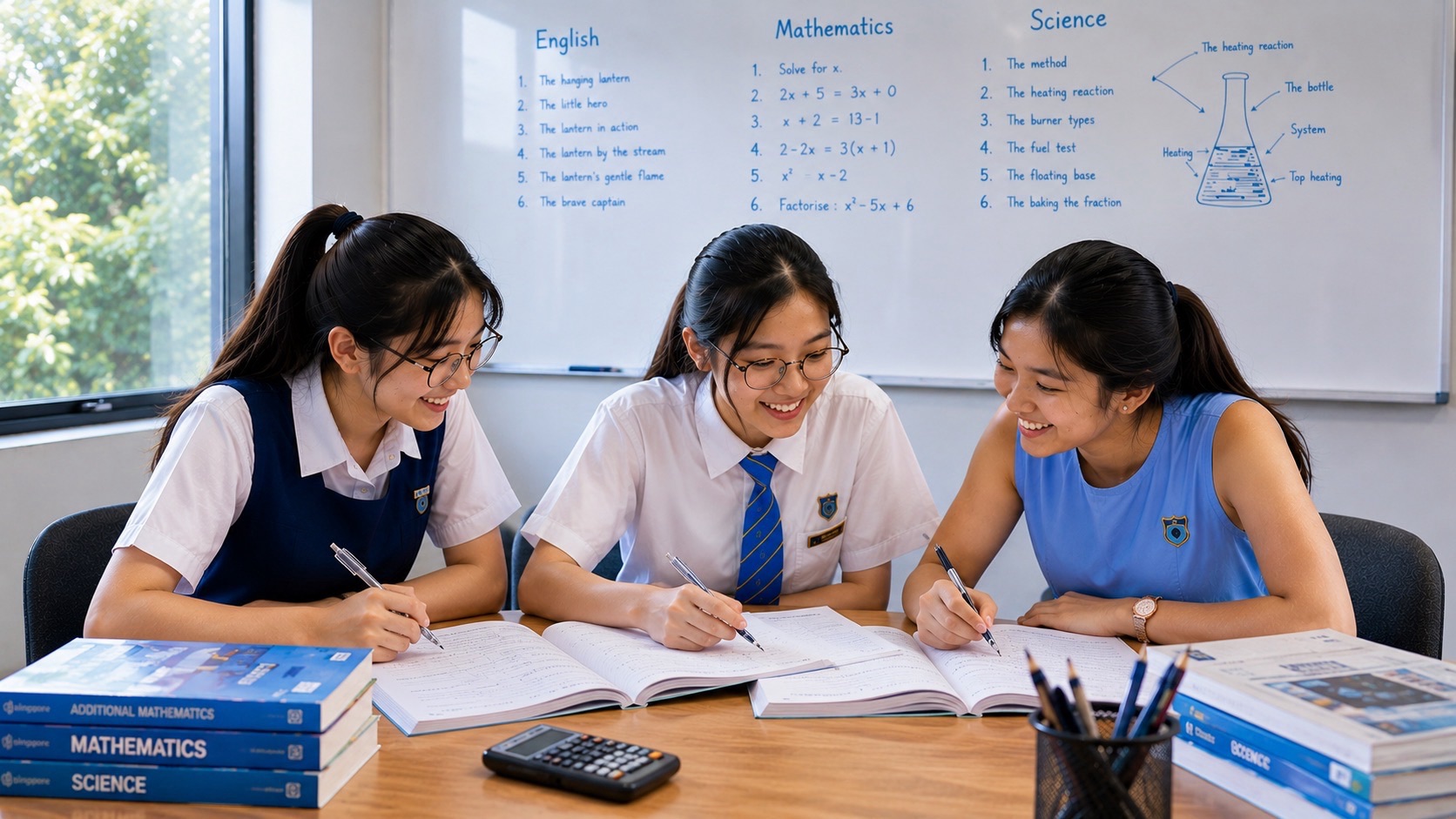
A three-student tutorial can preserve enough shared discussion for strategy comparison while giving the tutor visibility into individual working. One student may have an algebra gap, another an interpretation problem and another a timing problem. The same practice question can reveal different bottlenecks, which means the next task should not necessarily be identical for all three students.
Small-group teaching is useful when the tutor adapts the next step. Alicia may need an efficiency variant, Tricia a different wording and Kai Kai a checking requirement. The group should not become a lecture with fewer chairs. Its value comes from rapid diagnosis, targeted feedback and opportunities to explain reasoning aloud while preserving enough individual visibility for errors to be noticed quickly.
A 1.5-Hour SEC Mathematics Lesson
A productive lesson can open with short retrieval or correction work from the previous session. The main block addresses one concept, procedure or error pattern. Guided questions reduce scaffolding. A timed mini-set tests whether the repaired skill survives mild examination pressure. The final segment reviews errors and assigns a specific transfer target. Each segment should answer a clear question about readiness rather than merely occupy lesson time.
The lesson should produce evidence beyond page count: fewer prompts, better method selection, cleaner algebra, faster retrieval, stronger checking and lower recurrence of the same error class. Full papers belong in the wider cycle, but every weekly lesson should connect to the student’s examination-performance model. The tutor should know which behaviour is being strengthened and how it will be retested.
A Twelve-Week SEC Repair-and-Execution Cycle
A twelve-week cycle can begin with a diagnostic paper or carefully sampled topic set, followed by error classification. The next phase repairs prerequisite concepts and procedures. The middle phase mixes topics and increases retrieval speed. The final phase introduces more timed sections, full-paper strategy and delayed retesting of previously weak areas. This sequence prevents full-paper practice from becoming repeated exposure to unrepaired mistakes.
The cycle should remain individual. Alicia may spend more time on efficiency, Tricia on interpretation and Kai Kai on verification. The stable sequence is evidence, repair, transfer, timing and retest. Students should be able to explain not only whether their marks improved, but which underlying behaviours changed and which error categories are occurring less often than before.
Examination Confidence Is Built from Evidence
Confidence is often treated as a feeling that should appear before performance improves. In Mathematics it is more durable when built from evidence. A student becomes confident after repeatedly seeing that a method works, that a difficult question can be started, that an error can be diagnosed and that a checking routine catches mistakes. Confidence becomes an interpretation of experience rather than a motivational slogan.
This does not remove examination nerves, but it changes what the student can do with them. Instead of waiting to feel certain, the learner can return to a process: identify the target, represent the relationship, execute a valid method, inspect the result and move on. Process confidence is portable because it gives the student something concrete to do even when a question initially looks unfamiliar.
SEC Readiness Should Be Tracked by Error Recurrence
A single good paper can be encouraging without proving that a weakness has disappeared. A stronger indicator is whether the same error class keeps returning. If sign errors, graph-reading errors or premature rounding disappear across different topics and later papers, the repair is becoming durable. If the error returns whenever time pressure rises, the skill still needs work under realistic conditions.
This is why revision records should compare error patterns over time, not only total scores. A five-mark increase can hide a persistent foundational weakness if easier questions changed. Conversely, a similar total score may conceal major improvement if a previously unstable topic is now secure but another high-value topic has emerged as the next bottleneck. Diagnostic continuity makes progress interpretable.
School Assessments and Prelim Papers Are Diagnostic Evidence
School assessments, weighted tasks, common tests and preliminary examinations can reveal different parts of a student’s performance system. One paper may emphasise recent topics, another cumulative knowledge, another time pressure. Tuition should not treat every score as directly comparable without looking at the paper’s composition, but each script can still contribute evidence about recurring weaknesses and execution habits.
When a school script is reviewed, separate syllabus knowledge from paper execution. A student may know a topic but misread a condition, or may understand the question but fail because a prerequisite calculation is unstable. The repair should match the cause. School evidence becomes much more valuable when it is connected to a longitudinal error profile rather than stored as an isolated mark.
Conceptual Understanding and Examination Technique Must Work Together
Examination technique cannot rescue missing Mathematics, but good Mathematics can still be under-rewarded if execution is poor. Students need both. Conceptual understanding allows unfamiliar questions to be reconstructed. Procedural fluency makes routine work efficient. Examination technique protects time, working clarity, accuracy instructions and final checks. These layers should be trained as one performance system rather than as separate last-minute topics.
A strong revision plan therefore moves between concept repair and examination use. Learn or repair the idea, practise the method, place it inside mixed questions, then test it under realistic timing. If performance fails only when time is added, the next intervention is different from a failure that occurs even with unlimited time. The training condition should match the diagnosed bottleneck.
Diagnostic Gap Repair Should Reach the First Broken Prerequisite
A Secondary Mathematics error can have a long dependency chain. Difficulty with algebraic fractions may come from ordinary fraction operations. Difficulty with gradient may come from coordinate reading or ratio. Difficulty with compound interest may come from percentage change. Tuition should trace the chain backward until it reaches the first unstable idea, repair that point and then rebuild forward into the examination topic.
This avoids two extremes: reteaching an entire lower-year syllabus when only one prerequisite is weak, or drilling the current examination question while the prerequisite remains broken. Efficient repair is narrow enough to preserve time and deep enough to change the cause. After repair, the skill should be tested in a different context and again after a delay to confirm that it transferred.
Revision Should Alternate Retrieval, Application and Transfer
Revision becomes fragile when students spend all their time rereading notes or all their time doing full papers. Retrieval practice checks whether formulas, facts and procedures are accessible. Application places them inside ordinary questions. Transfer asks whether the same idea can be recognised when the wording, representation or topic combination changes. Each mode answers a different question about readiness.
A balanced week may include short retrieval, targeted topic practice, mixed questions and one timed cluster. The exact proportions should change as the examination approaches and as the student’s profile changes. A topic that was once weak may need only spaced review after repair, while a recurring timing bottleneck may require increasing amounts of realistic execution practice.
Local Context Does Not Change the SEC Mathematics Standard
Students around Queensway may reach school, libraries and tuition through different local routes, but the Mathematics standard remains national. Local discovery helps families find the right page; it does not create a neighbourhood syllabus. The actual level, syllabus document, school-year stage and examination needs should determine practice selection, and the same G1, G2 or G3 requirements apply regardless of the search term used to find tuition.
That distinction keeps the page useful without overstating locality. Queensway is the discovery context. G1, G2 or G3 is the subject level. The student’s error profile is the teaching problem. The established year-specific Secondary Mathematics owners remain responsible for progression, while this page helps families understand the SEC transition and examination-performance layer.
Home Revision Without Random Overload
Home revision should respond to evidence from school and tuition. A student with weak algebra does not need an equal amount of practice from every topic. A student with strong concepts but poor timing needs different work from a student who cannot interpret graphs. Revision is most efficient when it targets the current limiting factor and when the reason for each task is clear to the learner.
Use short retrieval sessions, targeted repair sets, mixed review and periodic timed work. Keep an error log concise enough that it is actually revisited. The purpose is not to create a second full school day at home. It is to make each revision block answer a specific question about readiness and to preserve enough energy for consistent practice across weeks.
Queensway as a Local Discovery Context
Queensway sits in the wider Queenstown-Alexandra corridor, and families may search for tuition using Queensway, Queenstown, Alexandra, Commonwealth, nearby transport routes or a school journey. A local SEC Mathematics page therefore has a useful discovery role even though the examination syllabus is national. It helps the family enter the system at the right point without creating a second version of the subject.
This page does not imply a special Queensway examination or a separate eduKateSG branch syllabus. It routes families from local search intent to the correct Mathematics and assessment architecture. The student’s actual subject level, year and diagnostic needs should determine the learning plan, not the neighbourhood name, and broader owners remain the authoritative routes for curriculum progression.
The Queensway Mathematics Progression
Families with younger learners can use Primary 1 Mathematics Tuition | Queensway, Primary 2 Mathematics Tuition | Queensway and Primary 3 Mathematics Tuition | Queensway. The existing P4, P5, P6 and PSLE Queensway pages remain the upper-primary local owners. Secondary learners should continue through the established year-specific Mathematics owners in the Mathematics Learning Hub. This SEC page remains the examination-transition route.
For broader revision, assessment and examination navigation, use the Examinations & Assessment Hub. This separation protects the roles of Secondary 1–4 Mathematics, Additional Mathematics and specialist exam-preparation owners while still giving Queensway families a clear local path into the system. The existing Additional Mathematics Tuition | Queensway page also keeps its distinct specialist intent.
Official SEC References
SEAB’s Secondary Education Certificate page states that from 2027 the former N(T), N(A) and O-Level certificates are combined into the Singapore-Cambridge SEC, while students sit subjects at G1, G2 or G3. SEAB also states that there is no change in the overall standards of examinations under the SEC.
For 2027 school candidates, SEAB lists Mathematics as K110 at G1, K210 at G2 and K310 at G3. Students and parents should use the current SEAB syllabus corresponding to the actual subject level.
Questions Parents and Students Should Ask About SEC Mathematics Tuition
Ask whether the programme has confirmed the student’s current subject level and syllabus. Ask how diagnostic work separates concept gaps from procedure, interpretation, accuracy, calculator use and timing. Ask how past papers are analysed, how corrected weaknesses are retested and how the tuition plan preserves the role of year-specific Secondary Mathematics. The answer should describe an evidence loop, not simply a promise of more papers.
Ask also how examination independence is measured. Can the student start an unfamiliar problem without a hint? Can an equation be checked? Can a graph be read before formulas are applied? Can an unreasonable answer be detected? Can time be recovered after a difficult question? These behaviours indicate that the learner has more than memorised methods; the learner has an examination operating system.
What Success Looks Like
Successful SEC Mathematics preparation is not a promise of effortless papers. It is a measurable reduction in avoidable failure. The student understands the relevant subject-level Mathematics more securely, retrieves necessary facts and procedures with less friction, begins unfamiliar questions more confidently, makes fewer repeated errors and uses checking deliberately. Improvement appears both in marks and in the behaviours that produce those marks.
For a learner in Queensway, the practical endpoint is clear: know the subject level, understand the Mathematics, repair the first broken prerequisite, practise until execution is reliable, test transfer under examination conditions and use evidence to check the final result. That approach respects the new SEC structure without allowing the administrative transition to obscure the central task—learning and performing Mathematics well.