
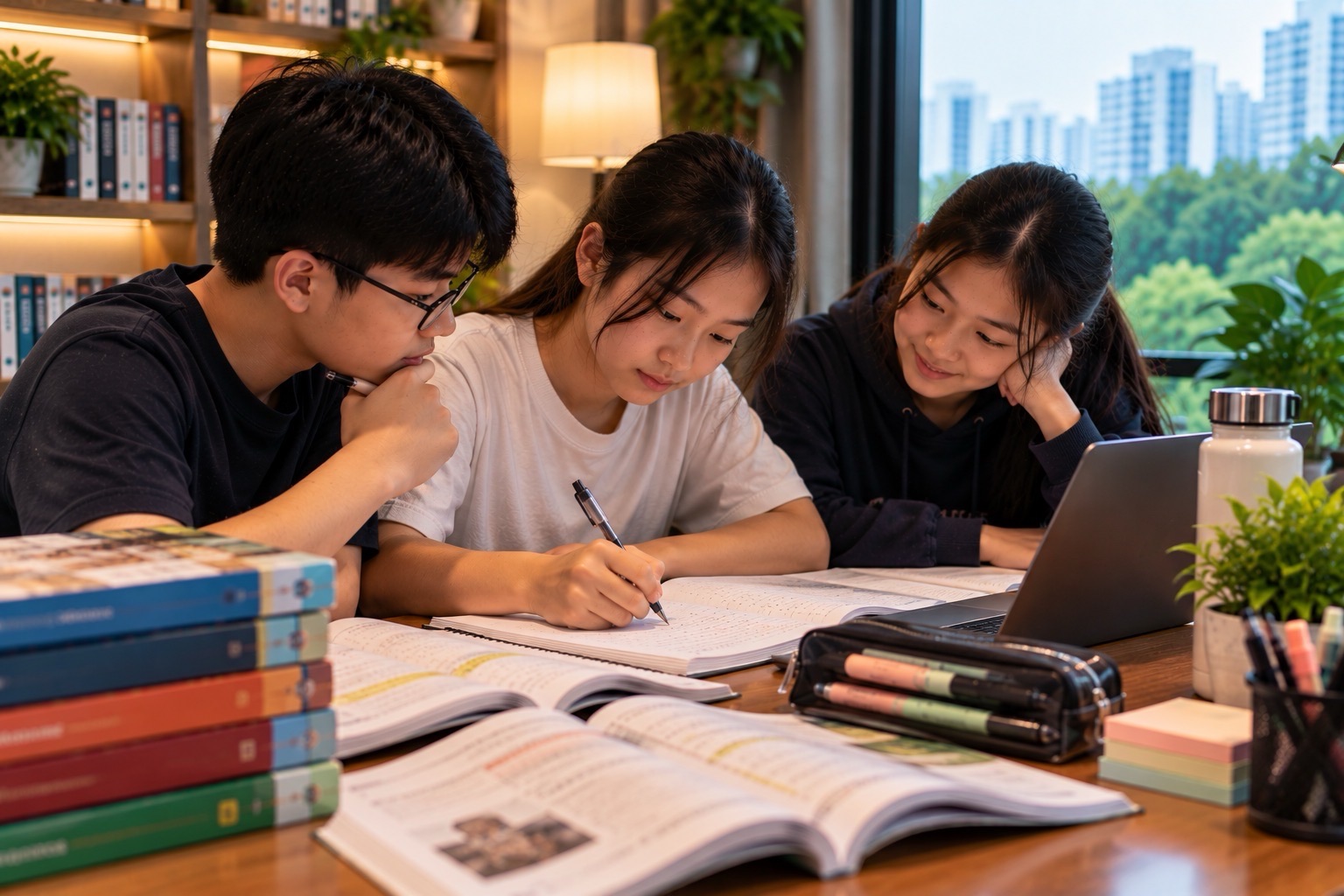

Weekday or weekend Secondary 1 Biology tuition in Bukit Batok? Choose weekday when a lighter afternoon lets your child bring a fresh Science question and still think clearly. Choose weekend when school afternoons are crowded and a rested session would help them ask and explain. Include one short later opportunity to use the teaching independently.
At Secondary 1, Biology-focused help usually supports biological topics within lower-secondary Science. Match the actual Science level and school sequence. The immediate goal can be simple: understand what a question asks, interpret its picture and explain a relevant idea clearly.
Try planning both choices from departure to return. Include meals, travel, CCA, homework and recovery. Then bring one recent worksheet with the original attempt to a consultation. A clear starting task makes it easier to choose a day that your child and family can maintain.
Find a learning rhythm that fits
Compare the course, the learning need and the complete family day.
Match the course · Compare weekdays · Compare weekends · See the worked example · Parent questions · Full contents · Science Learning Hub
Article contents
Course and timetable
Biology learning and teaching
Weekly plans and parent questions
A child may understand a demonstration in school but become uncertain when the homework uses another picture. That is useful information about the kind of support needed.
Ask them to explain the first step they would take. If they can identify the task but not the concept, the tutor begins in a different place from a child who misreads the instruction.
The first lesson need not repair every topic. A focused beginning can show the learner how to approach a question and give the parent something concrete to review.
Choose a day when the child can attempt, discuss and try again. Their actual attention matters as much as the visible gap in the timetable.
The school subject at this stage is usually Science. A search for Biology tuition may begin with one difficult biological worksheet rather than a separate course.
MOE provides lower-secondary Science syllabuses for G1 and G2/G3. Bring your child’s actual Science level, current topic list and recent work. A Posting Group is not the level of every subject.
The examples here illustrate possible skills and tasks, not a fixed Secondary 1 teaching order.
Suitable support follows current learning while keeping the other Science components in view. If difficulties span several components, ask whether broader Science support is appropriate. The class should match the course that is actually being taught.
A recent classroom question is often easier for a child to describe. They remember the picture and the point where the explanation stopped making sense.
A lesson on a lighter weekday can inspect that point, explain the missing connection and guide a comparable task. The student then has a clearer idea to use in schoolwork.
Check the afternoon around the class. An early finish may still lead into an activity, a rushed meal or a demanding journey.
Choose weekday when the child can participate actively and return to the idea later. If attendance repeatedly produces passive copying, review the teaching approach and the day’s demands together.
A rested weekend session can give a new secondary student room to ask the small question they did not manage to raise in school.
The tutor can let the child describe the diagram and try an answer before explaining. That conversation often reveals more than a clean copied response.
Protect the calm around the session. Several consecutive appointments can make a weekend difficult too.
Plan one brief school-week return: a changed picture or a short explanation with the notes closed. The later task shows what became usable.
These are planning examples, not advertised class times. Confirm current availability and choose a rhythm that leaves appropriate space for other subjects and ordinary life.
Imagine two drawings of seedlings. One is taller than the other. A learner can describe that visible difference, provided the drawings use a comparable scale.
The picture alone does not establish why the difference arose. The question may supply information about conditions, or it may ask only for an observation.
A child who immediately writes “more sunlight” has moved from observation to a possible explanation without checking the evidence.
Ask what is visible, what is given and what needs another piece of information. Keep the task at the course’s required depth.
A fresh pair of pictures then checks the approach. The student learns to make a supported answer rather than a familiar guess.
Choose a term from the current worksheet and ask the child to identify what it refers to. Then ask why it matters in this question.
Allow an initial explanation in ordinary language so the meaning becomes visible. Refine that explanation into accurate scientific phrasing.
A copied definition can be correct while remaining difficult to use. Change the picture or instruction to check whether the learner selects the word again.
The teaching aim is a connection between language and the task. One term understood and applied gives the child a firmer beginning than a long list memorised without examples.
Keep the detail appropriate to the actual Science level and current schoolwork.
eduKate’s small-group model centres on three students. Ask how the actual class gives each learner room to answer, explain and receive feedback.
Three answers to one picture may show three different assumptions. The tutor can compare them constructively while still checking each child’s own reasoning.
A shared correction should lead to an individual fresh attempt. Hearing another student’s explanation is useful; making a decision alone shows whether it became usable.
Confirm course matching and how different needs are handled. Small size matters through participation and teaching, rather than the number itself.
Ask which task your child should be able to complete more independently after the lesson.
Map the weekday from school or an activity and the weekend from home. Include walking, waiting, connections, meals and the return.
If an adult accompanies the child, include work and other children’s arrangements. A parent’s easiest slot may not be the child’s most alert window.
Confirm the actual address and current Biology-focused provision. An estate name alone does not establish a nearby class timetable.
Consider a child whose weekday is convenient for pickup but crowded with activities. A rested weekend may be more usable. Another child may have a comfortable weekday break and a busy weekend.
Choose from the actual pattern, including the follow-up, rather than a universal rule about the best day.
A weekday plan might use a recent school question, repair its difficulty on a lighter afternoon and check a changed task later.
A weekend plan might choose one question from the week, give it a calmer session and include a brief school-week return.
Choose a check small enough to happen. The child might distinguish an observation from an explanation or select a relevant feature in a new picture.
Compare similar tasks before relying on a broad test score. Ask what the learner can now do without a hint and what comes next.
Prepared arrival, active participation and usable follow-up show whether the timetable supports the teaching.
Does my child need a separate Biology course? Check the current lower-secondary Science need first. Broader support may fit difficulties across components.
Is the longer weekend session better? Ask what the additional time teaches and whether the child can sustain attention.
What should we bring? The Science level, school topic list, original attempt and honest timetable.
What should we confirm? Provision, address, duration, fees, absence arrangements and the process for checking fresh work.
A consultation should clarify the starting point. Choose a day that helps your child arrive ready, understand one useful idea and attempt it again with greater independence.
Which Science course does a Secondary 1 Biology tutor actually need to teach?
The quickest useful answer is to match the child’s current Science level and school topic. At Secondary 1, Biology-focused ideas normally sit within lower-secondary Science rather than an independent national Biology examination. MOE publishes G1 and G2/G3 lower-secondary syllabuses. They are not a licence to treat all students as taking identical content in the same term.
Biological topics can involve cells, the human body and interactions among organisms. A parent may say ‘Biology is weak’ when the child actually misreads a microscope diagram, confuses an organ with a tissue or cannot tell an observation from an inference. A first lesson should request the marked school question and show where the reasoning went wrong, rather than introduce an unrelated advanced chapter.
Ask the tutor how they will differentiate among learners in a small group. A child who needs to label a typical cell should not receive the same first task as one working on a more demanding data interpretation. Teaching from first principles means choosing the smallest missing concept, making it clear and checking it on an unfamiliar example without hints.
A park photograph cannot prove every biological explanation
NParks identifies Bukit Batok Town Park, also known as Little Guilin, as a park featuring a flooded former quarry and rocky formations. This is useful local context for distinguishing a documented environmental feature from an inferred biological claim. The existence of a lake does not establish how many fish live in it or the reasons for any particular change in biodiversity.
Show a pupil a hypothetical photograph of three birds near a lake. An observation might be that three birds are visible in the pictured area. It is not evidence that exactly three birds inhabit the entire park, that one species is increasing, or that the lake is healthier than another site. Those stronger claims require defined measurements and appropriate methods.
An effective tutor teaches the student to use three phrases: ‘the source shows’, ‘one possible explanation is’ and ‘to test this, we would need’. Then present a new photo or table and ask the child to fill each phrase with a defensible statement. This routine builds transferable evidence literacy without asking a child to conduct unsupervised fieldwork.
What the parts of a typical cell do, not merely what they are called
A model of an animal cell normally shows a membrane, cytoplasm and nucleus. The membrane forms a boundary and helps regulate movement of substances, the cytoplasm is where many cell reactions occur, and the nucleus contains genetic information. A weak answer such as ‘the nucleus is the brain of the cell’ is a metaphor and may not explain the function required by a school question.
When the course covers plant cells, students can compare a cell wall, large central vacuole and chloroplasts with the typical animal-cell diagram. Explain the wall’s support role and the chloroplast’s relation to photosynthesis in appropriate green cells. Do not insist every plant cell has chloroplasts; many root cells do not photosynthesise. That qualification teaches how models simplify living diversity.
Have the child classify two different-looking textbook cell diagrams, then name one similarity and one difference supported by the image. Next replace both with an unfamiliar drawing. A learner who can transfer the distinction has acquired more than the ability to reproduce one annotated picture. If a feature cannot be seen, they should say so instead of inventing it.
Worked example: magnification without unit confusion
Original fictional school diagram: the printed image of a cell is 28 mm across; the actual cell width is stated to be 0.14 mm. Magnification is image size divided by actual size. Because the lengths are in the same unit, 28 ÷ 0.14 = 200, so the drawing is at ×200 relative to the stated width.
A common mistake divides 0.14 by 28 and obtains 0.005. Ask the child whether a large image of a small structure should have a magnification less than one. The reasonableness check can expose reversed division more quickly than marking a whole worksheet wrong. The dimensionless result is not ‘200 mm’; the matching measurement units cancel.
Changed transfer: a different fictional image is 36 mm wide while the actual structure is 0.24 mm. Magnification is 36 ÷ 0.24 = ×150. Then suppose a printed copy is enlarged to 72 mm without changing the real cell; the drawing’s magnification is now ×300. The biology has not changed, only its representation. Let the student explain that without a memorised script.
Do not ask a Secondary 1 learner to handle unfamiliar microscope equipment without teacher instruction. The skill can be practised safely on paper, with real practical procedures taught and supervised under school rules.
Cell, tissue, organ and system: how levels fit together
A muscle cell is not the same thing as an entire heart. Similar specialised cells contribute to tissues; different tissues cooperate inside organs; multiple organs work together within systems. For example, the heart includes cardiac muscle tissue and other supporting tissues. The circulatory system includes the heart and blood vessels working together, so a system cannot be reduced to one organ.
Give the child four cards reading ‘muscle cell’, ‘muscle tissue’, ‘heart’ and ‘circulatory system’. Sorting them is an easy start, but the assessment of understanding comes when the pupil justifies each relationship. A response that merely orders cards by size may fail if asked how a structure is suited to its function.
Change the topic to digestion and ask how the stomach relates to the digestive system. The student should identify an organ within a larger coordinated system. If they repeat the heart example word for word, the tutor should supply an unfamiliar organ and ask for a functional explanation. Transfer, not repetition, is the standard.
From food to cells: keep digestion and respiration distinct
Food is taken into the body, processed and broken into suitable smaller substances for absorption. Cells then use nutrients in different ways, including releasing usable energy through respiration. A student who writes that ‘food digestion is the same as respiration’ has merged two different processes. A Biology-focused tutor should repair this conceptual boundary before asking for more definitions.
Use an imaginary meal with carbohydrates, protein and vegetables to ask which nutrient categories may be present and what their broad roles are. Avoid treating one meal as a personal health prescription. Digestion does not mean every molecule is absorbed unchanged, and dietary needs can vary. Any medical restriction or allergy needs qualified guidance rather than guessed substitutions.
Give the child a changed scenario about a snack and physical activity. Ask where energy is originally stored, how the body accesses nutrients, and why the explanation should distinguish the digestive system from cellular processes. The aim is a reasoned chain appropriate to the student’s level, not complex biochemistry beyond the school course.
Worked food-chain reasoning using entirely fictional organisms
Use a classroom food chain: grass → grasshopper → frog → snake. In the customary representation, arrows point in the direction of energy transfer from the organism eaten to the consumer. Grass is a producer; the grasshopper is a primary consumer; the frog eats grasshoppers; the snake eats frogs. An arrow is not showing which direction the frog walks.
Now ask what might happen if there are fewer grasshoppers. A cautious prediction is that less food might be available to frogs under otherwise comparable conditions. It would be wrong to promise that the frog population will halve or that every frog will die. Real ecosystems contain other food sources, environmental conditions and time-dependent effects.
Change the chain to leaves → caterpillar → bird and remove the labels. If the student can explain producer, consumer and direction of energy transfer independently, the lesson has transferred. Do not describe these invented classroom relationships as an actual census at Bukit Batok Nature Park.
Make Bukit Batok nature relevant without manufacturing fieldwork
NParks describes Bukit Batok Nature Park as a former quarry landscape with nature-walk opportunities, forest vegetation and various animals. These are official visitor facts, suitable for asking why a place might support a variety of organisms. They are not a measurement of exact animal populations or proof of environmental changes over time.
Ask the child to choose one claim from the visitor source and one question the source cannot answer. A published species description may indicate an animal has been recorded at the park, but it does not guarantee that a visitor will see the animal on a given day. Likewise, a single photograph cannot reliably estimate the number of individuals living across the entire park.
An optional home exercise can compare official descriptions of Bukit Batok Nature Park and Bukit Batok Town Park. Look for differences in published features and identify missing evidence before guessing about biodiversity. Families need not conduct a field trip. Any school-assessed fieldwork must follow the teacher’s research, safety, permission and privacy rules.
Worked data interpretation: counts depend on sampling area
Fictional numerical example: a student counts twelve visible organisms in a sample plot covering two square units and fifteen organisms in a plot covering five square units. The raw count is higher in the second plot, but the densities differ. First plot: 12 ÷ 2 = 6 per area unit. Second plot: 15 ÷ 5 = 3 per area unit.
If the question asks which plot contains more observed organisms, it is the second. If it asks which has the greater observed count per equal area, it is the first. Both comparisons can be valid depending on the wording. The child needs to select the correct denominator and state the unit instead of assuming that the largest raw number always wins.
Nothing in this invented table proves why the counts differ, whether either ecosystem is healthy or what happens at all seasons. A tutor can ask what extra evidence is needed: repeated measurements, comparable detection methods and controls for sampling conditions. The student should learn to separate a numerical result from a causal claim.
New practice: change the first plot to ten organisms across two units. Its density becomes five per unit, still greater than three. Ask the child to solve without notes and then state one source limitation. This combines correct arithmetic with scientific thinking.
Investigations begin with one clear question
Imagine a fictional experiment asking whether varying light duration changes how much a set of seedlings grows. The independent variable is the light duration, and a possible dependent measure is the change in stem height over a stated interval. Soil, water, seed type and other conditions should be considered when designing a fair comparison. No actual results are asserted here.
A flawed paper plan changes seed type, water, light and container size all at once and claims that light caused any difference. Ask the child to name the confounding factors and repair the plan before creating a graph. The tutor’s task is to teach experimental reasoning, not to fabricate a perfect-looking report.
Students should recognise that a single trial does not establish a universal rule. Repeats, clear measurements and honest description of exceptions matter. Actual practical work must remain within the school’s approved methods and safety boundaries; a lesson can teach the structure of an investigation through paper scenarios only.
Write a short Science explanation with evidence
A useful response often has three parts: identify the relevant feature or result, connect it to an appropriate scientific idea, and state the consequence within the evidence supplied. Consider the fictional cell-count example: saying ‘Plot A has the higher density because 12 ÷ 2 is six per unit compared with three’ is precise. Saying ‘Plot A is a better habitat’ adds a conclusion not established by the numbers alone.
Teach students to distinguish command words. ‘State’ may require a brief value; ‘describe’ needs a pattern; ‘explain’ needs the relevant mechanism; ‘suggest’ requires a plausible, suitably qualified idea. A long memorised paragraph that ignores the command word is not a substitute for answering the task.
Ask the pupil to edit one of their answers by underlining the measured evidence and circling the causal word. If no evidence supports ‘because’, the teacher should help identify what is missing. Then hide the worked example and give an unfamiliar question requiring the same reasoning.
Choose between a weekday and weekend using the child’s full timetable
A weekday lesson can correct a fresh school misconception while the original question is still easy to recall. That advantage disappears if school, CCA, travel and a late evening make the child too tired to think. Compare the entire day rather than the single tuition hour, and leave space for meals and rest.
A weekend session may be calmer for diagrams, models and a longer discussion of evidence. But a long session that consumes all recovery time and leaves no independent retry can also be ineffective. Different families will arrive at different answers depending on genuine schedules and attention.
Ask the child to complete one short changed problem the next day and again after several days. Compare independence and the kinds of errors made. When evaluating a tuition class, verify actual subject provision, teaching address, group size and fees; an article titled Bukit Batok does not confirm a local classroom.
Four weeks of measurable foundational Science improvement
Week 1: bring a marked Science task and identify the first wrong concept or source interpretation. Keep the original answer. Target one error type: cell identification, function explanation, unit handling or evidence assessment.
Week 2: teach the missing idea using an original example. For a magnification error, show why image size is divided by actual size. For a food-chain error, explain the meaning of arrows. Follow the guided step with a different numerical or biological context.
Week 3: combine two skills in a changed question, such as reading a cell diagram and interpreting a fictional count table. The child should select the method before seeing any worked response. Record prompting and check whether units and limitations are correctly expressed.
Week 4: present an unfamiliar question after a delay, and compare independent reasoning with the first attempt. Parents can then decide whether to continue tuition, reduce frequency, change the timetable or rely on school support. A four-week plan helps reveal progress but cannot promise grades.
Parent checklist before booking
- Confirm the student’s G1, G2 or G3 lower-secondary Science course and school unit.
- Bring one real marked answer and a concrete question about the first error.
- Ask the tutor to teach from the concept rather than issue only model answers.
- Request a new independent problem after the guided explanation.
- Check units and denominators when the question uses measurements or counts.
- Ask how a mixed small group differentiates learning targets.
- Compare travel, CCA, homework, meals and sleep for both proposed days.
- Verify actual subject availability, venue, class size, fees and follow-up evidence.
Frequently asked questions about Secondary 1 Biology-focused tuition
Is Secondary 1 Biology a standalone national exam subject?
Usually, biological topics are taught within the child’s lower-secondary Science programme; check the school’s actual arrangement.
Should a G1 pupil use a G3 textbook for extra challenge?
Not automatically. Start with the learner’s prescribed Science course and diagnose what is missing.
Do all plant cells contain chloroplasts?
No. Many photosynthetic green cells do, but various non-photosynthetic plant cells do not.
What is the difference between a cell and an organ?
A cell is a basic living unit; an organ contains different tissues working together.
How can I check a magnification answer?
Convert lengths to the same unit, divide image by actual size, and check plausibility.
Does a larger count prove a higher population density?
Not without considering the sampled area and method.
Can our child use the park as an official school fieldwork site?
Only when the school has authorised the activity and its research and safety procedures.
Does weekend tuition always produce stronger Science results?
No. Compare attention, targeted feedback, rest and a delayed independent answer.
What should a small group tutor show parents?
A before-and-after task demonstrating an individual child’s repaired first misconception.
Is additional tuition always required?
No. School support and independent revision may be sufficient when the student can solve new tasks unaided.
Official teaching references and related learning
- MOE G1 lower-secondary Science syllabus
- MOE G2/G3 lower-secondary Science syllabus
- NParks Bukit Batok Nature Park
- NParks Bukit Batok Town Park
- Secondary 2 Biology Bukit Batok continuation
- Clementi small-group teaching benchmark
- Verify available tuition programmes and locations
Independent educational commentary, October 2026. The numerical counts, imaginary experiments and food-chain examples are invented teaching material, not park observations or official examination questions. Follow the school’s current syllabus and practical safety rules.
Continue with suitable support
What Happens in Secondary 1 Bukit Batok Science Tuition | PSLE Bridging and Lab Skills gives more context for the same school stage. To discuss the current work and a suitable next step, book a consultation and confirm course provision and arrangements.
MOE secondary curriculum and syllabuses. Use the official information and school guidance relevant to your child’s actual course.