
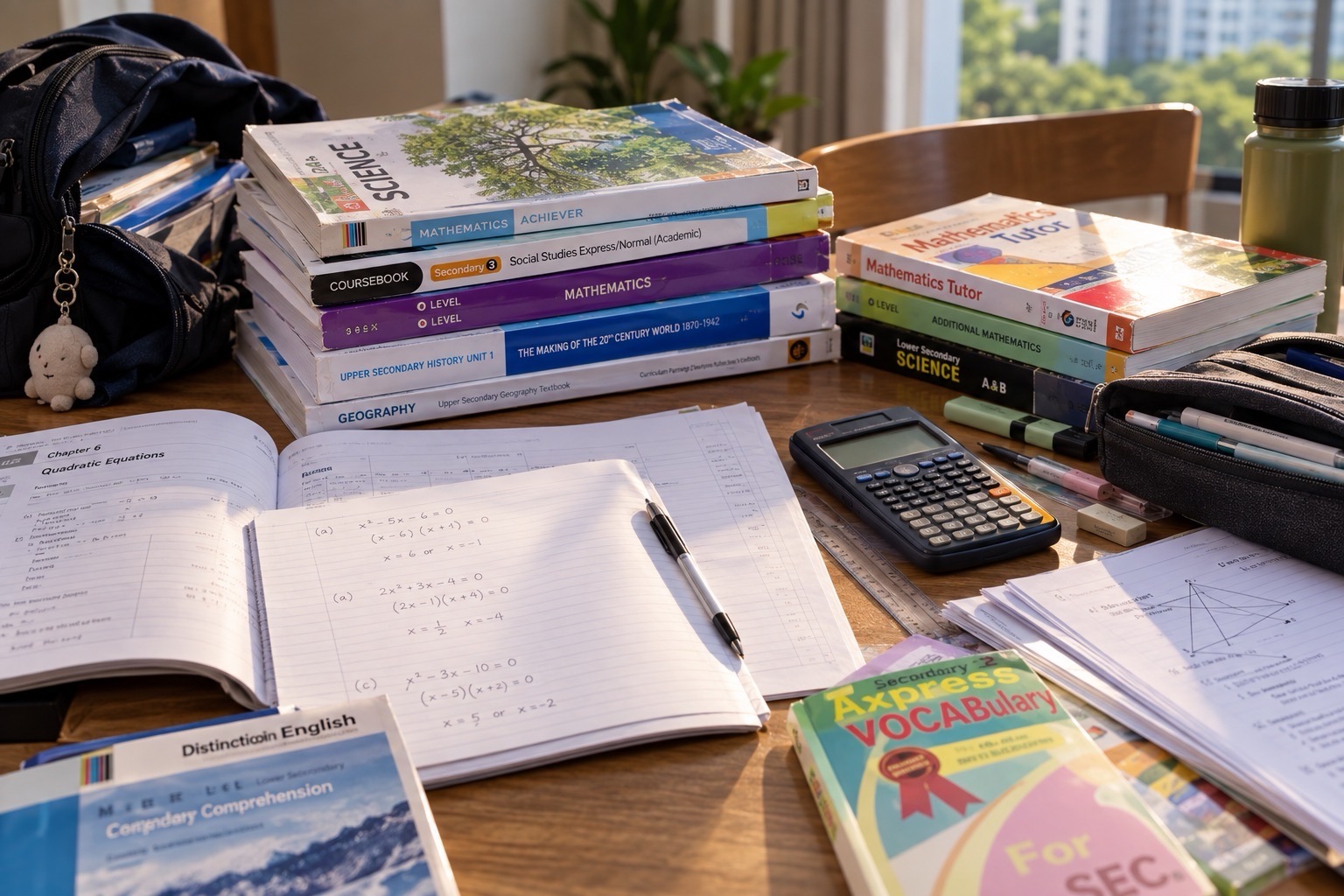
Did you know? A calculator can produce a perfectly accurate answer to the *wrong expression*. If the question is (24 − 8) ÷ (3 + 1) and a child types 24 − 8 ÷ 3 + 1, the machine has been given a different mathematical instruction. The problem isn’t that the calculator is unreliable. It is that the brackets, order and meaning were lost before the calculation began.
For a Secondary 1 G3 Mathematics student in Bukit Timah, learning how to use a calculator well is different from learning how to press keys quickly. This guide explains BODMAS, expressions containing signed numbers, fraction bars, powers and ordinary checking methods. It will also show what teachers mean when they ask students to estimate an answer before accepting what appears on the screen.
The goal is a simple but powerful habit: **understand the expression, preserve its grouping when entering it, and check the answer’s size and sign**.
Quickly find a worked calculation or self-check.
- Quick answer: how does BODMAS work?
- Worked example 1: why brackets matter
- Worked example 2: multiplication and division at equal priority
- Worked example 3: addition and subtraction share priority
- Worked example 4: brackets and negative numbers
- Worked example 5: brackets and powers
- Worked example 6: powers before multiplication
- Fraction bars behave as grouping
- Worked example 7: combined fractions
- Worked example 8: a nested expression
- Signs, decimal points and calculator input
- Why calculators and estimation should work together
- Unit conversions require explicit structure
Quick answer: how does BODMAS work?
BODMAS is a school mnemonic for the order of operations: brackets, orders such as powers, multiplication and division, then addition and subtraction.
There is an important detail hidden inside the mnemonic. Multiplication and division share the same priority and are carried out from left to right when they appear at the same level. Addition and subtraction likewise share the same priority.
For example, 18 ÷ 3 × 2 = 6 × 2 = 12. It is not 18 ÷ 6 = 3. The latter would be correct for the expression 18 ÷ (3 × 2), which has an explicit bracket around the product.
A calculator should support the mathematical structure shown in the question, not replace it with an imagined rule that all multiplication must happen before all division.
Worked example 1: why brackets matter
Calculate (24 − 8) ÷ (3 + 1).
First evaluate both bracketed expressions: 24 − 8 = 16 and 3 + 1 = 4. Then divide 16 by 4 to obtain 4.
A reliable calculator entry keeps the bracketed numerator and denominator together. The mathematical expression is (24 − 8)/(3 + 1).
If a pupil enters 24 − 8/3 + 1 without grouping, the resulting operation is completely different. The displayed result cannot be used to confirm the original question.
Before typing, ask: “What is the numerator? What is the denominator? What is inside each bracket?” These questions expose transcription errors early.
Worked example 2: multiplication and division at equal priority
Evaluate 36 ÷ 6 × 3.
Calculate from left to right: 36 ÷ 6 = 6; then 6 × 3 = 18.
Compare 36 ÷ (6 × 3), which equals 36 ÷ 18 = 2. Both expressions use the same three numbers and two operations, but their brackets change the result.
A student who says “multiplication always comes before division” has misunderstood the mnemonic. Correct the underlying priority rule rather than just telling them to remember a different answer.
Now evaluate 30 ÷ 5 × 2 = 12. The same logic applies. There is no need to memorise each example separately.
Worked example 3: addition and subtraction share priority
Calculate 16 − 5 + 2.
From left to right, 16 − 5 = 11; then 11 + 2 = 13.
Compare 16 − (5 + 2), which equals 16 − 7 = 9. The bracket makes the 5 and 2 a single amount to be subtracted.
A mistaken child may assume “addition before subtraction” or “subtraction before addition,” but neither is correct as a general priority rule. At the same level, follow the written order from left to right.
Another check: 10 − 6 + 1 = 5. The result differs from 10 − (6 + 1) = 3, even though both contain the same visible numbers.
Worked example 4: brackets and negative numbers
Calculate 8 − 3(2 − 5).
Start inside the bracket: 2 − 5 = −3. Multiply: 3 × (−3) = −9. Finally, 8 − (−9) = 17.
The correct answer is 17. The double negative at the end describes subtracting a negative quantity, which is equivalent to addition.
If the child gets −1, inspect the sign of the product. If they get 23, inspect whether they applied multiplication to the bracket correctly. Different wrong answers point to different missing ideas.
You can check by expanding first: 8 − 3(2 − 5) = 8 − 6 + 15 = 17. Two valid routes agree.
For more on negative signs, see negative-number sign errors and repair.
Worked example 5: brackets and powers
Compare −3² and (−3)².
By ordinary algebraic notation, −3² means the negative of 3². Since 3² = 9, the expression equals −9.
By contrast, (−3)² means the negative number −3 is multiplied by itself: (−3) × (−3) = 9.
The bracket changes what the exponent applies to. It is not a cosmetic difference.
Some calculators handle leading negative key presses and display conventions differently. Enter explicit brackets or a clear negative-of-power structure to avoid depending on a particular key sequence. The written expression—not whichever shortcut the machine happens to accept—decides the mathematical meaning.
Worked example 6: powers before multiplication
Evaluate 3 + 2³ × (5 − 2).
First, 5 − 2 = 3. Next, 2³ = 8. Then multiplication: 8 × 3 = 24. Finally addition: 3 + 24 = 27.
Do not add 3 + 2 before raising the result to a power. The order of operations does not allow that unbracketed regrouping.
Ask the learner to estimate roughly. Since 2³ = 8 and the bracket equals 3, the product alone is 24; an answer less than 24 is unlikely when a positive 3 is added.
Estimation can reveal a slip even when the intermediate working looks convincing.
Fraction bars behave as grouping
A fraction such as (3 + 5)/(2 + 2) means that the *entire* numerator 3 + 5 is divided by the *entire* denominator 2 + 2. It evaluates to 8/4 = 2.
If a calculator entry represents 3 + 5 ÷ 2 + 2, the division applies to 5 and 2 rather than to both bracketed totals. The result will not equal 2.
Treat the horizontal fraction bar as grouping across its full numerator and denominator. Write brackets where necessary, especially when using a linear expression-entry style.
This habit matters in algebra too. (x + 4)/3 does not equal x + 4/3. The first divides the entire numerator by three, while the second only divides four by three.
Worked example 7: combined fractions
Calculate 3/4 + 5/6.
The lowest common denominator is 12. Rewrite as 9/12 + 10/12 = 19/12, or 1 7/12.
The decimal is approximately 1.5833. A calculator can verify the computation, but it does not explain why the numerator becomes 19 or why the denominator is 12.
If the question requests an exact fraction, do not give only a prematurely rounded decimal. If a decimal is requested, follow the stated precision.
This shows how technology can confirm arithmetic without replacing knowledge of fraction equivalence.
Worked example 8: a nested expression
Evaluate 42 ÷ [3(2 + 5)].
The innermost bracket gives 7. Multiply 3 × 7 to obtain 21. Then 42 ÷ 21 = 2.
Compare 42 ÷ 3 × (2 + 5). Here equal-priority multiplication and division proceed from left to right after evaluating the bracket, giving 14 × 7 = 98.
The numbers match, but the grouping differs. If a pupil reports 98 for the first question, the issue is almost certainly the entry’s grouping or the assumed denominator.
A useful visual strategy is to draw one long fraction bar over the complete product 3(2 + 5) before calculating.
Signs, decimal points and calculator input
A sign can indicate a negative number, a subtraction operation or a negative multiplier. Confusing these roles may change the calculation even if every other key is correct.
For instance, −0.5 + 3/4 = −1/2 + 3/4 = 1/4. It is approximately 0.25.
If the pupil enters 0.5 + 3/4 instead, the calculator will return 1.25, accurate for its input but wrong for the original expression.
Similarly, 0.06 and 0.6 differ by a factor of ten. When copying a decimal, compare each digit and the decimal point against the printed question. Do this before relying on repeated calculations.
Why calculators and estimation should work together
Suppose we want 58.9 × 2.01. Estimate using 60 × 2 = 120. The more precise product is 118.389, sensibly near 120.
If the display shows 1183.89, look for a misplaced decimal point. If it shows −118.389, look for an unintended negative sign.
For a division example, estimate 49.8 ÷ 10.2 as 50 ÷ 10 = 5. The exact quotient is approximately 4.8824, which is plausible.
Estimation is not a substitute for a calculation when the question demands an accurate result. It is a guardrail that helps students recognise when a displayed number makes no sense.
Unit conversions require explicit structure
Convert 72 km/h into metres per second.
The numerical relationship is 72 × 1000 ÷ 3600 = 20. The unit conversion uses 1000 metres per kilometre and 3600 seconds per hour.
A student who types 72 × (1000 ÷ 3600) obtains 20. A student who accidentally types 72 × 1000 × 3600 gets an implausibly huge result. The structure of division matters.
For a related discussion of correct units and averages, see rate, speed and average speed.
The calculator cannot know that the first answer represents m/s unless the student has understood the units.
Rounding only at the intended stage
Suppose a question involves 1 ÷ 3 × 3. Exactly, the result is 1.
If a pupil rounds 1 ÷ 3 to 0.33 too early, then multiplies by 3, they get 0.99. That is an error introduced by early rounding rather than by the original expression.
Keep sufficient digits or exact fractions in intermediate calculations. Round at the final required stage unless the question says otherwise.
A calculator display with many decimal places is not permission to report every one as meaningful precision. The significant figures and decimal places guide explains how to report answers correctly.
What is the most reliable input-checking routine?
Before calculation, ask the student to read the expression aloud. Identify the full numerator and denominator, signs attached to numbers, and the brackets.
During calculation, preserve that structure. When evaluating manually, write enough intermediate steps to trace errors. When using a calculator, inspect how the expression is displayed or verify grouping with an independent calculation.
After calculation, estimate the magnitude, check the sign, and review any requested unit or rounding instruction.
The machine is good at arithmetic. The learner remains responsible for modelling the correct expression.
Twelve-question mini diagnostic
- A. Evaluate 18 ÷ 3 × 2.
- B. Evaluate 18 ÷ (3 × 2).
- C. Evaluate 16 − 5 + 2.
- D. Evaluate 16 − (5 + 2).
- E. Evaluate (24 − 8) ÷ (3 + 1).
- F. Evaluate 8 − 3(2 − 5).
- G. Evaluate −3².
- H. Evaluate (−3)².
- I. Evaluate 3 + 2³ × (5 − 2).
- J. Evaluate 42 ÷ [3(2 + 5)].
- K. Evaluate 3/4 + 5/6 exactly.
- L. Estimate 58.9 × 2.01.
Answers and reasons
A. 12. Divide then multiply from left to right.
B. 3. The bracket makes 3 × 2 one divisor.
C. 13. Addition and subtraction share precedence.
D. 9. The whole 5 + 2 is subtracted.
E. 4. Both grouped parts are evaluated before division.
F. 17. The product is −9, which is subtracted from 8.
G. −9. The exponent applies to 3 before the leading minus.
H. 9. The exponent applies to the entire negative base in brackets.
I. 27. Bracket gives 3, power gives 8, multiplication gives 24, and final addition gives 27.
J. 2. The full product 3(2 + 5) forms the divisor.
K. 19/12 or 1 7/12, obtained using denominator 12.
L. About 120. The exact product is 118.389.
A quick marking score is only the beginning. Look at which type of expression produced the first error: same-priority operations, fraction grouping, signed powers or transcription.
A home routine that takes fifteen minutes
Spend three minutes showing paired expressions that differ only by brackets, such as 18 ÷ 3 × 2 and 18 ÷ (3 × 2). Ask for a prediction before using the calculator.
Use the next five minutes for negative numbers and powers. The student should explain the difference between −3² and (−3)² in words.
Spend four minutes on fraction-style entry, copying a numerator and denominator carefully. Finish with an estimation task and ask whether the calculator answer is plausible.
Retest using fresh numbers at another sitting. If the learner can distinguish two almost-identical expressions without prompting, the understanding is becoming robust.
How Bukit Timah tuition can help
A tutor should not assume every incorrect calculator answer is “carelessness.” There may be a misconception about precedence, grouping, negative numbers, units or estimation.
The eduKateSG Secondary 1 Mathematics small-group tutorial reference describes close working checks in three-student classes near Sixth Avenue MRT. The Bukit Timah Secondary 1 G3 Mathematics tuition overview gives the local programme context. Ask the provider about current arrangements and match practice to the child’s actual school requirements.
The MOE G2 and G3 Mathematics syllabus includes calculations with a calculator, negative and rational numbers, and approximation and estimation in Secondary 1 G3.
Frequently asked questions
### Does BODMAS mean multiplication always happens before division?
No. They have equal precedence; evaluate from left to right unless brackets or the expression’s grouping changes the order.
### Can a calculator be wrong?
A correctly functioning calculator generally evaluates the expression entered, subject to its features and settings. A common school error is entering a different expression from the one printed.
### Why might −3² and (−3)² display differently?
They are different mathematical expressions. Clear brackets and inspection of the displayed entry help avoid confusion with calculator-specific negative-key conventions.
### Should I round every intermediate result?
Generally no. Keep exact forms or adequate precision until final rounding unless the task explicitly requires intermediate rounding.
### Is a calculator enough to check an answer?
Use a second route, an estimate, a sign check or substitution when possible. A calculator cannot tell whether the original question was copied incorrectly.
Related Secondary 1 G3 Mathematics guides
- Inequality symbols and number-line comparisons
- Negative-number sign errors
- Rational numbers and signed fractions
- Significant figures and estimation
- Algebraic substitution and evaluating formulae
The best calculator habit is not faster typing. It is knowing what the expression means, entering that exact structure, and deciding whether the displayed result could be right.