
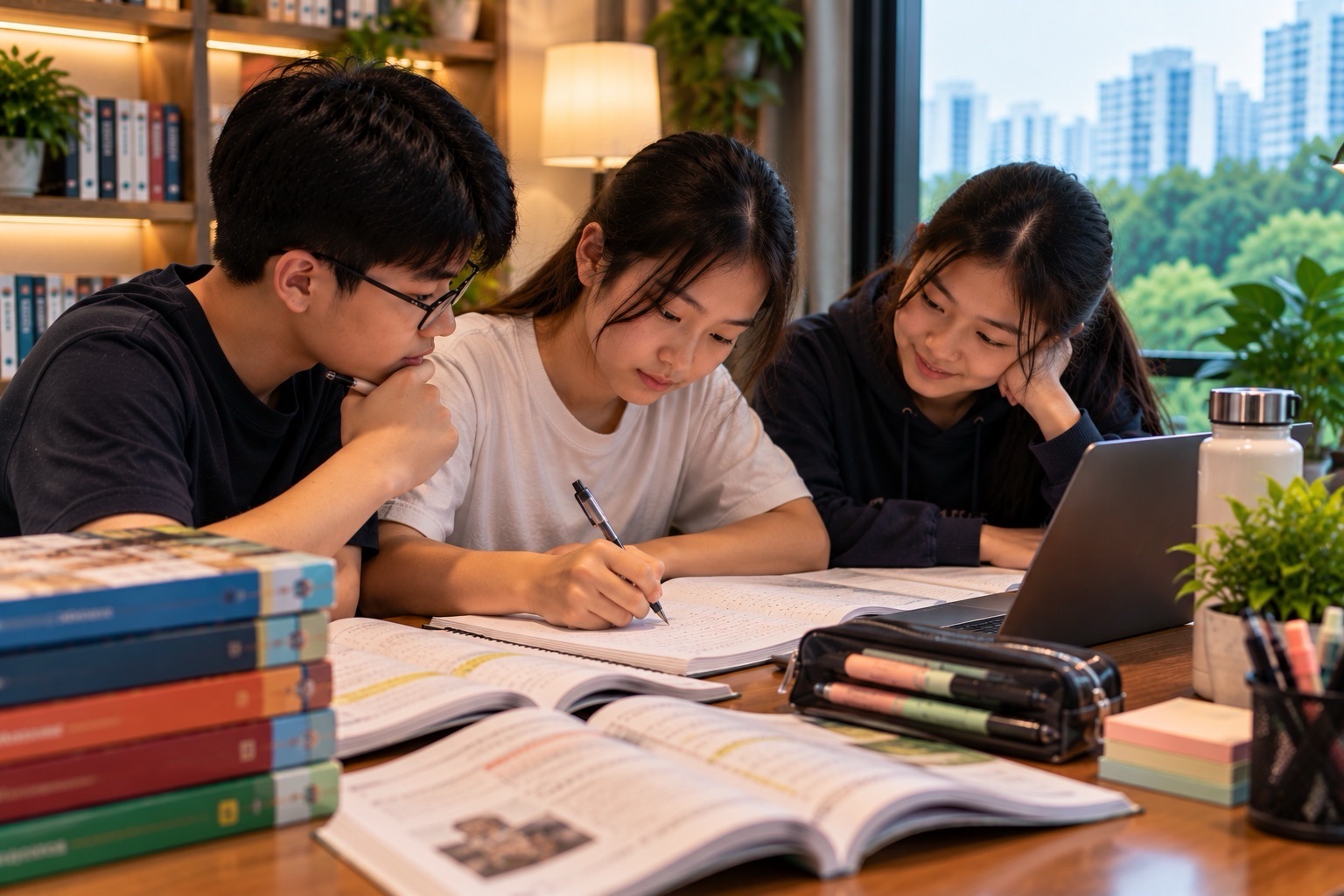
Did you know? A Secondary 1 student can feel completely confident while reading a worked Mathematics solution and then struggle to solve a similar question three days later. The worked example may have made the method look familiar, but familiarity is not the same as being able to choose and carry out that method independently.
For Secondary 1 G3 Mathematics students in Bukit Timah, revision needs to do more than repeat what was explained earlier in the week. Useful practice should help the learner retrieve the method without seeing the answer, return to it after a delay, and choose it from among other possible methods. That is the practical idea behind retrieval practice, spaced practice and interleaving.
This guide describes how a Secondary 1 G3 Mathematics tutor can use these techniques in a three-pupil class and how parents can support them at home. It offers ten worked examples, two mixed practice sets, a fourteen-day illustrative timetable and honest distinctions between evidence, practical teaching choices and guarantees nobody can make.
Quick navigation
- Quick answer: three study methods in plain English
- Worked retrieval example 1: recall after the model is hidden
- Worked retrieval example 2: a fraction after a delay
- Worked retrieval example 3: ratios with different givens
- Worked interleaving example 4: percentage versus reverse percentage
- Worked interleaving example 5: length, area or volume?
- Worked interleaving example 6: gradient versus an ordinary quotient
- Worked interleaving example 7: a fraction bar and an equation
- Worked interleaving example 8: the same angle, different total
- Worked interleaving example 9: two journeys, one averaging rule
- Worked interleaving example 10: a shape changes what is exposed
- A two-week practice calendar
- Twelve-question mixed practice set
- Answers to the mixed practice set
- A second mixed set for delayed checking
- Frequently asked questions
Quick answer: three study methods in plain English
Retrieval practice means trying to remember and use something already learned, without simply looking at the completed solution. A short quiz, a blank page where the student writes the formula, or a fresh equation can provide a retrieval opportunity.
Spaced practice means returning to a skill in separate sessions rather than doing all the practice at once. For example, learn a sign rule today, practise it in two days and revisit it next week.
Interleaving means mixing different but related problem types so the student must decide which method fits. A set could contain a ratio, a linear equation, a percentage and a geometry question rather than twenty identical fraction questions.
These are tools, not magic. A learner who never understood the original concept may need explicit teaching before unsupervised retrieval is helpful. Feedback after the attempt matters because repeatedly practising a wrong method is not a good goal.
Why copying a correct example can feel like learning
Imagine a worksheet with ten equations, each resembling 3(x − 2) + 5 = 20. The student sees a demonstration, copies the steps and solves several adjacent examples. They may be successful because the route was just shown.
Three days later, a question asks 4 − (2x + 3) = −9. The unknown is still found using a linear equation, but the negative sign before the bracket has a different role. The learner may freeze or distribute incorrectly.
The first worksheet demonstrated procedural fluency under a clear cue. The new problem tests whether the child can *choose and apply* the correct operation. Both experiences are useful, but they measure different things.
A tutor can reduce the gap by following guided practice with independent changed problems and later mixed retrieval.
What does research support—and what remains uncertain?
Research on spaced and retrieval practice has been conducted across a range of learning settings. A 2025 meta-analytic review focused on Mathematics learning found that spaced practice, on average, improved performance over concentrated practice, while the evidence for an additional testing-versus-restudy benefit in the smaller maths-specific set was less conclusive.
A 2026 meta-analysis of authentic primary and secondary classrooms found average benefits associated with retrieval, distributed practice and interleaving, but also reported substantial variation and conditions affecting when those benefits appeared.
These findings support thoughtful use of the methods, not a claim that the same schedule works for every student or that practice alone repairs a misunderstanding. Feedback, prior knowledge, the task format and the learner’s starting point matter.
The practical recommendation in this article is therefore modest: teach the concept clearly, ask for retrieval without the model, correct it promptly and return to it at different intervals.
What a first-principles explanation looks like before retrieval
Before a child is asked to retrieve a negative multiplication rule, explain it with an example such as −2(3x − 4).
The negative multiplier acts on both terms. Negative two times positive 3x gives −6x; negative two times negative four gives +8. So the expanded form is −6x + 8.
Check with x = 2. Original: −2(6 − 4) = −4. Expanded: −12 + 8 = −4. The forms agree.
A learner who can repeat “two negatives make positive” but cannot identify *which two factors* are negative needs conceptual clarification before more repeated practice. Retrieval should strengthen valid knowledge, not merely produce faster guessing.
Worked retrieval example 1: recall after the model is hidden
Teach the example −2(3x − 4) = −6x + 8, then remove it from view.
Ask the child to expand −3(2x − 5) independently. The answer is −6x + 15. Both terms receive the negative multiplier; the second product is positive.
If the answer is −6x − 15, the first error is a sign error. Have the learner calculate −3 × (−5) explicitly, then attempt another fresh example.
Do not respond by immediately showing the entire old solution. A brief targeted hint can preserve some retrieval while repairing the actual misconception.
Worked retrieval example 2: a fraction after a delay
Teach how to add fractions using equivalent denominators, then later ask for 3/4 − 5/6.
Use denominator twelve: 9/12 − 10/12 = −1/12. The student should be able to predict a small negative result because five sixths is slightly larger than three quarters.
A week later, change the problem to −2/3 + 5/6. With denominator six, −4/6 + 5/6 = 1/6.
A learner who can solve the earlier exact numbers after repetition but not the changed version may have remembered the output more than the method. Change values and signs deliberately.
Worked retrieval example 3: ratios with different givens
First teach a ratio sharing question where A:B = 3:5 and the total is 80. Eight parts represent eighty, so one part is ten and the quantities are thirty and fifty.
After a delay, ask the same ratio with a difference of sixteen. Now the difference is two parts, so one part is eight and the quantities are twenty-four and forty.
The common structure is equal ratio parts. The correct denominator for the first step is different because the given amount changed from a whole to a difference.
A child who automatically divides sixteen by eight has retrieved the old answer pattern instead of the meaning. Ask “What does sixteen represent in this question?”
What spacing might look like across a fortnight
An illustrative schedule for one newly learned skill could be: first lesson on Day 1, a short attempt on Day 3, another on Day 6, and a mixed check on Day 12. These are *example intervals*, not an experimentally verified universal optimum.
If the student still needs the original worked example on Day 3, repair the concept and reduce the complexity. If the skill is secure, broaden the interval or include a more unfamiliar context.
Spaced practice does not require extra hours. A short question revisited meaningfully may be more useful than completing another page immediately after the first lesson.
Keep the programme flexible around school lessons, homework and other subjects. Consistency matters more than a rigid schedule that leaves no room for feedback.
Interleaving should not begin as random confusion
A newly introduced concept often needs a short blocked phase, where several examples use the same method and the learner sees why it works. Mixing everything before a student knows any method can turn practice into guessing.
Once the foundations are reasonably secure, interleave two or three related methods. For example, a question about percentage of an amount can sit beside one about reverse percentage, forcing the learner to identify the 100% base.
Another useful pair is perimeter versus area. Both use a rectangle, but the requested measure changes which formula and unit are appropriate.
The purpose of interleaving is to practise selecting the relationship, not merely make a worksheet feel difficult.
Worked interleaving example 4: percentage versus reverse percentage
Question A asks: Find 20% of $90. That is 0.20 × 90 = $18.
Question B asks: A discounted price is $72 after 20% off. Find the original. Since $72 is 80% of the original, divide 72/0.80 to obtain $90.
Both questions mention 20% and similar values, but one applies a known percentage to a given base and the other works backward to discover the base.
Ask the student to state which amount represents 100% before calculating. That sentence reveals whether the correct method was chosen.
Worked interleaving example 5: length, area or volume?
Consider a cube with edge 5 cm. Its edge length is five centimetres, total surface area is 6 × 5² = 150 cm², and volume is 5³ = 125 cm³.
Mix three questions: How long is an edge? How much outside surface is present? How much three-dimensional space does the cube enclose?
All use the same number five. The pupil must identify the type of measurement and its correct unit before using a formula.
The metric conversion guide and nets-of-solids guide help students see the different dimensions physically.
Worked interleaving example 6: gradient versus an ordinary quotient
A line passes through (1,3) and (4,9). Gradient = (9 − 3)/(4 − 1) = 6/3 = 2.
Now ask for the value y/x at the point (4,9). That quotient is 9/4 = 2.25, not the line’s gradient. The gradient compares changes between points, not necessarily one point’s coordinates.
A student who automatically divides y by x has memorised the look of a fraction without knowing what it represents.
A changed graph after several days can test whether the correct relationship is retrieved independently.
Worked interleaving example 7: a fraction bar and an equation
Question A is “simplify (x + 4)/3 + (x − 2)/6.” Bring to denominator six: [2(x + 4) + (x − 2)]/6 = (3x + 6)/6 = (x + 2)/2.
Question B is “solve (x + 4)/3 + (x − 2)/6 = 5.” The same simplification produces (x + 2)/2 = 5, so x + 2 = 10 and x = 8.
Check in the original equation: (8 + 4)/3 + (8 − 2)/6 = 4 + 1 = 5.
Simplify and solve are different commands. Interleaving them makes the pupil read the equals sign and final instruction rather than carry out the most recently demonstrated procedure.
Worked interleaving example 8: the same angle, different total
Question A: two angles on a straight line include one of 110°. The companion is 180 − 110 = 70°.
Question B: a smaller angle is 110°. Its reflex companion is 360 − 110 = 250°.
Question C: three angles around a point measure 110°, 95° and 80°. The fourth is 360 − (110 + 95 + 80) = 75°.
These questions all use angle subtraction but rely on distinct geometric conditions. The learner should state “straight line,” “full reflex turn” or “angles around a point” before choosing the total.
This is the benefit of interleaving: it encourages recognition of what the problem *means*.
Worked interleaving example 9: two journeys, one averaging rule
Journey A covers 6 km in thirty minutes and 4 km in forty minutes. Total distance is 10 km; total time is 70 minutes, or 7/6 hour. Whole-journey average speed is 10/(7/6) = 60/7 km/h, about 8.57 km/h.
Journey B covers 10 km in one hour at one steady rate. Its average speed is 10 km/h.
A child who averages the stage speeds of Journey A without considering duration has used a shortcut that doesn’t match the question. The same formula—total distance divided by total time—must be recognised across both stories.
The speed and average-speed guide explains these distinctions in more detail.
Worked interleaving example 10: a shape changes what is exposed
A 4 cm cube has total surface area 6 × 4² = 96 cm². If the top face of a mathematical thin-walled open box with the same outside dimensions is absent, the five remaining faces total 80 cm².
The numerical edge length has not changed. The surface being counted has changed.
This makes a good delayed question after the learner has practised closed cuboids. The pupil must return to the model, identify exposed faces and decide which panels count.
If the child simply recites 6a² for both cases, revisit the physical meaning of surface area and the word “open.”
A two-week practice calendar
| Day | Short task | What to observe |
|---|---|---|
| 1 | Teach and practise one new skill | Can the child explain the rule? |
| 2 | One independent changed example | Is the same error repeated? |
| 3 | Retrieve a prior skill without notes | Does the method appear without a prompt? |
| 4 | Mix two previously learned types | Can the child select the right method? |
| 5 | Apply one skill in a word problem | Is the mathematical model correct? |
| 6 | Return to a question from Day 1 | Has the original rule survived? |
| 7 | Light review or normal school work | Avoid turning every day into a long test |
| 8 | Mix three secure topics | Check method selection and units |
| 9 | Fix one recurring error | Identify first incorrect line |
| 10 | One simple success plus one changed task | Balance confidence and challenge |
| 11 | Retrieve a skill not used for several days | Observe independent recall |
| 12 | Short mixed practice set | Watch the choice of method |
| 13 | Explain a solution aloud | Is the reason coherent? |
| 14 | Review error pattern and plan next week | Adapt the schedule, don’t just repeat it |
This calendar is an illustrative way to space tasks and feedback. It is not a mandated daily school timetable or a promise of a specified examination improvement.
Why the difficulty should be manageable
There is a difference between productive effort and unproductive confusion. If a student must work a little to recall how a fractional equation is balanced, the practice may be useful. If the student never understood what a denominator means, giving five harder fractional equations without explanation will not address the foundation.
Begin with a correctly taught model, move to a short independent changed example, and use feedback before the error is repeated too many times.
If several questions fail for the same reason, return to a simpler representation: a number line for signed fractions, a group of equal parts for ratio, a diagram for a triangle’s height, or a balance idea for linear equations.
Difficulty is not the goal. Independent and increasingly reliable reasoning is the goal.
How many questions belong in a retrieval session?
For a secure topic, a few changed questions may be enough to test whether the method can be recalled. For an unstable idea, the learner may need more explicit guidance and immediate corrective examples.
A ten- or fifteen-minute home session is a reasonable starting point, not a universal prescription. Some students benefit from brief sessions across several days; others need an occasional longer guided lesson.
Avoid assigning an arbitrary fixed number of questions regardless of their quality. A child who completes twenty copied equations has not necessarily demonstrated more learning than one who explains five new examples correctly.
A tutor can select the number and difficulty of questions according to the learner’s demonstrated progress.
Twelve-question mixed practice set
Try this set without the worked examples beside you. Before each calculation, identify the topic or method needed.
- A. Evaluate (−3)(−4) + 2.
- B. Find 3/4 − 5/6.
- C. Solve 4x + 7 = 31.
- D. Simplify 5x − 2x + 3y.
- E. Find the original price if $72 is 80% of it.
- F. Share $80 in the ratio 3:5.
- G. Find the gradient through (1,3) and (4,9).
- H. A rectangle measures 7 cm by 4 cm. Find its perimeter.
- I. Find that rectangle’s area.
- J. Find one exterior angle of a regular octagon.
- K. Convert 0.5 m² to cm².
- L. A closed cube has 5 cm edges. Find its total surface area.
Answers to the mixed practice set
A. 14; the negative factors give positive twelve, then add two.
B. −1/12; use twelfths to subtract equivalent fractions.
C. x = 6; subtract seven and divide by four.
D. 3x + 3y; only like variable parts combine.
E. $90; divide by 0.80 because $72 is 80% of the original.
F. $30 and $50; eight equal parts share the total eighty.
G. 2; vertical change six divided by horizontal change three.
H. 22 cm; perimeter = 2(7 + 4).
I. 28 cm²; area = 7 × 4.
J. 45°; eight exterior turns total 360°.
K. 5000 cm²; one square metre contains ten thousand square centimetres.
L. 150 cm²; six square faces, each of area twenty-five.
If questions H and I were confused, the learner needs to distinguish boundary from region. If E was answered with $86.40, revisit the reference base. If C was answered without a check, ask for substitution into the original equation.
A second mixed set for delayed checking
Use different numbers on a later day. The point is to see whether the method survives without the first model nearby.
- A. Evaluate −2(4 − 7) + 5.
- B. Find −2/3 + 5/6.
- C. Solve 5(x − 2) = 3x + 8.
- D. Factorise 12x + 18 fully.
- E. Find a price before 30% off if its final price is $84.
- F. If A:B = 3:5 and the difference is 16, find A and B.
- G. Find the gradient through (2,9) and (6,1).
- H. A trapezium has parallel sides 10 and 16 cm and height 6 cm. Find its area.
- I. Find the reflex partner of 125°.
- J. Convert 0.006 m³ into litres.
- K. Find the volume of a 5 cm cube.
- L. Find a pie-sector angle representing 25% of one whole.
The answers are 11; 1/6; x = 9; 6(2x + 3); $120; A = 24 and B = 40; gradient −2; 78 cm²; 235°; 6 L; 125 cm³; and 90° respectively.
This second set is not harder in every question. It is different enough that a pupil must retrieve methods rather than copy the same numerical output.
How to tell whether learning is lasting
A learner may solve the same worksheet correctly immediately after reviewing it. That is useful practice, but it doesn’t prove durable recall.
Look for correct independent solutions after several days, changes in numerical values, changes in problem wording and combinations of previously separated topics.
Also look at *how much prompting was needed*. If the child still requires “remember to use the total number of parts” on every ratio question, the method is not yet independently selected.
A short record of successful changed problems is more useful than a growing folder of copied solutions.
A ninety-minute three-pupil tutoring application
A lesson can begin with ten minutes of spaced retrieval from a previous topic, followed by focused teaching of one new idea. The tutor then models the new method with a worked question.
Guided practice checks whether each child understands the reasoning. Independent application changes numbers and problem wording. A mixed section revisits two older skills so the learner must choose the correct method without being told the chapter.
The final error review records the first invalid line and schedules a later retrieval attempt. In a group of no more than three students, the tutor can adapt the intervention for different weaknesses rather than giving everyone an identical worksheet sequence.
The eduKateSG Secondary 1 Mathematics small-group tutorial reference describes the wider ninety-minute teaching framework, while the Bukit Timah G3 Mathematics tuition overview provides local programme context.
Parents can help without turning every evening into an exam
Ask the child to explain one example from memory, then give a changed problem. The goal is a short moment of independent thinking with supportive feedback, not a daily high-pressure score.
If the learner has already completed substantial school homework, a two-question retrieval check may be more appropriate than another long practice paper.
Parents can also ask the student to predict the sign, units or magnitude before calculating. This encourages number sense and self-checking even when no full solution is written.
A child who genuinely cannot start a question may need to see a simpler model again. Retrieval is a learning tool, not a reason to withhold necessary teaching.
Frequently asked questions
Is retrieval practice the same as repeatedly copying notes?
No. Retrieval asks the student to recall and use something without seeing the completed answer. Copying is a different activity and may still be useful during initial explanation.
Does spacing mean practising only once a week?
No. It means distributing practice across separate sessions. Exact intervals should be adjusted to the learner and the topic rather than fixed universally.
Should I interleave everything from the first lesson?
Not necessarily. A new skill often needs explicit teaching and some focused examples before the pupil can productively distinguish it from other methods.
Is interleaving always better than blocked practice?
No universal rule fits every task. Blocked examples can teach a new method; mixing previously learned problem types can help students practise selecting it. Feedback and difficulty matter.
What if the child gets the same question wrong repeatedly?
Return to the first wrong step, teach that idea more concretely and give simpler changed examples. Repeated unsuccessful guessing is not the intended method.
Can research guarantee that grades will improve?
No. Research reports average outcomes and variations across settings, not a guarantee for an individual student. Understanding, feedback, practice quality and school context still matter.
How is this different from a weighted-assessment revision plan?
This guide focuses on *how learning is retained and methods are chosen* throughout the term. The weighted-assessment revision article focuses on responding to upcoming school assessment needs.
Is a tutor necessary to use these techniques?
No. Parents and students can use short retrieval and spacing routines at home. Tuition may be useful when concepts remain unclear or feedback is needed to identify the first incorrect reasoning step.
Connected Secondary 1 G3 Mathematics resources
- Weighted-assessment revision and error log
- Maths assessment time management and question order
- Number-skills diagnostic with worked answers
- Algebra diagnostic with 24 worked solutions
- Secondary 1 to Secondary 2 G3 Maths readiness
The next time a student says “I knew this yesterday,” that is useful information. The next teaching step is to help them retrieve the mathematical relationship tomorrow, next week and in a changed question—without needing the old worked example in front of them.