
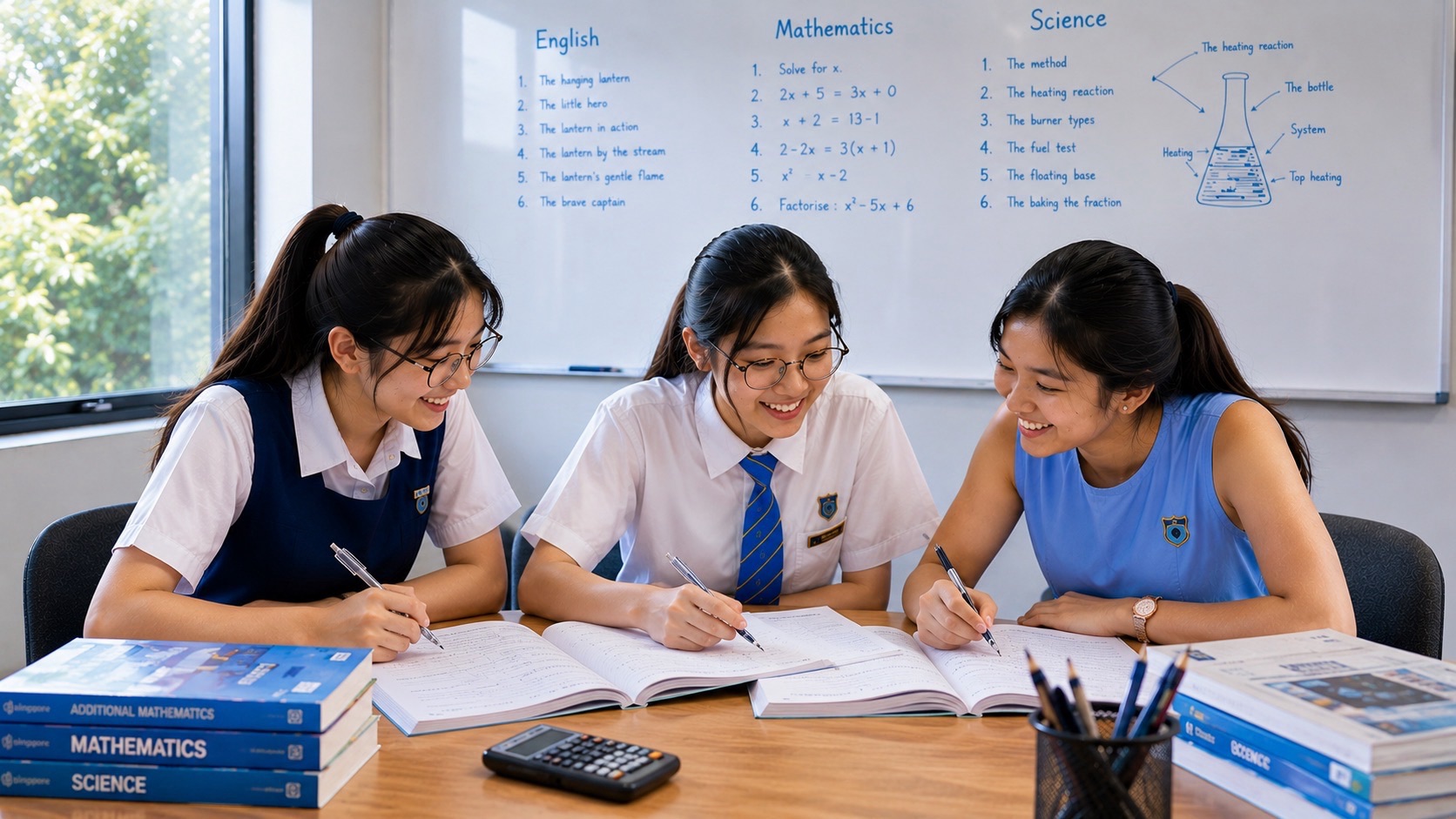
Secondary 1 Mathematics introduces a more symbolic way to describe quantities and relationships. Letters, expressions and graphs do not replace number sense; they extend what the student can represent before a particular answer is known.
The Darwin Series uses adaptation as a lens for this change. Read its symbolic-habitat explanations alongside the practical PSLE-to-algebra pillar, then test whether the learner can move between a story, diagram and equation. This is a conceptual companion; the programme page explains the local teaching arrangements.
Continue your Secondary 1 Mathematics journey: Bukit Timah Secondary 1 Mathematics programme · Parent reading guide · PSLE to algebra. This guide focuses on Adapting to symbolic Mathematics. For the 3-pax teaching approach and suitable class placement, use the programme page.
For the practical class route, use Secondary 1 Math Tuition Bukit Timah | 3-Pax Tutorials. For the broader reading map, use the Bukit Timah Secondary Mathematics and A-Math Article Directory.
G1, G2 and G3 are subject-demand environments, not labels on children. The tutor’s job is to understand the student’s actual course, starting point and school sequence, then build the symbolic control required for that environment.
Why Secondary 1 Feels Different
A Primary 6 student may be very competent at arithmetic and still feel unsettled when a familiar relationship is rewritten symbolically. The difficulty is not always the arithmetic. It may be the new language.
For example, 3 × 7 = 21 can become 3x = 21. The calculation is simple, but the learner now has to understand what x represents, why an equation expresses balance, what operations preserve that balance and how the answer can be checked.
- Read symbols as relationships rather than decoration.
- Control negative signs, brackets and fractions.
- Distinguish expressions from equations.
- Move between words and algebra.
- Use graphs as representations of relationships.
- Show enough working to protect a longer chain of reasoning.
- Carry Primary foundations forward instead of abandoning them.
How a 3-Pax Tutorial Builds Symbolic Control
The tutor can slow one symbolic move without slowing the whole class. If a student expands a bracket incorrectly, loses a negative sign or treats an equation as a collection of terms to move around, the error can be corrected at the exact point it appears.
Once the principle is secure, the pace can increase. Clarity first; speed afterwards.
- Short diagnostic questions to locate the precise break.
- First-principles explanation before shortcut language.
- Guided examples followed by independent starts.
- Interleaving so the student must recognise the structure.
- Retesting after a delay so the skill survives beyond the lesson.
- Carefully paced pre-teaching when the foundation is ready.
Deep Reading: The Symbolic Habitat
1. Primary 6 did not end the old world
The P6 learner arrives carrying:
NUMBER SENSEFRACTIONSDECIMALSPERCENTAGESRATIORATEGEOMETRYPROPORTIONAL REASONINGINVERSE RELATIONSHIPSWORD-PROBLEM MODELLINGTRANSFERRECOVERY
Secondary 1 does not erase this.
Instead:
PRIMARY MATHEMATICS ↓ENTERS SYMBOLIC ENVIRONMENT
This is crucial.
If fractions were weak in Primary school, Secondary algebra can expose that weakness.
If ratio was fragile, equation formation can expose it.
If negative-number control is poor, algebra and coordinate work amplify it.
eduKateSG’s current Sec 1 diagnostic work identifies exactly these inherited leaks—fractions, ratio and negative numbers—as common foundations underneath later algebraic difficulty. (eduKate Singapore)
So:
Secondary 1 Mathematics does not reset the learner. It increases the resolution at which old weaknesses can be seen.
2. The habitat discontinuity is symbolic
Consider a Primary problem:
3 + 5 = 8
Every number is known.
Now Secondary Mathematics introduces:
x + 5 = 8
One quantity is hidden.
Then:
3x + 5
which may not even be asking for an answer.
The learner has entered a different environment.
The central mathematical object is increasingly not:
NUMBER
but:
RELATIONSHIP
That is the Secondary 1 discontinuity.
3. xis not merely a box with a different shape
At first, teachers may explain:
□ + 4 = 9
becomes:
x + 4 = 9
That is a useful bridge.
But if the learner freezes:
x = MISSING NUMBER
as the entire meaning of algebra, trouble comes later.
A letter may eventually function as:
UNKNOWNVARIABLEGENERAL NUMBERCOORDINATEPARAMETER
depending on the mathematical environment.
So the representation must be allowed to expand.
Exactly as multiplication had to expand beyond repeated addition.
4. Secondary 1 introduces Mathematics before the number is known
This is profound.
A learner can reason:
3x + 2x = 5x
without knowing x.
They can reason:
2(x + 3) = 2x + 6
without knowing x.
They can transform:
3x + 5 = 17
before discovering:
x = 4
The learner now accepts:
I can know something true about a relationship even when I do not yet know the value.
That is a major change in mathematical cognition.
5. Algebra is a new representation layer over old Mathematics
Take:
Amy has three times as many stickers as Ben.
Primary representation might be:
BEN |----|AMY |----|----|----|
Secondary representation can become:
Ben = xAmy = 3x
The relationship has not changed.
The representation has.
So:
BAR MODEL↓ALGEBRA
should not be treated as:
OLD MATHEMATICS↓NEW UNRELATED MATHEMATICS
It is partly a change in representational power.
6. Algebra compresses relationships
Suppose:
Ben has x dollars. Amy has $7 more than Ben.
A long verbal statement becomes:
Ben = xAmy = x + 7
That is powerful compression.
A relationship can now be stored compactly.
But the Darwin/MAST rule remains:
Can the learner decompress it?
If:
x + 7
has become a meaningless token, the compression is too lossy.
The learner should still be able to say:
Seven more than the unknown quantity.
7. Algebra is therefore a compression technology
This gives Secondary 1 a major Darwin-Series connection.
Primary Mathematics repeatedly required the learner to:
SEE RELATIONSHIP↓REPRESENT
Secondary 1 gives a much more powerful representation language.
For example:
three consecutive numbers
can become:
xx + 1x + 2
A paragraph collapses into a structure.
That frees the learner to reason about the structure itself.
8. But compression increases coupling
This is where our larger systems research becomes useful.
When:
3x - 2(x - 4)
is written compactly, several relationships are packed tightly together.
The learner must coordinate:
SIGNBRACKETMULTIPLICATIONTERMLIKE TERMORDER
A tiny local error can propagate through the whole expression.
The mathematical system has become more coupled.
9. A small sign can now create a large downstream failure
Consider:
-2(x + 3)
Correct:
-2x - 6
But if the learner writes:
-2x + 6
one sign has changed.
Later:
-2x + 6 + 5x
becomes:
3x + 6
The later algebra may be perfectly executed.
But the entire corridor is already wrong.
Again:
CRASH LOCATION≠FAULT ORIGIN
The P2–P6 rule survives into Secondary Mathematics.
10. Negative numbers become infrastructure
Primary Mathematics introduced negative numbers lightly through contexts and ordering.
Secondary 1 makes them systemic.
They appear inside:
directed numbersalgebraic termsbracketssubstitutionequationscoordinatesgraphs
eduKateSG’s current Sec 1 material treats weak negative-number control as one of the most important early algebra leaks because sign errors can propagate across many later topics. (eduKate Singapore)
So:
NEGATIVE NUMBERS≠ONE CHAPTER
They become mathematical infrastructure.
11. The minus sign has several identities
Consider:
-3 - (-5)
There are several symbols that look similar.
But their roles differ.
-3
contains a sign attached to a number.
Then:
-
may indicate subtraction.
Then:
(-5)
contains another negative number.
The learner must separate:
NUMBER SIGN
from:
OPERATION
That is type discipline.
A tiny symbol can have different functional roles depending on where it sits.
12. Secondary 1 is where symbol ownership matters
Take:
-4x
The negative sign belongs to the term.
The mathematical object is:
(-4x)
not:
4x
with a decorative minus sign floating nearby.
This sounds trivial.
It is not.
If signs are not attached to the correct objects, expressions become unstable.
The learner needs symbol ownership.
13. This is the Symbolic Habitat equivalent of provenance
In the Darwin ID system we asked:
Which source does this information belong to?
In algebra we ask:
Which term does this sign belong to?
Or:
What does this exponent act on?
For example:
(-2)²
versus:
-2²
The symbols are nearly identical.
Their scope differs.
So:
SYMBOL+LOCATION+SCOPE=MEANING
This is mathematical provenance at microscopic scale.
14. Brackets become fences
At Primary level, brackets may have seemed like helpful notation.
At Secondary 1 they become structural boundaries.
Consider:
2(x + 5)
The bracket declares:
THIS WHOLE OBJECTIS MULTIPLIED BY 2
Without respecting the boundary:
2(x + 5)=2x + 5
appears plausible.
But it is structurally invalid.
So brackets act like a mathematical FENCE.
15. FENCE becomes almost literal
For:
-3(2x - 5)
the fence says:
-3ACTS ONTHE ENTIRE CONTENT
Therefore:
-6x + 15
The learner must not cross the boundary selectively.
This creates another Secondary 1 law:
Operations have scope.
That becomes fundamental later in:
algebraic fractionsindicesfunctionstrigonometrycalculus
16. Expressions are not equations
Another critical anti-flattening lock appears.
3x + 5
is an expression.
3x + 5 = 17
is an equation.
These are not interchangeable.
The first describes a mathematical object.
The second asserts a relationship between two objects.
So:
EXPRESSION≠EQUATION
A learner who does not preserve this distinction begins manipulating symbols without knowing what kind of object is being manipulated.
17. Equations introduce a balance system
A useful representation is:
LEFT SIDE=RIGHT SIDE
The equality sign means:
SAME VALUE
not:
the answer comes next.
That is a major conceptual repair for some learners.
In:
3x + 5 = 17
the equation represents a balanced relationship.
If we subtract 5:
3x + 5 - 5=17 - 5
both sides are changed consistently.
The relationship survives.
18. Solving an equation is invariant-preserving transformation
This is a beautiful Darwin-Series connection.
Start:
3x + 5 = 17
Transform:
3x = 12
Transform:
x = 4
The appearance changes.
What survives?
THE SAME SOLUTION SET
Every valid transformation must preserve the underlying equality relationship.
So equation solving is not:
Move things across and change the sign.
It is:
Transform the representation while preserving the invariant.
That is much stronger Mathematics.
19. “Move across, change sign” is dangerous compression
The shortcut:
Move +5 across, it becomes -5.
often produces the correct result.
But it can hide the actual operation:
subtract 5 from both sides
Once equations become more complex, the opaque shortcut can fail.
So again:
FAST PROCEDURE+RECOVERABLE RELATIONSHIP
is strong.
FAST PROCEDURE+NO UNDERLYING MODEL
is fragile.
Secondary 1 must preserve the bottle.
20. Algebra introduces legal and illegal transformations
For example:
3(x + 2)
may become:
3x + 6
Valid.
But:
3(x + 2)→3x + 2
invalid.
Similarly:
2x + 3x→5x
valid.
But:
2x + 3→5x
invalid.
The learner is now operating under a formal transformation grammar.
That is a new environment.
21. Like terms introduce mathematical type matching
Why can:
2x + 3x
become:
5x
but:
2x + 3
cannot?
Because the terms are not the same type.
A simple analogy:
2 apples + 3 apples = 5 apples
but:
2 apples + 3 oranges
does not become:
5 apples
The symbolic habitat makes type compatibility explicit.
22. The term becomes the basic local object
In:
-3x²
the term carries:
SIGNCOEFFICIENTVARIABLEPOWER
Those components belong together.
So instead of seeing:
-3x²
as four disconnected marks, the learner needs:
[-3x²]
as one structured mathematical object.
This reduces sign loss and algebraic fragmentation.
23. Indices increase compression again
Repeated multiplication:
x × x × x × x
compresses to:
x⁴
Again the representation becomes more efficient.
But the learner must retain:
x⁴=x × x × x × x
Otherwise later index laws become arbitrary slogans.
Secondary Mathematics repeatedly increases compression density.
That makes recoverability increasingly important.
24. The Symbolic Habitat is therefore denser than the Primary world
Compare:
3 groups of 4
with:
3 × 4
and later:
3x²y
Symbolic Mathematics packs more meaning into less visual space.
That creates efficiency.
It also creates higher information density.
So:
As notation becomes more compressed, symbol discipline becomes more important.
A missing bracket or sign can carry disproportionately large consequences.
25. This is the Forest City density problem
A large system can increase functional density by connecting more activity within less physical or organisational space.
But tighter coupling also means disturbances can spread faster.
The Secondary 1 analogue is:
MORE MATHEMATICSPACKED INTOFEWER SYMBOLS
This increases power.
It also increases coupling.
One symbol error can now affect several downstream operations.
26. The solution is not to fear abstraction
The answer is not:
KEEP MATHEMATICS CONCRETE FOREVER
Abstraction is enormously powerful.
Instead:
ABSTRACTION+PROVENANCE+SCOPE+TYPE+CHECKING
creates safe symbolic power.
The learner should know what every important symbol is doing.
27. Secondary 1 creates the External Mathematical Monologue
At Primary levels, much thinking can remain supported by:
objectsdrawingsbar modelsarithmetical working
Secondary 1 increasingly requires a visible symbolic reasoning trail.
For example:
3x + 7 = 223x = 15x = 5
The written sequence is an external mathematical monologue.
It shows:
WHAT I BELIEVEWHAT I CHANGEDWHY THE NEXT STATE FOLLOWS
The page becomes part of the thinking system.
28. Working is no longer merely showing the teacher
The learner’s written algebra acts as:
EXTERNAL MEMORYSTATE RECORDERROR TRACERETURN CHANNEL
If too many operations occur mentally:
STATE(t0)↓???↓STATE(t3)
then when the result fails, reconstruction becomes difficult.
Clear working makes the reasoning inspectable.
This is the same reason Darwin’s notebooks mattered.
29. One symbolic line should contain a defensible transition
The best Secondary 1 working increasingly behaves like:
STATE 0↓ legal transformationSTATE 1↓ legal transformationSTATE 2
Every line has provenance.
The learner should be able to ask:
Why is this line allowed to follow the previous one?
That is very different from copying memorised solution shapes.
30. This is where “skip steps” becomes a systems problem
A strong Primary learner may have become accustomed to mental jumps.
In Secondary 1, the density of symbolic relationships makes large invisible jumps risky. eduKateSG’s current transition work explicitly identifies excessive step-skipping as a common source of instability when students enter algebra. (eduKate Singapore)
The problem is not simply presentation.
It is lost state.
TOO MUCH COMPRESSION↓INTERMEDIATE RELATION LOST↓ERROR HARDER TO DETECT
So the required working resolution has changed.
31. Coordinates create a new spatial representation
The learner now moves more seriously into:
(x, y)
A pair of numbers becomes a location.
For example:
(-3, 2)
means:
x = -3y = 2
The order matters.
The signs matter.
The axes matter.
The coordinate is a typed structure.
Again:
-32
alone is insufficient.
Their relationship and order create meaning.
32. A coordinate graph is a mathematical world
Primary graphs largely represented data.
Secondary graphs increasingly represent relationships.
The learner moves from:
GRAPH AS DISPLAY
toward:
GRAPH AS MATHEMATICAL OBJECT
A point may satisfy an equation.
A line may represent infinitely many coordinate pairs.
A gradient may describe how one quantity changes relative to another.
The symbolic and visual worlds begin connecting.
33. This is another major representation bridge
A relationship might exist as:
y = 2x + 1
or:
TABLE OF VALUES
or:
STRAIGHT-LINE GRAPH
The surface changes radically.
The relationship remains connected.
P3’s Representation Habitat has now reached a much higher abstraction level.
34. Algebra and graphs become two views of one relationship
For example:
y = 2x + 1
can generate:
x = 0 → y = 1x = 1 → y = 3x = 2 → y = 5
which generate points:
(0,1)(1,3)(2,5)
which align on a line.
So:
SYMBOLIC RULE↔TABLE↔COORDINATE POINTS↔GRAPH
This is a powerful representation network.
35. The learner must now traverse representations in both directions
Given:
equation
produce:
graph
But also:
graph
infer:
relationship
Secondary Mathematics increasingly requires bidirectional traversal.
This is far beyond simply “drawing graphs.”
It is representation translation.
36. Tetris changes again
P3 Tetris rotated representations.
P4 Tetris assembled modules.
P5 Tetris assembled proportional relationships.
P6 Tetris assembled multi-topic solutions.
Secondary 1 Tetris becomes:
Can symbolic components be legally assembled into a general mathematical structure?
For example:
3x+5=17
Each component has a role.
Change the assembly:
3(x + 5) = 17
and the mathematical object changes.
Placement now carries meaning.
37. Symbolic Tetris has strict ports
For an algebraic term:
coefficient→ variable→ exponent
For an equation:
expression=expression
For a coordinate:
(x, y)
For a fraction:
numerator──────────denominator
The pieces cannot be recombined arbitrarily.
The symbolic world has stricter connection rules.
38. This makes syntax mathematically meaningful
Consider:
2x²
and:
(2x)²
They are not the same.
The first is:
2 × x²
The second is:
4x²
Small syntax change.
Different Mathematics.
So Secondary 1 begins teaching that mathematical notation behaves partly like a formal language.
Structure carries meaning.
39. Mathematics now has grammar
Examples:
3x
valid term.
3 + × x
not valid mathematical grammar.
Similarly:
2(x + 4)
contains a valid multiplication relation.
The learner increasingly has to read expressions structurally rather than as strings of marks.
This makes Secondary Mathematics more language-like.
40. Mathematical English also matters more
The learner encounters phrases such as:
three more than xthree times xthree less than xx less than threeat mostat leastconsecutive integers
Small language differences produce different algebra.
For example:
3 less than x=x - 3
while:
x less than 3=3 - x
The same words appear.
Order changes the relationship.
So language becomes another symbolic interface.
41. Translation errors can masquerade as algebra errors
A learner may correctly manipulate:
3x + 5 = 20
but incorrectly translate the original sentence into that equation.
Then:
ALGEBRA ENGINE=WORKING
while:
LANGUAGE → ALGEBRA COMPILER=FAILED
Again:
QUESTION TOPIC≠FAILURE ORIGIN
The old diagnostic law survives.
42. The Algebra Compiler
Secondary 1 now requires:
LANGUAGE↓ENTITIES↓UNKNOWN↓RELATIONSHIPS↓SYMBOLIC REPRESENTATION↓EQUATION / EXPRESSION↓TRANSFORMATION↓SOLUTION↓RETURN TO ORIGINAL WORLD
This is longer than most Primary symbolic corridors.
Every transition can fail separately.
That is why “weak algebra” is too broad a diagnosis.
43. The variable gives the unknown an ID
Suppose:
A number increased by 7 equals 19.
Assign:
x = the number
Now the unknown has an address.
Then:
x + 7 = 19
This is conceptually similar to our ID-card system:
something not yet fully known can still be stably referenced.
The learner does not need the value first.
The identity is enough to begin reasoning.
44. This is an enormous mathematical capability
Before symbolic representation, the unknown can feel like emptiness.
After:
x
the unknown becomes something the learner can:
refer tocombinecomparetransformconstrainsolve for
Algebra turns absence into an addressable mathematical object.
That is the defining power of the Symbolic Habitat.
45. Generalisation now becomes possible
Primary learner:
3 × 4 = 123 × 5 = 153 × 6 = 18
Secondary learner can express:
3n
for three times an arbitrary number.
Or:
n + (n + 1) + (n + 2)
for three consecutive integers.
The learner moves from examples toward general structure.
That is a major evolutionary movement in mathematical capability.
46. One symbolic statement can represent infinitely many cases
Consider:
a + b = b + a
This is not one calculation.
It represents a property across a vast class of numbers.
Symbolic Mathematics therefore dramatically expands compression.
MANY CASES↓ONE GENERAL REPRESENTATION
The learner begins working at a new zoom level.
47. The Forest City scale lesson returns
At Primary level, a learner might solve:
5 + 7 = 7 + 5
At Secondary level:
a + b = b + a
captures an entire structural family.
The mathematical object has scaled.
But the new representation works only if the invariant is correct.
So generalisation is:
OBSERVED CASES↓STRUCTURAL RELATION↓GENERAL SYMBOLIC FORM
not:
SEE TWO EXAMPLES↓DECLARE UNIVERSAL LAW
The evidence boundary still matters.
48. Counterexamples now become more powerful
Suppose a learner proposes:
(a + b)² = a² + b²
Test:
a = 1b = 1
Left:
(1 + 1)² = 4
Right:
1² + 1² = 2
The claim fails.
One counterexample can destroy a universal statement.
This is a powerful new return mechanism.
49. The symbolic world makes model attack easier
A general claim can be tested deliberately.
CLAIM↓SELECT TEST CASE↓RETURN
If it fails once where the claim says it should always hold:
REVISE / REJECT CLAIM
This is extremely Darwin-Series compatible:
Do not protect the representation from the world capable of correcting it.
50. Secondary 1 therefore begins proof-like discipline
Not formal proof at full mathematical maturity.
But the learner starts differentiating:
ONE EXAMPLE
from:
GENERAL REASON
and:
MANY EXAMPLES
from:
ALWAYS TRUE
This is an important intellectual transition.
A pattern suggests.
A reason establishes more.
A counterexample can refute.
51. G1, G2 and G3 now become different mathematical apertures
Under Full SBB, secondary subjects can be taken at G1, G2 or G3 levels, and the system is designed to provide more flexibility than the old fixed-stream structure. (Education Conversations)
For the Darwin Series, represent them as:
G1=ONE CURRENT SUBJECT-DEMAND APERTUREG2=ANOTHER CURRENT SUBJECT-DEMAND APERTUREG3=ANOTHER CURRENT SUBJECT-DEMAND APERTURE
Not:
LOW EVOLUTIONMEDIUM EVOLUTIONHIGH EVOLUTION
That interpretation is forbidden.
52. The underlying mathematical machinery overlaps
Across the lower-secondary landscape, the broad national mathematical architecture remains organised around major strands such as Number and Algebra, Geometry and Measurement, and Statistics and Probability, with differences in depth, pacing and expected complexity across subject levels. eduKateSG’s current Secondary 1 registry and programme pages use the same broad organisation. (Ministry of Education Singapore)
So the Darwin Series can preserve:
SHARED MATHEMATICAL WORLD
while varying:
DEPTHLOADABSTRACTIONPACETRANSFER DISTANCE
That is a much better model than three separate species of Mathematics.
53. G1/G2/G3 should be modelled as demand fields
Internally:
LEARNER STATE ↓CURRENT SUBJECT DEMAND ↓FIT / STRAIN / BUFFER
The useful question is:
Can this learner’s present mathematical system operate reliably in this demand field?
That is a state question.
Not an identity question.
54. Movement remains possible
Full SBB was designed to provide flexibility in subject-level study rather than permanently fixing every learner into one homogeneous stream. (Education Conversations)
That fits our Darwin architecture perfectly.
A subject-level state should therefore be:
CURRENT CONFIGURATION
not:
FINAL DESTINY
The mathematical tree remains open.
55. This matters enormously for the later Darwin world
We will eventually need:
SEC 1 G1SEC 1 G2SEC 1 G3↓SEC 2 G1SEC 2 G2SEC 2 G3↓SEC 3–4 pathways↓G3 Mathematics+possible Additional Mathematics branch↓JC / Polytechnic / other mathematical routes
But the tree must never become a vertical hierarchy of human worth.
It is a routing map.
56. Secondary 1 adds a major load problem
In Primary 6, one difficult question could combine several topics.
In Secondary 1, even a short algebraic expression can pack several operations into a small space.
For example:
3 - 2(4 - x)
requires:
bracket controlnegative sign controlexpansionlike termsorder
The visual footprint is tiny.
The internal load is not.
That is symbolic density.
57. Information density can turn into interference
This connects to the wider systems work.
When symbolic information is sparse, the learner can process each component separately.
As density rises:
SIGNBRACKETEXPONENTVARIABLECOEFFICIENTOPERATION
sit very close together.
Then one interpretation can interfere with another.
For example:
-2²
versus:
(-2)²
A tiny boundary change alters the output.
The system needs greater resolution to avoid interference.
58. Time pressure tightens coupling further
Under untimed conditions the learner may:
pauseexpandcheckrewrite
Under examination time pressure, steps compress.
If the learner compresses beyond safe resolution:
INFORMATION DENSITY+TIME PRESSURE↓INTERFERENCE
can rise.
This is why clear symbolic habits need to be installed before the mathematics becomes substantially harder.
59. Fast algebra is not the first target
The safe progression is:
MEANING↓STRUCTURAL ACCURACY↓SYMBOL DISCIPLINE↓REPEATABILITY↓COMPRESSION↓SPEED
Not:
SPEED↓HOPE STRUCTURE FOLLOWS
The same principle governed P6.
Secondary 1 makes it even more important.
60. Secondary 1 needs error containment
Suppose the learner makes a sign error on Line 2.
If every later line uses the corrupted state:
ERROR↓ERROR↓ERROR↓ERROR
The cascade grows.
A strong learner has telemetry:
Does the sign make sense?Can I substitute my answer?Does the graph agree?Does the magnitude make sense?
Return loops can stop propagation.
61. Substitution becomes a verification tool
After solving:
3x + 5 = 17
and obtaining:
x = 4
return:
3(4) + 5=17
Correct.
The solution feeds back into the original equation.
This is one of the cleanest mathematical Return loops in Secondary 1.
62. Algebra can increasingly check itself
The learner can use:
substitutioninverse operationsgraph intersectionalternative manipulationestimation
depending on the problem.
The mathematical system gains internal redundancy.
That increases recoverability.
63. Geometry also becomes more relational
Secondary Mathematics increasingly shifts from recognising shapes toward reasoning from properties.
Instead of:
This looks like an isosceles triangle.
the learner increasingly uses:
given equal sidestherefore equal base angles
or other declared geometric properties.
The move is:
APPEARANCE↓PROPERTY↓RELATION↓DEDUCTION
This continues the Darwin Series’ long anti-surface movement.
64. Diagram appearance becomes less trustworthy
A diagram may not be drawn to scale.
So:
LOOKS EQUAL
is not evidence that:
IS EQUAL
The learner must use given information and valid geometric relationships.
Thus:
REPRESENTATION≠REALITY
returns in a very literal mathematical form.
65. Secondary 1 Mathematics begins formal evidence discipline
A geometric conclusion may require:
GIVENPROPERTYREASONCONCLUSION
Likewise, an algebraic transformation requires a valid operation.
The student moves toward:
What allows me to claim this next step?
That is an important intellectual upgrade.
66. Forest City adds the global-coherence warning
A learner can have:
strong algebrastrong geometrystrong graphsstrong statistics
locally.
But Secondary Mathematics increasingly requires movement among these systems.
Later:
algebra↔graphsgeometry↔algebraratio↔equationsstatistics↔graphs
So the old law remains:
LOCAL MASTERY≠GLOBAL MATHEMATICAL COHERENCE
Secondary 1 must keep building the roads.
67. Algebra becomes the new transport network
eduKateSG’s current Sec 1 architecture describes algebra as the control room for later Secondary Mathematics because expressions, equations, substitution and symbolic translation recur inside graphs, proportion, geometry and later upper-secondary work. (eduKate Singapore)
That makes algebra analogous to infrastructure.
It is not simply one district.
It becomes a language through which other districts communicate.
68. This is why early algebra fractures compound
A weak algebraic habit may initially affect:
simplification
Then:
equations
Then:
graphs
Then later:
simultaneous equationsquadraticstrigonometric manipulationAdditional Mathematics
The earliest visible failure may appear small.
Its future network centrality is high.
So Sec 1 algebra deserves disproportionate repair attention.
69. Network centrality matters more than chapter length
A small chapter can have enormous future influence.
Negative-number control is one example.
Algebraic manipulation is another.
Coordinate interpretation another.
Therefore curriculum repair priority should not be determined only by:
HOW MANY MARKSTHIS CHAPTER HAS TODAY
but also:
HOW MANY FUTURE SYSTEMSDEPEND ON THIS CAPABILITY
That is a major systems improvement.
70. The Secondary 1 Control Tower
For each problem, the learner increasingly needs:
WHAT OBJECT TYPE IS THIS?NUMBER?TERM?EXPRESSION?EQUATION?COORDINATE?GRAPH?GEOMETRIC RELATION?DATA?
Then:
WHAT OPERATIONS ARE LEGAL?
This is classification before action.
A powerful protection against random symbolic manipulation.
71. The Secondary 1 Wiring Compiler
Once the object is identified:
CURRENT STATE+TARGET+AVAILABLE TRANSFORMATIONS↓ROUTE
For:
4x - 7 = 21
the compiler sees:
CURRENT:4x - 7TARGET:xLEGAL ROUTE:+7 both sides↓÷4 both sides
The learner is traversing state space.
72. Equation solving becomes mathematical navigation
4x - 7 = 21
is one location.
4x = 28
another.
x = 7
the target.
Legal transformations are roads.
Some routes are shorter.
Some are longer.
Some lead nowhere.
The symbolic habitat therefore becomes a navigable mathematical city.
73. The shortest route is not always the best learning route
An expert may jump:
4x - 7 = 21→x = 7
But a novice may need:
4x - 7 = 214x = 28x = 7
Same Mathematics.
Different required resolution.
This is another important receiver-state lesson:
Optimal compression depends on the learner.
74. G1/G2/G3 therefore cannot be handled by copying one runtime at three speeds
Different subject demands may require different:
depthrepresentation supportpacequestion complexityindependencetransfer distance
But the underlying education goal remains capability formation.
The task is not:
TEACH G1 SLOWLYTEACH G3 QUICKLY
as the entire architecture.
It is:
CALIBRATETHE MATHEMATICAL ENVIRONMENTTO THE ACTUAL RECEIVERWHILE KEEPING FUTURE ROUTES OPEN
That is a much stronger Full SBB interpretation.
75. The learner remains jagged inside every subject level
A G3 learner may have:
algebra strongfractions fragilegeometry strongsign control weak
A G2 learner may have:
number sense excellentalgebra developinggraphs strongtransfer moderate
A G1 learner may have yet another profile.
Therefore:
SUBJECT LEVEL≠COMPLETE LEARNER STATE
The Mathematics State Card remains necessary.
76. Secondary 1 Darwin State Card
BTM.DARWIN.SEC1.STATEINHERITED_PRIMARY number fraction decimal percentage ratio rate geometry proportional_reasoning transferSIGNED_NUMBER ordering operation_sign number_sign brackets sign_ownershipALGEBRA variable term coefficient expression equation substitution simplification expansion factor_structure equation_solvingSYMBOLIC_GRAMMAR scope type operation equality bracket_boundary exponentREPRESENTATION verbal arithmetic algebraic tabular coordinate graphical geometricGENERALISATION pattern variable structural_statement counterexampleRUNTIME classify_object identify_target select_legal_transformation preserve_invariant write_state monitor_sign check substitute change_representation recoverSYSTEM_HEALTH depth load transfer abstraction_tolerance symbolic_density compression retrieval routingDEMAND_APERTURE G1 | G2 | G3FAILURE inherited_foundation sign scope type syntax translation algebra representation state_loss premature_compression load transfer cascade
77. Secondary 1 Darwin Full Code
OBJECT.ID: BTM.DARWIN.SEC1TITLE: Secondary 1 Mathematics Bukit Timah | Darwin SeriesHABITAT: SYMBOLIC_WORLDINPUT: BTM.DARWIN.P6PRIMARY_TRANSITION: arithmetic_transfer_runtime → symbolic_relational_runtimeCORE_SHIFT: known_values → unknowns_variables_general_relationsPRIMARY_OBJECTS: signed_number variable term expression equation coordinate graph geometric_relationDARWIN_DISTILLATE: inherited_structure changing_environment representation_change invariant_preservation branching_routes accumulated_correction adaptation_under_new_demandFOREST_CITY_DISTILLATE: more_infrastructure != functioning_system local_strength != network_coherence algebra_is_high_centrality_infrastructure symbolic_density_increases_coordination_load tight_coupling_increases_cascade_risk receiver_capacity_mattersFAILURE_DISTILLATE: downstream_crash != upstream_fault tiny_local_error_can_propagate threshold_load_can_create_sudden_instability preserve_bufferTETRIS: symbolic_assembly expression_assembly representation_rotationFENCE: scope sign bracket term_type equality legal_transformationMAST: symbolic_compression must_preserve reconstructable_meaningCONTROL_TOWER: classify mathematical object identify required machineryWIRING_COMPILER: bind transform preserve_state route verifyEXTERNAL_MONOLOGUE: written_mathematics as inspectable reasoning and external memoryKNOWLEDGE_RETURN: substitution counterexample alternative_representation graph magnitude contextFULL_SBB: G1_G2_G3 = subject_demand_aperturesFULL_SBB_LOCK: subject_level != human_rank current_level != fixed_destinyFORBIDDEN_TRANSFER: learner != species G1_G2_G3 != evolutionary hierarchy abstraction_speed != intelligence algebra_fluency != human_fitness difficulty != worthOUTPUT: SYMBOLIC_MATHEMATICS_RUNTIME.v1NEXT: BTM.DARWIN.SEC2
78. What Secondary 1 must hand to Secondary 2
Not:
SEC 1 TOPICS COMPLETED
but:
A LETTER CAN REPRESENTA QUANTITY I DO NOT YET KNOWI CAN REASON ABOUT RELATIONSHIPSBEFORE VALUES ARE KNOWNAN EXPRESSIONIS NOT AN EQUATIONAN EQUATIONIS A RELATIONSHIP TO PRESERVEVALID ALGEBRATRANSFORMS APPEARANCEWITHOUT DESTROYING THE INVARIANTSIGNS, BRACKETS AND EXPONENTSHAVE SCOPEA SYMBOL BELONGSTO A MATHEMATICAL OBJECTA GRAPH CAN REPRESENTTHE SAME RELATIONSHIP AS AN EQUATIONMATHEMATICAL LANGUAGEHAS STRUCTUREONE EXAMPLEDOES NOT PROVE A GENERAL CLAIMA COUNTEREXAMPLECAN DESTROY ONEWRITTEN WORKIS EXTERNAL MATHEMATICAL MEMORYI CAN IDENTIFYWHICH SYMBOLIC STATE I AM INI CAN MOVE THROUGHLEGAL MATHEMATICAL TRANSFORMATIONSI CAN RETURN TO THE ORIGINAL RELATIONSHIPAND TEST MY ANSWER
That is the Secondary 1 inheritance.
79. Why Secondary 2 changes the habitat again
Secondary 1 creates symbolic infrastructure.
Secondary 2 begins connecting that infrastructure much more tightly.
Algebra increasingly connects to:
linear relationshipsgraphsgradientsproportioninequalitiessimultaneous relationshipsgeometrystatistics
The learner no longer only manipulates one symbolic system.
Several symbolic systems start interacting.
And this creates the phenomenon our larger research has repeatedly warned about:
MORE CONNECTIONS↓MORE CAPABILITYBUT ALSOMORE COUPLING↓MORE POSSIBLE INTERFERENCE
So the next Darwin habitat should be:
Secondary 2 Mathematics Bukit Timah | Darwin Series
The Coupled Systems Habitat
The central question changes from:
Can I think with symbols?
to:
Can several symbolic relationships operate together without one transformation corrupting another?
That is where Secondary Mathematics begins becoming substantially more networked.
Use Case
Use the Secondary 1 Darwin framework when a learner says:
“I don’t understand algebra.”
Do not accept that as the final diagnosis.
Trace:
PRIMARY NUMBER CONTROL?FRACTIONS?RATIO?NEGATIVE NUMBERS?SYMBOL ROLE?BRACKET SCOPE?ALGEBRAIC LANGUAGE?EQUATION MEANING?REPRESENTATION?WORKING RESOLUTION?RETRIEVAL?LOAD?
The algebra chapter may simply be the environment in which an older fracture finally becomes visible.
Repair the earliest consequential fracture.
Then return to the symbolic problem and run the system again.
Education Value
A Secondary 1 learner should increasingly understand:
A letter lets me reason about a quantity before I know its value.
Algebra compresses relationships.
Every sign and bracket has a job.
An expression and an equation are different mathematical objects.
When I solve an equation, I transform its form while preserving its truth.
A graph and an equation can be different representations of the same relationship.
Written working keeps my mathematical state outside my head where I can inspect and repair it.
A familiar-looking symbol does not automatically tell me which method to use.
If my algebra fails, I can trace the first place where the symbolic relationship became corrupted.
Primary 6 carried a mathematical system across unfamiliar terrain.
Secondary 1 now moves that system into a world where relationships can exist independently of known values.
That is the evolutionary change.
The learner is no longer only calculating Mathematics. The learner is beginning to manipulate the language in which Mathematics describes relationships themselves.
What Progress Should Look Like
- Algebraic notation becomes readable rather than intimidating.
- The student can explain what each symbol is doing.
- Negative signs and brackets are handled with greater control.
- The student can form an equation from written information.
- A changed question triggers inspection rather than immediate shutdown.
- Working becomes clearer and easier to check.
- The student enters Secondary 2 with a symbolic language strong enough to support a more connected mathematical system.
Class Details
Format: Premium 3-pax small-group tutorials
Level: Secondary 1 Mathematics
Subject: Mathematics
Duration: 1.5 hours weekly
Location: eduKateSG, 8 Fourth Avenue, Singapore 268674
Nearest MRT: Sixth Avenue MRT, Downtown Line
Attendance: By appointment and suitable class placement
Lessons combine direct explanation, guided practice, independent attempts, retrieval, error analysis and carefully paced pre-teaching when the student is ready.
The small group matters because the tutor can inspect workings closely while students still benefit from hearing another valid approach. The purpose is not to create dependence. It is to make the student increasingly capable of beginning, checking and recovering independently.
Frequently Asked Questions
Is this page the main Secondary 1 Mathematics tuition page?
No. This is the deeper Symbolic Habitat concept guide. The linked programme page carries the practical class route, while this article explains the learning mechanism in greater depth.
Why three students?
Three students give the tutor enough visibility to inspect individual workings, ask targeted questions and adjust pace, while preserving useful peer comparison and discussion.
Do you teach ahead of school?
Yes, when the foundation is stable. Pre-teaching should make the school lesson easier to understand, not bury an unresolved gap under faster coverage.
What should parents bring to a consultation?
Recent school papers, marked assignments, current topic coverage and a few examples of questions the student cannot start or repeatedly gets wrong are usually more useful than a score alone.
Does tuition guarantee a particular grade?
No. Strong tuition can improve the quality of diagnosis, practice, feedback and preparation, but results still depend on the student’s starting point, attendance, practice, school demands and time available.
Helpful Reading
- Secondary 1 Math Tuition Bukit Timah | 3-Pax Tutorials
- Bukit Timah Secondary Mathematics and A-Math Article Directory
- Mathematics Tuition Bukit Timah
Arrange a Parent–Student Consultation
Speak with us about the student’s current Mathematics, recurring errors, school pace and upcoming assessments. We can then decide whether the next job is repair, stabilisation, transfer or extension.
Chat with eduKateSG on WhatsApp
Properly taught kids shine a bright light into the future.
Choose the next useful reading step
PSLE to algebra · Algebra control · Diagnose learning gaps
For programme fit and the next conversation, continue to Secondary 1 Mathematics tuition in Bukit Timah. Bring recent marked work so the discussion can begin with the student’s actual starting point.