
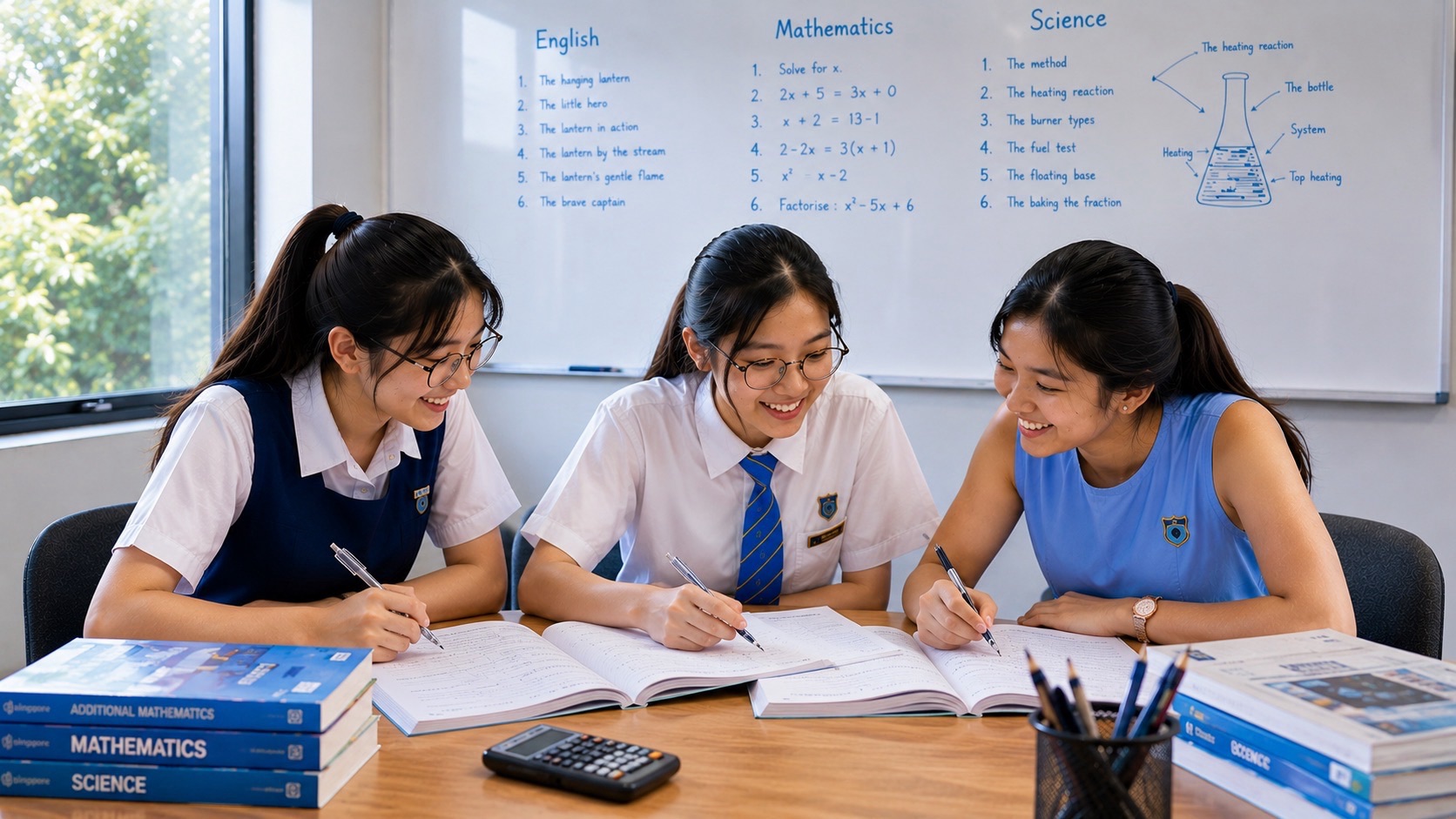
Secondary 1 Mathematics tuition for Jalan Besar families should make the move from Primary 6 into algebra, negative numbers, equations, coordinates and more formal mathematical language more intelligible, not merely more intensive. Families around Jalan Besar, Lavender, Little India, Farrer Park, Rochor and Kallang may compare class size, teaching experience, school alignment and whether the programme fits the student’s Mathematics level. The useful question is whether the teaching can locate the first unstable mathematical decision and repair it precisely.
A wrong final answer is not a diagnosis. One student may understand the relationship but make a sign or arithmetic error. Another may select the wrong representation. A third may reproduce a method only because the chapter heading made the route obvious. A small group becomes useful when the tutor can see these differences in the written work and change the next question accordingly.
Jalan Besar already has a local Primary Mathematics sequence through Primary 4, Primary 5, Primary 6 and PSLE Mathematics Tuition. This Secondary 1 guide continues the progression without treating Jalan Besar as a separate teaching system. Jalan Besar is the family’s location context; families should confirm the current teaching venue, timetable and travel route directly before committing.
Secondary 1 is a transition in mathematical language
Primary Mathematics already asks students to reason. Bar models, ratios, fractions, percentages, geometry and multi-step word problems are not simple forms of calculation. What changes in Secondary 1 is the amount of reasoning carried by symbols. A student may previously have represented three equal parts and a remainder with a bar model. In secondary algebra, the same relationship may be compressed into an expression or equation. The student now has to read the symbols as a relationship, not as decoration around the numbers.
That change creates a new kind of error. In Primary Mathematics, a learner may know exactly what quantities are involved but choose an inefficient arithmetic route. In Secondary 1, the learner can lose the meaning of the quantity before calculation starts. A variable may be treated as a label rather than a number. A negative sign may be copied as though it belongs only to the next digit. A bracket may be opened by visual habit without the student understanding which multiplication applies to which term. These are language problems expressed through mathematics.
Adrian, Jo and Ben are the first three members of the permanent fictional eduKateSG resident cast used throughout this series. Adrian tends to move quickly and drop signs. Jo is careful but sometimes overworks a problem. Ben understands a teacher’s explanation but hesitates when the question changes. Aisha, Ryan, Mira, Clara and Ethan appear later. These are fictional teaching cases, not real testimonials. They allow us to make the learning mechanisms concrete without implying a particular student outcome.
A diagnostic should reveal the first unstable point
Imagine Adrian writes 7 − 3(2x − 5) = 7 − 6x − 15. Jo writes 22 − 6x. Ben writes nothing because he remembers that the signs inside the bracket should change but cannot explain why. The three students appear to be doing the same topic, yet they need different interventions. Adrian has distributed the negative multiplier incorrectly to the constant. Jo has the correct simplified expression but should still justify it. Ben needs the meaning of distribution before more practice will help.
A useful tutor keeps the original work visible and asks a short sequence of questions. What is being multiplied by the bracket? What does subtraction of three groups mean? Can we rewrite the expression as 7 + (−3)(2x − 5)? Which terms are inside the bracket? When the student can answer these questions, the expansion becomes −6x + 15, producing 22 − 6x. The correction is not a slogan. It is a reconstruction of the relationship that the notation represents.
The important diagnostic principle is to find the first line at which the mathematics stops being true. A wrong final answer may be the result of an accurate model followed by one arithmetic slip. Another wrong answer may come from a completely invalid model. Those students should not receive the same correction simply because both answers are wrong. Secondary 1 tuition should make the chain visible enough to distinguish understanding, execution and interpretation.
Negative numbers need more than memorised sign rules
Negative numbers are often the first place where students discover that a familiar-looking symbol can perform different jobs. In −5, the minus sign belongs to the number. In 8 − 5, it indicates subtraction. In −(x + 4), it applies to the entire expression in the bracket. A student who learns only “two negatives make a positive” may use that phrase in situations where there is no multiplication or division of two negative quantities at all.
Consider −7 + 12. A number-line interpretation gives a movement from negative seven to positive five. Consider −7 − 12. Subtracting twelve gives negative nineteen. Now consider −7 − (−12). Removing negative twelve is equivalent to adding twelve, giving five. These examples should be compared side by side so that the student learns to identify the operation before selecting a sign rule.
Mira is asked to predict the sign of a result before calculating. Ryan is asked to explain whether the minus sign belongs to a number or to an operation. Clara checks a result by asking whether the answer is sensible relative to the starting value. These small routines create control. They also reduce the tendency to treat negative-number mistakes as mysterious carelessness. The student begins to see exactly which operation was misunderstood.
Fractions remain quantities when letters appear
Secondary 1 algebra becomes much easier when fraction meaning is stable. A learner who remembers fraction procedures without understanding denominator size may struggle when a letter is added because the surface becomes unfamiliar. The principle has not changed. A denominator identifies the size of the fractional unit. Two thirds and one sixth cannot be added by adding numerators and denominators because thirds and sixths are not the same unit.
For 2/3 + 1/6, rewrite two thirds as four sixths, then obtain five sixths. Before calculating, estimate the size. Two thirds is more than one half, and adding a positive sixth should move the total closer to one, not below one half. That estimate provides an independent reason to reject 3/9, which simplifies to one third and is smaller than the original two thirds.
Aisha’s difficulty appears later when she sees 3x/4 + x/2. The same equal-unit principle applies. Rewrite x/2 as 2x/4, producing 5x/4. Connecting algebraic fractions to numerical fractions reduces the sense that every new notation requires an unrelated rule. Secondary 1 is the right time to protect these continuities, because later algebra will depend on them repeatedly.
Variables should be read as quantities
If one notebook costs x dollars, three notebooks cost 3x dollars. The expression x + 3 describes a different relationship: the original price increased by three dollars. Students who read algebra only as symbols may confuse these because both contain x and 3. The cure is not more speed. It is to ask what each expression could mean in a situation.
Ben is asked to draw or describe a story for 4x, x + 4 and 4(x + 1). The first represents four equal x-quantities. The second is one x-quantity plus four. The third is four groups each containing x plus one. The student learns that brackets, coefficients and addition signs describe structure. This helps later when the expressions are transformed, because the student has something meaningful to preserve.
Like terms can be combined because they represent the same algebraic unit. Three x-quantities and five x-quantities make eight x-quantities. Three x-quantities and five y-quantities cannot generally be collapsed into eight xy. Nor is x + x the same as x². Substitute x = 3: x + x gives six, while x² gives nine. One numerical counterexample is enough to reject the proposed identity.
Substitution needs brackets and order
Take 2a² − 3a + 4 when a = −2. The safe substitution is 2(−2)² − 3(−2) + 4. The square acts on the whole negative number inside the brackets, so the result is 8 + 6 + 4 = 18. If the student writes −2² without understanding the notation, the calculator may interpret the expression as the negative of 2² rather than the square of negative two.
Jo is asked to write the substituted expression before doing arithmetic. This simple delay protects meaning. Ethan predicts whether the answer should be positive or negative. Adrian checks the value again using a calculator only after the mathematical expression is correctly written. The calculator supports execution; it does not decide the structure.
Later, substitution becomes the bridge between equations, graphs and formulas. If y = 2x + 1, substitution generates the coordinate pairs that lie on the line. If P = 2l + 2w, substitution connects dimensions to perimeter. A student who treats substitution as a narrow chapter skill misses how often it becomes part of later mathematics. That is why a Secondary 1 foundation lesson should connect the method to multiple representations.
Equations are statements that must stay true
An equation such as 3x + 5 = 26 states that two expressions are equal. Solving it means finding the value of x that makes the statement true. Subtract five from both sides to obtain 3x = 21, then divide both sides by three to obtain x = 7. The familiar phrase “move five across and change the sign” is shorthand for a legal operation. The student should understand the legal operation before relying on the shorthand.
For 4x − 7 = 2x + 9, subtract 2x from both sides to obtain 2x − 7 = 9. Add seven to both sides, giving 2x = 16, then x = 8. Substitute eight into the original equation: both sides equal twenty-five. This check is stronger than rereading the same algebraic steps because it returns to the original condition.
Ryan can solve quickly but is asked why each transformation preserves equality. Aisha may need the operation written beside both sides. The scaffolding should then be reduced. The desired outcome is not a student who can follow a tutor’s sequence. It is a student who can independently decide which equivalent transformation will simplify the equation while preserving the relationship.
Word problems require relationships, not keywords
Keyword hunting works only while the wording remains predictable. Suppose three identical tickets plus a booking charge of five dollars cost twenty-six dollars. Let x be the price of one ticket. The relationship is 3x + 5 = 26, so x = 7. The phrase altogether appears, but altogether is not a sufficient instruction. The student still has to understand that three equal ticket prices and one fixed charge form the total.
Rewrite the same relationship: the total cost is five dollars more than the cost of three identical tickets. The equation is unchanged. Rewrite again: three identical tickets cost five dollars less than twenty-six dollars. The mathematical structure is still the same. Comparing differently worded problems that share one structure helps the student stop treating every sentence as a unique puzzle.
Mira defines the unknown before writing an equation. Clara underlines the condition linking the quantities. Ethan checks the final answer against the situation. A negative ticket price would be algebraically possible in some equations but invalid in this context. Interpretation therefore remains part of solving. The final line should answer the actual question, not merely display a variable value without meaning.
Ratio can bridge Primary models and Secondary algebra
If red and blue counters are in the ratio 3:5 and there are thirty-two counters altogether, there are eight equal ratio units. Each unit represents four counters, so the groups contain twelve red and twenty blue counters. The familiar bar-model approach can sit beside an algebraic representation: red = 3k and blue = 5k, so 8k = 32 and k = 4.
That connection matters because Secondary 1 should not treat the student’s Primary knowledge as obsolete. The representations are becoming more compressed, but the underlying relationship remains. A student who sees algebra as an extension of earlier reasoning is less likely to experience it as a completely foreign system.
Now change the information. The blue group has eight more counters than the red group. The difference is two ratio units, so each unit is four. The same final numbers arise through a different use of the ratio. Students learn that the given quantity may represent a total, a difference or one part. The method depends on what the quantity represents, not on the presence of a colon in the question.
Percentage questions depend on the base
A twenty-percent discount on an eighty-dollar item reduces the price by sixteen dollars to sixty-four dollars. Returning from sixty-four dollars to eighty dollars requires an increase of sixteen dollars on a base of sixty-four, which is twenty-five percent. Equal dollar changes do not imply equal percentage changes because the reference quantities differ.
Ben initially assumes that a twenty-percent decrease can always be reversed by a twenty-percent increase. The tutor asks him to test the claim with simple values. The contradiction becomes visible immediately. He then writes a more useful correction note: identify the quantity that represents one hundred percent before selecting the multiplier.
This habit supports later topics involving percentage change, rates and compound relationships. The lesson should not become a catalogue of commercial examples. Use invented quantities and make the assumptions clear. The mathematical aim is to identify the base and the relationship, not to offer financial advice or imply current prices.
Coordinates connect numbers to a visual relationship
A coordinate such as (−2, 3) is an ordered pair. The horizontal coordinate comes first and the vertical coordinate second. Students should identify the axes and scales before plotting. Counting grid squares without checking the scale is a common reason for a graph that looks neat but represents the wrong values.
For y = 2x + 1, choose x-values such as −1, 0, 1 and 2. The corresponding y-values are −1, 1, 3 and 5. The table, equation and graph are three representations of the same relationship. Ask what happens to y when x increases by one. Ask what the value of y is when x is zero. These questions help students interpret the line rather than simply connect dots.
Adrian can calculate the values but rushes the scale. Jo plots carefully but does not see the link to the equation. Ethan explains that the constant term is the value of y at x = 0 in this simple linear form. The group can therefore discuss one graph while each student works on a different weak point.
Geometry requires reasons rather than visual guesses
A diagram can suggest a relationship without establishing it. Lines that look parallel are not necessarily given as parallel. A triangle that looks isosceles is not necessarily stated to have equal sides. Students should distinguish marked or stated facts from impressions created by the drawing. This matters especially when a diagram is not drawn to scale.
Suppose two angles of a triangle are 48° and 67°. The third angle is 65° because the interior angles sum to 180°. The reason belongs to the solution. If the same two numbers appeared around a point or on parallel lines, a different relationship would apply. The numbers alone do not determine the method.
Aisha is asked to annotate only facts she is entitled to use. Ryan explains which theorem justifies each step. Clara rotates the diagram and checks that the relationship survives the change of orientation. These activities reduce dependence on visual familiarity and strengthen the habit of reading geometry as a network of stated conditions.
Measurement requires the right quantity and the right unit
A rectangle measuring twelve centimetres by eight centimetres has area ninety-six square centimetres and perimeter forty centimetres. The two answers describe different quantities. Area measures surface coverage; perimeter measures boundary length. Students who memorise formulas without naming the quantity can use the correct dimensions in the wrong expression.
Unit conversion becomes more demanding when dimensions are squared or cubed. One metre is one hundred centimetres, but one square metre is ten thousand square centimetres because both dimensions are scaled by one hundred. A student who memorises a conversion ladder without understanding the dimensional change can make large errors in mensuration.
Mira draws a one-metre square and partitions it conceptually into centimetre squares. The visual model explains why the conversion factor is squared. Later, when volume appears, the same reasoning extends to three dimensions. Secondary 1 is an appropriate time to make units part of the mathematics rather than an afterthought written beside the final number.
Data questions require interpretation as well as calculation
For the values 4, 5, 5, 8 and 13, the mean is seven, the median is five, the mode is five and the range is nine. These statistics describe different features of the same data. A student should know which measure is being asked for and what it communicates.
Change thirteen to twenty-eight. The mean becomes ten while the median remains five. The comparison shows why an unusually large value can affect the mean strongly. It does not prove that the median is always the better measure. The choice depends on the purpose and the data.
Jo practises writing a sentence that names the statistic rather than saying one set is simply better. Ethan checks whether a claim is supported by the data or whether it introduces a cause that the numbers do not establish. These habits prepare students for later statistical reasoning and for the broader skill of making claims proportionate to evidence.
Full Subject-Based Banding changes the routing question
Under Full Subject-Based Banding, the most useful starting point is the Mathematics subject level the student is actually taking. MOE explains that students can offer subjects at G1, G2 and G3 levels according to their learning needs and strengths. A tuition class should therefore match the relevant subject requirements rather than assume that every Secondary 1 student follows one identical course.
The official MOE Full Subject-Based Banding explanation is the appropriate route for current policy information. The eduKateSG G1, G2 and G3 Mathematics guide explains the learning implications. This local article sits alongside those broader Mathematics guides. It uses them as the national and subject-level context while focusing on the local S1 transition.
A G1 student should not be treated as a delayed G3 student who receives the same worksheet with fewer questions. A G3 student should not be assumed to have perfect arithmetic or algebra merely because of the subject label. Diagnose the actual work. The subject level determines the relevant syllabus demand; the working reveals the student’s specific learning condition.
Three students create an opportunity for close observation
eduKateSG uses a three-student small-group model for Secondary Mathematics. The educational value does not come from the number three by itself. It comes from what the tutor can do because the group is small enough to inspect individual reasoning while still allowing useful peer comparison.
A ninety-minute lesson can begin with a short independent retrieval set. Each student writes before discussion. The tutor can see who recognises the method, who needs the topic named and who understands the concept but executes it inaccurately. The lesson then focuses on one high-impact dependency before returning to current schoolwork.
During guided practice, the students may share a central concept but receive different variations. Adrian might receive a sign-sensitive expansion. Jo might receive a worded equation that requires modelling. Ben might receive a simpler numerical case to rebuild the meaning. The group remains coherent because the mathematical family is shared, while the difficulty is calibrated.
A lesson should end with independent evidence
Understanding a teacher’s explanation is not the same as being able to begin a question alone. The final part of a tutorial should therefore remove the most helpful prompt. The student attempts a changed question without the solution open and without the chapter name announcing the method.
If the student succeeds, the tutor has evidence of transfer. If the student fails, the failure is useful because it shows which part of the explanation did not survive independently. That may lead to a smaller comparison task, a different representation or another prerequisite check.
Ryan learns that completing ten questions while the tutor guides every first step does not prove the same thing as completing four mixed questions independently. Both activities can be useful, but they belong to different stages of learning. The distinction should remain visible to student, tutor and parent.
Retrieval makes learning available after the lesson
A student has not fully learned a method merely because it was understood on the day it was taught. The idea must remain retrievable later. Short delayed checks help reveal what has been retained after the immediate explanation is no longer active in working memory.
For example, a lesson on equations may be revisited several days later through one equation hidden inside a mixed set. The student must recognise that the equation method is relevant without a heading telling them so. If the method disappears, the tutor can strengthen the retrieval route rather than assume the original explanation was entirely unsuccessful.
Clara’s revision plan includes small amounts of earlier work mixed with current content. The purpose is not to make every session long. It is to preserve access to important skills while new topics are added. Secondary Mathematics becomes difficult when each chapter appears to erase the one before it. Retrieval prevents that accumulation of forgotten learning.
Corrections should change the next attempt
A useful correction identifies the first wrong decision, explains the valid relationship and then tests the repaired understanding in a new question. Copying the full model answer may improve the appearance of the notebook without changing the mathematical behaviour.
Suppose Adrian loses a negative sign while expanding. His correction note does not need to reproduce six lines of work. It can state that the negative multiplier applies to every term inside the bracket. The follow-up question changes the coefficient and signs so that he must use the principle again.
If the same error returns in substitution, equations and graph tables, the tutor can identify a shared sign-control dependency. That is more useful than treating each appearance as a separate chapter problem. Error patterns can reveal a common mechanism. A small-group environment makes those patterns easier to notice because the tutor sees the working repeatedly across different contexts.
Parents can monitor progress without becoming the tutor
Parents do not need to reteach every chapter. Ask the student to explain one previously difficult question and one changed question attempted later. Listen for the first decision: what was known, what had to be found, and why the method was chosen.
A useful progress update is specific. “Negative substitution is now accurate in short expressions, but sign errors return when brackets are added” is actionable. “Be more careful” is not. “Word problems are improving because the student now defines the unknown before writing the equation” gives the family a visible change to look for.
Do not turn every wrong answer into a judgement about effort or ability. Ask where the meaning changed. Did the student misread the quantity, choose the wrong relationship or execute the right method inaccurately? The answer guides the next lesson. Calm diagnosis is more productive than an argument about whether the student should have known better.
When to repair and when to extend
Repair is appropriate when a missing prerequisite repeatedly blocks current work. If fraction operations undermine equations, repair the fractions inside a manageable algebra context. The student does not need to repeat an entire earlier syllabus merely because one dependency is unstable.
Consolidation is appropriate when the student can follow the method but cannot retrieve or select it independently. Extension is appropriate when the method remains accurate, explainable and transferable after a gap. These are descriptions of learning evidence, not permanent labels attached to a child.
Ben may need repair in signed numbers and extension in geometry during the same month. Jo may be accurate in routine algebra but need consolidation in mixed questions. A single overall mark cannot show those differences clearly. The tutor should set a small number of priorities and update them as the evidence changes.
Do not confuse advanced content with depth
A strong Secondary 1 student does not necessarily need premature Additional Mathematics. Depth can come from explaining why an equation has one solution, finding a counterexample to a false algebraic claim, comparing two valid methods, or identifying the assumptions inside a simple model.
These tasks strengthen mathematical judgement without rushing into a later syllabus. They also reveal whether the student genuinely controls the current mathematics. A learner who can generalise and explain a foundational idea is better prepared for future advanced work than one who merely recognises the name of a later topic.
Where a family is thinking ahead to A-Math, use the separate Additional Mathematics Tuition Jalan Besar route and the wider Additional Mathematics Hub. This S1 article should protect the main Mathematics foundation instead of creating a duplicate A-Math owner.
A practical weekly routine for Jalan Besar families
The tuition appointment is only one part of the student’s week. Travel, school assignments, co-curricular activities, meals and rest all draw on the same available time. A useful plan is modest enough to repeat. One short session might revisit the repaired skill, another might follow the current school topic, and a third might mix old and new work.
Fifteen attentive minutes on carefully chosen questions can be more revealing than an hour of copying worked solutions. When a student is stuck, allow a genuine attempt, record the exact point of difficulty, then use a limited hint. Afterwards close the explanation and attempt a changed question. This keeps help visible and prevents supported work from being mistaken for independent mastery.
Families should judge the full route to the actual teaching venue. Door-to-door practicality from Jalan Besar varies by home, school, lesson time and the current teaching venue. Confirm the live timetable, class fit and transport before committing. A tuition arrangement should strengthen the learning system, not remove every remaining hour in which the student could practise independently.
A four-week transition cycle
Week one can establish a short diagnostic across signed numbers, fractions, algebraic reading, equations, ratio and graphs. The aim is not to produce a giant score. It is to find the earliest unstable dependency that is affecting current schoolwork.
Week two can repair that dependency and connect it directly to the current school topic. If negative substitution is weak, the tutor uses it inside the student’s present algebra work. If ratio interpretation is weak, the repair is connected to the relevant application instead of isolated indefinitely.
Week three increases variation. The method appears in a different wording, with a changed sign pattern or inside a mixed set. Week four uses fresh independent work to see what survived. This is an example of a review cycle, not a guaranteed timetable for improvement. Some gaps are smaller; others need longer and a different representation.
What progress should look like
Progress may first appear as better mathematical behaviour before it appears as a large mark change. The student begins work sooner, defines quantities more clearly, shows enough working to locate mistakes, checks signs and units, and asks more precise questions.
Marks become more stable when several systems improve together: understanding, retrieval, method selection, execution, presentation and checking. A single test can still be affected by coverage and difficulty. Review several pieces of fresh work rather than expecting a perfectly rising score line.
Ethan’s early progress might be that he now explains why a graph scale matters. Aisha’s might be that she distinguishes the percentage base correctly. Adrian’s might be fewer repeated sign errors after he adopts a structured substitution layout. These are specific gains that can be tested again.
Choosing Secondary 1 Mathematics tuition in Jalan Besar
Ask how the tutor diagnoses before teaching. Ask what students do independently before the method is demonstrated. Ask how a three-student class handles different weaknesses. Bring recent marked work, current school topics and examples of corrections.
A useful answer should describe observable mathematical decisions. It should not rely only on the existence of worksheets, notes or a promise to teach ahead. Resources matter, but they become valuable only when they are selected for a reason and the student learns how to use the ideas independently.
Confirm the venue and current availability rather than inferring them from the local title. This year-specific page exists to clarify the Secondary 1 educational job. The best fit is a specific learning need, a sustainable timetable and a teaching process that can show whether the need is changing.
Questions families often ask
Does a lower first Secondary 1 mark mean the child has lost Primary Mathematics? Not necessarily. The new symbolic language, faster pace or mixed-topic demand may expose a narrow dependency that was previously hidden. Inspect several questions before drawing a broad conclusion.
Should every struggling S1 student restart Primary worksheets? No. Repair the smallest prerequisite that unlocks the current work. A learner who understands ratio but mishandles negative substitution needs a different intervention from a learner who cannot compare fractions.
Should a strong S1 student start A-Math early? Not automatically. Deep reasoning, transfer and explanation can provide challenge within the current mathematics. Later subject choices should be discussed with the school and supported by sustained readiness.
Can tuition guarantee a particular grade? No responsible programme can guarantee a specific examination result. Teaching can improve the learner’s knowledge, habits and preparation, but outcomes also depend on assessment demands and individual circumstances.
The Secondary 1 handover to Secondary 2
By the end of a productive first year, the student should carry a small set of dependable habits forward. Read the target. Define quantities. Preserve equality and equivalence. Keep signs and units visible. Use a reason for each method. Check the answer against the original relationship.
A useful handover note names the secure and unstable actions rather than describing the child with adjectives. For example: linear equations are independent, but percentage reverse problems still need support; graph plotting is accurate, but interpretation of gradient is weak. This gives the next stage a precise starting point.
Secondary 1 Mathematics tuition for Jalan Besar families should therefore do more than keep up with the next worksheet. It should convert the Primary-to-Secondary transition into an understandable system. Once the student sees how the symbols, relationships and checks fit together, confidence becomes the result of competence rather than reassurance alone.
Continue through the Jalan Besar Mathematics route
Use Secondary 1 Mathematics Tuition | Jalan Besar, Secondary 2 Mathematics Tuition | Jalan Besar, Secondary 3 Mathematics Tuition | Jalan Besar and Secondary 4 Mathematics Tuition | Jalan Besar for the year-specific local sequence.
For the wider subject framework, use the Secondary 1 Mathematics route, the Mathematics Learning Hub and How Mathematics Works. Where the student is separately taking Additional Mathematics, keep that subject distinct through the Additional Mathematics Tuition route and Additional Mathematics Hub.