
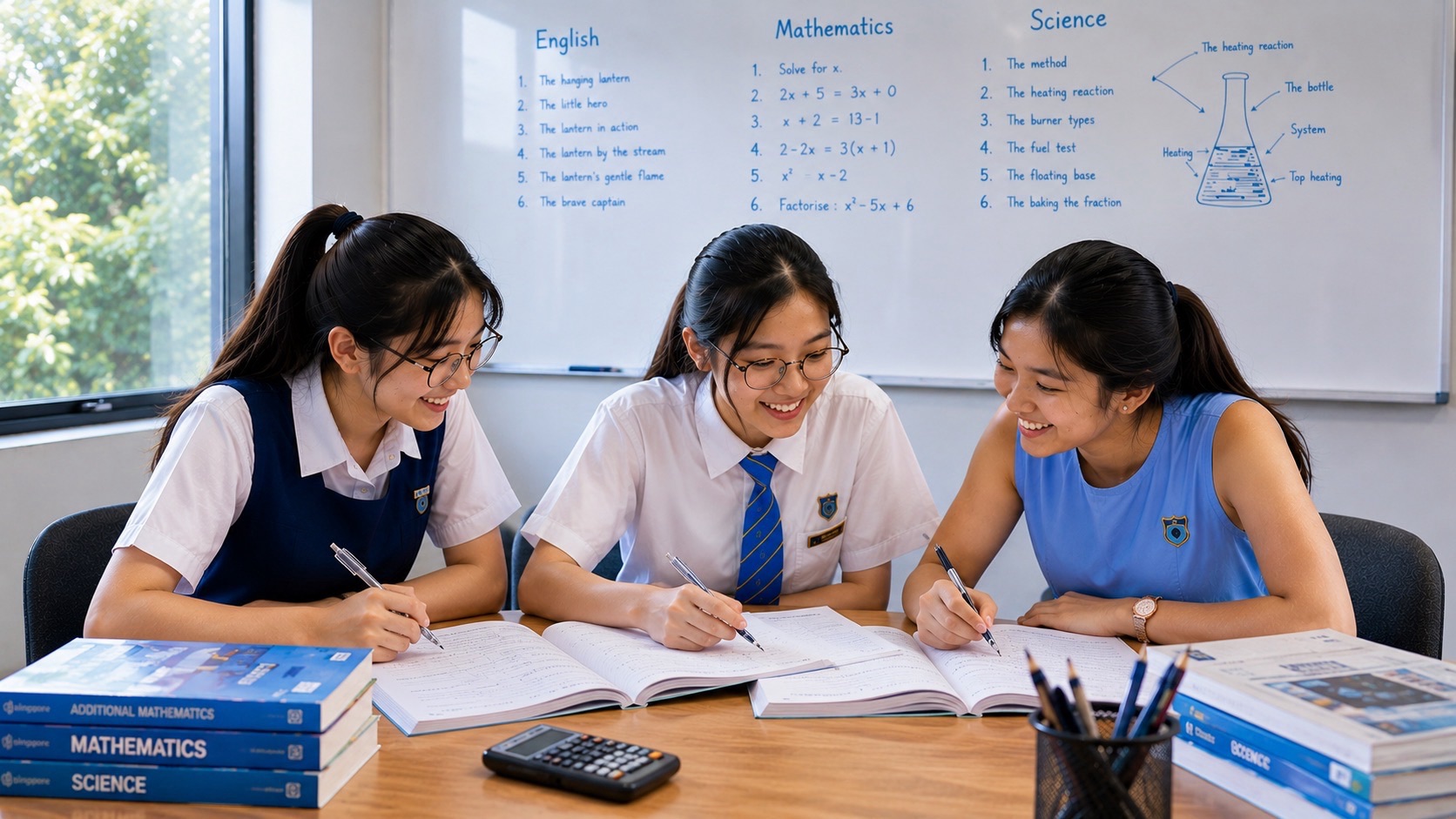
Secondary 1 Mathematics tuition for Nicoll Highway students. eduKateSG offers 3-pax tutorials at our Bukit Timah teaching venue near Sixth Avenue MRT, with algebra bridging, clear explanations and closely observed practice.
A good first year of secondary Mathematics begins with understanding what has changed.
The student is not simply receiving longer Primary 6 questions. Letters now represent quantities. Negative values appear inside expressions. Equations must remain balanced. A neat answer is no longer enough when the reasoning between the first and final lines cannot be explained.
Our tutorials help students make that transition deliberately. Lessons are 1.5 hours weekly, with materials, guided corrections and focused continuation work. Class placement depends on the student’s current Mathematics level, school programme and learning needs.
Nicoll Highway is the family’s home or travel area, not a claim that eduKateSG has a separate centre there. Confirm the venue, class fit and available timetable before enrolment.
Arrange a parent–student consultation with eduKate Singapore or ask about Secondary 1 Mathematics on WhatsApp.
A More Important Transition Than It First Appears
Primary Mathematics has already taught the student to compare quantities, interpret diagrams and solve problems. Those skills remain valuable. The difficulty is that secondary-school notation compresses more information into fewer symbols.
A bar model showing four equal parts and an extra six can become 4x + 6. A pupil who understood the drawing may still hesitate over the expression. The missing bridge is not necessarily multiplication. It may be the understanding that x is the size of each equal part and that the six is added once, rather than to every part.
We begin by preserving continuity. The model, verbal description and expression should tell the same story. The tutor moves between them until the student can explain what stays unchanged. Only then do we increase the number of operations or introduce less familiar wording.
Secondary 1 also changes the student’s week. Different teachers assign work, co-curricular activities occupy afternoons, and homework may be completed without the close supervision available in Primary school. Mathematics support must therefore develop a workable routine as well as explain a topic.
For a family travelling from Nicoll Highway, the useful outcome is not simply a full tuition notebook. It is a student who can return home, recognise a related question and begin without waiting for someone to announce the method.
A first disappointing test should be investigated rather than treated as a verdict. Does the student misread algebra? Forget a method after a gap? Lose signs during otherwise correct work? Each explanation leads to a different next lesson.
The Hidden Mathematics Problem: Arithmetic Must Become Structure
Consider 5 × 8 = 40. Now replace the eight with an unknown: 5x = 40. The arithmetic relationship is unchanged, but the student’s task is different. Instead of calculating a product, the student must find the value that makes the statement true.
Dividing both sides by five gives x = 8. Substituting eight into the original equation verifies the result. This is more than a remembered instruction to move a number. It is an operation that preserves equality.
Now compare 5x + 3 = 43 with 5(x + 3) = 55. In the first equation, three is added after multiplying x by five. In the second, five multiplies the whole bracket. Both equations happen to have x = 8, but they describe different structures. Matching answers do not make the equations interchangeable.
This comparison is useful because students sometimes judge a method by whether it produces a familiar-looking answer. We ask instead whether every line remains mathematically true. A lucky answer reached through an invalid step is not a dependable method.
One further contrast makes the point clearer. The expressions 4x + 7 and 4(x + 7) cannot be simplified in the same way. Substituting x = 2 gives fifteen in the first case and thirty-six in the second. A simple numerical check exposes the difference that a hurried visual reading may miss.
Our aim is to make students comfortable inspecting structure before calculating. That habit supports equations, graphs, formulas and later upper-secondary work.
Why a 3-Pax Mathematics Tutorial Can Help
A small class is useful when it changes what the tutor can observe. Three students can work on the same concept while the tutor checks three different ways of thinking.
Adrian, Jo and Ben are fictional students used in the examples below. Adrian tends to work quickly and lose signs. Jo is careful but sometimes takes an unnecessarily long route. Ben can follow a demonstration but needs help when the next question looks different. They illustrate teaching decisions, not actual testimonials or promised results.
Give the group 9 − 2(3x − 4). Adrian may write 9 − 6x − 8, Jo may correctly obtain 17 − 6x, and Ben may stop at the bracket. One worksheet has revealed three different needs.
Adrian needs to see that negative two multiplies both terms, making the constant positive eight. Jo can explain the distribution and test a value. Ben may begin with the numerical expression 9 − 2(6 − 4) before returning to the letter.
The tutor does not need to deliver three unrelated lessons. The shared idea is distribution. The support differs according to the evidence.
Students also learn from comparing valid approaches. A number-line explanation, an arithmetic check and a symbolic transformation can reinforce one another. However, discussion should follow an individual attempt. Otherwise, the most confident student can do the thinking while quieter learners appear to understand.
Every student should produce enough independent working for the tutor to see whether the explanation has become usable.
Secondary 1 Mathematics and the Student’s Subject Level
Start with the Mathematics course the student is actually taking, not with assumptions based on a school name or an earlier examination result. G1, G2 and G3 requirements are distinct. SEAB’s published 2027 lists identify G1 Mathematics, G2 Mathematics and G3 Mathematics separately.
The examples in this guide explain teaching methods; they are not a claim that every question belongs in every Secondary 1 classroom. We select the actual content and difficulty using the school programme and the student’s current work.
A learner should not receive material that is unsuitable merely because another student of the same age is studying it. Equally, a student working at a more demanding subject level may still have a narrow weakness in fractions or signed numbers. The label establishes the course; the working establishes the teaching need.
For students in an Integrated Programme or another school-specific course, bring the topic outline and recent assignments. We should not assume that its timing or assessment style is identical to a national-examination pathway.
Later syllabus documents should always be checked for the student’s own examination year. A first-year learner does not need to memorise future examination codes. The immediate responsibility is to build accurate, explainable Mathematics at the appropriate level.
What We Teach in Secondary 1 Mathematics Tutorials
The sequence follows the school where practical, while making room to repair prerequisites. These examples show how we teach the underlying relationships rather than presenting a fixed term-by-term syllabus.
Signed numbers and the job of a minus sign
Compare −8 + 13, −8 − 13 and −8 − (−13). Their answers are five, negative twenty-one and five. The student must identify the operation before applying a rule.
The phrase about two negatives becoming positive does not explain every expression containing two minus signs. In −8 − 13, the signs perform different jobs: the first belongs to the starting number and the second indicates subtraction. We use a number line or equivalent addition to make the distinction visible.
Before calculating, ask whether the result should increase or decrease from the starting value. If a student predicts that subtracting positive thirteen from negative eight should produce a positive result, the problem is conceptual and should be addressed before timed practice.
Next, place the same signed-number work inside substitution. A repair is more useful when it reconnects quickly to the student’s current algebra rather than remaining indefinitely on a separate easy worksheet.
Fractions that retain their meaning when letters appear
Three quarters plus one sixth requires a shared fractional unit. Writing nine twelfths plus two twelfths gives eleven twelfths. Adding the numerators and denominators directly would give four tenths, which is smaller than the original three quarters despite a positive quantity being added.
That size check gives the learner a reason to reject the incorrect procedure. It is not enough to say that a rule has been broken; the student should see why the proposed answer cannot represent the quantities.
Now consider 3x/4 + x/6. The same denominator reasoning gives 9x/12 + 2x/12 = 11x/12. The letter does not create a completely new arithmetic system.
We distinguish adding fractions from multiplying them. In a mixed exercise, the student first names the operation, then chooses the procedure. This prevents the most recently taught rule from being applied indiscriminately to every fraction question.
Variables, terms and useful symbolic language
A fictional fabric order can make algebra less remote. Suppose one metre costs x dollars. Four metres cost 4x dollars. A single delivery charge of six dollars produces a total of 4x + 6, not 4(x + 6). These are invented teaching quantities, not a quotation from any Nicoll Highway business.
Ask the student to explain each term before solving anything. What does x measure? Why is four a multiplier? Why is six added only once? The explanation checks the model rather than merely its arithmetic.
Like terms also need meaning. Five x-quantities minus two x-quantities leave three x-quantities. However, five x-quantities and two y-quantities cannot generally be collapsed into seven xy. Substituting small values can test a doubtful claim.
The student should also distinguish an expression from an equation. An expression can be simplified or evaluated for given values. An equation states equality and may be solved. The command in the question tells us which task is required.
Substitution without losing signs or powers
Evaluate 3a² + 2a − 5 when a = −2. Write the substitution first: 3(−2)² + 2(−2) − 5. The calculation is twelve minus four minus five, giving three.
Brackets protect the meaning of the negative value. They also distinguish the square of negative two from the negative of two squared. A calculator cannot correct an expression entered with the wrong structure.
Adrian is asked to pause after substitution, not after obtaining the answer. He checks that every occurrence of a has been replaced, that the square applies to the entire value, and that the original operations remain in place.
Jo checks the same expression with a second simple value to explain how the formula changes. Ben connects substitution to a table of values. This prepares the group for graphs, where repeated substitution produces ordered pairs rather than isolated answers.
Equations that preserve equality
Solve 3(x + 2) = 24. Dividing both sides by three gives x + 2 = 8, so x = 6. Expanding first also works: 3x + 6 = 24, followed by 3x = 18 and x = 6.
Comparing the routes develops choice. There is no benefit in insisting on expansion when division first reveals the answer clearly. The student should understand why both approaches preserve the original relationship.
Now solve 4x − 5 = 2x + 9. Subtracting 2x gives 2x − 5 = 9; adding five gives 2x = 14; dividing by two gives x = 7. Substitution into the original equation gives twenty-three on both sides.
Checking the original equation matters. A student may accurately solve an incorrectly copied equation. Returning to the question rather than the most recent line catches that separate error.
Ratio, rate and the correct reference quantity
A worksheet describes two lengths of ribbon in the ratio 2:5, with twenty-eight metres altogether. Seven equal ratio units represent twenty-eight metres, so each unit is four metres. The lengths are eight and twenty metres.
If the information changes to a difference of twelve metres, the three-unit difference represents twelve. The same lengths result, but the given quantity has a different role. We ask the student to identify whether a number represents a total, a difference or one part.
Rates require another distinction. A fictional walk of 900 metres in twelve minutes has an average speed of seventy-five metres per minute. That does not establish that the student walked at exactly that speed throughout. It is the total distance divided by the total time.
The local setting can make the question understandable, but the written assumptions govern the answer. The learner should never substitute an estimate of a real journey for the quantities supplied in an exercise.
Percentage change and reverse percentage
An imaginary item priced at fifty dollars is reduced by twenty percent. Its new price is forty dollars. Increasing forty by twenty percent gives forty-eight, not fifty, because the second percentage uses a different base.
To return from forty to fifty requires an increase of ten on a base of forty: twenty-five percent. We write the base beside the calculation so the student can explain what represents one hundred percent.
For a reverse problem, a price after a twenty-percent reduction is forty dollars. If the original price is p, then 0.8p = 40. Dividing by 0.8 gives fifty. Adding twenty percent to forty answers a different question.
This is a teaching example about proportional reasoning, not current pricing or financial advice. We use small numbers first so that the student can inspect the relationship before handling awkward decimals or longer wording.
Geometry, measurement and justified conclusions
A triangle has angles 46° and 71°. The third is 63° because the angles inside a triangle total 180°. The reason is part of the solution. Merely adding or subtracting the visible numbers without identifying the geometric relationship is unreliable.
A drawing should not be trusted to supply facts that are not stated. Lines that look parallel may not be given as parallel. Equal-looking lengths are not necessarily equal. The student marks only the facts supported by the question or a valid deduction.
In measurement, an invented rectangular display measuring 1.2 metres by 0.8 metres has area 0.96 square metres and perimeter four metres. These answers describe different quantities. Before selecting a formula, name what is being measured.
We also connect conversion to dimension. One square metre contains ten thousand square centimetres, because each of two lengths is multiplied by one hundred. A conversion appropriate for length cannot simply be reused for area.
Coordinates, graphs and data interpretation
For y = 3x − 2, the values x = −1, 0, 1 and 2 give y = −5, −2, 1 and 4. The table, equation and plotted points describe one relationship.
Students check both axis scales before plotting. One square does not automatically represent one unit. They explain what happens to y when x increases by one and identify the point where x is zero.
Data work also requires interpretation. For the values 3, 5, 5, 7 and 10, the mean is six, the median is five and the range is seven. Each describes a different feature. Replacing ten with twenty changes the mean to eight but leaves the median at five.
The exercise does not prove that one statistic is always preferable. It asks the learner to select and interpret the measure that fits the question. A numerical answer should be followed by a sentence when the task asks what the result means.
Our First-Principles Teaching Method
We teach the relationship, build a reliable procedure and then test whether the student can use it independently. A demonstration is a beginning, not the whole lesson.
Diagnose before increasing the workload
A description such as weak in algebra is too broad to determine a lesson. We inspect a short selection of school questions and ask the student to explain the first move. Did the difficulty begin in reading, representation, calculation or checking?
A student who can solve an equation but cannot form it from a sentence needs modelling practice. A student who forms the equation correctly but makes fraction errors needs a different repair. Assigning both students another full chapter obscures the distinction.
Rebuild the smallest missing connection
We return to an earlier skill when it is blocking current work. That might mean ten minutes on fraction equivalence before revisiting the student’s equation. It does not automatically mean repeating the whole Primary syllabus.
The return to the school task is important. The student should see why the repair matters. Once the fraction step is reliable, the original equation becomes an opportunity to use the repaired knowledge rather than evidence of a permanent weakness.
Use the Fencing Method to control difficulty
Our Fencing Method begins with a clearly bounded task. The student might first solve a positive-integer equation with one unknown. We then change one source of difficulty: add a negative coefficient, introduce a bracket or place the unknown on both sides.
Changing one feature at a time makes the source of an error easier to identify. If the method breaks only when a bracket appears, the next explanation can address distribution rather than reteaching everything.
After those features are secure separately, we combine them. The boundary is not a permanent limit on the student. It is a way to make the next increase in complexity understandable.
Move between concrete situations, representations and symbols
A ratio can begin with grouped counters, become a bar model and then become 2k and 5k. An equation can begin with a balance description before being written symbolically. A graph can begin with a table that the student has generated.
We choose the representation that clarifies the difficulty. More diagrams are not automatically better. Once the student can explain the relationship, the representation should support progress towards the notation required in school.
Let the student explain, then remove the explanation
Thinking aloud helps us inspect a decision. The learner might explain why the same quantity is subtracted from both sides or why an area conversion involves a squared factor.
However, a student does not need to narrate every routine arithmetic step forever. We use explanation to establish meaning, then ask for concise independent work. The support decreases as the student’s control becomes more dependable.
Return after a gap and mix the questions
A successful attempt immediately after a demonstration tells us that the student could follow the idea. A fresh attempt later answers another question: can the student retrieve and select it without the demonstration nearby?
We include earlier topics inside short mixed sets. The student must distinguish a percentage problem from a ratio problem, or an expression to simplify from an equation to solve. This is practice in choosing, not merely calculating.
What Happens During a 90-Minute Lesson
The allocation changes with the group, but every lesson should contain both support and independent evidence. The following is an illustrative rhythm rather than a promise that every session follows a stopwatch.
During the opening ten minutes, students complete a short retrieval set. One question revisits the last repair, another checks an older skill, and another prepares a dependency needed today. Students attempt the questions before discussing them.
The next fifteen minutes focus on one central idea. The tutor may compare two equations, explain a sign error or connect a diagram to an expression. The purpose is to make the relationship clear enough for students to use it.
About twenty-five minutes can then be devoted to guided practice. The students share the main concept but receive suitable variations. The tutor checks working while it is being produced and avoids supplying the first step before the student has tried to choose it.
A further twenty minutes might use independent application. The wording changes, the support is reduced, or the question appears without a topic label. This is where we find out whether the student can reconstruct the method.
The next ten minutes are used for correction. The student identifies the first incorrect line, explains the repair and attempts a short variation. Copying the tutor’s complete solution is not the only activity.
The final ten minutes establish continuation work. Each learner should leave knowing the small number of questions to revisit, what to check and which difficulty to bring back if it returns.
When an assessment is close, the balance may shift towards mixed or timed work. When a prerequisite is unstable, we spend more time repairing it. The principle remains: the student must do enough Mathematics for the tutor to see what has changed.
Three Secondary 1 Student Pathways
The repair pathway
Ben understands the teacher’s voice but cannot start a new equation alone. We first determine whether he can read the equation, identify the operation and explain equality. A manageable numerical example may reveal that his difficulty begins before the algebraic manipulation.
His work is temporarily simplified at that point. Once he can choose a valid first step, we restore the original difficulty and check a changed question. Repair should reconnect the student to current learning rather than leave him permanently on easier work.
The stabilisation pathway
Adrian knows the methods but his accuracy changes from one test to the next. His plan may emphasise negative substitution, clean copying and delayed mixed practice rather than a new chapter every week.
We track whether a recurring sign error appears in several topics. Reducing that shared error may matter more than completing another labelled worksheet. Stabilisation is the work of making existing knowledge dependable.
The extension pathway
Jo solves routine questions accurately. Her next task may ask her to compare methods, identify a false claim or construct an equation with a particular solution. Greater depth does not require immediately introducing upper-secondary content.
For example, she can explain why 2(x + 3) and 2x + 6 agree for every value of x, while x² + 4 and (x + 2)² do not. A counterexample rejects the second claim; expansion explains the underlying difference.
These pathways are temporary descriptions of needs. The same student may need repair in fractions and extension in geometry.
Why Algebra Receives Special Attention
Algebra connects many of the year’s topics. A formula describes a measurement relationship. A graph can represent an equation. Ratio units can be written as multiples of an unknown. A word problem can be expressed as a condition that the unknown must satisfy.
We therefore revisit algebra through different settings. After solving a linear equation, the student might use a related equation to find a missing side or interpret a table. The goal is not to turn every lesson into an algebra drill; it is to show how the same reasoning travels.
A useful question is whether the student can describe what a symbol measures. If x represents metres in one problem and a number of tickets in another, the final interpretation must change accordingly.
Clear algebra also makes checking possible. Substitution tests a solution, expansion checks a factorisation, and a numerical example can disprove a proposed identity. These are practical ways for students to take responsibility for their answers.
How We Reduce Careless Mistakes
We use the student’s actual error pattern instead of repeating a general instruction to concentrate. A mistake becomes teachable when its location and cause are visible.
Reading and representation errors
A student may calculate the total when the question asks for the difference. We ask the learner to write the target before solving and to name what the given number represents. Annotation is useful when it identifies a relationship, not when every sentence is highlighted.
If the model is wrong, perfect arithmetic will not repair it. The correction returns to the wording and rebuilds the representation before calculation begins again.
Sign and copying errors
A minus sign can disappear between lines even when the concept is understood. We separate each transformation, keep brackets visible and compare the new line with the previous one.
If the student cannot explain the sign rule, layout alone will not be enough. The tutor returns to meaning. If the rule is understood but transcription fails, a brief line-by-line check is a more appropriate intervention.
Unit and scale errors
Students write the required unit beside the target and check the graph’s labelled scale before counting squares. In measurement, they distinguish lengths, areas and volumes before converting.
A correct number without the correct quantity may still answer the wrong question. The final line should be read as a complete statement, not as an isolated figure.
Corrections that can be tested
The student’s correction note records the first wrong decision and a specific next action. For example: I treated the discount as a percentage of the reduced price; next time I will identify the original one-hundred-percent quantity first.
We then use a changed question. If the error returns, the plan changes. A page of beautifully copied solutions is not evidence that the behaviour has changed unless the student can now act differently without that page open.
Teaching Ahead Without Rushing
Pre-teaching can give a student a first encounter with unfamiliar notation before it appears in school. We use it when the relevant earlier skills are secure, not simply because the calendar says the class should move faster.
A short introduction to a graph may be useful when substitution is accurate. It is less useful to rush into graph questions while the student repeatedly miscalculates negative values in the table.
The first encounter should leave room for questions. Later, school practice provides another opportunity to use the idea. This approach is different from racing through solutions that the student cannot reconstruct.
Extension, consolidation and repair can all occur within a term. The next decision follows the learner’s evidence rather than a fixed ambition to stay a certain number of chapters ahead.
What Progress Should Look Like
We look for observable changes. The student begins a question with less prompting, identifies what the variable represents, keeps equations balanced and explains a correction more precisely.
In a fresh mixed set, the student should increasingly choose the method without a topic heading. After a gap, earlier skills should remain accessible. When something goes wrong, the learner should be able to locate the uncertain step rather than discard the entire solution.
School marks are important, but comparisons need context. Two tests may cover different topics or require different kinds of reasoning. We review the work behind the mark instead of expecting every score to rise in a straight line.
No specific grade or speed of improvement is guaranteed. The starting gaps, practice, attendance, school demands and time before assessment all matter. A useful progress discussion names what is now independent and what still requires support.
When Should a Nicoll Highway Student Begin Secondary 1 Mathematics Tuition?
Tuition is not automatically necessary because secondary school has begun. A student who understands lessons, completes work independently and responds well to school feedback may already have a suitable support system.
Consider additional help when a difficulty persists across several pieces of work. The student may rely on solutions before attempting homework, repeatedly lose signs, struggle to read algebra or become unable to complete ordinary assignments within a manageable time.
A consultation is also useful for a student who is doing well but needs carefully chosen extension. The question is what additional learning the class will provide, rather than whether the student can collect more worksheets.
Bring examples early enough for the tutor to investigate them. Waiting for every topic to become difficult can make it harder to identify where the original gap began. However, the decision should be based on actual work, not on anxiety about what other families are doing.
Travelling from Nicoll Highway to the Teaching Venue
The eduKateSG Bukit Timah venue is at 8 Fourth Avenue, Singapore 268674, near Sixth Avenue MRT. Consultations are by appointment. Confirm the venue and class arrangement through eduKate Singapore before travelling.
Nicoll Highway MRT is on the Circle Line. Students can travel to Botanic Gardens, transfer to the Downtown Line and continue to Sixth Avenue; check the current rail network information when planning the journey.
That rail connection is only part of the decision. Families starting nearer Beach Road, Suntec, the Stadium side or another part of the Nicoll Highway corridor may have different first-mile routes to the station or another interchange. Do not use a single advertised travel time as a substitute for checking the student’s actual route.
Plan the school-to-lesson journey as well as the homeward journey. A timetable should leave room for a meal, the student’s other assignments and enough energy to use the lesson. On a long school day, a different weekly slot may be more sustainable than the nearest available one.
Class Details
Format: Three-student small-group Mathematics tutorials.
Level: Secondary 1, with the actual content matched to the student’s school Mathematics course and readiness.
Duration: 1.5 hours weekly.
Lesson work: Concept explanation, guided practice, independent questions, corrections and selected mixed revision.
Materials: Lesson notes and practice chosen for the student’s learning needs. Students should also bring relevant schoolwork.
Placement: Subject to a suitable group and current availability. Confirm fees, timing, any trial arrangement and assessment-period support directly.
A small class should not mean three students receiving identical help regardless of need. We look for a compatible pace while retaining enough flexibility to address the individual errors visible in each student’s work.
What Parents Can Bring to the Consultation
Recent marked tests are useful, including the questions the student answered correctly. Correct work helps us identify secure skills and avoid unnecessary reteaching. Bring assignments containing the original attempt rather than only a cleaned-up correction.
The school topic schedule, textbook and teacher comments help establish the course. A parent can also describe how homework is completed: independently, with occasional questions, or with continual prompting. The amount of help matters when interpreting a completed worksheet.
Ask the student to choose one question that felt difficult and one that became clearer after correction. This gives the conversation a practical beginning without turning it into an interrogation about marks.
A useful initial plan should identify a small number of priorities, explain why they matter and describe how the tutor will check progress. It should not need a permanent label such as careless or weak to justify every later lesson.
A Manageable Week Between Tutorials
The home routine should reinforce the lesson without consuming every free evening. An illustrative pattern is one short correction session, one current-topic session and one brief mixed review, fitted around actual school assignments.
In the correction session, close the worked solution and retry the question or a variation. In the current-topic session, use a few questions that match what school is teaching. In the mixed review, include an older skill so the student has to recognise when it applies.
If help is needed, record what the hint supplied. Did it identify the topic, draw the diagram or give the first operation? This makes supported work distinguishable from an independent attempt.
Parents do not need to become the Mathematics teacher. A question such as what does this x represent can open a useful explanation. When the discussion becomes unproductive, preserve the working and bring the exact sticking point to the tutor.
Frequently Asked Questions
My child did well at PSLE. Why is algebra now difficult?
A strong Primary result does not mean every new representation will be immediately comfortable. The student may understand quantities but need a clearer bridge to symbols, brackets and equation balance. We compare a familiar model with its algebraic form and inspect where meaning is lost. The aim is to extend earlier strengths rather than dismiss them.
Will a struggling student have to restart Primary Mathematics?
Only the relevant dependencies should be revisited. A student may need fraction equivalence to solve a current equation or ratio meaning to interpret a word problem. That is different from repeating years of unrelated worksheets. The repaired skill should return to current schoolwork so its usefulness becomes visible.
Are all three students given the same questions?
They may share a concept while receiving different variations. One student might use numerical values to clarify a relationship, another might practise the standard symbolic version, and another might explain a counterexample. The tutor should still check individual work rather than infer that everyone understands because one student answered aloud.
Do you follow the school’s teaching order?
We consider the school’s sequence and upcoming assessments. Sometimes an earlier skill needs attention before the current topic becomes manageable. The tutor should explain that connection. A small adjustment to repair the prerequisite can be more useful than following the next worksheet while the same obstacle remains.
Can a capable student learn ahead?
Yes, where the foundation and class arrangement support it. Ahead should mean a thoughtful first encounter, not superficial coverage. A student can also be stretched through proof, explanation, unfamiliar wording and comparison of methods within the current topic. Later chapters are not the only source of worthwhile challenge.
How do you distinguish understanding from memorisation?
Change something important. Ask the student to explain a valid step, compare two expressions, solve a related question after a gap or choose a method without a chapter heading. No single task reveals everything, but these variations show more than repeated success immediately beneath a worked example.
Should Secondary 1 students start Additional Mathematics?
Premature drilling is not the priority. Accurate arithmetic, algebraic meaning, equation control, graph interpretation and independent learning form a stronger preparation. Additional Mathematics is a separate later subject, not a replacement for these foundations. Read the Additional Mathematics Hub when considering that longer-term progression.
Is tuition the right response to every careless mistake?
No. An occasional slip may need a simple correction. Repeated errors across several topics deserve closer investigation. The useful question is whether the student understands the rule and has a practical way to check its execution. More tuition hours without a specific repair may simply reproduce the same mistake in more places.
How soon should parents expect a higher mark?
There is no responsible fixed promise. First look for a more independent start, clearer working, fewer repeated errors and successful delayed attempts. Marks should be interpreted alongside assessment coverage and the student’s starting point. Review the plan if the same difficulties persist despite consistent attendance and purposeful practice.
Is there an eduKateSG centre in Nicoll Highway?
This guide is for families from Nicoll Highway. The teaching venue described here is the Bukit Timah location near Sixth Avenue MRT, not a new local branch. Confirm the exact venue, suitable group, fees and timetable through the consultation link before making arrangements.
Helpful Reading for Nicoll Highway Families
For the earlier transition, read Primary 6 Mathematics Tuition | Nicoll Highway and PSLE Mathematics Tuition | Nicoll Highway. Continue with Secondary 2 Mathematics Tuition | Nicoll Highway, Secondary 3 Mathematics Tuition | Nicoll Highway and Secondary 4 Mathematics Tuition | Nicoll Highway.
The Mathematics Learning Hub brings together wider learning guides, while How Mathematics Works explains the relationships behind the subject.
Secondary 1 Mathematics Tuition for Nicoll Highway Families
The first secondary year should make Mathematics more understandable, not merely more intimidating. A student needs to see how numbers, letters, diagrams and written conditions belong to the same problem.
For the learner who is behind, we identify and repair the missing connection. For the learner whose marks fluctuate, we make the method more dependable. For the learner who is ready, we deepen explanation and extend the challenge.
The goal is not permanent dependence on a tutor’s next instruction. It is a student who can read a question, choose a sound first move, carry the reasoning accurately and check the answer with increasing independence.
Arrange a Parent–Student Consultation
Bring your child’s current Mathematics level, recent schoolwork and the questions that are causing difficulty. We can then discuss the learning need and whether a suitable three-student group is available.
Contact eduKate Singapore or arrange a Secondary 1 Mathematics consultation on WhatsApp.
eduKateSG, 8 Fourth Avenue, Singapore 268674. Near Sixth Avenue MRT. Consultations by appointment.