
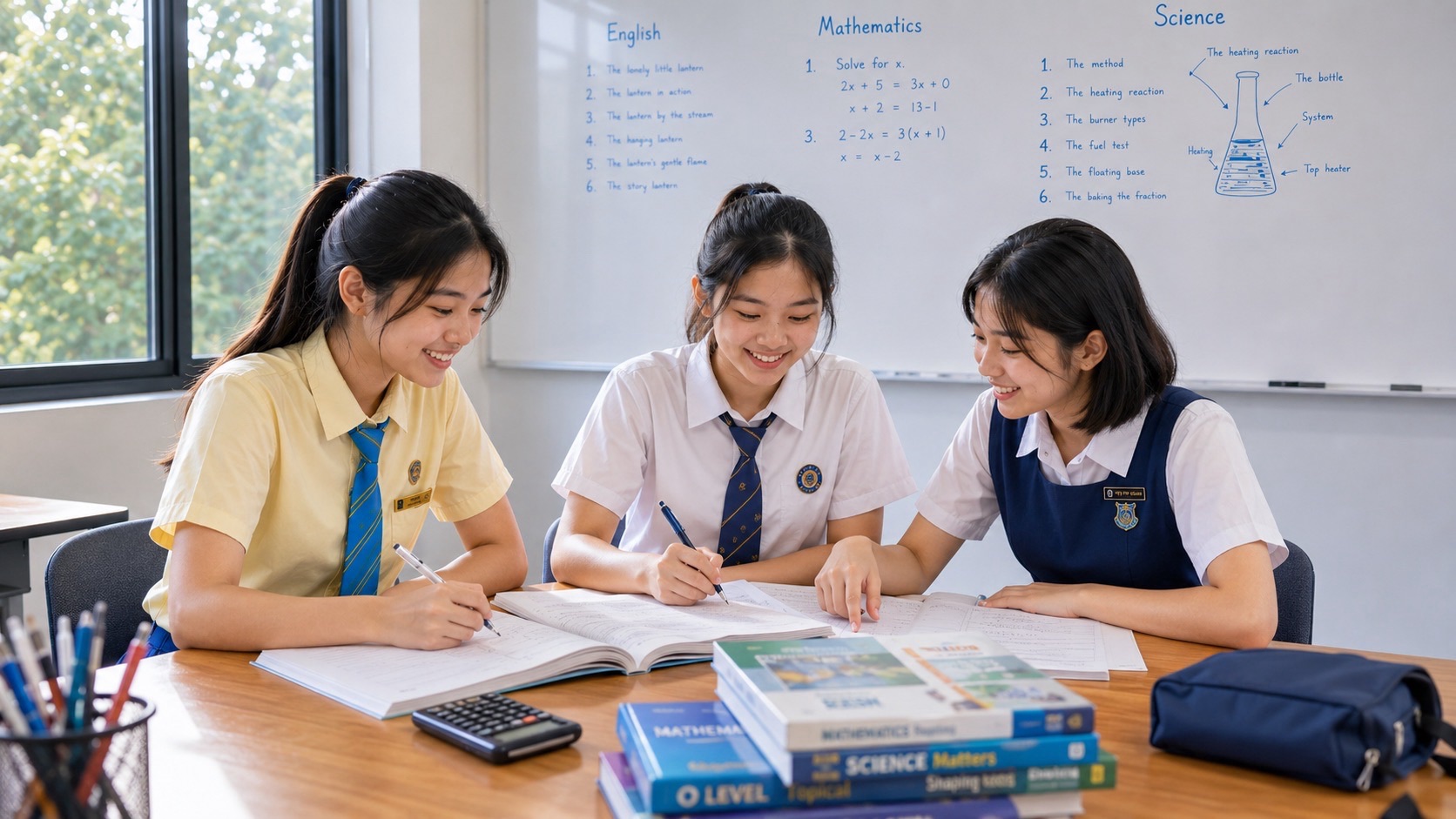
Secondary 1 Mathematics tuition for Whampoa families should solve the transition from Primary 6 arithmetic into secondary-school symbolic reasoning. The year introduces more directed numbers, algebra, equations, formal notation, graphs and multi-step modelling, so a child who was comfortable in Primary Mathematics can suddenly hesitate even when the underlying arithmetic remains familiar. Good support begins by identifying whether the difficulty lies in prerequisite knowledge, representation, method selection or execution.
Parents searching for Secondary 1 Mathematics tuition in Whampoa, a Secondary 1 Mathematics tutor, Sec 1 Math tuition, G2 Mathematics, G3 Mathematics or small-group algebra support are usually trying to find a programme that makes this transition reliable. Current Singapore search language also uses familiar terms such as E-Math, even though the teaching plan still has to follow the student’s actual school subject level and current syllabus rather than rely on marketing labels.
This page is the year-specific Whampoa route in eduKateSG’s Secondary Mathematics system. Whampoa is the family’s local discovery and planning context; this does not claim that eduKateSG operates a physical Whampoa branch. The page complements national year owners, the Mathematics Learning Hub and How Mathematics Works, while keeping Additional Mathematics and examination-specific routes separate.
Why Secondary 1 feels different even when the arithmetic is familiar
Adrian arrives in Secondary 1 able to calculate 56 ÷ 7 without hesitation, yet pauses when the same relationship is written as 7x = 56. That pause is not proof that he has forgotten Primary Mathematics. It shows that the representation has changed. Secondary 1 increasingly asks students to reason with symbols that stand for quantities and relationships rather than with numbers that are fully known from the start.
The transition should be diagnosed before it is accelerated
Jo may be one chapter ahead in tuition and still depend heavily on worked examples. Ben may be exactly on the school syllabus but already able to start unfamiliar problems independently. The second student may be better prepared. A useful Secondary 1 programme therefore begins by diagnosing how the learner reads notation, preserves equality, handles negative quantities, defines unknowns, and checks whether a result is plausible before deciding what should be taught next.
Whampoa is the discovery context, not a branch claim
Families searching for Secondary 1 Mathematics tuition in Whampoa may be comparing nearby school schedules, home routines, transport time, small-group options and subject-level support. This page uses Whampoa as the family’s local planning context only. It does not claim that eduKateSG operates a physical Whampoa branch. The wider subject architecture remains anchored in the national Mathematics owners, the Mathematics Learning Hub and How Mathematics Works.
A learner should understand equality before learning shortcut language
Aisha can solve 5x = 35 if told to “move the five and divide”, but that phrase gives her little help when the equation becomes 5(x + 2) = 35. A better foundation is that both sides of an equation have equal value. Dividing both sides by five preserves that equality, giving x + 2 = 7 and then x = 5. The legal transformation is the idea; the shortcut phrase is optional.
Directed numbers need an ordered mental model
Ryan can recite sign rules but compares -4 and -9 incorrectly because he focuses on the digits rather than their position on the number line. Place both values on a line and ask which lies farther to the right. Then connect the order to a temperature drop, an elevator moving below ground level, or a debit balance. Rules for addition and subtraction become more durable once negative values represent ordered quantities rather than mysterious signs.
A number line can reveal hidden misconceptions quickly
Mira is asked to mark -6, -1, 0, 3 and 8, then describe what happens when three is subtracted from -1. She moves three units left to -4. Next she explains why subtracting a negative can move in the opposite direction. The visual model is not meant to replace symbolic fluency forever. It is a diagnostic surface that makes a weak mental model visible before rules are compressed into faster procedures.
Algebra should begin as a language for quantities
Clara is told that one notebook costs n dollars. Three notebooks cost 3n dollars. If a delivery fee of $4 is added, the total is 3n + 4. She is then asked to tell the story represented by 5n + 2. The exercise moves in both directions: context to expression and expression back to context. This translation skill matters because later questions frequently hide the algebra inside ordinary language.
Like terms should be understood as compatible units
Ethan sees 4a + 3a as four a-units plus three a-units, which gives seven a-units. He also sees why 4a + 3 cannot become 7a: the terms are not the same algebraic kind. Thinking in units makes simplification less arbitrary. The learner is not merely “collecting letters”; the learner is combining quantities that share the same symbolic unit.
Substitution requires the entire value to replace the symbol
If p = -5, then p² means (-5)², not -5² interpreted casually through incomplete notation. Adrian writes brackets whenever a negative value is substituted. In an expression such as 2p² + 3p – 4, that habit protects both the sign and the order of operations. Small notation routines established in Secondary 1 become important error controls when upper-secondary expressions grow longer.
Expansion should preserve every term inside the bracket
Jo expands 4(x – 3) by multiplying four by x and by -3, giving 4x – 12. When the multiplier is negative, she says each multiplication aloud until the sign pattern is stable. A simple area model can support the idea during first learning. The objective is to understand distribution, then compress it into reliable symbolic fluency rather than memorise a vague rule about “opening brackets”.
Factorisation should be taught as the reverse view of expansion
Ben sees 6x + 18 and identifies six as a common factor, giving 6(x + 3). He immediately expands the answer to verify it. This reverse check turns factorisation from an isolated technique into a structural relationship between two equivalent forms. Later algebra depends heavily on recognising which form makes the next step easier.
Equation solving should look like a chain of valid statements
Aisha solves 4x – 7 = 21 by adding seven to both sides, giving 4x = 28, and then dividing both sides by four to get x = 7. Each line is equivalent to the previous one. The visible chain matters because it lets the student find the first point where an error enters. “Move it across and change the sign” may be faster to say, but it hides the reason the transformation is valid.
Word problems should define the unknown before building an equation
Ryan is told that three identical tickets plus a $5 booking fee cost $32. He defines t as the price of one ticket and writes 3t + 5 = 32. Solving gives t = 9. He then answers in the original context: one ticket costs $9. Defining the unknown first prevents symbols from becoming detached from the quantities they are meant to represent.
Ratio can be used to bridge Primary reasoning into algebra
Mira solves a ratio problem using parts, then rewrites the same situation algebraically. If red and blue counters are in the ratio 3:4 and there are 35 counters in total, let one part be k. Then 3k + 4k = 35, so k = 5, giving 15 red and 20 blue. The algebra is a formal version of a relationship she already understands.
Percentage needs a named reference quantity
Clara increases $250 by 20% to obtain $300. A later 20% decrease gives $240, not $250, because the second percentage is based on $300. Writing the reference quantity beside the percentage forces the learner to ask “20% of what?” This habit becomes increasingly important in discounts, reverse percentage, repeated change and financial contexts.
Reverse percentage should reconstruct the original base
Ethan sees an item that costs $84 after a 30% discount. The $84 represents 70% of the original price, so the original is 84 ÷ 0.70 = $120. He checks by calculating 30% of $120 and subtracting it. The checking route moves in the opposite direction from the solution and is therefore more useful than simply pressing the same calculator keys again.
Coordinates require order and meaning
Adrian plots (4, -2) and (-2, 4) and explains why they are different. The first coordinate controls horizontal position; the second controls vertical position. The ordered-pair idea seems elementary, but it supports graphs, gradients, line equations and coordinate geometry later. Small coordinate confusions can become large upper-secondary weaknesses if they remain hidden.
Graphs should be treated as compressed relationships
Jo works with y = 3x + 1. She produces a short table, plots the line and explains that y increases by three whenever x increases by one. The graph is not merely a picture produced after substitution. It is another representation of the same relationship, useful because slope, intercepts and intersections can be seen geometrically.
Geometry should reward reasons rather than appearances
Ben sees two angles that look equal in a diagram. Instead of accepting the picture, he identifies whether they are vertically opposite, corresponding, alternate, or part of an isosceles relationship. The reason is written beside the numerical step. Secondary 1 is an ideal stage to make this habit normal because later geometry depends on chains of justified relationships.
Measurement should keep units attached to every stage
Aisha calculates the area of a 4.8 m by 3.5 m rectangle as 16.8 m². The square unit matters because area measures a two-dimensional quantity. If the question mixes centimetres and metres, conversion happens before the main formula. Carrying units through working can expose the use of an unsuitable formula or an accidental scale mismatch.
Statistics should connect averages back to totals
Ryan learns that if six values have a mean of 14, their total is 84. If a seventh value of 21 is added, the new total is 105 and the new mean is 15. Translating between mean, total and count makes missing-value questions easier and prepares the learner for more complex data manipulation later.
Probability should start with the event space
Mira looks at a bag containing 5 red, 3 blue and 2 green counters. There are ten equally likely counters, so the probability of red is 5/10 = 1/2. If one red counter is removed without replacement, the next denominator changes. The physical change in the bag changes the probability model. The learner should notice that before writing fractions.
Mixed practice trains method selection, not just memory
Clara scores highly on a worksheet titled “Linear Equations” but hesitates when an equation appears among ratio, geometry and percentage questions. The issue is not equation solving itself; it is recognition. Mixed sets should therefore appear gradually during Secondary 1 so the student practises identifying structure after the chapter label has disappeared.
A three-student class should capture independent first moves
Ethan, Adrian and Jo may work on the same algebra problem, but each should write an independent first step before discussion. Otherwise one student can supply the method for the group and hide another student’s uncertainty. Small-group teaching is strongest when shared explanation comes after individual evidence has been captured.
Retrieval should be planned before forgetting becomes obvious
Ben’s weekly homework includes current work, two questions from the previous month and one older dependency. The set is short enough to survive busy school weeks. Its purpose is to keep important methods available instead of waiting for the next examination to reveal that a topic has quietly disappeared from memory.
Correction should identify the first wrong decision
Aisha does not write “careless” beside every lost mark. She writes specific mechanisms: combined unlike terms, forgot the percentage base, used diameter as radius, lost the negative sign during substitution, or answered for the wrong quantity. These notes become future checking rules. A correction is useful only if it changes the next attempt.
Delayed retesting separates explanation from learning
Ryan corrects a sign error today, then meets a different negative-bracket problem three days later without notes. If the sign control survives, the repair is more credible. Immediate correction can feel easy because the teacher’s explanation remains active in short-term memory. Delayed fresh questions test whether the principle has become retrievable.
Fluency and reasoning should not share the same timing rules
Mira can practise routine integer operations and algebraic simplification under a short time target because automaticity is useful. An unfamiliar modelling problem should initially be slower because the main task is deciding what to represent. Speed is added after the setup becomes reliable. Otherwise timing can make a weak method fail faster.
Estimate before trusting calculator output
Clara sees 49.6 × 3.1 and expects a result around 150 before entering it. If the display shows 15.376, she knows the entry deserves inspection. Estimation is not a replacement for exact work; it creates a reasonableness boundary that catches impossible or implausible outputs quickly.
Method-selection drills deserve their own place
Ethan is shown ten short questions and asked only for the first useful move: define an unknown, use a percentage multiplier, form a ratio equation, apply an angle property, calculate a mean from total, or use a coordinate relationship. He then solves only the items he found hardest to classify. This targets recognition directly rather than hiding it inside long worksheets.
Audit finished solutions to strengthen error detection
Adrian receives a completed solution containing one deliberate error. His task is to identify the first invalid line and explain the violated principle. Auditing another person’s working is useful because the learner is less attached to the answer. The same monitoring skill can later be applied to his own work.
Parents can observe progress without teaching the lesson
Whampoa families do not need to become Mathematics tutors to monitor learning. Ask the student to explain one corrected question, identify one recurring error, and show one fresh mixed problem solved without a worked example. Fewer blank starts, clearer notation, better sign control and more precise explanations are often visible before a dramatic mark increase.
A monthly mixed review should test transfer
At the end of each month, Jo completes a compact mixed set containing directed numbers, algebra, ratio or percentage, one coordinate or graph question, one geometry reason and one data item. The context and numbers differ from classroom examples. The review reveals whether learning survives after familiar surface cues are changed.
A transition file should capture what is stable and what is still active
Ben’s end-of-year file fits on one page. It states that directed numbers are stable, fraction work needs retrieval, algebraic substitution is reliable, reverse percentage still needs a base check, and geometry reasons are improving. Several fresh successful problems are attached as evidence. Secondary 2 can then begin from this map rather than restarting the year from vague impressions.
G1, G2 and G3 should be treated as subject routes
Singapore’s subject-level system uses G1, G2 and G3. These labels describe subject levels, not the entire learner. For 2027 SEC school candidates, official SEAB listings identify Mathematics as K110 at G1, K210 at G2 and K310 at G3. Families should verify the actual Mathematics course taken by the student and use current official guidance when syllabus accuracy matters.
Secondary 1 is not the year to force A-Math content early
A student preparing well for future Additional Mathematics does not need premature calculus or advanced algebra. The strongest preparation is stable main-Mathematics foundations: equations, graphs, fractions, proportional reasoning, geometry and careful symbolic work. The established Additional Mathematics architecture remains a separate subject lane when upper-secondary pathways make it relevant.
Whampoa search language should still map onto real educational needs
Current Singapore results commonly use terms such as Secondary 1–4 Mathematics, G2/G3, E-Math, A-Math and small-group tuition. Those phrases help families discover options, but they do not tell us what a learner needs. A good programme translates the search phrase into an actual diagnosis: transition, prerequisite repair, method selection, written control or independent transfer.
The location decision should protect the student’s weekly energy
For a Whampoa family, tuition planning should consider more than a map pin. Travel time, school dismissal, meals, CCA commitments and sleep all affect whether a student arrives ready to think. A nearby lesson that creates an exhausted evening may be less useful than a schedule that preserves attention and leaves enough time for independent retrieval.
Use one final audit to decide which scaffolds can be removed
Aisha completes a year-end set without notes, topic headings or teacher prompts. If routine equations are now stable, worked examples can disappear. If mixed percentage questions still require cues, that scaffold remains temporarily. Progress is partly measured by the amount of support the learner no longer needs.
Secondary 1 should end with evidence-based confidence
Ryan should be able to point to fresh work showing that he can manage signs, choose a method, explain a percentage base and justify a geometry step. Confidence grounded in evidence is more useful than either anxiety or empty reassurance. It tells the learner what can be trusted and what still deserves deliberate retrieval.
The handover into Secondary 2 should be clean
By year end, Adrian understands legal algebraic moves. Jo can translate between words and symbols. Ben checks relationships rather than guessing. Aisha manages units and geometry reasons. Ryan uses delayed retesting. Mira interprets graphs. Clara starts mixed questions independently. Ethan applies question-specific checks. Secondary 2 can therefore focus on consolidation and upper-secondary readiness rather than rebuilding the transition from scratch.
Continue through the Whampoa Mathematics routes
Use the Mathematics Learning Hub for the wider Mathematics map, How Mathematics Works for the underlying learning system, and the existing Whampoa Primary 4–PSLE routes for earlier local stages. The next year-specific route is Secondary 2 Mathematics Tuition | Whampoa, where the emphasis shifts from transition into consolidation, mixed-method selection and upper-secondary readiness.
Build a notation checklist before algebra becomes dense
Many Secondary 1 errors are not conceptual failures but notation failures that later become conceptual. Adrian writes negative values in brackets during substitution, keeps an equals sign between equivalent lines, labels variables in word problems and distinguishes multiplication from addition in expressions such as 3x and x+3. These small controls reduce ambiguity. By the time algebraic expressions become longer, the student already has a written system that protects meaning.
Use worked examples as temporary scaffolds, not permanent crutches
Jo first studies a worked solution to an equation and explains why each line is valid. She then completes a nearly identical problem with one step omitted. Next she solves a fresh problem with no scaffold. The worked example is therefore faded deliberately. If the example remains beside every question, the learner may feel fluent while actually depending on visual imitation.
Teach the student to ask what stays unchanged
When a question changes form, the learner should look for an invariant. In equation solving, equality must be preserved. In a ratio, the relationship between parts may stay constant. In a graph, a linear rate of change may remain constant. In a geometric transformation, certain lengths or angles may be preserved. Ben begins to ask, “What relationship must still be true?” This question helps him connect topics that otherwise seem unrelated.
Use verbal explanation to expose shallow understanding
Aisha can sometimes produce the correct answer without understanding why the method works. Asking her to explain one line in ordinary language reveals whether the reasoning is stable. “I divided both sides by four because I need to preserve equality” is stronger evidence than “I moved the four.” Verbal explanation should be brief and targeted, not a speech after every problem.
Build a correction ladder
Ryan classifies each important mistake at one of four levels. Level one: misread the question. Level two: chose the wrong mathematical model. Level three: selected the right method but executed it incorrectly. Level four: obtained a plausible answer but failed to check or state it properly. The ladder helps the tutor repair the earliest failure instead of treating every wrong answer as an arithmetic problem.
Use spaced mixed review instead of end-of-term rescue
Mira does not wait for the exam revision period to revisit September algebra in November. Her weekly set includes a small number of older questions. The workload stays modest, but the spacing prevents complete forgetting. When exam revision begins, the topics are being strengthened rather than relearned from zero.
Introduce mathematical vocabulary deliberately
Words such as term, coefficient, expression, equation, factor, multiple, gradient, perpendicular, parallel and corresponding carry precise meanings. Clara keeps a small working glossary and uses the words in complete explanations. Vocabulary matters because misunderstanding the language can make a mathematically simple instruction look unfamiliar. Language support should clarify the Mathematics, not replace it.
Worked example: combine algebra and ratio
The ratio of boys to girls in a club is 3:5, and there are 16 more girls than boys. Let one ratio part be k. Then boys=3k and girls=5k. The difference is 2k=16, so k=8. There are 24 boys and 40 girls. Ethan checks that the ratio 24:40 simplifies to 3:5 and that the difference is sixteen.
Worked example: percentage and algebra together
A quantity x is increased by 25% to become 90. Then 1.25x=90, so x=72. Adrian can solve this by percentage reasoning or algebra. Seeing both routes is useful because it shows that different representations can describe the same relationship. The student should choose the route that keeps the reasoning easiest to inspect.
Worked example: graph from a simple rule
For y=2x-3, Jo calculates several coordinate pairs, plots the line and identifies the y-intercept at -3. She then explains that increasing x by one increases y by two. The graph, table and equation are not separate tasks; they are three views of one relationship.
Worked example: probability after a change
A bag contains 4 blue and 6 yellow counters. One yellow counter is removed. The probability of drawing blue from the remaining bag is now 4/9. Ben updates the denominator because the sample space has changed. This simple exercise prepares him to notice changing conditions later in without-replacement probability.
Worked example: a unit conversion before area
A rectangle is 2.4 m long and 80 cm wide. Aisha converts 80 cm to 0.8 m before multiplying, giving an area of 1.92 m². She could also convert both measurements to centimetres, but the units must be consistent before the area calculation. The conversion step is part of the model, not a cosmetic detail.
Build an “I can start this” library
Ryan keeps a small set of first moves for common structures: define the unknown, write the ratio parts, mark the right angle, identify the percentage base, label coordinates, or turn the mean into a total. This is not a list of complete solutions. It is a library of entries into problems. Students who often go blank can become more independent by practising how to begin.
Use small-group discussion to compare methods after independent work
Mira may solve a ratio question using parts while Clara uses algebra. Both routes can be correct. After independent attempts, the group compares which representation was clearer and what each method made visible. This teaches flexibility without making students feel that only one memorised pathway is acceptable.
Whampoa families should look for a programme that can name the actual failure
A tutoring label such as “Sec 1 Math” does not reveal whether the programme can diagnose a student who understands concepts but cannot start, a student who follows methods but loses signs, or a student whose algebra is blocked by old fraction weaknesses. A useful programme should be able to say exactly what is failing and what evidence will show that the repair worked.
Final handover rule: stable skills move to retrieval, not reteaching
If Ethan can now solve routine equations, manage directed numbers and explain percentage bases independently, those skills should not consume full lessons next year. They move into spaced retrieval. Active weaknesses receive focused repair. This distinction protects Secondary 2 lesson time and makes the curriculum cumulative rather than repetitive.
Use diagnostic contrasts to separate concept from execution
Give Adrian two questions with the same underlying structure but different arithmetic. If he explains both correctly but loses a sign in one, the concept is probably sound and execution needs attention. If he cannot identify the relationship in either question, more teaching is required. These contrast pairs stop the tutor from over-teaching ideas the student already understands.
Teach the student to preserve a visible chain of meaning
Jo learns that each line of working should answer a simple question: what changed, and why is the new line still mathematically connected to the old one? This discipline applies to equations, percentage models, graph rules and geometry reasoning. When the chain is visible, correction becomes faster because the first broken link can be found.
Use small cumulative quizzes instead of one large memory test
Ben completes a six-question cumulative quiz every two weeks. One question is current, two come from the previous month, two are older and one deliberately combines topics. The quiz is short enough to avoid creating another heavy assessment but broad enough to show whether knowledge is still retrievable. Trends across several quizzes are more informative than one isolated score.
Worked example: identify the better representation
A taxi fare contains a fixed starting charge plus a rate per kilometre. Aisha can describe the relationship in words, represent it with a table, write an equation and draw a graph. She then compares which representation makes the fixed charge easiest to see and which makes the rate easiest to see. Mathematics becomes a choice among representations rather than a hunt for one prescribed format.
Worked example: compare two percentage descriptions
One quantity rises from 80 to 100. The increase is 20, which is 25% of the original 80. Ryan also notes that 80 is 20% less than 100 because the reference quantity changes. The same numerical difference supports different percentage statements depending on the base. Naming the base prevents ambiguity.
Use “because” sentences in geometry
Mira writes, “Angle A equals angle B because vertically opposite angles are equal.” This simple sentence structure makes the justification explicit. As geometry becomes more complex, the learner can shorten the wording into standard mathematical reasons, but the habit of attaching a reason to the conclusion should remain.
Keep the correction notebook small enough to use
Clara does not record every wrong question. She records recurring mechanisms and one representative example. A page that says “negative substitution”, “percentage base”, “radius versus diameter” and “define unknown first” is more useful than forty copied solutions. The notebook should function as a control panel before the next mixed set.
Make independence visible by reducing prompts
Ethan’s tutor gradually stops asking, “What is the unknown?” before every word problem. If Ethan can now define it himself, the prompt disappears. Similar fading happens with unit reminders, geometry reasons and percentage bases. A student is becoming more independent when correct work survives after these prompts are withdrawn.
Secondary 1 Mathematics tuition should create a reusable learning loop
The loop is simple: diagnose the first failure, teach or repair the smallest necessary idea, practise until the method is stable, retrieve it after a delay, mix it with other topics, then test whether support can be removed. Adrian, Jo, Ben, Aisha, Ryan, Mira, Clara and Ethan may each enter the loop at different points, but the mechanism remains consistent.
That loop is the real preparation for the years ahead
Secondary 1 does not need to predict every Secondary 2, Secondary 3 or Secondary 4 question. It needs to give the student a reliable way to learn unfamiliar Mathematics. When a new topic arrives, the learner can connect it to old knowledge, represent it clearly, practise it deliberately, check it intelligently and repair it when something goes wrong. That capability is more durable than being temporarily ahead of the school syllabus.
Final S1 review: test what remains when cues disappear
The last Secondary 1 review should remove the supports that normally make schoolwork feel easy. No chapter headings, no worked example beside the question, no reminder to define the unknown, no prompt to check units. Adrian and Jo should still recognise familiar structures. Ben and Aisha should still show legal algebraic steps. Ryan and Mira should still identify percentage bases and graph relationships. Clara and Ethan should still justify geometry and inspect answers for plausibility.
If performance remains strong, those skills move into periodic retrieval next year. If one support condition causes the work to collapse, that specific dependency stays active. The point is not to produce a perfect final score; it is to know exactly what the student can now run independently.
Whampoa Secondary 1 should finish with a precise next step
The strongest handover into Secondary 2 is concise: stable skills, active dependencies, recurring error controls and two or three fresh successful examples. That record protects next year from unnecessary reteaching and gives the student a clear explanation of what progress has actually meant. Secondary 1 Mathematics tuition in Whampoa therefore succeeds when the learner has become easier to teach, easier to diagnose and increasingly capable of managing mathematical decisions without continuous prompting.
One last delayed mixed set, completed several days after the final lesson, should confirm that the handover is real. The student should face altered numbers, unfamiliar wording and a changed question order without notes. If the same methods can still be selected and checked independently, the foundation is durable enough for Secondary 2. If an old error returns, it is carried forward by name rather than hidden behind a broad label. This final evidence keeps the next stage focused: stable knowledge is retrieved occasionally, active weaknesses are repaired deliberately, and new Mathematics can be learned without restarting the whole subject.
That discipline prevents transition work from becoming temporary exam preparation. It leaves the learner with a method for learning, checking and repairing Mathematics across the years ahead.