
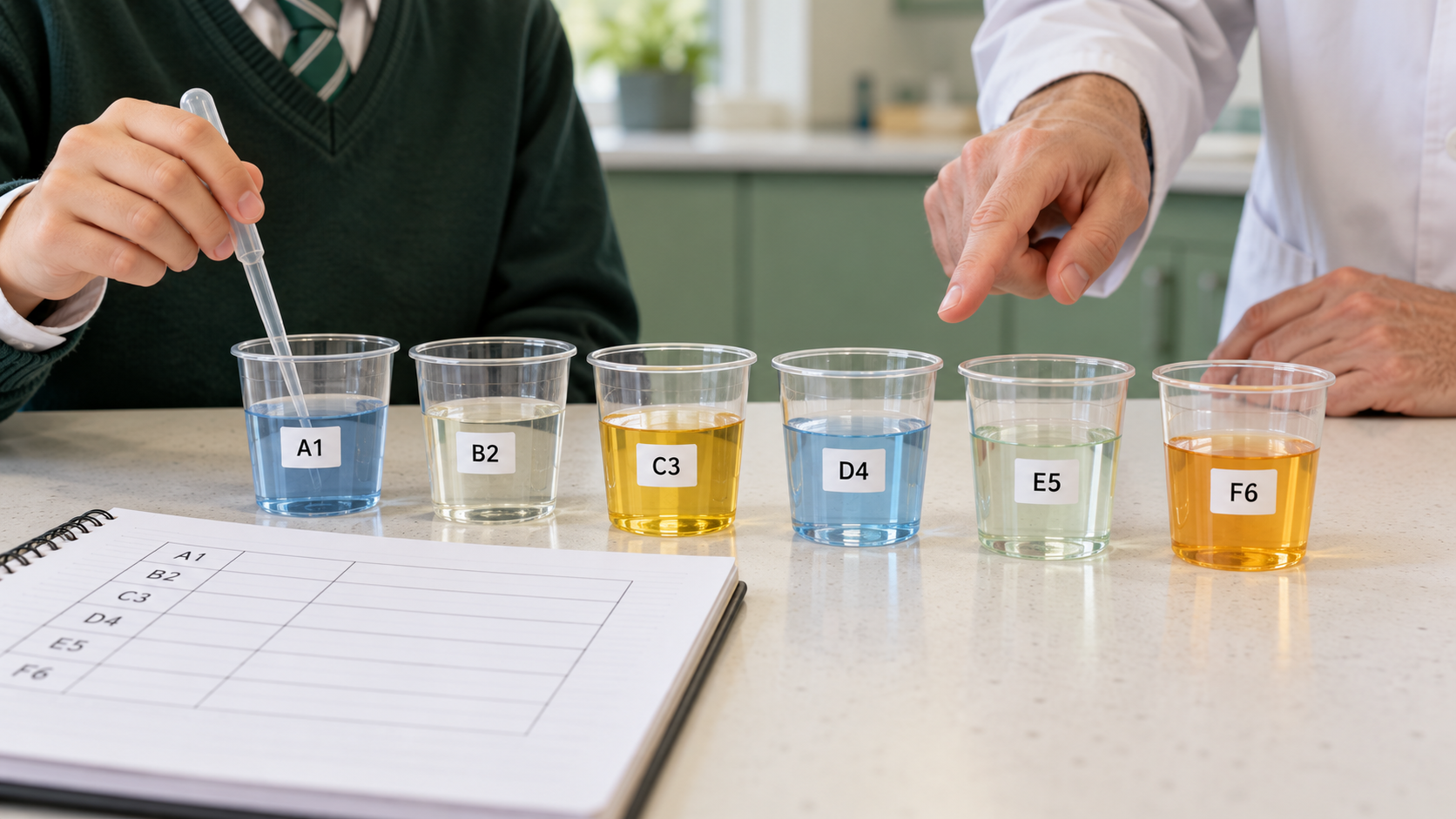
Secondary 1 Science small-group tuition for Hougang families is most useful when a student needs more than another set of notes: the student needs a tutor to reveal exactly where measurement, experimental reasoning or scientific explanation breaks down. A well-matched group of three can make each learner’s thinking visible and allow focused feedback, but it cannot guarantee marks and is not necessary for every child.
This guide helps Hougang parents assess a real decision. It explains the MOE G1/G2/G3 distinctions, illustrates errors in Science measurements and experiments, describes how a 90-minute tutorial might work, and compares the benefits with fees, group fit, transport and fatigue. It does not assume there is an eduKate Science centre within Hougang or that a particular class has a vacancy.
At a glance: ask for a diagnostic of two marked Science questions; check your child’s actual Science subject level; insist that all three learners answer independently; compare the full weekly travel-and-rest cost; review improvement using an unfamiliar question after a delay; stop or change the arrangement if the benefits do not appear.
- Primary goal: accurate measurement, scientific explanations and independent transfer.
- MOE alignment: check current G1/G2/G3 Science level, not the student’s age alone.
- Benefits: individual feedback and peer reasoning in a group of three.
- Costs: fees, journeys, fatigue, group mismatch and tutoring dependency.
- First action: bring recent Science scripts and ask the tutor for a four-week diagnostic plan.
Hougang’s most important Science question is often not ‘Does my child know the chapter?’
A family may see that a student has carefully highlighted pages on experimental procedures and still lost marks when asked to draw a conclusion from a table. The child can tell you what the chapter is about, yet cannot decide which part of an investigation matters. This is a mismatch between recognising information and using it. A useful tutorial makes that distinction immediately, rather than assuming the first remedy is a longer revision schedule.
For a Hougang parent, the practical test is simple. Place a school question beside its answer. Ask the pupil to point to the words that identify what is changed, what is measured, and what is kept constant. If the student can explain those decisions without reference to the answer key, understanding may already be secure. If the student can only recite ‘independent variable, dependent variable, constant variable’ without choosing them correctly, the concept needs work.
The third possibility is equally important: a student may understand the concept in conversation but write an answer that is too vague for a school assessment. That is not the same as a conceptual failure. The intervention might be sentence construction, precision and selection of evidence, rather than repeating an entire unit. A good small-group tutor must keep these diagnoses apart.
Some families in Hougang already have school commitments, CCA and regular travel. Learning gains therefore need to be substantial enough to justify the extra session. If the improvement can be achieved through ten focused minutes of independent correction at home, a weekly tuition commitment may not be proportionate. The first duty of the educator is to identify the right amount of help.
Worked example: reading a measuring cylinder is a reasoning task
Suppose a diagram shows a measuring cylinder containing water, with the liquid surface curving downward in the middle. The student must use the scale and read the bottom of the meniscus at eye level when that convention applies. A child may correctly name the apparatus but still misread the volume by looking from above or choosing the top of the curve. The error is not a failure to memorise ‘measuring cylinder’; it is failure to understand how the observation is obtained.
A tutor can model the distinction between a unit and a quantity. If the scale is marked in millilitres, the written result needs the number and its appropriate unit. If the small markings each represent two millilitres, a student who counts each as one creates a systematic reading error. Instead of simply correcting the final value, ask what each interval represents and why the learner chose that position.
Now introduce an irregularly shaped solid that can be safely submerged and does not dissolve. The water-displacement method can determine its volume by subtracting the initial liquid reading from the final reading. The child should recognise that these are measured volumes, not necessarily the dimensions of a rectangular block. Ask a changed version: what if trapped air bubbles cling to the object? Why might the apparent displacement be unreliable?
In a three-pupil group, one learner can check the scale, another the eye-level reading and another the subtraction. They must then attempt a different cylinder independently so the tutor can identify which decision each child actually understands. This is the sort of task where a class of three earns its place: three views of the same mistake can produce a richer discussion, provided responsibility rotates.
The actual Secondary 1 transition: from recalling facts to testing explanations
A child who passed Primary Science may still find the Secondary 1 version unfamiliar. The new work asks for a stronger connection between a scientific concept, the evidence available and the conclusion that follows. Remembering that heating can cause expansion is one thing; reading a new situation, deciding which observations matter, and explaining a sensible mechanism is another. The change is not a judgement on the child’s intelligence. It is a change in what a successful explanation must do.
Consider the answer, “The object became heavier because it got hotter.” The words are familiar, but the inference is unsupported. The tutor should ask what was measured, what the units mean and whether the question actually supplies mass readings. Students need to distinguish an observation from an explanation. That habit becomes useful across particles, energy, living systems and forces.
In a good tutorial the child first gives an answer before seeing the worked solution. The tutor then traces the decision chain: What did you notice? Which scientific idea did you select? Why does it apply? What evidence in the question supports the claim? Which part of the response would be different if the conditions changed? This sequence is more useful than simply requiring the child to copy a polished paragraph ten times.
Parents should not conclude that every hesitant explanation is a tuition emergency. Secondary 1 includes adjustment to new teachers, routines, school expectations and friendships. Some hesitation disappears as a student becomes more settled. A sensible decision compares marked work over time and looks for repeated conceptual problems rather than reacting to one surprising grade.
G1, G2 and G3 are subject levels, not interchangeable worksheet labels
Under Singapore’s Full Subject-Based Banding, Secondary 1 pupils study subjects at an appropriate subject level, which can differ across subjects. A pupil may be taking Science at a different level from another pupil who sits in the same form class. Tutors should not infer the correct Science syllabus from a child’s posting group alone, and they should not treat G1, G2 and G3 as three names for an identical question bank.
The MOE G2/G3 Lower Secondary Science syllabus is organised around the themes of scientific endeavour, diversity, models, interactions and systems. It introduces conceptual foundations and practices that later support Biology, Chemistry and Physics. The G1 syllabus is not a reduced photocopy of the G3 material: its context-based organisation includes laboratory measurements and procedures, Machines Around Us, Our Environment, and Our Body and Health. The school decides the sequence in which topics are taught. A tutor should verify the pupil’s actual level, school work and current unit.
The SEC is a national examination framework beginning in 2027 for graduating secondary cohorts. It is not a Secondary 1 examination. Parents who read about G3 SEC Science subject codes should not assume that a Sec 1 child needs to practise that year’s graduating examination paper. The more immediate goal is steady learning of lower-secondary content, inquiry and reasoning. Extension work can be valuable, but it should not replace foundations.
The first parent question should be, “Which level is my child taking for Science now, and what is the class studying this fortnight?” A clear answer makes subsequent planning possible. A tutor who cannot answer it may be designing lessons around an age label rather than the learner’s needs.
Worked example: density and the danger of using the wrong unit
Suppose a sample has a mass of 54 grams and a measured volume of 20 cubic centimetres. Its density is 2.7 grams per cubic centimetre. A student may know the relationship between mass, volume and density while still writing ‘2.7 g’ because the first number in the question was in grams. The concept and the unit need to be taught together.
Ask the student to explain what the value means: for a uniform sample, each cubic centimetre corresponds to 2.7 grams of mass. The explanation connects the calculation to a physical property. Then change one input. If a sample of the same uniform material has twice the volume and twice the mass, should the density double? No, because the ratio remains the same. The learner now has to distinguish a material property from the size of the sample.
Different lower-secondary courses and schools may introduce quantitative treatment at different points and levels. This is a teaching illustration, not an assertion that every Secondary 1 pupil is presently studying density calculations. For a student whose current course is not ready for the arithmetic, a tutor can begin with the simpler idea that two objects of equal volume may have different mass, then use comparisons suited to that course.
The more important learning habit is the same: state what is being compared, use appropriate units and check whether the answer makes physical sense. If a child arrives at an impossible or implausible result and never asks why, tuition should make checking a normal part of the task rather than an optional luxury after all the questions are done.
Worked example: filtering muddy water is not the same as cleaning every pollutant
Imagine a sample of water containing visible sand, a dissolved substance and perhaps microorganisms. A basic filtration question may establish that a filter can retain suitable undissolved particles from a mixture while liquid passes through. It would be wrong, however, to claim that ordinary filter paper removes every dissolved material or makes unknown water safe for drinking.
This makes a useful Hougang classroom discussion about scientific limits. A student who writes ‘filtration removes the impurities’ may have communicated the everyday intention but not a defensible scientific conclusion. The tutor should ask what kind of impurity is present. Is it dissolved? Is it suspended? Is there evidence about the filtration equipment’s pore size? Has a treatment been shown to remove microbes or harmful chemicals? Without these details, the broad claim goes beyond the evidence.
A second question could place salt in the water. Ordinary filtration will not recover dissolved salt. Evaporation or crystallisation may help recover the dissolved solid in an appropriately designed context, but the process and desired product must be specified. A third question combines sand and salt: students need a sequence that separates the undissolved material before attempting to recover the dissolved solute. The pupil learns to select methods by properties, not from a list of favourite verbs.
Local drains and ponds can prompt curiosity, but children should not sample potentially contaminated water or improvise treatment experiments without trained supervision. The educational exercise can be completed through diagrams, supplied results or safe teacher-directed demonstrations. Science education includes learning when a simple experiment does not justify a public-health claim.
The Hougang lesson on rainfall: one observation can have several explanations
A child notices that one sheltered walkway stays damp while a nearby sunlit surface appears dry. The tempting answer is ‘the sun dried it.’ That may be one plausible explanation, but a scientific investigation would ask which variables differ: shade, airflow, surface material, exposure, starting quantity of water and time since the rain. A casual observation cannot isolate a single cause.
The tutor might design a classroom thought experiment. Two otherwise similar trays receive the same volume of water and have the same exposed surface area. One is placed where air moves; the other where it does not. The investigation is about the effect of airflow on evaporation, so other relevant conditions should be held as consistent as practical. A student must identify the independent variable, the measured outcome and the controls.
Now change the example to make it deliberately unfair: one tray is wide and shallow while the other is narrow and deep. If the water levels differ later, the comparison confounds airflow with exposed area. Children who memorised ‘control the variables’ can be asked which particular variable was not controlled. This transforms a textbook term into a decision.
This is an illustrative observation for Hougang families, not a claim that a measured experiment has taken place on a particular local walkway. That honesty matters. Scientific habit begins when the child can say ‘I think this is possible, but I would need better evidence.’ A tutor who rewards such accuracy is teaching more than exam technique.
Why graph answers go wrong even when the plotted points are right
A graph of temperature against time might show a rising line. One pupil writes ‘the water heats up.’ A second writes ‘the temperature increased from 25°C to 40°C during the recorded period.’ The latter describes the evidence more precisely, assuming those figures match the graph. A third claims ‘the heater supplied twice the energy’, although the graph gives no energy measurement. These answers are not equally defensible.
In a small-group tutorial, every pupil first labels the axes, includes units and chooses a sensible scale. Then the group separates description from interpretation. The tutor can ask, ‘What can you read directly?’ and ‘What extra information would you need before claiming a cause?’ This prevents children from treating a graph as a decorative picture that must produce a dramatic story.
A particularly useful exercise changes the vertical scale but keeps the recorded data consistent. Does the student notice the change, or do they copy a previous answer shape without reading? Another exercise includes one unusual reading. Students should report it accurately and consider measurement conditions rather than erase it because it spoils a smooth curve.
The skill applies well beyond Science. But the aim here is concrete: a Hougang Secondary 1 learner should write one observation supported by the plotted values and one cautious explanation supported by the relevant science. The teacher can then check whether the response still works when the example is unfamiliar.
Why a group of three can be useful—and why the number alone proves nothing
In a three-learner group, the tutor has a chance to see individual written answers and hear each student’s reasoning while still creating discussion among peers. One learner might identify the right scientific principle but omit the evidence. Another might analyse the evidence carefully but choose an irrelevant principle. A third may understand both and struggle to communicate a precise conclusion. Their errors look similar if a page is marked only as right or wrong; they are quite different as teaching problems.
The tutor can rotate roles deliberately. One child makes a claim, one asks what observation supports it, and one looks for an alternative explanation. They then work independently on a changed scenario. The essential feature is not that three children are present; it is that all three must think, speak and write. If one confident child always answers while two copy, the small group has lost its most important advantage.
An individual tutorial may be the better arrangement when the pupil has substantial foundational gaps, significant anxiety about public mistakes or highly specialised support needs. A larger class may serve a confident, organised learner well when teaching is strong and fees are affordable. Even a three-pax group can fail if levels, topics or pace are badly mismatched. Parents should evaluate the tutor’s actions rather than the class-size label.
Ask the tutor to show how the same concept is explained to three learners with three different errors. The response should describe diagnostics, differentiated prompts and independent checking. Generic statements about being ‘personalised’ are not evidence of personalisation. A good educator can explain which work each pupil did, what changed and what remains uncertain.
A realistic ninety-minute lesson without a worksheet factory
A 90-minute Science tutorial might open with five to ten minutes of retrieval from a previously studied idea. Students then answer a short diagnostic question without notes. The tutor compares not just scores but explanations. One specific misconception becomes the teaching target. The tutor offers a model, demonstration or carefully chosen analogy and makes its limitations clear. Each learner describes why the example works rather than merely copying the steps.
The next part is guided application. A pupil might be asked to name the changed variable in an investigation, while another explains how a graph is labelled and a third identifies what can safely be inferred. Roles rotate. After the short group discussion, everyone answers a new task on paper without help. This is the moment when the tutor finds out whether a child can use the idea alone.
The final part is review, not just a farewell. Each pupil writes a small correction in ordinary language, attempts one transfer question, and records the next review date. A short and appropriate home task can follow. During the next session, the tutor checks retention again. This prevents immediate confidence from being mistaken for durable understanding.
Ninety minutes is the usual eduKate small-group lesson duration, but the structure described here is an illustrative teaching design, not a promise about every current class. The sequence should be adjusted to a pupil’s readiness, the actual syllabus and the school assessment calendar. The purpose is to recover independent performance, not to keep children dependent on weekly explanations forever.
How to detect when ‘careless mistake’ hides a deeper problem
Parents often hear ‘careless’ used to explain everything from missing units to choosing the wrong variable. Some errors are slips; others reveal a concept that is not secure. When an error repeats across three differently worded questions, the tutor should ask what decision remains unstable. If a pupil always reverses independent and dependent variables, merely telling them to be more careful is inadequate.
Consider another mistake: drawing a smooth curve through every point without inspecting the nature of the data. It may come from copying a classroom convention into a situation where a different graph is appropriate. The problem is not simply concentration; it is understanding why a graph type is selected. Ask the student to explain what the axes represent and whether a line implies a relationship the data support.
A productive error log uses short categories: reading, measurement, concept, inference, communication and checking. The purpose is not to label the child as a ‘measurement student’ forever, but to find which correction has the highest return. A learner who repeatedly leaves out a unit may need a final answer checklist. A learner who cannot interpret a scale needs instruction before any checklist will help.
Parents can request to see before-and-after answers, not just a stack of practice papers. A school mark may rise or fall for many reasons; a corrected reasoning pattern is more useful early evidence of teaching quality. Progress is clearest when the student repeats the skill alone days later.
How to choose a Science topic for the first month
A tutor who begins with the first page of a commercially convenient workbook may miss an urgent school problem. For a learner studying experimental procedures, start with apparatus, variables, measurements and units if those are the recurring errors. For a student studying matter, check whether terms like solution, mixture, solute and solvent are being confused. For a student working on light or heat, explore the diagrams and mechanisms that are actually in the school’s current unit.
Choose one central concept for initial repair. Then add variations. In the first session, diagnose it; in the second, practise it in an altered context; in the third, mix it with another topic; in the fourth, ask for a fresh independent explanation. A larger plan can be added once the first weakness is stable.
Some pupils need a more fundamental bridge from Primary Science, especially around evidence and scientific vocabulary. Others may be ready for extension that asks them to compare models, discuss measurement uncertainty or explain what an investigation cannot establish. These paths should not be compressed into a single activity simply because three children share a table.
For Hougang families, a useful consultation should end with a specific first-month plan: ‘We will repair measurement reading and variable control and revisit them in new examples.’ It should not end with a vague claim that the child will complete the entire Secondary 1 syllabus ahead of school.
The real travel question for Hougang families
Hougang families may compare classes in several nearby districts. Do not evaluate a Science tuition choice only by what looks close on a map. A student travelling after CCA has a different capacity from one attending on a rested weekend. The door-to-door journey, meal timing, travel safety and time left for homework are all part of the educational choice.
eduKate’s established tuition network includes Punggol, Sengkang and Bukit Timah operations, but this page is not advertising a confirmed dedicated Hougang Science venue. Before committing, ask where the proposed Secondary 1 Science session would actually be delivered, whether a suitable three-student group exists and how the child’s subject level is matched. A tutor’s capability matters more than the estate name in a headline.
Consider a trial decision sheet with four entries: what exact skill needs work, how the tutor plans to teach it, how much travel it creates, and how progress will be measured after four sessions. If any entry is unknown, pause the purchasing decision until it is clear. This simple exercise can prevent a family from paying for an excellent class that is nevertheless unsuitable for the child.
The objective is not to fill every weekday afternoon. It is to create an arrangement that the child can attend alert, learn within and later use independently. If the commute would remove sleep or essential school time, ask about a lower-frequency alternative or choose school-based help instead.
What good progress evidence looks like after four weeks
In week one, collect two or three marked school answers and ask the learner to reattempt a comparable unseen question. Identify the first mistaken decision rather than counting every red mark. Set one teachable priority, such as distinguishing a changed variable from a measured variable, or separating a graph’s observation from a proposed cause.
In week two, vary the examples while keeping the underlying concept stable. The student should explain why a familiar solution applies to a slightly different question. In week three, mix that idea with another topic so that the chapter heading no longer gives away the method. In week four, try a delayed independent question and compare it with the original error. The important result is whether the learner now selects and uses the concept without prompting.
A simple record can contain the question type, the original answer, the correction and a later attempt. Avoid displaying a long wall of mistakes as a motivational device; use the notes to guide teaching. If the child consistently performs independently, the next phase may be consolidation or a reduction in support. If the pattern does not improve, investigate the teaching method, grouping, attendance and fatigue before buying more worksheets.
A higher school grade can be welcome, but it is affected by many variables, including the difficulty of the assessment and the student’s work elsewhere. The most defensible early claim is a concrete improvement in reasoning on a comparable task. Any provider promising a specific AL or A1 grade simply because a group has three pupils is promising more than a tutor can responsibly guarantee.
The consequences families should weigh before committing
Extra tuition has an opportunity cost. A pupil may leave school, eat quickly, travel, attend another class, return home and then attempt homework while tired. When such a schedule is repeated, recovery, sleep, social activity and unstructured curiosity can be displaced. A shorter journey can help, but it does not compensate for poor teaching, and a very efficient lesson can still be poorly timed for the child.
There is also a dependency risk. If the tutor always supplies the opening sentence or tells pupils which formula to use, work may look impressive during class while the student freezes in school. Another risk is a poorly matched group: one child’s material is too easy, another’s too hard, and everyone spends their limited time waiting for the tutor to reconcile the difference.
The financial comparison should be transparent. Consider the actual fee, transport, materials, any replacement-lesson conditions and the number of weeks the family expects to try before reviewing. Ask when tuition would be paused or stopped if it was no longer helping. A responsible tutor should welcome that question.
When the child is understanding school lessons, correcting errors independently, handling assignments and getting sufficient rest, home reading, occasional targeted help or school consultation may be the better choice. The objective is a young person who can reason more confidently, not the largest possible collection of tuition receipts.
A parent–student conversation that often reveals the correct next step
The parent might say, ‘Show me one Science question that felt unfair.’ Let the child pick a marked script and explain what they originally believed. Ask whether the difficulty was unfamiliar content, the wording of the question, or choosing the correct evidence. Resist giving a model answer during the first minute; the hesitation itself shows where help may be required.
Next, ask for a second question of the same type. If the child can solve it independently after a short explanation, the family may be able to practise at home. If the confusion persists, bring the two questions to a qualified educator. A tutor can then design instruction based on the actual point of failure.
Keep the tone investigative. The child is not a defendant explaining why marks were lost. They are a learner learning to test a proposed answer. If the student begins to dread these conversations, shorten them and let school support take the lead. Confidence grows when corrections are specific and manageable, not when every dinner becomes a surprise oral examination.
A four-week review should revisit the child’s opening concern. Can they now explain the first problem, and can they answer a different problem without cues? If so, recognise the improvement. If not, reconsider the plan before adding another round of generic worksheets.
Choosing among a three-student group, private tuition, school support and home review
A three-student group can combine active discussion with close feedback when classmates have compatible needs. Private tuition can give a more individualised pace when foundational gaps are large or participation is difficult. School consultation offers direct knowledge of the child’s curriculum and teacher expectations; it is often the best first step for a narrowly defined issue. Home review can be sufficient when the learner understands concepts but needs a consistent correction routine.
Do not equate higher price with stronger scientific understanding. The educational question is who will notice the wrong inference, which explanation will repair it, and whether the child can later use the corrected idea. A diligent student can sometimes make substantial progress with a small number of carefully chosen questions and school feedback.
If the child has persistent difficulties with reading, attention or an identified additional learning need, ask whether the tutor has appropriate support strategies and coordinate with school resources as relevant. A generic three-pax Science group is not a substitute for specialised assessment or appropriate educational accommodations.
The strongest choice protects the learner’s wider life. Friends, physical activity, family time and sleep all contribute to a sustainable school week. Parents should seek the minimum additional help that produces meaningful independence, not the maximum lesson load that fits the calendar.
Frequently asked questions: Secondary 1 Science in Hougang
Is Secondary 1 Science tuition compulsory? No. Start with marked work and actual learning needs. Some pupils settle into lower-secondary Science after ordinary school practice; others benefit from targeted diagnostic teaching.
Does ‘small groups’ always mean three students? Not across the industry. Here, three-pax describes eduKate’s established tutorial approach. Verify the actual group capacity and attendance arrangement for the specific session.
Does Hougang in the title mean the tutor teaches at a Hougang address? No. This is an estate-specific parent guide. Confirm the actual venue and class availability before making plans.
What if my child is on G1 Science? Ask for genuine G1 alignment, including its context-based content, rather than automatic use of G3 worksheets. The relevant MOE documents are linked below.
What if my child is on G3 and already scores well? Extension may emphasise models, evidence quality, transfer and limits of inference. A higher-level worksheet is not automatically a better extension.
Can a child work on measurement without a home laboratory? Yes. Accurate diagrams, supplied data and safe supervised demonstrations can teach many reasoning skills. Do not improvise hazardous experiments.
How quickly will marks rise? No reliable timeframe can be promised. A strong early indicator is that the child can explain and solve a changed question without help after a delay.
How should parents judge an unfamiliar tutor? Request a diagnosis from marked work, a clear correction plan, an example of differentiated group teaching and a scheduled review of independent results.
What if the group seems too fast? Ask for adjustment or another group. A three-student limit alone does not prevent a pace mismatch.
Is the SEC exam in Secondary 1? No. SEC is a graduating-cohort examination framework from 2027. Secondary 1 tuition should focus on the current lower-secondary syllabus and school assessments.
Official sources and what this page does not promise
For curriculum alignment, consult the MOE G1 Lower Secondary Science syllabus, MOE G2/G3 Lower Secondary Science syllabus, and SEAB’s SEC explanation. These official sources describe curriculum and examination frameworks. This article interprets how a parent might choose extra teaching, not a replacement official syllabus, a claim of school endorsement or a promise of an examination result. The Clementi small-group Mathematics tutorial guide is a reference for the three-learner teaching structure; the Science situations here are independently developed.
Class schedules, tutor assignments, exact programme subjects and fees must be checked with eduKate directly before any enrolment. An estate in this title means a guide written for families living there; it does not assert the existence of a dedicated eduKate premises within that estate. Contact eduKate Singapore for current arrangements and suitability.