
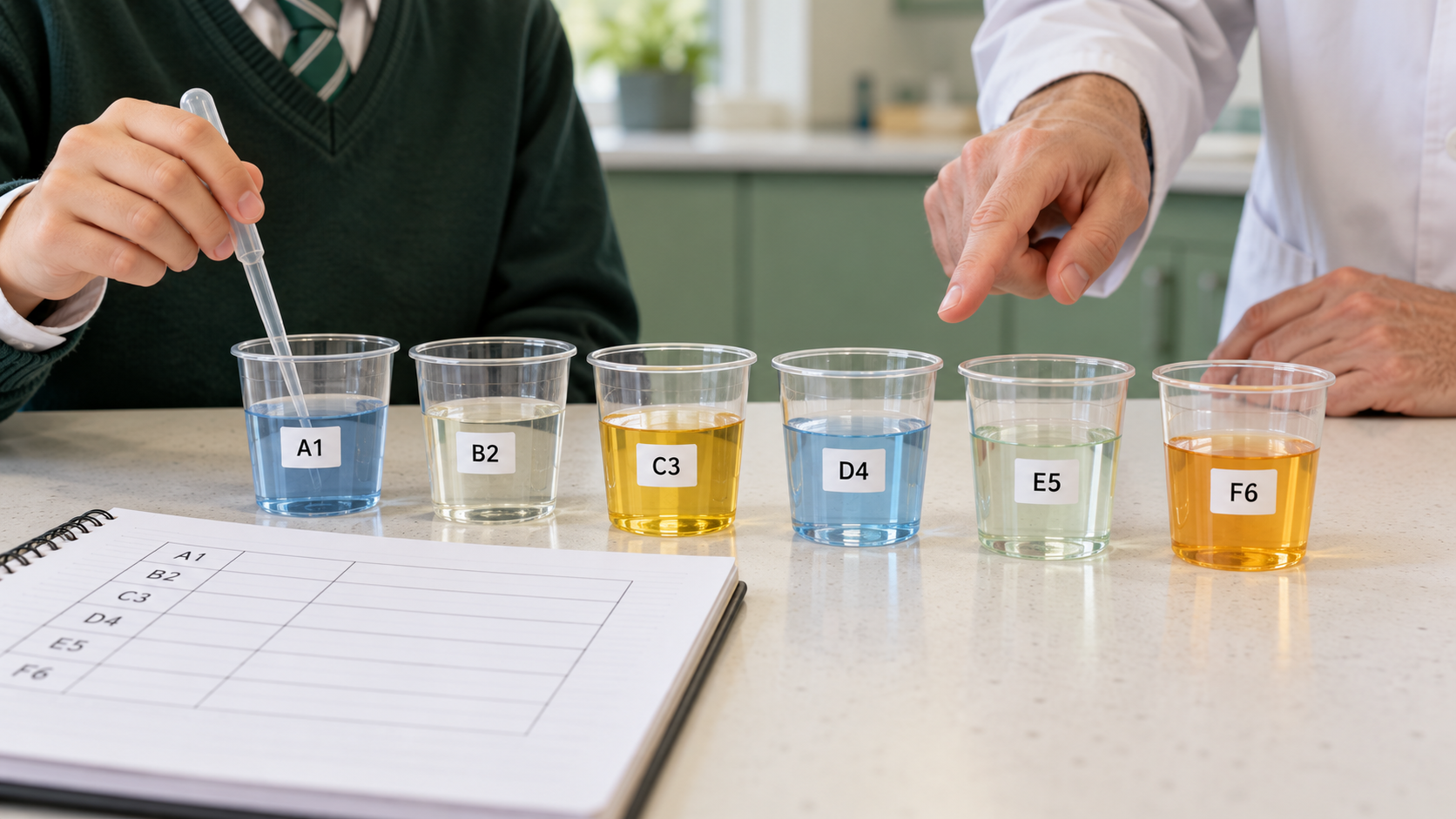
Secondary 1 Science small-group tuition in Punggol can help a student make the move from remembering Primary Science facts to using evidence, models, measurements and precise explanations. A three-student tutorial is most useful when the tutor diagnoses an actual weakness, teaches the underlying scientific idea and checks that the student can apply it independently. It is not automatically necessary for every Secondary 1 learner, and a small class does not guarantee a particular grade.
This Punggol parent guide explains what changes in lower-secondary Science, how MOE’s G1, G2 and G3 subject levels affect teaching, what a purposeful 90-minute tutorial might involve, which benefits are realistic and which consequences families should consider before committing time and fees. It also offers worked examples and a practical way to decide whether school support, home practice or tuition is the next sensible step.
- Best reason for tuition: a specific, recurring difficulty with scientific reasoning, evidence, models, experiments or written explanations.
- Three-pax advantage: the tutor can hear each student’s thinking and respond without losing the benefits of peer discussion.
- Most important limitation: extra attendance cannot replace independent recall, rest, curiosity and practice.
- First parent action: bring two marked Science questions, the current school unit and subject level; request a diagnosis before choosing a programme.
- Local context: Punggol families should consider actual journey and CCA load, not only a centre’s postcode or an attractive schedule.
Why Secondary 1 Science can surprise a capable Primary 6 learner
A child may leave Primary 6 knowing what condensation is, how roots absorb water and how simple electrical circuits behave. Then Secondary 1 begins, and the same child hesitates over a question that asks what the evidence supports. The problem is not necessarily a sudden loss of knowledge. The intellectual task has shifted. Students encounter a wider range of models, need to design fair comparisons and must connect observations to explanations rather than reproduce familiar textbook phrases. A learner who enjoyed Science in Primary school can still require a deliberate bridge.
Consider the difference between recalling that a material dissolves and explaining why a proposed separation method cannot recover a dissolved substance by filtration. One task asks for a stored fact. The other asks the student to select the relevant property, understand what the method can and cannot separate, and defend a conclusion. Many students can supply the keyword filter without first checking whether an undissolved solid is present. Tuition should expose this first incorrect decision, not merely mark the sentence wrong.
Parents can look for three signals. First, the child memorises notes but cannot explain an unfamiliar situation. Second, answers contain accurate nouns but weak links such as “because of energy” or “due to particles.” Third, the child can follow a tutor’s demonstration but cannot independently decide which idea belongs in the next question. These are teachable problems. Their remedy is not automatically a thicker worksheet book.
What MOE actually expects from lower-secondary Science
Singapore’s Ministry of Education frames Science as more than a list of Biology, Chemistry and Physics facts. Its lower-secondary syllabus combines core ideas, the Practices of Science and scientific values and attitudes. For G2/G3, the broad themes are scientific endeavour, diversity, models, interactions and systems. The G1 programme has its own syllabus and its own emphasis. A tutor should therefore check the student’s actual subject level and school scheme of work before selecting material.
The MOE framework asks learners to investigate the world, interpret evidence, communicate ideas and consider how Science relates to society and the environment. That requires clear explanation, not simply fast recall. A Secondary 1 child does not sit the Singapore-Cambridge Secondary Education Certificate in that year; the SEC begins in 2027 for graduating cohorts. Lower-secondary tutorials should build readiness for later study without presenting upper-secondary examination specifications as if they were the Secondary 1 school paper.
Schools can organise units and assessments differently. A Punggol student might be studying matter while a friend in another school is revising cells or experimental skills. A tuition centre that promises the same fixed chapter each week to every Secondary 1 child may miss both students’ immediate needs. Good planning begins with the school’s topic sequence, recent work and the exact errors that show up when a child is alone with the question.
Official reading: MOE G2/G3 Lower Secondary Science syllabus, MOE G1 Lower Secondary Science syllabus and SEAB information about the SEC.
Three students, three misunderstandings: why class size can matter
Imagine three pupils looking at a line graph of temperature against time. One reads the vertical scale incorrectly; the second reads it correctly but assumes every flat section means “no heat is supplied”; the third understands the graph yet gives an answer with no reference to the data. All three may score badly, but their learning problems are completely different. In a larger class, it can be difficult to investigate every wrong step. A well-run group of three makes the errors easier to hear and discuss.
The tutor can ask each learner to describe the graph before explaining it. The first practises scales and units. The second distinguishes what is observed from what can safely be inferred and learns what additional information is required. The third builds an answer using a measured observation, a scientific principle and a conclusion. When the group then discusses the difference between their answers, peers become useful sources of contrasting reasoning rather than merely companions completing the same page.
Three pupils are not automatically better than one or eight. The benefit depends on competent teaching, suitable level grouping, enough individual attempts, behavioural climate and the tutor’s capacity to adapt. A teacher who lectures for an hour and gives every learner the same correction key has not used the small-group advantage. Parents should ask what every child actually does during the session, how the tutor distinguishes misconceptions, and how independent progress is checked.
Punggol as a place to observe—without turning observation into proof
Punggol Waterway, neighbourhood parks and ordinary HDB surroundings provide familiar prompts for scientific thinking. A student might notice that one surface dries sooner than another after rain, or that shadows differ along a walkway. The place can make the question memorable; it does not, by itself, establish the explanation. A photograph of two wet surfaces cannot tell us which single factor caused their different appearances. Surface material, exposure to sunlight, airflow, timing and initial water quantity may all differ.
This distinction is a useful introduction to controlled variables. Suppose a child claims, “The pavement dries faster because it is warmer.” The tutor can accept that this is a hypothesis while asking for measurements, conditions and another plausible explanation. Which variable could we change? What should be held constant? What readings would support the claim? Could the observation be an effect of shade rather than material? The child learns to treat a real-world idea as a question to investigate, not a sentence to memorise.
No outdoor class or excursion is implied here. These are illustrative learning contexts families may recognise on a normal journey. The educational value is the movement from curiosity to testable reasoning. A child who can do this with a walkway may later do it with data from a textbook experiment on evaporation or heat transfer, provided the tutor explicitly bridges the two situations and checks transfer on a new task.
Worked example 1: a muddy-water problem and the limits of filtration
Present a mixture of water and visibly suspended sand. Ask how the solid can be separated from the liquid. A sensible response is filtration, because an appropriate filter retains the undissolved solid while much of the liquid passes through. Ask the child what would happen if the solid were actually a dissolved substance. The same word, “solid,” no longer licenses the same method. The physical state and whether the material is dissolved matter more than how the mixture was first described.
The second question is where understanding shows itself: “A clear salt solution is poured through ordinary filter paper. Will the salt be removed?” The correct conclusion is no. The salt is dissolved; ordinary filtration does not recover the dissolved salt from the liquid. A student who replies yes may be confusing “solid before mixing” with “undissolved solid in the mixture.” The tutor can use a particle-level representation to explain why those situations are different, without pretending the drawing is a literal photograph of the particles.
Next change the problem: “How could the salt be recovered from the solution?” Evaporation or crystallisation may be suitable, depending on the aim and conditions. Then ask a transfer question about a mixture containing both sand and dissolved salt. Students must reason about the sequence of methods rather than rely on a memorised single-action answer. At Secondary 1, the target is not a laboratory recipe copied from a guide; it is correct identification of the material properties and limitations of each method.
Worked example 2: fair testing with evaporation
Two dishes contain equal amounts of water. One is placed under moving air; the other is in still air. If the goal is to investigate the effect of air movement on evaporation, the volume and exposed surface area of the water should be controlled as far as practicable. The temperature and surrounding conditions should be monitored. The amount of water remaining is measured over the same period. The child should first state the independent variable, then the dependent measurement, then relevant controlled variables.
Now introduce an intentionally flawed setup: one dish is shallow and wide, the other deep and narrow. If the shallow dish loses more water, we cannot cleanly assign the difference to airflow because exposed surface area also changed. This is the moment to diagnose whether the learner understands fair test as a principle or only repeats the phrase “keep all other things the same.” A good answer identifies which condition is confounded and proposes a better comparison.
Three-pax discussion is helpful here because each pupil can challenge a different assumption. One checks whether the dishes are comparable, another checks whether equal starting volumes were used, and the third explains what the measurements would establish. Rotate these roles. Never let the most articulate learner become the permanent answer-provider for the group.
Worked example 3: a graph must answer a question, not decorate a page
Suppose a student measures the temperature of water at several time points. Before drawing anything, ask what the graph is meant to show. If the horizontal axis represents time and the vertical axis temperature, labels and units must be correct, the scale must be sensible and the values must be plotted accurately. An apparently beautiful graph can still be scientifically useless when its axes are reversed or its data points are invented to create a smooth line.
Ask the child to write two sentences. The first describes a specific pattern visible in the recorded data. The second gives a scientifically defensible interpretation, marked clearly as an interpretation rather than a direct observation. This teaches restraint. A graph might support “temperature rose over the recorded interval”; it does not automatically prove which source supplied the energy unless the experiment’s conditions tell us more. Science rewards careful boundaries around claims.
During tuition, the tutor can deliberately insert a changed scale or one unusual reading. Does the student check the axis? Do they erase inconvenient evidence, or report it and consider possible measurement error? These decisions are more revealing than whether the pupil can imitate one worked graph from a textbook.
Worked example 4: cells are models, not decorative labels
A familiar cell diagram may have large coloured organelles with neatly separated shapes. Such drawings help pupils learn relationships, but they simplify reality. Ask a student why a cell model is useful, what it can represent and what it leaves out. A model may show the relative presence and role of structures without giving true scale, texture or movement. This question prevents students from treating a labelled drawing as a complete account of what happens inside living things.
When comparing plant and animal cells, the child should connect features to functions rather than recite a detached checklist. For example, a cell wall contributes structural support in plant cells; a cell membrane regulates movement of substances across its boundary. If the child says “the cell wall controls everything entering the cell,” the tutor can return to the distinction between support and selective transport. The correction is conceptual, not merely a red mark beside one word.
A useful independent transfer is to give an unfamiliar simplified cell image and ask which features are visible, which cannot be determined and what additional evidence might help. This rewards precise observation. A student should be free to say “the image does not show enough information” when that is the scientifically responsible answer.
Scientific vocabulary: use words to sharpen thought
Secondary Science introduces terms whose everyday meaning is narrower or different in a scientific setting. Mass is not simply interchangeable with weight. Evidence is not the same as opinion. A variable is not merely a “thing that changes”; its role depends on the investigation. A model is not always a miniature physical object. Students can appear fluent because they recognise a word on a worksheet while remaining unable to use it accurately in a novel explanation.
A practical method is to build a small word bank around one concept at a time. For a fair test, the bank might include independent variable, dependent variable, controlled variable, reliability, repeat, measure and conclusion. For each word, ask the student to give a definition in ordinary language, point to a correct example, identify a near miss and use the term in a sentence about real data. Correct scientific language should reduce ambiguity, not add decorative complexity.
Parents can help by asking their child to explain one new term without notes, then explain it again through an example the next day. A memorised sentence copied from a textbook is not enough. The learner needs to recognise when the concept applies and when it does not. The measure of vocabulary mastery is whether it improves the accuracy of reasoning.
How an effective 90-minute three-pax tutorial may work
Lesson time is scarce. A purposeful model might begin with ten minutes of retrieval from earlier topics, followed by a short diagnostic question that exposes the day’s first stumbling block. The tutor then gives a focused explanation and a concrete or diagram-based example. Guided attempts follow, with each student required to explain a different decision. Once the idea is understood, help is reduced and pupils attempt a new question individually. The session ends with an error note and a small amount of targeted continuation practice.
The order matters more than a rigid clock. If the group cannot distinguish an observation from an inference, adding ten mixed questions will probably produce ten repetitions of the same confusion. If two pupils are already secure, they need a changed scenario while the third receives a brief foundational repair. The tutor must plan for both individual and shared attention. Three learners should never mean three identical worksheets and three silent heads.
A parent should be able to ask what changed by the end of a lesson. A meaningful response might be, “Your child can now separate a recorded observation from a proposed explanation and did so correctly on an unfamiliar problem without prompting.” That is more useful than a vague claim that the pupil was “good today.” Results are assessed over time, and one confident lesson is not proof of stable mastery.
A twelve-week learning progression that makes improvement visible
In weeks one and two, prioritise diagnosis, school alignment and one or two high-impact errors. A student who routinely misses the units of measurement may need a different plan from one who cannot build a causal explanation. During weeks three and four, consolidate the repaired concept with varied examples. Use a retrieval question several days after teaching, because immediate repetition can create a false impression of fluency.
Weeks five and six can bring in mixed practice: interpreting a graph after a lesson on matter, explaining a cell diagram after an experimental-variables exercise. This demands selection, not just repetition. By weeks seven and eight, invite short independent answers with fewer prompts and more precise vocabulary. Weeks nine and ten should introduce unfamiliar formats and ask students to justify why a familiar idea applies. Weeks eleven and twelve can review the pattern of errors, compare baseline and current work and decide whether the next phase should focus on repair, consistency or extension.
These weeks describe an illustrative planning framework, not a guaranteed syllabus schedule or a published eduKate class package. Schools vary, the child’s readiness varies and the next weighted assessment may change the immediate priorities. A good programme is responsive. The constant feature is visible evidence of increasingly independent explanation and better decisions.
Repair, stabilise or extend: three genuinely different student routes
Repair: A student cannot identify what a fair test controls, misreads axes and regularly substitutes vague phrases for a scientific mechanism. Start with one stable idea, one clear worked example and an independent question. Do not begin with a full mock examination simply because the student is in Secondary school. Correct the conceptual floor first and return to current schoolwork before the gap grows.
Stabilise: Another child understands the lesson but produces uneven answers when several ideas appear together. Focus on retrieval after a delay, mixed-topic recognition and editing weak explanations. The child should practise selecting the right idea without the worksheet heading telling them what to use. Results often become more dependable when the learner learns to notice which reasoning step is missing.
Extend: A third student scores comfortably but rarely explains the limits of an experiment or compares alternative interpretations. Add richer questions about model limitations, reliability, outliers, trade-offs and scientific uncertainty. Extension is not racing into upper-secondary content for its own sake. It is learning to ask better questions and defend a conclusion with appropriate evidence.
Realistic benefits of a small Science group
First, the teacher can inspect reasoning at the moment an error occurs. Second, every learner can be asked to explain, observe and challenge claims. Third, feedback can be specific: “You described the result but did not explain the cause” is actionable. Fourth, a peer’s alternative answer may make a hidden assumption visible. Fifth, the tutor can adjust the difficulty when basic understanding is secure rather than keep everyone on the same page.
These benefits may be especially useful to a pupil who is quiet in a large class but willing to speak in a calmer setting, provided the tutor makes participation safe and does not turn discussion into a constant competition. Small group learning can support scientific communication because the student must say what is known, what is inferred and why a particular principle is relevant.
Benefits should be judged by changes in the child’s independent work, not the number of handouts carried home. If a learner becomes more confident, asks better questions, identifies uncertainty and writes clearer scientific explanations without a model answer nearby, something important is improving. Better marks can follow, but an honest tutor will not promise an AL, A1 or SEC outcome from class size alone.
Consequences, costs and reasons tuition may be a poor fit
A small group still consumes time, money, attention and recovery capacity. A Secondary 1 student with a long day, CCA, homework and travel may have too little energy left to consolidate the lesson. Another may rely on the tutor so heavily that independent problem solving weakens. A third may feel embarrassed speaking in front of peers if the environment is not well managed. Those are meaningful consequences, not minor footnotes in a sales page.
Group mismatch is another risk. If pupils are following different subject levels and receive identical teaching, a child may be lost or unchallenged. Likewise, a tutor who emphasises answer templates without conceptual accuracy may improve short-term familiarity while leaving the learner unable to respond when the question changes. Parents should request evidence of level matching, diagnostics and eventual independence, not just the promise of a premium three-seat room.
No tuition is often the right choice when school lessons are understood, homework is manageable, marked errors are corrected independently and the child has healthy time for sleep and interests. School consultation, a targeted teacher question, a lighter home review or one-off help may be enough. A responsible decision treats the student’s whole week as part of learning, rather than treating every available evening as an opportunity for another lesson.
How Punggol parents can evaluate the travel and timing decision
For Punggol families, a local learning arrangement can reduce some journey pressure, but proximity is not the only variable. The student’s school dismissal time, CCA, home routine, meals, available study space and lesson start time all matter. A close class at the end of an exhausting day may work less well than a slightly later or less frequent session attended with energy. Families should compare the true door-to-door burden and the quality of teaching, not guess from an address alone.
eduKate conducts tuition lessons in Punggol and lists a contact location at 83 Punggol Central, Singapore 828761, with appointments arranged in advance. A specific Secondary 1 Science three-pax seat, Science tutor or chosen session still requires direct confirmation. Ask directly about the exact subject level, teacher, schedule, fee and group composition before travelling or committing. It is better to receive an honest answer about fit than to enrol in the wrong programme because a location sounds convenient.
For the wider estate and subject context, read Secondary 1 Science Tuition Punggol: Evidence, Models & Scientific Thinking and Secondary 1 Tuition Punggol: English, Mathematics & Science. They cover related questions; this page focuses specifically on the benefits, downsides and decision criteria for three-student Science tutorials.
Five questions to ask before paying for any class
- What did you find when you inspected my child’s marked work, and which recurring difficulty will you address first?
- How will you align lessons to the school’s current Secondary 1 Science subject level and unit sequence?
- What does each of the three students do individually during a normal lesson?
- How will you prove that an explanation can be reproduced days later without the tutor’s prompts?
- What would make you recommend reducing, changing or stopping tuition rather than continuing indefinitely?
Useful answers name the evidence, the teaching change and the independent test. Vague answers rely on adjectives. “Personalised”, “interactive” and “premium” mean little until the tutor can show how a particular misconception is noticed and corrected. An educator should also be comfortable saying when the school teacher, a different subject specialist or additional rest would better solve the family’s problem.
What parents can do at home without becoming the Science tutor
Choose one short question that the child has already encountered. Ask what the question wants to find out. Let the learner write an independent answer; do not feed the first sentence. Then ask what observation, fact or measurement supports the claim. If the child has a wrong idea, identify the first assumption that may be incorrect. The parent need not immediately supply the scientific solution; sometimes writing down the question for the school teacher is the best next step.
Use a two-minute explanation challenge after a delay. A child might explain why a dissolved substance cannot be separated by ordinary filtration, or why a fair comparison should hold relevant conditions constant. Ask for a fresh example and a counterexample. This reveals whether the pupil has learned the idea or just remembered a worked answer. End the exercise while it is still manageable; daily interrogation can make Science feel like a test rather than a way to understand the world.
Families can maintain a simple progress record: the date, the question type, what the learner initially wrote, the correction and a later independent attempt. Compare patterns rather than obsess over individual scores. A note such as “now names the independent and dependent variables in new experiments” gives much clearer guidance than “must work harder.” The purpose of the record is to make teaching decisions better, not to create a permanent catalogue of a child’s mistakes.
Frequently asked questions from Punggol families
Does every Secondary 1 pupil need tuition?
No. A child who learns well in school, reviews errors independently and remains curious may need no additional class. Start from evidence of a learning gap, not fear that classmates may have signed up. If the issue is narrow, targeted practice or one question to a school teacher may resolve it.
Is Secondary 1 Science the same as upper-secondary Biology, Chemistry and Physics?
No. Lower-secondary Science builds ideas and practices that later support the disciplines. Schools may sequence themes differently, and students take the subject at an appropriate G1, G2 or G3 level. Do not infer a Secondary 1 examination paper from an upper-secondary SEC specification.
Should a child memorise definitions?
Precise definitions matter, but they are only one part of learning. The child must identify situations where the term applies, interpret evidence and produce explanations. A definition recalled fluently but used in the wrong context can still cost marks.
Why might a three-pax group be better than one-to-one tuition?
Peer comparison can reveal other approaches, give opportunities to justify claims and make discussion feel less like an oral examination. One-to-one teaching may be better when a pupil needs intensive support or cannot yet participate comfortably. Quality and fit are more important than the label.
What if the other two pupils are ahead?
The tutor should maintain an individual entry point and stretch task for each student. If a child consistently cannot follow the shared lesson, the group may not be appropriate. Ask how the tutor detects and handles that mismatch before committing.
Can my child improve before the next weighted assessment?
A focused misconception may be corrected quickly, but durable transfer is more demanding. Grade changes depend on the question mix, earlier gaps, revision and assessment timing. Look for independently correct explanations and reduced error patterns first.
How much home Science practice is enough?
There is no universal number of pages. A short independent reconstruction, a few well-chosen problems and delayed retrieval may be more useful than a long copying exercise. Coordinate with school demands and protect adequate sleep and recovery time.
How do we know whether the tuition is working?
Compare similar question types attempted without hints at different points in time. Notice clarity, correct variables, scientific vocabulary, accurate graph reading and ability to explain an unfamiliar example. Do not equate a full worksheet with meaningful progress.
Can three students from different schools learn together?
Sometimes, if the tutor can align core concepts while respecting different school sequences and subject levels. Different schools may be an advantage for comparing approaches, or a source of harmful mismatch. Ask how the teaching plan separates shared reasoning from each child’s immediate syllabus needs.
What should we bring to the first conversation?
Bring recent marked Science work, the subject level, current units, teacher comments, the school timetable and one question the student genuinely cannot explain. Do not bring only the aggregate test score. A learning diagnosis needs to see how the student thinks.
The useful next step
If your Punggol child is struggling to move from Science facts to scientific thinking, begin with a specific example and ask an educator to locate the first uncertain step. If the child is progressing comfortably, preserve what already works. The strongest small-group tuition does not make students dependent on a tutor: it helps them learn to ask clearer questions, check evidence, explain their reasoning and do more of the next problem on their own.
Enquiries and programme fit: contact eduKate Singapore. Teaching-structure reference: Secondary 1 Mathematics Tutor Clementi | Small Groups Tutorials. MOE and SEAB are the governing sources for curriculum and examination details; eduKate’s teaching explanations are independent guidance.