
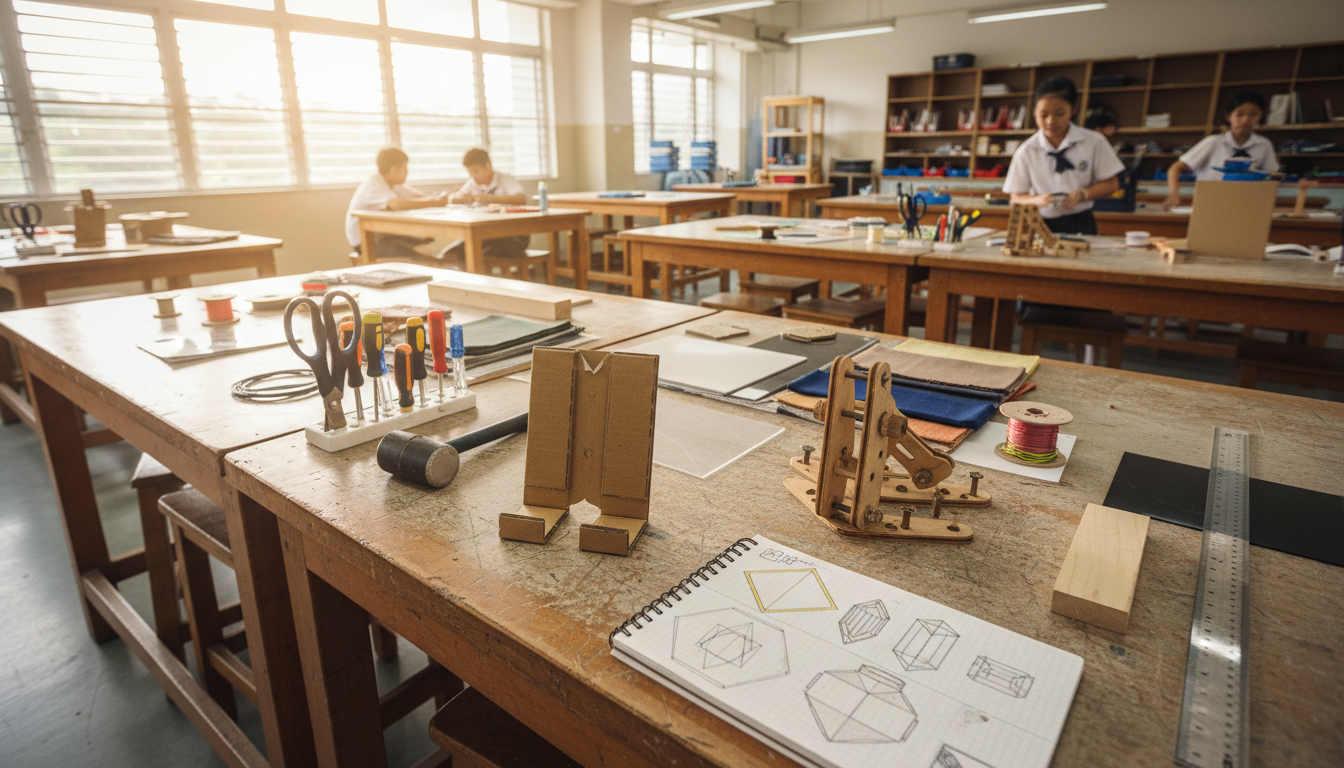
In Secondary 1, Design and Technology is a Full SBB common-curriculum subject, not a separate G2-graded class simply because your child entered through Posting Group 2. Students with different subject levels can learn design together. If your child enjoys ideas but struggles with sketches, a design journal or a working model, help them define the user problem and test a simple mock-up before demanding a polished finished object.
MOE’s lower-secondary D&T syllabus develops needs analysis, design briefs, idea generation, sketching, mock-ups, safe making and evaluation. SEAB lists Design and Technology K234 for the separate 2027 graduating G2 SEC examination, which is relevant only if a student later offers that subject and is registered for that examination. It is not a compulsory Secondary 1 SEC D&T paper; school assessment and workshop safety instructions govern the first-year course.
- Read the timetable correctly: lower-secondary D&T belongs to the common curriculum under Full SBB.
- Do not infer that a G2 SEC K234 examination is compulsory because the child is in PG2.
- Start each project with the real user, problem and practical constraints, not a favourite gadget.
- Use quick, inexpensive, safe mock-ups before building any full prototype.
- Make the design journal show actual thinking, decisions, test findings and revisions.
- Leave cutting tools, adhesives, heat, electronics and machinery to school-approved supervised procedures.
- Judge improvement by clear problem-solving and safe iteration rather than by how expensive or polished the prototype looks.
First check the two different documents parents often confuse
The school timetable and current MOE lower-secondary teaching plan tell a parent what the pupil is learning now. By contrast, the SEAB 2027 SEC G2 index gives an examination entry for a graduating cohort, including K234 for Design and Technology. A Secondary 1 pupil is not sitting a national SEC examination in their first year. A school may introduce ideas that later support an SEC subject, but that does not turn today’s homework into a national paper.
An important exception is Design and Technology itself: at lower secondary it is a common-curriculum subject, usually shared in mixed form classes. The G2 designation in this article describes the family’s Posting Group or future G2 pathway; it does not label the lower-secondary workshop as a separate G2-only class. Confirm how the school schedules D&T, its practical work, safety rules and assessment.
The 2027 subject list is useful for understanding how a subject may eventually be assessed, but a 2027 Secondary 1 entrant would usually graduate in a later examination year. Parents must verify the correct examination-year syllabus when that time comes. Do not purchase a full upper-secondary paper set as a substitute for the child’s immediate school materials.
What the MOE curriculum actually teaches
The publicly available MOE lower-secondary Design and Technology syllabus was written with pre-Full SBB course labels and implemented from the 2017 Secondary 1 cohort. Its central design approach remains valuable: identify a real need, generate and develop ideas through sketching, test with quick mock-ups and make a prototype with safe, appropriate processes. Under Full SBB, schools teach D&T among common-curriculum subjects at lower secondary. The eventual 2027 G2 K234 examination is a different stage and should not be confused with an S1 school project’s marking scheme.
- Need: a problem an actual user experiences, not merely a product the student wants to build.
- Design brief: a short description of the problem, user and intended purpose.
- Design specification: useful criteria such as size, stability, accessibility, materials and safety.
- Ideation: producing several plausible directions before committing to the first sketch.
- Mock-up: a quick test model used to expose flaws cheaply and safely.
- Prototype and evaluation: a more developed version tested against the original need and revised using observations.
A syllabus tells the destination and the capabilities expected. It does not replace a school’s topic order, approved text or workshop instructions. If a family gets anxious about a national document, ask the teacher for the next two chapters, the marking criteria and a typical answer or project sample at the level currently taught.
The real Secondary 1 transition, before any examination result
A child who has just entered secondary school is adjusting to several different teachers, a new timetable, CCAs, homework from multiple subjects, greater independence and peers with diverse interests. One low mark may reflect unfamiliar task demands rather than lack of effort. The most useful intervention begins with the first specific error the student can explain.
For Design and Technology, parents should observe three samples: a school task before correction, the child’s explanation of the teacher’s feedback and an unfamiliar short reattempt. If the final product looks good only after adult prompting, the learner may not yet have independent control. If the child can explain the reasoning but writes too little or misreads a task, a different support strategy may be appropriate.
Avoid turning a first-year setback into predictions about JC, polytechnic, ITE or an entire future SEC result. Later pathways depend on a combination of subject levels, results and current admissions policy. Today the priority is learning skill and confidence: accurate reasoning, constructive self-correction and sustainable school engagement.
Eight common difficulties in Secondary 1 Design and Technology: symptoms and the right intervention
The examples below are possible learning patterns, not a diagnosis of every learner. Start with the current school task and select the one that most closely matches your child’s independent work. Do not use all eight as a checklist of weaknesses.
1. The student starts with a product, not a user problem
What this looks like: A pupil says ‘I want to build a fancy phone stand’ but cannot explain whose problem it solves.
Check the understanding: Ask which person would use the stand, where, with what device and what inconvenience they encounter. Wait for the explanation rather than immediately telling the student which word, diagram or operation is correct.
Repair the thinking: Write a concise user statement and two measurable requirements before drawing. Avoid arbitrary decorations at this stage. Choose a short, age-appropriate exercise from the present school unit rather than a complicated graduating-level examination item.
What improvement should look like: The child can explain why a particular feature follows from a user need. Ask the subject teacher: What does the school’s design brief require students to identify?
2. Sketching is treated as an art competition
What this looks like: The child refuses to draw because early sketches are untidy or not photorealistic.
Check the understanding: Ask for three thirty-second sketches that show position, movement or support rather than perfect shading. Wait for the explanation rather than immediately telling the student which word, diagram or operation is correct.
Repair the thinking: Label function, approximate dimensions, arrows and materials. Explain that a design sketch is for thinking and communication. Choose a short, age-appropriate exercise from the present school unit rather than a complicated graduating-level examination item.
What improvement should look like: The learner generates several useful alternatives and can explain differences without apologising for rough drawings. Ask the subject teacher: Which drawing and annotation conventions does the teacher expect at S1?
3. Only one idea is generated
What this looks like: The student commits to a first concept and feels every later suggestion is criticism.
Check the understanding: Give one design need, then ask for at least three distinct mechanisms or arrangements. Wait for the explanation rather than immediately telling the student which word, diagram or operation is correct.
Repair the thinking: Compare options against the same user criteria rather than selecting the most decorative option. Choose a short, age-appropriate exercise from the present school unit rather than a complicated graduating-level examination item.
What improvement should look like: The child can choose and justify an option after identifying a weakness in another. Ask the subject teacher: How much ideation and comparison is expected in the design journal?
4. Mock-ups are considered wasted time
What this looks like: The learner wants to go straight to the workshop, then discovers a dimension or balance problem too late.
Check the understanding: Use paper or cardboard to test a simple support angle without operating workshop tools. Wait for the explanation rather than immediately telling the student which word, diagram or operation is correct.
Repair the thinking: Explain that mock-ups are experiments. Record the question, what was tested, what happened and the next change. Choose a short, age-appropriate exercise from the present school unit rather than a complicated graduating-level examination item.
What improvement should look like: The child can describe how a quick test prevented an avoidable design problem. Ask the subject teacher: Are school-approved mock-up materials and time available before final making?
5. Measurements and stability are ignored
What this looks like: A stand looks attractive in a drawing but falls over under the intended load.
Check the understanding: Ask where the centre of support is and which dimension most affects tipping, using a school-approved safe model. Wait for the explanation rather than immediately telling the student which word, diagram or operation is correct.
Repair the thinking: Test one variable at a time within the school’s approved procedures. Compare dimensions to the design specification. Choose a short, age-appropriate exercise from the present school unit rather than a complicated graduating-level examination item.
What improvement should look like: The learner revises a measurable detail, explains why and can show the result. Ask the subject teacher: What measurement or testing standards apply to the current project?
6. Journal pages are retrospective decoration
What this looks like: The final journal has polished photographs but does not show how a problem was discovered and corrected.
Check the understanding: Ask the student to describe the precise difference between the first sketch and the working version. Wait for the explanation rather than immediately telling the student which word, diagram or operation is correct.
Repair the thinking: Keep dated mini-entries: decision, evidence, result, problem, next step. Use the school’s required format rather than copying a commercial portfolio. Choose a short, age-appropriate exercise from the present school unit rather than a complicated graduating-level examination item.
What improvement should look like: The teacher can follow the real design process from the child’s journal without guessing missing steps. Ask the subject teacher: What is the school’s journal rubric and which evidence is required?
7. Safety becomes secondary to finishing quickly
What this looks like: The child proposes hot glue, sharp tools or electronics at home because a deadline is close.
Check the understanding: Ask whether the school permits that material or process and who is responsible for supervision. Wait for the explanation rather than immediately telling the student which word, diagram or operation is correct.
Repair the thinking: Move hazardous making back to the supervised D&T room, use harmless paper mock-ups at home and request guidance on alternatives. Choose a short, age-appropriate exercise from the present school unit rather than a complicated graduating-level examination item.
What improvement should look like: The student understands that a safe revision is a successful design decision, not a sign of weakness. Ask the subject teacher: Which tools and materials are approved, and what work is allowed outside school?
8. Feedback is heard as failure
What this looks like: A teacher asks for changes and the child decides the project was a disaster.
Check the understanding: Ask the child to identify one test result or user comment that shows why the change could help. Wait for the explanation rather than immediately telling the student which word, diagram or operation is correct.
Repair the thinking: Frame iteration as the normal design process. Change one component, explain the trade-off and test again. Choose a short, age-appropriate exercise from the present school unit rather than a complicated graduating-level examination item.
What improvement should look like: A revised version is linked to evidence and the student can describe the improvement calmly. Ask the subject teacher: What does the school value in reflection, evaluation and prototype iterations?
Four worked examples parents can use without turning home into school
The following questions and scenarios are original teaching examples. They are not copied from the national examination or claimed to be official mark schemes. Use them to uncover reasoning, then check the school materials before choosing future practice.
Worked example 1: A prototype that tips over
Starting difficulty: A Secondary 1 student creates a cardboard phone stand. It looks tidy but falls forward with a device. The child wants to rebuild everything from scratch.
Step-by-step parent response: Ask what the prototype was designed to do and what the test showed. The issue may involve the support footprint, angle, material stiffness or load location. Make a harmless paper sketch of two alternatives, choose one measurable change and ask the teacher to approve testing.
Independent transfer: The next attempt should check the specific failure and document the result. It is useful even if the revised stand still needs work, because the reason for the change is now visible. Record what the child can explain without help; repeating a supplied sentence is not yet evidence of mastery.
Worked example 2: Three options instead of a perfect first drawing
Starting difficulty: A pupil is asked for a classroom stationery organiser but submits a beautiful single drawing with no user research.
Step-by-step parent response: First ask who uses it and which items need storing. Idea A separates pencils from notes; B uses modular containers; C hangs items near the desk edge. The options are examples, not products the student must build. Compare access, stability, space and material requirements.
Independent transfer: Can the student explain why one option suits a specific user better and what they would test next? That reasoning matters more than how polished the first sketch looks. Record what the child can explain without help; repeating a supplied sentence is not yet evidence of mastery.
Worked example 3: A design journal that tells the truth
Starting difficulty: A student writes ‘the prototype worked well’ despite a loose joint and repeated failed attempts.
Step-by-step parent response: Replace the empty claim with an observation: the support joint loosened under a light test. State the potential cause only as a hypothesis, record the proposed change and ask the school for safe testing approval.
Independent transfer: When the next version is tested, note the outcome—even if the result is mixed. Honest iteration creates evidence of thinking and helps a teacher give useful feedback. Record what the child can explain without help; repeating a supplied sentence is not yet evidence of mastery.
Worked example 4: The expensive-materials trap
Starting difficulty: A parent proposes buying advanced parts and tools so the child can make a professional-looking prototype quickly.
Step-by-step parent response: The educational goal is not to outspend classmates. Ask for the school’s allowed materials, cost expectations, assessment criteria and safety rules. Explore a low-cost mock-up first, and do not substitute an adult-built product for the child’s own learning.
Independent transfer: The child should be able to explain the brief, choices, constraints and improvements themselves. If only an adult understands the project, it no longer demonstrates the intended learning. Record what the child can explain without help; repeating a supplied sentence is not yet evidence of mastery.
A parent-friendly four-part diagnostic method
1. Name the precise failed step
Replace general statements such as ‘my child is weak in Design and Technology’ with one observable difficulty. Was the problem interpreting a term, noticing a crucial feature, connecting an observation to a claim, choosing evidence, explaining a decision or checking the final result? Write down the exact question and the child’s first attempt before providing hints.
2. Teach one underlying idea
Use the simplest appropriate example, preferably drawn from the current school chapter. Discuss what makes an answer valid and where the child began to diverge. Avoid transferring a generic template from a different subject. A child may remember a phrase yet misunderstand the logic of the task.
3. Give one fresh independent attempt
A completed correction is necessary but not sufficient. Change the context, material or wording and ask the child to work without the original model. If the same conceptual error returns, make the explanation simpler and shorter; if the next attempt succeeds, schedule a brief delayed recheck.
4. Agree on the next check with the teacher
Keep the two or three most informative work samples and ask the subject teacher whether the pattern occurs in class. Find out whether the task reflects the current expected standard, an upcoming assessment, an enrichment activity or material that should be taught later. This can prevent anxious families from teaching the wrong content.
What not to do when your child brings home a weak result
- Do not compare the result with another child’s marks without knowing which subject level and task were assessed.
- Do not buy the entire graduating SEC syllabus or a pile of examination papers to ‘catch up’ in the first term.
- Do not call a conceptual misunderstanding careless or lazy before examining a genuine attempt.
- Do not repeat an example so many times that the child only learns the answer’s surface pattern.
- Do not make after-school practice so long that sleep, friendships, CCA and school engagement deteriorate.
- Do not promise a change to G3 or a particular post-secondary route based on one improved test.
- Do not rewrite an assessed project or essay so extensively that it becomes adult work rather than the student’s learning.
A useful home routine consists of one brief recall or explanation, a targeted task, a correction and an independent transfer attempt. On a heavily loaded school day, the right intervention may be rest and a calmer conversation instead. A sustainable plan is much stronger than a dramatic but short-lived increase in worksheet hours.
What to bring to a school conversation
- A photograph or copy of one original marked Design and Technology task, together with the student’s first independent response.
- The teacher’s comments and a clear account of which part the child could or could not explain.
- One new short reattempt completed without a guide or parent’s wording.
- A brief description of when the difficulty began and what the family tried.
- A realistic idea of the time available around CCAs, travel, meals and sleep.
- One or two specific questions about the school’s expected method, available support and next review point.
Begin collaboratively: ‘We noticed that our child knows some facts but struggles to use them in a new question. Here is the original answer and an independent retry. Could you help us identify which part of the reasoning or task is most important to work on now?’ This kind of question is more actionable than ‘Why are the marks so low?’
If the child needs additional teaching, a tutor should be able to diagnose the problem, explain the current Design and Technology curriculum, use appropriate materials and check whether the child can work without the tutor. Additional instruction is an option, not an obligation, and no responsible provider can guarantee a grade or school placement.
Subject levels, confidence and what decisions to postpone
For lower-secondary D&T, the first-year priority is engaging in common-curriculum design thinking and safe project work. A family should not lobby for a ‘G3 D&T class’ in Secondary 1, because that misunderstands the status of the subject at this stage. A later upper-secondary D&T choice must follow the school’s offerings, student interest, readiness and the relevant examination-year rules.
Students also need emotional safety. If the child becomes persistently distressed by school, avoids class because of fear, or shows a marked change in sleep or mood, involve the school’s pastoral team or appropriate professional support. More worksheets cannot substitute for help with persistent anxiety. Parents can help by keeping conversations factual, kind and centred on a small next step.
The next six weeks: short practical improvement, not a crash course
The sequence below is an adaptable family routine, not a promised grade-raising programme. Use school-taught content, allow time for CCA and rest, and do not assume six weeks should cover the full two-year curriculum.
Week 1: Identify the design brief
Read the actual school’s project instructions. Write down user, need, criteria, deadlines, permitted materials and safety constraints.
Week 2: Observe and ask questions
Use safe conversations and non-intrusive observation to understand how a user works. Record findings briefly rather than inventing survey results.
Week 3: Sketch several possibilities
Try three rough sketches, annotate their functions and compare them against the same specifications. Preserve the alternatives in the journal.
Week 4: Make safe mock-ups
Use low-risk paper or cardboard models where permitted. Test a single idea, record the outcome and ask permission before moving to workshop fabrication.
Week 5: Review and refine
Link one test failure to a design revision. Ask whether the change improves usability, stability, safety or another documented criterion.
Week 6: Explain the process
Prepare a short account of original need, options tested, evidence, final choice and limitations. The child—not the parent—should be able to explain the decisions.
A short weekly tracking sheet
- The school topic and exact skill being developed
- One representative error and the underlying misunderstanding
- What explanation or model was used to repair it
- The child’s new answer without prompts
- Whether the same idea works with a different case several days later
- Any question to take to the teacher or school support team
Use the sheet to make learning visible without assigning marks every evening. When a small improvement appears, acknowledge the reasoning and checking that made it possible. When progress is uneven, use the evidence to adjust the plan rather than increasing criticism.
Frequently asked questions from parents
1. Is D&T a G2 subject at Secondary 1?
No. Under Full SBB, lower-secondary Design and Technology is part of common curriculum taken in mixed form classes. ‘G2 D&T’ describes a possible later SEC examination subject, not the first-year class level.
2. What is SEAB K234 then?
K234 is the Design and Technology subject code for the 2027 G2 SEC graduating examination. It applies when offered and registered at that later stage; schools vary in available subject combinations.
3. Must my child buy tools to build projects at home?
No general rule requires that. Use the school’s materials list and instructions; workshop and potentially hazardous work belongs under appropriate supervision.
4. Does a beautifully finished product guarantee good marks?
No. Design education values understanding users, problem-solving, documented decisions, testing, safe practice and evaluation. Follow the school’s actual assessment rubric.
5. What if my child cannot draw well?
A functional, labelled sketch communicates a design idea. Help the child show how parts relate, rather than treating early design sketches as fine-art drawings.
6. Should I correct or rebuild the prototype myself?
Support questions, planning and safe discussion. Do not submit adult-made work as the child’s. Teachers need to see the student’s own decisions and learning.
7. How should the design journal be organised?
Use the teacher’s required format. As a practical principle, capture dates, purpose, sketches, trials, feedback, changes and evaluation rather than a last-minute decorative narrative.
8. What if materials are expensive?
Ask the teacher for approved alternatives and school provisions. A well-reasoned simple model is a better teaching tool than unnecessary purchases.
9. Can D&T become an upper-secondary G2 SEC subject?
The 2027 G2 directory includes K234, but subject availability and individual eligibility depend on the school and year. Ask during the school’s actual subject-choice briefing.
10. What evidence shows genuine design learning?
The student can explain the user need, compare alternatives, justify a test, describe an error and make a safe evidence-based revision without an adult doing the work.
Official documents and further parent guides
Sources checked on 24 November 2026. The 2027 SEAB listing is referenced only as the published 2027 graduating examination directory. Consult the school’s current teaching notes for a Secondary 1 lesson, and the correct later examination-year SEAB document when your child approaches graduation.
MOE — Design and Technology teaching syllabus
SEAB — 2027 G2 SEC school-candidate syllabus directory
SEAB — Singapore-Cambridge Secondary Education Certificate overview
MOE-school Full SBB explanation and Humanities level options
eduKateSG — What the G2 syllabus means for Secondary 1 and 2
Design and Technology or Nutrition and Food Science: school subject choice
Full SBB G2 learning in Secondary 1 and 2
A sensible next step for your family
This week, begin with the child’s actual Design and Technology task. Ask them to show what they understood before correction, identify the first unsupported assumption or missing explanation, and try a fresh short example. Bring the pattern to the teacher if it persists. A capable student is not one who never makes an error, but one who gradually learns to notice, explain and repair it.
eduKateSG’s small-group teaching philosophy is to identify the precise missing idea before increasing speed or difficulty. Families should expect honest explanations, individual attention and suitable practice—not guarantees about future grades or subject-level placement.
Contact eduKate Singapore for a parent–student consultation
Properly taught kids shine a bright light into the future.