
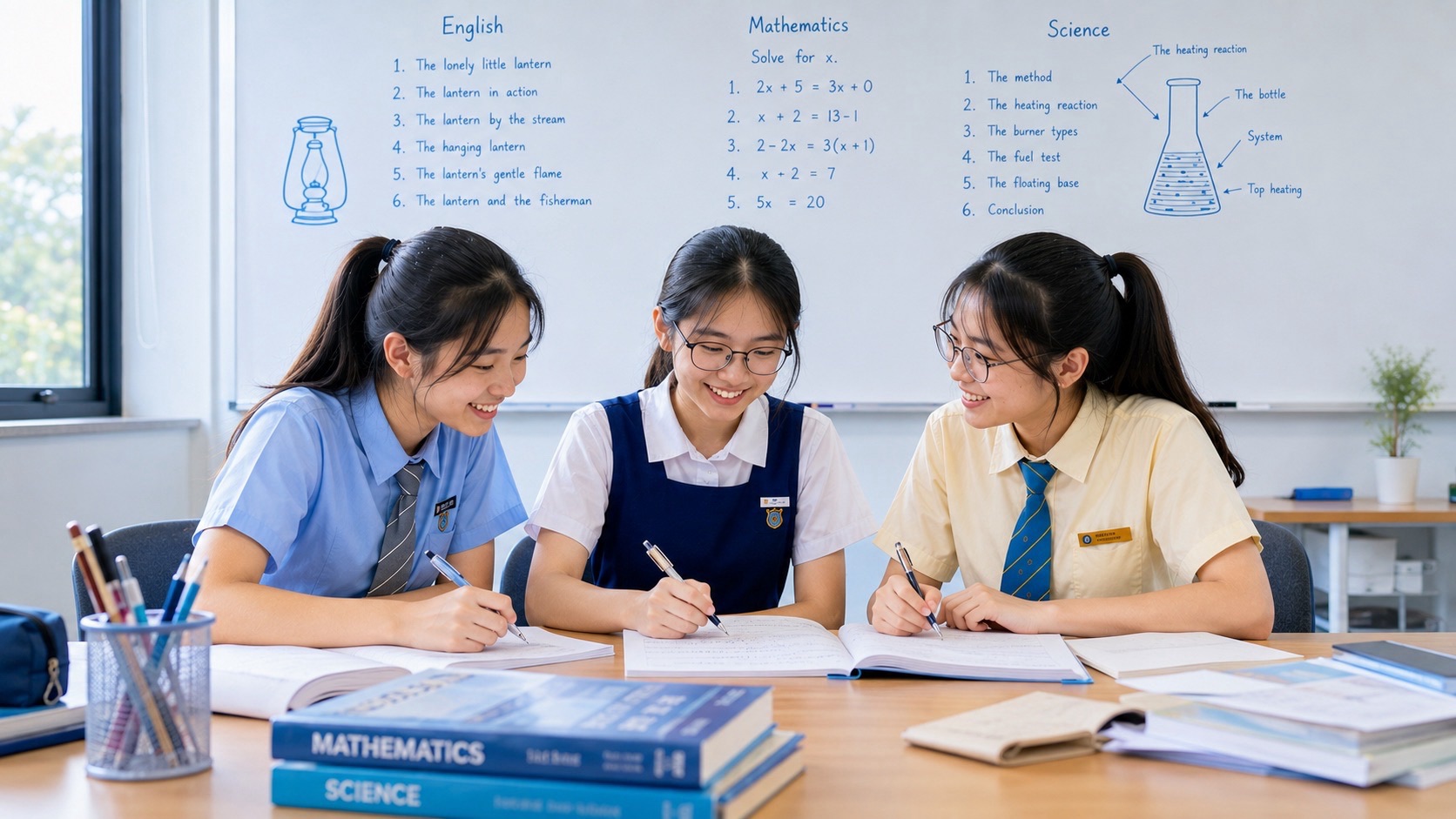
Secondary 2 Chinese small-group tuition for Lavender families can help when a child needs closer feedback and repeated opportunities to explain answers. The format works best when all three pupils can share meaningful tasks and each receives individual correction. It is not automatically better than school support or one-to-one tuition, and it cannot guarantee a particular examination grade.
This guide focuses on comprehension evidence and answer precision. Parents should bring the student’s actual school Chinese course, recent feedback and an independent sample before selecting a class. The estate name identifies the intended audience, not confirmation that a Secondary 2 Chinese tutorial currently operates at a particular Lavender address. Verify the subject, venue, teacher and vacancies directly.
- Benefits: individual participation, feedback and peer discussion.
- Risks: mismatched levels, excessive copying, fatigue and costs.
- Start with: the exact school subject and an independent diagnosis.
- Teach through: attempt, explanation, correction and transfer.
- Measure: fresh independent work after several weeks.
- Verify: actual programme availability and venue.
Lavender: comprehension evidence and answer precision
Locate the question’s demand
Students must distinguish a question asking for an event from one asking for a cause or inference. Begin by underlining the task word and explaining what a sufficient answer would contain.
In a three-pupil tutorial, each learner should first attempt an appropriately pitched task before hearing classmates’ answers. The tutor can then compare approaches, explain the relevant principle and ask for another attempt on changed material. This prevents a polished group response from hiding individual uncertainty. If the child cannot access the task, the instructor should rebuild a prerequisite or consider another group; if it is too easy, the learner should receive a deeper challenge rather than more copying.
Parents in Lavender can ask what this skill looks like in the student’s current school work, what the tutor will correct and how progress will be tested. A useful report identifies the original error and demonstrates a fresh independent response. The family’s decision should also consider the time required for travel, homework and rest. An effective class builds a habit the child can use outside tuition rather than creating dependence on the teacher’s exact wording.
Trace cause and consequence
A fictional delay caused by heavy rain can teach the chain from weather to transport disruption to arrival. Ask the child to explain the relationship rather than copy one keyword.
In a three-pupil tutorial, each learner should first attempt an appropriately pitched task before hearing classmates’ answers. The tutor can then compare approaches, explain the relevant principle and ask for another attempt on changed material. This prevents a polished group response from hiding individual uncertainty. If the child cannot access the task, the instructor should rebuild a prerequisite or consider another group; if it is too easy, the learner should receive a deeper challenge rather than more copying.
Parents in Lavender can ask what this skill looks like in the student’s current school work, what the tutor will correct and how progress will be tested. A useful report identifies the original error and demonstrates a fresh independent response. The family’s decision should also consider the time required for travel, homework and rest. An effective class builds a habit the child can use outside tuition rather than creating dependence on the teacher’s exact wording.
Separate observation from inference
A silent character may be embarrassed or angry; the passage determines which conclusion is supported. Require evidence and avoid inventing motives.
In a three-pupil tutorial, each learner should first attempt an appropriately pitched task before hearing classmates’ answers. The tutor can then compare approaches, explain the relevant principle and ask for another attempt on changed material. This prevents a polished group response from hiding individual uncertainty. If the child cannot access the task, the instructor should rebuild a prerequisite or consider another group; if it is too easy, the learner should receive a deeper challenge rather than more copying.
Parents in Lavender can ask what this skill looks like in the student’s current school work, what the tutor will correct and how progress will be tested. A useful report identifies the original error and demonstrates a fresh independent response. The family’s decision should also consider the time required for travel, homework and rest. An effective class builds a habit the child can use outside tuition rather than creating dependence on the teacher’s exact wording.
Follow pronouns across paragraphs
When several characters appear, map who spoke, acted and changed their mind. Gradually remove the map as the student gains independence.
In a three-pupil tutorial, each learner should first attempt an appropriately pitched task before hearing classmates’ answers. The tutor can then compare approaches, explain the relevant principle and ask for another attempt on changed material. This prevents a polished group response from hiding individual uncertainty. If the child cannot access the task, the instructor should rebuild a prerequisite or consider another group; if it is too easy, the learner should receive a deeper challenge rather than more copying.
Parents in Lavender can ask what this skill looks like in the student’s current school work, what the tutor will correct and how progress will be tested. A useful report identifies the original error and demonstrates a fresh independent response. The family’s decision should also consider the time required for travel, homework and rest. An effective class builds a habit the child can use outside tuition rather than creating dependence on the teacher’s exact wording.
Write concise answers
Compare a vague answer, an overlong copied passage and a short supported explanation. Select only what the question needs.
In a three-pupil tutorial, each learner should first attempt an appropriately pitched task before hearing classmates’ answers. The tutor can then compare approaches, explain the relevant principle and ask for another attempt on changed material. This prevents a polished group response from hiding individual uncertainty. If the child cannot access the task, the instructor should rebuild a prerequisite or consider another group; if it is too easy, the learner should receive a deeper challenge rather than more copying.
Parents in Lavender can ask what this skill looks like in the student’s current school work, what the tutor will correct and how progress will be tested. A useful report identifies the original error and demonstrates a fresh independent response. The family’s decision should also consider the time required for travel, homework and rest. An effective class builds a habit the child can use outside tuition rather than creating dependence on the teacher’s exact wording.
Build reading stamina
Start with accessible paragraphs, summarise their roles and extend the text length only when the learner can maintain meaning.
In a three-pupil tutorial, each learner should first attempt an appropriately pitched task before hearing classmates’ answers. The tutor can then compare approaches, explain the relevant principle and ask for another attempt on changed material. This prevents a polished group response from hiding individual uncertainty. If the child cannot access the task, the instructor should rebuild a prerequisite or consider another group; if it is too easy, the learner should receive a deeper challenge rather than more copying.
Parents in Lavender can ask what this skill looks like in the student’s current school work, what the tutor will correct and how progress will be tested. A useful report identifies the original error and demonstrates a fresh independent response. The family’s decision should also consider the time required for travel, homework and rest. An effective class builds a habit the child can use outside tuition rather than creating dependence on the teacher’s exact wording.
Discuss competing interpretations
Give each pupil an initial independent inference, then invite respectful evidence-based disagreement and a fresh individual answer.
In a three-pupil tutorial, each learner should first attempt an appropriately pitched task before hearing classmates’ answers. The tutor can then compare approaches, explain the relevant principle and ask for another attempt on changed material. This prevents a polished group response from hiding individual uncertainty. If the child cannot access the task, the instructor should rebuild a prerequisite or consider another group; if it is too easy, the learner should receive a deeper challenge rather than more copying.
Parents in Lavender can ask what this skill looks like in the student’s current school work, what the tutor will correct and how progress will be tested. A useful report identifies the original error and demonstrates a fresh independent response. The family’s decision should also consider the time required for travel, homework and rest. An effective class builds a habit the child can use outside tuition rather than creating dependence on the teacher’s exact wording.
Time work after accuracy stabilises
Find out whether delay comes from decoding, rereading or overlong writing. Do not treat speed as proof of understanding.
In a three-pupil tutorial, each learner should first attempt an appropriately pitched task before hearing classmates’ answers. The tutor can then compare approaches, explain the relevant principle and ask for another attempt on changed material. This prevents a polished group response from hiding individual uncertainty. If the child cannot access the task, the instructor should rebuild a prerequisite or consider another group; if it is too easy, the learner should receive a deeper challenge rather than more copying.
Parents in Lavender can ask what this skill looks like in the student’s current school work, what the tutor will correct and how progress will be tested. A useful report identifies the original error and demonstrates a fresh independent response. The family’s decision should also consider the time required for travel, homework and rest. An effective class builds a habit the child can use outside tuition rather than creating dependence on the teacher’s exact wording.
Use school corrections as diagnostics
A red mark is useful when the learner can explain why the response was insufficient and solve a new question using the same principle.
In a three-pupil tutorial, each learner should first attempt an appropriately pitched task before hearing classmates’ answers. The tutor can then compare approaches, explain the relevant principle and ask for another attempt on changed material. This prevents a polished group response from hiding individual uncertainty. If the child cannot access the task, the instructor should rebuild a prerequisite or consider another group; if it is too easy, the learner should receive a deeper challenge rather than more copying.
Parents in Lavender can ask what this skill looks like in the student’s current school work, what the tutor will correct and how progress will be tested. A useful report identifies the original error and demonstrates a fresh independent response. The family’s decision should also consider the time required for travel, homework and rest. An effective class builds a habit the child can use outside tuition rather than creating dependence on the teacher’s exact wording.
Review after four weeks
Compare new unfamiliar comprehension work with the baseline, looking for better evidence selection and clearer independent explanation.
In a three-pupil tutorial, each learner should first attempt an appropriately pitched task before hearing classmates’ answers. The tutor can then compare approaches, explain the relevant principle and ask for another attempt on changed material. This prevents a polished group response from hiding individual uncertainty. If the child cannot access the task, the instructor should rebuild a prerequisite or consider another group; if it is too easy, the learner should receive a deeper challenge rather than more copying.
Parents in Lavender can ask what this skill looks like in the student’s current school work, what the tutor will correct and how progress will be tested. A useful report identifies the original error and demonstrates a fresh independent response. The family’s decision should also consider the time required for travel, homework and rest. An effective class builds a habit the child can use outside tuition rather than creating dependence on the teacher’s exact wording.
Singapore syllabus, group size and the parent decision
The three-person learning cycle
A good small group creates a repeated sequence: diagnose a weakness, explain the principle, invite a guided attempt, correct the error and check a new independent task. The tutor must hear every learner’s thinking. A class of three is not automatically personalised if one student dominates or everyone silently copies the teacher’s answers.
The practical test is whether the student can perform the target operation independently on unfamiliar material. Ask the tutor to explain how the task matches the child’s current Chinese level and how every pupil receives meaningful feedback. If the method does not transfer, the next step is to change the teaching approach, difficulty or group placement, not simply add more hours.
G1, G2 and G3 under Full Subject-Based Banding
The student’s actual school Chinese course matters more than the Posting Group label alone. Texts and writing expectations should match the subject level and readiness. A harder worksheet is useful only when the learner can access its prerequisites. Formal subject-level changes are school decisions, not promises an external tutor can make.
The practical test is whether the student can perform the target operation independently on unfamiliar material. Ask the tutor to explain how the task matches the child’s current Chinese level and how every pupil receives meaningful feedback. If the method does not transfer, the next step is to change the teaching approach, difficulty or group placement, not simply add more hours.
The 2027 SEC is a later examination
The Singapore-Cambridge Secondary Education Certificate begins in 2027 for national exit examinations. SEAB lists Chinese K120 at G1, K220 at G2 and K320 at G3, with Higher Chinese K355 at G3. Secondary 2 pupils take school-based assessments; the future national syllabus is a progression reference, not their current examination paper.
The practical test is whether the student can perform the target operation independently on unfamiliar material. Ask the tutor to explain how the task matches the child’s current Chinese level and how every pupil receives meaningful feedback. If the method does not transfer, the next step is to change the teaching approach, difficulty or group placement, not simply add more hours.
Ordinary Chinese and Higher Chinese
These are distinct courses. A tutor must ask what the child actually takes, inspect school work and select suitable tasks. Sharing a theme across levels is sometimes possible, but large curriculum differences may make a three-person group unsuitable.
The practical test is whether the student can perform the target operation independently on unfamiliar material. Ask the tutor to explain how the task matches the child’s current Chinese level and how every pupil receives meaningful feedback. If the method does not transfer, the next step is to change the teaching approach, difficulty or group placement, not simply add more hours.
The value of an error log
A correction should record what the child attempted, why it was insufficient and how a new task will test the same skill. A neat corrected page is not evidence of mastery if the learner cannot reproduce the reasoning alone. Revisit significant errors after a delay.
The practical test is whether the student can perform the target operation independently on unfamiliar material. Ask the tutor to explain how the task matches the child’s current Chinese level and how every pupil receives meaningful feedback. If the method does not transfer, the next step is to change the teaching approach, difficulty or group placement, not simply add more hours.
The real consequences of tuition
Costs include fees, travel, fatigue, additional homework and possible social comparison. A small group can improve participation, but an unsuitable group may harm confidence or create dependence on models. Parents should weigh these against school support, independent reading and individual teaching.
The practical test is whether the student can perform the target operation independently on unfamiliar material. Ask the tutor to explain how the task matches the child’s current Chinese level and how every pupil receives meaningful feedback. If the method does not transfer, the next step is to change the teaching approach, difficulty or group placement, not simply add more hours.
A responsible stopping rule
Agree on observable goals before enrolment and compare unfamiliar independent work after four to eight weeks. Continue when the teaching is useful and sustainable; adjust or stop when progress is absent, the group is mismatched or the target skill is already stable. No class size guarantees a grade.
The practical test is whether the student can perform the target operation independently on unfamiliar material. Ask the tutor to explain how the task matches the child’s current Chinese level and how every pupil receives meaningful feedback. If the method does not transfer, the next step is to change the teaching approach, difficulty or group placement, not simply add more hours.
Frequently asked questions
Will a three-pupil class guarantee an A1?
No. Results depend on the learner, teaching quality, school assessments and practice.
Does Secondary 2 sit the 2027 SEC?
No. Secondary 2 assessments are school-based. The SEC is the national exit examination.
Can G1, G2 and G3 pupils use identical materials?
Not automatically. Their actual school course and readiness should determine the main work.
Is Higher Chinese the same as ordinary Chinese?
No. Higher Chinese is a distinct course.
Does this article confirm a local tuition class?
No. Ask the provider to verify subject, address, teacher, fees, group and vacancies.
How do parents judge progress?
Compare new independent tasks with the baseline and check for reduced prompting.
Parent checklist
- Confirm the student’s school Chinese or Higher Chinese level.
- Bring recent uncorrected work and school feedback.
- Ask how all three pupils are matched and given turns.
- Verify the real tutor, venue, timetable, fees and vacancies.
- Ask how corrections are retested independently.
- Keep home practice manageable.
- Review progress after four to eight weeks.
- Change or end tuition when the evidence supports it.
Official references and related reading
MOE Full Subject-Based Banding explains the subject-level framework. SEAB’s SEC syllabus directory provides the national examination pathway, including G1 Chinese K120, G2 Chinese K220 and G3 Chinese K320 / Higher Chinese K355. Check the child’s school for current Secondary 2 assessments.
- Immutable small-group format reference: Secondary 1 Mathematics Tutor Clementi
- The SEAB Syllabus | 2027 SEC Chinese Language G1 G2 G3
- How G2 Chinese Language Works | SEC Guide
The Clementi Mathematics reference describes a Mathematics teaching arrangement and does not confirm a Chinese class at the same location. Contact eduKate Singapore to ask about actual Secondary 2 Chinese availability, teaching address, course fit and fees. No grade outcome is guaranteed.
Reviewed November 2026. This is educational guidance, not a verified live class listing. School and national requirements may change.